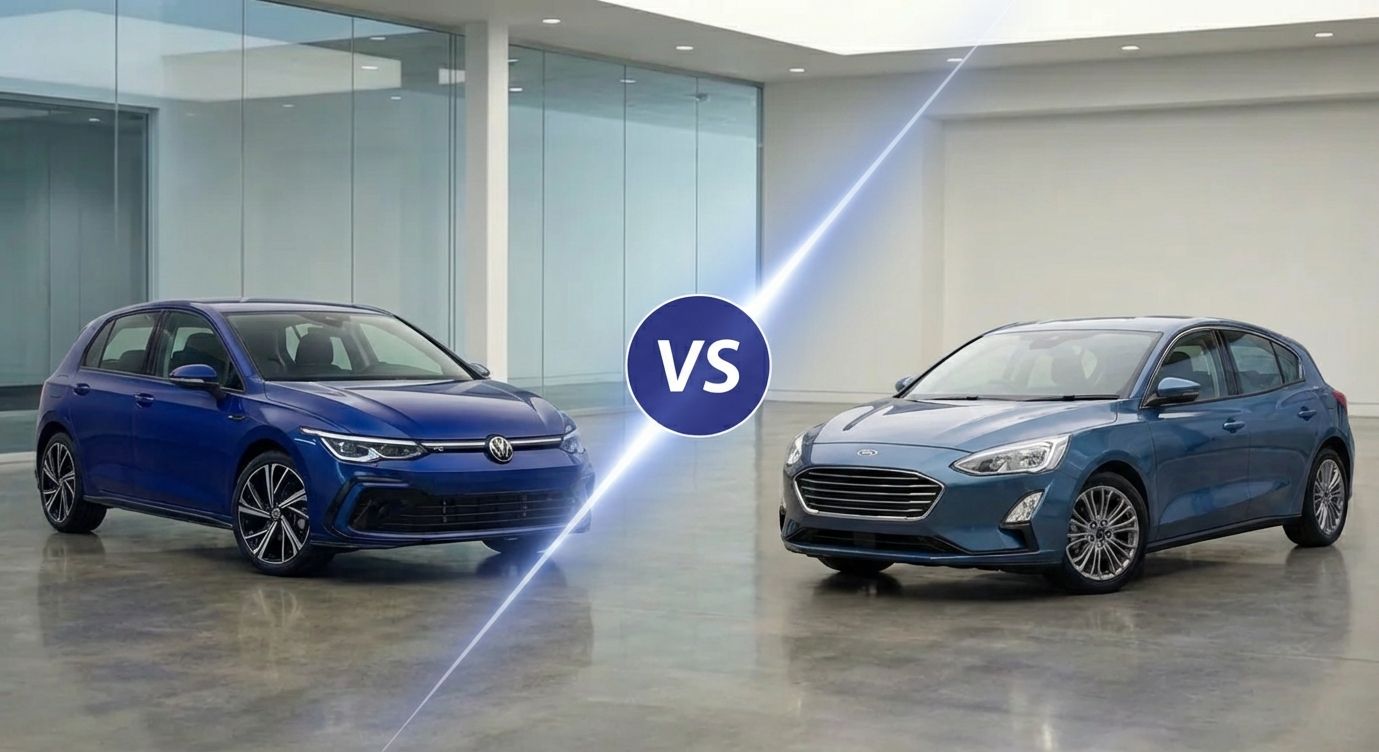
Car battle
Volkswagen Golf vs. Ford Focus: Complete comparison 2026
Volkswagen Golf vs. Ford Focus: a detailed comparison of the engine, equipment, and reliability. Find out which of these hatchbacks is the best choice for you.
Apr 13, 2026
Detailed comparison of Ford Focus ST vs Volkswagen Golf GTI. Find out which hot hatch offers better performance, equipment, and practicality. Read our final verdict!
May 4, 2026
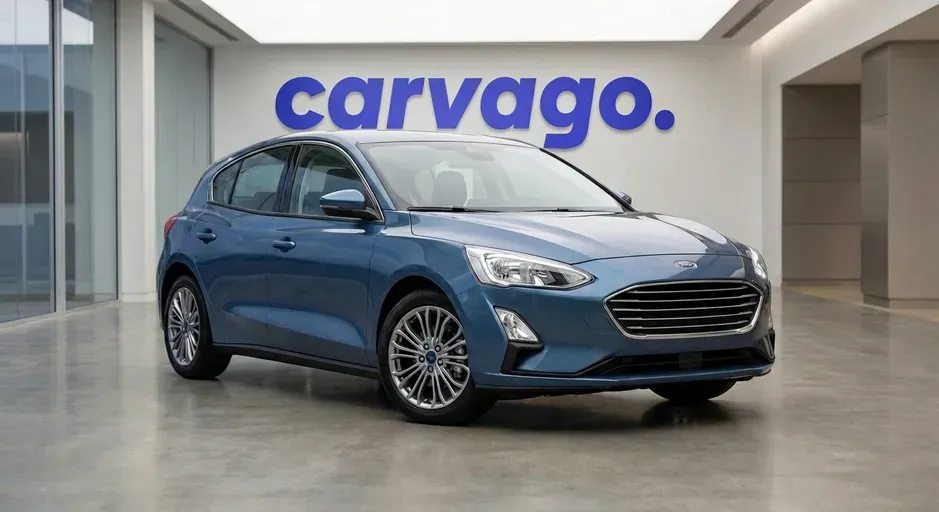
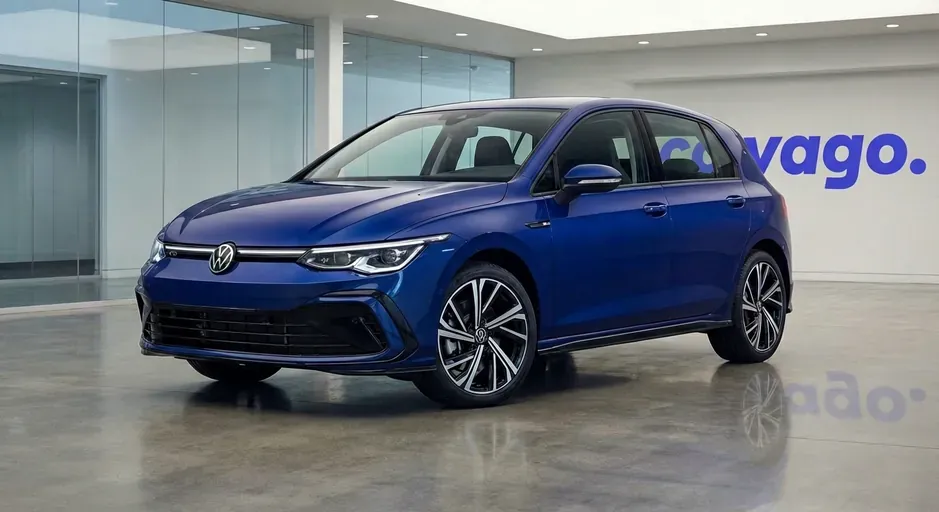
Ford Focus ST represents an exceptionally engaging hot hatch for drivers, perfectly combining precise driving dynamics with everyday practicality. Volkswagen Golf GTI, on the other hand, is an iconic pioneer of the entire segment, long valued for its inimitable balance between sporting performance and refined comfort. Let's find out together which of these two legendary and extremely popular rivals fares better in our head-to-head comparison and becomes the ideal choice for your garage.
When looking at the exterior dimensions of both cars on the market for roughly four-year-old used cars (i.e., the eighth-generation Golf and fourth-generation Focus), it is clearly evident that the Ford Focus ST is a noticeably larger vehicle. With a length approaching 4393 mm, the Focus is about 100 mm longer than the Golf GTI, and with a width of 1825 mm, it surpasses it by 36 mm. These values give the Ford a wider and more aggressive stance on the road, which benefits overall stability and confidence at high speeds. On the other hand, in practice, this means slightly worse maneuverability in narrow city streets and when parking. The Volkswagen Golf GTI, with a length just under the 4.3-meter mark and a width of 1789 mm, maintains a much more compact character, making it a bit easier to live with in the city and responding more nimbly to sharp changes in direction.
A fundamental difference can also be found in the wheelbase, which directly affects cabin spaciousness. The Focus ST boasts a wheelbase of 2700 mm, which is a full 73 mm more than what the Golf GTI offers (around 2627 mm). This stretched wheelbase gives the Ford a clear advantage in longitudinal space for rear-seat passengers and provides a more composed driving experience on highways. The Golf GTI tries to compensate for this with a slightly taller body construction (reaching a height of up to 1478 mm compared to 1440 mm for the Focus), which provides passengers with slightly more headroom and a somewhat more upright position behind the wheel. However, the Volkswagen's shorter wheelbase generally favors better agility on winding backroads, while the longer Focus scores as a more comfortable car for long distances.
When comparing practicality, we must not forget the Ford's significant advantage in terms of available body styles. While the Volkswagen Golf GTI is available exclusively as a classic five-door hatchback (those interested in a fast estate from VW must look to the significantly more expensive and powerful Golf R within the eighth generation), you can also purchase the Focus ST as a very practical estate. This measures an impressive 4675 mm in length and offers families uncompromising luggage space without the need to sacrifice sharp sports performance. For driving enthusiasts who need a full-fledged family car, the Focus ST estate is the absolute winner, while the Golf GTI remains true to the traditional purist definition of a hot hatch.
| Parameter | Ford Focus ST Hatchback | Volkswagen Golf GTI Hatchback | Ford Focus ST Estate |
|---|---|---|---|
| Width (mm) | 1825 | 1789 | 1825 |
| Length (mm) | 4388 - 4393 | 4287 - 4292 | 4668 - 4675 |
| Height (mm) | 1438 - 1440 | 1463 - 1478 | 1462 - 1466 |
| Wheelbase (mm) | 2700 | 2627 - 2629 | 2700 |
When choosing a sporty car, practicality and luggage capacity play a surprisingly important role, especially if the car is to serve as the primary vehicle for daily family use. Here, the approach of the two manufacturers differs quite fundamentally. While the Volkswagen Golf GTI remains true to its tradition and is offered exclusively as a classic five-door hatchback, the Ford Focus ST gives customers a choice between a hatchback and a highly practical estate (wagon) body style. This makes the Focus ST a much more versatile choice for drivers who need to combine driving pleasure with family responsibilities. Unlike plug-in hybrid alternatives (such as the Golf GTE), where trunk capacity is limited by traction batteries, the traditional petrol variants of the Focus ST and Golf GTI do not suffer from any such volume compromises.
When looking at specific figures for roughly four-year-old used cars (model year 2022 and newer), the Ford Focus ST in hatchback version offers a trunk volume of 392 liters, which increases to 1,354 liters after folding down the rear seats. The eighth-generation Volkswagen Golf GTI lags slightly behind with its 374 liters in the base and 1,230 liters of maximum space. While this difference in the basic layout means space for only a few extra small bags, it is much more noticeable with the seats folded, where the Focus offers significantly more room. However, it is important to mention that for older Focus ST models (pre-facelift in 2022), the base volume of the hatchback is often reduced to 301 liters due to the installation of a premium audio system subwoofer. For everyday life, however, the volume of both rivals is perfectly sufficient for weekend shopping and standard travel.
The biggest advantage of the Ford for family use is the existence of the Focus ST Estate variant itself. This fast estate has a generous base volume of 635 liters (for older models before 2022 it was 608 liters) and after folding the seats, the loading space increases to a massive 1,653 liters. Such capacity is easily sufficient for weekend shopping or a longer holiday with a pile of oversized luggage and a stroller. At Volkswagen, the GTI model does not offer an estate body at all, and if you wanted a fast Golf with a large trunk, you would have to choose the more powerful, but also significantly more expensive Golf R Estate. From the perspective of variability, the Focus ST thus represents a more rational solution for buyers of used family sports cars.
| Parameter | Ford Focus ST Hatchback | Volkswagen Golf GTI Hatchback | Ford Focus ST Estate | Volkswagen Golf GTI Estate |
|---|---|---|---|---|
| Base volume (liters) | 392 | 374 | 635 | N/A |
| Max volume with seats folded down (liters) | 1354 | 1230 | 1653 | N/A |
While the Golf GTI is an excellent everyday hatchback with a solid trunk, the Focus ST scores significant extra points thanks to slightly more interior space and the unbeatable choice of a giant family estate version.
The ability to tow a trailer is not usually a primary purchase criterion for hot hatches, yet it can play an important role for drivers who want to combine dynamic driving with everyday practicality. Looking at roughly four-year-old cars on the used market – the fourth-generation Ford Focus ST and the eighth-generation Volkswagen Golf GTI – the base petrol variants of both rivals are surprisingly identical in this regard. Both the Ford Focus ST 2.3 EcoBoost and the Volkswagen Golf GTI 2.0 TSI can safely tow a braked trailer with a maximum weight of 1,600 kg. However, Ford offers a significant difference and advantage with the diesel Focus ST 2.0 EcoBlue version, whose towing capacity increases to an above-standard 1,800 kg. With Volkswagen, on the other hand, it is important to remember that sharper, track-focused variants, such as the Golf GTI Clubsport, are not homologated for the installation of a tow bar at all.
From a practical standpoint, the 1,600 kg figure provides a more than sufficient margin for transporting motorcycles or jet skis for the weekend, or for towing a smaller caravan on a longer holiday, making both sports cars surprisingly practical companions. The brief conclusion from this comparison is clear: if you are looking for a fast car that can reliably handle more demanding transport and towing of heavier loads, the diesel Focus ST represents a more flexible choice thanks to its higher limit. However, the petrol derivatives of both cars meet expectations in terms of towing power equally.
| Model and engine | Braked trailer weight (kg) | Unbraked trailer weight (kg) |
|---|---|---|
| Ford Focus ST 2.3 EcoBoost (206 kW) | 1600 | 750 |
| Ford Focus ST 2.0 EcoBlue (140 kW) | 1800 | 750 |
| Volkswagen Golf GTI 2.0 TSI (180 kW) | 1600 | 750 |
While both cars target drivers looking for sporty experiences in a practical hatchback format (or a family estate in the case of the Ford), their approach to engines differs significantly. The fourth-generation Ford Focus ST relied on displacement dominance and fuel variety, offering a powerful turbodiesel alongside a potent petrol engine. This was the ideal choice for drivers who covered long distances but didn't want to give up great dynamics and a sporty chassis. The eighth-generation Volkswagen Golf GTI, on the other hand, is a strict petrol purist. The manufacturer focused on the perfect evolution of its iconic turbocharged two-litre, which features on the roughly four-year-old used car market as both a fantastic daily all-rounder and an ultimate track weapon in the sharper Clubsport version. Both manufacturers allow a choice between manual and automatic transmissions, although a sophisticated automatic usually has the final word in top specifications.
The Ford Focus ST arrived on the market with a very confident offering that, unlike its contemporaries, did not rely solely on a 2.0-litre engine. The petrol peak was the robust 2.3 EcoBoost four-cylinder with 206 kW (280 hp) and 420 Nm of torque. For this engine, engineers used innovative anti-lag technology inspired by the Ford GT supercar, which keeps the turbocharger spinning even when the pedal is released, ensuring immediate throttle response in every corner. For motorway flyers, Ford had an excellent alternative up its sleeve – the 2.0 EcoBlue diesel four-cylinder. This offered a more modest 140 kW (190 hp), but with a strong pull of 400 Nm. For both the petrol and diesel versions, buyers could choose either a precise six-speed manual or an automatic transmission. However, it is important to mention that the 2.0 EcoBlue diesel engine was quietly withdrawn from the ST sports range around 2021, so finding it among used cars requires a bit more luck.
| Engine type | Fuel | Power (kW) | Torque (Nm) | Transmission |
|---|---|---|---|---|
| 2.3 EcoBoost | Petrol | 206 | 420 | 6MT / 7AT |
| 2.0 EcoBlue | Diesel | 140 | 400 | 6MT / 8AT |
With its legendary eighth-generation Golf GTI, Volkswagen bets purely on petrol classics and makes no compromises (those looking for diesel must choose the sister GTD model). Under the hood, you will always find the constantly improved 2.0 TSI turbocharged four-cylinder (EA888 evo4 generation). The standard version has a perfectly sufficient 180 kW (245 hp) and 370 Nm of torque. In this variant from the first years of production, you will come across cars equipped with a purist six-speed manual in used car dealerships, alongside the widespread seven-speed dual-clutch DSG automatic. A real gem for petrolheads is the GTI Clubsport version. This pushes the power to a breathtaking 221 kW (300 hp) and torque to the level of powerful diesels (400 Nm). The Clubsport was supplied exclusively with a modified and faster version of the DSG transmission and scores with completely redesigned chassis software, which includes, among other things, a special driving profile tuned directly for the broken asphalt of the famous Nürburgring Nordschleife.
| Engine type | Fuel | Power (kW) | Torque (Nm) | Transmission |
|---|---|---|---|---|
| 2.0 TSI | Petrol | 180 | 370 | 6MT / 7DSG |
| 2.0 TSI Clubsport | Petrol | 221 | 400 | 7DSG |
While the Focus ST scores with its more powerful 2.3 EcoBoost petrol engine and a rare diesel option for high-mileage drivers, the Golf GTI attracts with an unbeatable daily compromise complemented by the uncompromising driver-focused Clubsport version.
When choosing the ideal hot hatch, the powertrain plays an absolutely crucial role. While Ford opted for a large-displacement and mechanically raw 2.3 EcoBoost unit for the fourth generation of the Focus ST, Volkswagen sticks to the highly efficient and years-refined concept of the 2.0 TSI four-cylinder for the eighth edition of the iconic Golf GTI. Both manufacturers approach performance differently, which is why choosing the right engine is essential for long-term satisfaction, top-tier reliability, and reasonable real-world fuel consumption in daily use. Our recommendations are therefore based on real-world service practice.
This turbocharged petrol four-cylinder is undoubtedly the most enticing and logical engine choice for the fourth-generation Focus ST (the Mk4 generation was produced between 2019 – 2025). Given the definitive end of Focus production in 2025, this excellent unit is now available exclusively on the used car market, making it a sought-after item and a potential classic for enthusiasts.
The eighth generation of the Golf GTI (available from 2021 – present) relies on the most advanced evolutionary branch of the famous EA888 two-litre family to date, technically designated as Evo4. Although the manufacturer updates the range periodically, in terms of the engine, you get an absolutely universal and precisely functioning package in every case.
Official fuel consumption figures (now measured according to the more realistic WLTP cycle) still sometimes seem like something out of a dream, especially when talking about sporty hatchbacks. In practice, real-world consumption depends primarily on how much you let your driving temperament and the car's potential speak. To get a true picture suitable for those interested in a roughly four-year-old used car, we drew data from owners themselves on the Spritmonitor.de community portal. We focused on the current generations of the Ford Focus Mk4 and Volkswagen Golf Mk8, which dominate the current market for lightly used hot hatches.
{news_site}
| Model and engine | Average consumption (l/100 km) |
|---|---|
| Volkswagen Golf GTD 2.0 TDI | 5.2 |
| Ford Focus ST 2.0 EcoBlue | 5.5 |
| Volkswagen Golf GTI 2.0 TSI | 7.1 |
| Volkswagen Golf GTI Clubsport 2.0 TSI | 7.4 |
| Ford Focus ST 2.3 EcoBoost | 8.1 |
What do the numbers tell us?
Looking at the classic petrol versions, it is clearly visible that the size of the power unit plays a crucial role in real-world traffic.
Who are these variants suitable for?
If you intend to use your sporty hatchback as a universal car for city driving and short trips, expect real-world consumption for petrol versions to easily climb to 9 or 10 liters. For typical daily drivers or customers sensitive to the operating budget, the inherently more economical Golf GTI makes much more sense. Conversely, drivers who cover huge distances on the highway every month will find an absolutely ideal compromise between dynamics and economy in the GTD or ST EcoBlue versions.
In conclusion, it can be stated that fuel consumption for these two rivals can be a surprisingly strong decision-making factor. A difference of roughly one liter of fuel per hundred kilometers in favor of the Golf GTI represents a significant annual financial saving for daily users. On the other hand, for those looking for a pure weekend car for fun, this argument will likely not play a significant role, and they will prefer the more robust character of the larger engine from Ford.
When looking at the used car market for vehicles approximately four years old (2021 to 2022 models), a clear trend emerges for both of these hot hatches. Although both models offer fantastic daily sports enjoyment, their depreciation curves and overall price levels differ slightly. For comparison, we focus on the Ford Focus Mk4 and Volkswagen Golf Mk8 generations, which dominate the used car market at this age.
The Ford Focus ST clearly represents one of the best price-to-fun ratios on the secondary market. Four-year-old cars of this generation with reasonable mileage are very affordable.
The Volkswagen Golf GTI has long been considered a safe bet that maintains its residual value exceptionally well on the used car market. A more premium image, a strong name, and cult status mean that you will simply pay more for a used eighth-generation Golf.
The following table serves for quick market orientation, reflecting the real situation of approximately four-year-old models in good technical condition:
| Model (2021–2022 models) | Starting price of a used car | Common price (good condition and equipment) | Top versions on the market |
|---|---|---|---|
| Ford Focus ST (Mk4) | approx. €23,000 | €27,000 | approx. €33,000 (ST X) |
| VW Golf GTI (Mk8) | approx. €27,000 | €31,000 | €37,000 and more (Clubsport) |
While the Focus ST is more affordable on the used car market and offers more raw performance for less money, the Golf GTI represents a more conservative choice with slower depreciation, which is doubly true for the sought-after Clubsport version.
Both vehicles achieved the maximum five-star rating in independent crash tests by Euro NCAP. However, when choosing a used car, it is crucial to understand the context and the year of testing. Euro NCAP testing protocols are constantly evolving and becoming more stringent, meaning newer tests include more complex scenarios – from advanced cyclist detection to stricter simulations of side and frontal collisions. For this reason, percentage results from different years cannot be directly compared, as achieving a high score in newer tests is significantly more challenging.
The fourth generation of the Ford Focus, on which the ST sports version is based, underwent original testing in 2018 and was re-evaluated in 2019. Improvements were made primarily to the front seats and headrests, which helped the car achieve an outstanding 96% for adult occupant protection. The car is equipped with an autonomous emergency braking system with pedestrian and cyclist detection, which reacts very well at urban speeds. However, the score for safety assists (75%) reflects the more lenient testing criteria of 2019 and, from today's perspective, points to the absence of the most modern active safety features.
Although the eighth-generation Volkswagen Golf was also first tested in 2019, it underwent an extensive re-evaluation in 2022 according to significantly stricter Euro NCAP protocols. The manufacturer improved the car and added an innovative center airbag between the front seats to the standard equipment, which effectively prevents the heads of the driver and passenger from colliding in a side impact. Thanks to these modifications, the Golf GTI passed the more demanding tests with flying colors. It has a significant lead particularly in the evaluation of safety assistance systems (82%), where it scored thanks to advanced lane-keeping and prompt emergency braking.
| Parameter | Ford Focus ST | Volkswagen Golf GTI |
|---|---|---|
| Year of testing | 2019 | 2022 |
| Adult occupant protection | 96% | 88% |
| Child occupant protection | 87% | 87% |
| Vulnerable road user protection | 72% | 74% |
| Safety assist systems | 75% | 82% |
Overall, both cars represent a very safe choice, but the Volkswagen Golf GTI has the upper hand in terms of modern safety. While the Ford Focus ST offers impressive structural rigidity and great adult protection according to 2019 standards, the 2022 Volkswagen Golf GTI benefits from more modern and stricter certifications. Thanks to the integrated center airbag and a more advanced suite of active assistance systems, it provides more comprehensive protection that better meets current automotive safety standards.
Although both cars are five-star rated, the Volkswagen Golf GTI scores points thanks to the stricter 2022 certification and advanced features such as the center airbag, making it a more modern and better-protecting choice.
In addition to standard equipment, each model offers several unique features that go far beyond common functions, with both approaching this added value in completely different ways. While Ford focuses on uncompromising mechanics and purist driving experiences, Volkswagen bets on sophisticated digitalization and clever integration of electronic systems complemented by famous historical details.
Excellent driving characteristics, precise steering, and top-tier handling in corners
Powerful 2.3 EcoBoost engine providing strong pull and a characterful sound profile
Electronically controlled limited-slip differential (eLSD) ensuring fantastic traction on corner exits
Practicality highlighted by the option of a spacious estate body style
Traditional physical buttons and rotary dials for easy climate control operation without taking your eyes off the road
Stiffer suspension tuning, which may be less comfortable on rough country roads
The interior feels somewhat cheaper compared to more premium competitors, especially due to some of the plastics
Higher average fuel consumption for the larger displacement engine
Graphics and response of the SYNC 3 infotainment in pre-facelift models lag behind today's standards
Ford Focus ST is built for enthusiastic drivers looking for maximum driving pleasure, mechanical feedback, and genuine sporty character. It offers much sharper reactions and a rawer experience than its German rival, making it an ideal choice for those who prefer driving dynamics and fun over absolute daily comfort.
Perfect balance between sporty dynamics and high comfort for daily commuting
More premium interior with high-quality materials and excellent sound insulation
Highly reliable and efficient 2.0 TSI (EA888) engine, which is surprisingly economical during normal driving
Fast and smooth DSG dual-clutch automatic transmission
Legendary model status, guaranteeing very good residual value and easy resale
Frustrating touch-sensitive infotainment controls and lack of backlighting for temperature or volume sliders
Touch pads on the steering wheel (in older eighth-generation models) often lead to unintended commands during sharp maneuvering
Driving performance at the limit is somewhat more sterile and fails to involve the driver as well as the Focus ST
Higher purchase price on the used car market and more expensive optional equipment
Volkswagen Golf GTI will appeal to buyers who want a very fast, yet maximally refined and versatile car for every day. Although it doesn't feel as lively on twisty country roads, it more than makes up for it with a high level of comfort, a more luxurious cabin feel, and very mature highway behavior.
Based on our own statistics from the CarAudit service, long-term user feedback, service reports, and field inspections, we have compiled an overview of the most common problems that buyers of roughly four-year-old used cars should watch out for.
In the fourth generation Ford Focus ST (Mk4), the mechanical base is usually very robust, however, specific defects associated with sporty use of the car may appear, which require attention.
The Ford Focus ST with the 2.3 EcoBoost engine is among the most mechanically reliable hot hatches, where you are more likely to be bothered by interior noises or chassis wear from sporty driving. Before the purchase itself, we recommend a used car inspection to safely detect potential fluid leaks from adaptive dampers or an excessively worn clutch.
The eighth-generation Volkswagen Golf GTI (Mk8) brought significant digitalization, which is unfortunately closely linked to the most common teething troubles of used cars from the first years of production (2020 and 2021).
The eighth generation of the Golf GTI suffers mainly from software and electronic ailments from the beginning of production, while the mechanics, led by the 2.0 TSI engine, remain exemplarily reliable. Therefore, an independent technical inspection of the car's condition is key, focusing on whether the car has the latest infotainment software installed and a proven service history of DSG gearbox oil changes.
When buying a used car, a thorough inspection is key. Here are a few specific points to focus on for these two models. With hot hatches like the Focus ST and Golf GTI, it always pays to invest in professional services and arrange a detailed comprehensive car audit to avoid expensive surprises.
The Ford Focus ST is often rated as a sharper and more driver-engaging car thanks to its more aggressive suspension tuning and faster steering. The Volkswagen Golf GTI, on the other hand, is more neutral and primarily focused on a clean and stable line. If you are looking for a rawer and more emotional driving experience, the Ford model is the better choice of the two.
The Volkswagen Golf GTI has long been considered an unrivaled compromise between a powerful sports car and a comfortable daily driver. Its suspension, especially with the DCC adaptive dampers, offers significantly higher comfort on broken city roads than its stiffer competitor. Furthermore, the Golf pleases with overall better cabin soundproofing and a more premium interior finish.
In the compared generations around four years old, the Focus ST has a slight advantage thanks to its larger 2.3-liter EcoBoost engine producing 280 hp. The eighth-generation Golf GTI, by contrast, relies on the proven 2.0-liter TSI engine, which in its standard version offers 245 hp. The larger displacement in the Ford provides a stronger pull from low revs, but the Volkswagen counters with smoother operation and better fuel consumption.
When it comes to interior spaciousness and everyday practicality, both cars offer very comparable parameters for normal use. The Ford Focus ST has a basic trunk volume of 375 liters, while the Golf GTI offers a slightly larger 380 liters. However, the Ford has a significant advantage in that you can also purchase it on the used car market in a very practical estate version with a huge amount of luggage space.
Volkswagen has long excelled with its lightning-fast DSG dual-clutch transmission, which perfectly complements its character and represents a great choice for all types of journeys. While Ford does offer an optional automatic, its absolute greatest strength is the excellently tuned six-speed manual for automotive purists. Therefore, if you exclusively prefer automatic shifting, the German representative is clearly the more refined choice.
Sources: ADAC, auto.cz, e15.cz, automix.cz, chytreauto.cz, automotodrom.cz
This article was prepared using artificial intelligence tools. The section guarantor is Petr Dušek.
Volkswagen Golf vs. Ford Focus: a detailed comparison of the engine, equipment, and reliability. Find out which of these hatchbacks is the best choice for you.
Apr 13, 2026
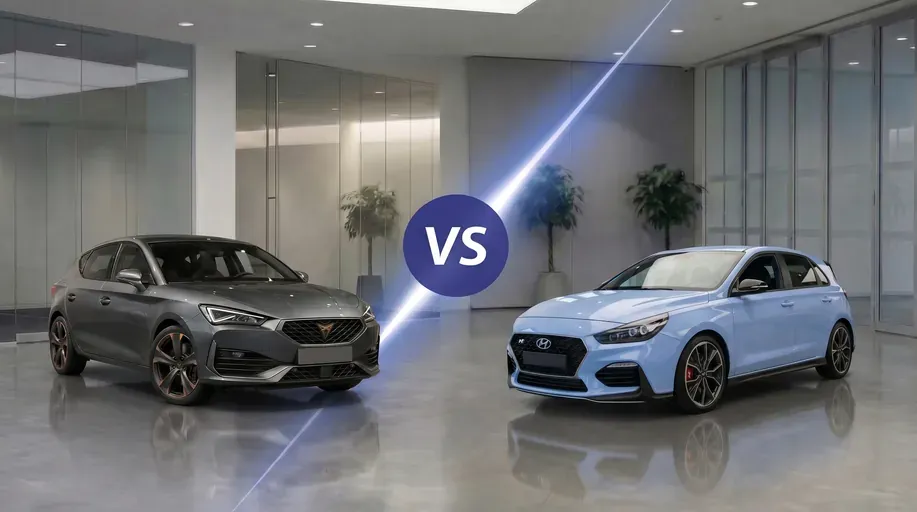
Cupra Leon vs Hyundai i30 N: Which hot hatch is better? A detailed comparison of performance, equipment, and reliability of used cars. Find out our verdict and make the right choice!
Apr 18, 2026
Detailed comparison of Maserati MC20 vs Porsche 911. Discover real-world experiences, performance differences, and a clear verdict to help you choose the ideal supercar.
Apr 24, 2026