Car battle
Opel Insignia vs. Renault Talisman: Complete comparison 2026
Opel Insignia vs Renault Talisman: A Detailed Comparison. Find out which executive sedan is the better choice. Real data, features, and verdict.
Apr 14, 2026
Articles
Car battle
Detailed comparison of the BMW 5 Series and Volvo S90. Discover the differences in comfort, performance, and reliability of used cars. Read our verdict and choose the best sedan.
April 14, 2026
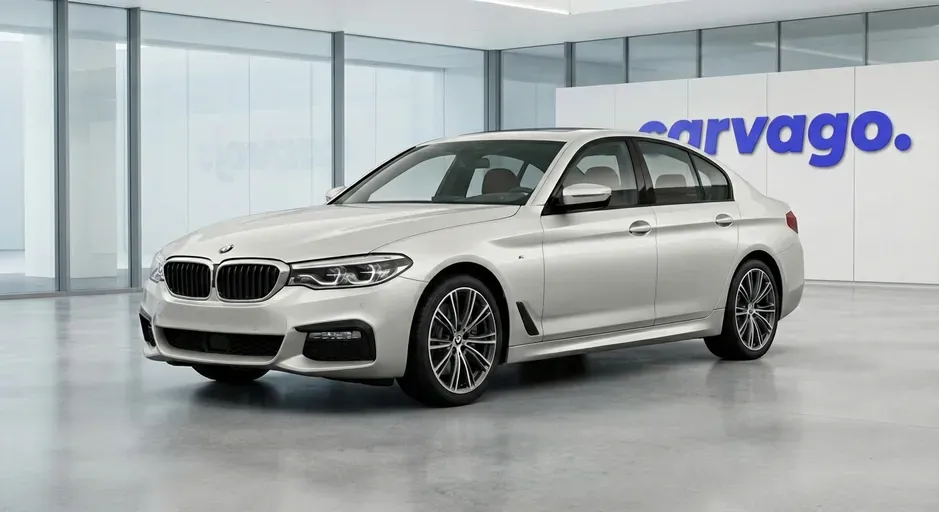
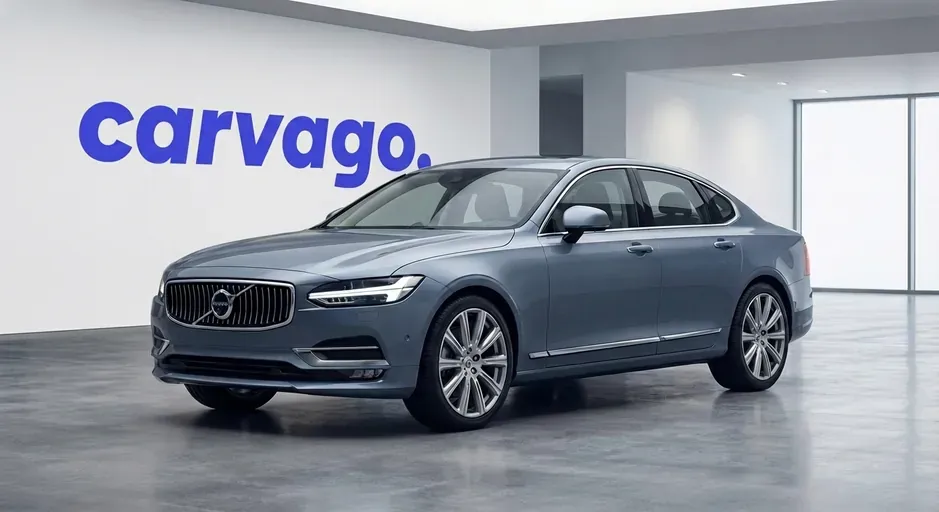
The BMW 5 Series, often abbreviated by motorists as the "Five" or searched for under the internal code of the popular G30 generation, represents a long-standing benchmark of the sport-tuned premium executive class with a maximum emphasis on top-notch driving characteristics. Proudly standing against it is the Swedish Volvo S90, a representative of minimalist Nordic elegance, which stands out on the market primarily for its unrivaled focus on advanced safety systems and first-class comfort for the entire crew. Let's take a detailed look at how these two distinctive representatives of the luxury segment stack up in a direct comparison and which of them will be the right choice for you on the used car market.
Both cars represent typical representatives of the executive class, which is unmistakably reflected in their impressive exterior dimensions. If we focus on models approximately four years old (the BMW 5 Series generation G30/G31 and the Volvo S90 after the 2020–2024 facelift), we find that both cars are dangerously close to the five-meter mark with their proportions. This majestic footprint guarantees a representative appearance and generous interior space, but at the same time requires a certain level of caution when maneuvering in narrow underground garages.
In a detailed comparison of the sedan (saloon) body variants, the Volvo S90 is a negligible 6 mm longer and 11 mm wider than its Bavarian competitor. The Swedish automaker opted for a very low and elegant silhouette, which is confirmed by the fact that the Volvo is 39 to 43 mm lower than the BMW. This proportional play gives the Volvo S90 a very low-slung and aerodynamic stance, which makes an unmistakable impression on the road. In contrast, the BMW offers a more traditional layout, and moreover, unlike the S90, it can also be purchased as a more spacious estate (Touring). The Swedish alternative with an estate body is the V90 model, which, however, forms a separate model line.
A key parameter for interior spaciousness, especially in the legroom area for rear passengers, is the wheelbase. Here, the BMW 5 Series gains an advantage, as despite a slightly shorter overall vehicle length, it offers a wheelbase that is 34 mm longer. The developers from Munich thus managed to push the wheels further into the corners of the body. This has a positive effect not only on cabin space but also on driving stability at high speeds and weight distribution, which is so characteristic of BMW.
In everyday use, both vehicles require large parking spaces, as a length just under 5 meters and a width approaching 1.9 meters make them true highway cruisers. The choice between these two models in terms of dimensions thus depends more on nuances: if you prefer a longer wheelbase and slightly more headroom (thanks to a taller body), or if you need an estate variant, the BMW 5 Series makes more sense. The Volvo S90, on the other hand, attracts with a slightly wider cabin at shoulder level and a stylish, dynamically lowered roof.
| Parameter | BMW 5 Series Sedan | Volvo S90 Sedan | BMW 5 Series Estate |
|---|---|---|---|
| Width (mm) | 1868 | 1879 | 1868 |
| Length (mm) | 4963 | 4969 | 4963 |
| Height (mm) | 1479-1483 | 1440 | 1498 |
| Wheelbase (mm) | 2975 | 2941 | 2975 |
When choosing an executive or family car on the used market – typically around 4 years old, which corresponds to the BMW G30/G31 generations and the second generation of the Volvo S90 – luggage space plays a key role. Whether it's for family usability, transporting several golf bags, or packing for a longer vacation, customers in the premium executive class expect not only above-standard volume but also excellent accessibility and practicality. Both automakers approach the trunk design with an emphasis on elegance, but with minor differences in overall capacity.
In a direct comparison of the standard sedan versions, the Munich representative has the upper hand. The BMW 5 Series Sedan offers exactly 530 liters as standard, while the Volvo S90 counters with a slightly more modest value of 500 liters. For both cars, this is sufficient space for regular weekend shopping and longer trips, but it is necessary to keep plug-in hybrid motorizations in mind. The placement of the batteries cuts away valuable liters – the BMW 530e has a volume of only 410 liters, while the trunk of the Volvo S90 T8 shrinks to 461 liters. Interestingly, after folding down the rear backrests, the Volvo S90 offers a maximum transport capacity of up to 1328 liters, a figure that BMW does not officially state for its sedan.
If maximum practicality is your priority, BMW brings a fundamental advantage in the form of the Estate (Touring) version. This pleases with a basic volume of 570 liters, which can be expanded to a generous 1700 liters after easily folding down the seats. This means hassle-free space for several extra suitcases, sports equipment, or transporting bulkier items. The Volvo S90 is sold exclusively as a sedan; those interested in a more spacious Swedish estate must therefore reach for the sister model V90.
| Parameter | BMW 5 Series Sedan | Volvo S90 Sedan | BMW 5 Series Estate |
|---|---|---|---|
| Basic volume (liters) | 530 | 500 | 570 |
| Max. volume after folding seats (liters) | Not specified | 1328 | 1700 |
In conclusion, it can be summarized that both sedan variants offer very similar space for storing luggage, with a slight on-paper lead for BMW. However, the Munich brand clearly dominates with the option of choosing the Estate (Touring) version, which, thanks to its top-notch variability, makes much more sense from the perspective of family usability.
The ability to tow a trailer is a key parameter for premium upper-middle-class sedans and station wagons, making these comfortable highway cruisers exceptionally practical vehicles for active families. Whether you are transporting building materials, towing a boat to the lake, or hooking up a residential caravan, roughly four-year-old used models of both these cars (BMW 5 Series generation G30/G31 and Volvo S90 2nd generation) offer excellent towing capacities. The standard maximum weight of a braked trailer for most traditional combustion versions of the BMW 5 Series is a very solid 2000 kg. The Volvo S90 offers a slightly wider range – for basic engines (e.g., D3 or T5), the permitted trailer weight is 1800 kg, but more powerful variants like the B5, D5, or T6 boast a maximum capacity of up to an impressive 2200 kg.
Interesting differences can be found in the popular plug-in hybrid engines, which tend to have adjusted capacities due to the installation of heavy traction batteries. While the oldest model years of the hybrid BMW 530e (up to 2020) could only tow 750 kg, models around four years old already boast a towing capacity ranging from 1700 to 2000 kg. The Swedish competitor in its top S90 T8 version, on the other hand, offers a very stable 2100 kg. In practice, these values mean that the more powerful Volvo engines will provide you with a slightly larger technical reserve for safely towing large twin-axle trailers. Nevertheless, both cars are more than sufficient for a weekend purchase of bulky materials at a DIY store as well as a longer holiday with a fully equipped family caravan. In conclusion, the Volvo S90 slightly wins in this regard, as its more powerful diesel and petrol versions offer a 200 kg higher maximum towing capacity than a comparable BMW.
| Model and engine | Braked trailer (kg) | Unbraked trailer (kg) |
|---|---|---|
| BMW 530i / 530d (generation G30/G31) | 2000 | 750 |
| BMW 530e Plug-in hybrid (generation G30/G31) | 1700 - 2000 | 750 |
| Volvo S90 D3 / D4 / T4 / T5 | 1800 - 2200 | 750 |
| Volvo S90 B5 / B6 / D5 / T6 | 2200 | 750 |
| Volvo S90 T8 Plug-in hybrid | 2100 | 750 |
When it comes to the engine lineup, the BMW 5 Series (generation G30/G31) and the Volvo S90 (2nd generation) represent two different philosophies, which plays a key role for those interested in a used car. BMW traditionally targets driving enthusiasts and highway mile-munchers, and therefore continues to offer a diverse range of engines – from economical four-cylinders to the renowned and silky-smooth inline six-cylinders, primarily combined with rear-wheel or all-wheel drive (xDrive). The Volvo S90, on the other hand, has fully bet on its modular architecture of two-liter four-cylinders, making up for any displacement deficit with sophisticated supercharging and electrification. If you are choosing a roughly four-year-old used car (production year around 2021–2022), you will encounter a massive onset of mild-hybrid and plug-in hybrid technologies in both brands. While BMW tempts with powerful diesel six-cylinders, Volvo will charm those interested in a quiet ride with smooth hybrid systems and the overwhelming power of its top version.
The engine lineup for the BMW 5 Series is exceptionally diverse on the used car market. The gold standard and the most sought-after choice for long journeys is the three-liter six-cylinder diesel 530d. In newer versions (LCI) with mild-hybrid assistance, it provides a commanding 210 kW and a massive torque of 650 Nm. For those looking for a more accessible and economical variant, the popular two-liter four-cylinder 520d is available. The petrol spectrum is logically represented by the four-cylinder 530i model, which offers an excellent compromise between agility and fuel consumption (power around 180–185 kW), or the velvety six-cylinder 540i. For urban commuting and tax benefits, there is the popular plug-in hybrid 530e, combining a two-liter petrol engine with an electric motor for a total system output of up to 215 kW (with the XtraBoost function). All modern engines of this generation are paired exclusively with the excellent eight-speed Steptronic automatic transmission.
| Engine type | Fuel | Power (kW) | Torque (Nm) | Transmission |
|---|---|---|---|---|
| 520d | Diesel (Mild-hybrid) | 140 | 400 | 8-speed automatic |
| 530d | Diesel (Mild-hybrid) | 195 - 210 | 620 - 650 | 8-speed automatic |
| 530i | Petrol (Mild-hybrid) | 180 - 185 | 350 | 8-speed automatic |
| 540i | Petrol (Mild-hybrid) | 245 - 250 | 450 | 8-speed automatic |
| 530e | Plug-in hybrid | 185 - 215 | 420 | 8-speed automatic |
The engine lineup of the Volvo S90 is strictly limited to two-liter four-cylinders, but this is compensated by innovations and electrification. In the context of the market for roughly four-year-old used cars, it is extremely important to mention a fundamental generational change in powertrains: traditional purely diesel (D3, D4, D5) and petrol (T4, T5, T6) engines without electrification were permanently phased out of sales around 2020. Today, they are therefore replaced in newer models by more efficient mild-hybrid units with the new B designation (B4, B5, B6). Customers will thus most often encounter the B5 version, which, despite the shared badge, is offered in both diesel (173 kW and a generous 480 Nm) and petrol forms (184 kW). The absolute pinnacle of dynamics and ecology is the plug-in hybrid T8 Recharge version, which combines a turbo- and supercharged petrol engine with a powerful electric motor. This system generates an impressive 288 kW (and up to 335 kW from 2022), making the S90 an incredibly fast car despite its dimensions. Power transmission is handled by the reliable eight-speed Geartronic automatic transmission.
| Engine type | Fuel | Power (kW) | Torque (Nm) | Transmission |
|---|---|---|---|---|
| D4 / D5 (up to 2020) | Diesel | 140 - 173 | 400 - 480 | 8-speed automatic |
| B5 Diesel | Diesel (Mild-hybrid) | 173 | 480 | 8-speed automatic |
| B5 | Petrol (Mild-hybrid) | 184 | 350 | 8-speed automatic |
| T6 (up to 2020) | Petrol | 228 | 400 | 8-speed automatic |
Final RecommendationFor drivers who spend thousands of kilometers on long highway routes every year, the BMW 530d is the clear and most reliable choice. Its refined inline six-cylinder engine with a huge reserve of torque and surprisingly low fuel consumption simply cannot be fully replicated by Volvo with its four-cylinders. However, if you spend a large part of your time in the city or are looking for massive power combined with the possibility of emission-free driving and convenient charging, the Volvo S90 T8 Recharge offers crushing dynamics for similar money, which the mid-range BMW offering (including the 530e) can hardly compete with. The basic petrol engines (530i vs. S90 B5) are very quiet and economical companions in both cases, however, thanks to its brilliant chassis and dominant rear-wheel drive, BMW can provide a significantly more fun and communicative driving experience.
When choosing a premium second-hand executive sedan or estate, selecting the right engine plays a key role in your long-term satisfaction and wallet. An interesting aspect of this comparison is the completely different approach of both car manufacturers to powertrains – while BMW proudly retained the legendary and driver-loved diesel inline six-cylinder in its 5 Series (G30 generation), Volvo took a radical step with the S90 model and put exclusively two-liter four-cylinders under the hood. The Swedes ingeniously compensate for this smaller displacement with sophisticated twin-turbocharging, smart mild-hybrid technology, and in older versions even the unique PowerPulse system with compressed air. The following recommendations target engines commonly available on the market of roughly four-year-old used cars and are based on real mechanics' experiences, operating costs, and overall reliability.
The three-liter diesel six-cylinder (code B57) is an absolute bullseye for the 5 Series BMW (generation G30/G31, whose production ended at the turn of 2023 and 2024) and quite possibly the best diesel engine in its class ever. It offers massive torque (620 to 650 Nm), thanks to which the heavy car accelerates with effortless ease, while in real traffic it asks for an excellent 6 to 7 liters of diesel per 100 km. In conjunction with the phenomenally tuned eight-speed ZF automatic transmission, it forms a technically perfect, balanced, and highly reliable package.
Given that Volvo only offered two-liter engines for the S90 model, the best choice for the large and heavy car is the top diesel engine designated B5 Diesel, or its older non-hybrid predecessor D5. Production of the B5 Diesel version was terminated in 2024, so for the market of roughly four-year-old used cars, it is an absolutely current and the most reasonable candidate. The engine provides an output of 173 kW (235 horsepower) and a very solid 480 Nm of torque. Its main technical advantage is an exceptionally quiet and smooth operation for a four-cylinder (enhanced by mild-hybrid assistance) and the ability to economically cruise highways with consumption oscillating around 6.5 liters. In the non-hybrid D5 version (available until 2020), Volvo additionally deployed the clever PowerPulse system with a pressure vessel, which injects compressed air into the exhaust manifold upon starting off to instantly spin up the turbo and thus eliminate the unpopular lag after stepping on the gas.
While the official tables of car manufacturers promise almost miraculous values for modern cars, the real world of highway transfers and crawling in traffic jams is often different. Available data records show that, for example, a four-year-old BMW 530d (generation G30/G31) should drive for an unrealistic 5.1 to 5.4 l/100 km according to the manufacturer's methodology, while the Volvo S90 in the B5 Diesel version declares a very optimistic 5.7 l/100 km. For an objective comparison of fuel consumption, we therefore relied on long-term user data from the independent portal Spritmonitor, where thousands of drivers record their actual refueling. This approach allows us to find out how much the models sold on the market of four-year-old used cars actually consume in everyday traffic.
| Model and engine | Average consumption (l/100 km) | Data source |
|---|---|---|
| Volvo S90 D4 / B4 Diesel (140 kW) | 6.6 | Spritmonitor |
| BMW 530d (195 kW) | 6.8 | Spritmonitor |
| Volvo S90 D5 / B5 Diesel (173 kW) | 7.1 | Spritmonitor |
| Volvo S90 B5 / T5 (184 kW) | 7.5 | Spritmonitor |
| BMW 530i (185 kW) | 7.8 | Spritmonitor |
| Volvo S90 T8 Recharge (288 kW) | 4.5 - 5.0 | Spritmonitor |
| BMW 530e (185 kW) | 4.5 - 5.5 | Spritmonitor |
From the presented data, it is clear that although both cars offer modern and economical diesel engines, the BMW 5 Series is considered the uncrowned king of efficiency in the premium class. The velvety and extremely potent six-cylinder in the diesel BMW 530d can, despite a massive portion of power, run long-term with an average of under 7 liters per hundred kilometers. This is a result that the Swedish Volvo with its top diesel four-cylinders D5 and B5 struggles to keep up with, as they usually ask for a little more in real traffic (an average of 7.1 l/100 km), while they simply cannot match the Munich six-cylinders in dynamics and refinement. The weaker, but highly sought-after D4 and B4 engines from Volvo on the used car market push the consumption down to a solid 6.6 liters, however, the equivalent four-cylinder BMW 520d commonly operates in practice at levels around an excellent 6.2 liters.
With petrol engines, the scales are much more balanced. The popular two-liter petrol versions of both cars (BMW 530i and Volvo with T5 and B5 engines) oscillate their real consumption quite stably in the range of 7.5 to 8 liters. For many buyers among more frugal drivers, it may be a surprising finding that relatively smaller turbocharged petrol four-cylinders in such heavy and large executive sedans do not save fuel in the real world as drastically as they might have imagined. A separate chapter is then the plug-in hybrid versions (BMW 530e and Volvo T8), where consumption absolutely fatally depends on the frequency of charging from the grid. With regular overnight charging, the daily routine can easily be managed for a fraction of traditional consumption, but during long highway journeys with a depleted battery, consumption very quickly catches up with (or even slightly exceeds) the values of purely petrol variants.
What does this mean for a typical buyer interested in a car from this premium category? For drivers and corporate fleets that spend most of their time on highways and long intercity routes, a diesel engine is still an absolute necessity. In this regard, the Bavarian diesel power units offer a phenomenal ratio of operating costs to utility value. The Volvo S90, even if slightly thirstier, will please defensive and balanced drivers, but it doesn't quite match the mechanical and aerodynamic efficiency of the BMW. Plug-in hybrids make logical sense only and exclusively for those users who have absolute certainty of guaranteed daily charging – whether in the driveway at home or in company garages.
In conclusion, it can be summarized that for petrol engines and plug-in hybrids, the differences in consumption between the two cars are not so vast as to serve as a primary decision-making factor. However, if you are looking for a diesel highway cruiser built for swallowing thousands of kilometers, the operating consumption and unrivaled overall maturity of the powertrain clearly speak for the representative from Munich. Thanks to first-class aerodynamics, masterfully engineered engines, and a perfectly tuned ZF automatic transmission, the 5 Series models provide their owner with significantly more attractive dynamics, without charging a higher tax at the gas station.
Looking at the market for used cars around 4 years old (model years 2021–2023), the different positions of both brands are fully manifested. While the Volvo S90 attracts with a very appealing price-to-equipment ratio, the BMW 5 Series (G30 generation after facelift) holds its value slightly better, and its price range is, largely due to an extremely wide range of engines, much more diverse.
The Munich automaker traditionally offers huge variability, which is also reflected in the secondary market. In general, the offer of used "fives" is significantly wider than in the case of the Swedish competitor.
The representation of used Volvo S90 models on the market is noticeably more modest. This is mainly due to the automaker's bet exclusively on unified two-liter four-cylinders and the preference of customers who more often choose the more practical V90 estate or cars from the XC family with this brand. The S90 model therefore experiences a steeper drop in value on the used car market, from which, however, second-hand buyers benefit.
| Market category | BMW 5 Series (G30) | Volvo S90 |
|---|---|---|
| Base models (higher mileage) | from ~€29,000 | from ~€23,000 |
| The sweet spot (4x4, quality equipment) | €35,000 – €49,000 | €27,000 – €33,000 |
| Nearly new and top-tier engines | €53,000 and more | €37,000 – €41,000 |
Market situation summary:
If you are primarily looking at finances when buying a used executive sedan, a four-year-old Volvo S90 represents an incredibly rational choice. You get a beautifully crafted and maximally safe interior for amounts that are usually barely enough for nearly new models of non-premium brands. The BMW 5 Series, on the other hand, requires a noticeably higher initial investment. Moreover, there is a much stronger motivation to pay extra for a better engine and equipment, but it will reward you with more sophisticated driving characteristics and greater certainty that the car will not lose its value as drastically when resold in the future.
Both of these premium models, the BMW 5 Series and the Volvo S90, boast a maximum five-star rating in independent Euro NCAP crash tests. However, when choosing a used car, especially if you are considering models that are approximately four years old, it is extremely important to put these numbers into the right context and take the year of testing into account. The Euro NCAP protocols are constantly evolving over time and becoming significantly stricter. While in the past it was enough to meet basic passive criteria for a great result, today's methodologies place a huge emphasis on advanced active safety, cyclist detection, complex scenarios at intersections, and new types of frontal impacts. This leads to a key rule: percentage scores from different years cannot be directly compared.
The latest rating for the BMW 5 Series comes from 2023, when Euro NCAP tested the brand new G60 generation according to the strictest current standards. Although you will mostly encounter the older G30 generation on the market for roughly four-year-old used cars (which received five stars in 2017, but its official certification has formally expired), the latest test shows a huge technological shift by the Munich automaker. BMW achieved an excellent 89% for adult occupant protection and 85% for child occupant protection. It significantly excelled in the protection of vulnerable road users (86%) and took away 78% for safety assist systems. Modern tests at BMW examined and praised innovative features such as autonomous braking that reacts promptly to motorcyclists or warnings against dangerously opening a door into a cyclist's path (so-called dooring).
The Volvo S90, on the other hand, relies on tests from 2017, when the car completely dominated safety statistics shortly after its market launch. In the context of the milder methodology of the time, the car recorded a phenomenal 95% for adult occupant protection and a record 93% in the safety assist systems category. The main credit for this went to the standard pioneering City Safety system, which handled pedestrian detection and emergency braking absolutely flawlessly. Child occupant protection was rated at 80% and the protection of vulnerable road users received 76%. However, it must be noted that due to the year of testing, the validity of this specific five-star certificate has already expired. Despite this, the Volvo ranks among structurally extremely robust and safe cars among four-year-old used vehicles.
In conclusion, it can be stated that you will not go wrong with either car in terms of safety. However, if you are looking for the absolute technological pinnacle reflecting the most demanding current standards for crash protection and advanced assistance, the newer rated generation of the BMW 5 Series offers a demonstrably more comprehensive and modern sensor package in today's traffic. Nevertheless, thanks to its perfect passive safety and excellent City Safety assistant, the Volvo S90 continues to maintain its status as an exceptionally protected family car.
| Parameter | BMW 5 Series | Volvo S90 |
|---|---|---|
| Year of testing | 2023 | 2017 |
| Adult occupant protection | 89% | 95% |
| Child occupant protection | 85% | 80% |
| Vulnerable road users protection | 86% | 76% |
| Safety assist systems | 78% | 93% |
In addition to standard equipment, each model offers several unique features that can be decisive for the customer, and both brands have their own completely distinctive approach to offering maximum added value to both drivers and passengers.
The Bavarian sedan has long been considered the benchmark for driving characteristics in the executive class, and its equipment focuses primarily on cutting-edge technology, a sporty driving feel, and making the driver's job easier.
Volvo approaches the construction of its flagship sedan from the opposite end. It creates an oasis of calm on board, places absolute emphasis on passive and active safety, and bets on minimalist Scandinavian luxury combined with ecological thinking.
Pros:
Cons:
Pros:
Cons:
Based on long-term user experiences, service reports, recall campaigns, and findings from our own inspections, such as a comprehensive car audit, we have compiled an overview of the most common problems for both models. The following comparison focuses primarily on the generations and model years most frequently found on the market for roughly four-year-old used cars, i.e., the BMW 5 Series (G30/G31 generation after facelift) and the updated Volvo S90.
The BMW G30 (sedan) and G31 (Touring estate) generation are generally considered very reliable cars, provided they receive regular service. However, they are not entirely free of problems, especially if preventive care is neglected.
Summary for BMW: The BMW 5 Series of this generation is one of the most durable premium cars, especially when choosing the proven 530d six-cylinder diesel. The biggest financial risk is neglected maintenance of the xDrive drivetrain and leaking air springs. To ensure none of these ailments catch you off guard, a detailed physical inspection of the used car is recommended before purchase.
Volvo opted exclusively for modular 2.0-liter four-cylinder engines (VEA architecture) for the S90 model. Although these are very safe and comfortable cars, their complex powertrains have their own specifics and weak points.
Summary for Volvo: The Volvo S90 is a sturdy car with excellent anti-corrosion protection, but its complex 2.0-liter engines – whether twin-charged or in the plug-in hybrid version – require careful checking of the service history. Potential repairs to the PowerPulse system or the plug-in hybrid powertrain can be expensive. A careful independent inspection of the car's technical condition is therefore an absolute necessity for the more complex versions of the S90.
When buying a used car, a thorough inspection is crucial, and both of these premium sedans have their specifics that are worth paying attention to.
The BMW 5 Series in the sedan version provides a trunk volume of 530 liters, which is slightly more than the 500 liters of the S90 model. However, Volvo counters with better spaciousness for rear-seat passengers thanks to a very generous wheelbase. In the popular plug-in hybrid engine variants, the luggage space of both representatives is slightly reduced due to the integrated batteries.
The Bavarian car is an ideal choice for drivers looking for a sportier expression, great feedback, and perfect chassis balance. The Swedish competitor, on the other hand, is tuned more for maximum smoothness, safety, and comfort on long highway journeys. It therefore depends entirely on whether you prefer a dynamic driving response or a quiet, relaxing driving experience.
A major advantage of BMW is the wide range of exceptionally refined and reliable six-cylinder engines, whether petrol or diesel. In its current generations, the Swedish automaker has switched exclusively to two-liter four-cylinders, which, although offering very good performance, logically do not achieve the silky smooth operation of larger engines. However, both models excel in the nearly-new used car market if you are looking for an advanced and economical plug-in hybrid drive.
The iDrive system in the German representative has long been one of the best on the market thanks to its lightning-fast response and excellent physical rotary controller. Volvo relies on a vertical touchscreen running on the modern Android Automotive system, into which Google services and maps are fully integrated. While the Nordic approach will please fans of clean minimalism, the German solution with buttons distracts the driver's attention significantly less while driving.
Both brands represent the absolute top in their segment and unhesitatingly received five stars in Euro NCAP tests. The S90 model historically benefits from its brand's famous safety legacy and the excellent Pilot Assist for semi-autonomous driving. However, the 5 Series does not lag behind in any way, and its assistance package is among the most intelligent active protection features on the market.
Sources: ADAC, mdcr.cz, denik.cz, smartmania.cz, elektromobil.cz, classiccars.cz
This article was prepared using artificial intelligence tools. The section guarantor is Petr Dušek.
Opel Insignia vs Renault Talisman: A Detailed Comparison. Find out which executive sedan is the better choice. Real data, features, and verdict.
Apr 14, 2026
Audi Q3 vs BMW X1: Detailed comparison of design, performance, and practicality. Find out which premium SUV is the right choice for you in our verdict.
Apr 14, 2026
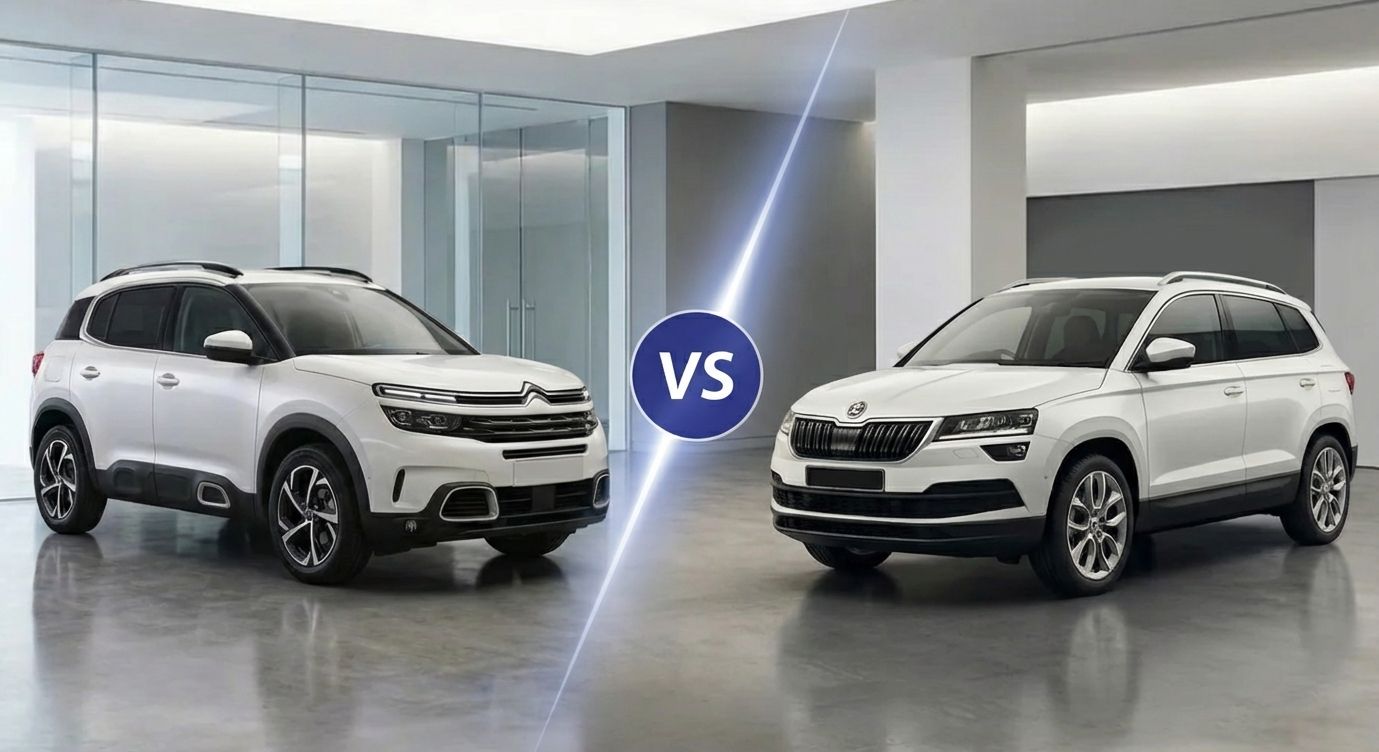
Hesitating between the Citroën C5 Aircross and the Škoda Karoq? Our detailed comparison and verdict will help you choose the right SUV for your needs.
Oct 16, 2026