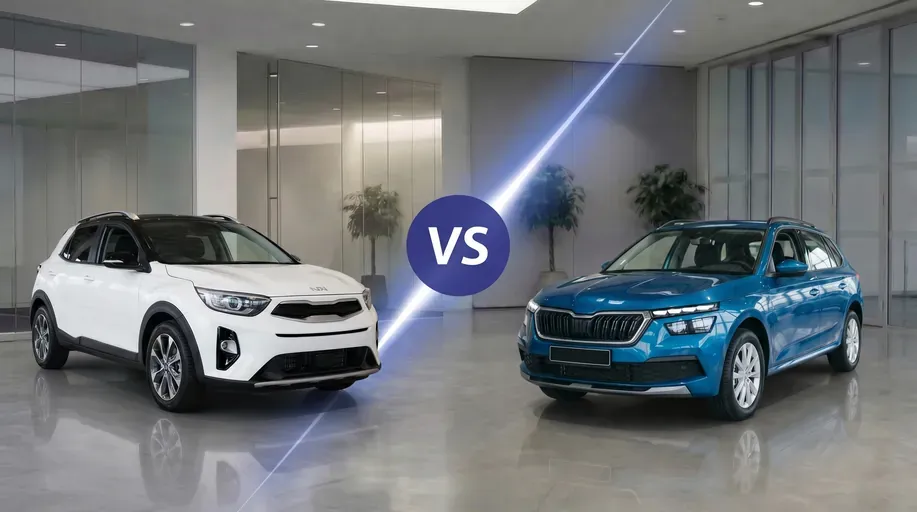
Car battle
Kia Stonic vs. Škoda Kamiq: Complete comparison 2026
Kia Stonic vs. Škoda Kamiq: Which used city SUV is better? Discover the differences in equipment, fuel consumption, and space. Read our detailed verdict.
Oct 16, 2026
Volkswagen T-Roc review: real owner impressions, practical boot space, new eTSI mild-hybrid engines, running costs, and our definitive verdict.
October 17, 2026
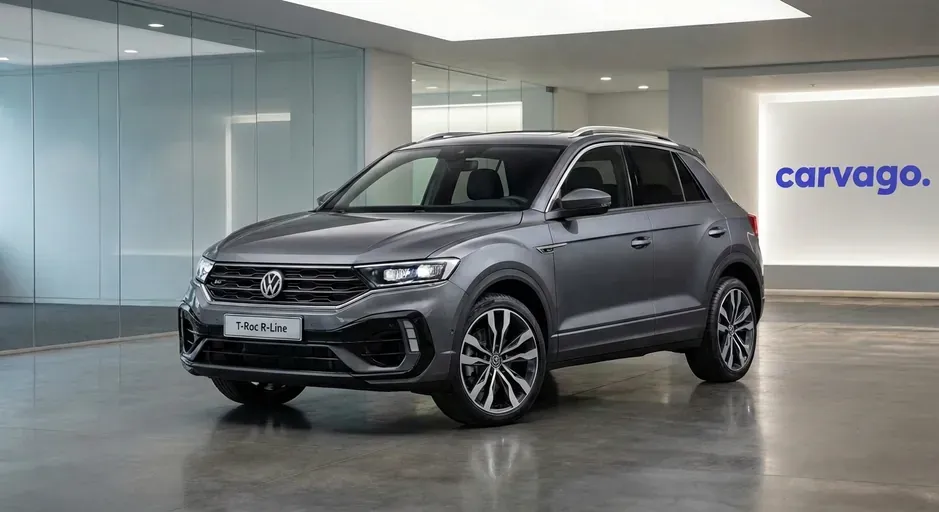
The second-generation Volkswagen T-Roc represents the brand's core offering in the competitive European compact crossover segment. Unveiled at its world premiere on 27 August 2025, order books opened the following day on 28 August 2025. Initial European customer deliveries from the Palmela assembly plant commenced in November 2025. As a recent arrival, this generation has not undergone a mid-cycle facelift.
This generation of the Volkswagen T-Roc SUV is sold exclusively as a five-door crossover. The powertrain lineup expanded in April 2026 when a full-hybrid version opened for order alongside the initial petrol mild-hybrid units.
The vehicle primarily targets private commuters and small families who seek an elevated seating position and daily practicality without the cumbersome exterior footprint of a larger family vehicle. This review focuses specifically on the second generation from its November 2025 market launch onward, examining its day-to-day usability and long-term ownership prospects.
Because European deliveries of the second-generation Volkswagen T-Roc commenced in November 2025, long-term durability and high-mileage wear patterns are not yet established. Across its initial period on the market, official technical registers and roadside assistance records show no repeated, model-specific mechanical defects for this generation.
Isolated software glitches have appeared in early owner reports, primarily involving sporadic slow startup times for the central touchscreen or temporary smartphone integration dropouts. These occurrences are handled through standard over-the-air software updates rather than workshop interventions.
Despite the lack of systemic wear faults, an urgent safety recall applies to early production units of the second-generation Volkswagen T-Roc. Announced in February 2026, the campaign addresses an improper bolted connection of the tie rod to the wheel bearing housing that can loosen and lead to a partial or complete loss of steering control. The notice affected 4,025 vehicles worldwide (including 1,404 units in Germany) built between September 2025 and February 2026, accompanied by an explicit stop-drive instruction until authorized workshops inspect and replace the bolted connections on both sides.
| Defect | Affected Build Period | Scope | Workshop Remedy |
|---|---|---|---|
| Tie-rod bolted connection loosening (risk of steering loss) | 06.09.2025 – 05.02.2026 | 4,025 vehicles worldwide | Inspect and replace bolted connections on both sides |
When considering an early pre-owned example, ensuring that safety-critical campaigns have been addressed is essential. If you want independent reassurance about a vehicle's mechanical status and completed workshop campaigns before buying, you can have it inspected by CarAudit.
The second-generation Volkswagen T-Roc relies entirely on electrified petrol powertrains, having eliminated all diesel engines and manual gearboxes from the European range. Buyers can choose between 48V mild-hybrid options, a self-charging full hybrid, and an all-wheel-drive variant.
| Engine | Fuel | Power | Gearbox | Drivetrain | Model years |
|---|---|---|---|---|---|
| 1.5 eTSI | Petrol mild-hybrid | 85 kW (116 hp) | 7-speed automatic | Front-wheel drive | 2025–present |
| 1.5 eTSI | Petrol mild-hybrid | 110 kW (150 hp) | 7-speed automatic | Front-wheel drive | 2025–present |
| 1.5 Hybrid | Full hybrid | 125 kW (170 hp) | Dedicated hybrid automatic | Front-wheel drive | 2026–present |
| 2.0 eTSI 4MOTION | Petrol mild-hybrid | 150 kW (204 hp) | 7-speed automatic | All-wheel drive | 2026–present |
For urban commuting and frequent short hops, the hybrid Volkswagen T-Roc powered by the 1.5 Hybrid unit is the most sensible option. It operates predominantly on electric power during low-speed city manoeuvres, providing silent stop-start progress without requiring plug-in charging. The entry 1.5 eTSI provides adequate pace around town, though it feels strained when asked to overtake with a full load of passengers.
For mixed everyday driving, the more powerful petrol Volkswagen T-Roc 1.5 eTSI is the most versatile choice in the line-up. Its cylinder-deactivation system works unobtrusively under light throttle to rein in fuel use, while offering ample acceleration reserves for country roads and motorway slip roads.
Long-distance commuters and owners planning to tow will be best served by the 2.0 eTSI 4MOTION Volkswagen T-Roc 4x4. Its larger displacement engine and all-wheel-drive system ensure confident stability at sustained motorway speeds and deliver the highest braked trailer rating in the range, whereas the full hybrid is constrained by a significantly lower towing capacity.
Across the initial market rollout, no recurring mechanical engine or transmission failures have been documented.
| Dimension | Measurement |
|---|---|
| Length | 4,373 mm |
| Width (excluding / including mirrors) | 1,828 / 2,050 mm |
| Height | 1,573 mm |
| Wheelbase | 2,629 mm |
| Boot capacity (seats upright / folded) | 475 / 1,350 l |
Stated luggage capacities apply to front-wheel-drive mild-hybrid versions; full-hybrid and all-wheel-drive variants have smaller cargo areas due to underlying hardware components.
The Volkswagen T-Roc SUV provides sufficient legroom and headroom for adult passengers across the rear bench, supported by comfortable outer seat cushioning. While the rear bench is fixed in position and does not slide forward or back, day-to-day passenger comfort remains dependable.
The cargo bay offers a wide floor between the wheel housings and a flat loading surface. A split-folding rear backrest is standard across the lineup, while higher trims add an independently folding centre armrest that doubles as a through-load ski hatch. Additionally, select configurations feature an optional fully folding front passenger seatback, accommodating long items entirely within the enclosed interior.
On the road, the Volkswagen T-Roc displays composed body control, dependable roadholding, and responsive steering that remains predictable during sudden evasive manoeuvres. Cornering manners prioritise reassuring grip and stability over agile responsiveness. Ride quality, however, depends heavily on chassis configuration. On the standard passive setup, the suspension feels medium-firm; while it handles gentle tarmac undulations competently, broken urban surfaces and potholes transmit sharp thumps into the cabin, especially when paired with larger wheels. Testers widely note that the optional adaptive dampers noticeably improve compliance, smoothing out rougher pavement.
Acoustic insulation keeps wind and road rumble subdued at sustained cruising speeds, though the petrol engine drones into the cabin under heavy acceleration. The mild-hybrid coasting function frequently cuts the engine under light throttle, introducing perceptible driveline transitions that take acclimation. In the automatic Volkswagen T-Roc, testers also noted occasional shift hesitation during abrupt downshifts and slight clutch snatch during low-speed parking manoeuvres.
The cabin represents a clear advance in perceived quality. Textured fabric dashboard inserts and padded surfaces replace the reflective, hard plastics of earlier iterations. The reinstatement of physical steering-wheel buttons and direct rotary controls receives praise for restoring straightforward ergonomics. Thick rear pillars do compromise over-the-shoulder visibility when parking or merging. Professional road tests agree on the vehicle's safe road manners and improved cabin ergonomics, but they diverge on ride comfort: while some consider the passive setup acceptable on smaller wheels, others view the adaptive dampers as an essential option for rougher roads.
All the charts in this section are drawn from Carvago's listings of the whole Volkswagen T-Roc model family, including other generations represented in the data, not only the reviewed generation. Because these figures represent advertised offerings across multiple production years, this chart does not establish a separate price level for the reviewed generation. Across the wider model line, the median asking price ranges from €20,000 for 2019 vehicles to €36,200 for 2026 examples, with 2022 builds sitting at a median asking price of €24,600.
Active Volkswagen T-Roc listings rose from 39,885 in April 2026 to a peak of 42,537 in July before declining into late summer, as tracked in the monthly counts below.
Active listings over time
| Month | Volkswagen T-Roc |
|---|---|
| 2026-04 | 39 885 |
| 2026-05 | 41 285 |
| 2026-06 | 42 400 |
| 2026-07 | 42 537 |
| 2026-08 | 39 489 |
| 2026-09 | 38 702 |
Source Carvago
Even after dropping to 38,702 listings in September 2026, the volume of advertised vehicles provides buyers with a wide selection across the market.
Among Volkswagen T-Roc listings advertised today, the median asking price stands at €20,000 for cars built in 2019 and reaches €36,200 for those built in 2026.
Median advertised price by year of manufacture
| Model year | Volkswagen T-Roc |
|---|---|
| 2019 | 20 000 |
| 2020 | 22 000 |
| 2021 | 22 500 |
| 2022 | 24 600 |
| 2023 | 27 000 |
| 2024 | 30 000 |
| 2025 | 31 000 |
| 2026 | 36 200 |
Source Carvago
Across the available model years, buyers looking at 2020 examples encounter a median asking price of €22,000 among current listings, whereas moving up to a 2024 model corresponds to a median asking price of €30,000.
This depreciation curve traces how the Volkswagen T-Roc loses residual value as it ages, shedding 22% in its first year. By age three, cumulative loss reaches 33% of the initial value.
Residual value by vehicle age
| Vehicle age | Volkswagen T-Roc |
|---|---|
| New | 36 600 |
| 1 yr | 28 500 |
| 2 yrs | 26 200 |
| 3 yrs | 24 500 |
| 4 yrs | 22 700 |
| 5 yrs | 21 500 |
| 6 yrs | 19 800 |
| 7 yrs | 18 200 |
Source Carvago
Across the seven-year span, the model sheds 50% of its initial residual value. The sharpest drop is concentrated in the opening year, after which annual losses moderate to steady single-digit percentages.
Petrol models make up the vast majority of active listings over the period, accounting for 32,911 advertised cars in September 2026 alongside 5,589 diesel options. The breakdown below tracks how the available inventory has shifted across each fuel type month by month.
Supply composition by fuel type
Petrol
Diesel
Hybrid
Electric
LPG
| Month | Petrol | Diesel | Hybrid | Electric | LPG |
|---|---|---|---|---|---|
| 2026-04 | 33 271 | 6 525 | 10 | 0 | 6 |
| 2026-05 | 34 421 | 6 736 | 22 | 1 | 9 |
| 2026-06 | 35 520 | 6 741 | 25 | 1 | 11 |
| 2026-07 | 35 931 | 6 463 | 36 | 0 | 14 |
| 2026-08 | 33 653 | 5 664 | 47 | 0 | 15 |
| 2026-09 | 32 911 | 5 589 | 55 | 0 | 13 |
Source Carvago
In practice, buyers will find their realistic choices confined almost entirely to petrol and diesel engines. Alternative powertrains remain negligible across the classifieds, with only 55 hybrids and 13 LPG-equipped cars listed in September 2026.
Between April 2026 and September 2026, the average asking price for the Volkswagen T-Roc opened at €28,000, as shown in the monthly figures below.
Average price development over time
| Month | Volkswagen T-Roc |
|---|---|
| 2026-04 | 28 000 |
| 2026-05 | 27 800 |
| 2026-06 | 27 600 |
| 2026-07 | 27 500 |
| 2026-08 | 27 400 |
| 2026-09 | 27 400 |
Source Carvago
Across the six months, the average shifted from €28,000 to €27,400, a minor change of just over 2% that levelled off between August and September.
Composed body control and predictable steering with dependable roadholding
Improved cabin materials with intuitive physical steering-wheel and rotary controls
Functional luggage area with a flat loading floor and versatile folding seat options
Firm standard suspension that transmits sharp thumps over broken pavement
Automatic transmission can hesitate or snatch clutches during low-speed parking
Urgent tie-rod steering recall on early production cars requiring verification by VIN
Long-term durability is not yet established because deliveries only commenced in November 2025. While recurring mechanical faults have not emerged, early examples built between September 2025 and February 2026 are subject to an urgent steering tie-rod recall requiring immediate workshop verification.
For mixed everyday driving, the more powerful 1.5 eTSI petrol unit provides the most versatile balance of performance and efficiency. Frequent city drivers benefit most from the quiet low-speed running of the hybrid Volkswagen T-Roc, while those planning to tow or commute long distances should select the Volkswagen T-Roc 4x4.
Check the vehicle's history by VIN to ensure the mandatory steering tie-rod recall has been completed on cars built between September 2025 and February 2026. On the test drive, verify smooth low-speed transmission engagement and confirm that all pending software updates have been installed.
No. This generation of the Volkswagen T-Roc is built exclusively as a five-door crossover with electrified petrol powertrains and automatic transmissions, with no diesel or convertible options offered.
Sources: volkswagen-newsroom.com, adac.de, autocar.co.uk, autobild.de, autoexpress.co.uk
This article was prepared using artificial intelligence tools. The section guarantor is Petr Dušek.
Kia Stonic vs. Škoda Kamiq: Which used city SUV is better? Discover the differences in equipment, fuel consumption, and space. Read our detailed verdict.
Oct 16, 2026
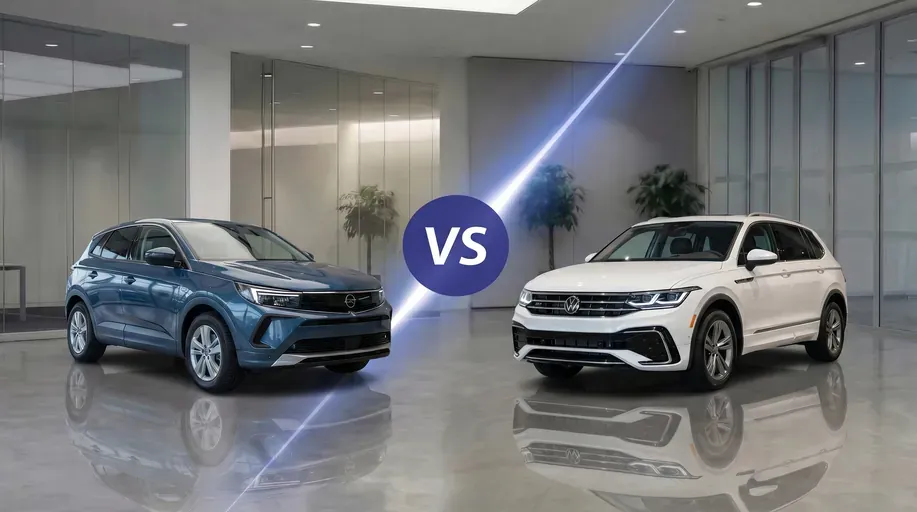
Comparison of the Opel Grandland (formerly Grandland X) and the Volkswagen Tiguan. Discover real-world experiences, equipment comparisons, and find out which used SUV is the right one for you.
Oct 16, 2026
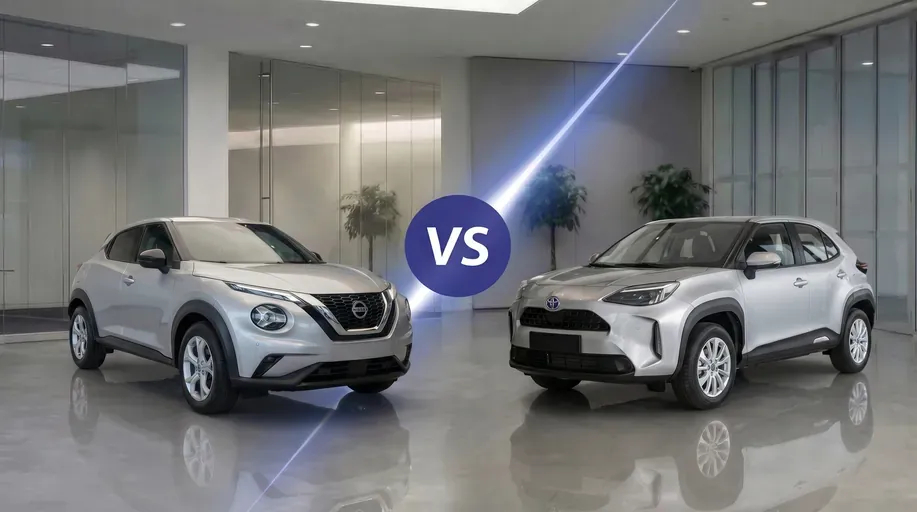
Nissan Juke vs Toyota Yaris Cross comparison. Find out which city SUV offers better equipment, fuel consumption, and driving characteristics. Read our final verdict!
May 21, 2026