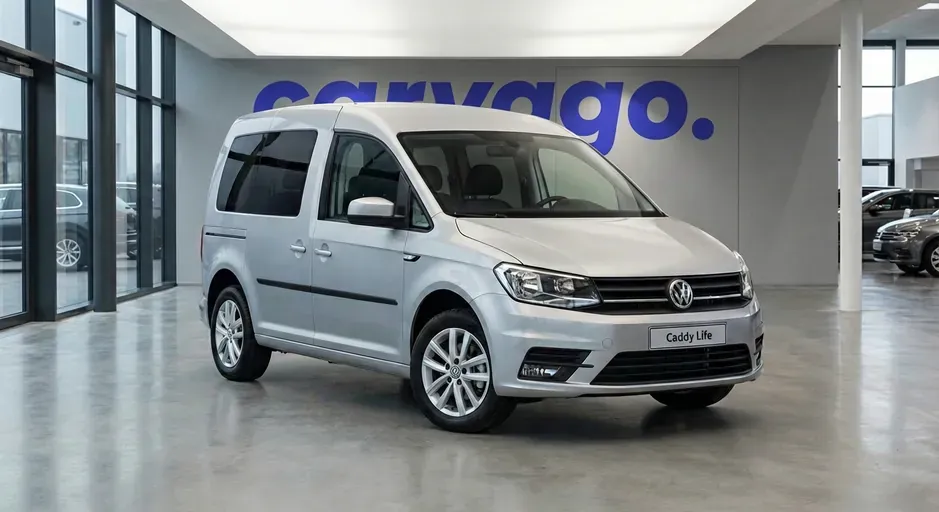
Review Volkswagen Caddy: What do owners and experts really say?
Volkswagen Caddy review: real owner experience, common faults, engine picks and practical space — everything you need before you buy.
October 18, 2026
Introduction
The fifth-generation Volkswagen Caddy occupies a distinct position between traditional light commercial vehicles and conventional family passenger cars. Transitioning to the MQB evo platform, production of this generation began in October 2020, with first European market deliveries starting in November 2020. This review focuses exclusively on models produced from late 2020 through 2026.
The lineup offers two body lengths: the standard wheelbase and the extended long-wheelbase Maxi. Buyers can choose between closed panel-van formats, dual-purpose models with folding partition walls, factory camper configurations, and passenger versions seating up to seven.
Aimed primarily at families, tradespeople, and lifestyle buyers requiring utility alongside modern passenger-car chassis architecture, the Volkswagen Caddy MPV pairs practical box-shaped packaging with mainstream driving controls. The following sections evaluate its ownership record, engines, interior flexibility, and overall value.
Owner Experiences: Common Faults and Recalls
Early production years of the fifth-generation Volkswagen Caddy generated noticeable owner complaints regarding on-board electronics. On models built from 2020 through 2023, tests describe frozen touchscreens, sluggish system boot times, blank central displays upon starting, and sporadic communication dropouts from driver assistance systems or emergency call modules. Dealership and over-the-air software updates resolved these system crashes on most affected vehicles, though some early production examples required replacement of the physical infotainment hardware.
On forum communities, owners of both standard-wheelbase and long-wheelbase Volkswagen Caddy models frequently report issues with the sliding side doors. Over uneven road surfaces, misaligned door latches produce metallic tapping and rattling, while worn or improperly seated weatherstripping causes wind noise at higher speeds. Furthermore, owners report that the lower guide rollers can wear away clearcoat and paint along the sill running path, exposing bare sheet metal if protective film or alignment adjustments are not applied. On the diesel Volkswagen Caddy with the 2.0 TDI engine, owners also report delays in AdBlue level recognition after top-ups; the ultrasonic sensor often requires leaving the ignition switched on for several minutes before starting, or driving extended distances, before clearing the instrument cluster warning.
Several safety recalls have been issued across the European market for this generation. The most extensive safety campaign, registered in September and October 2026, involves 2,159,054 vehicles worldwide across several manufacturer models produced between 24 September 2013 and 1 July 2024. In the official notice's words, moisture ingress could lead to corrosion of a steering rack bolt, which may result in a fracture of the bolt and a loss of steering capability. Authorised workshops inspect the steering gear assembly and install an updated corrosion-resistant bolt.
Verified European Safety Recalls
Defect Subject
Affected Production Window
Scope and Official Remedy
Steering rack mounting bolt
24 September 2013 – 1 July 2024
Worldwide (2,159,054 vehicles across multiple models). Moisture causes bolt corrosion and risk of fracture; workshops inspect and install coated replacement bolts.
Rear left brake line connection
Standard wheelbase: 6–8 April 2024 & 2–6 August 2024; Long wheelbase: 13 May 2024 – 19 June 2024
Worldwide (4,118 vehicles). Incorrect threading can cause brake fluid leaks; workshops inspect and tighten or replace the brake line assembly.
Front axle transverse link welds
20 April 2021 – 7 July 2022
Worldwide (6,112 vehicles). Inadequate welding on front wishbones can cause the wheel to bend sideways; workshops inspect batch codes and replace defective arms.
Defective factory-fitted tyres
29 September 2022 – 24 February 2023
Worldwide (1,206 vehicles). Internal sidewall bulges or tears risk sudden pressure loss; dealers replace tyres from the identified batch.
Damaged seat belt webbing
31 March 2023 – 5 April 2023
Limited European batch. Potential manufacturing damage reduces webbing strength in an impact; workshops inspect and fit new belts where required.
When shopping for a used petrol Volkswagen Caddy with the 1.5 TSI engine and a manual transmission, tests note that some cold engines exhibit low-speed hesitation or minor surging in first and second gear before reaching full operating temperature. Prospective buyers seeking complete peace of mind can have any vehicle's service history and physical components verified independently before purchase through CarAudit.
🔍 What to check before buying
Verify through an authorised dealer using the vehicle's VIN that all safety recalls—particularly those concerning the steering rack mounting bolt and front axle transverse links—have been formally completed.
Inspect the lower sliding door sills on both sides for paint abrasion or bare metal caused by roller contact, and test-drive over coarse surfaces to check for door rattles and latch alignment.
Test the infotainment screen thoroughly from a cold start to ensure fast boot times, smooth menu transitions, and the absence of recurring emergency call or assistance warnings.
On the 1.5 TSI petrol manual, conduct a cold test drive at low speeds to assess smooth throttle pickup without surging in first and second gear.
On the 2.0 TDI diesel, check the instrument display to confirm that the AdBlue fluid level is registered accurately without persistent refill warnings.
Engines: Which One to Choose
The fifth-generation Volkswagen Caddy offers a modernised range of four-cylinder turbocharged engines built on the MQB evo architecture, spanning petrol, diesel, and plug-in hybrid options alongside front-wheel and all-wheel drive.
Engine
Fuel
Power
Gearbox
Drivetrain
Model years
1.5 TSI
Petrol
84 kW (114 hp)
6-speed manual / 7-speed automatic
Front-wheel drive
2020–2024
1.5 TSI
Petrol
85 kW (116 hp)
6-speed manual / 7-speed automatic
Front-wheel drive
2024–present
1.5 TGI
CNG / Petrol
96 kW (131 hp)
6-speed manual
Front-wheel drive
2022–2023
1.5 TSI eHybrid
Plug-in hybrid
110 kW (150 hp)
6-speed automatic
Front-wheel drive
2024–present
2.0 TDI
Diesel
55 kW (75 hp)
6-speed manual
Front-wheel drive
2020–2021
2.0 TDI
Diesel
75 kW (102 hp)
6-speed manual
Front-wheel drive
2020–present
2.0 TDI
Diesel
90 kW (122 hp)
6-speed manual / 7-speed automatic
Front-wheel drive
2020–present
2.0 TDI 4MOTION
Diesel
90 kW (122 hp)
6-speed manual
All-wheel drive
2021–present
Urban driving and short trips
For drivers operating mostly in town or covering short daily runs, the petrol Volkswagen Caddy with the 1.5 TSI engine is the most practical choice. It warms up rapidly and eliminates the exhaust-filter clogging risks common to diesels on short cycles. Those with regular home-charging access can consider the plug-in hybrid Volkswagen Caddy eHybrid, which covers daily city commutes entirely on electric power while retaining petrol flexibility for occasional trips. The niche 1.5 TGI natural-gas variant is an economical alternative as a used car where refueling infrastructure allows.
Mixed commuting
For general suburban and regional use, the mid-range 2.0 TDI and the updated 1.5 TSI are well balanced. The least powerful 2.0 TDI is strictly a used-car proposition that feels strained when carrying passengers. In contrast, the mid-level diesel offers sufficient pulling power for everyday family needs, although it is restricted to a manual gearbox.
Motorway distances and heavy loads
For frequent high-speed cruising and heavy commercial use, the stronger 2.0 TDI is the most capable option. It provides muscular low-end tractability and relaxed engine speeds on long stretches, along with the option of a seven-speed dual-clutch automatic transmission that substantially reduces driver fatigue on long journeys.
Towing and slippery terrain
When towing trailers or driving regularly with substantial payloads, the stronger diesel Volkswagen Caddy delivers the essential low-end pulling power needed on steep inclines. Drivers living in mountainous regions or regularly navigating muddy tracks, building sites, or wet ramps should opt for the Volkswagen Caddy 4x4 with 4MOTION, keeping in mind that all-wheel traction comes paired exclusively with a six-speed manual gearbox.
For a detailed review of mechanical durability, exhaust hardware faults, and workshop campaigns across these engines, see the owner experiences section.
Space & Practicality
Dimension / Capacity
Standard Wheelbase
Long Wheelbase
Length (mm)
4,500
4,853
Width (mm)
1,855
1,855
Height (mm)
1,798–1,832
1,800–1,836
Wheelbase (mm)
2,755
2,970
Boot volume, 5 seats up (l)
1,213
1,720
Boot volume, seats removed (l)
2,556
3,105
Figures apply to standard passenger models; camper conversions with permanent interior fittings alter usable cargo capacities.
Inside the Volkswagen Caddy people-carrier, the tall roofline ensures ample headroom across all seating rows, allowing front occupants of any height to find an upright, relaxed seating posture. In the second row, however, professional tests note that legroom is merely adequate, meaning taller adults seated behind a tall driver will find knee clearance tight. Practicality remains the model's core strength: the split second-row bench folds forward and tumbles to quickly clear floor space. Removing the seats entirely transforms the Volkswagen Caddy into a flat-floored van, though hauling the heavy seat sections out of the vehicle demands considerable muscle. Choosing the long-wheelbase version substantially improves versatility, widening the sliding side door aperture and preserving practical luggage depth behind third-row seating when fitted.
What the Tests Say
Professional road tests describe the Volkswagen Caddy as closer to a conventional passenger car than its commercial van origins suggest. Steering response is precise, directional tracking on motorways remains stable, and body lean is controlled through bends despite the tall roofline. On open roads, the suspension absorbs transverse expansion joints smoothly. At low urban speeds, however, testers report a fidgety secondary ride when unladen, accompanied by thumping and clatter from the rear axle over speed bumps. Motorway cruising generates noticeable tyre roar and resonance inside the passenger shell, alongside wind whistle around the door mirrors and diesel chatter under hard acceleration.
Inside, testers praise the tight panel fitment and carpeted boot sides on passenger variants for their durability. However, hard, scratch-prone utility plastics dominate the dashboard and door cards. The control ergonomics receive consistent criticism: the central touchscreen features layered, unintuitive menu paths, while the unlit touch-sensitive sliders for temperature and audio volume prove distracting to operate while driving.
Evaluations agree on the composed handling and predictable road manners, but diverge on ride comfort: some consider the setup adequately supple, while others penalise the unladen rear suspension for low-speed harshness. The technical update introduced for model year 2025 addressed early cockpit criticisms by adopting an updated digital instrument display alongside larger, revised central touchscreens.
Prices and Market Offer
All charts in this section are drawn from Carvago listings of the whole Volkswagen Caddy model family, including other generations represented in the data, not only the reviewed generation. Consequently, this dataset does not establish a separate price level for the reviewed generation alone. Across the advertised inventory, the median asking price stands at €18,500 for 2019 builds, compares to €22,000 for 2021 vehicles, and reaches €36,500 for 2026 examples.
The monthly count of advertised Volkswagen Caddy models started at 14,363 in April 2026 and reached 15,211 in June 2026, as tracked in the chart below.
Volkswagen Caddy - availability over time
Active listings over time
Month
Volkswagen Caddy
2026-04
14 363
2026-05
14 260
2026-06
15 211
2026-07
14 982
2026-08
14 384
2026-09
14 390
Source Carvago
Buyers can expect an extensive selection on the market, with availability seeing modest month-to-month swings before ending at 14,390 listings in September 2026.
The median asking price of cars advertised today built in 2019 is €18,500, while the median asking price of cars advertised today built in 2026 is €36,500. The chart below illustrates how these asking prices compare across build years.
Volkswagen Caddy - median price by model year
Median advertised price by year of manufacture
Model year
Volkswagen Caddy
2019
18 500
2020
19 500
2021
22 000
2022
24 900
2023
29 900
2024
33 500
2025
35 700
2026
36 500
Source Carvago
Buyers focusing on earlier model years face median asking prices of €18,500 for 2019 and €19,500 for 2020 models. Securing the newest vehicles requires a significantly higher budget, with median asking prices running from €33,500 for 2024 models up to €36,500 for 2026 models.
This depreciation curve illustrates how the Volkswagen Caddy loses residual value as it ages, shedding roughly 32% of its value over the first three years.
Volkswagen Caddy - value loss by age
Residual value by vehicle age
Vehicle age
Volkswagen Caddy
New
35 800
1 yr
30 900
2 yrs
28 700
3 yrs
24 200
4 yrs
23 200
5 yrs
21 300
6 yrs
17 500
7 yrs
15 600
Source Carvago
Over the full seven-year span, the model sheds 56% of its initial residual value. The rate of decline moderates between three and five years of age before steepening again in the sixth year.
Between April and September 2026, diesel vehicles formed the bulk of active advertisements, recording 9,574 listings in September 2026 compared to 3,335 petrol models. The breakdown below illustrates how listing numbers across each fuel type shifted over this six-month period.
Volkswagen Caddy - supply by fuel over time
Supply composition by fuel type
Petrol
Diesel
Hybrid
Electric
CNG
LPG
Month
Petrol
Diesel
Hybrid
Electric
CNG
LPG
2026-04
3 741
9 725
755
2
134
1
2026-05
3 537
9 737
832
1
150
0
2026-06
3 761
10 379
921
1
145
3
2026-07
3 561
10 235
1 013
0
159
11
2026-08
3 414
9 737
1 061
2
150
17
2026-09
3 335
9 574
1 318
3
145
13
Source Carvago
Diesel dominates the cars on offer, followed by petrol, meaning buyers will find by far the widest selection among diesel models. In September 2026, hybrid options stood at 1,318 listings, while compressed natural gas recorded 145, LPG 13, and electric 3.
The chart below tracks the average asking price for the Volkswagen Caddy from April 2026 to September 2026, opening at €28,200.
Volkswagen Caddy - price trend over time
Average price development over time
Month
Volkswagen Caddy
2026-04
28 200
2026-05
28 000
2026-06
28 000
2026-07
27 700
2026-08
27 700
2026-09
28 100
Source Carvago
Across this period, the average shifted within a narrow band, touching a low of €27,700 before ending at €28,100 in September 2026. That represents an overall change of less than one percent from the opening month, showing only modest month-to-month variation rather than a sustained trend.
Pros & Cons
Volkswagen Caddy
Pros
Composed, passenger-car-like handling with precise steering and controlled body lean
Versatile cargo flexibility with folding, tumbling, and removable rear seats
Diverse powertrain choices including torquey diesels, plug-in hybrid, and all-wheel drive
Cons
Unlit touch sliders and software glitches on early production infotainment systems
Fidgety low-speed ride quality and rear-axle noise over bumps when unladen
Hard, scratch-prone cabin plastics and heavy rear seat sections that demand muscle to remove
Frequently asked questions
Which engine is best for a used Volkswagen Caddy?
For urban trips and short commutes, the petrol Volkswagen Caddy with the 1.5 TSI engine is the most practical choice to avoid exhaust-filter clogging. Frequent motorway drivers and those hauling heavy loads will prefer the stronger 2.0 TDI diesel Volkswagen Caddy for its relaxed high-speed cruising.
Is the fifth-generation Caddy reliable?
Mechanically the model is dependable, though 2020–2023 examples suffered from software instability that required dealer updates. Buyers should confirm through an authorised workshop that all manufacturer safety recalls have been formally completed.
What should you check before buying a used Caddy?
Check that all safety recalls are completed and inspect the sliding side door sills for paint wear caused by guide rollers. Verify that the infotainment system operates smoothly from a cold start, or have the vehicle inspected before purchase using CarAudit.
How does the Volkswagen Caddy compare to a conventional car?
Built on modern passenger-car architecture, the Volkswagen Caddy delivers composed road manners and precise steering comparable to a conventional passenger car. The primary compromise is an unladen rear suspension that feels firmer over low-speed urban bumps, alongside elevated tyre and wind noise at motorway speeds.