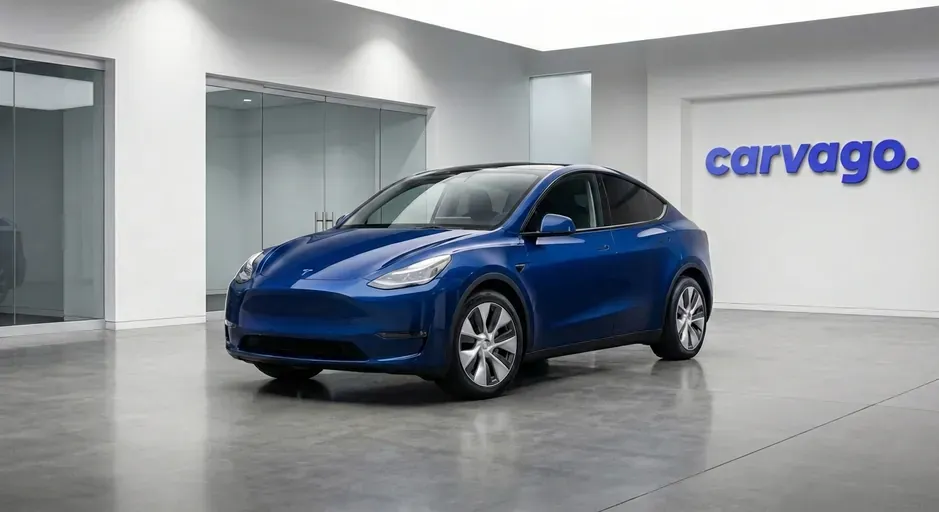
Review Tesla Model Y: What do owners and experts really say?
Tesla Model Y review: real owner experience, common faults, real-world range, running costs and prices — everything you need before you buy.
October 28, 2026
Introduction
The Tesla Model Y represents the brand in the competitive mid-size crossover class. This review evaluates the first generation, which began customer deliveries in Europe in August 2021 through imports, followed by regional factory production starting in March 2022. Production remains active as of October 2026.
Available solely as a five-door crossover SUV, the model received a comprehensive mid-cycle refresh that began production on 14 January 2025, with European deliveries commencing on 7 March 2025. Subsequent range additions followed into early 2026, including extended-range rear-wheel-drive offerings and the return of an optional third seating row.
Aimed at family buyers, fleet drivers, and private motorists seeking practical zero-emission transport, the electric Tesla Model Y SUV blends hatchback convenience with elevated seating. The following sections examine how it holds up across practical usability, real-world reliability, driving dynamics, and secondary-market pricing.
Owner Experiences: Common Faults and Recalls
Since European deliveries began in August 2021, the first-generation Tesla Model Y has established a clear reliability profile across European markets. For the refreshed version delivered to European buyers from March 2025, long-term fleet reliability is not yet established in periodic inspection records. On earlier build years, however, independent technical inspection data reveals that chassis wear is the primary mechanical concern. Tests describe premature wear on front axle suspension joints and upper control arm compliance bushings, driven by the car's substantial mass and loss of ball-joint lubrication. Owners experiencing this issue report squeaking, creaking, or groaning from the front axle during low-speed manoeuvres and over road undulations. Replacing the worn assemblies with updated factory components or heavy-duty aftermarket designs in most cases resolves the noise.
Another frequent finding in roadworthiness tests involves the braking hardware. Because the all-wheel-drive Tesla Model Y and rear-wheel-drive variants rely heavily on regenerative deceleration, mechanical friction brakes are underutilised during ordinary driving. Tests describe surface corrosion, rust banding, and uneven friction-ring wear on brake discs, particularly in regions where winter roads are salted. Periodic deliberate braking from higher speeds helps maintain clean rotor surfaces, but heavily pitted or corroded discs require physical rotor and pad replacement. In addition, inspection tests report a higher rate of low-beam headlight misalignment, caused either by factory miscalibration or software updates resetting the zero-level reference, which requires optical realignment in a workshop.
Official safety recalls have encompassed both mechanical chassis components and software logic across global and European fleets. Early hardware campaigns required physical workshop intervention to inspect steering knuckles and control arm fasteners, whereas subsequent safety notices have predominantly been resolved through over-the-air updates.
Announcement
Production Window
Scope
Defect & Workshop Remedy
December 2021
2020 – 2021
Worldwide
Front lateral control arm fasteners could loosen from the subframe; workshop inspection to retorque or replace fasteners.
April 2022
16 June 2020 – 10 November 2021
Worldwide (23,437 units)
Steering knuckles could deform or fracture, risking control arm detachment; workshop inspection and casting replacement.
July 2024
2020 – 2024
Worldwide (~1.85m units across models)
Front trunk latch open-detection failure could fail to warn the driver of an unlatched bonnet; rectified via over-the-air software update.
May 2025
January 2023 – September 2024
Worldwide (>550,000 units across models)
Software calculation error causing sudden loss of electric power steering assist; resolved via over-the-air software update.
July 2025
09 January 2018 – 21 November 2024
Worldwide (387,642 units across models)
Tyre pressure monitoring warning lamp non-persistence across drive cycles; rectified via over-the-air software update.
Before buying, verifying the vehicle's physical condition and service history through an independent inspection such as CarAudit provides certainty that past service campaigns and chassis wear points have been properly addressed.
🔍 What to check before buying
Front suspension joints: Listen for creaking, groaning, or knocking sounds from the front axle during tight turns and across speed bumps, indicating worn control arm bushings or ball joints.
Brake disc corrosion: Inspect the inner and outer faces of all four brake discs through the wheels for heavy rust ridges, pitting, or uneven contact bands.
Tyre inner-shoulder wear: Examine tread depth across the full contact patch, checking especially for accelerated wear on the inside edges of the rear tyres.
Recall and update records: Check the vehicle identification number (VIN) to verify that all physical workshop campaigns, including front control arm fasteners and steering knuckles, were completed.
Engines: Which One to Choose
Every European Tesla Model Y relies on a pure electric powertrain paired with a single-speed automatic transmission. The line-up divides between single-motor rear-wheel-drive configurations and dual-motor all-wheel-drive layouts, with power deliveries and battery chemistries tailored to different usage profiles.
Designation
Fuel
Power
Gearbox
Drivetrain
Model years
Rear-Wheel Drive
Electric
220 kW
Automatic
Rear-wheel drive
2022–2025
Long Range RWD
Electric
255 kW
Automatic
Rear-wheel drive
2024–2025
Long Range AWD
Electric
324 kW
Automatic
All-wheel drive
2021–2025
Performance AWD
Electric
393 kW
Automatic
All-wheel drive
2022–2025
Rear-Wheel Drive (facelift)
Electric
220 kW
Automatic
Rear-wheel drive
2025–present
Long Range RWD (facelift)
Electric
220 kW
Automatic
Rear-wheel drive
2026–present
Long Range AWD (facelift)
Electric
324 kW
Automatic
All-wheel drive
2025–present
Performance AWD (facelift)
Electric
338 kW
Automatic
All-wheel drive
2025–present
For city driving and short daily commutes, the base rear-wheel-drive electric Tesla Model Y is the sensible option. Its lithium iron phosphate battery tolerates regular charging to full capacity without accelerated wear, making routine charging management straightforward.
Drivers with mixed regional commutes should look at the Long Range rear-wheel-drive model. By eliminating the weight and friction of an extra front motor while retaining the larger battery pack, it delivers the longest driving distance per charge in the range.
For sustained motorway travel across long distances, the dual-motor Long Range version remains the most versatile choice. The added front motor improves high-speed stability and traction in severe weather, while its battery chemistry supports higher peak replenishment rates on high-power charging corridors. Buyers intending to tow regularly should also choose the Tesla Model Y with all-wheel drive, which provides secure launch traction on wet surfaces and steep inclines.
The Performance variant delivers rapid acceleration and the highest top speed in the range. Overall powertrain reliability across all models is high, with electric drive units and high-voltage battery modules showing minimal defect rates in periodic inspection data.
Real-world range and charging behaviour
Cold ambient conditions noticeably reduce cruising range, with highway distances dropping during sub-zero temperatures due to higher cabin heating draw and increased air density. Utilizing the scheduled preconditioning function via an external power supply preserves cabin comfort without depleting battery energy before departure.
Fast-charging performance differs by battery chemistry. Base single-motor models feature a flat replenishment curve that holds moderate intake speeds consistently across the mid-range. In contrast, dual-motor versions accept rapid initial bursts from a depleted state, though the charging pace tapers progressively once the battery fills beyond half capacity.
Space & Practicality
Dimension / Capacity
Value
Length
4,751–4,797 mm
Width (excluding mirrors)
1,920 mm
Height
1,611–1,624 mm
Wheelbase
2,890 mm
Boot capacity (seats upright / folded)
822–854 / 2,022–2,158 l
Front luggage compartment (frunk)
114–116 l
Dimensions vary slightly across model revisions, while optional seven-seat layouts reduce rear luggage capacity when all rows are deployed.
Passenger space in the rear of the Tesla Model Y benefits from a flat floor and elevated front seat bases that allow rear occupants to slide their feet underneath easily, providing ample legroom and headroom for tall adults. On variants specified with an optional third seating row, the second-row bench slides fore and aft to facilitate access, though the rearmost seats remain constrained by limited legroom.
Loading practicality in the Tesla Model Y SUV is supported by a wide aperture, a flush load lip, and a deep sub-trunk well beneath the boot floor that stores charging cables and luggage out of sight, supplemented by a secondary storage tub beneath the front bonnet. The second-row backrest features electric angle adjustment and splits in a 40/20/40 arrangement, enabling long cargo such as skis to pass through the middle while retaining two full outer seats.
What the Tests Say
Professional road tests describe the Tesla Model Y as an agile but firm electric crossover. Early production years drew widespread criticism for a fidgety, unyielding ride that crashed over expansion joints and pitched persistently over uneven pavement. While body roll through fast corners is suppressed and grip remains strong, testers note that the quick steering feels isolated from tyre feedback, requiring frequent micro-corrections on the motorway. Tyre roar and boomy resonance on coarse asphalt also compromised high-speed refinement in early cars.
The minimalist cabin divides opinion. Early seats offered mediocre lateral bolstering and short rear cushions that lacked under-thigh support. Squeaks and inconsistent trim alignment featured in initial builds, but the primary complaint remains ergonomics: delegating virtually every vehicle function to the central touchscreen demands too much visual attention while driving. Inconsistent speed-limit detection and sudden assistance disengagements also received demerits.
What the facelift changed
Updates introduced in 2025 significantly refined daily usability. Revised dampers filter out sharp surface imperfections and settle low-speed fidgeting, though the chassis retains a distinctly firm edge rather than floating over broken tarmac. Additional acoustic insulation noticeably suppresses wind rush and road roar, creating a calmer motorway cruiser. Interior materials and panel alignments show tighter factory tolerances, and the front seats provide improved cushioning with integrated cooling. However, testers almost unanimously criticise the removal of physical steering-column indicator stalks in favour of steering-wheel buttons, calling it an unnecessary and frustrating ergonomic step backwards.
Prices and Market Offer
All charts in this section are drawn from Carvago listings across the entire electric Tesla Model Y model family rather than separating individual production phases, so this market overview does not isolate a standalone price level for the refreshed series. Asking figures show an entry point at a median asking price of €29,900 for 2021 builds, which climbs to €35,700 for both 2022 and 2023 examples as supply broadened across dual-motor and standard-range variants. Across more recent offerings, listings record a median of €37,900 for 2024, €36,400 for 2025, and reach €40,000 for 2026 vehicles.
Between April and September 2026, the volume of active Tesla Model Y listings tracked on the market increased from 2,669 to 3,711. The chart below traces how advertised inventory evolved across this six-month window.
Tesla Model Y - availability over time
Active listings over time
Month
Tesla Model Y
2026-04
2 669
2026-05
2 777
2026-06
3 215
2026-07
3 387
2026-08
3 339
2026-09
3 711
Source Carvago
Buyers can expect an extensive selection, with active listings staying well above 2,600 throughout the period and reaching 3,711 by September. Overall market choice expanded across these months, interrupted only by a minor drop to 3,339 in August.
The median asking price of cars advertised today, built in 2021, is €29,900, compared to a median asking price of €40,000 for listings from the 2026 build year.
Tesla Model Y - median price by model year
Median advertised price by year of manufacture
Model year
Tesla Model Y
2021
29 900
2022
35 700
2023
35 700
2024
37 900
2025
36 400
2026
40 000
Source Carvago
Buyers targeting 2022 or 2023 model years face an identical median asking price of €35,700, while 2026 models stand at €40,000. Differences across build years do not follow a consistent upward step, as 2025 listings show a median asking price of €36,400 compared to €37,900 for 2024 cars.
This depreciation curve traces how the model's residual value declines with vehicle age. Cars lose roughly 25% of their initial value by age two and 31% by age three, leading into the curve below.
Tesla Model Y - value loss by age
Residual value by vehicle age
Vehicle age
Tesla Model Y
New
42 700
1 yr
38 800
2 yrs
32 100
3 yrs
29 400
4 yrs
26 600
5 yrs
23 900
6 yrs
20 700
7 yrs
18 000
Source Carvago
Across the seven-year span shown, the model sheds 58% of its initial residual value, retaining 42%. The steepest annual drop occurs between years one and two, after which value loss moderates to around 8% to 10% per year.
Monthly advertised listings for the model family consist entirely of all-electric vehicles, rising from 2,669 listings in April 2026 to 3,711 by September 2026. The chart below tracks this active monthly supply by powertrain.
Tesla Model Y - supply by fuel over time
Supply composition by fuel type
Month
Electric
2026-04
2 669
2026-05
2 777
2026-06
3 215
2026-07
3 387
2026-08
3 339
2026-09
3 711
Source Carvago
With zero listings recorded for petrol, diesel, or hybrid options across the entire period, buyers shopping the used market will exclusively encounter pure electric models.
The following chart outlines the average asking price for the Tesla Model Y from April 2026 to September 2026, beginning at €32,900.
Tesla Model Y - price trend over time
Average price development over time
Month
Tesla Model Y
2026-04
32 900
2026-05
33 500
2026-06
33 100
2026-07
33 200
2026-08
33 700
2026-09
34 000
Source Carvago
Across the six months, the overall movement remained modest, rising from €32,900 in April to €34,000 in September—an increase of approximately 3%—with an intermediate dip to €33,100 in June.
Practical luggage capacity with a deep underfloor compartment and a front trunk
Strong acceleration and composed high-speed stability, especially with all-wheel drive
Noticeably improved acoustic insulation and ride compliance on refreshed models
Cons
Premature front suspension joint wear and brake disc corrosion on earlier model years
Over-reliance on the touchscreen for basic vehicle functions and steering-wheel indicator buttons on the facelift
Firm, fidgety ride quality and intrusive tyre roar on pre-facelift cars
Frequently asked questions
Is a used Model Y reliable?
Earlier build years frequently exhibit premature suspension wear, though powertrains remain reliable. Refreshed models delivered from March 2025 lack long-term periodic inspection data, so verify past recall repairs by VIN.
Which powertrain is the best choice?
The base rear-wheel-drive Tesla Model Y suits daily commuting due to its resilient battery chemistry. Drivers needing motorway range, towing capability, or winter traction should opt for the all-wheel-drive Tesla Model Y.
What should be checked before buying?
Inspect the front suspension and brake discs for premature wear or corrosion. Prospective buyers should also verify the vehicle identification number to confirm all past physical safety recalls were addressed.
Is the refreshed model worth seeking out?
The updated version delivered from March 2025 provides noticeably better acoustic insulation and improved suspension compliance. The main trade-off is the removal of indicator stalks in favour of steering-wheel buttons, which compromises daily ergonomics.