Review Škoda Enyaq iV: What do owners and experts really say?
Škoda Enyaq iV review: real owner experience, range, common faults, running costs and prices — everything you need before you buy.
October 25, 2026
Introduction
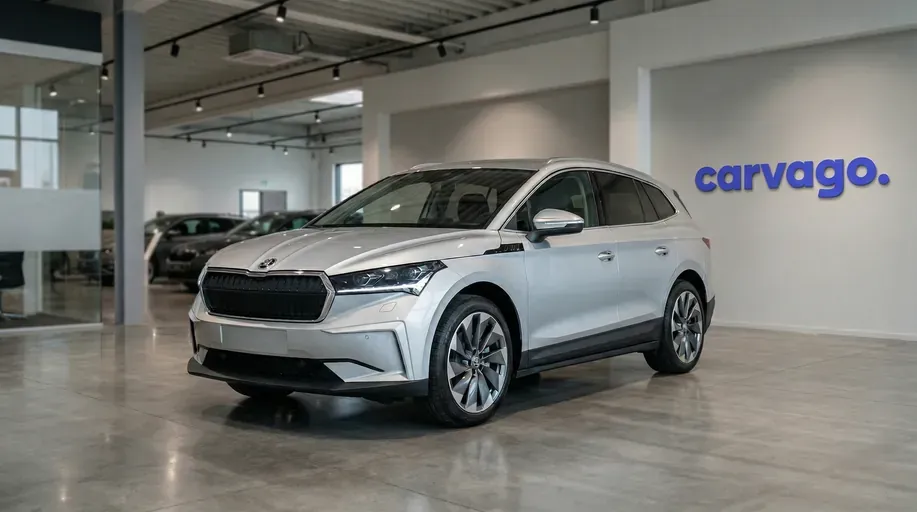
The Škoda Enyaq represents the Czech brand’s first purpose-built all-electric model on the Volkswagen Group MEB platform, competing directly in the mid-size electric crossover class. Originally introduced as the Enyaq iV at its world premiere on 1 September 2020, European customer deliveries commenced on 27 April 2021 in Norway before expanding across Central and Western Europe in May and June 2021. This review covers the first-generation model throughout its ongoing production cycle from late 2020 into 2026.
Offered in two distinct body formats, the range comprises the traditional five-door upright SUV and the sleeker Škoda Enyaq Coupé, which debuted on 31 January 2022. Škoda dropped the "iV" badge during an extensive drivetrain overhaul in October 2023. A comprehensive mid-cycle facelift premiered on 8 January 2025, incorporating the brand’s "Modern Solid" front styling and revised aerodynamic detailing, followed by an additional model-year update introduced on 23 March 2026.
Aimed primarily at family buyers and corporate company-car drivers transitioning away from conventional combustion estates and SUVs, the Enyaq focuses on long-distance usability and everyday practicality.
Owner Experiences: Common Faults and Recalls
Across official European vehicle safety registries, the Škoda Enyaq has accumulated zero mandatory safety recalls through October 2026. Rather than regulatory safety interventions, technical revisions and high-voltage module checks have been handled through voluntary manufacturer service actions during routine workshop appointments. When considering a used vehicle, buyers should verify the completion of these service updates by checking the vehicle identification number (VIN) with an authorized retailer or having the car inspected independently through CarAudit.
The most widespread fault reported by owners involves the driver assistance sensors. On vehicles built between 2021 and 2023, owners report frequent, spurious warning chimes alongside instrument cluster alerts stating that Travel Assist is unavailable or prompting the driver to take control of the steering, even when both hands remain firmly on the wheel. Testers describe this defect as contact degradation within the capacitive sensor mats embedded beneath the leather of the steering wheel rim. Replacing the steering wheel assembly with an updated hardware revision under warranty resolved the problem in most cases.
Early operating software stability is another frequent subject of owner complaints. On 2021 and 2022 vehicles, owners describe the central touchscreen intermittently freezing, rebooting while driving, or turning entirely black. These glitches temporarily disable access to ventilation controls, navigation mapping, and the reversing camera view. Comprehensive workshop software updates rolled out by the manufacturer substantially improved system stability and eliminated recurring black screens, although early screen processors retain noticeable input delay compared to the updated infotainment systems fitted to later production years.
Electrical management on early builds also produced low-voltage auxiliary battery drain. Owners report that cars built in 2021 and 2022 occasionally failed to unlock or enter drive mode after sitting parked for several days, accompanied by multiple spurious electronic fault messages. Workshops addressed this parasitic draw by fitting an upgraded auxiliary battery alongside revised power management software logic. In addition, testers report accelerated wear on front suspension drop links and rubber control arm bushings due to the vehicle's substantial weight, as well as premature wear on the inner tyre shoulders of cars fitted with larger 20- and 21-inch wheels, including all-wheel-drive variants such as the Škoda Enyaq 4x4.
Repeated Model-Specific Faults
Fault
Affected Model Years
Resolution
Steering wheel capacitive sensor failure
2021–2023
Steering wheel assembly replacement
Infotainment freezing and black screens
2021–2022
Dealer workshop software updates
Auxiliary 12V battery discharge
2021–2022
Upgraded auxiliary battery and power software update
🔍 What to check before buying
Request an official high-voltage battery diagnostic certificate to verify usable capacity retention and cell health before committing to purchase.
Check service documentation to confirm that early build models received all manufacturer workshop software updates and the upgraded auxiliary 12V battery.
Conduct a test drive with lane-centring assist engaged to ensure the steering wheel capacitive sensors do not trigger false hands-off warnings.
Inspect the charging flap and socket to verify that the motorised locking pin engages and releases charging cables smoothly without sticking.
Listen for clunking from the front suspension over road imperfections, and check the inner shoulders of tyres on large rims for uneven tread wear.
Engines: Which One to Choose
Built on the Volkswagen Group MEB platform, the electric Škoda Enyaq is offered exclusively with fully electric powertrains. Buyers can choose between single-motor rear-wheel-drive configurations and twin-motor all-wheel-drive setups, all paired with a single-speed automatic reduction gearbox.
Engine
Fuel
Power
Drivetrain
Transmission
Model years
Enyaq iV 50
Electric
109 kW (148 hp)
Rear-wheel drive
Automatic
2021–2023
Enyaq iV 60 / Enyaq 60
Electric
132 kW (180 hp)
Rear-wheel drive
Automatic
2021–2026
Enyaq 60
Electric
150 kW
Rear-wheel drive
Automatic
2025–2026
Enyaq 60
Electric
140 kW
Rear-wheel drive
Automatic
2026–present
Enyaq iV 80
Electric
150 kW (204 hp)
Rear-wheel drive
Automatic
2021–2023
Enyaq iV 80x
Electric
195 kW (265 hp)
All-wheel drive
Automatic
2021–2023
Enyaq 85
Electric
210 kW (286 hp)
Rear-wheel drive
Automatic
2023–present
Enyaq 85x
Electric
210 kW (286 hp)
All-wheel drive
Automatic
2023–present
Enyaq 85x
Electric
220 kW
All-wheel drive
Automatic
2026–present
Enyaq iV RS
Electric
220 kW (299 hp)
All-wheel drive
Automatic
2022–2023
Enyaq RS
Electric
250 kW (340 hp)
All-wheel drive
Automatic
2023–present
Which variant to choose
For urban commuting and short daily journeys, the smaller-battery versions make practical sense. As a used car, the base Enyaq 50 provides adequate performance for city streets, while the rear-wheel-drive Enyaq 60 delivers enough flexibility for mixed suburban driving without carrying the dead weight of a larger battery pack.
For balanced mixed driving and family duty, the rear-wheel-drive models offer the most balanced compromise. On the secondary market, the earlier single-motor Enyaq 80 provides calm, progressive throttle response and steady efficiency. If budget allows, the updated rear-wheel-drive Enyaq 85 is the strongest all-rounder across the entire range; its upgraded rear drive unit delivers immediate overtaking response at highway speeds while retaining single-motor efficiency.
For frequent long motorway journeys, towing, or severe winter conditions, look toward the twin-motor versions. The all-wheel-drive Škoda Enyaq in 80x or 85x form provides dependable all-weather traction and high trailer limits. The performance-focused RS adds punchier straight-line acceleration, though its heavier chassis tuning means it functions primarily as a fast touring crossover rather than an agile hot hatch.
For an in-depth assessment of high-voltage battery health, low-voltage charging electronics, and known electrical component issues, refer to the owner experiences section.
Real-world range and charging
Owner reports indicate that cold winter conditions noticeably reduce highway driving range, driven by the energy demands of cabin climate control and colder traction cells. The introduction of manual and navigation-linked battery pre-conditioning on later software revisions significantly improved winter fast-charging performance on the Škoda Enyaq. At public high-power direct-current chargers, the charge rate peaks early before steadily tapering down beyond half capacity to preserve battery cell life.
Space & Practicality
Dimension / Capacity
SUV
Coupé
Length (mm)
4,649–4,658
4,653–4,658
Width (mm)
1,879
1,879
Height (mm)
1,616–1,622
1,617–1,625
Wheelbase (mm)
2,764–2,766
2,765–2,766
Boot capacity (upright / folded, l)
585 / 1,710
570 / 1,610
Figures reflect standard configurations; all-wheel-drive and performance variants differ slightly in overall length, height, and wheelbase.
Thanks to its dedicated electric architecture, the Škoda Enyaq features a completely flat floor without a central tunnel, ensuring unrestricted foot room across all three seating positions in the back. Even behind tall front occupants, rear passengers benefit from plentiful kneeroom and supportive seat bases. Headroom is at its most accommodating in the standard Škoda Enyaq SUV, though the tapered roofline of the Coupé still accommodates taller passengers without feeling restrictive. Everyday versatility is enhanced by a standard 60:40 split-folding rear backrest, a central folding armrest, and a through-loading hatch for longer gear. A wide boot opening, minimal sill lip, and a practical underfloor compartment for charging cables simplify loading bulky items, although the vehicle does not provide front luggage storage under the bonnet.
What the Tests Say
Professional road tests consistently note that the Škoda Enyaq prioritises touring comfort over sporting agility. On standard passive suspension, the chassis absorbs rolling highway undulations well, but testers report noticeable fidgeting over sharp urban ruts and transverse joints. Choosing optional adaptive dampers improves primary bump absorption, though larger wheels still transmit abrupt impacts over frost fractures. In corners, rear-wheel-drive versions feel nimble in tight city manoeuvres thanks to a small turning circle, while all-wheel-drive configurations trade some low-speed agility for composed high-speed stability. Across all variants, acoustic suppression is an area of unanimous praise, with road rumble and wind buffeting effectively hushed at cruising speeds.
Testers widely appreciate the cabin ambiance, noting supportive seating and tactile dashboard textiles that create a welcoming environment. Physical steering-wheel buttons and knurled scrolling rollers are praised for everyday usability. However, road tests also note functional compromises: lower console plastics feel scratch-prone, individual rotary shut-off dials for the air vents are absent, and the compact digital driver display carries limited trip information. Adjusting ventilation settings and driver-assistance features still requires interacting with the central touchscreen.
Professional verdicts agree that the chassis defaults to safe, predictable understeer when pressed, and that high vehicle weight curbs genuine cornering eagerness. Testers diverge on standard suspension composure, with some finding it adequately settled and others criticising float over undulating country roads. The mid-cycle update brought swifter touchscreen software response, though accessing chassis adjustments and assist settings through digital sub-menus remains a shared criticism.
Prices and Market Offer
All market charts in this section reflect Carvago listings across the entire Škoda Enyaq iV model family rather than a filtered selection of a single generation, so the data does not establish a separate price level for specific production phases. In the current European market offer, the median asking price stands at €27,000 for 2021 examples and €36,000 for 2023 cars. Newer inventory commands higher medians, posting €45,500 for 2024 vehicles and reaching €53,600 for 2026 registrations as updated motor technology and larger battery configurations shape recent listings.
Between April and September 2026, the number of advertised Škoda Enyaq iV models moved from an initial high of 6,076 cars down to 4,597 in June before rising back to 5,197 listings.
Škoda Enyaq iV - availability over time
Active listings over time
Month
Škoda Enyaq iV
2026-04
6 076
2026-05
4 964
2026-06
4 597
2026-07
4 728
2026-08
4 915
2026-09
5 197
Source Carvago
Buyers have a broad selection to choose from, with inventory dipping early in the period before climbing steadily across the late summer months.
Among used listings advertised today, the median asking price is €28,800 for cars built in 2020 and reaches €53,600 for 2026 models. The distribution across model years is not strictly increasing, as listings from 2021 reflect a lower median asking price of €27,000.
Škoda Enyaq iV - median price by model year
Median advertised price by year of manufacture
Model year
Škoda Enyaq iV
2020
28 800
2021
27 000
2022
32 100
2023
36 000
2024
45 500
2025
49 900
2026
53 600
Source Carvago
Buyers comparing build years will find the lowest median asking price among advertised listings at €27,000 for 2021 cars, while 2023 models stand at €36,000 and 2026 examples reach €53,600.
This depreciation curve illustrates how the model's residual value falls with vehicle age. The steepest decline occurs in the first two years, with the vehicle losing 14% of its value by age one and 27% by age two.
Škoda Enyaq iV - value loss by age
Residual value by vehicle age
Vehicle age
Škoda Enyaq iV
New
53 400
1 yr
45 900
2 yrs
38 900
3 yrs
35 000
4 yrs
33 800
5 yrs
29 800
6 yrs
28 000
7 yrs
25 800
Source Carvago
Across the seven-year span, the model sheds roughly 52% of its initial residual value. The steepest loss is concentrated in the first two years, meaning vehicles past age two have already absorbed more than half of that total depreciation.
Active listings for the model family were entirely electric across the recorded period, moving from 6,076 advertised cars in April 2026 to 4,597 in June. The chart below tracks the monthly volume of advertised cars split by fuel type.
Škoda Enyaq iV - supply by fuel over time
Supply composition by fuel type
Month
Electric
2026-04
6 076
2026-05
4 964
2026-06
4 597
2026-07
4 728
2026-08
4 915
2026-09
5 197
Source Carvago
In September 2026, electric vehicles made up the entire selection with 5,197 listings, while petrol, diesel, and hybrid options each stood at zero. Anyone browsing the used market will realistically find only all-electric versions available.
The chart below illustrates the average asking price between April 2026 and September 2026, starting at €34,400 in the first month.
Škoda Enyaq iV - price trend over time
Average price development over time
Month
Škoda Enyaq iV
2026-04
34 400
2026-05
35 200
2026-06
36 900
2026-07
37 900
2026-08
38 700
2026-09
39 100
Source Carvago
Across the six months shown, the average increased consistently from €34,400 to €39,100, representing an overall rise of roughly 14%.
Spacious passenger cabin with a flat rear floor and accommodating luggage capacity
Well-insulated cabin with effective suppression of wind buffeting and road rumble
Tight turning circle on rear-wheel-drive versions that aids city manoeuvrability
Cons
Early model years suffered from infotainment freezing and false hands-off steering alerts
Standard suspension can fidget over sharp road ruts, with heavy vehicle weight limiting cornering agility
No front luggage storage compartment under the bonnet for charging cables
Frequently asked questions
Is the Škoda Enyaq reliable as a used electric car?
Official European vehicle registries record zero mandatory safety recalls for the Škoda Enyaq, though early models required voluntary workshop software and sensor remedies. Buyers should ensure all dealer service updates and campaigns have been completed.
Which version is the best choice for family driving?
The rear-wheel-drive Enyaq 85 is the strongest all-rounder for mixed family duty thanks to its updated motor response and steady efficiency. Buyers requiring severe-weather traction or maximum towing limits should opt for an all-wheel-drive version instead.
What should you inspect before buying a used Enyaq?
Request an official high-voltage battery diagnostic certificate to verify usable cell capacity retention. During the test drive, verify that the driver-assistance systems and steering wheel sensors function without false warnings.
Which model years offer the best value on the used market?
Two- to three-year-old models offer the most sensible balance after absorbing the steepest initial depreciation. Earlier 2021 cars carry lower asking prices, but their central screen processors exhibit noticeable input latency compared to later builds.