Review Renault Grand Scénic: What do owners and experts really say?

Renault Grand Scénic IV review: real owner experience, common faults, running costs and used prices — everything you need before you buy.

October 25, 2026

Renault Grand Scénic

Verdict at a Glance

  • Who it suits: Family buyers seeking adaptable passenger seating and flexible cargo space as an alternative to an SUV.
  • Recommended engine: The 1.3 TCe petrol for balanced everyday family driving, or the 1.7 Blue dCi for long-distance motorway cruising.
  • What to avoid: Early models built from 2016 to 2017 with the 1.2 TCe engine, prone to oil consumption and timing chain elongation.

Introduction

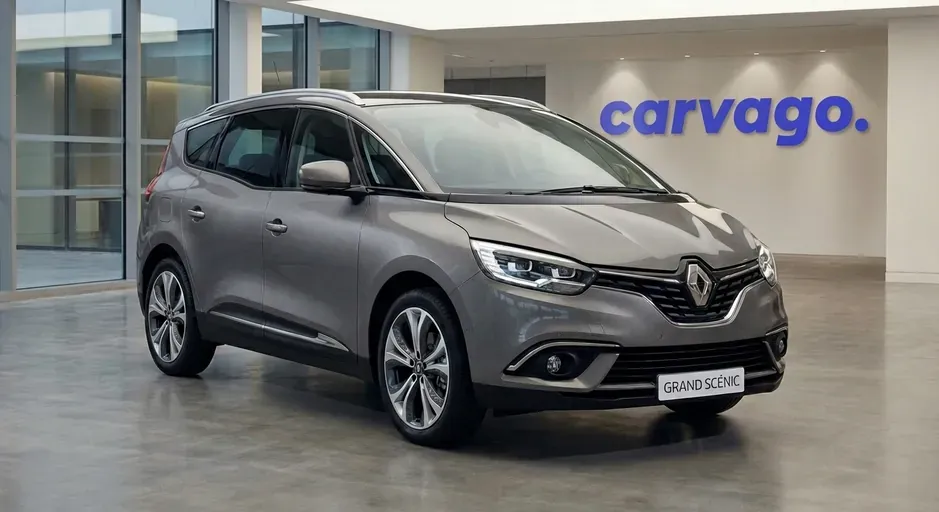
The fourth-generation Renault Grand Scénic represents the final iteration of the manufacturer's long-wheelbase multi-purpose vehicle lineage. Following its premiere in May 2016, European order books opened that October, and the first customer deliveries began on 01 December 2016. Assembly took place at the Douai plant in France until production ceased in early 2023, ending the model line without a direct combustion-powered successor.

Positioned in the compact-to-midsize MPV segment, the Renault Grand Scénic MPV was sold primarily in a seven-seat layout across European markets, while a dedicated five-seat body variant was also marketed in select countries. In October 2020, a Phase II mid-cycle facelift premiered, introducing a revised front bumper and grille, a shark-fin antenna, and standardized LED headlamps.

The model appeals primarily to family buyers requiring adaptable passenger accommodation and flexible luggage capacity, competing as a practical alternative to three-row crossover utility vehicles and traditional estates.

Owner Experiences: Common Faults and Recalls

Routine technical inspections across Europe reveal that the front suspension of the Renault Grand Scénic requires frequent maintenance. Front lower wishbone ball joints and anti-roll bar drop links show disproportionately high failure rates during regular roadworthiness tests. The vehicle's kerb weight, combined with the standard fitment of large 20-inch wheels, transmits substantial road shock into suspension joints. Worn components manifest as clunking noises over uneven tarmac and slight steering vagueness, with replacements often becoming necessary between 50,000 and 80,000 km.

Drivetrain durability depends heavily on the engine and transmission combination. Early petrol models built from late 2016 through December 2017 with the 1.2 TCe engine suffer from documented oil consumption issues and premature timing chain elongation, typically signaled by metallic rattling on cold starts. Engine management software updates partially alleviated intake pressure issues, but engines with advanced wear required mechanical rebuilds before the unit was replaced by the 1.3 TCe petrol engine in early 2018. For the automatic Renault Grand Scénic, professional tests and owners report low-speed hesitation and clutch shudder during stop-and-go driving or when shifting from reverse to drive. Transmission software recalibrations resolve minor shifting hesitations, though persistent judder indicates worn clutch packs.

Onboard electronics represent another recurring point of friction, particularly on pre-facelift vehicles produced between 2016 and 2020. Owners report frequent software instability with the R-Link 2 infotainment system, whether fitted with the standard 7.0-inch display or the portrait 8.7-inch display available on higher trims. Symptoms include sudden screen blackouts, frozen navigation graphics, dropped Bluetooth connections, and delayed responses when adjusting climate settings via the display. Dealership software updates resolved most system crashes, although unresponsive screens in isolated cases required complete multimedia computing unit replacement.

Safety campaigns covering European models have addressed several mechanical and electronic components. On the diesel Renault Grand Scénic, fire risks prompted remedial actions on the 1.7 Blue dCi engine regarding fuel line chafing, as well as electronic cooling fan modules prone to cracking capacitors. Before committing to a used vehicle, verifying documented service records and recall completion through CarAudit ensures the car has received all required manufacturer updates.

Verified European Safety Recalls
Campaign SubjectAffected Models & Build DatesDefect & Remedy
Front Seat Runner BoltsEarly production models from 2016Floor mounting bolts could loosen, compromising seat security. Authorised workshops inspected and tightened bolts to specification.
Side Curtain AirbagVehicles built 20 September 2016 to 30 November 2016Defective pyrotechnic mix could prevent curtain airbag deployment in a side collision. Authorised dealers checked serial numbers and replaced non-compliant modules.
Engine Cooling Fan ModuleEuro 6d-Temp diesels with manual gearbox built 02 October 2018 to 12 November 2018Stressed electronic capacitors could crack and overheat, creating a fire hazard. Workshops replaced the engine cooling fan assembly.
NOx Exhaust SensorBlue dCi diesels built 21 September 2018 to 03 June 2019Insufficient tightening torque during assembly posed a potential fire risk. Technicians inspected and torqued the sensor to factory specification.
Fuel Supply Line1.7 Blue dCi diesel models built 20 September 2018 to 20 June 2019Damaged fuel line could leak fuel onto the road or hot exhaust components. Workshops replaced the fuel hose assembly.

🔍 What to check before buying

  • Check the vehicle identification number (VIN) with an authorised dealer to confirm all official recall actions—especially fuel hose and cooling fan campaigns—have been completed.
  • Test the dual-clutch automatic transmission when cold, checking for clutch shudder during low-speed crawling or delays when shifting between drive and reverse.
  • Listen for knocking, creaking, or clunking sounds from the front axle over speed bumps, indicating worn lower ball joints or drop links.
  • Test the central touchscreen thoroughly to confirm rapid input response, stable smartphone pairing, and unhindered access to ventilation controls.
  • Inspect the 20-inch tyres for uneven inner-edge wear and check wheel rims for curb damage, as replacement tyres in this dimensions profile carry higher prices than standard MPV sizes.

Engines: Which One to Choose

The fourth-generation Renault Grand Scénic underwent significant powertrain updates over its production cycle, shifting from early turbocharged four-cylinders to a co-developed petrol family and phasing out diesel units entirely with the 2020 facelift. All versions were front-wheel drive and paired with either six-speed manual or dual-clutch automatic transmissions.

EngineFuelPowerGearboxModel years
1.2 TCe 115Petrol85 kW (115 hp)6-speed manual2016–2018
1.2 TCe 130Petrol96 kW (130 hp)6-speed manual2016–2018
1.3 TCe 115Petrol85 kW (115 hp)6-speed manual2018–2022
1.3 TCe 140Petrol103 kW (140 hp)6-speed manual, 7-speed automatic2018–2023
1.3 TCe 160Petrol120 kW (160 hp)6-speed manual, 7-speed automatic2018–2020
1.3 TCe 160Petrol116 kW (160 hp)7-speed automatic2020–2023
1.5 dCi 110Diesel81 kW (110 hp)6-speed manual, 7-speed automatic2016–2018
1.5 dCi 110 Hybrid AssistDiesel mild-hybrid81 kW (110 hp)6-speed manual2017–2018
1.6 dCi 130Diesel96 kW (130 hp)6-speed manual2016–2018
1.6 dCi 160 Twin TurboDiesel118 kW (160 hp)6-speed automatic2016–2018
1.7 Blue dCi 120Diesel88 kW (120 hp)6-speed manual, 6-speed automatic2018–2020
1.7 Blue dCi 150Diesel110 kW (150 hp)6-speed manual, 6-speed automatic2018–2020

Urban Driving and Short Commutes

For frequent city driving, a petrol Renault Grand Scénic equipped with the 1.3 TCe engine is the practical recommendation. The earlier 1.2 TCe lacks low-end pull when accelerating from low speeds in a fully seated vehicle, whereas the 1.3 TCe delivers steady tractability from low engine speeds and reaches operating temperature quickly without the exhaust aftertreatment clogging common to short-trip diesel use.

Mixed Everyday Use

The 1.3 TCe 140 stands out as the most balanced option across the entire range for mixed family duties. Whether paired with the six-speed manual or the seven-speed automatic, it provides adequate mid-range punch for suburban commuting and occasional motorway journeys without needing to push the engine hard. The stronger 1.3 TCe 160 offers marginally better overtaking response, but the performance gain in regular driving remains modest.

Motorway Cruising

Long-distance drivers benefit most from a diesel Renault Grand Scénic. Among pre-facelift models, the single-turbo 1.6 dCi 130 provides refined cruising with lower mechanical complexity than the twin-turbo 1.6 dCi. For vehicles built between 2018 and 2020, the 1.7 Blue dCi 150 delivers steady open-road performance with broad torque delivery. Because diesels were dropped after the 2020 update, post-facelift motorway buyers should look to the 1.3 TCe 140 or 160 with the automatic gearbox.

Towing and Heavy Payloads

When routinely carrying seven passengers or towing trailers up to the vehicle's maximum limits, the 1.7 Blue dCi 150 is the most capable choice due to its high pulling power. For buyers who prefer petrol, the 1.3 TCe 140 or 160 with the manual transmission is preferable to the automatic, as it avoids thermal stress on the dual-clutch transmission when maneuvering heavy loads on inclines.

For a detailed analysis of known mechanical faults, maintenance histories, and workshop inspection points across these engines, refer to the owner experiences section.

Space & Practicality

Dimension / CapacityGrand Scénic IV (7-seat)Grand Scénic IV (5-seat)
Length4,634 mm4,634 mm
Width (without mirrors)1,866 mm1,866 mm
Height1,655–1,660 mm1,655–1,660 mm
Wheelbase2,804 mm2,804 mm
Boot volume (standard layout)233 l (596–765 l with 3rd row folded)765 l
Boot volume (maximum flat floor)2,128 l2,128 l

The Renault Grand Scénic MPV provides accommodating headroom and legroom across its first two rows, where upright seating and a sliding split middle bench allow passengers to adjust the balance between rear knee space and cargo capacity. In seven-seat versions, the two individual third-row seats fold flush beneath the luggage floor. Because of their low cushion height and restricted headroom close to the rear roof frame, these rearmost seats are better suited to children than adults. Depending on trim level, one-touch electric folding controls located in the luggage compartment and within the touchscreen interface lower the passenger seats to create a continuous flat floor, while an available folding front passenger seat allows particularly long cargo to fit inside the cabin.

What the Tests Say

Professional road tests characterize the Renault Grand Scénic as a composed long-distance cruiser, though its chassis tuning divides opinion. On smooth motorways, the suspension feels settled and controls body roll effectively. However, testers consistently note that low-speed compliance suffers over sharp potholes and expansion joints, where the large wheels transmit firm jolts into the cabin. Road manners remain predictable and secure, backed by intrusive stability control, but testers disagree on agility: some appreciate the prompt turn-in on sweeping roads, while others describe quick directional changes as ponderous due to the long wheelbase and numb steering.

Cabin refinement is respectable at constant cruising speeds, though coarse asphalt produces noticeable tyre roar and the expansive windscreen catches wind buffeting. Inside, testers commend the airy dashboard styling and tactile upper materials, but criticize hollow plastics lower down. The sliding drawer-style glovebox is also flagged for striking the front passenger's knees upon opening.

Ergonomics draw the sharpest criticism across tests. The portrait touchscreen infotainment system suffers from delayed responses and convoluted menu structures that distract the driver while moving. Testers also lament awkward control placements, such as the cruise control toggle positioned on the lower console rather than on the steering wheel, along with the absence of a physical volume rotary dial.

Prices and Market Offer

All market charts in this section are drawn from Carvago listings across the entire Renault Grand Scénic model family, including earlier generations represented in the data, rather than exclusively reflecting the fourth generation. Because the dataset groups vehicles purely by year of manufacture, it does not establish a separate price level isolated to the reviewed generation alone. Across the advertised stock, the median asking price stands at €11,500 for 2016 examples and reaches €28,200 for 2023 models, reflecting the broader market premium paid for later manufacturing dates with updated powertrains.

Advertised Renault Grand Scénic listings ranged between 586 and 704 per month from April 2026 to September 2026, starting at 641 cars before reaching a peak in June.

Renault Grand Scénic - availability over time

Active listings over time

MonthRenault Grand Scénic
2026-04641
2026-05700
2026-06704
2026-07693
2026-08586
2026-09593

Source Carvago

After listings fell to 586 in August 2026 and closed at 593 in September, buyers still had close to 600 used vehicles to choose from across the wider model range.

The median asking price of used listings advertised today is €11,500 for cars built in 2016 and is higher for each subsequent model year, reaching €28,200 for those built in 2023.

Renault Grand Scénic - median price by model year

Median advertised price by year of manufacture

Model yearRenault Grand Scénic
201611 500
201715 000
201816 000
201917 300
202018 500
202120 500
202223 000
202328 200

Source Carvago

Buyers targeting 2018 models face a median asking price of €16,000, while 2021 vehicles sit at €20,500 and 2023 examples reach €28,200.

Between April and September 2026, the volume of advertised vehicles was led by petrol models, which started at 425 listings in April 2026 alongside 216 diesel cars. The chart below tracks how the available fuel types evolved over this six-month span.

Renault Grand Scénic - supply by fuel over time

Supply composition by fuel type

  • Petrol

  • Diesel

  • Hybrid

  • LPG

MonthPetrolDieselHybridLPG
2026-0442521600
2026-0544525500
2026-0645424901
2026-0745024201
2026-0836222310
2026-0937222100

Source Carvago

By September 2026, listings were divided between 372 petrol and 221 diesel cars, while alternative powertrains recorded at most 1 listing in any single month. Buyers will realistically be choosing between petrol and diesel, with petrol offering the wider selection.

The chart below tracks the average asking price for the Renault Grand Scénic from April 2026 to September 2026, starting at €17,000.

Renault Grand Scénic - price trend over time

Average price development over time

MonthRenault Grand Scénic
2026-0417 000
2026-0516 600
2026-0616 600
2026-0716 400
2026-0816 300
2026-0916 200

Source Carvago

Over this span, the average moved from €17,000 down to €16,200, pausing briefly at €16,600 across May and June. That total drop of under five percent represents only a minor shift across the six months relative to overall asking prices.

Pros & Cons

Renault Grand Scénic

Pros

Versatile interior modularity with one-touch folding seats and a flat cargo floor

Composed motorway stability with well-controlled body roll

Balanced everyday performance and tractability from 1.3 TCe petrol engines

Cons

Firm low-speed ride over sharp road imperfections transmitted by large wheels

Accelerated wear of front suspension ball joints and drop links

Distracting touchscreen controls with delayed responses and cumbersome menu navigation

Frequently asked questions

The 1.3 TCe petrol Renault Grand Scénic introduced in 2018 is the most balanced choice for everyday driving, offering dependable tractability. Frequent motorway drivers may prefer the 1.7 Blue dCi diesel, though all diesels were discontinued with the 2020 facelift.

No, the rearmost seats have low cushions and limited headroom, making them suitable only for children on shorter journeys. Adults are best accommodated in the first two rows.

Check the front suspension for clunking over bumps and test automatic models for low-speed clutch judder. Confirm via the VIN through CarAudit that all safety recalls have been completed.

Examples of the Renault Grand Scénic built from 2018 onward are preferable thanks to the revised petrol powertrain and improved electronic stability. Facelifted models from late 2020 add updated styling and standard LED headlights, though they command higher asking prices.

Sources: media.renault.com, adac.de, ec.europa.eu, autobild.de, autocar.co.uk

This article was prepared using artificial intelligence tools. The section guarantor is Petr Dušek.

Related articles

Car battle

BMW 2 Series Gran Tourer vs. Citroën Grand C4 SpaceTourer: Complete comparison 2026

Detailed MPV comparison: BMW 2 Series Gran Tourer vs. Citroën Grand C4 SpaceTourer (Picasso). Discover the differences in equipment, real-world experience, and the final verdict.

Oct 22, 2026

Car battle

Mercedes-Benz B-Class vs. Renault Grand Scénic: Complete comparison 2026

Detailed comparison of the Mercedes-Benz B-Class and Renault Grand Scénic MPVs. Find out which used family car offers better space, equipment, and value for money.

Oct 16, 2026

Car battle

BMW 2 Series Gran Tourer vs. Volkswagen Touran: Complete comparison 2026

BMW 2 Series Gran Tourer vs Volkswagen Touran. A detailed comparison of family MPVs, including a space test and final verdict. Choose your ideal used car!

Oct 22, 2026

We accept online card payments as well as wire transfers.

visa payment provider logovisa-electron payment provider logomastercard payment provider logomaestro payment provider logodiners-club payment provider logodiscover payment provider logo