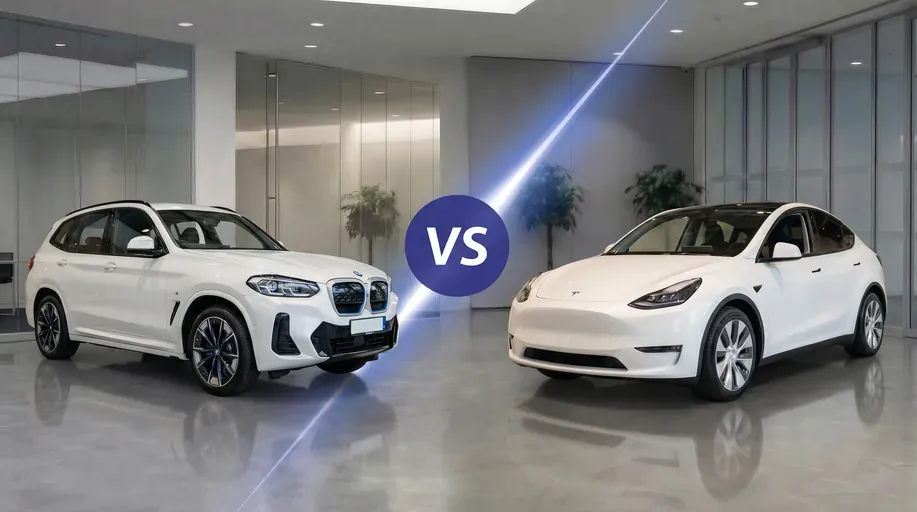
Car battle
BMW iX3 vs. Tesla Model Y: Complete comparison 2026
BMW iX3 vs Tesla Model Y: A detailed comparison of electric SUVs. Discover real-world range, differences in equipment, and read our verdict for an easier choice.
Oct 16, 2026
Mercedes-Benz EQE SUV review: real owner experience, EV range, common faults, and practical verdict — everything you need before buying.
October 20, 2026
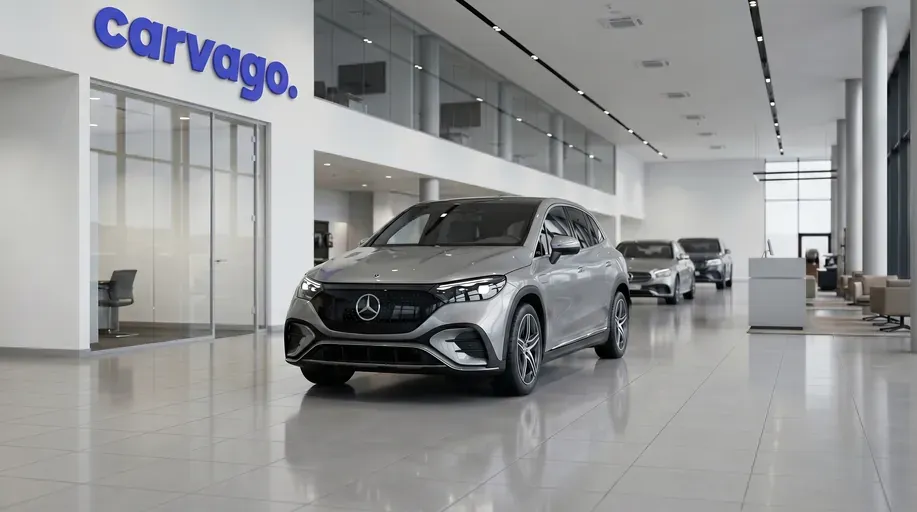
The Mercedes-Benz EQE SUV is a dedicated battery-electric mid-size luxury crossover positioned directly beneath the larger EQS SUV in the manufacturer's electric portfolio. This review focuses exclusively on the first-generation model, which celebrated its world premiere in October 2022 and arrived for initial European customer deliveries in March 2023, with production running through 2026.
Offered solely as a five-seat, five-door crossover in rear-wheel and all-wheel-drive configurations, the model did not receive a conventional mid-cycle visual redesign. Instead, the vehicle received continuous running model-year revisions, most notably technical updates introduced in late 2023 and April 2024 that brought revisions to battery hardware and cabin equipment.
Aimed primarily at executive company-car drivers, long-distance commuters, and families seeking an upscale crossover, the electric Mercedes-Benz EQE SUV competes against established premium electric rivals. The following sections evaluate how this electric SUV holds up in real-world ownership, daily functionality, and European market availability.
Customer deliveries of the Mercedes-Benz EQE SUV began across Europe in spring 2023, meaning long-term reliability over high mileages is not yet established. Early ownership reports and professional assessments indicate that while the core electric drive units are mechanically sound, early production runs were troubled by low-voltage electrical gremlins and software integration glitches.
Owners report frequent issues with the 12V auxiliary AGM battery discharging prematurely when the vehicle is parked for extended periods or queried repeatedly through the smartphone application. In affected vehicles, persistent control module communication prevents the vehicle networks from entering a deep sleep state, starving the 12V system because the onboard DC/DC converter only engages when the vehicle cycles properly. Updating the gateway and telematics modules at an authorised workshop resolves this parasitic drain in most cases, though severely discharged auxiliary batteries require replacement. Additionally, both tests and owners report occasional screen freezes and blackouts on the central display and the driver instrument cluster, which temporarily block access to reversing cameras and climate controls until the system restarts. Dealership software flashes have largely stabilised the system.
Tests and owners also describe an unnatural, non-linear brake pedal action on 2023 and early 2024 models. Under strong deceleration recuperation, the blended brake-by-wire mechanism actively pulls the pedal downward toward the floorpan. In some cases, this leaves initial pedal travel feeling devoid of mechanical resistance before friction braking bites. Mercedes-Benz introduced revised brake calibrations during running updates in spring 2024 to smooth the transition, but physical pedal movement remains an inherent trait on earlier builds.
The model has been subject to several safety recalls monitored by European authorities. In February 2024, a worldwide campaign addressed a defective 80-ampere pre-fuse box where contact interruptions could lead to sudden loss of drive power or fire risks. In May 2025, a related worldwide recall affected pre-fuse boxes that were improperly reworked during production. Another major worldwide campaign launched in June 2024 required a dealership software update for the battery management system to prevent memory overflow from continuous diagnostic queries, which could trigger an unannounced high-voltage shutdown while driving. More recent European campaigns involved replacing short-range front radar sensors due to faulty circuit boards, replacing telematics modules to avoid permanent eCall communication failures, and checking front wheel bolt torque to prevent detachment. Before purchasing, verifying whether all factory service actions were completed using an independent inspection service like CarAudit provides peace of mind.
| Affected Production Window | Reach | Stated Defect & Required Workshop Remedy |
|---|---|---|
| August 2022 – May 2024 | Worldwide (50,744 vehicles) | Battery management software memory overflow could shut down the high-voltage system while driving. Remedy: Dealership updates the battery management software via diagnostic tools. |
| 25 January 2023 – 17 November 2023 | Worldwide (247,443 vehicles) | Defective 80-ampere fuses could cause loss of propulsion or fire risk. Remedy: Free replacement of the pre-fuse box. |
| 31 January 2023 – 17 October 2023 | Worldwide (4,652 vehicles) | Improperly reworked pre-fuse box could lead to contact breaks, sudden drive power loss, or fire. Remedy: Inspection and replacement of the pre-fuse box. |
| 12 April 2021 – 12 June 2025 | Worldwide (23,101 vehicles) | Non-compliant communication module configuration risks memory corruption and permanent eCall failure. Remedy: Hardware replacement of the telematics communication module. |
| 17 November 2022 – 04 December 2025 | Worldwide (2,712 in Germany) | Front wheel bolts were not tightened to intended torque and could loosen. Remedy: Inspection and retorquing of the wheel attachment. |
| 19 October 2022 – 28 May 2024 | Germany (7 vehicles) and limited worldwide batch | Inadequately secured wheel trim covers may detach from the vehicle. Remedy: Authorised workshop inspection of wheel covers and replacement with correctly latched parts. |
| 16 April 2025 – 15 July 2025 | Germany & global run | Faulty short-range radar circuit board causes incorrect object detection or assistance deactivation. Remedy: Replacement of the front short-range sensor. |
The electric Mercedes-Benz EQE SUV relies entirely on permanently excited synchronous electric motors paired with single-speed reduction transmissions, offered in single-motor rear-wheel-drive and dual-motor all-wheel-drive layouts. Running technical updates revised power ratings across several powertrains and phased out early performance configurations.
| Engine | Fuel | Power | Gearbox | Drivetrain | Model years |
|---|---|---|---|---|---|
| EQE 300 | Electric | 180 kW (245 hp) | Automatic | Rear-wheel drive | 2023–2025 |
| EQE 300 | Electric | 195 kW (265 hp) | Automatic | Rear-wheel drive | 2025–2026 |
| EQE 350+ | Electric | 215 kW (292 hp) | Automatic | Rear-wheel drive | 2023–2025 |
| EQE 350+ | Electric | 235 / 236 kW (320 hp) | Automatic | Rear-wheel drive | 2025–2026 |
| EQE 350 4MATIC | Electric | 215 kW (292 hp) | Automatic | All-wheel drive | 2023–2025 |
| EQE 350 4MATIC | Electric | 235 / 236 kW (320 hp) | Automatic | All-wheel drive | 2025–2026 |
| EQE 500 4MATIC | Electric | 300 kW (408 hp) | Automatic | All-wheel drive | 2023–2025 |
| EQE 500 4MATIC | Electric | 330 kW (449 hp) | Automatic | All-wheel drive | 2025–2026 |
| Mercedes-AMG EQE 43 4MATIC | Electric | 350 kW (476 hp) | Automatic | All-wheel drive | 2023–2025 |
| Mercedes-AMG EQE 53 4MATIC+ | Electric | 460 kW (625 hp) | Automatic | All-wheel drive | 2023–2026 |
For city driving and everyday commuting, the rear-wheel-drive EQE 300 provides adequate responsiveness with the lowest initial acquisition outlay. Drivers covering higher annual mileages or spending substantial time at motorway speeds will find the rear-wheel-drive EQE 350+ the most compelling option, as its single-motor configuration maximises driving range between charging stops.
For mixed conditions requiring all-weather stability or regular towing duties, the dual-motor all-wheel-drive Mercedes-Benz EQE SUV variants are essential; the rear-wheel-drive models carry a restricted trailer rating, whereas the EQE 350 4MATIC and EQE 500 4MATIC comfortably handle heavier trailers with the optional factory hitch. The EQE 500 4MATIC offers rapid cross-country pace without the firmer chassis compromises of performance models. The Mercedes-AMG EQE 43 4MATIC makes sense strictly as a used car purchase following its discontinuation, while the range-topping Mercedes-AMG EQE 53 4MATIC+ caters solely to buyers prioritising track-focused acceleration over touring comfort.
For details on powertrain software updates, battery management campaigns, and auxiliary electrical issues, refer to the owner experiences section.
Real-world driving reports highlight that motorway cruising speeds and cold winter conditions cause noticeable range contraction due to the vehicle's substantial mass and climate heating draw. Public DC rapid charging performs at its quickest and most consistent rate when using the built-in navigation system to trigger automatic battery thermal pre-conditioning, whereas unconditioned arrivals or charging past standard fast-charge thresholds see charging speeds taper down noticeably.
| Dimension / Capacity | Value |
|---|---|
| Length | 4,863 mm |
| Width (excluding mirrors) | 1,940 mm |
| Height | 1,685 mm |
| Wheelbase | 3,030 mm |
| Boot volume (seats upright / folded) | 520 / 1,675 l |
Exterior dimensions do not apply to dedicated performance versions, which feature modified body lengths and lowered ride heights.
In the rear passenger compartment, the Mercedes-Benz EQE SUV provides ample knee clearance courtesy of its long wheelbase. However, adult seating comfort is compromised by the underfloor battery packaging, which raises the cabin floor and results in shallow under-thigh support, placing passengers in a knees-up posture. The rear backrest is also set at a relatively upright angle, and the bench cannot slide fore or aft. Luggage loading is handled entirely by the rear cargo area, which features a flat floor, underfloor charging cable storage, and standard three-way split-folding backrests with a central ski hatch for long items. An optional adjustable backrest cargo setting can latch the rear seats slightly steeper to free additional boot space behind upright passengers. Unlike several dedicated electric competitors, there is no front boot underneath the bonnet, which is sealed and reserved strictly for workshop access.
Professional road tests agree that the electric Mercedes-Benz EQE SUV delivers thorough acoustic isolation. Tyre rumble, electric motor whine, and wind noise around the windscreen pillars are effectively suppressed at motorway speeds. Driving manners, however, depend heavily on chassis specification. On standard passive steel springs fitted to entry versions, testers criticise an inharmonious ride that struggles to absorb sharp surface imperfections. Vehicles equipped with air suspension—standard on higher trims and optional on entry models—glide smoothly over rolling highway undulations, though low-speed urban potholes and bridge joints still send noticeable lateral jolts into the cabin. Vehicle mass remains evident during sudden directional changes, but optional rear-axle steering noticeably aids low-speed manoeuvrability.
The cabin earns approval for front-seat posture support and a responsive central infotainment interface. Forward-quarter visibility is hampered by thick windscreen pillars, however. Material execution also draws mixed verdicts: upper dashboard sections feel solidly assembled, but lower centre-console sections rely on hard, creak-prone plastics and fingerprint-prone glossy trim.
Road tests largely converge in praising high-speed cabin quietness and low-speed manoeuvrability with rear-wheel steering. Conversely, they remain critical of secondary ride compliance around town on steel springs and lower-tier interior plastics.
All the charts in this section are drawn from Carvago's listings of the whole model family, including other generations represented in the data, not only the reviewed generation, and this dataset does not establish a separate price level for the reviewed generation. Across current listings for the Mercedes-Benz EQE SUV, the median asking price is €68,500 for 2023 models, €67,000 for 2024 cars, and €66,700 for 2025 builds. For 2026 models, the median asking price stands at €68,700, reflecting the differing mix of powertrains, battery capacities, and factory equipment present across advertised inventory.
The chart below tracks the number of Mercedes-Benz EQE SUV listings advertised each month from April 2026 to September 2026, starting at 897 and dropping to 743 by the end of the period.
Active listings over time
| Month | Mercedes-Benz EQE SUV |
|---|---|
| 2026-04 | 897 |
| 2026-05 | 797 |
| 2026-06 | 770 |
| 2026-07 | 768 |
| 2026-08 | 762 |
| 2026-09 | 743 |
Source Carvago
Buyers still have a broad selection of several hundred vehicles to compare, though available inventory has contracted over these six months after an initial drop between April and May.
The median asking price of cars advertised today built in 2023 is €68,500, while the median asking price of cars advertised today built in 2025 is €66,700. As the following chart shows, listing medians do not follow a single direction across recent model years.
Median advertised price by year of manufacture
| Model year | Mercedes-Benz EQE SUV |
|---|---|
| 2023 | 68 500 |
| 2024 | 67 000 |
| 2025 | 66 700 |
| 2026 | 68 700 |
Source Carvago
A buyer targeting 2025 models faces a median asking price of cars advertised today of €66,700. For those considering 2026 models, the median asking price of cars advertised today is €68,700.
This depreciation curve illustrates how the model's residual value declines with age, losing approximately 12% in its first year and 26% by age three. The chart below details this progression over seven years of ownership.
Residual value by vehicle age
| Vehicle age | Mercedes-Benz EQE SUV |
|---|---|
| New | 69 200 |
| 1 yr | 60 600 |
| 2 yrs | 57 300 |
| 3 yrs | 51 400 |
| 4 yrs | 47 100 |
| 5 yrs | 43 300 |
| 6 yrs | 39 600 |
| 7 yrs | 36 100 |
Source Carvago
Across the full seven-year span shown, the model sheds roughly 48% of its starting residual value, with the sharpest decline occurring between age zero and one before the rate of annual loss moderates.
Active listings across the tracked period consisted entirely of electric vehicles, moving from 897 advertised cars in April 2026 to 743 in September 2026. The breakdown below illustrates the monthly listings across each powertrain type.
Supply composition by fuel type
| Month | Electric |
|---|---|
| 2026-04 | 897 |
| 2026-05 | 797 |
| 2026-06 | 770 |
| 2026-07 | 768 |
| 2026-08 | 762 |
| 2026-09 | 743 |
Source Carvago
Every other fuel category recorded 0 listings throughout the six months, meaning prospective buyers will exclusively encounter all-electric options on the market.
The following chart shows the average asking price for the Mercedes-Benz EQE SUV from April 2026 to September 2026, beginning at €65,900 and rising to €66,700 in May.
Average price development over time
| Month | Mercedes-Benz EQE SUV |
|---|---|
| 2026-04 | 65 900 |
| 2026-05 | 66 700 |
| 2026-06 | 66 200 |
| 2026-07 | 65 400 |
| 2026-08 | 64 900 |
| 2026-09 | 64 900 |
Source Carvago
After May, the average moved down to €64,900 in August 2026 and finished at €64,900 in September. That net change from €65,900 to €64,900 is a decrease of roughly 1.5%, representing only minor month-to-month variation relative to the overall price level.
Thorough acoustic isolation with effectively suppressed wind, tyre, and motor noise at speed
Ample rear passenger knee clearance alongside supportive front seating
Agile low-speed manoeuvrability on models equipped with optional rear-axle steering
Raised cabin floor compromises rear under-thigh support, and there is no front luggage compartment
Inconsistent brake pedal feel and a restless ride over sharp bumps on standard steel suspension
Early production models prone to auxiliary battery drain, screen blackouts, and several safety recalls
Long-term reliability over high mileages is not yet established given its spring 2023 launch, though core drive units are mechanically sound. Early builds suffered from auxiliary battery drain and screen blackouts, both largely resolved via dealer software updates.
The rear-wheel-drive EQE 350+ is the most compelling choice for motorway commuters because its single-motor setup maximises driving range between charging stops. However, buyers who need all-weather traction or regular towing capability must step up to an all-wheel-drive 4MATIC variant, as rear-wheel-drive models have a restricted trailer rating.
Verify by VIN that all official safety recalls—particularly the pre-fuse box renewal and battery management software updates—are logged as completed. During a test drive of a used Mercedes-Benz EQE SUV, pay close attention to brake pedal resistance during recuperation and check all four tyres for accelerated inner-shoulder wear.
The cabin provides ample knee clearance and a practical boot with underfloor cable stowage, but the underfloor battery raises the cabin floor, placing rear adult passengers in a knees-up posture. Additionally, there is no front boot under the bonnet, which is sealed for workshop access only.
Sources: mercedes-benz-media.co.uk, adac.de, europa.eu, autocar.co.uk, autoexpress.co.uk
This article was prepared using artificial intelligence tools. The section guarantor is Petr Dušek.
BMW iX3 vs Tesla Model Y: A detailed comparison of electric SUVs. Discover real-world range, differences in equipment, and read our verdict for an easier choice.
Oct 16, 2026
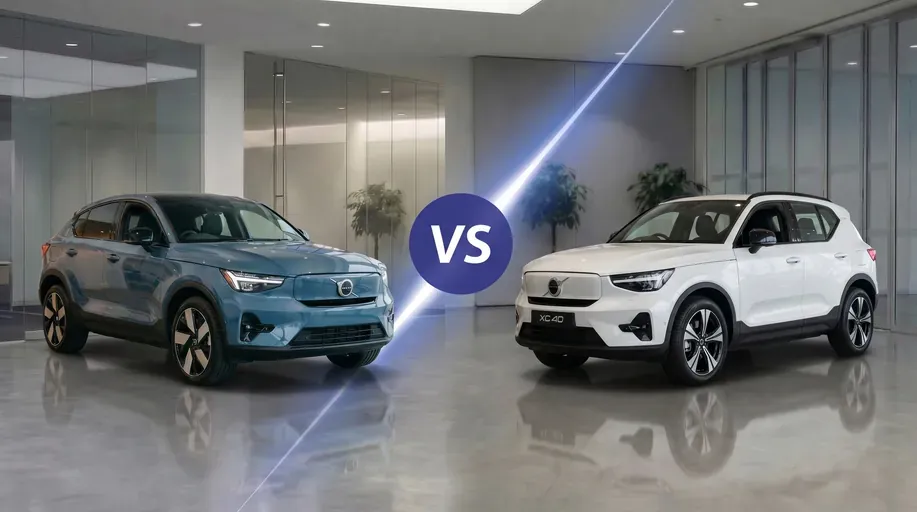
Detailed comparison of Volvo C40 Recharge (EC40) vs Volvo XC40 Recharge (EX40). Discover the differences in range and design. Verdict for an easy choice of an electric SUV!
May 13, 2026
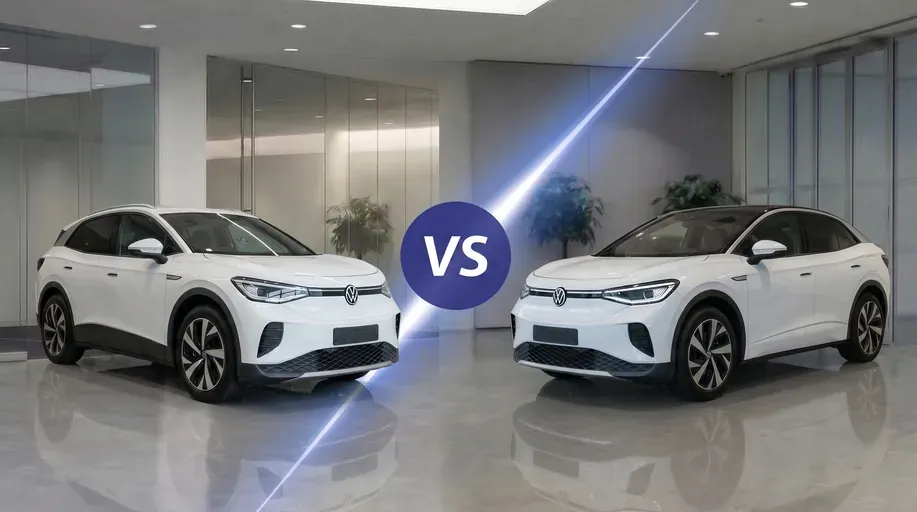
Volkswagen ID.4 vs. Volkswagen ID.5: Practical electric SUV or stylish coupe? Read our detailed comparison of range, space and our final verdict.
Oct 16, 2026