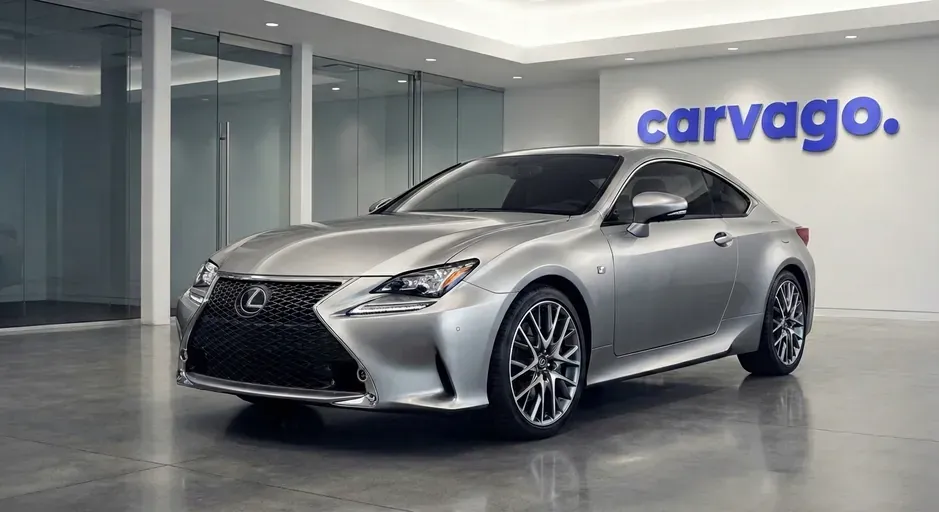
Review Lexus RC F: What do owners and experts really say?
Lexus RC F coupe review: real owner experience, common faults, running costs and used prices — everything you need to know before you buy.
October 31, 2026
Verdict at a Glance
Who it suits: Grand-touring enthusiasts seeking a durable, naturally aspirated V8 coupé rather than a track-focused lap-time tool.
Recommended engine: The naturally aspirated V8, preferably from April 2019 onward for crisper response on open roads and motorway cruising.
What to avoid: Short urban errands, and cars without documented fuel-system recall repairs verified by VIN.
Introduction
The Lexus RC F represents the brand's high-performance contender in the premium sports coupé segment, positioned directly against established European rear-wheel-drive alternatives. Sold exclusively as a two-door coupé with a 2+2 seating layout, this review covers its single generation (chassis code XC10). European customer deliveries commenced in December 2014, and manufacturing continued until global production concluded in December 2025 with no direct successor.
Lexus revised the model several times over its production life. A major facelift entered European sales in April 2019, bringing restyled bodywork, aerodynamic revisions, and chassis alterations alongside the introduction of a lightweight, track-focused derivative. A later revision in February 2023 introduced an updated touchscreen infotainment setup and refreshed driver-assistance systems.
On the European used market, the Lexus RC F coupé appeals primarily to buyers seeking an alternative to turbocharged rivals. It attracts enthusiasts who prioritise a large-displacement, naturally aspirated engine and durable grand-touring usability over track-focused lap times.
Owner Experiences: Common Faults and Recalls
The Lexus RC F coupé has established a solid mechanical reputation across European markets. Its naturally aspirated V8 engine and torque-converter automatic transmission avoid many of the forced-induction and dual-clutch complexities found in rival performance coupés. However, several model-specific mechanical quirks, accelerated wear characteristics, and official safety campaigns require close attention when evaluating a used example.
Two official safety recalls affect this generation across the European Union and the United Kingdom, both involving fuel system components with a potential risk of fuel leakage.
European Safety Recall
Affected Build Window
Official Defect & Workshop Remedy
High-Pressure Fuel Pump Fatigue
June 2014 – December 2017
A defective pulsation damper in one of the high-pressure fuel pumps can cause vibration and fatigue cracks in the pump cover. Authorized workshops inspect both high-pressure fuel pumps and replace them with updated assemblies if required.
Fuel Tank Vent Tube Flange
June 2014 – August 2018
An improper flange design can lead to stress cracks on the outer surface where the vent tube attaches to the fuel tank. Authorized dealers replace the fuel tank vent tube assembly free of charge.
Beyond factory campaigns, owners report a recurring coolant issue known as valley plate leakage. The aluminium coolant manifold situated beneath the intake manifold is sealed to the engine block using liquid silicone sealant rather than an embossed metal gasket. Over multiple heat cycles and higher mileages—typically beyond 100 000 km—this factory sealant degrades. Coolant slowly weeps into the engine valley between the cylinder banks, producing a faint sweet smell and dried pink crusting that eventually tracks down the rear of the engine over the transmission bellhousing. Resolving the leak requires removing the intake manifold to clean the mating surfaces and resealing the plate with updated sealant.
Chassis compliance under braking is a noted characteristic on the Lexus RC F. Tests describe accelerated inner-shoulder tyre wear on the front axle, where the inside edges can wear down to the cords while substantial tread depth remains across the rest of the tyre. The vehicle's substantial mass and powerful multi-piston front brakes generate heavy loads that deflect the factory rubber rear lower control arm bushings rearward under deceleration, inducing dynamic toe-out. Because this geometry change occurs dynamically under load, static four-wheel alignments rarely resolve it. Owners report that upgrading to stiffer aftermarket polyurethane bushings or sealed spherical bearings can prevent this dynamic deflection and help normalise tyre life.
Official manufacturer technical bulletins address low-speed brake squeal on cars built between 2015 and 2018. The factory high-friction semi-metallic pads generate vibration harmonics against the slotted iron discs under light pedal application. Revised anti-squeal shims and alternative low-dust brake pad compounds resolve the noise, though the softer friction material slightly diminishes high-temperature track resistance. On models equipped with exposed carbon-fibre composite bodywork, inspect the bonnet, roof, and active rear spoiler for lacquer bubbling or clouding from UV exposure along the drainage seams. In the cabin, owners report occasional failures of the HVAC blend door servo motors, which can leave passenger vents stuck blowing hot air when the climate control is set to cooling.
🔍 What to check before buying
Recall completion by VIN: Have an authorized Lexus retailer verify via the vehicle identification number that the high-pressure fuel pump and fuel tank vent tube recalls have been completed.
Coolant valley plate inspection: Use a torch to check beneath the intake manifold and down the rear of the engine block over the transmission bellhousing for dried pink coolant residue or sweet-smelling fluid leaks.
Front inner tyre wear: Turn the steering wheel to full lock and thoroughly examine the inside shoulders of both front tyres for accelerated wear, uneven scrubbing, or exposed cord layers.
Dual-zone climate servos: Cycle the air conditioning through its full temperature range on both sides to verify that all passenger dash vents respond immediately and do not blow hot air when set to cold.
Carbon-fibre clear-coat integrity: On examples specified with exposed carbon-fibre panels, closely inspect the clear lacquer on the bonnet, roof, and spoiler edges for sun haze, peeling, or moisture ingress.
Engines: Which One to Choose
Throughout its production run to December 2025, the Lexus RC F was built around a single powertrain architecture: a high-revving, naturally aspirated petrol V8 paired with an eight-speed automatic transmission delivering drive to the rear wheels. Although the mechanical layout remained constant, an emissions recalibration in January 2018 slightly adjusted peak output and introduced particulate filters to meet stricter European standards.
Engine
Fuel
Power
Gearbox
Model years
5.0 V8
Petrol
351 kW (477 hp)
8-speed automatic
2014–2017
5.0 V8
Petrol
341 kW (464 hp)
8-speed automatic
2018–2025
Which version to choose on the used market
Because every petrol Lexus RC F shares the same displacement and transmission, selecting the right model comes down to production timing, chassis updates, and driving requirements rather than picking between distinct engines.
Short trips in town: The large-capacity V8 is unsuited to brief urban errands. The multi-cylinder engine takes considerable time to reach stable operating temperatures, while low-speed stop-start driving accelerates oil degradation and incurs high fuel usage.
Mixed use and spirited driving: Open rural routes represent the best operating environment for this powertrain. Drivers seeking sharper mid-range response and crisper off-the-line acceleration should focus on post-facelift examples from April 2019 onward, which feature revised intake ducting and shorter final-drive gearing. Earlier versions deliver a slightly more vocal exhaust character due to the absence of particulate filters.
Long motorway distances: The coupe functions effectively as a long-distance grand tourer. The tall eighth gear keeps engine revolutions low at motorway speeds, ensuring a quiet cabin and relaxed cruising manners over long journeys.
Towing: Across all model years, towing is prohibited, as the vehicle is not homologated for trailer operation.
For an overview of mechanical reliability, servicing requirements, and factory safety recalls, see the dedicated owner experiences section.
Space & Practicality
Measurement
Pre-facelift (2014–2019)
Facelift (2019–2025)
Length
4,705 mm
4,710 mm
Width
1,845 mm
1,845 mm
Height
1,390 mm
1,390 mm
Wheelbase
2,730 mm
2,730 mm
Boot capacity (seats up)
366 l
366 l
Boot capacity (seats folded)
Not expandable (fixed seatbacks)
Not expandable (fixed seatbacks)
As a dedicated 2+2 sports coupe, the Lexus RC F coupe prioritises front-seat packaging over passenger versatility. While the front bucket seats provide firm lateral support, space in the rear is compromised. The two sculpted rear positions have restricted legroom and tight headroom beneath the sloping roofline, leaving them practical only for small children or brief emergency journeys. Access to the rear bench is similarly awkward due to the low roofline and forward-tilting seat mechanism.
Everyday cargo usability reflects the coupe format. The boot offers adequate luggage depth for travel bags or weekly shopping, but versatility is inherently limited because the rear seatbacks are fixed and cannot be folded forward to extend cargo capacity. Standard variants feature a central through-loading hatch behind the rear armrest for carrying longer, narrow items such as skis, although track-focused lightweight derivatives omit this opening entirely in favour of a structural carbon-fibre rear partition bulkhead. Cabin oddment storage is modest, confined to slim door pockets, a shallow centre console bin, and a pair of central cupholders.
What the Tests Say
Professional road tests characterize the Lexus RC F coupé as a grand tourer rather than an incisive track car. Low-speed ride comfort is firm and restless over broken surfaces, transmitting abrupt vertical kicks into the cabin. Once up to cruising speeds, the chassis settles into composed stability. In corners, substantial kerb weight generates noticeable inertia during quick directional changes, with front-end push-understeer evident on corner entry. However, versions equipped with the optional torque-vectoring rear differential offer predictable traction and communicative rear-axle behavior. Acoustic refinement is a consensus highlight; the naturally aspirated engine hums quietly on motorways yet delivers an authentic mechanical tone at higher revs, though the automatic transmission draws criticism for sluggish downshifts.
Cabin assembly is commended for durable construction, zero rattles, and plush upholstery. The heavily sculpted front bucket seats provide long-distance support, although the driving position feels slightly high. Ergonomics suffer from scattered secondary switchgear, and testers condemn the console-mounted touch-sensitive pad for being imprecise and distracting to operate while driving.
Testers agree on the car's touring stability, robust build quality, and engine character, while universally noting that its mass compromises agility against key German rivals. Views diverge on daily suspension tolerance, with some finding urban damping too unforgiving. Later chassis revisions and the facelift brought marginally sharper turn-in and reduced unsprung weight, but left the relaxed cruising persona intact.
Prices and Market Offer
All market charts in this section are drawn from Carvago listings across the entire Lexus RC F model family, including other generations represented in the data rather than exclusively the reviewed generation. Because these figures reflect broad platform inventory, this dataset does not establish a separate price level for the reviewed generation alone. Currently, the median asking price on the platform stands at €54,000 for 2016 models and reaches €101,800 for 2024 examples, with 2017 and 2019 vehicles recording median asking prices of €66,700 and €63,000 respectively.
The chart tracks active monthly listings for the Lexus RC F from April to September 2026, where counts moved between a high of 9 cars in April and a low of 3 cars in June.
Lexus RC F - availability over time
Active listings over time
Month
Lexus RC F
2026-04
9
2026-05
6
2026-06
3
2026-07
3
2026-08
7
2026-09
7
Source Carvago
Buyers can expect a narrow selection on the market, as active listings shifted between 3 and 9 vehicles across the period and ended at 7 cars in September 2026.
Among used cars advertised today, the median asking price for models built in 2016 is €54,000, while those built in 2024 reach a median asking price of €101,800.
Lexus RC F - median price by model year
Median advertised price by year of manufacture
Model year
Lexus RC F
2016
54 000
2017
66 700
2019
63 000
2024
101 800
Source Carvago
Median asking prices among current listings are not strictly higher for newer build years, with 2019 models listed at a median asking price of €63,000 compared to €66,700 for 2017 cars. Buyers looking at 2024 models will find the median asking price among today's advertisements is €101,800.
Over the six-month period from April 2026 to September 2026, active listings consisted entirely of petrol models, moving from 9 advertised cars in April to 7 in September. The chart below tracks how advertised numbers split across fuel types each month.
Lexus RC F - supply by fuel over time
Supply composition by fuel type
Month
Petrol
2026-04
9
2026-05
6
2026-06
3
2026-07
3
2026-08
7
2026-09
7
Source Carvago
In September 2026, all 7 advertised cars were petrol, with 0 listings recorded for diesel, hybrid, or electric options. Anyone shopping for this model family will realistically be choosing exclusively among petrol examples.
Between April 2026 and September 2026, the average asking price for the model opened at €89,200 before climbing to €100,800 in August. The chart below traces how advertised prices moved over this six-month span.
Lexus RC F - price trend over time
Average price development over time
Month
Lexus RC F
2026-04
89 200
2026-05
89 900
2026-06
91 300
2026-07
93 300
2026-08
100 800
2026-09
93 100
Source Carvago
Across the full period, the average asking price rose by roughly 4%, finishing at €93,100 in September after pulling back from the August peak.
Durable and characterful naturally aspirated V8 powertrain
Composed high-speed touring stability and quiet cruising refinement
Solid cabin construction with supportive long-distance front seats
Cons
Substantial weight that blunts agility and causes corner-entry understeer
Imprecise console touchpad that is distracting to operate on the move
Tight rear passenger space and fixed backrests that prevent boot expansion
Frequently asked questions
Is the Lexus RC F mechanically reliable?
The naturally aspirated V8 and torque-converter automatic transmission are durable, avoiding the complex turbocharger and dual-clutch issues of rivals. However, higher-mileage examples can develop valley plate coolant leaks, and fuel-system recall status must be verified by VIN.
Which model year is the best choice to buy?
Facelift models from April 2019 onward are recommended for their revised suspension tuning and sharper throttle response. Earlier versions remain appealing for their more vocal exhaust note uninhibited by particulate filters, provided maintenance records are complete.
What should you check before buying a used example?
Inspect the inner shoulders of the front tyres for uneven wear and check the engine valley for dried coolant residue. Buyers should also verify with an authorized dealer that all factory fuel-system recalls have been completed by VIN.
Can it serve as a practical everyday car?
It functions well as a refined long-distance cruiser for two occupants, though cramped rear seating suits only small children. Cargo practicality is also limited because the rear seatbacks are fixed and cannot fold down to expand the boot.