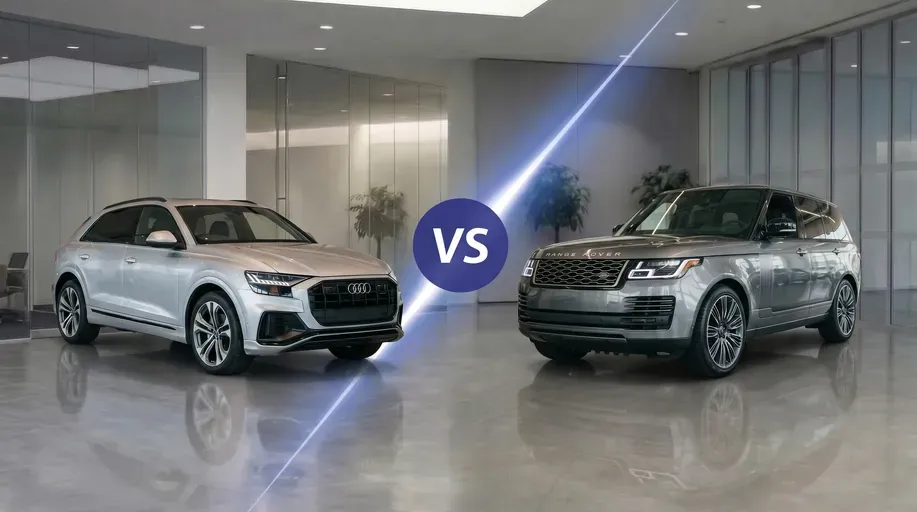
Car battle
Audi Q8 vs. Range Rover: Complete comparison 2026
Audi Q8 vs Land Rover Range Rover: Detailed comparison of used luxury SUVs. Discover the differences in equipment, performance and read our final verdict.
May 3, 2026
Articles
Review
Range Rover L460 review: real owner experience, engine choices, running costs and reliability. Everything you need to know before you buy.
October 27, 2026
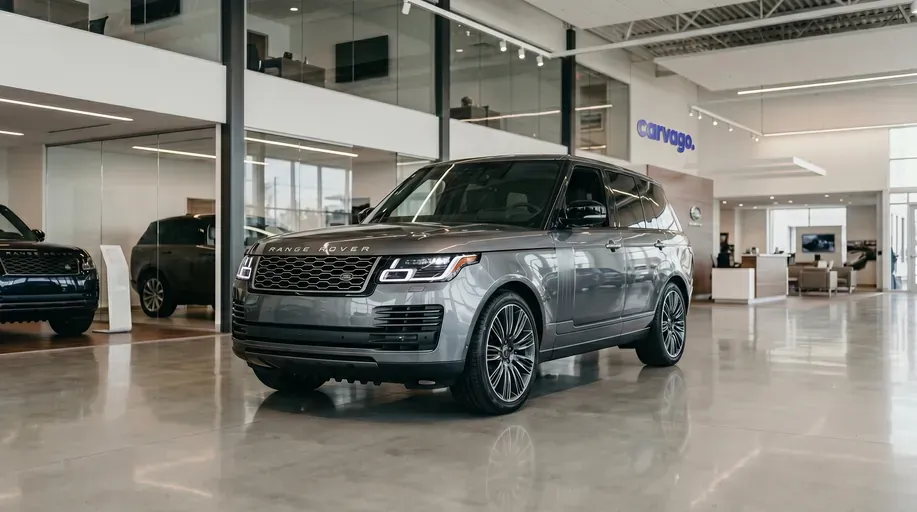
The fifth-generation Land Rover Range Rover sits at the top of the brand's luxury lineup, competing directly in the full-size prestige SUV segment. Following its world premiere in October 2021, series production began in early 2022, and the first European customer deliveries arrived in April 2022.
As of October 2026, the model has not received a visual mid-cycle redesign. Instead, a major technical and powertrain update was introduced on 17 May 2023 for the 2024 model year. This revision upgraded the infotainment interface and replaced the initial plug-in hybrids with revised, higher-output electrified powertrains alongside the existing mild-hybrid petrol and diesel options.
Land Rover manufactures the Range Rover SUV in standard-wheelbase and extended long-wheelbase body styles. Seating arrangements include a standard five-seat layout, an optional four-seat executive arrangement with a fixed rear console, and a three-row seven-seat configuration available on long-wheelbase derivatives. It primarily targets buyers requiring comfortable long-distance travel, chauffeured passenger transport, or versatile multi-row family accommodation.
With European customer deliveries of the fifth-generation Land Rover Range Rover commencing in April 2022, long-term durability and high-mileage component wear are not yet established. Early reliability patterns and workshop evaluations focus primarily on the vehicle’s complex electrical architecture, auxiliary power management, and onboard software rather than core structural defects.
Software stability has produced frequent complaints. Professional tests and technical bulletins record instances where the curved infotainment touchscreen experiences freeze-ups, black screens upon starting, or continuous reboot cycles following interrupted software-over-the-air updates. While a manual hardware reboot often resolves minor glitches, interrupted system flashes require recovery programming through retailer diagnostic ports.
Secondary electrical drain represents another recurring issue. Workshop evaluations note that parasitic current draw from the telematics unit, proximity keyless entry sensors, and automated air suspension levelling checks can deplete the auxiliary 12V battery if the vehicle remains parked for more than a week. This low-voltage state frequently triggers erroneous instrument cluster warnings upon starting, such as false air suspension or electrical system alerts. Routine software updates have reduced sleep-mode draw, though battery health remains critical. In winter conditions, tests also describe instances where the exterior flush deployable door handles bind due to freezing grime or cable tension misalignments, occasionally causing an internal microswitch to trigger a false door-open warning.
Several official safety recall campaigns have been registered across European databases, requiring workshop intervention across specific production windows.
| Concern | Powertrain / Application | Official Production Window | Corrective Action |
|---|---|---|---|
| Driver airbag connector corrosion | All powertrains | 04.04.2019 to 26.06.2026 (includes previous generation) | Application of protective dielectric grease to clockspring connector terminals to prevent fretting corrosion. |
| Panoramic roof side finisher detachment | All models with panoramic glass roof | 14.12.2021 to 10.12.2025 | Inspection and refitting of exterior roof side finisher trim using an approved primer and adhesive process. |
| Belt idler pulley collision | Straight-six diesel | 01.03.2024 to 18.04.2026 | Replacement of the auxiliary drive belt idler pulley to prevent contact with the oil sensor and resultant leaks. |
| Second-row center seat belt buckle | All seat configurations with second-row bench | 19.12.2024 to 19.02.2025 | Inspection and replacement of the center seat belt buckle assembly and retaining bolt. |
| Hybrid transmission clutch plate tolerance | Plug-in hybrid Land Rover Range Rover | 2023 to 2024 | Diagnostic testing of clutch packs and full replacement of the automatic hybrid transmission if debris is found. |
| Oil filter housing cracking | Straight-six petrol | 11/2023 to 03/2024 | Inspection and replacement of out-of-specification plastic filter housings with an approved compound part. |
| Oil cooler hose fixings | Petrol V8 | 09/2020 to 11/2022 (includes previous generation) | Inspection and retorquing of engine oil cooler hose fixings to prevent inadequate thread engagement. |
The airbag connector campaign—notified across Europe in July 2026—addresses fretting corrosion on steering column terminals that could impede deployment during a collision. In September 2026, European safety authorities logged a recall for the straight-six diesel Land Rover Range Rover regarding an idler pulley on the front accessory drive that could over-rotate and damage an oil sensor. For plug-in hybrids, a European campaign initiated in late 2024 addressed transmission clutch plates manufactured out of flatness specification, which could contaminate transmission fluid and cause an unexpected shift to neutral. Buyers considering a used model can verify documented service actions and maintenance records independently through CarAudit.
The fifth-generation Range Rover offers an extensive powertrain catalogue comprising mild-hybrid inline-six diesels, mild-hybrid inline-six petrols, plug-in hybrids, and twin-turbo V8 petrol units. Every version comes standard with an eight-speed automatic transmission and permanent all-wheel drive featuring a low-range transfer case.
| Engine | Fuel | Power | Gearbox | Model years |
|---|---|---|---|---|
| D250 | Diesel MHEV | 183 kW (249 hp) | 8-speed automatic | 2022–2023 |
| D300 | Diesel MHEV | 221 kW (300 hp) | 8-speed automatic | 2022–present |
| D350 | Diesel MHEV | 258 kW (350 hp) | 8-speed automatic | 2022–present |
| P400 | Petrol MHEV | 294 kW (400 hp) | 8-speed automatic | 2022–present |
| P440e | Petrol PHEV | 324 kW (440 hp) | 8-speed automatic | 2022–2023 |
| P510e | Petrol PHEV | 375 kW (510 hp) | 8-speed automatic | 2022–2023 |
| P460e | Petrol PHEV | 338 kW (460 hp) | 8-speed automatic | 2023–present |
| P550e | Petrol PHEV | 405 kW (550 hp) | 8-speed automatic | 2023–present |
| P530 | Petrol | 390 kW (530 hp) | 8-speed automatic | 2022–2023 |
| P530 | Petrol MHEV | 390 kW (530 hp) | 8-speed automatic | 2023–present |
| P615 | Petrol MHEV | 452 kW (615 hp) | 8-speed automatic | 2023–present |
For high-mileage drivers and frequent motorway cruising, a diesel Range Rover remains the most practical match for this heavy platform. The D350 delivers strong low-rpm pulling power and calm highway cruising, while the D300 provides adequate long-distance capability. The base D250, available only as a used car from early production years, moves the car steadily but offers less passing reserve when fully laden.
Buyers who primarily commute in urban areas or undertake mixed daily trips with home charging should look at a plug-in hybrid Range Rover. The early P440e and P510e cover typical suburban journeys on battery power, while the updated P460e and P550e benefit from a stronger electric motor for brisker zero-emission acceleration. However, plug-in hybrid buyers who tow should note that these electrified variants have lower certified braked towing limits than the non-hybrid models.
For demanding towing duties or heavy trailer work, the D350 diesel and the twin-turbo V8 variants are the primary candidates thanks to their maximum certified trailer ratings. The six-cylinder mild-hybrid petrol P400 delivers linear throttle response without turbo lag, though it demands higher engine speeds and frequent fuelling under load. The petrol Range Rover equipped with the twin-turbo V8—whether the P530 or the top-tier P615—is aimed at drivers seeking rapid grand-touring pace and relaxed power reserves, trading operating efficiency for performance.
For detailed information on known mechanical issues and official safety campaigns across these powertrains, refer to the owner experiences section.
| Dimension / Capacity | Standard Wheelbase (SWB) | Long Wheelbase (LWB 5-Seat) | Long Wheelbase (LWB 7-Seat) |
|---|---|---|---|
| Length (mm) | 5,052 | 5,252 | 5,252 |
| Width without mirrors (mm) | 2,047 | 2,047 | 2,047 |
| Height (mm) | 1,870 | 1,870 | 1,870 |
| Wheelbase (mm) | 2,997 | 3,197 | 3,197 |
| Boot volume, seats up (VDA dry, l) | 818 | 818 | 212 (857 with row 3 folded) |
| Boot volume, seats folded (VDA dry, l) | 1,841 | 2,176 | 2,050 |
Boot capacities reflect certified VDA dry block measurements. Stated load volumes do not apply to optional four-seat specifications, where a fixed rear centre console prevents flat folding and reduces luggage volume.
The fifth-generation Range Rover SUV offers spacious passenger accommodation, aided by a tall glasshouse that delivers substantial headroom and clear outward visibility in every direction. Standard-wheelbase models provide ample legroom on the standard three-abreast power-folding rear bench, while the longer wheelbase noticeably expands rear knee room. For larger families, the extended body can be configured with an optional third seating row that accommodates adults on intermediate journeys and folds flat into the boot floor electronically. Everyday practicality is enhanced by a standard horizontally split two-piece tailgate that keeps cargo secured on inclines and doubles as an outdoor viewing bench. Luggage loading is made easier via suspension lowering switches mounted inside the boot, though choosing optional individual rear seats eliminates through-loading versatility in exchange for power recline functions.
On the move, the Land Rover Range Rover isolates occupants with a gliding sensation over undulating tarmac. Active roll compensation keeps the heavy body level through bends, while standard all-wheel steering lends agility in tight urban spaces. Testers observe, however, that this suppleness falters over abrupt surface imperfections: optional large alloy wheels transmit low-speed shudder and audible thuds across sharp potholes. Cabin acoustic isolation proves thorough thanks to active noise cancellation, which suppresses tyre roar and keeps engines muted at cruising speeds, though upright windscreen pillars generate faint wind rustle on motorways.
Inside, the cabin features authentic wood, metal accents, and deep seat cushioning that minimises journey fatigue. The elevated seating position grants clear outward visibility, although some testers find the posture overly upright. Material quality is judged high, though minor ergonomic grievances include fiddly multifunction steering wheel switches and gloss-black consoles that quickly attract fingerprints.
Ergonomic assessments shifted following the technical update for the 2024 model year. Earlier cars retained tactile climate switchgear alongside a console-mounted audio control. Later models absorbed these heating and ventilation functions entirely into the central touchscreen menus. Professional reviews widely agree that adjusting cabin temperature on the move became noticeably more distracting once physical dials were eliminated.
All charts in this section are drawn from Carvago’s listings across the broader Land Rover Range Rover model family, including earlier generations represented in the data, rather than exclusively reflecting the reviewed generation. Because entries are grouped solely by production year, this dataset does not establish a separate price level for the newest generation alone. Advertised inventory shows a median asking price of €64,200 for 2019 models and €74,900 for 2021 models, whereas 2022 builds reflect a median asking price of €134,000. Among the most recent offerings, the median asking price peaks at €179,900 for 2024 models and stands at €173,000 for 2026 models.
Between April 2026 and September 2026, the volume of active Range Rover listings tracked across the platform increased from 2,760 to 3,242. The chart below outlines the total number of vehicles advertised in each of these six months.
Active listings over time
| Month | Range Rover |
|---|---|
| 2026-04 | 2 760 |
| 2026-05 | 2 936 |
| 2026-06 | 3 012 |
| 2026-07 | 3 149 |
| 2026-08 | 3 139 |
| 2026-09 | 3 242 |
Source Carvago
Buyers had a broad selection throughout this period, with availability expanding overall aside from a small dip to 3,139 listings in August 2026. Choice was at its widest in September 2026, when active listings reached 3,242.
The median asking price of cars advertised today, built in 2019, is €64,200. The chart below illustrates how median asking prices compare across build years from 2019 to 2026.
Median advertised price by year of manufacture
| Model year | Range Rover |
|---|---|
| 2019 | 64 200 |
| 2020 | 66 000 |
| 2021 | 74 900 |
| 2022 | 134 000 |
| 2023 | 149 900 |
| 2024 | 179 900 |
| 2025 | 169 900 |
| 2026 | 173 000 |
Source Carvago
For buyers planning their budget, the median asking price of cars advertised today is €64,200 for 2019 models and €134,000 for 2022 models. Asking prices are not strictly higher for each subsequent model year, as the median asking price of cars advertised today built in 2025 is €169,900 compared to €179,900 for 2024 models.
This depreciation curve traces how the Range Rover's average residual value declines with age, showing that the model loses roughly 28% of its initial value by age three. The progression below details this continuous decline across the first seven years.
Residual value by vehicle age
| Vehicle age | Range Rover |
|---|---|
| New | 171 000 |
| 1 yr | 152 000 |
| 2 yrs | 137 100 |
| 3 yrs | 122 300 |
| 4 yrs | 105 700 |
| 5 yrs | 69 900 |
| 6 yrs | 59 000 |
| 7 yrs | 50 600 |
Source Carvago
Across the full seven-year span, the model sheds 70% of its initial value, with the steepest single-year drop occurring between age four and five. Beyond that fifth year, the pace of depreciation flattens considerably, with seven-year-old vehicles retaining nearly 30% of their starting value.
Active listings for the Range Rover span hybrid, diesel, and petrol options, with hybrid advertisements rising from 1008 in April 2026 to 1177 in September 2026. The breakdown below tracks monthly advertised counts across each fuel type over this six-month span.
Supply composition by fuel type
Petrol
Diesel
Hybrid
Electric
| Month | Petrol | Diesel | Hybrid | Electric |
|---|---|---|---|---|
| 2026-04 | 861 | 890 | 1 008 | 0 |
| 2026-05 | 877 | 951 | 1 106 | 0 |
| 2026-06 | 873 | 948 | 1 189 | 0 |
| 2026-07 | 930 | 1 025 | 1 191 | 0 |
| 2026-08 | 916 | 1 026 | 1 192 | 0 |
| 2026-09 | 982 | 1 072 | 1 177 | 6 |
Source Carvago
In September 2026, hybrids led the market with 1177 listings, followed by 1072 diesels and 982 petrol models, while electric variants numbered only 6. Buyers will find a balanced choice across hybrid, diesel, and petrol powerplants, whereas pure electric options remain negligible on the used market.
From April 2026 to September 2026, the average asking price for the Range Rover moved within a narrow range, starting at €125,700 and peaking at €127,700 in May and June.
Average price development over time
| Month | Range Rover |
|---|---|
| 2026-04 | 125 700 |
| 2026-05 | 127 700 |
| 2026-06 | 127 700 |
| 2026-07 | 126 100 |
| 2026-08 | 126 400 |
| 2026-09 | 126 600 |
Source Carvago
The period ended with an average asking price of €126,600 in September 2026, representing an overall change of less than one percent and reflecting very little movement relative to the overall price level.
Refined long-distance ride comfort with active noise cancellation and standard all-wheel steering
Versatile cabin space offering multi-row family accommodation alongside a practical split tailgate
Broad powertrain lineup delivering strong towing capability from diesel and petrol V8 engines
Recurring software glitches and parasitic battery drain requiring regular dealer attention
Touchscreen-only climate controls introduced for the 2024 model year increase driver distraction
Low-speed ride firmness and audible thuds over sharp potholes on large alloy wheels
Long-term durability is not yet established due to the model's recency, though early reports highlight software and auxiliary battery glitches rather than mechanical failures. Verifying that all European safety recalls have been completed by VIN is essential before buying.
The straight-six diesel Range Rover, particularly the D350, offers the strongest balance of low-rpm torque, motorway cruising refinement, and certified towing capacity. Plug-in hybrids suit zero-emission daily commuting, though they carry lower trailer ratings.
Introduced in May 2023, the update replaced early plug-in hybrids with higher-output electrified powertrains and absorbed all physical climate controls into the central touchscreen. While the newer powertrains provide stronger electric acceleration, operating ventilation controls on the move became noticeably more distracting.
Verify through CarAudit or an official dealer that all safety recalls have been completed by VIN. Additionally, ensure the auxiliary battery and infotainment screen boot cleanly without lingering fault warnings.
Sources: media.jlr.com, ec.europa.eu, adac.de, autocar.co.uk, autobild.de
This article was prepared using artificial intelligence tools. The section guarantor is Petr Dušek.
Audi Q8 vs Land Rover Range Rover: Detailed comparison of used luxury SUVs. Discover the differences in equipment, performance and read our final verdict.
May 3, 2026
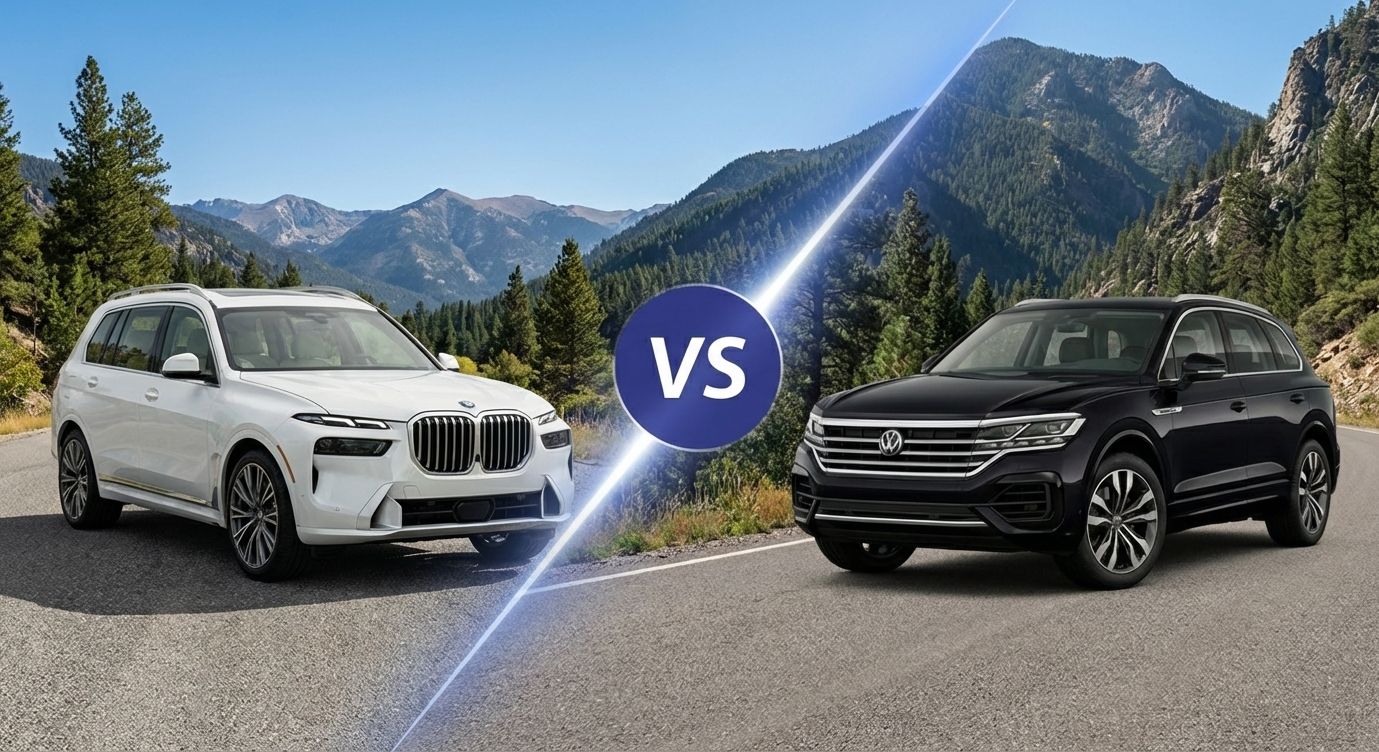
BMW X7 vs. Volkswagen Touareg. Our detailed comparison of design, performance, and practicality will help you choose the right luxury SUV.
Oct 16, 2026
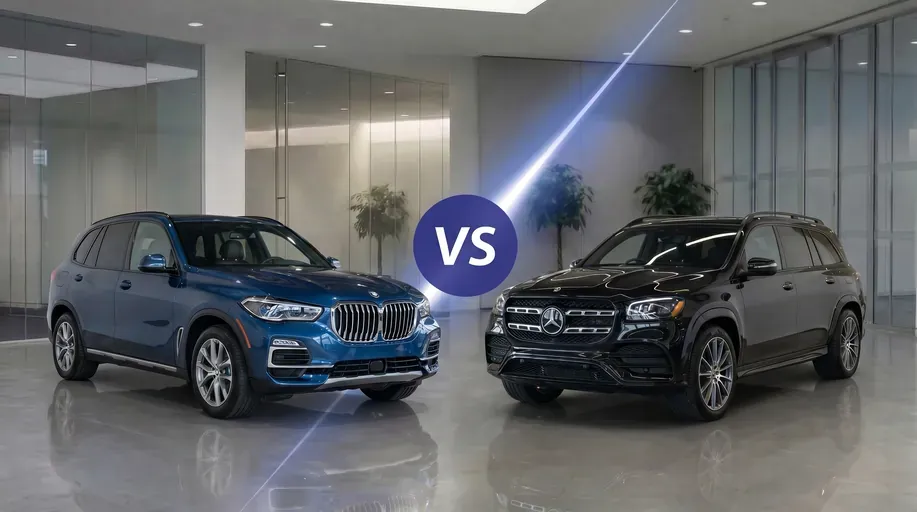
BMW X5 vs Mercedes-Benz GLS comparison. Discover real-world experiences, differences in spaciousness, engines, and equipment. Our verdict will help you choose the right SUV.
Apr 29, 2026