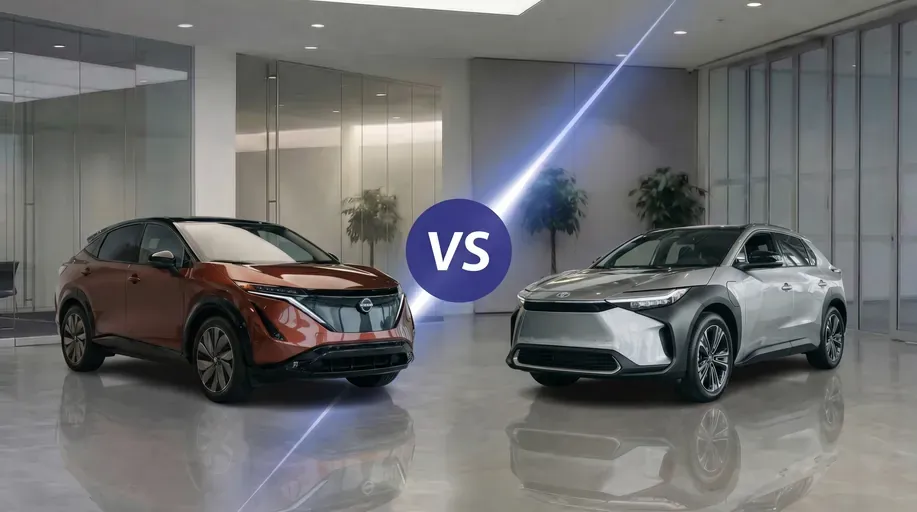
Car battle
Nissan Ariya vs. Toyota bZ4X: Complete comparison 2026
Detailed comparison of the Nissan Ariya vs. Toyota bZ4X electric SUVs. Discover the real-world range, equipment, and a clear verdict to help you with your choice.
Apr 14, 2026
Articles
Review
Kia EV6 review: real owner experience, battery range, common faults, running costs and used prices — everything you need before you buy.
October 29, 2026
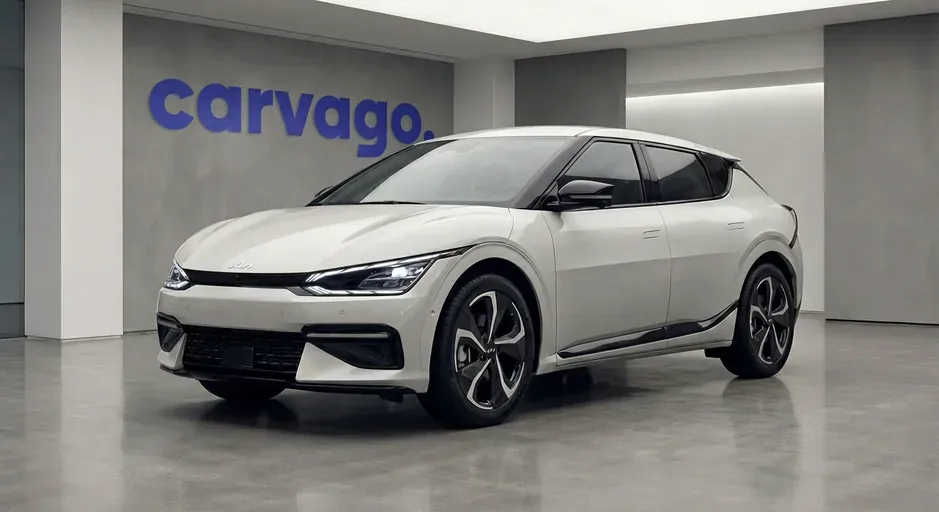
The electric Kia EV6 serves as the manufacturer’s dedicated battery-electric offering in the mid-size segment, straddling the line between a traditional five-door hatchback and a raised crossover. This first generation (internal code CV) commenced series production in 2021. European retail customer order books opened on 18 May 2021, followed by the first customer deliveries on 25 October 2021. The range expanded when customer deliveries of the high-performance GT variant got underway in October 2022.
A mid-cycle refresh had its world premiere on 14 May 2024. European orders for the facelifted Kia EV6 opened on 2 September 2024, with customer deliveries starting in October 2024, while deliveries of the updated GT followed in early 2025. The update introduced revised front-end lighting, interior refinements, and updated high-voltage hardware to sustain competitiveness in an increasingly crowded class.
Available exclusively in a single five-door crossover body style, the Kia EV6 primarily targets private family buyers, company car users, and long-distance drivers looking for an electric vehicle with rapid charging capability and distinctive styling.
While owner satisfaction with the Kia EV6 is generally favourable, vehicles produced during the initial production run between 2021 and 2024 have accumulated specific technical issues that used-car buyers must evaluate. The primary areas of concern involve power management electronics, auxiliary battery drainage, and minor body hardware. If you are assessing a prospective vehicle, having its physical condition and workshop history confirmed via CarAudit ensures transparency regarding past maintenance and outstanding campaigns.
The most prominent systemic fault reported on this platform involves the Integrated Charging Control Unit (ICCU). Official defect notices confirm that the unit can degrade over time due to transient high voltage and thermal cycling. A compromised charging unit ceases to replenish the auxiliary 12-volt battery, resulting in gradual discharge while driving and progressive loss of motive power. Owners report an audible popping sound originating from beneath the rear passenger bench shortly before the instrument cluster displays charging warnings and forces the vehicle into limp-home mode. In parallel, survey data identifies 12-volt auxiliary battery failure as a frequent source of roadside assistance callouts. Owners report that continuous background data queries from third-party remote apps or connected charging services prevent the vehicle control computers from entering deep sleep, hastening parasitic battery drain.
Hardware quirks outside the powertrain mainly concern external fittings and braking hardware. Owners report that the motorized flush-mounted door handles fitted on higher trims can bind, fail to present, or fail to retract fully in freezing sub-zero weather when moisture enters the recess. If internal actuators fail, authorized workshops replace the lock mechanism. Beneath the vehicle, inspection reports describe accelerated surface corrosion on the brake discs and sticking caliper slide pins, as the regenerative braking system carries out most routine deceleration and leaves friction components underused. In addition, vehicle mass contributes to uneven tyre wear along the inner shoulders, particularly on versions equipped with larger factory wheel packages.
Multiple verified safety recalls have been issued across European markets for the first-generation model. Official actions have targeted software logic errors, mechanical integrity, and high-voltage assembly checks.
| Defect in Official Notice | Verified Build Window | Scope | Workshop Remedy |
|---|---|---|---|
| Shift control unit voltage fluctuation causing parking disengagement | 17 July 2021 to 2 May 2022 | 58,500 vehicles worldwide | Reprogramming of the shift control unit software logic |
| Rear driveshaft heat-treatment defect leading to loss of drive | January 2023 to April 2023 | 2,977 vehicles worldwide | Inspection and replacement of the rear driveshaft assembly |
| Charging control unit degradation and 12V battery discharge | 20 April 2021 to 28 February 2024 | 224,752 vehicles worldwide | Diagnostic fault check; logic update or replacement of the control unit and fuse |
| Instrument cluster display delay, resetting, or blank screen | 1 July 2025 to 17 December 2025 | Over 174,000 shared platform vehicles worldwide | Control unit logic update via over-the-air transmission or workshop upload |
| High-voltage traction battery cell electrode misalignment | 16 September 2021 to 19 January 2024 | Limited global production batch | Replacement of the suspect module or complete high-voltage battery pack |
The electric Kia EV6 is built on a dedicated 800-volt skateboard platform and comes exclusively with single-speed reduction transmissions. Depending on the production year, buyers can choose between single-motor rear-wheel-drive setups and dual-motor all-wheel-drive configurations across two battery capacities, capped by a dedicated high-performance flagship.
| Engine | Fuel | Power | Gearbox | Drivetrain | Model years |
|---|---|---|---|---|---|
| Standard Range (58 kWh) | Electric | 125 kW (170 hp) | Automatic (1-speed) | RWD | 2021–2024 |
| Long Range (77.4 kWh) | Electric | 168 kW (229 hp) | Automatic (1-speed) | RWD | 2021–2024 |
| Long Range (77.4 kWh) | Electric | 239 kW (325 hp) | Automatic (1-speed) | AWD | 2021–2024 |
| GT (77.4 kWh) | Electric | 430 kW (585 hp) | Automatic (1-speed) | AWD | 2022–2024 |
| Standard Range (63 kWh) | Electric | 125 kW (170 hp) | Automatic (1-speed) | RWD | 2024–present |
| Long Range (84 kWh) | Electric | 168 kW (229 hp) | Automatic (1-speed) | RWD | 2024–present |
| Long Range (84 kWh) | Electric | 239 kW (325 hp) | Automatic (1-speed) | AWD | 2024–present |
| GT (84 kWh) | Electric | 448 kW (609 hp) | Automatic (1-speed) | AWD | 2025–present |
For city driving and short daily commutes, the entry-level standard-range rear-wheel-drive version is an agile, responsive option. Carrying the lowest weight over the front axle, it turns into tight streets with ease and provides instantaneous response away from traffic lights, making it economical to run in urban traffic.
For mixed commuting and frequent long-distance motorway driving, the long-range rear-wheel-drive Kia EV6 is the most balanced choice across the entire lineup. Operating with a single rear motor, it yields the highest efficiency and the longest highway driving autonomy while keeping steering feel natural and precise. On the pre-facelift used market, this specification represents an economical balance for total running costs.
Drivers who routinely tow trailers, live in mountainous terrain, or tackle severe winter weather will be better served by the dual-motor Kia EV6 4x4. Its driven front axle adds surefooted traction and increases pulling limits, although the second electric motor introduces a noticeable efficiency penalty.
The range-topping GT model is strictly for enthusiast drivers desiring supercar-rivaling acceleration and track-focused agility via an electronic limited-slip differential. However, its stiffer sports suspension, heavier power drain at speed, and shorter touring range make it less practical for relaxed everyday cruising.
For an overview of electrical drive unit reliability, including high-voltage control components and auxiliary battery management, refer to the owner experiences section.
The 800-volt high-voltage architecture allows the EV6 to replenish energy much faster than conventional competitors, maintaining a wide, flat fast-charging curve on ultra-rapid chargers when arriving with a warm pack. Owners note that DC charging speeds slow noticeably once the battery passes the eighty-percent threshold, making it most time-efficient on long journeys to unplug and continue driving rather than waiting for a full charge.
In cold winter conditions, real-world highway range drops noticeably due to cabin heating demands and cold chemical resistance within the cells. Utilizing the onboard navigation system to trigger automatic battery preconditioning before arriving at high-power charging stops is essential in freezing weather to avoid sluggish charge rates.
| Dimension / Capacity | Kia EV6 |
|---|---|
| Length | 4,680–4,695 mm |
| Width (excluding mirrors) | 1,880–1,890 mm |
| Height | 1,545–1,550 mm |
| Wheelbase | 2,900 mm |
| Luggage compartment (upright / folded) | 490 / 1,300 l (480 l upright with premium audio) |
| Front luggage compartment (frunk) | 52 l (rear-wheel drive) / 20 l (all-wheel drive) |
The sports model accounts for the lower overall height, while all-wheel-drive hardware reduces front trunk capacity.
The long wheelbase of the Kia EV6 provides ample legroom for rear passengers, complemented by a completely flat cabin floor. Taller occupants may find thigh support compromised on longer journeys because the underfloor traction battery elevates the floor plane relative to the seat cushion. The descending roofline also limits rear headroom for taller adults. The rear seatbacks recline and fold in a 60:40 split with a centre pass-through for longer items, though the rear bench does not slide fore or aft. Everyday cargo loading benefits from a wide aperture and dedicated underfloor cable stowage, though the main luggage deck is shallow, and outward rear visibility is hampered in wet conditions by the absence of a rear window wiper.
Professional road tests consistently characterise the Kia EV6 as a taut, road-biased crossover rather than a soft cruiser. The suspension prioritises body control and resists lean through quick direction changes, delivering stable cornering and progressive understeer at the limit. On sharp urban potholes and sunken drain covers, however, the chassis reacts firmly, and testers note that uneven secondary roads can trigger a busy vertical ride. The flagship performance version benefits from adaptive dampers, which provide better composure over mid-corner compressions and sharper steering precision.
Testers note solid cabin assembly quality with rattle-free panels, though hard plastics on the lower door casings and centre console draw criticism. The primary ergonomic complaint targets the dual-function touch strip below the central display, which toggles between climate controls and media navigation; testers find switching between functions distracting while driving. In pre-facelift models, elevated tyre roar was a recurring grievance at motorway speeds, despite the quiet electric motors.
The mid-cycle update directly tackled the cabin's acoustic shortcomings. The introduction of acoustic double glazing curtails ambient road rumble and wind noise at cruising speeds. Testers also welcomed the interior trim revision, which replaced scratch-prone glossy black console surfaces with matte, textured finishes, alongside a redesigned steering wheel.
All market charts in this section are drawn from Carvago listings across the entire Kia EV6 model family, including other generations represented in the data, not only the reviewed generation. Because the dataset does not establish a separate price level for the reviewed generation, these figures reflect all advertised configurations together. Across the current selection, the median asking price starts at €21,700 for 2021 models and reaches €39,600 for the 2023 model year. Recent 2026 model year examples record a median asking price of €53,800, led primarily by sought-after single-motor configurations.
Between April and September 2026, the volume of advertised Kia EV6 models ranged from a high of 3,525 in April down to 3,151 in June. The chart below shows how active listings changed over this six-month stretch:
Active listings over time
| Month | Kia EV6 |
|---|---|
| 2026-04 | 3 525 |
| 2026-05 | 3 302 |
| 2026-06 | 3 151 |
| 2026-07 | 3 267 |
| 2026-08 | 3 286 |
| 2026-09 | 3 302 |
Source Carvago
Buyers can expect a broad selection of vehicles on the market, with overall availability staying above 3,100 listings each month and ending at 3,302 in September 2026.
Across used listings advertised today, the median asking price is €21,700 for vehicles built in 2021 and reaches €53,800 for those built in 2026, with higher figures for each successive model year.
Median advertised price by year of manufacture
| Model year | Kia EV6 |
|---|---|
| 2021 | 21 700 |
| 2022 | 30 300 |
| 2023 | 39 600 |
| 2024 | 46 800 |
| 2025 | 49 700 |
| 2026 | 53 800 |
Source Carvago
Buyers focusing on 2022 models encounter a median asking price of €30,300, while stepping up to 2024 models brings that median figure to €46,800.
This depreciation curve illustrates how the model's residual value declines with age, showing a loss of approximately 28% of its initial value over the first two years and around 35% by age three.
Residual value by vehicle age
| Vehicle age | Kia EV6 |
|---|---|
| New | 52 700 |
| 1 yr | 45 400 |
| 2 yrs | 37 800 |
| 3 yrs | 34 500 |
| 4 yrs | 32 700 |
| 5 yrs | 29 800 |
| 6 yrs | 26 000 |
| 7 yrs | 22 900 |
Source Carvago
Across the seven years shown, the model sheds roughly 57% of its value in total, with the steepest depreciation occurring during the first two years before the decline moderates.
Active listings for the Kia EV6 stood at 3,525 electric cars in April 2026 and finished at 3,302 in September 2026, with zero listings recorded for petrol, diesel, or hybrid alternatives. The chart below traces these advertised counts across each month.
Supply composition by fuel type
| Month | Electric |
|---|---|
| 2026-04 | 3 525 |
| 2026-05 | 3 302 |
| 2026-06 | 3 151 |
| 2026-07 | 3 267 |
| 2026-08 | 3 286 |
| 2026-09 | 3 302 |
Source Carvago
Electric models make up the entirety of the advertised selection in every recorded month, meaning buyers will encounter exclusively battery-electric vehicles on the market.
Between April 2026 and September 2026, the average asking price for the Kia EV6 started at €35,300 and reached a high of €35,600 in June 2026, as tracked in the chart below.
Average price development over time
| Month | Kia EV6 |
|---|---|
| 2026-04 | 35 300 |
| 2026-05 | 35 000 |
| 2026-06 | 35 600 |
| 2026-07 | 34 800 |
| 2026-08 | 34 300 |
| 2026-09 | 34 500 |
Source Carvago
Prices fluctuated within a narrow band across the six months, dropping to a low of €34,300 in August before closing the recorded period at €34,500.
Rapid fast-charging capability supported by advanced high-voltage architecture
Ample rear-seat legroom over an entirely flat cabin floor
Taut chassis delivering composed cornering and controlled body roll
Known charging control unit defects and auxiliary battery drain issues
Distracting dual-function touch panel toggling between climate and media controls
Compromised wet-weather rear visibility due to the lack of a back wiper
Overall reliability is favourable, though pre-facelift models built between 2021 and 2024 are prone to charging control unit degradation. Buyers should verify via the vehicle identification number that all official recall remedies have been completed.
The long-range rear-wheel-drive Kia EV6 is the optimal choice, delivering the greatest efficiency and highway touring range. The dual-motor Kia EV6 4x4 is worth choosing only if you regularly require all-weather traction or higher towing limits.
Check the vehicle identification number through an official dealer to confirm that all manufacturer recall campaigns have been registered as complete. Prospective buyers should also inspect the brake discs for corrosion and verify the health of the auxiliary battery.
Facelifted models introduced from late 2024 added acoustic double glazing to curb motorway road noise, alongside more durable matte interior surfaces. These updates resolve the pre-facelift car's cabin refinement weaknesses, though newer examples carry a substantial price premium.
Sources: kia.com, adac.de, service.gov.uk, whatcar.com, autocar.co.uk
This article was prepared using artificial intelligence tools. The section guarantor is Petr Dušek.
Detailed comparison of the Nissan Ariya vs. Toyota bZ4X electric SUVs. Discover the real-world range, equipment, and a clear verdict to help you with your choice.
Apr 14, 2026
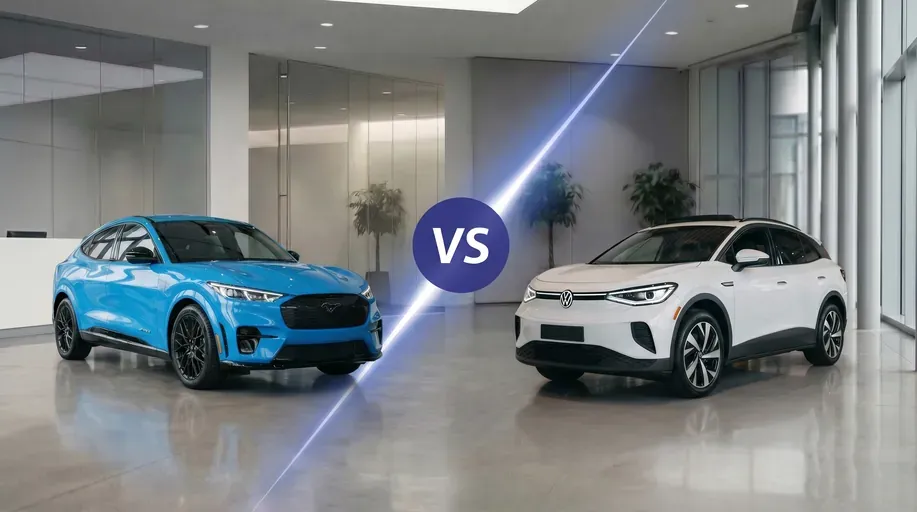
Detailed comparison of the Ford Mustang Mach-E and Volkswagen (VW) ID.4. Discover real-world range data, equipment details, and a clear verdict to help you choose a used EV.
May 18, 2026
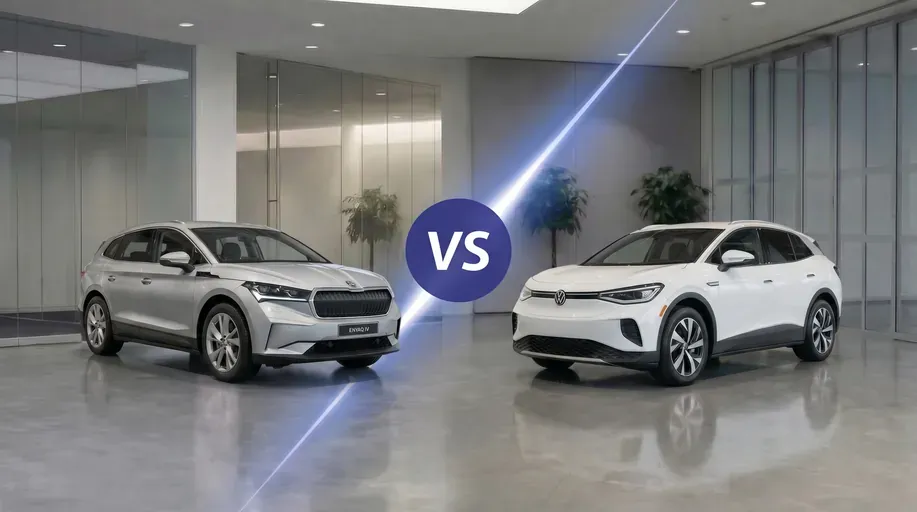
Detailed comparison of the Škoda Enyaq iV vs. Volkswagen (VW) ID.4. Discover the real differences in range, equipment, and reliability, and choose the right electric SUV for you.
Apr 27, 2026