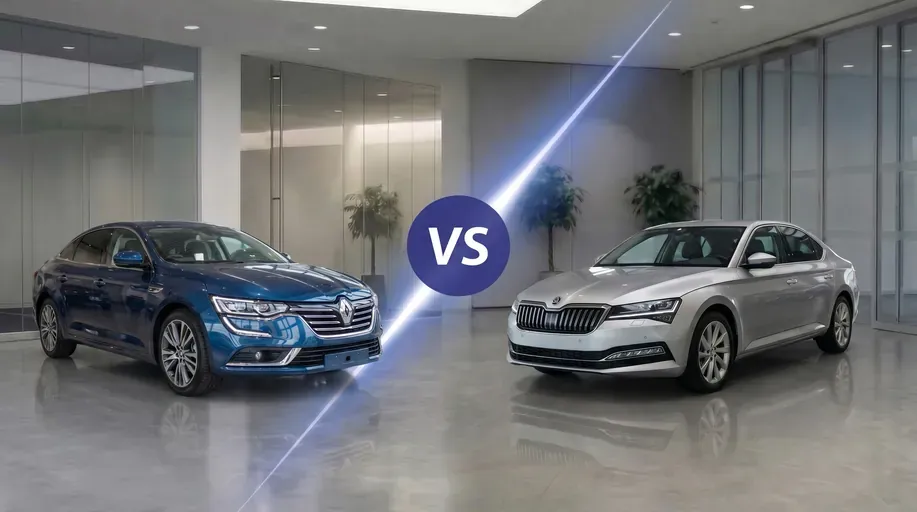
Car battle
Renault Talisman vs. Škoda Superb: Complete comparison 2026
Detailed comparison of Renault Talisman vs. Škoda Superb. Read our used car reviews, comparison of spaciousness, engines, and our final verdict before buying.
Apr 30, 2026
Jaguar XE review: real owner experiences, common faults, running costs and used prices — our complete buying verdict on the saloon.
November 4, 2026

The Jaguar XE represents the British marque's entry in the compact executive segment, designed as an alternative to established German contenders. This guide focuses on the first and only generation, which entered production in April 2015 with European deliveries starting in June 2015. Sold exclusively as a four-door Jaguar XE saloon, series manufacturing officially concluded on 22 May 2024 without a direct combustion-engined replacement.
Jaguar updated the model with a mid-cycle facelift that opened for orders on 26 February 2019, followed by European showroom arrivals in June 2019. The refresh brought revised exterior styling alongside redesigned cabin architecture and updated touch interfaces. Additional revisions were announced on 6 October 2020, bringing a mild-hybrid diesel powertrain and updated infotainment.
On the European pre-owned market, the Jaguar XE primarily attracts buyers seeking distinctive styling and rear-wheel-drive dynamics over class conformity. Across its nine-year production span, it remains a niche consideration in the executive saloon landscape.
Owner experiences with the first-generation Jaguar XE show a clear divide between engine types and production phases. The primary mechanical concern centres on the 2.0-litre diesel engine, particularly on pre-facelift models built between 2015 and 2018. Technical service bulletins and workshop reports indicate that the dual timing chains, which are mounted at the rear of the engine block against the transmission, suffer from premature wear of the plastic tensioner guides and link stretching. The defect begins as a distinct metallic rattling noise on cold starts before oil pressure builds. If ignored, the chain can slip or break, resulting in internal engine damage. Rectifying the issue requires removing the transmission or dropping the engine to install revised chains, sprockets, and tensioners.
A secondary issue on the diesel Jaguar XE involves engine oil dilution. When vehicles are operated predominantly on short urban trips, active diesel particulate filter regenerations are frequently interrupted. Unburnt post-injection fuel seeps past the piston rings into the oil sump, raising the fluid level and degrading lubrication viscosity, which directly accelerates wear on the timing chain guides. Manufacturer software updates adjusted the regeneration triggers, but urban-driven diesels still require shortened oil-drain intervals rather than relying on maximum factory service intervals.
Cabin electronics and chassis components also account for repeated reports. On models produced between 2015 and 2020, owners report software instability with the early infotainment touchscreens, including frozen displays, infinite reboot loops, and momentary loss of reversing camera feeds. Periodic software reflashes resolved many operational errors, while chronic hardware bus faults required module replacement before a newer infotainment generation arrived for the 2021 model year. Additionally, workshop reports note vacuum-assisted engine mounts leaking hydraulic fluid or degrading over time, allowing heavy idle vibration and shudder to reach the steering wheel and cabin.
Several official safety recalls apply to European-specification models across the production run. The most widespread involves long-term chemical degradation of Takata airbag gas generators, alongside later safety actions addressing engine bay fuel lines and turbocharger plumbing. Before committing to a purchase, verifying whether safety campaigns and mechanical updates have been documented or arranging an inspection via CarAudit provides clarity on a specific vehicle's maintenance history.
| Defect in Official Notice | Affected Production Window | Market Reach | Workshop Action |
|---|---|---|---|
| Driver and front passenger airbag gas generator propellant deterioration risking fragment injury | January 2015 – April 2017 | EU and worldwide | Replacement of driver and front passenger airbag modules |
| Turbocharger oil feed pipe clamp loosening and leaking oil onto the road | January 2020 – July 2024 | EU and worldwide | Replacement and tightening of oil feed pipe retaining clamp |
| Front seat belt pre-tensioner tube manufacturing defect risking impaired restraint function | 2022 | EU and worldwide | Inspection and replacement of front seat belt retractor assembly |
| Fuel injector rubber return hose internal wire defect posing a leak and fire risk | November 2019 – April 2021 | EU and worldwide | Replacement of complete fuel return hose assembly |
The Jaguar XE arrived with an extensive engine lineup spanning four-cylinder petrols, diesels, and supercharged six-cylinder units, before rationalising down to an electrified four-cylinder offering later in its life cycle. Rear-wheel drive served as the standard layout, while all-wheel drive was optional or standard on higher-output derivatives.
| Engine | Fuel | Power | Gearbox | Drivetrain | Model years |
|---|---|---|---|---|---|
| 2.0 GTDi 20t | Petrol | 147 kW (200 hp) | 8-speed automatic | RWD | 2015 – 2017 |
| 2.0 GTDi 25t | Petrol | 177 kW (240 hp) | 8-speed automatic | RWD | 2015 – 2017 |
| 2.0 Ingenium 20t | Petrol | 147 kW (200 hp) | 8-speed automatic | RWD | 2017 – 2019 |
| 2.0 Ingenium 25t | Petrol | 184 kW (250 hp) | 8-speed automatic | RWD | 2017 – 2019 |
| 2.0 Ingenium 25t | Petrol | 184 kW (250 hp) | 8-speed automatic | AWD | 2017 – 2018 |
| 2.0 Ingenium P250 | Petrol | 184 kW (250 hp) | 8-speed automatic | RWD | 2019 – 2024 |
| 2.0 Ingenium 30t | Petrol | 221 kW (300 hp) | 8-speed automatic | AWD | 2017 – 2019 |
| 2.0 Ingenium P300 | Petrol | 221 kW (300 hp) | 8-speed automatic | AWD | 2019 – 2024 |
| 3.0 S V6 | Petrol | 250 kW (340 hp) | 8-speed automatic | RWD | 2015 – 2017 |
| 3.0 S V6 | Petrol | 280 kW (380 hp) | 8-speed automatic | RWD | 2017 – 2018 |
| 2.0 E-Performance | Diesel | 120 kW (163 hp) | 6-speed manual | RWD | 2015 – 2019 |
| 2.0 E-Performance | Diesel | 120 kW (163 hp) | 8-speed automatic | RWD | 2015 – 2019 |
| 2.0 20d | Diesel | 132 kW (180 hp) | 6-speed manual | RWD | 2015 – 2019 |
| 2.0 20d | Diesel | 132 kW (180 hp) | 8-speed automatic | RWD | 2015 – 2019 |
| 2.0 20d | Diesel | 132 kW (180 hp) | 8-speed automatic | AWD | 2015 – 2019 |
| 2.0 D180 | Diesel | 132 kW (180 hp) | 8-speed automatic | RWD | 2019 – 2020 |
| 2.0 D180 | Diesel | 132 kW (180 hp) | 8-speed automatic | AWD | 2019 – 2020 |
| 2.0 25d | Diesel | 177 kW (240 hp) | 8-speed automatic | AWD | 2017 – 2019 |
| 2.0 D200 MHEV | Mild-hybrid diesel | 150 kW (204 hp) | 8-speed automatic | RWD | 2021 – 2024 |
| 2.0 D200 MHEV | Mild-hybrid diesel | 150 kW (204 hp) | 8-speed automatic | AWD | 2021 – 2023 |
For urban driving and short daily commutes, petrol engines are the only sensible route. The mid-range four-cylinder petrols, badged 25t or P250, provide the most balanced compromise for mixed use, offering ample overtaking punch paired with the smooth ZF eight-speed automatic. The base petrol delivers adequate pace around town, whereas the high-output 30t and P300 petrols bring sports-car acceleration and all-weather traction from standard all-wheel drive, albeit at the expense of higher real-world fuel consumption. Enthusiasts seeking character should look toward the early supercharged V6 S, which pairs sharp throttle response with an evocative exhaust note.
For frequent long motorway journeys, a diesel Jaguar XE remains the natural choice due to strong low-end pulling power and relaxed cruising ability. The post-facelift D200 mild hybrid represents the most refined diesel option, using a 48V starter-generator that smooths urban stop-start transitions. Drivers planning regular trailer towing or navigating adverse winter conditions will benefit from the all-wheel-drive configurations available across diesel derivatives, which combine high towing capability with superior traction. Manual gearboxes exist only on early entry-level diesels, but the ubiquitous eight-speed automatic suits the chassis far better.
For detailed information regarding mechanical durability, timing gear wear, and fuel dilution risks across these powertrains, refer to the owner experiences section.
| Measurement | Pre-facelift Saloon (2015–2019) | Facelift Saloon (2019–2024) |
|---|---|---|
| Length (mm) | 4,672 | 4,678 |
| Width without / folded mirrors (mm) | 1,850 / 1,967 | 1,850 / 1,967 |
| Height (mm) | 1,416–1,425 | 1,410–1,425 |
| Wheelbase (mm) | 2,835 | 2,835 |
| Boot capacity – seats upright (l) | 455 | 394–410 |
| Boot capacity – seats folded (l) | — | 1,275 |
Mild-hybrid diesel models provide reduced luggage capacity due to underfloor electrical hardware.
The Jaguar XE saloon prioritises a driver-focused, low-slung cockpit over passenger and cargo packaging. In the second row, knee clearance and headroom are noticeably tight for taller adults, hemmed in by the sloping roofline and a bulky centre transmission tunnel. Relatively narrow rear door apertures also require passengers to duck when climbing in and out. Practicality is further compromised by a small boot opening with a tall loading lip, which makes loading bulky, rigid suitcases challenging. Prospective buyers shopping early production years should verify the rear bench configuration, as early pre-facelift models originally arrived with a fixed, one-piece seatback as standard, while a three-way split-folding bench was optional before becoming standard on facelift cars. Additionally, early diesel models require lifting the luggage compartment floor to access the AdBlue tank filler neck rather than housing it behind the exterior fuel flap.
Professional evaluations consistently praise the chassis balance of the Jaguar XE. Testers highlight its direct steering feel, natural weighting, and poised cornering composure without unsettling body lean. The suspension setup effectively cushions broken asphalt, though testers note noticeable tyre roar on larger optional wheels. In early production years, the four-cylinder diesel drew criticism for coarse acoustic clatter and vibration under heavy acceleration, whereas petrol versions operate with calmer cruising refinement.
Inside, early models disappointed road testers due to plain dashboard plastics, unsupportive base front seating lacking standard lumbar adjustment, and sluggish infotainment menus. Outward visibility also drew reproaches for narrow rear glass, though later models mitigated this with an optional digital rear-view mirror.
Professional road tests broadly agree that the mid-cycle facelift addressed the cabin's primary tactile shortcomings. Revised soft-touch dashboard surfaces, a redesigned gear selector, and more responsive touchscreen software brought perceived quality closer to segment expectations. While opinions diverge slightly on whether optional oversized wheels compromise low-speed compliance over rough urban surfaces, reviewers agree on the car's driver-focused dynamics.
All market charts in this section reflect listings of the entire Jaguar XE model family on Carvago, including other generations represented in the data, so they do not establish a separate price level for the reviewed generation alone. In the current offer, the median asking price is €17,000 for 2017 cars, €26,000 for 2020 models, and €46,500 for 2024 vehicles. Stronger asking figures for later model years reflect buyer preference for post-facelift cabin technology and revised powertrains, whereas earlier model years face buyer caution over early diesel maintenance.
Between May 2026 and October 2026, advertised Jaguar XE listings peaked at 332 cars in June before dipping to 280 by October. The chart below tracks how monthly listings changed across this six-month window.
Active listings over time
| Month | Jaguar XE |
|---|---|
| 2026-05 | 324 |
| 2026-06 | 332 |
| 2026-07 | 322 |
| 2026-08 | 304 |
| 2026-09 | 294 |
| 2026-10 | 280 |
Source Carvago
With 280 cars listed in October, buyers maintain a solid pool of vehicles to choose from, though total listings have contracted after June.
Across used Jaguar XE listings advertised today, the median asking price of cars built in 2017 is €17,000, while the median asking price of cars built in 2024 reaches €46,500 across the recorded model years.
Median advertised price by year of manufacture
| Model year | Jaguar XE |
|---|---|
| 2017 | 17 000 |
| 2018 | 19 100 |
| 2019 | 22 000 |
| 2020 | 26 000 |
| 2021 | 28 800 |
| 2022 | 31 000 |
| 2023 | 37 500 |
| 2024 | 46 500 |
Source Carvago
Buyers evaluating available listings today will find a median asking price of €22,000 for cars built in 2019, whereas cars built in 2022 reflect a median asking price of €31,000.
Between May 2026 and October 2026, listings were largely split between diesel and petrol options, opening in May 2026 with 181 diesel and 133 petrol cars on offer. The monthly figures illustrate how available choices compare across powertrains.
Supply composition by fuel type
Petrol
Diesel
Hybrid
| Month | Petrol | Diesel | Hybrid |
|---|---|---|---|
| 2026-05 | 133 | 181 | 10 |
| 2026-06 | 147 | 175 | 10 |
| 2026-07 | 143 | 172 | 7 |
| 2026-08 | 142 | 155 | 7 |
| 2026-09 | 119 | 166 | 9 |
| 2026-10 | 109 | 162 | 8 |
Source Carvago
Diesel remains the most prevalent option, with 162 active listings in October 2026 compared to 109 petrol models and 8 hybrids. Buyers will have the easiest time finding diesel or petrol configurations, whereas hybrid options make up only a small share of the market offer.
Between May 2026 and October 2026, the average asking price for the Jaguar XE began at €18,300 before finishing the period at €17,300.
Average price development over time
| Month | Jaguar XE |
|---|---|
| 2026-05 | 18 300 |
| 2026-06 | 18 300 |
| 2026-07 | 17 300 |
| 2026-08 | 18 000 |
| 2026-09 | 17 300 |
| 2026-10 | 17 300 |
Source Carvago
Across these months, the average fluctuated within a narrow range, rising back up to €18,000 in August before returning to €17,300, representing an overall net decline of around 5%.
Poised chassis balance with direct steering feel and composed cornering
Smooth automatic transmission that pairs well across petrol and diesel engines
Noticeably improved interior materials and infotainment on facelift models
Restricted rear-seat headroom and legroom for taller adult passengers
Small boot opening with a high loading lip that complicates loading luggage
Premature timing chain wear and oil dilution risks on early diesel engines
Reliability depends heavily on the engine and build era. Pre-facelift two-litre diesels built between 2015 and 2018 pose risks of timing chain slack and oil dilution, whereas petrol models and post-facelift cars demonstrate fewer mechanical concerns.
For mixed driving and city use, mid-range four-cylinder petrol Jaguar XE versions like the 25t or P250 deliver the most balanced compromise between pace and day-to-day usability. High-mileage motorway drivers should consider the later mild-hybrid diesel, provided it is spared short urban stop-and-go routines.
Focusing on the Jaguar XE from the 2019 facelift onward is recommended, as the update improved cabin quality and infotainment stability. Later models from 2021 also added mild-hybrid diesels.
Listen for metallic timing chain rattle on cold starts on diesel models and inspect the oil level for fuel dilution. Always verify through the VIN or a CarAudit inspection that all safety recalls have been completed.
Sources: media.jlr.com, jaguar.com, adac.de, ec.europa.eu, autocar.co.uk
This article was prepared using artificial intelligence tools. The section guarantor is Petr Dušek.
Detailed comparison of Renault Talisman vs. Škoda Superb. Read our used car reviews, comparison of spaciousness, engines, and our final verdict before buying.
Apr 30, 2026
Mercedes-Benz C-Class (W206) review: real owner experiences, hybrid engine picks, common faults, running costs, and our final verdict.
Oct 24, 2026
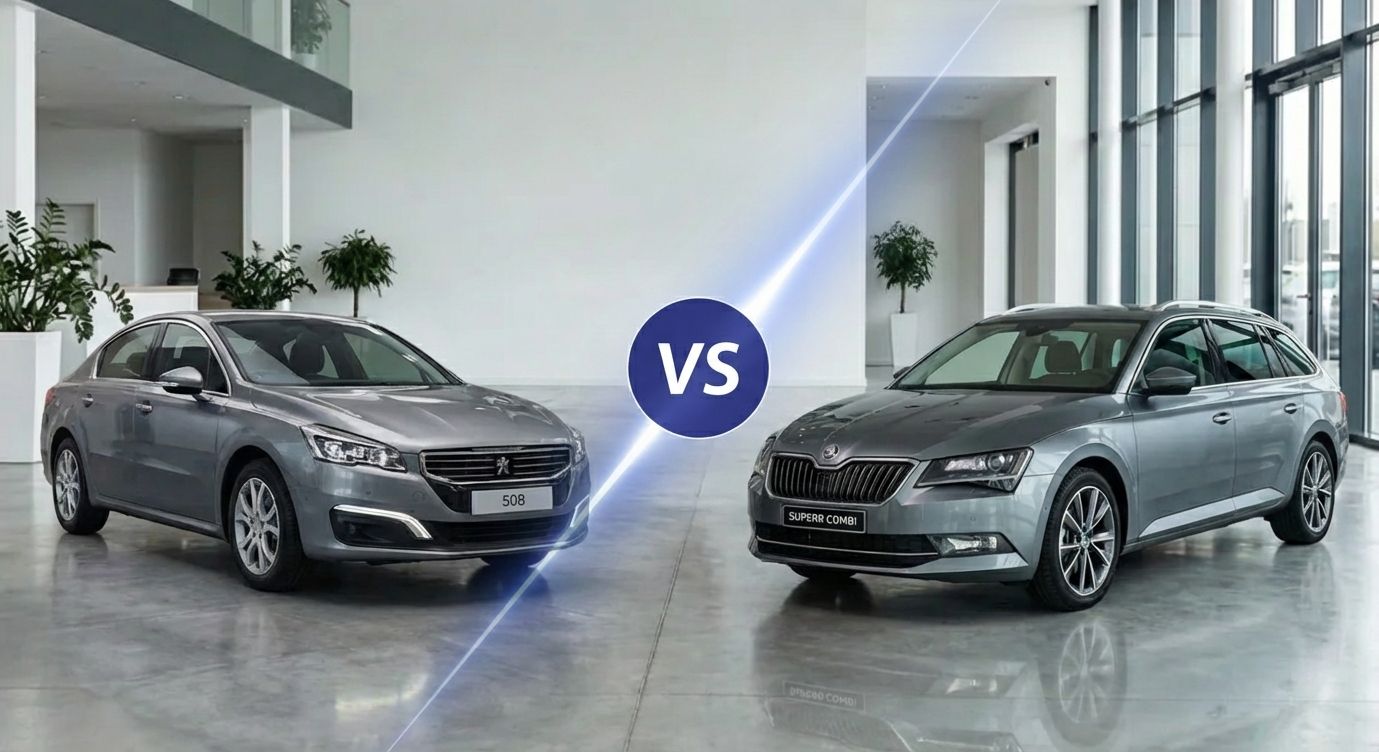
Peugeot 508 vs. Škoda Superb: Detailed comparison, real-world experiences, and the verdict to help you choose the best executive car.
Oct 23, 2026