
Review
Review Volkswagen Caddy: What do owners and experts really say?
Volkswagen Caddy review: real owner experience, common faults, engine picks and practical space — everything you need before you buy.
Oct 18, 2026
Articles
Review
Ford Tourneo Connect review: real owner experience, practicality, engine picks, running costs and verdict — everything you need before you buy.
October 25, 2026

The third-generation Ford Tourneo Connect is a compact passenger van built on shared platform architecture with Volkswagen. This review covers the third generation, which had its European premiere on 12 October 2021, opened for orders in February 2022, and arrived with European customer deliveries in May 2022, with production ongoing in 2026.
Available as either the standard-wheelbase model or the extended Grand Tourneo Connect, it is aimed at families and drivers with active outdoor lifestyles who require modular cabin flexibility. Both body formats feature twin sliding side doors and accommodate either five- or seven-seat seating layouts, with seven seats standard on the Grand Tourneo Connect and optional on the standard-wheelbase model.
Rather than receiving a cosmetic sheet-metal facelift, the generation has evolved through progressive mechanical and cabin updates. An all-wheel-drive option accompanied initial deliveries in May 2022. Ford subsequently revealed a petrol plug-in hybrid variant on 19 March 2024, with first deliveries starting in October 2024. Updates implemented across Europe on 28 July 2026 refreshed the digital cockpit displays and consolidated the engine range to Euro 6e-bis emissions standards.
Because customer deliveries of the third-generation Ford Tourneo Connect only commenced in May 2022, long-term reliability across high mileages is not yet established. The lineup expanded further in late 2024 with the introduction of the plug-in hybrid powertrain, leaving long-term battery and hybrid component durability in its early stages. Most owner feedback to date centres on early-production software stability and minor hardware assembly details rather than mechanical engine failures.
The most frequent owner complaint involves the central infotainment touchscreen and digital interface. Owners report intermittent black screens upon starting the vehicle, unexpected mid-drive restarts, and audio dropouts. Touch-sensitive sliders for cabin temperature and volume adjustments can occasionally prove unresponsive or suffer from noticeable input lag. While owners describe temporary relief by performing an on-screen hard reset, permanent resolution typically requires an authorised dealer to install complete software re-flashes. In isolated persistent cases, workshops have had to replace the display head-unit entirely.
Official safety campaigns on this generation have addressed a handful of assembly defects and emissions compliance adjustments across European markets. These range from structural suspension weld inspections on early production batches to software updates for the reversing camera.
| Issue | Affected Build Dates | Market Scope | Official Remedy |
|---|---|---|---|
| Lower control arm weld | 03 March 2022 – 07 July 2022 | 117 vehicles worldwide | Inspect lower control arms for missing welds and replace non-conforming suspension arms. |
| Reversing camera freeze | 17 August 2023 – 27 March 2024 | 5,423 vehicles worldwide | Install updated camera software; replace the front-end module in select individual cases. |
| Rear brake pipe connection | 07 August 2024 – 28 August 2024 | 999 vehicles worldwide | Inspect rear brake screw connections and install improved brake lines to prevent fluid leaks. |
| Diesel particulate filter (Generation 2) | 12 May 2014 – 19 January 2023 | 1,249,828 vehicles worldwide | Recalibrate particulate filter regeneration software and replace cracked ceramic filter units free of charge. |
The largest regulatory campaign affects the Generation 2 diesel Ford Tourneo Connect alongside several other commercial models. In this case, hairline fractures in the ceramic particulate filter substrate cause tailpipe particle numbers to rise over time, risking failed roadworthiness emissions tests. Authorised workshops inspect the filter assembly, update the powertrain control software, and replace damaged filters without charge.
On the road, tests describe occasional low-speed hesitation from the dual-clutch transmission on automatic Ford Tourneo Connect models, particularly when creeping in stop-and-go traffic or performing three-point turns. Routine wear concerns also apply to the sliding rear side doors, where dirt and road grit can collect in the floor runners over family duties. Before committing to a used vehicle, buyers can confirm maintenance status and outstanding service actions using CarAudit.
The third-generation Ford Tourneo Connect offers a focused powertrain lineup comprising turbocharged petrol and diesel engines alongside a plug-in hybrid option. Power is routed to the front wheels via manual or dual-clutch automatic gearboxes, with all-wheel drive reserved for a single diesel variant.
| Engine | Fuel | Power | Gearbox | Drivetrain | Model Years |
|---|---|---|---|---|---|
| 1.5 EcoBoost | Petrol | 84 kW (114 hp) | 6-speed manual | Front-wheel drive | 2022–2024 |
| 1.5 EcoBoost | Petrol | 84 kW (114 hp) | 7-speed automatic | Front-wheel drive | 2022–2024 |
| 1.5 EcoBoost | Petrol | 85 kW (114 hp) | 6-speed manual | Front-wheel drive | 2024–present |
| 1.5 EcoBoost | Petrol | 85 kW (114 hp) | 7-speed automatic | Front-wheel drive | 2024–present |
| 2.0 EcoBlue | Diesel | 75 kW (102 hp) | 6-speed manual | Front-wheel drive | 2022–present |
| 2.0 EcoBlue | Diesel | 90 kW (122 hp) | 6-speed manual | Front-wheel drive | 2022–2024 |
| 2.0 EcoBlue | Diesel | 90 kW (122 hp) | 7-speed automatic | Front-wheel drive | 2022–present |
| 2.0 EcoBlue AWD | Diesel | 90 kW (122 hp) | 6-speed manual | All-wheel drive | 2022–present |
| 1.5 EcoBoost PHEV | Plug-in Hybrid | 110 kW (150 hp) | 6-speed automatic | Front-wheel drive | 2024–present |
For suburban driving, lower annual mileage, and frequent short journeys, the petrol Ford Tourneo Connect is the simplest starting point. The 1.5 EcoBoost warms up quickly and avoids the diesel particulate filter complications associated with city stop-and-start cycles. However, buyers with regular access to home or workplace charging who spend most of their time in urban environments will benefit more from the hybrid Ford Tourneo Connect. Its plug-in system allows daily urban commuting on electricity alone while retaining petrol backup for longer journeys.
For regular long-distance motorway driving or carrying heavy passenger loads, the diesel Ford Tourneo Connect is the more practical option. While the base 2.0 EcoBlue offers tractable low-end pull, it is sold strictly with a manual gearbox and front-wheel drive. The more powerful 2.0 EcoBlue is better suited to maintaining steady cruising speeds when fully laden, and it can be specified with a dual-clutch automatic Ford Tourneo Connect. Buyers living in mountainous regions or dealing with slick winter roads should look for the Ford Tourneo Connect 4x4, which pairs the stronger diesel with all-wheel drive and a manual Ford Tourneo Connect transmission.
For towing, the stronger diesel variant is the most capable unit across the range. Buyers considering the plug-in hybrid must check the seating layout carefully: while standard-wheelbase hybrid models are approved to tow, the seven-seat long-wheelbase hybrid variant is not factory-certified for towing.
| Parameter | Tourneo Connect (SWB) | Grand Tourneo Connect (LWB) |
|---|---|---|
| Length (mm) | 4,500–4,515 | 4,853–4,868 |
| Width without mirrors (mm) | 1,855 | 1,855 |
| Height (mm) | 1,833–1,851 | 1,835–1,856 |
| Wheelbase (mm) | 2,755 | 2,970 |
| Boot capacity – seats up / folded (l) | 1,213 / 2,556 | 1,720 / 3,105 |
| Boot capacity behind 3rd row (l) | 191 | 446 |
Boot volume figures reflect manufacturer roof-height measurements with rear seats in place and fully removed. Plug-in hybrid versions retain identical luggage capacities due to underfloor battery packaging. Exterior dimension ranges reflect roof rail fitment and body-cladding variations.
The Ford Tourneo Connect delivers straightforward passenger-van practicality, providing an upright seating posture and ample headroom across both rows. In the longer Grand version, the individual third-row seats accommodate adult passengers without forcing knees against the forward backrests.
The second-row bench splits in two sections that fold flat or tumble forward against the front seats to clear a flat load area; both rear rows can also be unlatched and lifted out completely when cargo capacity takes priority over passenger accommodation. Removing the heavy rear chairs requires notable physical effort, and neither row offers fore-and-aft sliding adjustment. Twin sliding side doors ease access in tight parking bays, while the standard folding front passenger seatback permits transporting long cargo through the full length of the cabin.
On the road, the Ford Tourneo Connect behaves with secure composure and direct steering, tracking cleanly at motorway speeds without feeling nervous. However, its tall silhouette inevitably induces body lean through tighter bends. Testers diverge on low-speed ride comfort: while the suspension remains settled over sweeping highway undulations, multiple road tests report that the rear suspension thumps loudly over sharp potholes and transverse seams when traveling unladen. Refinement reflects its commercial-vehicle platform architecture. Tyre rumble on coarse asphalt and wind whistle around the upright windscreen and large door mirrors intrude at sustained cruising speeds. The petrol and diesel engines sound vocal under heavy acceleration, whereas the hybrid Ford Tourneo Connect earns praise for silent low-speed operation in electric mode.
Cabin build quality prioritises utility over tactile appeal. Interior assembly fits tightly with even panel gaps, yet rigid plastics cover the dashboard and door casings without soft-touch surfaces. Ergonomics draw universal criticism across professional evaluations. The infotainment system absorbs ventilation and temperature settings into digital submenus, and the touch-sensitive sliders beneath the screen lack backlighting, making adjustments awkward in darkness. The absence of physical rotary controls for cabin climate compromises ease of operation while driving.
Professional testers reach broad consensus on the model: they commend its predictable, car-like roadholding, but remain uniformly critical of the distracting digital switchgear and cost-conscious interior plastics.
All charts in this section reflect advertised listings across the broader Ford Tourneo Connect model family, including earlier generations present in the market data, rather than isolating the reviewed generation alone. Because listings are grouped strictly by production year, the dataset does not establish a separate price level for the latest generation.
Higher price bands typically reflect recent deliveries, factory options such as extended wheelbases, and preferred diesel automatic configurations.
Active listings for the Ford Tourneo Connect ranged between 1,597 in April 2026 and a peak of 1,802 in June 2026, as detailed in the monthly figures below.
Active listings over time
| Month | Ford Tourneo Connect |
|---|---|
| 2026-04 | 1 597 |
| 2026-05 | 1 653 |
| 2026-06 | 1 802 |
| 2026-07 | 1 768 |
| 2026-08 | 1 662 |
| 2026-09 | 1 746 |
Source Carvago
Buyers can expect a substantial volume of choices across the market, with available listings fluctuating within a relatively narrow range before finishing at 1,746 in September 2026.
The median asking price of cars advertised today built in 2019 is €17,500, compared to €36,000 for models built in 2026. The chart below outlines how asking figures differ across each build year.
Median advertised price by year of manufacture
| Model year | Ford Tourneo Connect |
|---|---|
| 2019 | 17 500 |
| 2020 | 19 000 |
| 2021 | 20 400 |
| 2022 | 24 800 |
| 2023 | 29 000 |
| 2024 | 33 000 |
| 2025 | 34 800 |
| 2026 | 36 000 |
Source Carvago
Buyers considering earlier vehicles from 2019 to 2021 find median asking prices between €17,500 and €20,400. Those looking at newer examples from 2024 to 2026 see median figures between €33,000 and €36,000.
This depreciation curve illustrates how the model's residual value falls with vehicle age. Over its first three years, it loses approximately 26% of its initial value, after shedding just 4% in year one.
Residual value by vehicle age
| Vehicle age | Ford Tourneo Connect |
|---|---|
| New | 34 800 |
| 1 yr | 33 400 |
| 2 yrs | 29 400 |
| 3 yrs | 25 600 |
| 4 yrs | 23 200 |
| 5 yrs | 19 100 |
| 6 yrs | 17 200 |
| 7 yrs | 15 400 |
Source Carvago
Across the full seven-year span, the car sheds around 56% of its initial residual value. The sharpest annual drop occurs between four and five years of age, beyond which losses ease to roughly 10% per year.
The volume of advertised vehicles shows a clear split by powertrain, opening in April 2026 with 1125 diesel listings alongside 290 petrol models as detailed in the monthly figures below.
Supply composition by fuel type
Petrol
Diesel
Hybrid
Electric
LPG
| Month | Petrol | Diesel | Hybrid | Electric | LPG |
|---|---|---|---|---|---|
| 2026-04 | 290 | 1 125 | 179 | 1 | 1 |
| 2026-05 | 320 | 1 147 | 184 | 0 | 1 |
| 2026-06 | 335 | 1 261 | 203 | 0 | 2 |
| 2026-07 | 313 | 1 218 | 234 | 0 | 1 |
| 2026-08 | 274 | 1 151 | 236 | 0 | 1 |
| 2026-09 | 262 | 1 217 | 267 | 0 | 0 |
Source Carvago
In September 2026, diesel led the available inventory with 1217 listings, while hybrid models accounted for 267 and petrol vehicles stood at 262. Buyers will find the widest selection by far among diesel variants, with hybrid and petrol cars offering a smaller, comparable pool of alternatives.
Between April 2026 and September 2026, the average asking price for the Ford Tourneo Connect ranged from €28,900 to €30,100 across advertised listings. The monthly figures over this six-month span are shown below.
Average price development over time
| Month | Ford Tourneo Connect |
|---|---|
| 2026-04 | 29 000 |
| 2026-05 | 28 900 |
| 2026-06 | 29 000 |
| 2026-07 | 29 000 |
| 2026-08 | 29 400 |
| 2026-09 | 30 100 |
Source Carvago
After holding near €29,000 between April and July 2026, the average moved up to €29,400 in August and reached €30,100 in September. Across the entire six months, the average asking price rose by just under 4%.
Highly versatile cabin layout with twin sliding side doors and fully removable rear seats
Predictable, car-like roadholding and reassuring high-speed stability
Varied powertrain lineup including all-wheel drive and plug-in hybrid options
Distracting digital climate controls with unbacklit touch-sensitive sliders
Firm unladen rear suspension over sharp bumps and noticeable cabin noise at cruising speeds
Intermittent infotainment screen freezing, system reboots, and sluggish touch inputs
Because European customer deliveries only began in May 2022, long-term reliability for the Ford Tourneo Connect across high mileages is not yet established. Most reported owner issues involve central touchscreen software glitches and unresponsive touch sliders rather than mechanical engine failures.
The petrol engine suits suburban driving and short journeys, while the stronger diesel Ford Tourneo Connect is the most capable choice for sustained motorway cruising or hauling heavy loads. Buyers with regular charging access will get the most efficiency from the plug-in hybrid for urban commuting.
Petrol and diesel variants can tow trailers, as can the standard-wheelbase plug-in hybrid. However, the seven-seat long-wheelbase hybrid model is not factory-approved for towing.
Check the vehicle's VIN with an authorised dealer to confirm all official recall campaigns have been completed. On a cold start, verify that the central display and touch sliders respond without freezing or restarting.
Sources: ford.co.uk, adac.de, ec.europa.eu, autocar.co.uk, autoexpress.co.uk
This article was prepared using artificial intelligence tools. The section guarantor is Petr Dušek.
Volkswagen Caddy review: real owner experience, common faults, engine picks and practical space — everything you need before you buy.
Oct 18, 2026
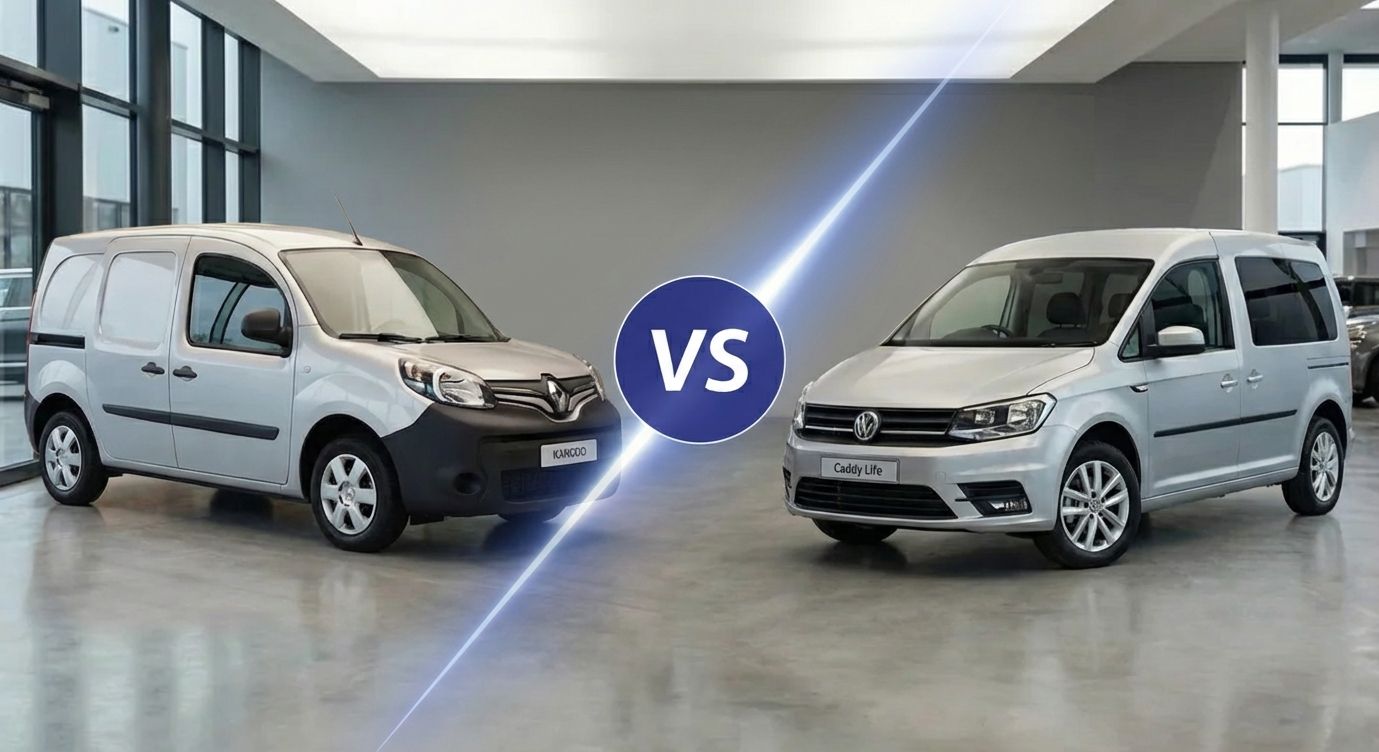
Renault Kangoo or Volkswagen Caddy? Our detailed comparison reveals the key differences and helps you decide which car is right for you.
Oct 16, 2026

Detailed comparison of Ford Tourneo Connect vs. Mercedes-Benz Citan Tourer. Discover the real differences in space, equipment, and reliability. Which car to choose?
Apr 13, 2026