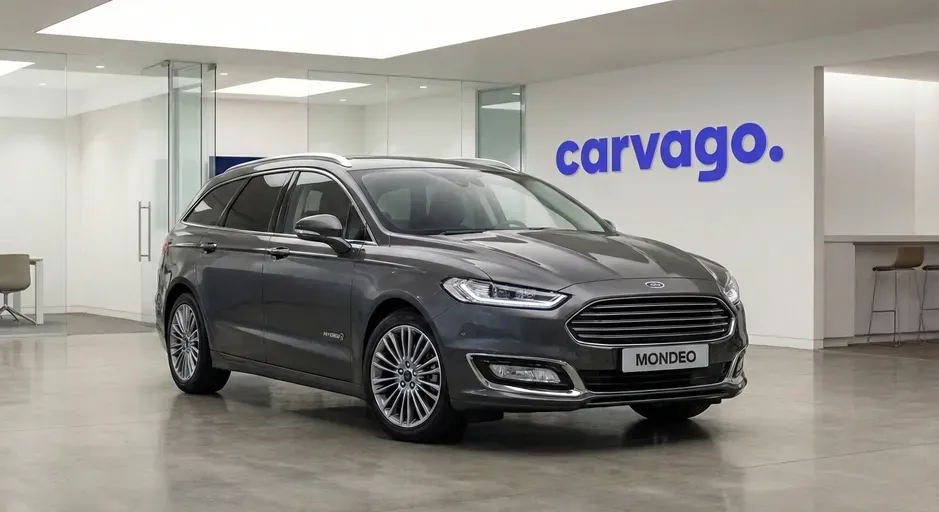
Review Ford Mondeo: What do owners and experts really say?
Ford Mondeo (2014–2022) review: real owner experience, reliability, running costs and used prices — everything you need before you buy.
November 7, 2026
Verdict at a Glance
Who it suits: Long-distance motorway commuters and families prioritising cruising composure and cargo capacity over high-riding crossovers.
Recommended engine: The post-facelift 2.0 EcoBlue diesel paired with the eight-speed automatic for relaxed motorway cruising.
What to avoid: Pre-facelift dual-clutch automatics lacking documented fluid changes, and any car without verified recall repairs.
Introduction
The fourth-generation Ford Mondeo represents the final European chapter of the brand's long-running mid-size family and fleet nameplate. European production commenced in October 2014, with first customer deliveries arriving in January 2015. Manufacturing at the Valencia plant in Spain concluded on 30 March 2022, ending the Mondeo line without a direct successor in Europe.
Ford offered this generation in three distinct body configurations: a practical five-door Ford Mondeo hatchback, a load-carrying Ford Mondeo estate, and a four-door saloon dedicated primarily to hybrid powertrains. A mid-cycle update was unveiled on 18 January 2019 at the Brussels Motor Show, reaching showrooms for first customer deliveries in March 2019. This revision brought refreshed exterior detailing, new diesel units, an eight-speed automatic gearbox operated via a rotary dial, and expanded hybrid availability to the estate body style.
As a used purchase, this generation appeals primarily to company-car fleets, long-distance motorway commuters, and families who prioritise highway composure, high cargo capacity, and low running costs over high-riding crossovers.
Owner Experiences: Common Faults and Recalls
On the European used market, owner reports and workshop data for the fourth-generation Ford Mondeo highlight several recurring mechanical patterns. The most widely discussed powertrain issue involves the pre-facelift six-speed dual-clutch automatic transmission paired with earlier 2.0 TDCi diesel engines. Tests and owners describe low-speed shuddering during take-off, hesitant downshifts, and delayed reverse engagement. These symptoms typically stem from degraded transmission fluid and suspended clutch debris contaminating the hydraulic valve bodies. While adhering strictly to transmission fluid and external filter renewals every 3 years or 60,000 km prevents minor hesitation, neglected units frequently develop clutch pack slippage or require hydraulic control unit rebuilds. Later eight-speed torque-converter automatics and hybrid electronic continuously variable transmissions do not share these dual-clutch complications.
Petrol variants demand specific scrutiny regarding cooling system integrity. On four-cylinder 1.5 EcoBoost petrol engines manufactured from 2014 to 2019, official manufacturer service bulletins and professional tests record internal coolant loss without visible external leaks. The issue is caused by the cylinder block cooling channel design between the bores, which can allow coolant to breach the head gasket or induce cylinder liner cracking, resulting in white exhaust smoke and cold-start misfires. When the engine deck has warped, replacing the cylinder head gasket does not provide a lasting repair; permanent resolution requires a redesigned engine short block featuring revised cooling passages. On diesel Ford Mondeo models driven predominantly on short urban trips, tests describe compromised particulate filter regenerations and exhaust vaporiser glow plug fouling, which can lead to engine oil dilution.
Chassis and electrical reports focus on wear items and peripheral modules. Owners report that rear suspension trailing arm bushes deteriorate over time, leading to unstable tracking over mid-corner road imperfections and accelerated tyre wear along the inner tread shoulders. In the cabin and body hardware, owners report occasional failures of the electronic tailgate release mechanism, fitted optionally or on higher trims, as well as spurious driver assistance or instrument cluster warnings provoked by declining 12-volt battery voltage.
Official European recall databases record several safety campaigns affecting this generation, covering chassis components, electrical sub-assemblies, and emissions hardware.
Recalibrate engine control software, inspect filter structural integrity, and replace cracked particulate filters.
Emergency call (eCall) loss of function (Passenger car range)
14/11/2019 – 12/11/2020
Update Telematics Control Unit software.
Front flexible brake hose leakage (Passenger car range)
14/08/2014 – 08/07/2017
Replace both front flexible brake hoses and modify hose routing.
Battery monitor sensor thermal incident (Passenger car range)
13/02/2014 – 11/02/2019
Install a fused jumper loom into the battery monitor sensor wiring harness.
Clutch pressure plate fracture (EcoBoost petrol with manual gearbox)
30/06/2016 – 30/05/2018
Recalibrate software to detect clutch slippage or install an updated clutch assembly.
Adaptive LED headlamp shut-off (Models with optional dynamic LED headlamps)
03/05/2014 – 22/12/2015
Update Headlamp Control Module software.
🔍 What to check before buying
Verify recall completion by VIN: Check with an authorised dealer or arrange an inspection via CarAudit to confirm that all applicable safety actions—including front brake hose replacement, battery sensor wiring protection, and EcoBlue particulate filter checks—have been officially carried out.
Test dual-clutch transmission behaviour: On pre-facelift automatics, ensure smooth pull-away from a standstill, prompt reverse gear engagement, and verify documented evidence of oil and filter changes every 3 years or 60,000 km.
Inspect coolant levels on 1.5 EcoBoost: Check the expansion reservoir for unexplained coolant loss, observe cold-engine exhaust for white smoke, and check for rough idling after a cold start.
Check rear suspension trailing arm bushes: Inspect the rubber mounting bushes for perishing or play, and check the rear tyres for uneven wear across the inner shoulders.
Test electrical and convenience functions: Ensure the electronic tailgate latch operates cleanly, confirm the rear-view camera display functions normally, and check that the 12-volt battery maintains sufficient charge.
Engines: Which One to Choose
Across its production run, the fourth-generation Ford Mondeo offered a wide spread of turbocharged petrol, diesel, and petrol-electric hybrid powertrains. The engine range underwent a comprehensive revision in 2019, when new EcoBlue diesels and an eight-speed torque-converter automatic replaced the earlier TDCi units and dual-clutch transmissions.
Engine
Fuel
Power
Gearbox
Drivetrain
Model years
1.0 EcoBoost
Petrol
92 kW (125 hp)
6-speed manual
Front-wheel drive
2015–2018
1.5 EcoBoost
Petrol
118 kW (160 hp)
6-speed manual / 6-speed automatic
Front-wheel drive
2014–2018
1.5 EcoBoost
Petrol
121 kW (165 hp)
6-speed manual / 6-speed automatic
Front-wheel drive
2018–2020
2.0 EcoBoost
Petrol
149 kW (203 hp)
6-speed automatic
Front-wheel drive
2014–2018
2.0 EcoBoost
Petrol
177 kW (240 hp)
6-speed automatic
Front-wheel drive
2014–2018
2.0 Ti-VCT Hybrid
Petrol Full Hybrid
138 kW (187 hp)
e-CVT automatic
Front-wheel drive
2014–2022
1.6 TDCi ECOnetic
Diesel
85 kW (115 hp)
6-speed manual
Front-wheel drive
2014–2015
1.5 TDCi ECOnetic
Diesel
88 kW (120 hp)
6-speed manual
Front-wheel drive
2015–2019
2.0 TDCi
Diesel
110 kW (150 hp)
6-speed manual / 6-speed dual-clutch
Front-wheel drive / All-wheel drive
2014–2019
2.0 TDCi
Diesel
132 kW (180 hp)
6-speed manual / 6-speed dual-clutch
Front-wheel drive / All-wheel drive
2014–2019
2.0 TDCi Bi-Turbo
Diesel
154 kW (210 hp)
6-speed dual-clutch
Front-wheel drive
2015–2018
2.0 EcoBlue
Diesel
88 kW (120 hp)
6-speed manual
Front-wheel drive
2019–2020
2.0 EcoBlue
Diesel
110 kW (150 hp)
6-speed manual / 8-speed automatic
Front-wheel drive
2019–2022
2.0 EcoBlue
Diesel
140 kW (190 hp)
8-speed automatic
Front-wheel drive / All-wheel drive
2019–2022
Which engine to choose as a used buy
For urban driving and frequent short commutes, the hybrid Ford Mondeo is the most suitable option, delivering smooth low-speed progress without the diesel emission hardware concerns of urban driving. In contrast, the three-cylinder 1.0 EcoBoost struggles with the physical bulk of this chassis and demands heavy throttle inputs to maintain pace, making it difficult to recommend.
For mixed everyday commuting, the four-cylinder 1.5 EcoBoost serves moderate annual mileages well, provided it is paired with a verified service record. Buyers covering higher mileages on regional routes will find the mid-output 2.0 EcoBlue diesel an easy compromise between running costs and flexible overtaking capability.
For regular long-distance motorway travel, a diesel Ford Mondeo remains the default pick. The post-facelift 2.0 EcoBlue paired with the eight-speed torque-converter automatic operates at low engine revolutions at highway speeds and delivers relaxed cruising manners. Among pre-facelift cars, the stronger single-turbo 2.0 TDCi is more composed on open roads than the smaller diesels, whereas the bi-turbo flagship delivers brisk initial pace but offers limited tangible advantage over the single-turbo unit during steady high-speed driving.
For towing caravans or trailers, the high-output 2.0 EcoBlue or 2.0 TDCi with all-wheel drive provides the required pulling reserves and the highest certified capacities. The hybrid powertrain is poorly suited to heavy hauling due to strict trailer limits.
For detailed analysis of known mechanical vulnerabilities, cooling circuit designs, and transmission maintenance requirements, consult the Owner experiences section.
Space & Practicality
Body Style
Exterior Dimensions (L × W × H, mm)
Wheelbase (mm)
Boot Capacity (Seats Up / Folded, l)
5-door Hatchback
4,871 × 1,852 × 1,482
2,850
550 / 1,446
5-door Estate
4,867 × 1,852 × 1,501
2,850
525 / 1,630
5-door Estate (Hybrid)
4,867 × 1,852 × 1,501
2,850
403 / 1,508
4-door Saloon (Hybrid)
4,871 × 1,852 × 1,482
2,850
383 / —
Standard luggage capacities reflect vehicles equipped with a tyre repair kit; fitting an optional temporary or full-size spare wheel reduces available cargo room. The saloon hybrid does not offer an ISO-measured seats-folded volume due to its fixed battery bulkhead.
Thanks to its long wheelbase, the Ford Mondeo provides expansive rear legroom, allowing tall adults to sit comfortably behind tall front occupants without their knees contacting the seatbacks. Headroom is noticeably more accommodating in the Ford Mondeo Estate than under the tapering roofline of the Ford Mondeo Hatchback. Buyers fitting child seats should verify whether optional inflatable rear seatbelts impede child-seat installation. Everyday practicality is strongest in the combustion-engined models, where the estate features a wide, low load sill and an unobstructed floor, while the hatchback counters with a massive tailgate aperture. Choosing the hybrid Ford Mondeo requires practical compromises: the estate hybrid incorporates a raised floor section over the high-voltage battery pack that creates a stepped loading area, and the saloon hybrid sacrifices folding seat versatility entirely.
What the Tests Say
Professional road tests consistently praise the Ford Mondeo for its relaxed motorway ride. The suspension prioritises compliance over agility, absorbing undulations and coarse surfaces effectively, particularly when equipped with optional adaptive dampers. However, handling characteristics divided reviewers. While the chassis remains stable in everyday traffic, testers found it softer and less engaging, noting that the steering lacks road feel under load and the body can feel unsettled through sudden direction changes. Acoustic refinement on diesel models is widely commended, with wind and road noise isolated well at sustained cruising speeds.
Cabin execution receives mixed reviews. Although assembly is durable, material quality trails key segment rivals due to hard lower dashboard plastics and switchgear that lacks damped tactile feedback. The front seats provide decent comfort on straight roads but lack lateral support in bends, while taller passengers find the rear head restraints positioned too low. Testers also criticised the pre-facelift touchscreen infotainment system for sluggish responses and delayed menu transitions.
Tests agree that the updated Ford Mondeo Estate maintained the model's pliant ride after the 2019 facelift. However, verdicts diverged sharply on the hybrid Ford Mondeo. While quiet and relaxed in low-speed urban conditions, the hybrid was criticised during motorway overtakes, where sudden acceleration causes the engine to rev continuously and drone through the automatic transmission. Testers also noted that its driver assistance systems felt dated compared to newer rivals.
Prices and Market Offer
All the charts in this section are drawn from Carvago listings across the entire Ford Mondeo model family, including other generations represented in the data, rather than the reviewed generation alone, so this data does not establish a separate price level for the reviewed generation. In today's market snapshot, the median asking price sits at €11,600 for 2015 models, stands at €17,500 for 2019 models, and reaches €20,000 for 2022 examples. Differences between model years primarily reflect variations in powertrain choices, body styles, and overall mileage across the offered vehicles.
The chart tracks the volume of advertised Ford Mondeo listings month by month, sliding from 1,173 active listings in May 2026 down to 830 by October 2026.
Ford Mondeo - availability over time
Active listings over time
Month
Ford Mondeo
2026-05
1 173
2026-06
1 114
2026-07
1 065
2026-08
984
2026-09
961
2026-10
830
Source Carvago
Available stock declined continuously across all six months, though buyers still have over 800 active vehicles to compare.
Across used listings advertised today, the median asking price for a Ford Mondeo built in 2015 is €11,600, with each subsequent model year priced higher up to €20,000 for cars built in 2022.
Ford Mondeo - median price by model year
Median advertised price by year of manufacture
Model year
Ford Mondeo
2015
11 600
2016
12 500
2017
14 000
2018
16 200
2019
17 500
2020
18 000
2021
19 000
2022
20 000
Source Carvago
A buyer targeting 2015 models faces a median asking price of €11,600, while stepping up to 2018 examples requires €16,200, and 2022 listings stand at €20,000.
Between May and October 2026, diesel accounted for the largest share of advertised cars, beginning at 779 listings in May 2026 alongside 278 hybrids. The chart below shows how the monthly volume of active listings changed across each fuel type.
Ford Mondeo - supply by fuel over time
Supply composition by fuel type
Petrol
Diesel
Hybrid
LPG
Month
Petrol
Diesel
Hybrid
LPG
2026-05
115
779
278
1
2026-06
102
750
261
1
2026-07
87
723
253
1
2026-08
80
662
240
1
2026-09
76
663
221
1
2026-10
67
604
158
1
Source Carvago
In October 2026, diesel remained the most widely available option with 604 listings, followed by 158 hybrids, 67 petrol models, and 1 LPG vehicle. Buyers will realistically find the greatest choice among diesel models, while petrol options offer a far more limited selection.
The average asking price for advertised Ford Mondeo listings stood at €15,600 in May 2026, easing slightly to €15,300 in June 2026, as illustrated in the data below.
Ford Mondeo - price trend over time
Average price development over time
Month
Ford Mondeo
2026-05
15 600
2026-06
15 300
2026-07
15 200
2026-08
15 100
2026-09
14 900
2026-10
14 900
Source Carvago
Across the recorded span, the monthly average shifted from €15,600 to €14,900 by October 2026—a minor overall movement of under 5 percent, with figures holding steady across the final two months.
Practical cargo capacity with wide load apertures on combustion models
Cons
Pre-facelift dual-clutch automatics prone to low-speed shudder and clutch wear
Compromised boot packaging and stepped load floors on hybrid variants
Hard cabin plastics and sluggish response times on earlier infotainment systems
Frequently asked questions
Is a used Ford Mondeo reliable?
Overall reliability is sound provided you avoid early dual-clutch automatic diesels and early 1.5 EcoBoost petrol engines prone to coolant leaks. Facelifted models from 2019 onwards and the hybrid Ford Mondeo are significantly less troublesome choices.
Which engine is best for long motorway journeys?
The post-facelift 2.0 EcoBlue diesel Ford Mondeo paired with the eight-speed automatic is the most capable motorway cruiser, operating with low engine speeds and strong acoustic refinement. It is poorly suited to frequent short urban trips, however, where diesel running gear struggles to reach operating temperature.
Which model year is the best used buy?
Models built from 2019 onwards represent the lowest ownership risk because Ford replaced the dual-clutch transmission with an eight-speed torque-converter automatic. On earlier Ford Mondeo cars, choose a manual gearbox or verify documented evidence of regular transmission fluid renewals.
What should be checked before buying?
Confirm with an authorised dealer or through CarAudit that all official safety recalls have been completed by VIN. On pre-facelift automatics, test thoroughly for low-speed shuddering or delayed engagement from a standstill.