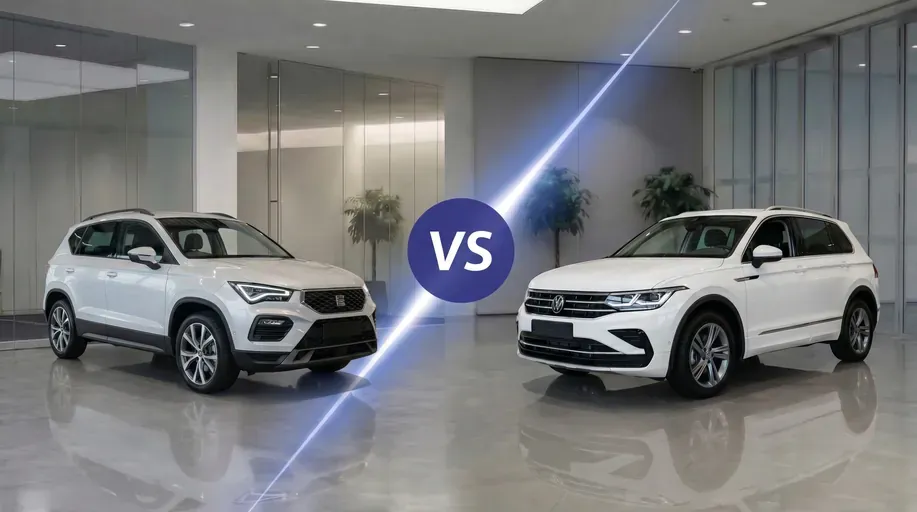
Car battle
Seat Ateca vs. Volkswagen Tiguan: Complete comparison 2026
Seat Ateca vs. Volkswagen Tiguan: Which used SUV is better? Read our detailed comparison of engines, space, and equipment and discover your winner.
May 14, 2026
Ford Kuga review: real owner experience, hybrid engine picks, common faults, running costs and prices — everything you need before you buy.
October 17, 2026

The third-generation Ford Kuga sits squarely in the competitive compact crossover segment. Following its world premiere in April 2019, European order books opened in December 2019, with the first customer deliveries arriving in March 2020. A full hybrid variant joined the initial petrol, diesel, and plug-in hybrid lineup in October 2020.
A mid-cycle revision was revealed on 17 January 2024, introducing refreshed exterior styling, revised hybrid powertrains, and a restructured engine range that saw diesel options completely discontinued. Customer deliveries of the facelifted models commenced across Europe in April 2024.
Offered exclusively as a five-door Ford Kuga SUV, this generation is designed primarily for family buyers and fleet drivers seeking a practical mid-size vehicle with versatile rear seating, straightforward daily usability, and electrified options tailored for urban commutes or routine towing.
Official European safety registers and workshop bulletins show that third-generation Ford Kuga models have been subject to several safety recalls, predominantly focused on fire prevention in early production runs. Facelifted models built between 2024 and 2026 have already been subject to a safety recall (campaign 26S62) affecting 35,545 vehicles to address wiring harness chafing in the engine bay that presents a fire risk.
Hybrid powertrains account for the most extensive recall actions. For the hybrid Ford Kuga, an official campaign announced in March 2024 affected full hybrid and plug-in hybrid variants built between 23 July 2019 and 20 April 2023, covering 336,754 vehicles worldwide. In these models, internal engine damage from crankshaft or connecting rod bearing failure could cause an engine block rupture and underhood fire. Workshops update the engine control software to detect bearing wear and modify the lower engine shield with drain louvres. In May 2026, an additional worldwide recall covering 252,972 plug-in hybrids built between 02 August 2019 and 31 March 2026 addressed high-voltage battery cells prone to internal short circuits. Dealerships update battery control software to cap charging thresholds and enlarge buffer capacity, or replace defective battery modules. However, owners report that this software calibration permanently curtails practical pure-electric driving range.
Petrol and diesel variants have separate verified issues. Across the petrol Ford Kuga lineup, 1.5-litre EcoBoost engines built between 19 November 2018 and 28 May 2024 were subject to recalls announced in March 2024 and February 2026 due to cracked high-pressure fuel injectors leaking onto the hot engine block. Authorised repairs involve updating control software to detect pressure drops, fitting physical cylinder-head drain tubes, and replacing cracked injectors. For pre-facelift diesel Ford Kuga models produced between 2020 and 2023, workshop bulletins and owner reports confirm that the 1.5-litre EcoBlue diesel is prone to premature stretching of its camshaft interconnecting chain. This causes metallic ticking on cold starts and risks severe valvetrain damage before the timing belt interval, prompting an official workshop repair kit with an upgraded chain.
Auxiliary electrical issues represent another repeated complaint. Professional tests and owner reports verify that hybrid variants frequently suffer from discharged 12V auxiliary batteries. Parasitic current drain from onboard telematics and keyless entry systems depletes the battery during inactivity or short journeys, leading to deep sleep system alerts, unresponsive start buttons, or an unmovable electric parking brake. Revised management software and retrofitting an Absorbent Glass Mat (AGM) battery help resolve the condition. Before completing a purchase, having a specific car verified by an independent inspection service such as CarAudit provides valuable reassurance regarding past software campaigns and general wear.
| Date Announced | Powertrain | Build Window | Defect and Workshop Action |
|---|---|---|---|
| September 2026 | Facelift models | 2024 – 2026 | Wiring harness chafing against fixing screws. Risk of loss of motive power and underhood fire. |
| May 2026 | Plug-in hybrid (PHEV) | 02/08/2019 – 31/03/2026 | High-voltage battery cell internal short circuit causing fire hazard. Battery control software updated to cap charging limits; degraded modules replaced. |
| February 2026 | 1.5 EcoBoost petrol | 19/11/2018 – 28/05/2024 | Cracked high-pressure fuel injector leaking onto engine block. Software update, drain tube check, and replacement of defective injectors. |
| March 2024 | 2.5 FHEV & PHEV | 23/07/2019 – 20/04/2023 | Bearing failure risking engine block rupture and fire. Engine software updated to monitor bearings; drain louvres added to lower acoustic shield. |
| March 2024 | 1.5 EcoBoost petrol | 25/11/2022 – 19/12/2023 | High-pressure fuel injector rupture. Installation of a physical fuel drain tube in the cylinder head and replacement of cracked injectors. |
The third-generation Ford Kuga launched with petrol, diesel, and plug-in hybrid options, but the powertrain strategy shifted significantly over its life cycle. By the arrival of the 2024 facelift, all EcoBlue diesel engines were discontinued across Europe, focusing the line-up on petrol and electrified setups.
| Engine | Fuel | Power | Gearbox | Drivetrain | Model years |
|---|---|---|---|---|---|
| 1.5 EcoBoost | Petrol | 88 kW (120 hp) | 6-speed manual | FWD | 2020–2022 |
| 1.5 EcoBoost | Petrol | 110 kW (150 hp) | 6-speed manual | FWD | 2020–2024 |
| 1.5 EcoBoost | Petrol | 111 kW (150 hp) | 6-speed manual | FWD | 2024–present |
| 1.5 EcoBoost | Petrol | 137 kW (186 hp) | 8-speed automatic | FWD | 2024–present |
| 1.5 EcoBlue | Diesel | 88 kW (120 hp) | 6-speed manual | FWD | 2020–2023 |
| 1.5 EcoBlue | Diesel | 88 kW (120 hp) | 8-speed automatic | FWD | 2020–2023 |
| 2.0 EcoBlue mHEV | Diesel | 110 kW (150 hp) | 6-speed manual | FWD | 2020–2021 |
| 2.0 EcoBlue | Diesel | 140 kW (190 hp) | 8-speed automatic | AWD | 2020–2023 |
| 2.5 Duratec FHEV | Hybrid | 140 kW (190 hp) | e-CVT | FWD | 2020–2024 |
| 2.5 Duratec FHEV | Hybrid | 140 kW (190 hp) | e-CVT | AWD | 2020–2024 |
| 2.5 Duratec FHEV | Hybrid | 132 kW (180 hp) | e-CVT | FWD | 2024–present |
| 2.5 Duratec FHEV | Hybrid | 134 kW (183 hp) | e-CVT | AWD | 2024–present |
| 2.5 Duratec PHEV | Plug-in Hybrid | 165 kW (225 hp) | e-CVT | FWD | 2020–2024 |
| 2.5 Duratec PHEV | Plug-in Hybrid | 178 kW (243 hp) | e-CVT | FWD | 2024–present |
For city driving and suburban commuting, the plug-in hybrid makes practical sense if home charging is available, enabling daily journeys purely on electric power without engaging the petrol engine. Those lacking home wallboxes will find the full-hybrid petrol version more convenient for mixed urban use, as its self-charging system operates without external cables and uses an automatic planetary transmission.
Drivers covering long motorway distances should look at the discontinued diesels as a used buy. The larger two-litre diesel delivers strong mid-range pull, whereas the smaller 1.5-litre diesel suits steady cruising but feels strained during high-speed overtaking when carrying passengers.
The entry three-cylinder petrol engine provides a light front end and smooth manual shifting for general suburban duties, and gained a 137 kW (186 hp) automatic option during the 2024 facelift. Buyers needing all-weather traction or pulling power for towing should seek out the all-wheel-drive versions, particularly the updated full hybrid or the original larger diesel.
For known mechanical defects, safety recalls, and high-voltage battery service campaigns across these powertrains, refer to the owner experiences section.
| Variant | Dimensions (L × W × H, mm) | Wheelbase (mm) | Boot volume (seats up / folded, l) |
|---|---|---|---|
| Pre-facelift (petrol, diesel, full hybrid) | 4,614–4,629 × 1,883 × 1,650–1,680 | 2,710 | 475–645 / 1,534 |
| Pre-facelift plug-in hybrid (traction battery under floor) | 4,614–4,629 × 1,883 × 1,658–1,675 | 2,710 | 411–581 / 1,481 |
| Facelift (all powertrains) | 4,604–4,645 × 1,882 × 1,651–1,683 | 2,711 | 412–553 / 1,534 |
Cargo volume ranges reflect the sliding rear seat bench positioned fully rearward versus fully forward.
The third-generation Ford Kuga provides a passenger compartment with ample knee and headroom in both rows, comfortably accommodating adult occupants on longer journeys. A key practicality asset across all specifications is the standard split-folding rear bench mounted on fore-and-aft sliding runners. Moving the bench forward expands the luggage area for bulky cargo, while sliding it rearward prioritises second-row legroom. The rear backrests also recline to enhance passenger posture and fold forward to create a flat, extended cargo deck. Loading heavy cargo is aided by a wide aperture and a low sill, although on early hybrid Ford Kuga plug-in variants, the high-voltage battery beneath the boot floor consumes the underfloor compartment available on standard combustion versions.
Professional road tests describe the Ford Kuga as a responsive but firm-riding family crossover. Testers consistently note that examples fitted with sports suspension feel stiff and jittery over urban potholes and speed bumps. Standard suspension setups settle far better, maintaining calm body control at motorway speeds. While quick turn-in provides agility, testers observe that the steering responds somewhat nervously around the straight-ahead position. Under sudden evasive manoeuvres, the chassis exhibits heavy understeer paired with intrusive stability-control intervention.
Road and wind noise remain well muted at cruising pace. Powertrains deliver mixed acoustic results: the entry three-cylinder petrol runs smoothly, and hybrid variants transition smoothly between electric drive and petrol power, though sustained hard acceleration sounds vocal and strained.
While the elevated seating position provides clear forward visibility, interior plastics lower down the cabin trail class rivals. Early production years earned praise for intuitive physical climate dials beneath the central screen. The mid-cycle revision modernised the dashboard with a larger infotainment display, but migrating heating and ventilation settings into on-screen menus makes routine adjustments more awkward on the move.
All figures and charts in this section reflect current listings across the entire Ford Kuga model family on Carvago, encompassing earlier generations alongside the current iteration, and do not establish a separate price level for the reviewed generation alone. Advertised median asking prices range from €18,000 for 2019 examples up to €39,600 for 2026 builds. Mid-cycle model years like 2022 sit at a median asking price of €24,000, with listings reaching €32,000 for 2024 models as prevailing hybrid powertrains and updated equipment shape what buyers encounter across each manufacturing year.
Between April 2026 and September 2026, active Ford Kuga advertisements moved from 24,031 to 21,739 cars. The chart below tracks how the number of available listings changed over these six months.
Active listings over time
| Month | Ford Kuga |
|---|---|
| 2026-04 | 24 031 |
| 2026-05 | 23 684 |
| 2026-06 | 23 694 |
| 2026-07 | 23 242 |
| 2026-08 | 21 858 |
| 2026-09 | 21 739 |
Source Carvago
Although the count of advertised vehicles drifted downward over the period, total market volume remains substantial, ensuring prospective buyers still have plenty of choice.
Among listings advertised today, the median asking price for a Ford Kuga built in 2019 is €18,000, while the median asking price for vehicles built in 2026 is €39,600. The overview below outlines these median asking prices across each build year.
Median advertised price by year of manufacture
| Model year | Ford Kuga |
|---|---|
| 2019 | 18 000 |
| 2020 | 21 800 |
| 2021 | 22 900 |
| 2022 | 24 000 |
| 2023 | 27 700 |
| 2024 | 32 000 |
| 2025 | 35 000 |
| 2026 | 39 600 |
Source Carvago
A buyer looking at a 2020 model encounters a median asking price of €21,800, while a 2023 model reflects a median asking price of €27,700, and a 2025 model has a median asking price of €35,000.
This depreciation curve illustrates how the Ford Kuga loses value as it ages, shedding 15% of its initial residual value in the first year alone and roughly 35% by age three. The chart below traces this trajectory across seven years of vehicle age.
Residual value by vehicle age
| Vehicle age | Ford Kuga |
|---|---|
| New | 39 500 |
| 1 yr | 33 500 |
| 2 yrs | 29 900 |
| 3 yrs | 25 700 |
| 4 yrs | 23 100 |
| 5 yrs | 21 400 |
| 6 yrs | 20 700 |
| 7 yrs | 17 100 |
Source Carvago
Across the seven years shown, the model sheds roughly 57% of its residual value in total. Annual value losses moderate noticeably between age four and age six following the steep early depreciation, before picking up again into age seven.
Active listings for the Ford Kuga are led by hybrid models, which accounted for 13,281 vehicles in September 2026 alongside 4,937 petrol options. The chart below tracks how advertised numbers for each fuel type shifted from April to September 2026.
Supply composition by fuel type
Petrol
Diesel
Hybrid
Electric
CNG
LPG
| Month | Petrol | Diesel | Hybrid | Electric | CNG | LPG |
|---|---|---|---|---|---|---|
| 2026-04 | 6 338 | 4 011 | 13 651 | 1 | 1 | 4 |
| 2026-05 | 6 223 | 4 034 | 13 403 | 0 | 1 | 4 |
| 2026-06 | 6 267 | 3 929 | 13 469 | 0 | 1 | 4 |
| 2026-07 | 6 010 | 3 775 | 13 428 | 0 | 1 | 2 |
| 2026-08 | 5 282 | 3 492 | 13 059 | 0 | 1 | 2 |
| 2026-09 | 4 937 | 3 492 | 13 281 | 0 | 1 | 2 |
Source Carvago
With 13,281 hybrid listings compared to 4,937 petrol and 3,492 diesel cars in September 2026, hybrid powertrains clearly dominate the available inventory. Shoppers have extensive hybrid choices and a solid secondary selection of conventional petrol and diesel models, while other powertrains are virtually absent.
Between April 2026 and September 2026, the average asking price for the Ford Kuga moved within a narrow range, starting at €25,500 and ending at €25,700.
Average price development over time
| Month | Ford Kuga |
|---|---|
| 2026-04 | 25 500 |
| 2026-05 | 25 300 |
| 2026-06 | 25 300 |
| 2026-07 | 25 300 |
| 2026-08 | 25 500 |
| 2026-09 | 25 700 |
Source Carvago
After holding at €25,300 from May through July, the average rose to €25,500 in August and reached €25,700 in September, reflecting an overall shift of less than one percent across the six months.
Standard sliding and reclining rear bench provides practical cabin flexibility
Quiet cabin with well-muted wind and road noise at cruising speeds
Smooth transitions between electric and petrol drive on hybrid versions
Multiple safety recalls affecting hybrid batteries and fuel injectors require checking by VIN
Facelifted models replace physical climate controls with awkward touchscreen menus
Stiff, jittery ride over urban potholes on cars fitted with sports suspension
Early production years of the third-generation Ford Kuga faced several safety recalls and auxiliary battery issues, and facelifted models have already been subject to a safety recall. Buyers should verify that all recall work has been completed before purchasing.
The pre-facelift two-litre diesel is best suited for long motorway journeys thanks to its strong pulling power. However, all diesel options were discontinued with the 2024 facelift, restricting newer examples to petrol and hybrid setups.
Confirm by vehicle identification number or independent inspection via CarAudit that all official safety recalls have been completed. It is also wise to check the auxiliary battery health on hybrids and listen for cold-start engine rattling on early diesels.
No, the plug-in hybrid delivers its primary efficiency benefits only when charged regularly at home for pure-electric daily driving. Buyers without home charging facilities are better served by the self-charging full hybrid, which operates without plug-in cables.
Sources: fordpresse.be, ford.co.uk, adac.de, europa.eu, autocar.co.uk
This article was prepared using artificial intelligence tools. The section guarantor is Petr Dušek.
Seat Ateca vs. Volkswagen Tiguan: Which used SUV is better? Read our detailed comparison of engines, space, and equipment and discover your winner.
May 14, 2026
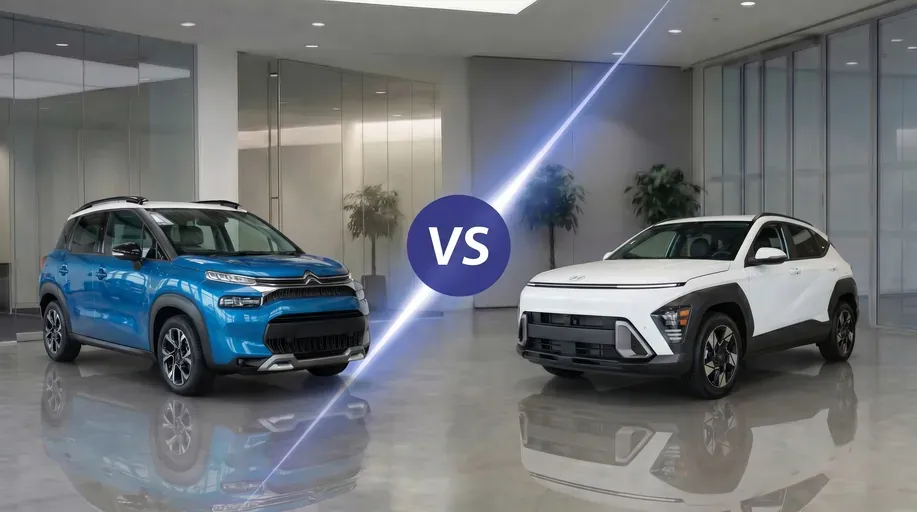
Big comparison: Citroën C3 Aircross vs. Hyundai Kona! Find out which compact SUV performs better in practice. Equipment details, driving characteristics, and a clear verdict.
May 20, 2026

Detailed comparison of Seat Ateca vs. Škoda Karoq. Discover the differences in engines, driving characteristics, and practicality, and read our final verdict.
May 13, 2026