Mercedes-Benz B-Class vs. Renault Grand Scénic: Complete comparison 2026
Detailed comparison of the Mercedes-Benz B-Class and Renault Grand Scénic MPVs. Find out which used family car offers better space, equipment, and value for money.
Oct 16, 2026
Ford Galaxy (2015-2023) review: real owner experience, common faults, engine picks and used prices — everything you need before you buy.
November 4, 2026

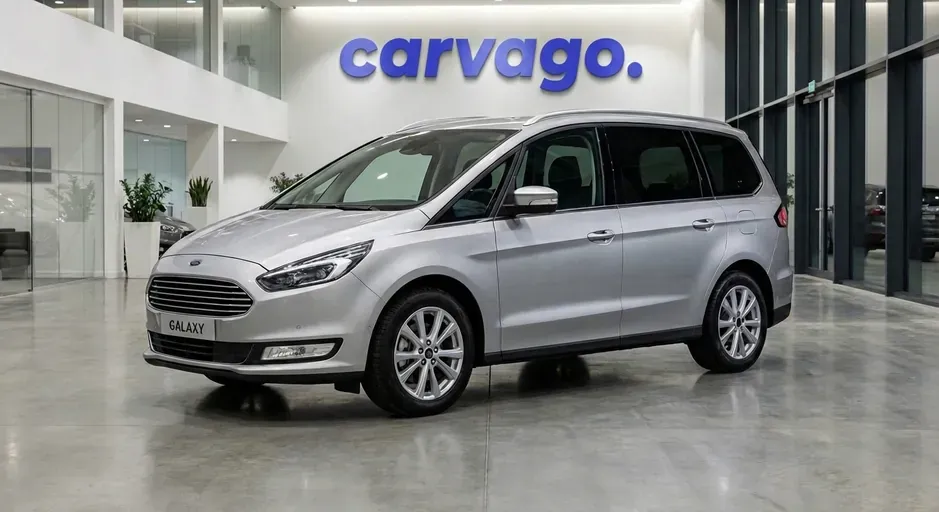
The Ford Galaxy MPV occupies the traditional full-size multi-purpose vehicle segment, prioritising upright passenger accommodation and three-row practicality over sports-utility styling. This review focuses on the third-generation Ford Galaxy, which entered series production in June 2015 following an April 2015 premiere. European customer deliveries commenced in July 2015, and assembly concluded in April 2023 without a direct successor.
A revised diesel range and an eight-speed automatic transmission arrived in September 2018, followed by a mid-cycle styling and technical refresh announced in October 2019. A petrol-electric full hybrid powertrain joined the line-up in February 2021.
Delivered across Europe as a five-door MPV with seven seats fitted as standard, the third-generation Ford Galaxy targeted buyers seeking maximum interior versatility and passenger capacity in a classic people-carrier format.
Real-world ownership of the third-generation Ford Galaxy reveals a vehicle that is mechanically durable when maintained strictly to schedule, but demanding of rigorous adherence to fluid specifications and preventative component replacement. Long-term reliability on the used market is predominantly defined by engine generation and gearbox configuration.
The most critical maintenance issue concerns the 2.0 EcoBlue diesel Ford Galaxy, which replaced earlier diesel options in late 2018. This engine uses a "belt-in-oil" design, running both its timing belt and oil pump drive belt submerged in engine lubricant. Extended oil intervals or the use of motor oil outside the strict manufacturer specification degrades the belt's rubber compound. As the belt sheds debris into the sump, the oil pump pickup strainer clogs, leading to low oil pressure, premature turbocharger wear, and eventual engine seizure. While official guidelines initially listed longer intervals, independent specialists consider replacement of both wet belts and an oil strainer cleaning necessary around 130,000 to 160,000 km.
On pre-facelift models built between 2015 and 2018 fitted with the 2.0 TDCi diesel, the six-speed dual-clutch automatic Ford Galaxy demands careful inspection. In some cases, low-speed judder, hesitation when selecting reverse, and harsh gear changes occur on neglected gearboxes. The internal clutches shed friction material into the shared fluid circuit; if transmission fluid and filters are not regularly renewed, metallic particles contaminate the hydraulic valve body. From late 2018 onward, this dual-clutch unit was replaced by an eight-speed torque-converter automatic, which largely eliminated these transmission complaints.
Auxiliary systems also present recurring patterns. Owners report persistent AdBlue faults on 2.0 EcoBlue diesels, where urea crystallization and electrical failure of the heating element inside the reservoir illuminate the engine management light and trigger a non-restart countdown. Because the heater and sensor are integrated into the tank assembly, repairing this requires replacing the complete reservoir module. On all-wheel-drive variants, workshops report oil seepage around the power transfer unit seals, resulting in driveline whine under load if fluid levels drop. Owners also note occasional software glitches on 2015 to early 2016 builds with adaptive headlights, as well as unresponsive electric switches for the third-row folding seats. A professional pre-purchase inspection through CarAudit can identify hidden transmission slippage and check diagnostic modules for logged fault codes.
Several official safety recalls have been issued across Europe affecting this generation of the Galaxy.
| Affected System | Affected Production Window | Scope | Defect and Workshop Remedy |
|---|---|---|---|
| Diesel Particulate Filter (DPF) | 2018-04-06 to 2024-06-03 | Worldwide (over 1,200,000 vehicles across model lines) | DPF cracking on 2.0-litre EcoBlue diesel vehicles causes excess soot emissions exceeding legal limits. Workshops update engine software, inspect the filter, and replace damaged DPF units. |
| Emergency Call System (eCall) | 2018-08-14 to 2024-10-15 | Worldwide (57,920 vehicles across model lines) | Telematics control module malfunctions cause loss of manual and automatic eCall operation during an accident. Workshops update module software configuration. |
| Hybrid Powertrain Calibration | 2021-12-02 to 2022-01-26 (within the broader 2019–2023 hybrid population) | Pan-European / Worldwide | Blocked engine oil passages can cause connecting rod bearing seizure, engine block rupture, and under-hood fire on the 2.5-litre hybrid. Workshops re-flash engine control software with fail-safe shutdown protocols. |
| Rear Suspension Bolts | 2015-01-20 to 2020-02-18 | Europe / Worldwide (202,696 vehicles across model lines) | Control arm bolts are prone to corrosion and fracture, which can cause loss of rear axle steering stability. Workshops inspect the rear suspension and install replacement bolts with increased corrosion resistance. |
| Battery Monitoring Sensor | 2014 to 2019 (including the previous generation) | Europe / Worldwide | Battery acid leaking onto the negative terminal can create a conductive short circuit and fire risk. Workshops install a fused jumper harness. |
Over its production run, the third-generation Ford Galaxy transitioned from traditional turbocharged petrol and diesel engines to revised Euro 6d diesels and, ultimately, a petrol-electric full hybrid.
| Engine | Fuel | Power | Gearbox | Drivetrain | Model years |
|---|---|---|---|---|---|
| 1.5 EcoBoost | Petrol | 118 kW (160 hp) | 6-speed manual | Front-wheel drive | 2015–2018 |
| 1.5 EcoBoost | Petrol | 121 kW (165 hp) | 6-speed manual | Front-wheel drive | 2018–2020 |
| 2.0 EcoBoost | Petrol | 177 kW (240 hp) | 6-speed automatic | Front-wheel drive | 2015–2018 |
| 2.0 TDCi | Diesel | 88 kW (120 hp) | 6-speed manual | Front-wheel drive | 2015–2018 |
| 2.0 TDCi | Diesel | 110 kW (150 hp) | 6-speed manual / 6-speed automatic | Front-wheel drive / All-wheel drive | 2015–2018 |
| 2.0 TDCi | Diesel | 132 kW (180 hp) | 6-speed manual / 6-speed automatic | Front-wheel drive / All-wheel drive | 2015–2018 |
| 2.0 TDCi Bi-Turbo | Diesel | 154 kW (210 hp) | 6-speed automatic | Front-wheel drive | 2015–2018 |
| 2.0 EcoBlue | Diesel | 88 kW (120 hp) | 6-speed manual | Front-wheel drive | 2018–2019 |
| 2.0 EcoBlue | Diesel | 110 kW (150 hp) | 6-speed manual / 8-speed automatic | Front-wheel drive / All-wheel drive | 2018–2021 |
| 2.0 EcoBlue | Diesel | 140 kW (190 hp) | 6-speed manual / 8-speed automatic | Front-wheel drive / All-wheel drive | 2018–2021 |
| 2.0 EcoBlue Bi-Turbo | Diesel | 177 kW (240 hp) | 8-speed automatic | Front-wheel drive | 2018–2020 |
| 2.5 Duratec FHEV | Petrol hybrid | 140 kW (190 hp) | Automatic (e-CVT) | Front-wheel drive | 2021–2023 |
For frequent short trips, urban commutes, and school runs, diesel variants are ill-suited due to emission-filter regeneration demands. A petrol Ford Galaxy powered by the 1.5 EcoBoost avoids diesel exhaust complications, though hauling seven occupants requires working the manual gearbox diligently. A practical choice for town driving is the hybrid Ford Galaxy with the 2.5 Duratec FHEV; running on electric power at lower speeds and utilizing an electronic continuously variable transmission, it eliminates clutch wear and diesel filter concerns.
For mixed everyday family driving, the mid-range 2.0 TDCi or later 2.0 EcoBlue diesel represents the practical middle ground. The entry-level diesel feels sluggish when fully laden, whereas the mid-output diesels carry a full cabin comfortably. Buyers seeking a two-pedal setup will find an automatic Ford Galaxy from late 2018 onward preferable, as the eight-speed torque-converter automatic operates noticeably smoother at crawling speeds than the earlier dual-clutch transmission.
Long-distance motorway travel calls directly for a diesel Ford Galaxy fitted with the higher-output 2.0 TDCi or 2.0 EcoBlue engine. These units cruise quietly at high speeds and retain ample overtaking reserves when loaded to capacity. The biturbo diesels offer swift acceleration, but their added complexity yields diminishing returns over the single-turbo versions on typical motorway journeys.
For pulling heavy trailers or navigating winter conditions, an all-wheel-drive Ford Galaxy paired with the stronger diesel engines is essential, as it delivers the highest permitted towing limits in the range; by comparison, the front-wheel-drive hybrid has a noticeably restricted towing capacity.
For a thorough examination of long-term engine durability, service schedules, and known mechanical vulnerabilities, refer to the owner experiences section.
| Dimension / Capacity | Value |
|---|---|
| Length | 4,848–4,853 mm |
| Width (excluding mirrors) | 1,916 mm |
| Height | 1,747–1,811 mm |
| Wheelbase | 2,850 mm |
| Boot capacity (7 seats in place) | 200–300 l |
| Boot capacity (rear seats folded) | 2,339 l |
The Ford Galaxy accommodates adult passengers across all three rows without the cramped third-row packaging typical of seven-seat SUVs. In the second row, three individual seats of identical width slide and recline independently, each fitted with dedicated child-seat attachment points. Access to the rearmost chairs is assisted by outer seats that tilt and slide forward, while the boxy roofline maintains headroom even in the rearmost positions. For cargo hauling, both rear rows fold flat into the floor, aided by standard cargo-wall switches that drop the rear seats. The resulting loading bay is level and unobstructed, though the open tailgate does not lift particularly high, which can pose a contact hazard for taller drivers during loading.
Professional road tests describe the Ford Galaxy as a stable, comfortable long-distance tourer. The suspension filters out road scars and undulating motorway tarmac with composure, keeping body lean progressive during direction changes. While its bulk and substantial width compromise low-speed urban agility, the chassis remains predictable. Testers disagree somewhat on steering precision: some note a vague feel immediately off-centre with pronounced understeer, whereas others find its directional tracking reassuring for a full-sized people carrier. Acoustic insulation is effective at high speeds, keeping wind and road roar subdued, though cold diesel engines emit noticeable clatter before warming up, and the hybrid's automatic gearbox flares under brisk acceleration.
Forward visibility is clear thanks to a deep windscreen and slender pillars, and the primary controls remain straightforward to operate. However, testers frequently point out that hard, scratch-prone plastics dominate the lower dashboard and centre console, which lags behind some period European rivals in perceived cabin richness. The earlier infotainment screen drew criticism for sluggish responses and reflective glare, alongside an overly dense instrument cluster display.
The mid-cycle update addressed several cabin shortcomings with a faster touchscreen interface and optional certified ergonomic front seating. Road manners remained broadly identical, retaining the comfortable, motorway-biased damping while trading ultimate cornering agility for passenger comfort.
All market charts in this section are drawn from Carvago listings of the whole Ford Galaxy model family, including other generations represented in the data, rather than exclusively reflecting the reviewed generation. Because of this shared dataset, the figures do not establish a separate price level for the reviewed generation alone. Buyers comparing available build years will find a median asking price of €23,000 for 2019 models, whereas final production units from 2023 sit at €41,900.
Active Ford Galaxy listings remained within a narrow range from May to October 2026, starting at 439 advertised cars and reaching a high of 464 in August.
Active listings over time
| Month | Ford Galaxy |
|---|---|
| 2026-05 | 439 |
| 2026-06 | 452 |
| 2026-07 | 446 |
| 2026-08 | 464 |
| 2026-09 | 456 |
| 2026-10 | 441 |
Source Carvago
With the count finishing at 441 listings in October 2026, monthly availability has stayed consistent across the six-month span, giving buyers a steady volume of choices on the market.
Among used listings of this model advertised today, the median asking price for vehicles built in 2017 is €19,800, compared to €48,800 for those registered in 2024. The chart below details the median asking price for each available build year.
Median advertised price by year of manufacture
| Model year | Ford Galaxy |
|---|---|
| 2017 | 19 800 |
| 2018 | 20 500 |
| 2019 | 23 000 |
| 2020 | 25 000 |
| 2021 | 27 500 |
| 2022 | 28 000 |
| 2023 | 41 900 |
| 2024 | 48 800 |
Source Carvago
Securing an example built between 2017 and 2022 corresponds to median asking prices between €19,800 and €28,000, whereas listings registered in 2023 and 2024 require a substantially higher outlay, with medians of €41,900 and €48,800.
Between May and October 2026, monthly listings for the Ford Galaxy showed diesel as the most common powertrain, recording 329 advertised vehicles in May 2026 alongside 83 hybrid models. The chart below details how active listings were distributed across fuel types over this period.
Supply composition by fuel type
Petrol
Diesel
Hybrid
Electric
| Month | Petrol | Diesel | Hybrid | Electric |
|---|---|---|---|---|
| 2026-05 | 26 | 329 | 83 | 1 |
| 2026-06 | 24 | 335 | 92 | 1 |
| 2026-07 | 19 | 355 | 71 | 1 |
| 2026-08 | 23 | 357 | 83 | 1 |
| 2026-09 | 27 | 346 | 82 | 1 |
| 2026-10 | 25 | 339 | 76 | 1 |
Source Carvago
In October 2026, diesel accounted for 339 active listings, while hybrids stood at 76, petrol models at 25, and electric vehicles at 1. Buyers will have the greatest choice searching for a diesel model, while hybrid and petrol alternatives provide a much smaller selection.
The chart below outlines the average asking price for the Ford Galaxy from May 2026 to October 2026, beginning at €22,800 and reaching €22,900 in June 2026.
Average price development over time
| Month | Ford Galaxy |
|---|---|
| 2026-05 | 22 800 |
| 2026-06 | 22 900 |
| 2026-07 | 22 700 |
| 2026-08 | 22 400 |
| 2026-09 | 22 500 |
| 2026-10 | 22 500 |
Source Carvago
Overall movement across the six months remained minimal, with the average asking price shifting from €22,800 in May 2026 to €22,500 in October 2026, an overall decline of just over 1%.
Genuine adult accommodation across all rows with individual sliding second-row seats
Composed suspension and effective acoustic insulation on long motorway journeys
Smooth later torque-converter automatic replaces hesitation-prone early dual-clutch transmission
Diesel wet-belt system risks oil starvation and engine damage without strict fluid maintenance
Scratch-prone plastics on lower interior surfaces and sluggish early touchscreen response
Substantial exterior bulk compromises urban manoeuvrability alongside a low-lifting tailgate
It is mechanically durable when maintained strictly to schedule, but highly sensitive to fluid quality and service intervals. The primary concerns involve timing belt degradation on post-2018 diesels and fluid contamination on early dual-clutch transmissions.
For urban driving, the hybrid Ford Galaxy is well suited to avoid diesel filter issues, though its towing capacity is restricted. For long-distance driving and heavy towing, the higher-output diesel Ford Galaxy remains the practical choice.
Models built from late 2018 onward are recommended because an eight-speed torque-converter automatic replaced the earlier dual-clutch gearbox. However, diesels from this period require documented oil and timing belt maintenance.
Confirm all outstanding safety recalls have been resolved by VIN through an authorised dealer. In addition, check service records for timely transmission fluid renewals on early automatics and belt maintenance on later diesels.
Sources: ford.co.uk, adac.de, service.gov.uk, autobild.de, autocar.co.uk
This article was prepared using artificial intelligence tools. The section guarantor is Petr Dušek.

Detailed comparison of the Mercedes-Benz B-Class and Renault Grand Scénic MPVs. Find out which used family car offers better space, equipment, and value for money.
Oct 16, 2026

Volkswagen Touran review: real owner experience, common faults, engine picks and used prices — everything you need before you buy.
Oct 22, 2026

Detailed comparison of the Ford S-Max vs. Volkswagen Sharan MPVs. Find out which used car offers more space, better driving characteristics, and reliability for the family.
Oct 16, 2026