
Review
Review Volkswagen Caravelle: What do owners and experts really say?
Volkswagen Caravelle review: real-world practicality, seating versatility, engine picks, and running costs for the latest 9-seater shuttle.
Oct 30, 2026
Citroën SpaceTourer review: real owner experience, common faults, diesel vs electric picks, and running costs — everything before you buy.
November 4, 2026
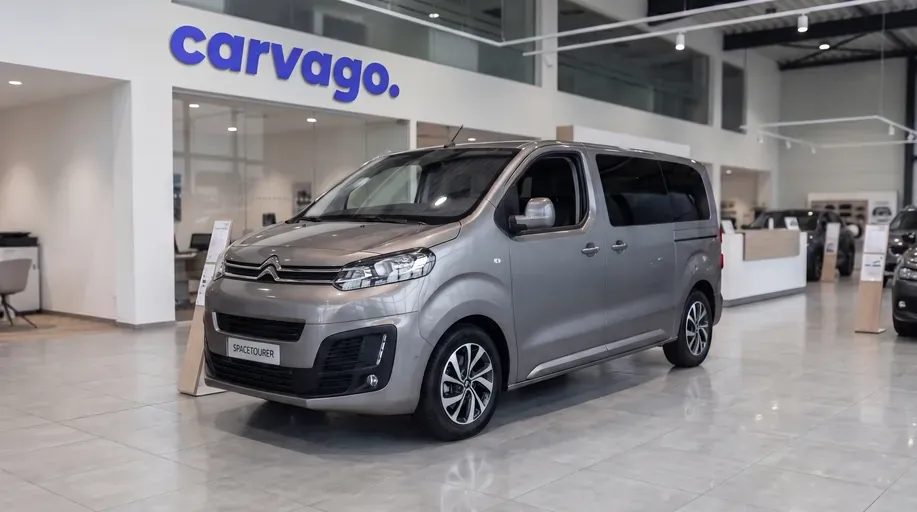
The Citroën SpaceTourer is a passenger van built on the modular EMP2 platform, positioned in the multi-purpose vehicle and commercial shuttle sector. This review covers the first generation, which arrived with first European customer deliveries in July 2016 and remains in production in 2026. Designed with flexible interior configurations seating between five and nine occupants, it primarily serves large families, commercial shuttle operators, and drivers transporting bulky leisure equipment.
Citroën initially offered the model in three body lengths: compact XS, standard M, and extended XL. The fully electric Citroën ë-SpaceTourer expanded the range when first customer deliveries commenced in November 2020. Electric propulsion temporarily became the exclusive retail passenger configuration across European order books in January 2022, before diesel versions were reintroduced with deliveries resuming in autumn 2025.
A mid-cycle facelift premiered on 19 December 2023, with order books opening on 18 March 2024 and customer deliveries starting in June 2024. The update dropped the XS body length, introduced revised front-end styling featuring the updated brand emblem, and reworked the dashboard with updated digital driver displays and connectivity systems.
The first-generation Citroën SpaceTourer has accumulated a detailed service record across European markets since customer deliveries began in 2016. Because the platform serves both commercial transport and passenger shuttle duties, high annual mileages quickly reveal mechanical wear points. In long-term operation, owner reports and technical service bulletins highlight exhaust aftertreatment components and valvetrain hardware on specific diesel engines, alongside several Europe-wide safety recalls.
On diesel Citroën SpaceTourer variants, the Selective Catalytic Reduction (SCR) AdBlue system is the most frequent source of unscheduled workshop visits. The breather valve on the composite urea tank can fail to equalize pressure, creating a vacuum that deforms the tank. Because the AdBlue supply pump and fluid level sensors are integrated directly into the tank assembly, a pressure drop or pump failure requires replacing the entire tank unit rather than individual sensors. In addition, urea crystallisation can clog the downstream dosing injector, triggering emissions warnings and non-restart countdown timers on the dashboard.
For vehicles equipped with the 1.5 BlueHDi diesel engine built between 2017 and early 2023, the secondary camshaft drive mechanism is a documented vulnerability. While an external belt drives the exhaust camshaft, a 7 mm chain transfers drive between the two camshafts inside the cylinder head. Under high contact pressure and degraded engine oil, owners report that this internal chain can stretch or break, causing valvetrain collisions and severe engine damage. A revised 8 mm chain and modified housing were introduced on later production engines to resolve the issue.
The SpaceTourer has been subject to multiple European safety campaigns covering mechanical components, electrical hardware, and software.
The first-generation Citroën SpaceTourer offers a broad selection of powertrains spanning frugal four-cylinder turbo-diesels to fully electric passenger variants. While the lineup shifted strictly to electric power for private European buyers between 2022 and 2024, revised diesel power returned to passenger showrooms in autumn 2025 alongside the battery-electric models.
| Engine | Fuel | Power | Gearbox | Model years |
|---|---|---|---|---|
| 1.6 BlueHDi 95 | Diesel | 70 kW (95 hp) | 5-speed manual / 6-speed automated manual | 2016–2018 |
| 1.6 BlueHDi 115 | Diesel | 85 kW (115 hp) | 6-speed manual | 2016–2018 |
| 1.5 BlueHDi 100 | Diesel | 75 kW (100 hp) | 6-speed manual | 2018–2020 |
| 1.5 BlueHDi 120 | Diesel | 88 kW (120 hp) | 6-speed manual | 2018–2022 |
| 2.0 BlueHDi 140 | Diesel | 103 kW (140 hp) | 6-speed manual / 8-speed automatic | 2020–2022 |
| 2.0 BlueHDi 150 | Diesel | 110 kW (150 hp) | 6-speed manual | 2016–2020 |
| 2.0 BlueHDi 180 | Diesel | 130 kW (180 hp) | 6-speed automatic | 2016–2018 |
| 2.0 BlueHDi 180 | Diesel | 130 kW (180 hp) | 8-speed automatic | 2018–2022 |
| 2.2 BlueHDi 180 | Diesel | 132 kW (180 hp) | 8-speed automatic | 2025–present |
| ë-SpaceTourer (50 kWh) | Electric | 100 kW (136 hp) | Single-speed automatic | 2020–present |
| ë-SpaceTourer (75 kWh) | Electric | 100 kW (136 hp) | Single-speed automatic | 2020–present |
For urban shuttle duties, local school runs, and low-mileage city driving, the electric Citroën SpaceTourer is the most suitable option. Its electric motor delivers smooth, silent progress from a standstill during short urban journeys.
For mixed everyday driving on the used market, the 2.0 BlueHDi 150 paired with the six-speed manual gearbox hits a sensible middle ground. It provides adequate pulling power for family transport without demanding high fuel expenditure. The smaller 1.5 BlueHDi and older 1.6 BlueHDi manual versions suit light-duty commuting, but they require frequent gear shifting when climbing motorway gradients with a full passenger load. Avoid the robotised automated transmission paired with the early base 1.6 BlueHDi, which suffers from hesitant take-offs and jerky shifting.
For regular long-distance motorway journeys and cross-country family touring, the BlueHDi 180 is the most capable choice. Its torque reserves maintain unstrained cruising speeds with eight or nine occupants aboard, and the torque-converter eight-speed automatic gearbox operates far more smoothly than the early six-speed automatic. By contrast, the electric models face heavy consumption penalties at sustained motorway speeds, requiring frequent charging pauses.
For towing, choose a diesel Citroën SpaceTourer with the larger displacement engine. The manual BlueHDi 150 and the automatic BlueHDi 180 carry the highest braked trailer limits in the lineup, whereas the electric variants are restricted to light utility trailers.
For an overview of known mechanical concerns, including emissions hardware and timing components, consult the owner experiences section.
| Body Length | Dimensions L × W × H (mm) | Wheelbase (mm) | Boot Volume: Seats Up / Max (l) |
|---|---|---|---|
| XS (Pre-facelift) | 4,606 × 1,920 × 1,890–1,950 | 2,925 | 224 / 3,397 |
| M (Standard) | 4,956–4,983 × 1,920 × 1,890–1,950 | 3,275 | 603 / 3,968 |
| XL (Long) | 5,306–5,333 × 1,920 × 1,890–1,950 | 3,275 | 989 / 4,554 |
Boot volumes apply equally to combustion and electric variants due to the underfloor battery packaging.
The Citroën SpaceTourer people-carrier prioritises passenger versatility, offering cabin layouts for between five and nine occupants across three rows depending on the seating specification chosen. Rows two and three mount on floor-mounted rails, allowing them to slide forward and aft or recline, making it easy to balance legroom with cargo needs. Individual seats and split benches fold forward flat, and depending on seat layout, up to six Isofix mounting points accommodate child seats across the rear rows. Loading unusually long cargo is aided where an optional fold-flat front passenger seat is fitted. However, extracting maximum load capacity requires unlatching and removing the rear seats entirely. Professional road tests note that these seat assemblies are heavy and cumbersome to lift out through the sliding side doors, demanding substantial physical effort. For buyers who travel frequently with a full passenger complement, the longer body lengths leave a deep, practical luggage area behind the third row, whereas the compact version provides limited cargo space when every seat is occupied.
Professional road tests report that the Citroën SpaceTourer prioritises functional carriage over sharp road manners. The unladen suspension behaves stiffly over potholes and sharp ridges, transmitting noticeable thumps through the rear axle, although the chassis settles into a more composed posture under load or on smooth motorways. In corners, tall proportions and weight result in pronounced body lean, while the steering feels slow-geared and offers limited road feedback. Cabin noise at cruising speeds is dominated by wind buffeting around the upright windscreen and large door mirrors, alongside road roar resonating through the large interior volume, even though the diesel Citroën SpaceTourer and electric Citroën ë-SpaceTourer isolate motor noise well under steady throttle.
The cabin provides an upright driving position with well-aligned primary controls, yet the dashboard and door panels are dominated by durable, utilitarian hard plastics that scratch easily. Operating the native central touchscreen reveals sluggish response times. Professional verdicts agree on the van-derived utility, unladen suspension stiffness, and pronounced cornering roll. They diverge primarily on steering effort—characterised as light in parking manoeuvres by some testers, yet slow and cumbersome by others in tight urban junctions—and whether the chassis feels planted or wallowy over undulating highway surfaces.
All the charts in this section are drawn from Carvago listings of the whole model family, including other generations represented in the data, not only the reviewed generation, meaning this data does not establish a separate price level for the reviewed generation. Across the available selection, the median asking price stands at €27,000 for 2019 and 2020 examples of the Citroën SpaceTourer, alongside €29,500 for 2021 and €34,800 for 2022 vehicles. Later offerings record a median asking price of €42,600 for 2023, €37,700 for 2024, €42,000 for 2025, and €40,000 for 2026 listings, where variations reflect differing powertrain configurations.
Active Citroën SpaceTourer listings tracked between May 2026 and October 2026, starting at 1,094 and reaching a peak of 1,183 cars. The monthly figures below illustrate how the available selection moved over this six-month period.
Active listings over time
| Month | Citroën SpaceTourer |
|---|---|
| 2026-05 | 1 094 |
| 2026-06 | 1 170 |
| 2026-07 | 1 183 |
| 2026-08 | 1 150 |
| 2026-09 | 1 118 |
| 2026-10 | 1 027 |
Source Carvago
With inventory holding above 1,000 vehicles throughout the recorded span, buyers can expect a wide selection even as available listings softened toward the final month.
Among listings advertised today, the median asking price of cars built in 2019 is €27,000, while the median asking price of cars advertised today built in 2023 is €42,600. The following chart outlines how these figures compare across model years.
Median advertised price by year of manufacture
| Model year | Citroën SpaceTourer |
|---|---|
| 2019 | 27 000 |
| 2020 | 27 000 |
| 2021 | 29 500 |
| 2022 | 34 800 |
| 2023 | 42 600 |
| 2024 | 37 700 |
| 2025 | 42 000 |
| 2026 | 40 000 |
Source Carvago
Buyers considering 2019 or 2020 models encounter a median asking price of €27,000, though asking figures across newer model years do not follow a uniform upward pattern. Listings for 2024 models show a median asking price of €37,700, sitting below the €42,600 recorded for 2023 models and the €42,000 recorded for 2025 models.
This depreciation curve illustrates how Citroën SpaceTourer loses value as it ages, showing a relatively gradual decline of roughly 11% of its initial residual value over the first three years. The chart below details this progression across each year of vehicle age.
Residual value by vehicle age
| Vehicle age | Citroën SpaceTourer |
|---|---|
| New | 39 800 |
| 1 yr | 37 300 |
| 2 yrs | 35 800 |
| 3 yrs | 35 300 |
| 4 yrs | 31 900 |
| 5 yrs | 28 300 |
| 6 yrs | 26 000 |
| 7 yrs | 24 000 |
Source Carvago
Across the seven years shown, the model sheds approximately 40% of its initial value, retaining about 60% by year seven. The sharpest annual drops occur between ages three and five, after which the rate of value loss eases.
Between May and October 2026, diesel models made up the vast majority of advertised listings, rising from 1053 vehicles in May to a peak of 1139 in July. The chart below illustrates the monthly count of advertised cars across each fuel type.
Supply composition by fuel type
Petrol
Diesel
Electric
| Month | Petrol | Diesel | Electric |
|---|---|---|---|
| 2026-05 | 2 | 1 053 | 38 |
| 2026-06 | 3 | 1 132 | 34 |
| 2026-07 | 4 | 1 139 | 40 |
| 2026-08 | 4 | 1 110 | 36 |
| 2026-09 | 4 | 1 087 | 27 |
| 2026-10 | 3 | 996 | 28 |
Source Carvago
In October 2026, diesel remained overwhelmingly dominant with 996 listings, compared to 28 electric and 3 petrol models on offer. Buyers browsing current listings will find an abundant supply of diesel vehicles, while petrol and electric choices remain very rare.
The chart tracks the monthly average asking price for the Citroën SpaceTourer from May 2026 to October 2026, opening at €36,400 before peaking at €36,700 in August.
Average price development over time
| Month | Citroën SpaceTourer |
|---|---|
| 2026-05 | 36 400 |
| 2026-06 | 36 600 |
| 2026-07 | 36 400 |
| 2026-08 | 36 700 |
| 2026-09 | 36 600 |
| 2026-10 | 36 300 |
Source Carvago
Across the six months shown, the average asking price moved from €36,400 to €36,300, remaining essentially flat with month-to-month fluctuations of under one percent.
Versatile interior with sliding and reclining rail-mounted seats
Underfloor battery packaging preserves full cargo volume on electric models
Composed and quiet motorway cruising manners when carrying a passenger load
Heavy rear seat assemblies that require substantial physical effort to remove
Stiff unladen ride over sharp bumps combined with pronounced body lean in corners
Documented diesel reliability concerns with exhaust emissions tanks and camshaft drive chains
For long-distance touring and towing, the BlueHDi 180 with the eight-speed automatic provides ample pulling power, while the manual BlueHDi 150 offers a balanced middle ground for mixed everyday driving. Avoid the early base 1.6 BlueHDi with the automated manual gearbox due to jerky shifts.
Verify through the vehicle's VIN that all safety campaigns have been completed, particularly for front control arm bolts, starter motor corrosion, and the 1.5 BlueHDi camshaft drive chain. On any diesel Citroën SpaceTourer, scan for stored AdBlue diagnostic faults and listen for abnormal valvetrain noise.
The Citroën ë-SpaceTourer is better suited to local shuttle duties than long family trips, as sustained motorway speeds sharply reduce driving range and demand frequent charging stops. It is also limited to pulling light utility trailers.
The standard M and extended XL lengths offer the best balance of passenger space and luggage capacity behind the third row. The compact XS provides minimal boot volume when fully seated and was dropped during the Citroën SpaceTourer mid-cycle facelift.
Sources: media.stellantis.com, adac.de, ec.europa.eu, autoexpress.co.uk, whatcar.com
This article was prepared using artificial intelligence tools. The section guarantor is Petr Dušek.
Volkswagen Caravelle review: real-world practicality, seating versatility, engine picks, and running costs for the latest 9-seater shuttle.
Oct 30, 2026

Mercedes-Benz Vito Tourer vs Volkswagen Caravelle comparison. Discover the differences in space, equipment, and reliability and read our clear final verdict!
Oct 16, 2026
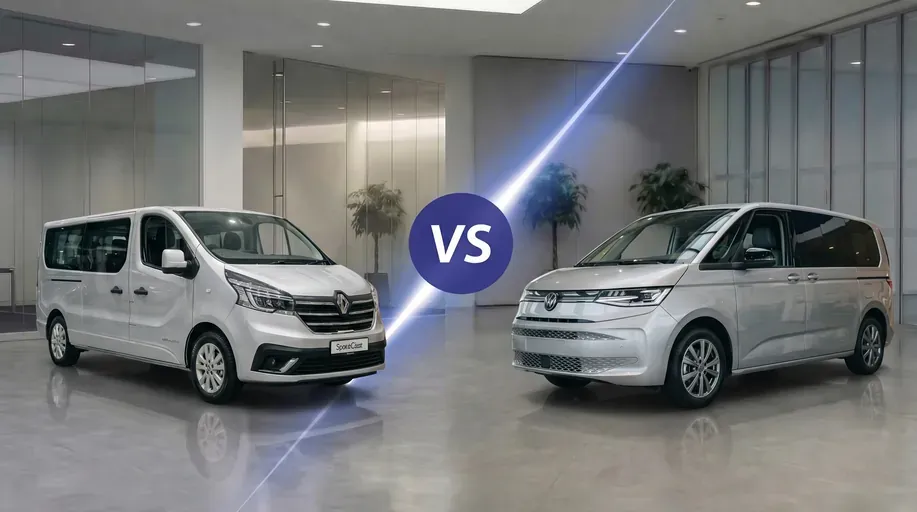
Detailed comparison of Renault Trafic SpaceClass vs. Volkswagen Multivan. Discover the real differences in space, equipment, and driving characteristics to make the right choice.
May 4, 2026