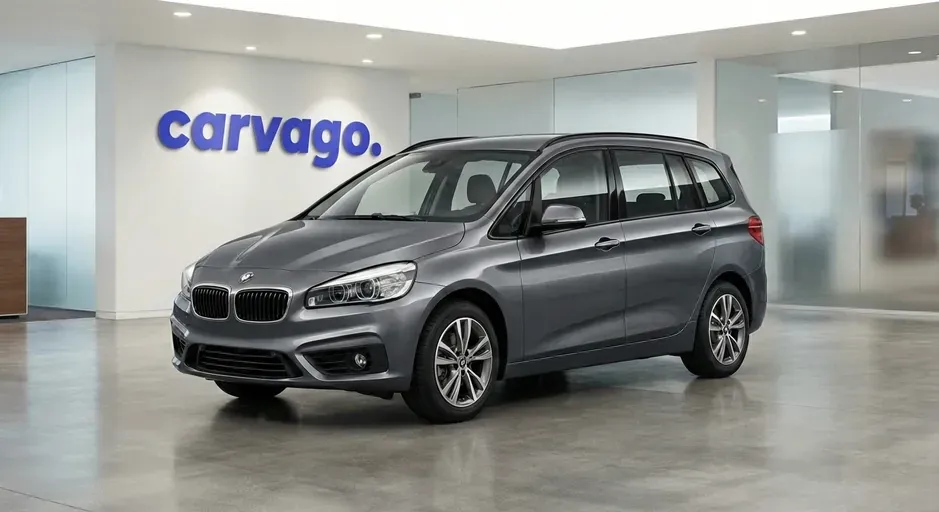
Review BMW 2 Series Gran Tourer: What do owners and experts really say?
BMW 2 Series Gran Tourer review: real owner experience, common faults, 7-seat practicality, engine picks and used prices before you buy.
October 22, 2026
Verdict at a Glance
Who it suits: Growing families wanting flexible cargo space and occasional seven-seat utility in a premium compact package.
Recommended engine: The 218i for suburban commuting, or the four-cylinder 218d for carrying heavy loads over long distances.
What to avoid: Underpowered 214d and 216i models, and any car lacking documented safety recall repairs verified by VIN.
Introduction
The BMW 2 Series Gran Tourer arrived as a distinct entry in the premium compact MPV segment. Conceived as an extended, taller sibling to the Active Tourer, it brought a family-focused proposition to the brand by offering front-wheel-drive packaging alongside both five-seat and seven-seat configurations.
This review covers the model's single production generation, which began series assembly in March 2015, followed by initial European customer deliveries in June 2015. The range expanded shortly afterwards with additional petrol and front-wheel-drive diesel choices in July 2015, as well as the 218d all-wheel-drive diesel option in March 2016. A facelift was unveiled on 10 January 2018, with European order books opening on 25 January 2018 and deliveries starting in March 2018. This update brought subtly restyled bumper fascias, refreshed exterior lighting, and revisions to interior trim appointments.
BMW concluded series production at its Regensburg plant in December 2022 without introducing a direct multi-seat successor. On the pre-owned market, the BMW 2 Series Gran Tourer appeals primarily to growing families and practicality-focused buyers who require occasional third-row utility and flexible cargo arrangements without leaving the premium segment.
Owner Experiences: Common Faults and Recalls
Long-term owner reports and workshop findings show that the BMW 2 Series Gran Tourer is generally mechanically robust, but it suffers from a few recurring, model-specific design weaknesses. Chief among these on automatic versions from the 2015 to 2018 model years is a failing gear selector microswitch. Drivers are greeted by a persistent warning message on the central display stating "Secure vehicle against rolling away" upon shifting into Park. While the gearbox remains safely locked mechanically, a small internal torsion spring slips from its stop. Main dealerships routinely replace the entire gear shifter assembly, though independent specialists frequently resolve the issue by fitting an uprated steel replacement spring.
Under the bonnet, owner reports and workshop data frequently document the failure of the upper right hydraulic engine mount, primarily on three-cylinder and four-cylinder models such as the 218i, 216d, and 218d between 60,000 and 100,000 km. Once the internal damping fluid leaks onto the subframe, heavy knocking thuds appear during initial acceleration, accompanied by coarse vibrations spreading through the passenger cell at idle. Installing a revised replacement mount resolves the issue. In addition, workshops note accelerated wear on the rear brake pads and discs compared to the front axle. This higher consumption is an inherent trait of the platform's electronic parking brake, hill-start assistance, and continuous stability control interventions designed to curb understeer.
Multiple official safety recalls apply to the model in European markets. The most notable for owners of a diesel BMW 2 Series Gran Tourer involves glycol leaking from the exhaust gas recirculation (EGR) cooler, which in rare instances could melt the intake manifold and trigger a fire. Other campaigns involve water ingress into the starter motor relay, potential driver airbag inflator rupture, a missing collar disc on the steering tie-rod, and front seat-belt retractors on late-production vehicles.
Verified Safety Recalls
Safety Recall
Affected Production Window
Reach & Variants
Workshop Remedy
EGR cooler glycol leak
24 February 2015 – 01 March 2018
EU & worldwide; diesel models
Inspects intake manifold, replaces EGR cooler, and updates engine software
Starter relay water ingress
28 September 2015 – 07 September 2021
EU & worldwide; combustion engines
Replaces starter motor and relay assembly with a sealed unit
Takata driver airbag
13 March 2003 – 20 June 2018 (retrofitted parts) / 02 January 2016 – 12 December 2017 (factory fit)
Worldwide; factory installations and retrofitted sports steering wheels
Inspects and replaces the driver airbag module free of charge
Steering tie-rod collar disc omission
05 August 2016 – 08 April 2019
EU & worldwide; all variants
Retrofits the missing spherical-collar disc or replaces damaged tie-rod assemblies
Seat-belt retractor gas generator
11 January 2022 – 02 March 2022
Worldwide; late-production models
Replaces front seat-belt retractor assemblies
🔍 What to check before buying
Confirm with an authorised dealer using the car's VIN or arrange a pre-purchase inspection via CarAudit to ensure all safety campaigns—especially the diesel EGR cooler and starter relay actions—have been completed.
Shift the Steptronic selector into Park during the test drive to verify that no warning to secure the vehicle against rolling appears on the dashboard.
Inspect the upper right engine hydraulic mount for fluid leakage and listen for harsh thuds or excess cabin vibration under initial load and at idle.
Check the remaining thickness of the rear brake discs and pads, as stability control interventions cause them to wear faster than the front brakes.
Cycle the folding third-row seats to ensure latching mechanisms operate cleanly and do not trigger false seat-belt or airbag warning lights.
Engines: Which One to Choose
The BMW 2 Series Gran Tourer was offered with turbocharged three-cylinder and four-cylinder engines across both petrol and diesel line-ups, driving the front wheels or featuring all-wheel drive. Transmissions across its production run included six-speed manuals, torque-converter automatics, and later dual-clutch units.
For urban driving and short suburban commutes, the three-cylinder petrol 218i represents the most sensible balance. The entry-level petrol 216i struggles when carrying a full load of passengers and cargo, demanding high engine speeds to keep up with traffic. By contrast, the 218i responds promptly from low engine speeds and handles suburban school runs without feeling overtaxed. For buyers who frequently travel on mixed routes, the four-cylinder petrol BMW 2 Series Gran Tourer in 220i guise delivers smooth acceleration and quiet cruising, though its thirst rises noticeably in heavy city traffic.
Long-distance travellers and high-mileage family drivers will be better served by a diesel BMW 2 Series Gran Tourer. The three-cylinder diesels require compromise: the early 214d lacks adequate merging pace on motorways, while the 216d is frugal on open roads but quickly runs out of breath at higher speeds. The four-cylinder 218d is the sweet spot of the entire range, offering robust pulling power that easily handles a fully laden seven-seat cabin. The top-tier 220d adds authoritative overtaking reserves for unrestricted motorway journeys.
For regular towing, steep gradients, or winter conditions, choose an all-wheel-drive BMW 2 Series Gran Tourer in 218d xDrive or 220d xDrive specification. The xDrive configuration eliminates front-wheel slip and torque steer under heavy acceleration, ensuring secure traction when towing trailers. As for gearboxes, the eight-speed torque-converter automatic paired with the four-cylinder diesels shifts smoothly under heavy loads, whereas the seven-speed dual-clutch transmission fitted to later petrols can show minor hesitation during tight parking manoeuvres.
For detailed analysis of engine durability, manufacturer recalls, and common mechanical faults, consult the dedicated owner experiences section.
Space & Practicality
Dimension
5-seater
7-seater
Length
4,556 mm (facelift: 4,568 mm)
4,556 mm (facelift: 4,568 mm)
Width
1,800 mm
1,800 mm
Height
1,608 mm
1,612 mm
Wheelbase
2,780 mm
2,780 mm
Boot capacity (seats upright / folded)
645 / 1,905 l
145 / 1,820 l
Values apply to vehicles with standard suspension; optional factory sport suspension lowers exterior height by 10 mm. In seven-seat versions, cargo volume measures 560 litres when the third row is stowed flat into the floor.
The BMW 2 Series Gran Tourer provides a practical interior layout tailored for family transport, though cabin flexibility varies between five- and seven-seat configurations. The second-row bench slides fore and aft on rails and features reclining, split-folding backrests that drop via mechanical release switches in the luggage bay. Headroom and outer legroom comfortably accommodate tall adults, although the contoured bench profile and floor tunnel restrict shoulder room when seating three passengers abreast. In models equipped with the optional third row, the pair of rearmost seats fold flat into the floor when not needed. However, shallow footwells and limited knee clearance restrict row three to occasional use or younger children. Loading everyday cargo is aided by a low loading sill and a wide tailgate opening, while sliding the middle bench forward allows drivers to balance rear luggage depth against passenger leg space.
What the Tests Say
Professional road tests consistently describe the BMW 2 Series Gran Tourer as one of the most agile multi-purpose vehicles of its era, delivering direct steering and controlled body movement through corners. However, chassis calibration sits firmly on the stiff side. While the suspension tracks securely over undulating tarmac and feels settled at motorway speeds, sharp expansion joints and broken city surfaces transmit distinct thumps into the cabin—a trait aggravated by larger optional wheels or the firmer optional sports suspension. Vehicles equipped with optional adaptive dampers handle uneven surfaces with noticeably better compliance. Testers also point out that front-wheel-drive models paired with stronger engines exhibit noticeable torque steer under brisk acceleration, tugging at the steering wheel.
Inside, assembly standards and upper cabin materials outshine mainstream family vans, though cheaper hard plastics remain evident around the lower dashboard. The driving position is upright and supportive, yet visibility draws consistent criticism across tests: the thick, bifurcated front pillars create severe forward-diagonal blind spots when turning at junctions or pedestrian crossings. Professional assessments diverge on acoustic refinement; while the diesel BMW 2 Series Gran Tourer is praised for settled motorway cruising, several tests note audible engine clatter and mild mechanical vibration through the pedals under load. Testers also observe that the transverse automatic gearbox exhibits occasional hesitation, lacking the crisp shift logic found in the brand's rear-wheel-drive models.
Prices and Market Offer
All the charts in this section are drawn from Carvago listings of the whole model family, including other generations represented in the data, and do not establish a separate price level exclusively for the reviewed generation. For advertised examples across the broader model family, the median asking price sits at €14,000 for 2016 models and reaches €25,500 for 2023 models. Later model years reflect listings featuring updated onboard equipment, seven-seat seating layouts, and four-cylinder engines that buyers typically prefer over base three-cylinder versions.
Between April and September 2026, active listings for the BMW 2 Series Gran Tourer opened at 563 and reached a high of 575 in June before dipping later in the period. The chart below tracks the number of vehicles advertised on the market across these six months.
BMW 2 Series Gran Tourer - availability over time
Active listings over time
Month
BMW 2 Series Gran Tourer
2026-04
563
2026-05
569
2026-06
575
2026-07
571
2026-08
462
2026-09
478
Source Carvago
Buyers can consistently find several hundred vehicles on offer, though available inventory contracted in late summer following a drop to 462 listings in August.
Across used listings of the broader model family advertised today, the median asking price for cars built in 2016 is €14,000, while the median asking price of vehicles built in 2023 is €25,500.
BMW 2 Series Gran Tourer - median price by model year
Median advertised price by year of manufacture
Model year
BMW 2 Series Gran Tourer
2016
14 000
2017
15 800
2018
17 900
2019
18 900
2020
20 400
2021
22 200
2022
23 900
2023
25 500
Source Carvago
For buyers planning their budget, a 2018 model year car carries a median asking price of €17,900, while newer 2021 listings command a median asking price of €22,200.
This depreciation curve illustrates how the model's residual value declines with vehicle age, shedding roughly 25% of its initial value in the first year alone and 37% by year three, as detailed below.
BMW 2 Series Gran Tourer - value loss by age
Residual value by vehicle age
Vehicle age
BMW 2 Series Gran Tourer
New
41 200
1 yr
30 800
2 yrs
29 200
3 yrs
26 100
4 yrs
23 700
5 yrs
19 800
6 yrs
17 400
7 yrs
16 200
Source Carvago
Over the seven years shown, the car sheds approximately 61% of its value, with the steepest drop taking place in the first year before annual depreciation moderates.
Advertised listings between April and September 2026 were divided between petrol and diesel models, with September 2026 counting 240 petrol and 238 diesel cars. The chart below traces how the active supply for each fuel type developed over this six-month period.
BMW 2 Series Gran Tourer - supply by fuel over time
Supply composition by fuel type
Petrol
Diesel
Month
Petrol
Diesel
2026-04
254
309
2026-05
266
303
2026-06
264
311
2026-07
278
293
2026-08
233
229
2026-09
240
238
Source Carvago
In the latest month, petrol and diesel make up the entire selection in nearly equal numbers, with zero hybrid or electric models listed. Buyers in the market will realistically be choosing strictly between petrol and diesel engines.
Between April 2026 and September 2026, the average asking price for the BMW 2 Series Gran Tourer began at €17,200, following the monthly progression outlined below.
BMW 2 Series Gran Tourer - price trend over time
Average price development over time
Month
BMW 2 Series Gran Tourer
2026-04
17 200
2026-05
17 000
2026-06
16 700
2026-07
16 600
2026-08
16 300
2026-09
16 200
Source Carvago
Across these six months, the average declined each month from €17,200 down to €16,200, an overall drop of roughly 6%.
Agile handling and direct steering for a compact MPV
Practical cabin modularity with a sliding second row and fold-flat seating
Frugal four-cylinder diesel engines well suited to fully laden travel
Cons
Stiff suspension that transmits sharp bumps and broken tarmac into the cabin
Thick split front pillars that obstruct visibility at junctions
Tight third-row seating restricted to small children or occasional short journeys
Frequently asked questions
Is the 2 Series Gran Tourer reliable?
Mechanically, the BMW 2 Series Gran Tourer is generally robust, though automatic versions from 2015 to 2018 are prone to gear selector microswitch failures. Buyers should also verify that all safety recall campaigns have been performed.
Which engine is best for family use?
The four-cylinder 218d diesel is the most capable all-rounder, delivering strong pulling reserves to comfortably move a fully laden seven-seat cabin on longer trips. For low-mileage suburban routines, the three-cylinder 218i petrol is the most sensible choice, whereas entry-level engines struggle under load.
Is the third row spacious enough for adults?
The rearmost seats in the seven-seat BMW 2 Series Gran Tourer have shallow footwells and tight knee clearance, making them practical only for younger children or emergency short trips. The sliding second-row bench, however, comfortably accommodates tall adults.
What should be checked before buying a used model?
Confirm via the vehicle's VIN that all safety recalls—especially the EGR cooler and starter relay—have been completed. During the test drive, verify that selecting Park does not trigger a warning to secure the vehicle.