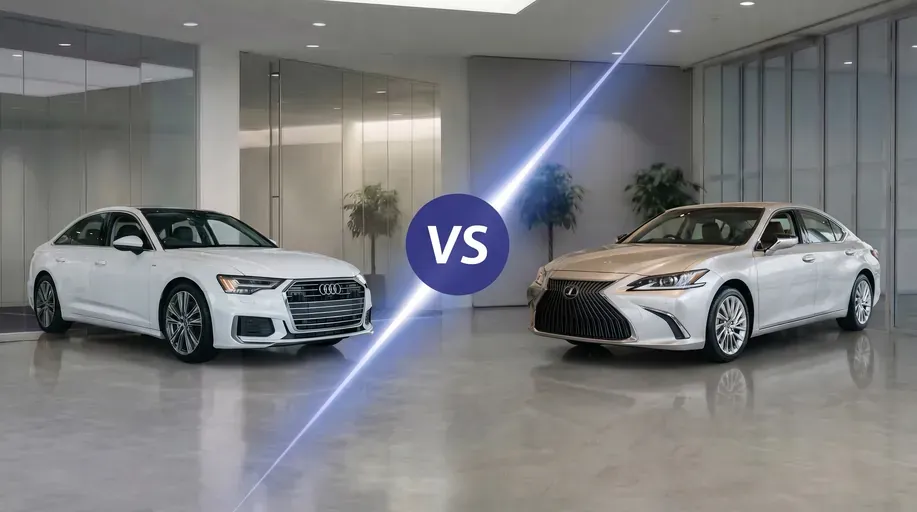
Car battle
Audi A6 vs. Lexus ES: Complete comparison 2026
Audi A6 vs. Lexus ES: A detailed comparison of premium sedans. Discover the differences in comfort, equipment, and reliability, and read our final verdict.
May 16, 2026
Audi A6 (C9) review: real owner feedback, expert road test verdicts, engine picks, boot capacity, and pricing — everything before you buy.
October 18, 2026
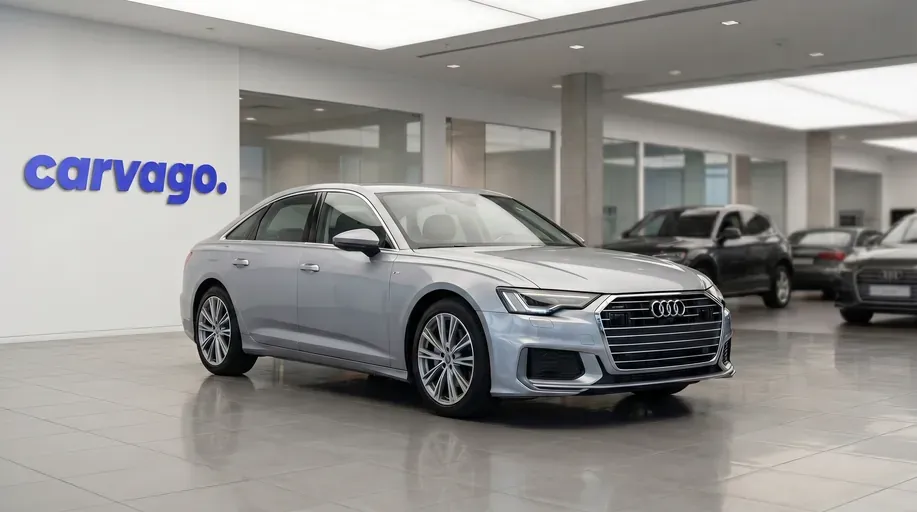
The Audi A6 sits firmly in the executive segment, targeting long-distance business commuters, corporate fleets, and private buyers seeking an understated long-haul cruiser. This review examines the ninth generation (C9), which underpins Audi's combustion and hybrid executive lineup on the Premium Platform Combustion architecture.
Audi initiated the rollout with the world premiere of the Audi A6 Avant in March 2025, followed by the premiere of the Audi A6 Saloon in April 2025. First customer deliveries in Europe began at the end of May 2025, before a plug-in hybrid variant expanded European order books in October 2025. With production active in 2026, the current generation has not undergone a mid-cycle facelift.
Offered in both estate and four-door saloon formats, this generation appeals to drivers who need dependable highway range and variable luggage space while retaining traditional premium proportions.
Because customer deliveries of the ninth-generation Audi A6 only began across Europe at the end of May 2025, long-term durability and high-mileage component wear are not yet established. Independent teardowns and workshop statistics require multiple registration years before recurring mechanical failure patterns emerge. At this early stage in the production lifecycle, the vehicle has generated no confirmed systemic mechanical faults, though its early months have seen official safety campaigns alongside initial electronic and drivetrain observations noted in professional tests and owner discussions.
Two official European safety recalls were announced during 2025 for this generation. Both require verification on early-production vehicles to ensure authorized workshop remedies have been completed:
Beyond official recall notices, professional tests note that pure combustion variants paired with the seven-speed automatic transmission can show hesitation when downshifting under abrupt accelerator input, an effect less evident on hybrid variants where electric assistance smooths low-speed response. On early-delivery cars, some owners report audible high-frequency noise from the LED headlamp units while idling, as well as occasional transient dashboard warnings related to driver-assistance sensors or tailgate latch actuators that typically require software updates. When considering a used Audi A6 Avant or saloon from the initial production months, prospective buyers can arrange an independent technical inspection such as CarAudit to scan control modules and verify documentation before taking delivery.
The ninth-generation Audi A6 arrived with an updated engine line-up developed on the Premium Platform Combustion architecture, featuring four-cylinder and six-cylinder turbocharged units equipped with mild-hybrid or plug-in hybrid technology. Every powertrain is paired with a seven-speed dual-clutch automatic transmission.
| Engine | Fuel | Power | Gearbox | Drivetrain | Model years |
|---|---|---|---|---|---|
| 2.0 TFSI | Petrol | 150 kW (204 hp) | 7-speed automatic | Front-wheel drive | 2025–present |
| 2.0 TFSI MHEV plus | Petrol | 200 kW (272 hp) | 7-speed automatic | All-wheel drive | 2026–present |
| 3.0 TFSI MHEV plus | Petrol | 270 kW (367 hp) | 7-speed automatic | All-wheel drive | 2025–present |
| 2.0 TDI MHEV plus | Diesel | 150 kW (204 hp) | 7-speed automatic | Front-wheel drive / All-wheel drive | 2025–present |
| 3.0 TDI MHEV plus | Diesel | 220 kW (299 hp) | 7-speed automatic | All-wheel drive | 2025–present |
| 2.0 TFSI e-hybrid | Petrol plug-in hybrid | 220 kW (299 hp) | 7-speed automatic | All-wheel drive | 2025–present |
| 2.0 TFSI e-hybrid | Petrol plug-in hybrid | 270 kW (367 hp) | 7-speed automatic | All-wheel drive | 2025–present |
For buyers whose driving consists primarily of town trips, errands, and short commutes, the base 2.0 TFSI petrol is the most sensible starting point. Operating without the mild-hybrid drivetrain generator, it provides smooth power delivery from rest and eliminates concerns about diesel particulate filter regeneration during low-speed cycles. Those with access to domestic or workplace charging facilities can opt for the hybrid Audi A6 in its entry 2.0 TFSI e-hybrid specification, which handles typical weekday commuting purely on electric power before engaging the petrol engine.
For long-distance commuting and frequent motorway driving, the diesel Audi A6 fitted with the 2.0 TDI and mild-hybrid assistance is the primary recommendation. Its transmission-mounted electric generator assists during initial acceleration and reduces stop-start hesitation, delivering high efficiency at steady motorway cruising speeds. Drivers seeking greater reserve power and traditional six-cylinder refinement across long cross-country routes will be better served by the 3.0 TDI or the six-cylinder petrol Audi A6 3.0 TFSI, both of which provide authoritative overtaking performance.
For towing horseboxes, boats, or work trailers, all-wheel drive is essential. While the 2.0 TDI with all-wheel drive handles moderate towing needs capably, the six-cylinder 3.0 TDI offers the strongest tractive capability and superior low-end pull when navigating steep gradients or towing at the legal limit. The higher-output 2.0 TFSI e-hybrid also provides high towing capacities combined with standard all-wheel drive, though pulling heavy loads will deplete the high-voltage battery at a faster rate.
For detailed owner reports on powertrain electronics, software behaviour, and verified European safety recalls, refer to the owner experiences section.
In terms of accommodation, the Audi A6 provides seating for five on a fixed rear bench without sliding adjustments. Independent tests note that while knee clearance accommodates adults, the rear seat cushion sits relatively low to the floor, which forces taller passengers to sit with knees bent sharply and compromises under-thigh support on longer journeys. Evaluators also report that rear legroom and cargo capacity lag behind primary executive rivals. For everyday functionality, versatility is aided by a standard three-piece split-folding rear backrest that permits loading long cargo through the centre while carrying two outer passengers. Buyers should note that electrification affects cargo depth: mild-hybrid and plug-in hybrid variants incorporate battery hardware beneath the floor, yielding a shallower compartment than conventional petrol versions in both the Audi A6 Saloon and the Audi A6 Avant.
| Dimension / Capacity | Estate | Saloon |
|---|---|---|
| Length (mm) | 4,990 | 4,999 |
| Width (mm) | 1,886 | 1,875 |
| Height (mm) | 1,460 | 1,452 |
| Wheelbase (mm) | 2,927 | 2,923 |
| Standard boot volume (seats up / folded, l) | 503 / 1,534 | 492 / — |
| Plug-in hybrid boot volume (seats up / folded, l) | 404 / 1,423 | 354 / — |
Mild-hybrid variants have reduced boot capacities compared to standard petrol models due to underfloor electrical equipment, while seats-folded volume for the saloon is not published by the manufacturer.
On the road, the Audi A6 displays two distinct chassis personalities depending on its running gear. Testers driving cars equipped with optional adaptive air suspension report calm absorption of uneven road surfaces and composed high-speed stability. In contrast, tests on passive sports suspension combined with large wheels describe a jarring, reactive ride over broken urban asphalt. Steering feels direct and light, with optional rear-axle steering providing agile handling in evasive maneuvers and a tight turning circle, although one test noted that the system can feel less progressive mid-corner. Cabin refinement earns broad approval across reviews, with effective acoustic insulation isolating tyre and wind rumble at motorway speeds.
Inside, the Audi A6 Avant draws shared criticism regarding cabin appointments. Professional tests consistently observe that interior plastics and surface finishes feel less substantial than in the preceding generation, undermining its executive atmosphere. Ergonomics also draw mixed verdicts: the digital instrument cluster is complex to configure, and certain central touchscreen menus demand too much attention on the move. While testers agree on the car's acoustic isolation and straight-line stability, their verdicts diverge sharply on chassis specification, warning that avoiding the firmer passive sports suspension is essential for long-distance comfort.
All the market charts in this section reflect Carvago listings across the entire Audi A6 model family, including earlier generations represented in the data, rather than the reviewed generation alone. Because listings from different production eras overlap, these figures do not establish a separate price level solely for the newest generation. Across the wider model range, the median asking price begins at €31,500 for 2019 builds and reaches €36,000 for 2022 examples, before climbing to €59,000 for 2025 and €69,900 for 2026 models.
Active Audi A6 listings hovered between 23,481 in April 2026 and a peak of 24,771 in July 2026 across the six recorded months. The chart below traces how monthly advertised volumes developed through September 2026, when 24,345 cars were on offer.
Active listings over time
| Month | Audi A6 |
|---|---|
| 2026-04 | 23 481 |
| 2026-05 | 23 696 |
| 2026-06 | 24 145 |
| 2026-07 | 24 771 |
| 2026-08 | 24 187 |
| 2026-09 | 24 345 |
Source Carvago
With well over 23,000 cars advertised each month, buyers have extensive choice across the market, supported by listing counts that fluctuated only slightly over the period.
Across recent build years, the median asking price of used Audi A6 models advertised today starts at €31,500 for cars built in 2019 and reaches €69,900 for those built in 2026.
Median advertised price by year of manufacture
| Model year | Audi A6 |
|---|---|
| 2019 | 31 500 |
| 2020 | 33 000 |
| 2021 | 34 800 |
| 2022 | 36 000 |
| 2023 | 46 400 |
| 2024 | 51 600 |
| 2025 | 59 000 |
| 2026 | 69 900 |
Source Carvago
Buyers exploring older options from the 2019 to 2022 model years face median asking prices between €31,500 and €36,000, whereas stepping up to a 2023 model requires a median asking price of €46,400, rising to €69,900 for 2026 models.
This curve illustrates how the Audi A6 sheds value over time, recording its sharpest drop in the first year as average residual value falls by 24%. By three years of age, the model loses roughly 47% of its initial value.
Residual value by vehicle age
| Vehicle age | Audi A6 |
|---|---|
| New | 74 400 |
| 1 yr | 56 800 |
| 2 yrs | 46 900 |
| 3 yrs | 39 800 |
| 4 yrs | 36 100 |
| 5 yrs | 33 500 |
| 6 yrs | 30 600 |
| 7 yrs | 28 000 |
Source Carvago
Across the full seven-year span shown, the car sheds around 62% of its original value, with annual depreciation easing considerably and staying below 10% per year from age four onward.
Across the six months from April to September 2026, advertised Audi A6 listings were led by diesel models, which stood at 12,237 in April 2026 and 12,728 in September 2026. The chart below tracks how the active vehicle count developed for each powertrain.
Supply composition by fuel type
Petrol
Diesel
Hybrid
Electric
LPG
| Month | Petrol | Diesel | Hybrid | Electric | LPG |
|---|---|---|---|---|---|
| 2026-04 | 4 743 | 12 237 | 4 792 | 1 700 | 1 |
| 2026-05 | 4 715 | 12 316 | 4 940 | 1 717 | 0 |
| 2026-06 | 4 865 | 12 413 | 4 929 | 1 928 | 0 |
| 2026-07 | 4 907 | 12 746 | 4 886 | 2 221 | 0 |
| 2026-08 | 5 087 | 12 443 | 4 451 | 2 197 | 0 |
| 2026-09 | 5 068 | 12 728 | 4 387 | 2 154 | 0 |
Source Carvago
Diesel dominates the available listings, with 12,728 advertised cars in September 2026 compared to 5,068 petrol and 4,387 hybrid vehicles. Buyers will find the widest selection among diesel options, whereas electric variants make up a smaller portion of the market at 2,154 listings.
Between April 2026 and September 2026, the average asking price for the Audi A6 opened at €42,400, as shown in the monthly data below.
Average price development over time
| Month | Audi A6 |
|---|---|
| 2026-04 | 42 400 |
| 2026-05 | 42 200 |
| 2026-06 | 42 300 |
| 2026-07 | 42 700 |
| 2026-08 | 43 300 |
| 2026-09 | 43 400 |
Source Carvago
Prices experienced little overall movement across the six months, dipping slightly to €42,200 in May before finishing at €43,400 in September, an overall shift of just over 2%.
Calm ride comfort and composed stability when equipped with optional adaptive air suspension
Effective acoustic insulation that isolates wind and tyre noise at motorway cruising speeds
Broad powertrain line-up offering efficient long-distance diesels and capable plug-in hybrids
Interior plastics and surface finishes feel less substantial than in the previous generation
Low-mounted rear seat bench leaves taller passengers with limited under-thigh support
Jarring, reactive ride over broken urban surfaces when fitted with passive sports suspension
Long-term reliability of the ninth-generation Audi A6 is not yet established because European customer deliveries only began at the end of May 2025. While no systemic mechanical defects have emerged, early builds require verification that official safety recalls affecting the passenger airbag and seat belt buckle anchorage were performed.
For high-mileage highway journeys, the diesel Audi A6 equipped with the mild-hybrid 2.0 TDI is the primary recommendation for cruising efficiency. Drivers who regularly tow heavy loads or seek superior overtaking punch are better served by the six-cylinder 3.0 TDI.
Confirm via the vehicle identification number (VIN) that early recalls for the passenger airbag housing and seat belt anchorage have been resolved by an authorized workshop. On your test drive, evaluate the seven-speed automatic transmission for downshift hesitation under abrupt throttle input and verify that no transient sensor warnings appear on the display.
Prioritize models fitted with the optional adaptive air suspension, which delivers calm road isolation and composed motorway stability. Professional road tests caution against the passive sports suspension, which yields a jarring ride over broken tarmac.
Sources: audi.com, adac.de, kba.de, autobild.de, autocar.co.uk
This article was prepared using artificial intelligence tools. The section guarantor is Petr Dušek.
Audi A6 vs. Lexus ES: A detailed comparison of premium sedans. Discover the differences in comfort, equipment, and reliability, and read our final verdict.
May 16, 2026
Audi A8 vs BMW 7 Series: A detailed comparison of luxury sedans. Find out which model offers better performance, comfort, and reliability to help you make the right choice.
Oct 22, 2026
Detailed comparison of Volvo S90 vs Volvo V90. Discover the differences in practicality, equipment, and driving characteristics. Read the detailed verdict before you buy!
May 7, 2026