Car battle
Hyundai Kona vs. Renault Captur: Complete comparison 2026
Hyundai Kona vs. Renault Captur: Which urban SUV to choose? A detailed used car comparison, equipment evaluation, and a clear verdict to make your choice easier.
Apr 16, 2026
Comparison of used Ford Kuga and Hyundai Tucson SUVs. Find out which one is the better choice. We bring a detailed comparison of equipment, space, and reliability.
October 16, 2026
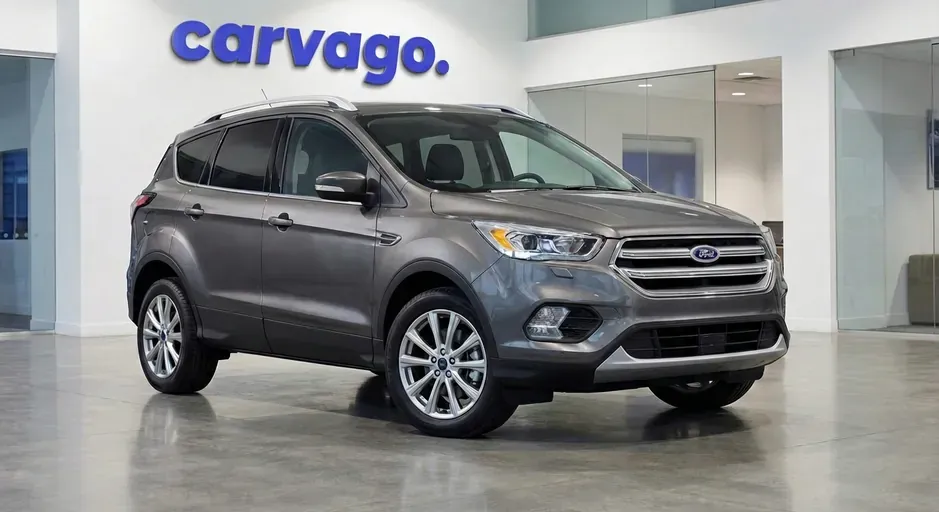
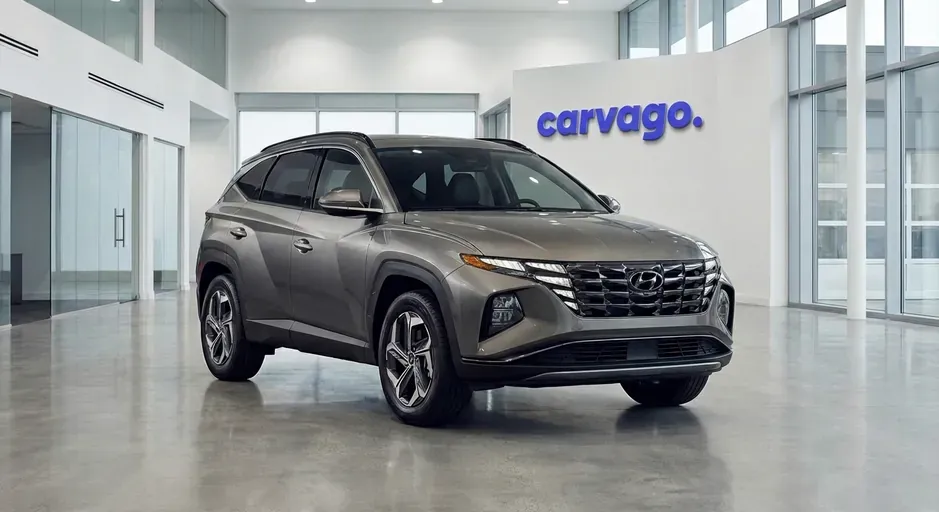
[Ford Kuga](https://carvago.com/en/cars/ford/kuga), also known as the Ford Escape in some overseas markets, is a popular compact SUV that attracts drivers primarily with its precise handling and a wide range of modern engines. Standing against it is the [Hyundai Tucson](https://carvago.com/en/cars/hyundai/tucson), a visually bold and immensely popular South Korean bestseller that appeals to family users with its exceptionally spacious interior and top-tier technological equipment. Let's take a detailed look together at which of these two sought-after cars represents a smarter choice on the nearly-new used car market for your daily journeys.
In a direct comparison of the current generations of both popular SUVs, which you will most often find on the used car market at around four years old (i.e., the third-generation Ford Kuga and the third-generation Hyundai Tucson), the different approach to body proportions stands out at first glance. With a length of 4614 to 4629 mm, the Ford Kuga is a significant 114 to 119 mm longer than its South Korean competitor, which measures 4500 to 4510 mm. This difference gives the Kuga a visually longer, more dynamic silhouette. In terms of daily use, this means that the Tucson, with its more compact exterior dimensions, offers slightly easier maneuverability and more trouble-free parking in narrow city streets, while the Kuga, on the other hand, benefits from a more majestic road presence.
Another key parameter is the wheelbase, which has a fundamental influence on driving stability and cabin layout. The Ford Kuga has a value of 2710 mm here, which is exactly 30 mm more than in the case of the Hyundai Tucson (2680 mm). The wider stance of the American car is also confirmed by its width of 1883 mm, which exceeds the Tucson by 18 mm. In practice, the longer wheelbase and wider body of the Ford mean more confident directional stability at highway speeds and a slight benefit for the longitudinal space of rear passengers. The Tucson, on the other hand, has managed to conjure up an incredibly efficiently designed interior from its slightly shorter wheelbase, thanks to which it can very cleverly mask the millimeter loss from the outside in real-world use.
The height of both cars is highly comparable; the Tucson stays steadily at 1650 mm, while the Kuga ranges between 1650 and 1663 mm depending on the specific engine and equipment. Both cars thus offer a raised driving position and comfortable entry, which is typical for the modern SUV category. From the perspective of overall exterior proportions, a clear conclusion follows from this comparison: if you are looking for a more robust family cruiser with a maximized footprint and confidence on fast highway journeys, the longer [Ford Kuga](https://carvago.com/en/cars/ford/kuga) will suit you. The [Hyundai Tucson](https://carvago.com/en/cars/hyundai/tucson) on the other hand, represents an ideally balanced compromise for drivers requiring a more agile and shorter car, which, thanks to its dimensions, is not afraid of even cramped underground garages.
| Parameter | Ford Kuga SUV | Hyundai Tucson SUV |
|---|---|---|
| Width (mm) | 1883 | 1865 |
| Length (mm) | 4614 - 4629 | 4500 - 4510 |
| Height (mm) | 1650 - 1663 | 1650 |
| Wheelbase (mm) | 2710 | 2680 |
When choosing a family SUV, the size of the trunk plays an absolutely key role. Whether you're dealing with daily logistics with a stroller or looking for a car sufficient for weekend shopping and longer vacations, every extra liter is of immense value. In a direct comparison of the third generations of these vehicles (which correspond to an ideal age of around four years on the used car market), the different priorities of both automakers are fully revealed. The Kuga emphasizes dynamic design, while the Tucson is a master of interior spaciousness, easily offering room for several extra suitcases inside.
Looking at the exact numbers, the dominance of the Korean representative is clear. The standard version of the [Hyundai Tucson](https://carvago.com/en/cars/hyundai/tucson) with an internal combustion engine (for example, with the popular 1.6 T-GDI engine) offers a top-tier 620 liters in its basic configuration. After folding down the rear backrests, this space increases to a massive 1,799 liters. The third-generation [Ford Kuga](https://carvago.com/en/cars/ford/kuga), on the other hand, with basic engines (1.5 EcoBoost, 2.0 EcoBlue), offers a volume of only 435 liters, expandable to 1,534 liters. The actual difference of nearly 200 liters in the base configuration gives the Tucson a huge advantage when packing for a family vacation without having to make compromises at the expense of passengers.
Significant differences in practicality also exist in today's highly sought-after electrified versions, where automakers had to reduce part of the trunk to safely accommodate traction batteries:
The conclusion is clear when considering these dimensions. The Hyundai Tucson maintains a huge lead even after the batteries are installed. From the perspective of daily transport functionality, the Korean SUV is a much better tool.
| Parameter | Ford Kuga SUV | Hyundai Tucson SUV |
|---|---|---|
| Basic volume (liters) | 435 | 620 |
| Max. volume after folding seats (liters) | 1,534 | 1,799 |
The Hyundai Tucson beats the Ford Kuga by a wide margin in both total trunk volume and its basic configuration. For families and used car buyers who need to regularly transport large amounts of cargo, the Tucson represents a significantly more practical choice, regardless of whether you choose a conventional or hybrid engine.
Towing capacity plays an absolutely key role for many people interested in a mid-size SUV. Whether you plan on towing a caravan for a family holiday, need to transport heavier building materials, or are just looking for enough reserve for weekend shopping and transporting bulky items. When comparing the Ford Kuga (3rd generation) and Hyundai Tucson (3rd generation) models from 2020 to 2024, we encounter quite fundamental differences that can strongly influence the choice of a dream used car.
Standard vs. maximum towing capacity
Both cars can easily handle a standard unbraked trailer up to the common European limit of 750 kg, which is fully sufficient for normal domestic use and lighter loads. However, we find fundamental differences when it comes to braked trailers. The Ford Kuga clearly scores here – with the 2.0 EcoBlue diesel, it can tow a massive 2100 kg, which is an above-standard value in this class. The 1.5 EcoBoost petrol engine also performs very solidly with a capacity of up to 1800 kg. In contrast, the Hyundai Tucson is designed more as a family cruiser than a purebred tow vehicle. Its petrol (1.6 T-GDI) and diesel (1.6 CRDi) engines top out at a unified maximum value of 1650 kg.
Watch out for hybrids and batteries
An important rule applies to both models: electrification usually means compromises in towing capacity. Traction batteries increase the weight of the car itself and, conversely, reduce the permitted limits on the tow bar. The Ford Kuga in the popular Plug-in Hybrid (PHEV) version from 2020–2024 can tow a maximum of 1500 kg (for early units from 2020, even only 1200 kg). The Hyundai Tucson in a similar plug-in hybrid specification falls even lower, specifically into the range of 1210 to 1350 kg.
Final summary
In practice, this means that while the Hyundai Tucson represents a reliable companion for occasionally hitching up a trailer or towing a smaller recreational trailer, the Ford Kuga in its more powerful internal combustion versions offers room for significantly heavier loads and provides much more confidence for spacious family caravans. If maximum trailer weight is a decisive factor for you and you are looking for a workhorse for regular towing, the Ford Kuga represents a significantly more robust and capable choice.
| Model and engine | Braked trailer (kg) | Unbraked trailer (kg) |
|---|---|---|
| Ford Kuga 1.5 EcoBoost (3rd generation) | 1600 – 1800 | 750 |
| Ford Kuga 2.0 EcoBlue (3rd generation) | 2100 | 750 |
| Ford Kuga 2.5 Hybrid / PHEV (3rd generation, 2020–2024) | 1200 – 1600 | 750 |
| Hyundai Tucson 1.6 CRDi / 48V (3rd generation) | 1650 | 750 |
| Hyundai Tucson 1.6 T-GDI (3rd generation) | 1510 – 1650 | 750 |
| Hyundai Tucson 1.6 T-GDI PHEV (3rd generation) | 1210 – 1350 | 750 |
When choosing a four-year-old used SUV (production year roughly 2021–2022), the available engine options play a pivotal role. Both models, Ford Kuga and Hyundai Tucson, represent the best of the current transition to electrification and offer a diverse range that will satisfy conservative diesel fans as well as those interested in technologically advanced hybrids.
While the Ford Kuga relies on a robust 2.5-liter naturally aspirated four-cylinder combined with an e-CVT transmission for its full hybrid (FHEV) and plug-in hybrid (PHEV) versions, the Hyundai Tucson covers its entire hybrid range with a turbocharged 1.6-liter engine. The base pure petrol engines are very similar – both Ford and Hyundai offer an identical 110 kW (150 hp) and a manual transmission. However, a striking difference can be found at the top of the electrified range. There, the Tucson has the upper hand with an impressive 195 kW and relies on a classic six-speed automatic; furthermore, unlike the Kuga, it offers advanced all-wheel drive even for the Plug-in Hybrid (PHEV).
The third generation of the Ford Kuga offers a diverse spectrum of powertrains, in which exceptionally reliable hybrids and traditional diesel units for highway cruisers particularly stand out. For calmer drivers with lower annual mileage, the 1.5 EcoBoost three-cylinder petrol engine (110 kW) serves well, which you will primarily find with front-wheel drive and a six-speed manual.
A major competitive advantage in the used car market is the proven range of diesels. The smaller 1.5 EcoBlue (88 kW) unit was completely dropped from the range in mid-2022, so it will be a rarer choice on the four-year-old car market. Conversely, the more powerful 2.0 EcoBlue diesel remains a sought-after classic (supplied with 110 kW as a mild-hybrid with a manual, or with a more powerful 140 kW and a proper 8-speed automatic). However, the Kuga gained its greatest fame in Western markets for its sophisticated large-displacement hybrid system. It is offered as a classic self-charging hybrid (FHEV) with 140 kW or a Plug-in Hybrid (PHEV) boosted to a system output of 165 kW. However, for the PHEV version, expect only front-wheel drive.
| Engine / Powertrain | Fuel | Power (kW) | Torque (Nm) | Transmission |
|---|---|---|---|---|
| 1.5 EcoBoost | Petrol | 110 | 240 | 6-speed manual |
| 1.5 EcoBlue | Diesel | 88 | 300 | 6-speed manual / 8-speed automatic |
| 2.0 EcoBlue / MHEV | Diesel / Mild-hybrid | 110 / 140 | 370 / 400 | 6-speed manual / 8-speed automatic |
| 2.5 FHEV (Hybrid) | Petrol / HEV | 140 | 200 | e-CVT automatic |
| 2.5 PHEV (Plug-in) | Petrol / PHEV | 165 | 200 | e-CVT automatic |
Note: The torque value of 200 Nm for the 2.5 Duratec hybrid engines represents the torque of the internal combustion engine alone.
The third generation of the Tucson represents a huge leap forward, and its modern engine range is built entirely around a uniform modular 1.6-liter displacement. The vast majority of used cars from 2021 and 2022 already feature 48V mild-hybrid technology, which actively helps reduce fuel consumption in the city and provides the car with the necessary dynamics.
The base versions of the engines without any electrification (e.g., the pure 1.6 CRDi diesel with 85 kW) disappeared from the price lists at the beginning of 2022. You are therefore much more likely to come across the excellent 1.6 CRDi 48V (100 kW) and the brisk 1.6 T-GDI 48V petrol mild-hybrid tuned to 110 kW or 132 kW. The Koreans like to pair these mild-hybrids with the iMT intelligent manual or a very fast seven-speed dual-clutch (7DCT). The technological pride of the range are the full hybrid 1.6 T-GDI HEV (169 kW) and the top-of-the-line Plug-in Hybrid (195 kW). Compared to the rival Ford, the Tucson brings a major asset – you can enjoy premium 4x4 all-wheel drive with a significantly wider range of engines (including both full hybrids), and shifting is handled by a proper six-speed torque converter automatic instead of a stepless CVT.
| Engine / Powertrain | Fuel | Power (kW) | Torque (Nm) | Transmission |
|---|---|---|---|---|
| 1.6 T-GDI | Petrol | 110 | 250 | 6-speed manual |
| 1.6 T-GDI 48V | Petrol / Mild-hybrid | 110 / 132 | 250 / 265 | 6-speed iMT / 7-speed DCT |
| 1.6 CRDi | Diesel | 85 | 280 | 6-speed manual |
| 1.6 CRDi 48V | Diesel / Mild-hybrid | 100 | 320 | 6-speed iMT / 7-speed DCT |
| 1.6 T-GDI HEV | Petrol / HEV | 169 | 350 | 6-speed automatic |
| 1.6 T-GDI PHEV | Petrol / PHEV | 195 | 350 | 6-speed automatic |
Final RecommendationIf you are a driver with mostly suburban driving, you will love the Ford Kuga for its efficient, comfortable e-CVT hybrid system with its reliable "two-and-a-half-liter" engine. The diesel Kuga with the 2.0 EcoBlue engine is then the clear winner for drivers spending most of their time on the highway. If your priority is sharp design, intelligent torque distribution to all four wheels in every situation, and you prefer a traditional step-gear automatic over a planetary transmission, the overall richer and on-paper more powerful range in the Hyundai Tucson will definitely not disappoint you.
While the Ford Kuga appeals to those seeking maximum city efficiency thanks to its advanced full hybrid system with a sturdy naturally aspirated 2.5-liter engine, the Hyundai Tucson scores with overall more powerful plug-in hybrids, a traditional automatic, and a wide range of 4x4 drive options for electrified units.
Selecting the right engine is absolutely crucial for long-term satisfaction with a vehicle, its reliability, and sustainable operating costs. Our recommendations are based on real-world owner experiences, actual fuel consumption, and proven mechanical durability in cars approximately four years old. It is fascinating to observe the different engineering approaches of both brands – while Ford opted for a large-displacement naturally aspirated 2.5-liter engine combined with an eCVT gearbox for maximum longevity in the third-generation Kuga, Hyundai chose the path of a flexible turbocharged 1.6 T-GDI unit with a classic automatic for the third-generation Tucson. Both paths represent the absolute pinnacle of contemporary hybrid engineering but target a slightly different type of driver.
Within the third generation of the Kuga (on the market since 2020), the hybrid powertrain is clearly the most rational and best choice. Whether you come across a classic full-hybrid (HEV / FHEV) or the popular plug-in hybrid (PHEV) in the selection of four-year-old used cars, you will get an exceptionally robust engine.
For the current third generation of the Tucson (available since late 2020), the full-hybrid variant (HEV) makes the most sense in the category of four-year-old used cars. In the used car market, it clearly outshines the basic petrol and diesel engines, which often involve compromises in driving performance.
Official fuel consumption figures provided by manufacturers often differ significantly from everyday reality on the roads. Standardized laboratory tests cannot always fully simulate real-world traffic, aerodynamic drag at higher speeds, vehicle load, or individual driving styles. To get the most accurate picture of how much the Ford Kuga and Hyundai Tucson actually "consume," we rely on real-world user data from independent platforms like the popular Spritmonitor.de, which aggregates long-term records from thousands of drivers. For this comparison, we have selected the most common engine options of the current generations (Kuga 3rd generation and Tucson 3rd generation), which currently dominate the market for approximately four-year-old used cars.
Data source: User statistics from Spritmonitor.de and databases
| Model and engine | Average consumption (l/100 km) |
|---|---|
| Petrol and mild-hybrid engines | |
| Ford Kuga 1.5 EcoBoost | 6.6 |
| Hyundai Tucson 1.6 T-GDI | 6.8 |
| Hyundai Tucson 1.6 T-GDI 48V (Mild-hybrid) | 6.7 |
| Full hybrid engines (HEV) | |
| Ford Kuga 2.5 Hybrid (FHEV) | 5.6 |
| Hyundai Tucson 1.6 T-GDI Hybrid | 6.0 |
| Diesel engines | |
| Ford Kuga 1.5 EcoBlue | 5.1 |
| Hyundai Tucson 1.6 CRDi | 5.6 |
| Hyundai Tucson 1.6 CRDi 48V (Mild-hybrid) | 5.6 |
| Ford Kuga 2.0 EcoBlue | 5.8 |
| Plug-in hybrid engines (PHEV)* | |
| Ford Kuga 2.5 PHEV | 1.2 |
| Hyundai Tucson 1.6 T-GDI Plug-in-Hybrid | 1.3 |
(Note: For plug-in hybrids, average fuel consumption is extremely dependent on the frequency of charging the battery from the grid. The figures shown reflect an ideal state with regular charging.)
Several interesting trends emerge from the measured data. A surprising finding is that the small turbo engine with mild-hybrid technology (48V) in the Hyundai Tucson does not bring such significant fuel savings in real-world operation as drivers might expect. The difference compared to the pure petrol version is on average only a single tenth of a liter. Conversely, the full hybrid system (FHEV) in the Ford Kuga works fantastically in terms of efficiency. The combination of a large 2.5-liter naturally aspirated four-cylinder with an electric motor can realistically achieve 5.6 liters, beating the Tucson's more complex turbocharged hybrid system by nearly half a liter. In the diesel category, Ford confirms its long-standing experience with diesel – the entry-level 1.5 EcoBlue is the most economical non-electrified choice in the entire comparison and is the only one to reliably stay below the 5.5-liter mark.
What does this mean for the typical user and used car buyer? If you spend most of your time in the city and suburban traffic, the full hybrid (HEV) versions of both SUVs will be the best choice for you. In frequent stop-and-go traffic, they can effectively regenerate energy, and consumption drops sharply. For calm drivers looking for a car with more affordable servicing for a regular mix of journeys, the basic petrol engines (1.5 EcoBoost for Ford or 1.6 T-GDI for Hyundai) will suffice, but expect consumption safely between 6.5 and 7 liters. However, if you are buying the car primarily for regular highway trips and long commutes, diesel engines (both EcoBlue and CRDi) still make the most economic sense. Plug-in hybrids are only worth it on the used market for those who have their own garage or a reliable way to charge the car every day.
In summary, fuel consumption can be an important, but not entirely decisive, factor in this duel. The Ford Kuga offers slightly more efficient power units across almost all categories – from a very economical small diesel to a brilliantly tuned full-hybrid that benefits from a reliable naturally aspirated concept. However, the Hyundai Tucson counters with a more comprehensive range across trim levels, and the differences in consumption (often within half a liter per 100 km) are not so vast as to discourage potential buyers. For the buyer of a roughly four-year-old family SUV, a documented service history and the overall technical condition of the specific vehicle will ultimately play a bigger role than a few saved deciliters of fuel.
When looking for a roughly four-year-old family SUV, you will find an excellent price-to-utility ratio for both models on the used car market. We will focus on the current generations – the third-generation Ford Kuga and the fourth-generation Hyundai Tucson (designated NX4), which most frequently populate used car inventories from the 2021 and 2022 model years. Both vehicles have seen a significant drop from their original list prices, which plays into the hands of second-hand buyers.
The Ford Kuga is proving to be a great opportunity for bargain hunters on the used car market, largely thanks to a strong presence of former fleet and company vehicles.
Thanks to its extravagant design, highly modern interior, and attractive five-year factory warranty with no mileage limit, the Hyundai Tucson holds its value slightly better than its European counterpart. For the buyer, this means a slightly higher initial investment, but with the benefit that 2021/2022 models are usually still covered by the manufacturer's official warranty.
| Price category | Ford Kuga (3rd generation) | Hyundai Tucson (4th generation) |
|---|---|---|
| Basic models (higher mileage or lower trim) | €14,000 – €17,000 | €16,000 – €20,000 |
| The sweet spot (ST-Line / Style trim, up to 80k km) | €18,000 – €23,000 | €21,000 – €25,000 |
| Top versions and full hybrids (PHEV/HEV) | €25,000 – €29,000+ | €27,000 – €31,000+ |
Note: Prices depend on the specific technical condition, service history, and selected optional equipment.
While the Ford Kuga attracts with a faster price depreciation and represents an absolutely fantastic value-for-money ratio on the used market, the Hyundai Tucson holds its market value slightly better thanks to the remaining five-year warranty and offers greater certainty against unexpected expenses for the future owner.
Both compared models, Ford Kuga and Hyundai Tucson, boast a maximum five-star rating in independent Euro NCAP tests. When choosing a used family SUV, however, it is important to view this result in a broader context and take into account the specific year of testing. The Euro NCAP testing methodology is constantly evolving and tightening its requirements every year, both in the area of structural resilience and active safety assistants. Percentage scores from different years therefore cannot be directly and completely objectively compared.
The third generation of the Ford Kuga underwent Euro NCAP crash tests in 2019. At that time, the car excelled particularly in adult occupant protection, where it achieved an excellent 92%. It also performed great in child protection with a score of 86%. The 2019 methodology already fully included autonomous emergency braking (AEB) tests with pedestrian and cyclist detection, for which the Kuga earned a very respectable 82% in vulnerable road user protection. Safety assistance systems were then rated at 73%. Although the certification is slightly older according to today's strictest standards, it still testifies to a very solid body and a reliable level of passive safety.
The fourth generation of the Hyundai Tucson headed to the Euro NCAP laboratories two years later, in 2021. In doing so, it encountered newer, and therefore stricter, testing protocols. These included, for example, a modified frontal crash simulation with a moving deformable barrier and more demanding intersection scenarios. Despite these tougher conditions, the car earned 86% for adult protection and 87% for child protection. The lower percentage score for vulnerable road user protection (66%) and assistance systems (70%) directly reflects the stricter standards introduced for the new decade. An additional advantage of the Tucson is the presence of a center airbag between the front seats, which prevents the bodies of the driver and passenger from colliding in a side impact – a feature that has become practically a necessity under modern standards.
In terms of overall safety, you won't go wrong with either of these family SUVs. On paper, the Ford Kuga shows higher percentages for adult and pedestrian protection, but it benefits from an older and slightly more lenient methodology. The Hyundai Tucson, on the other hand, offers a structure and assistance features designed for more modern and stricter standards. As a result, its safety arsenal is more comprehensive and better meets current occupant protection requirements on the used car market.
| Parameter | Ford Kuga | Hyundai Tucson |
|---|---|---|
| Year of testing | 2019 | 2021 |
| Adult occupant protection | 92 % | 86 % |
| Child occupant protection | 86 % | 87 % |
| Vulnerable road user protection | 82 % | 66 % |
| Safety assistance systems | 73 % | 70 % |
Both cars provide maximum five-star protection, but the Hyundai Tucson, thanks to testing under stricter 2021 rules, brings a slightly more modern approach to safety, including the installation of a center airbag.
Beyond standard equipment, both cars offer more than just basic features, and each model approaches added value in its own distinctive way. These unique elements and clever solutions can often be the deciding factor for everyday life with the vehicle.
Ford Kuga is the sliding rear bench with a range of up to 150 mm. This allows the user to easily choose whether they prefer king-sized legroom for rear passengers or need to maximize luggage space. A traditionally strong point for Ford is also the popular Quickclear heated windshield, which significantly speeds up morning departures in winter months.Great driving characteristics and an agile chassis among the best in its class
Very efficient and reliable plug-in hybrid powertrain (one of the best-selling in Europe)
Practical sliding rear seats allowing for variability between passenger space and the trunk
Intuitive ergonomics with plenty of traditional physical buttons for air conditioning and radio
Cheaper-looking hard plastics are used in some places in the interior
Smaller basic luggage compartment volume compared to the Tucson
Graphically outdated SYNC 3 infotainment system in pre-facelift models
[Ford Kuga](https://carvago.com/en/cars/ford/kuga) targets primarily drivers who want to enjoy a bit of fun and dynamics even behind the wheel of a practical family SUV. Thanks to a very successful plug-in hybrid system and a variable sliding rear bench, it represents an excellent compromise between everyday usability, economical operation, and driving experience.
Bold futuristic design with integrated LED lights that looks very modern even after years
Above-average interior craftsmanship using high-quality and soft-touch materials
Huge luggage compartment offering a volume of up to 616 liters (depending on the engine)
Top-tier safety and modern assistance systems often available even in the base trim
A very wide range of electrified powertrains (mild-hybrid, full-hybrid, and plug-in hybrid)
The fully touch-sensitive climate control panel distracts the driver while driving
More detached steering and an overall less engaging driving experience strictly oriented towards comfort
Higher fuel consumption and dynamic limits in basic gasoline versions without hybrid assistance
[Hyundai Tucson](https://carvago.com/en/cars/hyundai/tucson) is the perfect choice for buyers looking for maximum interior space, a premium-feeling cabin, and modern technology in a used car. Its striking appearance and uncompromising emphasis on travel comfort make it an ideal and exceptionally safe family car for calmer journeys.
Based on our own independent technical inspections of the car, long-term user experience, service reports, and breakdown statistics, we have compiled a detailed overview of the most common problems that buyers of these used cars should watch out for.
The third-generation Ford Kuga is generally a reliable family SUV; however, especially in the first years of production (from 2020), it faced several teething problems, mainly concerning the onboard electronics and electrified powertrains.
[comprehensive car audit](https://carvago.com/en/caraudit) before buying a used car 100% confirms that the specific unit has undergone this official service modification. For EcoBlue diesel engines, there is a risk of faster clogging of the diesel particulate filter (DPF) and EGR valve during frequent short trips.The third-generation Ford Kuga suffered from initial battery issues in the PHEV version and minor software glitches in the onboard systems. However, if the chosen car has undergone the necessary recalls, it offers robust mechanics and a solid level of reliability.
The fourth generation of the Hyundai Tucson (NX4) is among the most reliable representatives of its segment, but given the high degree of digitalization and the complexity of modern hybrid systems, it has not escaped certain characteristic defects.
physical inspection of the car for diesel versions should therefore always include a detailed reading of error codes and a check of the emission system's flow.The fourth-generation Hyundai Tucson is overall a highly reliable SUV, whose occasional weaknesses lie primarily in glitchy onboard system software and hesitation of the automatic dual-clutch transmission. However, the extensive five-year factory warranty with unlimited mileage reliably covers most potential risks even for four-year-old used cars.
When buying a used car, a thorough inspection is key. Here are some specific points to focus on for these two models to avoid unpleasant surprises and potentially expensive repairs.
[comprehensive car audit](https://carvago.com/en/caraudit), which will also reveal leaks in the oil separator on petrol engines.independent technical inspection of the car is worthwhile, as it will confirm through deep diagnostics whether there are hidden errors in the control unit for assistance or comfort systems.[Hyundai Tucson](https://carvago.com/en/cars/hyundai/tucson) offers a larger base luggage compartment, with a volume of around 616 liters depending on the specific engine. [Ford Kuga](https://carvago.com/en/cars/ford/kuga) on the other hand features practical sliding rear seats, which allow the base trunk volume to be increased from 412 to 526 liters. The Tucson is thus the overall more spacious choice, while the Kuga offers slightly more interior flexibility.
The Ford Kuga is traditionally considered one of the best-driving cars in its class, as it provides precise steering and a very agile chassis. The Hyundai Tucson, on the other hand, focuses more on top-notch comfort, sound insulation, smoothness over bumps, and overall on-board well-being. The choice therefore primarily depends on whether you prefer a sportier response for the driver or a more comfortable and quieter ride.
Both models offer very sophisticated hybrid powertrains that, with regular maintenance, show above-average reliability and efficiency. The Ford Kuga in its plug-in hybrid (PHEV) version excels with an excellent real-world electric range and great fuel economy once the battery is depleted. The Hyundai Tucson, in its full-hybrid and plug-in hybrid versions, scores with the availability of all-wheel drive, which is missing in the PHEV version of the Ford.
With a roughly four-year-old Hyundai Tucson, watch out for occasional infotainment glitches and check the smoothness of shifting in the DCT dual-clutch transmission. For the Ford Kuga, in the early production years of the third generation, there were recalls concerning the traction battery in plug-in hybrid models. For both vehicles, it is always absolutely crucial to check for a complete and transparent service history.
The Hyundai Tucson feels slightly airier inside and overall offers generous legroom and headroom in the rear seats. While the Kuga is slightly narrower, it fully compensates for this minor drawback with the aforementioned flexibility of the sliding rear bench. For frequent transport of older children or adult passengers in the back on longer trips, the Tucson remains the more comfortable choice.
Sources: ADAC, svetmotoru.cz, e15.cz, autoweb.cz, automix.cz, retroauta.cz
This article was prepared using artificial intelligence tools. The section guarantor is Petr Dušek.
Hyundai Kona vs. Renault Captur: Which urban SUV to choose? A detailed used car comparison, equipment evaluation, and a clear verdict to make your choice easier.
Apr 16, 2026
Comparison of the Opel Grandland (formerly Grandland X) and the Volkswagen Tiguan. Discover real-world experiences, equipment comparisons, and find out which used SUV is the right one for you.
Oct 16, 2026
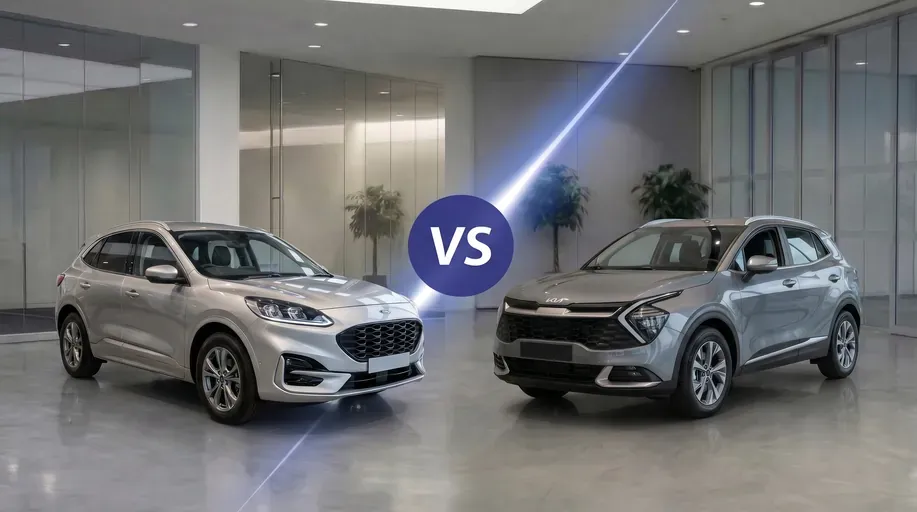
Detailed comparison: Ford Kuga vs. Kia Sportage. Discover the differences in engines, equipment, and reliability, and find out which used SUV is the best choice for you.
Apr 22, 2026