
Car battle
Kia Sorento vs. Škoda Kodiaq: Complete comparison 2026
Detailed comparison of Kia Sorento vs. Škoda Kodiaq. Find out which family SUV offers better engines, real-world fuel consumption, and equipment in our final verdict.
May 10, 2026
Volkswagen Tiguan Allspace review: real owner feedback, practicality, engine picks, common faults and used prices for the 7-seat SUV.
November 5, 2026
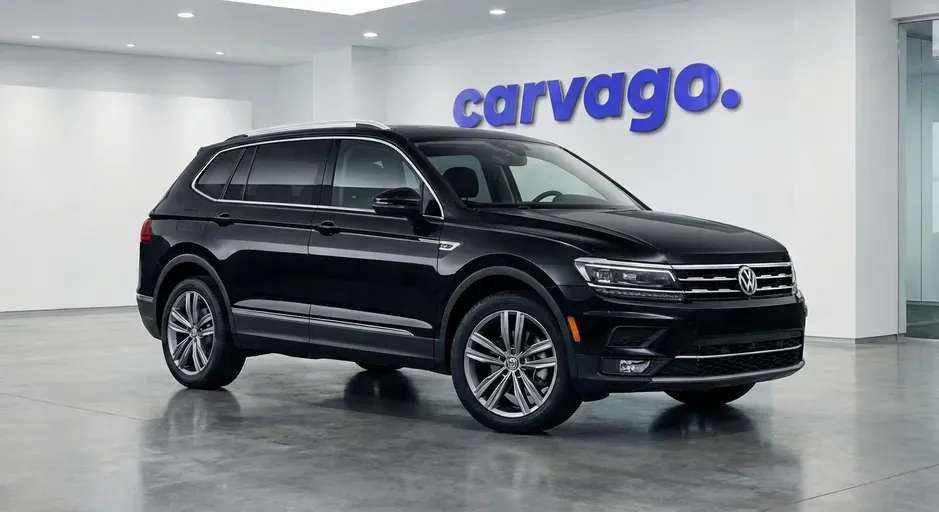
The Volkswagen Tiguan Allspace is the extended, long-wheelbase derivative of Volkswagen’s mid-size family crossover. Sold across a single generation, European customer deliveries began in September 2017 and concluded in 2024. It bridges the gap between traditional compact crossovers and larger full-size vehicles, offering extra utility without the bulk of a commercial passenger van.
A mid-cycle facelift made its world premiere on 12 May 2021. Order books opened on 27 May 2021, and the first refreshed customer vehicles arrived across European showrooms in October and November 2021. The revision introduced updated front-end styling, refreshed driver assistance packages, and digitalised touch controls for the cabin climate system.
Available strictly as an SUV, the Volkswagen Tiguan Allspace came in a standard five-seat layout or with an optional fold-flat third row to accommodate seven passengers. The model is aimed primarily at private families and long-distance drivers who require large luggage volume, flexible rear seating, and stable towing capability.
Owner reports for the Volkswagen Tiguan Allspace depict a dependable family vehicle whose underlying running gear is durable, though electronics and secondary convenience fittings account for the majority of recorded workshop visits. Because two-pedal variants were equipped exclusively with wet-clutch automatic gearboxes, the vehicle avoids the rapid clutch wear associated with smaller dry-clutch transmissions, making mechanical driveline issues relatively infrequent when routine servicing is maintained.
On facelifted models built from autumn 2021 to 2024 equipped with capacitive touch steering wheels, owners frequently report persistent warning messages stating that Travel Assist or Emergency Assist is currently unavailable. These alerts are accompanied by repetitive chimes and typically occur after activating the heated steering wheel, during colder ambient temperatures, or when turning the wheel slightly off-centre. The underlying defect involves intermittent failures within the capacitive touch sensor mats embedded inside the steering wheel rim. While control software updates were initially trialled, owners report that permanent resolution generally requires replacing the complete steering wheel rim assembly.
For early 1.5 TSI petrol versions built between 2018 and 2020, tests and manufacturer technical service bulletins noted noticeable hesitation and cyclic surging—often described as bucking—when pulling away from a standstill while the engine was cold. This behaviour was caused by lean cold-start emissions calibrations; authorized workshops resolved the problem by applying an updated engine management software calibration.
Water ingress is another repeated concern on models equipped with the optional panoramic glass sunroof. Tests and owners describe damp patches on the headliner, wet carpeting in the footwells, and standing water collecting in the spare-wheel well. In most cases, this occurs when road grime and debris clog the rubber drain flaps located inside the wheel arches, trapping rainwater in the drainage tubes. Cleaning the drain passages and modifying the rubber drain ends often resolves the issue, though hairline stress fractures in the sunroof's plastic corner water channels occasionally necessitate replacing the entire drainage frame cassette.
Several official European safety recalls have been registered for the Volkswagen Tiguan Allspace:
| Component / Defect | Affected Production Window | Scope & Workshop Remedy |
|---|---|---|
| Steering rack bolt | 24 September 2013 to 1 July 2024 (group campaign) / 28 November 2016 to 22 September 2018 (dedicated campaign) | Worldwide. Moisture ingress could cause corrosion of a steering rack bolt, which may subsequently fracture and potentially result in a loss of steering capability. Workshops inspect the fastener and replace it with a newly specified bolt. |
| Head airbag housing | 25 November 2018 to 18 February 2019 | Worldwide (644 units). Parts of the inflator housing may detach when the airbag deploys, creating an injury risk for occupants. Workshops replace the complete head airbag module. |
| Engine design cover | Model years 2021 to 2022 (2.0 TSI petrol) | Worldwide. The engine cover can come loose during spirited driving; contact with hot exhaust turbocharger components may cause thermal damage and lead to a fire. Workshops remove the cover until a redesigned version is fitted. |
| Panoramic roof LED lighting | Production up to 5 July 2018 | Worldwide. Moisture ingress into the ambient lighting strip surrounding the panoramic sunroof can cause an electrical short circuit and fire hazard. Workshops retrofit a wiring harness with an integrated fuse. |
Throughout its production run from 2017 to 2024, the Volkswagen Tiguan Allspace was offered exclusively with turbocharged four-cylinder petrol and diesel engines. Unlike the standard-wheelbase Tiguan, it was never engineered with plug-in hybrid options or high-output sports derivatives, maintaining a focus on family utility and towing ability.
| Engine | Fuel | Power | Gearbox | Drivetrain | Model years |
|---|---|---|---|---|---|
| 1.4 TSI | Petrol | 110 kW (150 hp) | 6-speed manual / 6-speed automatic | Front-wheel drive | 2017–2018 |
| 1.5 TSI | Petrol | 110 kW (150 hp) | 6-speed manual / 7-speed automatic | Front-wheel drive | 2018–2024 |
| 2.0 TSI | Petrol | 132 kW (180 hp) | 7-speed automatic | All-wheel drive | 2017–2018 |
| 2.0 TSI | Petrol | 140 kW (190 hp) | 7-speed automatic | All-wheel drive | 2019–2024 |
| 2.0 TSI | Petrol | 162 kW (220 hp) | 7-speed automatic | All-wheel drive | 2017–2020 |
| 2.0 TSI | Petrol | 180 kW (245 hp) | 7-speed automatic | All-wheel drive | 2021–2024 |
| 2.0 TDI | Diesel | 110 kW (150 hp) | 6-speed manual / 7-speed automatic | Front-wheel drive / all-wheel drive | 2017–2024 |
| 2.0 TDI | Diesel | 140 kW (190 hp) | 7-speed automatic | All-wheel drive | 2017–2020 |
| 2.0 TDI | Diesel | 147 kW (200 hp) | 7-speed automatic | All-wheel drive | 2021–2024 |
| 2.0 TDI | Diesel | 142 kW (193 hp) | 7-speed automatic | All-wheel drive | 2024 |
| 2.0 TDI BiTurbo | Diesel | 176 kW (240 hp) | 7-speed automatic | All-wheel drive | 2017–2020 |
Short trips and town driving:
For lower annual mileage and predominantly urban use, a petrol Volkswagen Tiguan Allspace fitted with the 1.5 TSI is the most sensible choice. It reaches operating temperature quickly and avoids the emission filter complications that can affect diesels on short journeys. Professional tests note, however, that when fully laden with passengers, the 1.5 TSI requires considerable throttle input to maintain pace on steep inclines.
Mixed daily driving:
Buyers dividing their time between suburban errands and country roads can look at either the 1.5 TSI or the entry-level 2.0 TDI. The petrol variant runs quietly in traffic, while the base diesel provides stronger low-rpm pulling power that moves this sizable vehicle with less noticeable strain when luggage is on board.
Long motorway journeys:
Frequent long-distance drivers should focus on a diesel Volkswagen Tiguan Allspace. The entry-level 2.0 TDI handles sustained motorway cruising with ease, while the higher-output 2.0 TDI variants provide useful overtaking reserves at higher speeds. The 2.0 TSI petrol versions cruise just as smoothly, though tests consistently record substantially higher fuel consumption on rapid cross-country journeys.
Towing and heavy use:
For towing caravans or driving in winter conditions, an all-wheel drive Volkswagen Tiguan Allspace is essential. The higher-output 2.0 TDI and BiTurbo diesel units deliver the necessary low-down traction and high braked towing limits. While the larger 2.0 TSI petrol engines also carry solid trailer ratings, their fuel consumption increases dramatically under sustained towing loads.
A detailed analysis of powertrain mechanical durability, mechatronic behavior, and documented service actions is covered in our owner experiences and faults section.
The Volkswagen Tiguan Allspace uses its extended wheelbase to provide substantial cabin versatility, though its seating layout prioritises middle-row comfort over carrying seven adults. The second-row bench slides fore and aft and features reclining backrests, ensuring adult passengers have ample legroom and head clearance on long journeys. However, because the middle row is arranged as a split bench rather than three individual seats, securing three child seats side-by-side is impractical. In seven-seat versions, the two rearmost seats fold flat into the luggage floor; these seats have restricted foot space and low seat cushions, making them suitable primarily for children or occasional short journeys. In five-seat configuration, the boot is deep, square, and easy to load, with remote levers in the side walls allowing the rear backrests to drop flat for bulky cargo.
| Specification | Pre-facelift (2017–2021) | Facelift (2021–2024) |
|---|---|---|
| Length | 4,701 mm | 4,723–4,728 mm |
| Width | 1,839–1,859 mm | 1,839–1,859 mm |
| Height | 1,674 mm | 1,679–1,687 mm |
| Wheelbase | 2,787 mm | 2,789 mm |
| Boot volume, 5-seat (upright / folded) | 760 / 1,920 l | 760 / 1,920 l |
| Boot volume, 7-seat (behind 3rd row / folded) | 230–700 / 1,775 l | 230–700 / 1,755 l |
Figures represent standard luggage capacity; models equipped with the optional spare-wheel subwoofer lose a portion of their underfloor storage space.
Professional tests consistently praise the Volkswagen Tiguan Allspace for its composed cruising manners. When equipped with optional adaptive dampers, the suspension settles comfortably over undulating tarmac. On larger wheels, however, sharp urban ridges, sunken manholes, and expansion joints thump through the floor. Handling remains secure and predictable, with neatly checked body roll and light, accurate steering, though the wheel provides little road feedback. While it corners with more composure than many large SUV rivals, testers note that the extended wheelbase makes tight urban manoeuvres noticeably less nimble than in the standard Tiguan.
Refinement is solid on the motorway, where tyre noise is hushed, though wind rustle around the large side mirrors is audible. Diesels produce combustion clatter under hard acceleration before fading into the background, whereas petrol engines run much quieter around town. The cabin offers supportive front seating and durable assembly, although harder plastics line the lower console.
Testers agree on the ergonomic step backward introduced with the facelift. While earlier models earned praise for intuitive physical dials and rotary climate knobs, the updated touch-sensitive climate sliders and capacitive steering-wheel controls are fiddly to operate and prone to accidental activation while driving.
All market figures and charts across this section reflect Carvago listings for the entire Volkswagen Tiguan Allspace model family, including other generations represented in the data, rather than isolating the reviewed generation alone. Because this dataset aggregates the broader lineup, it does not establish a separate price level for the reviewed generation specifically. In the current market snapshot, the median asking price starts at €27,400 for 2019 model years and reaches €43,000 for 2024 examples.
Between May and October 2026, advertised listings for the Volkswagen Tiguan Allspace moved from an initial 5,859 down to 4,820. The chart below tracks how the volume of active listings evolved over these six months.
Active listings over time
| Month | Volkswagen Tiguan Allspace |
|---|---|
| 2026-05 | 5 859 |
| 2026-06 | 5 728 |
| 2026-07 | 5 350 |
| 2026-08 | 4 897 |
| 2026-09 | 5 127 |
| 2026-10 | 4 820 |
Source Carvago
Although the total count dropped over the period despite a brief rise to 5,127 in September, availability remained substantial, giving buyers a wide pool of vehicles to choose from.
The median asking price of used listings advertised today built in 2019 is €27,400, whereas the median asking price of listings advertised today built in 2026 is €49,900.
Median advertised price by year of manufacture
| Model year | Volkswagen Tiguan Allspace |
|---|---|
| 2019 | 27 400 |
| 2020 | 29 400 |
| 2021 | 31 000 |
| 2022 | 34 000 |
| 2023 | 36 900 |
| 2024 | 43 000 |
| 2025 | 42 500 |
| 2026 | 49 900 |
Source Carvago
Buyers considering earlier model years face a median asking price of €29,400 for 2020 listings or €34,000 for 2022 listings. The asking price pattern is not strictly higher for each subsequent build year, as listings from 2025 show a median asking price of €42,500 compared to €43,000 for 2024 listings.
This depreciation curve traces how the Volkswagen Tiguan Allspace loses residual value as it ages. The steepest decline occurs in the first year, with the model shedding roughly 17% of its initial value and reaching a 29% loss by age three.
Residual value by vehicle age
| Vehicle age | Volkswagen Tiguan Allspace |
|---|---|
| New | 48 700 |
| 1 yr | 40 500 |
| 2 yrs | 37 600 |
| 3 yrs | 34 500 |
| 4 yrs | 31 700 |
| 5 yrs | 28 200 |
| 6 yrs | 25 500 |
| 7 yrs | 23 000 |
Source Carvago
Across the seven-year span shown, the model sheds around 53% of its initial residual value. The rate of loss eases noticeably after the first year, with annual declines moderating over subsequent years.
The volume of advertised vehicles was led by conventional engines throughout the period, starting with 3604 diesel and 2145 petrol listings in May 2026. The chart below traces how monthly active listings for each fuel type developed through October 2026.
Supply composition by fuel type
Petrol
Diesel
Hybrid
| Month | Petrol | Diesel | Hybrid |
|---|---|---|---|
| 2026-05 | 2 145 | 3 604 | 109 |
| 2026-06 | 2 126 | 3 510 | 92 |
| 2026-07 | 2 014 | 3 288 | 48 |
| 2026-08 | 1 893 | 2 993 | 11 |
| 2026-09 | 1 992 | 3 135 | 0 |
| 2026-10 | 1 881 | 2 939 | 0 |
Source Carvago
In October 2026, available stock comprised 2939 diesel and 1881 petrol cars, while hybrid listings stood at 0. Buyers will find their choices practically limited to diesel and petrol, with diesel offering the largest number of options.
The chart below tracks the average asking price for the Volkswagen Tiguan Allspace between May 2026 and October 2026, opening at €30,900.
Average price development over time
| Month | Volkswagen Tiguan Allspace |
|---|---|
| 2026-05 | 30 900 |
| 2026-06 | 30 700 |
| 2026-07 | 30 300 |
| 2026-08 | 30 000 |
| 2026-09 | 29 800 |
| 2026-10 | 29 600 |
Source Carvago
Across the six months shown, the average asking price decreased steadily each month to €29,600, representing a modest decline of about 4% over the period.
Deep, practical boot and sliding second row with ample legroom
Composed, refined motorway cruising manners and secure handling
Durable wet-clutch automatic transmissions avoid dry-clutch wear issues
Cramped optional third-row seats are suitable only for children
Facelift touch-sensitive climate sliders and steering controls are fiddly
Firm low-speed ride over sharp urban bumps on larger wheels
Mechanically, the Volkswagen Tiguan Allspace is dependable because all two-pedal variants use robust wet-clutch automatic transmissions. Most reported issues relate to secondary electronics on facelift models and water leaks from the optional panoramic sunroof.
The 2.0 TDI diesel paired with all-wheel drive is best suited for towing and long motorway trips due to its low-end torque and modest fuel consumption. Petrol variants run quietly in urban traffic, but consume substantially more fuel under load.
The optional third row is suitable primarily for children or occasional short trips due to limited foot space and low cushions. However, the sliding second row comfortably accommodates adult passengers on long journeys.
Verify by VIN that all safety recalls have been carried out, particularly for the steering rack bolt and engine cover. In addition, inspect footwells for dampness on cars with the optional panoramic roof and ensure assistance systems trigger no warning chimes during the test drive.
Sources: volkswagen-newsroom.com, adac.de, oeamtc.at, autobild.de, autoexpress.co.uk
This article was prepared using artificial intelligence tools. The section guarantor is Petr Dušek.
Detailed comparison of Kia Sorento vs. Škoda Kodiaq. Find out which family SUV offers better engines, real-world fuel consumption, and equipment in our final verdict.
May 10, 2026
Detailed comparison of Hyundai Santa Fe vs. Kia Sorento. Discover real-world experiences, differences in equipment and engines, and read our verdict. Which SUV to choose?
Apr 29, 2026
Alfa Romeo Stelvio vs. Lexus NX Comparison: Which used premium SUV to choose? We bring you a detailed look at reliability, equipment and a clear final verdict.
Apr 17, 2026