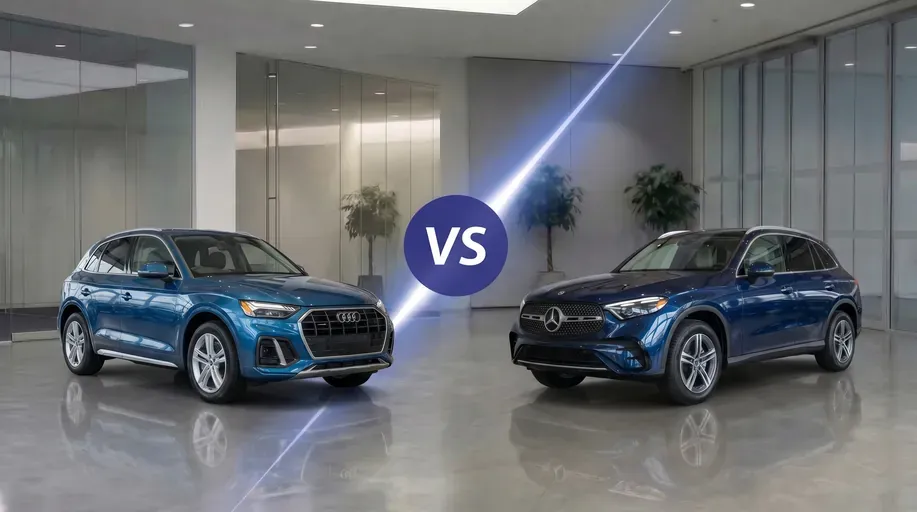
Car battle
Audi Q5 vs. Mercedes-Benz GLC: Complete comparison 2026
Audi Q5 vs Mercedes-Benz GLC: A detailed comparison of premium SUVs. Read real-world experiences, engine and equipment comparisons, and find out which one to choose.
May 15, 2026
Articles
Review
Toyota Highlander review: real owner experiences, 7-seater practicality, hybrid efficiency, running costs, and used prices before you buy.
November 1, 2026
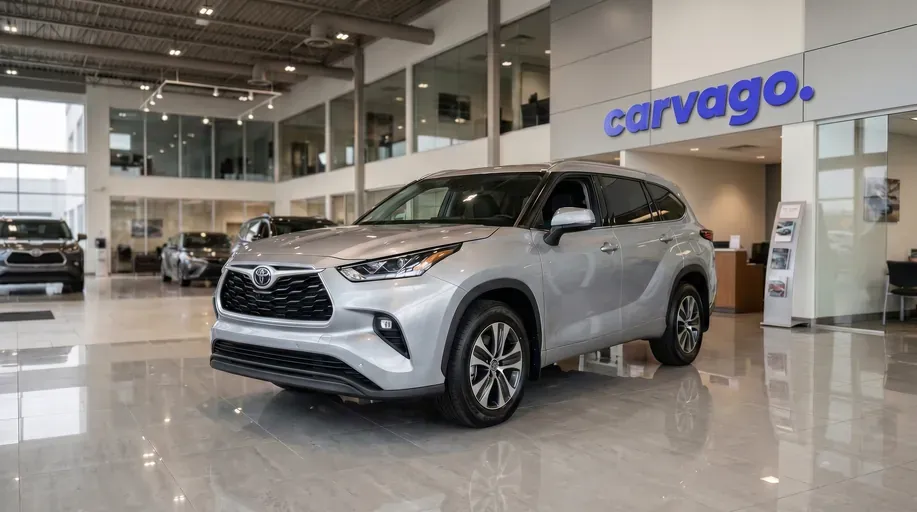
The Toyota Highlander SUV represents the manufacturer's largest passenger vehicle offering in Europe, sitting above the RAV4 as a dedicated three-row crossover. While long established in North America, this fourth-generation model (internal code XU70) marked the nameplate's official European debut, with regional order books opening in January 2021 ahead of initial customer deliveries in March 2021.
Offered exclusively as a five-door, seven-seat SUV with all-wheel drive, the Toyota Highlander appeals primarily to buyers needing three usable rows of seating, towing capability, and a self-charging hybrid powertrain without moving to a van-based people carrier.
A mid-cycle technical revision was announced in July 2022 for the 2023 model year, with deliveries commencing in January 2023. Although new-vehicle orders ceased across Western European markets between December 2023 and August 2024, the fourth-generation Highlander remains an active presence on the European used market.
Because European customer deliveries of the fourth-generation Toyota Highlander commenced in March 2021, long-term fleet reliability is still developing. The hybrid powertrain’s core mechanical components show few systemic failures, but real-world running and technical analyses highlight several specific electrical, hardware, and assembly vulnerabilities that prospective buyers should examine.
In regions that experience harsh winters and salted roads, tests and owners describe galvanic corrosion affecting the high-voltage cable connector at the rear electric drive unit on the hybrid Toyota Highlander AWD. Road spray and de-icing chemicals can penetrate the connector housing, eroding the wiring shield and terminals. In some cases, this issue can cause radio interference, trigger hybrid system error warnings, disable all-wheel drive, and eventually prevent the car from entering drive-ready mode. Early detection allows workshops to clean terminals, apply protective sealant, and install an updated splash guard, whereas advanced corrosion necessitates replacing the complete high-voltage harness.
Owners also frequently report rapid discharge of the 12-volt auxiliary battery. Because this compact battery powers control units and relays rather than cranking an engine, vehicles left parked for several weeks or driven only on short trips can deplete it below operating thresholds. A discharged auxiliary battery prevents the hybrid system from starting and generates cascade warning messages across driver-assistance systems. On 2021 and 2022 builds, tests and owners also report that internal tank geometry and venting can cause filling nozzles to click off prematurely, leaving the tank short of its full capacity and distorting remaining-range estimates.
Several official safety recalls have been registered across European markets for this model generation. Authorized workshops address these issues free of charge.
| Defect | Affected Production Window | Workshop Remedy |
|---|---|---|
| Front lower bumper cover and underbody shield detachment | 06.12.2019 – 29.08.2023 | Inspect mounting tabs and fit redesigned retention hardware |
| Steering column spiral cable / driver airbag deactivation | 02.02.2023 – 12.06.2023 | Inspect serial number and replace defective spiral cable assembly |
| Rearview camera display freezing or failing to show image | 31.03.2021 – 09.09.2025 | Reprogram parking assist control unit software |
| Digital instrument cluster memory overflow and display blackout | 2022 – 2025 | Reprogram combination meter ECU software |
| Second-row seatback recliner latch failure to remain locked | 31.03.2021 – 01.11.2023 | Inspect and replace second-row seatback recliner mechanisms |
When evaluating a used hybrid Toyota Highlander, buyers can verify the vehicle's maintenance history, electronic control modules, and physical underbody condition through an independent inspection such as CarAudit.
Across Western and Central European markets, the fourth-generation Toyota Highlander was offered exclusively with a full hybrid powertrain paired with an electric all-wheel-drive system. Selected Eastern European markets also received a non-hybrid turbocharged petrol engine linked to a conventional automatic gearbox.
| Engine | Fuel | Power | Gearbox | Model years |
|---|---|---|---|---|
| 2.5 Hybrid | Petrol hybrid | 182 kW (248 hp) | Automatic (e-CVT) | 2021–2024 |
| 2.4 Turbo | Petrol | 198 kW (269 hp) | Automatic (8-speed) | 2022–present |
| 3.5 V6 | Petrol | 183–220 kW (249–295 hp) | Automatic (8-speed) | 2020–2022 |
For urban driving and daily family duty, the hybrid Toyota Highlander is the most suitable variant. At city speeds, the electric motors handle low-speed manoeuvres quietly, and the transition to the combustion engine under light acceleration remains unobtrusive. In stop-and-go conditions, frequent regenerative braking replenishes the traction battery without driver intervention.
On mixed roads and suburban commutes, the hybrid system balances its power sources effectively. As a used car, it represents the default option for buyers seeking predictable running costs in a seven-seat vehicle.
Long-distance motorway travel exposes the primary operational trade-off of the hybrid setup. Under sudden acceleration, overtaking manoeuvres, or prolonged uphill climbs, the planetary automatic transmission forces the combustion engine to hold high revolutions, creating a sustained drone until road speed stabilises. For drivers who cover extensive motorway mileage, the rarer petrol Toyota Highlander eliminates this rev flare through its stepped automatic gearbox, though it demands significantly higher fuel consumption in return.
For towing duties, both versions provide all-wheel-drive traction, but their characteristics diverge under load. The hybrid pulls braked trailers competently on level roads, yet towing heavy loads up steep gradients places heavy continuous demand on the combustion unit once battery assistance wanes, resulting in persistent engine noise. Drivers planning frequent, heavy towing trips will find the conventional turbocharged petrol variant less acoustically strained under sustained strain.
| Dimension / Capacity | Toyota Highlander |
|---|---|
| Length | 4,966 mm |
| Width | 1,930 mm |
| Height | 1,755 mm |
| Wheelbase | 2,850 mm |
| Boot volume (seats up / folded) | 268–658 / 1,909 l |
Width excludes door mirrors. Cargo figures include the underfloor compartment and vary depending on the second-row seating position.
The three-row layout of the Toyota Highlander SUV delivers practical packaging for large families. In the second row, passengers enjoy substantial legroom and foot space, aided by a sliding split bench that travels fore and aft to divide knee room with the rearmost passengers. The third-row seats fold flush into the luggage floor and are easily reached thanks to the wide rear door openings and tilt-slide middle row, though the low seat base makes the third row best suited to children or adults on shorter journeys. Even with all passenger places occupied, the boot retains sufficient depth for everyday grocery bags, aided by a practical underfloor storage box. Folding the third row creates a broad, level cargo deck capable of holding bulky prams or family holiday gear, while dropping both rear seating rows yields an expansive, flat carrying area.
Professional road tests characterize the hybrid Toyota Highlander as an unhurried, comfort-focused cruiser. At urban speeds in pure-electric mode, the cabin remains quiet. Long motorway stretches highlight supple damping and stable straight-line tracking, aided by well-calibrated lane-centring assistance. However, when demanding sudden acceleration to shift its substantial weight, the petrol engine revs loudly, disrupting cabin refinement. On undulating secondary roads, the softly sprung chassis reveals its limits: several tests report noticeable body float, lateral sway, and wallow that can unsettle rear passengers.
The steering draws mixed reactions. Some testers praise its natural weighting and intuitive positioning despite the vehicle's footprint, while others find it numb and disconnected under lateral cornering loads. Low-speed bump absorption also divides opinion, with some reviewers noting that sharp expansion joints filter through on larger alloy wheels.
Inside, the Toyota Highlander receives consistent marks for solid assembly and functional ergonomics. Testers appreciate physical switchgear for climate controls and practical dash storage shelves. The primary criticism directed at earlier cars was the sluggish multimedia interface and low-resolution navigation graphics. The 2023 model year revision addressed this shortcoming with an updated multimedia system and digital instrument cluster standard across European-market cars, bringing onboard technology closer to European rivals while retaining straightforward everyday operation.
All the charts in this section are drawn from Carvago listings representing the broader Toyota Highlander model family across all available generations, rather than exclusively filtering for the reviewed generation. Consequently, the supplied data does not establish separate price levels by individual generation. Across the current market offer, the median asking price sits at €44,000 for 2021 models and €48,000 for 2022 cars. Later builds generally reflect higher sums, with 2023 examples recording a median asking price of €60,000 and 2024 models reaching €64,600, though 2025 listings drop to €44,500.
Active Toyota Highlander listings on the market stood at 240 in April 2026 and peaked at 242 the following month. The chart below illustrates how advertised availability developed through September 2026.
Active listings over time
| Month | Toyota Highlander |
|---|---|
| 2026-04 | 240 |
| 2026-05 | 242 |
| 2026-06 | 238 |
| 2026-07 | 233 |
| 2026-08 | 186 |
| 2026-09 | 217 |
Source Carvago
Buyers faced shifting availability across the six months, with listings falling to a low of 186 in August 2026 before climbing back to 217 in September 2026. This span provides a broad selection of vehicles to evaluate, though the volume of cars on offer has fluctuated rather than holding stable.
Across listings on the market, the median asking price of cars built in 2020 is €42,700, compared to €64,600 for those built in 2024.
Median advertised price by year of manufacture
| Model year | Toyota Highlander |
|---|---|
| 2020 | 42 700 |
| 2021 | 44 000 |
| 2022 | 48 000 |
| 2023 | 60 000 |
| 2024 | 64 600 |
| 2025 | 44 500 |
Source Carvago
Buyers examining 2020 to 2022 models face median asking prices between €42,700 and €48,000, whereas 2024 models stand at €64,600; the progression is not strictly higher for newer cars, however, with 2025 listings recorded at €44,500.
Between April and September 2026, the advertised selection was centered on hybrids, which peaked at 235 listings in May 2026 and stood at 211 in September 2026. The chart below shows how each fuel type was represented on the market month by month.
Supply composition by fuel type
Petrol
Hybrid
LPG
| Month | Petrol | Hybrid | LPG |
|---|---|---|---|
| 2026-04 | 6 | 233 | 1 |
| 2026-05 | 6 | 235 | 1 |
| 2026-06 | 7 | 230 | 1 |
| 2026-07 | 6 | 226 | 1 |
| 2026-08 | 2 | 183 | 1 |
| 2026-09 | 5 | 211 | 1 |
Source Carvago
Hybrids dominate the available options, with September 2026 recording 211 hybrid listings alongside 5 petrol vehicles and 1 LPG vehicle. Buyers in the market for this model will realistically be choosing almost entirely from hybrid stock.
Between April 2026 and September 2026, the average asking price for the Toyota Highlander opened at €48,500 and reached €48,700 in May.
Average price development over time
| Month | Toyota Highlander |
|---|---|
| 2026-04 | 48 500 |
| 2026-05 | 48 700 |
| 2026-06 | 47 100 |
| 2026-07 | 47 200 |
| 2026-08 | 46 800 |
| 2026-09 | 47 100 |
Source Carvago
Values fluctuated across the six months, touching a low of €46,800 before ending at €47,100 in September 2026. This net change of under 3% represents only modest variation relative to overall price levels.
Quiet and refined cruising at urban speeds and on level motorways
Practical seven-seat layout with versatile sliding middle row and flat cargo area
Intuitive interior ergonomics with physical switchgear and practical storage options
Engine drone and rev flare under sudden acceleration or uphill towing on the hybrid
Noticeable body float and lateral sway on undulating secondary roads
Low third-row seat base best suited to children or short journeys
The hybrid powertrain shows few systemic mechanical faults, making it fundamentally reliable. However, buyers should check for underside road-salt corrosion on the rear high-voltage connector and ensure the 12-volt auxiliary battery is healthy.
Models produced from 2023 onward are the easiest to recommend because the mid-cycle revision introduced an updated digital instrument cluster and faster infotainment. Earlier 2021 and 2022 examples remain sensible alternatives, provided all recall work has been documented as completed.
The hybrid Toyota Highlander is the default choice for daily family duty, delivering quiet urban driving and low running costs. The non-hybrid turbo petrol avoids engine flare under heavy load, but consumes more fuel and was restricted to selected Eastern European markets.
Verify by VIN that all manufacturer safety recalls have been documented as completed. Additionally, inspect underneath for road-salt corrosion on the rear electric drive connector and check that the lower bumper undertrays are secure.
Sources: newsroom.toyota.eu, adac.de, ec.europa.eu, autobild.de, whatcar.com
This article was prepared using artificial intelligence tools. The section guarantor is Petr Dušek.
Audi Q5 vs Mercedes-Benz GLC: A detailed comparison of premium SUVs. Read real-world experiences, engine and equipment comparisons, and find out which one to choose.
May 15, 2026
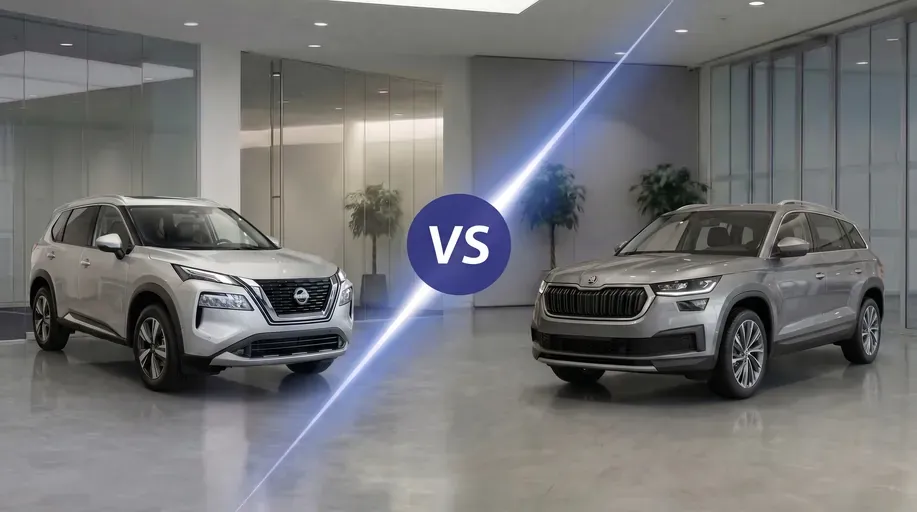
Detailed comparison of Nissan X-Trail vs Škoda Kodiaq. Discover real-world experiences, differences in equipment, and the final verdict that will help you choose the best SUV.
Oct 16, 2026
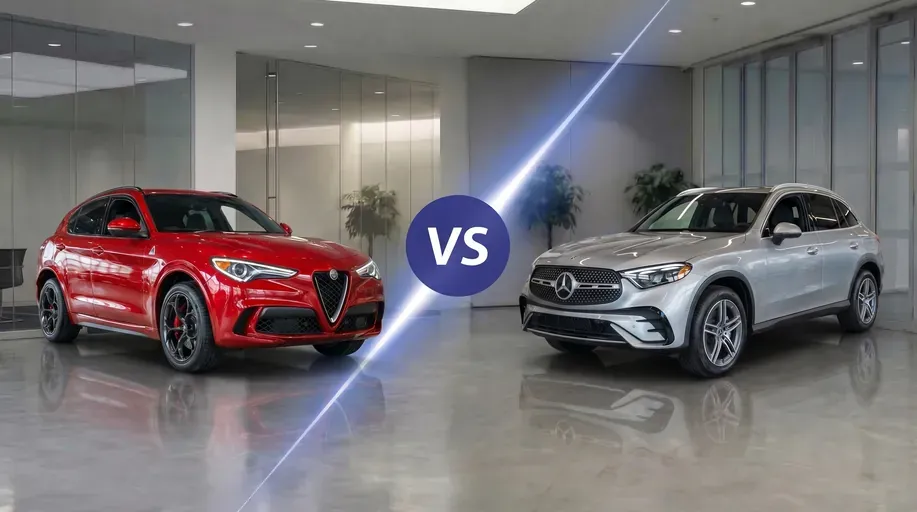
Detailed comparison of the Alfa Romeo Stelvio vs Mercedes-Benz GLC. Discover the differences in driving characteristics, equipment, and reliability, and find out our final verdict.
May 21, 2026