Review Hyundai Staria: What do owners and experts really say?
Hyundai Staria review: real owner experience, engine picks, reliability, practicality and running costs — everything you need before you buy.
November 8, 2026
Verdict at a Glance
Who it suits: Large families and shuttle services prioritising passenger comfort over modular cargo flexibility.
Recommended engine: The 2.2 CRDi diesel for motorway trips and towing, or the 1.6 T-GDI hybrid for urban driving.
What to avoid: Demands for bulky cargo hauling, as rear seats cannot be removed without tools.
Introduction
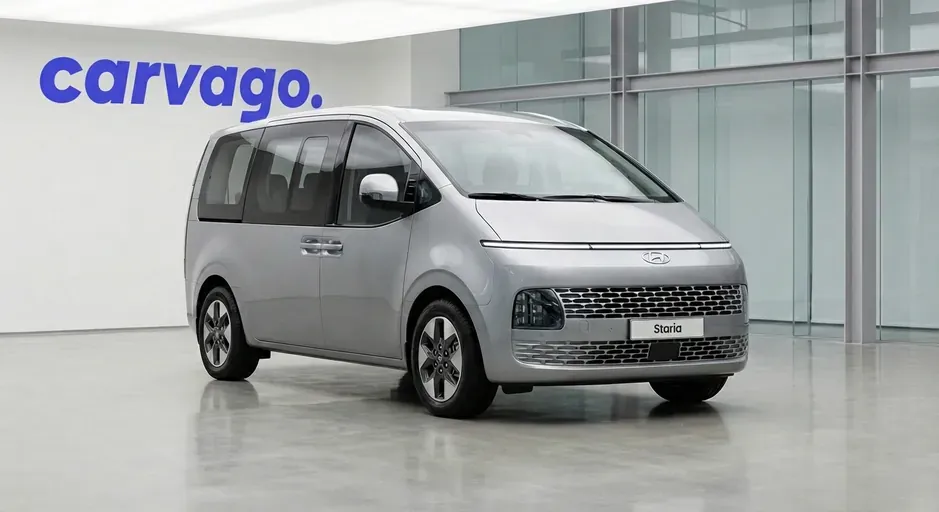
The Hyundai Staria is a full-size multi-purpose vehicle positioned in the large van segment, competing with established passenger vans and shuttle transports. This review focuses on the first generation, which began customer deliveries across Europe in August 2021. Available in both passenger iterations and a commercial cargo van, the model offers seven-seat and nine-seat interior layouts aimed at large families, shuttle operators, and business fleets.
Initial European deliveries launched with the diesel Hyundai Staria, followed by additional nine-seater configurations added to order books between December 2022 and March 2023. A mechanical revision arrived in November 2024, when orders opened for the hybrid Hyundai Staria equipped with a 1.6 T-GDI petrol-electric powertrain, which replaced the diesel in most European passenger listings.
The lineup expanded further following the January 2026 premiere of the fully electric passenger and cargo variants, with European order books opening in September 2026. While its monobox styling distinguishes the Staria from traditional vans on the road, prospective buyers must evaluate how its distinct seating configurations and changing powertrain choices match their daily driving requirements.
Owner Experiences: Common Faults and Recalls
European customer deliveries of the Hyundai Staria began in August 2021, meaning long-term reliability over high mileages is still being established across the continent. Early maintenance records and workshop findings indicate that the mechanical underpinnings are fundamentally durable, with most reported complaints centering on ancillary electronics, powered door mechanisms, and software calibration rather than core powertrain failures.
Official safety registries across Europe remained clear of safety recalls for the model throughout 2025 and 2026. The sole official campaign recorded in Europe was published in May 2022 and concerned an administrative type-approval discrepancy on early production runs spanning model years 2021 and 2022. Vehicles were manufactured and delivered without the idle stop-and-go start-stop system, deviating from their original European approval documentation. Independent technical appraisal confirmed that the affected vehicles complied with Euro 6d emissions standards without the system active, meaning the remedy was strictly administrative and involved updating vehicle registration paperwork.
The most frequent hardware complaint involves the motorized side access. On 2021 to 2024 models equipped with power sliding doors—standard on higher trims and optional on others—tests describe and owners report doors intermittently reversing during closing cycles, failing to cinch securely into the secondary latch, or sounding false door-open warning chimes when driving over road unevenness. These symptoms typically stem from tight factory anti-pinch threshold calibration and guide rail friction. Authorised workshops have resolved the vast majority of cases through guide track lubrication, mechanical latch alignment, and control-module software updates to recalibrate the anti-pinch current limits.
On the digital front, tests describe occasional software freezing on the central touchscreen display and intermittent dropouts of the 360-degree surround-view camera or blind-spot display (standard on higher trims, optional on others) when activating the indicators. This glitch has been recorded on both the diesel Hyundai Staria and the hybrid Hyundai Staria. Dealership software installations have largely stabilized the system.
In terms of running gear, tests describe accelerated tyre shoulder wear and quicker brake pad wear on the rear axle. Given the substantial unladen mass of the vehicle, high tyre wear is a standard operating characteristic rather than a defect, particularly on versions equipped with all-wheel drive or operated regularly with full passenger complements. Prospective buyers can have the chassis components, brake wear, and electronic control units professionally verified prior to purchase through CarAudit.
🔍 What to check before buying
Confirm official documentation and campaign status with an authorised dealer using the vehicle's specific VIN, verifying that registration paperwork reflects the factory specification.
Test both power sliding doors thoroughly via the interior dashboard buttons, pillar switches, exterior handles, and key fob to ensure smooth movement without unexpected anti-pinch reversals.
Operate the turn signals while maneuvering at low speeds to confirm the instrument-cluster blind-spot view cameras and 360-degree parking monitors feed visual data without screen lag or dropouts.
Inspect the rear tyres and brake discs for uneven inner and outer shoulder thinning, as the vehicle's substantial mass accelerates wear on friction surfaces.
Check diagnostic fault memory for low-voltage sensor errors, which can occasionally occur if the 12-volt auxiliary battery suffers frequent discharge on short urban trips.
Engines: Which One to Choose
In the European market, the Hyundai Staria launched exclusively with a four-cylinder turbodiesel, before transitioning to a full hybrid setup and later introducing a pure electric powertrain. The factory paired the combustion engine variants with an automatic transmission, with all-wheel drive reserved solely for the early diesel.
Engine
Fuel
Power
Gearbox
Drivetrain
Model years
2.2 CRDi
Diesel
130 kW
8-speed automatic
Front-wheel drive
2021 – 2024
2.2 CRDi HTRAC
Diesel
130 kW
8-speed automatic
All-wheel drive
2021 – 2024
1.6 T-GDI HEV
Full Hybrid
165 kW
6-speed automatic
Front-wheel drive
2024 – present
Staria Elektro (84 kWh)
Electric
160 kW
1-speed reduction gear
Front-wheel drive
2026 – present
Staria Cargo Elektro (84 kWh)
Electric
160 kW
1-speed reduction gear
Front-wheel drive
2026 – present
Which engine to choose
For long motorway trips, European family holidays, or regular towing, the diesel Hyundai Staria remains the most practical recommendation as a used car. Its broad pulling power shifts a fully loaded cabin with low effort, and the eight-speed torque-converter automatic operates smoothly without constant downshifting on gradients. Buyers living in mountainous regions or frequently driving on slick surfaces should target the all-wheel-drive version, as subsequent powertrains dropped four-wheel traction entirely.
Drivers whose routine consists of city commuting, urban shuttle service, or school runs will be better served by the front-wheel-drive hybrid Hyundai Staria. The hybrid relies on its electric motor for low-speed maneuvering and stop-and-go traffic, delivering a far quieter environment around town than the diesel while completely avoiding the exhaust particulate issues associated with short urban hops. However, when loaded to maximum capacity at sustained highway speeds, the smaller turbocharged petrol unit must rev noticeably higher to maintain pace once electrical assistance fades.
The pure electric Hyundai Staria fits operators looking for local delivery duty, emissions-restricted city zones, or commercial fleet use. Thanks to its 800-volt charging hardware, it recharges rapidly at fast chargers and provides the highest towing rating in the lineup, though its boxy shape and large frontal area reduce effective highway driving range at speed.
Space & Practicality
Dimension / Parameter
Minibus (Passenger)
Cargo Van
Length (mm)
5,253
5,253
Width (mm)
1,997
1,997
Height (mm)
1,990
2,000
Wheelbase (mm)
3,273
3,273
Boot volume (seats up, l)
117 – 831
—
Boot volume (seats folded / max, l)
431 – 3,095
4,935
The passenger boot volume depends entirely on seating arrangement and rail position: seven-seat layouts offer the lower standard volume with the rearmost bench pushed back, whereas nine-seat variants provide the larger cargo bays.
Inside the cabin, the Hyundai Staria people-carrier prioritises dedicated passenger comfort over modular cargo flexibility. On seven-seat versions, standard on higher trims, the middle row features individual relaxation seats with extendable leg rests and deep recline angles, while the nine-seater comfortably accommodates adult passengers across all three rows. The low window line and upright profile create an airy feeling of space throughout. However, everyday practicality reveals notable compromises. The heavy rear seat assemblies are permanently mounted on longitudinal slide rails and cannot be unlatched or removed without workshop tools, which prevents the vehicle from functioning as a flat-floor removal van. Furthermore, child-seat accommodation is constrained, as child-seat anchor points are restricted to the outer positions of the second row, leaving the rearmost bench without dedicated fittings.
What the Tests Say
On the road, the Hyundai Staria provides composed suspension absorption over rough tarmac and remains stable in crosswinds. Steering feels light and easy to direct in town, though testers note noticeable body lean and slow directional responses typical of a massive people mover. Chassis behaviour remains predictable, but instrumented testing consistently marks down emergency braking performance, citing prolonged stopping distances. Acoustic insulation keeps the cabin quiet at moderate cruising speeds, but wind rush around the upright windscreen pillars and large mirrors becomes audible on the motorway.
Interior build quality and switchgear assembly feel solidly executed, accompanied by multiple storage bins throughout the cabin. Testers criticise minor ergonomic compromises, including a central display that is not angled towards the driver, front door glass that does not fully retract, and a climate system that splits only front-to-rear rather than between driver and front passenger. Seating comfort is universally commended, particularly on higher-trim models with reclining individual armchairs.
Prices and Market Offer
All charts in this section are drawn from Carvago listings of the entire Hyundai Staria model family, including other generations represented in the data, rather than solely the reviewed generation. Consequently, this overview does not establish a separate price level for the reviewed generation alone. Within the current market offer, the median asking price stands at €15,000 for 2021 vehicles, €21,800 for 2023 listings, and reaches €49,000 for 2026 examples. These figures describe advertised listings for available stock across build years rather than tracked price movements over time.
From May to October 2026, active Hyundai Staria listings moved between 3,563 and 3,925 cars, starting at 3,914 in May. The chart below shows how monthly advertised counts developed across this six-month period.
Hyundai Staria - availability over time
Active listings over time
Month
Hyundai Staria
2026-05
3 914
2026-06
3 867
2026-07
3 925
2026-08
3 692
2026-09
3 563
2026-10
3 753
Source Carvago
Buyers can expect a broad selection of vehicles on the market, as active listings remained above 3,500 throughout the entire span. Although monthly supply varied, volume recovered from its low of 3,563 in September to reach 3,753 listings in October 2026.
Among cars advertised today, the median asking price of vehicles built in 2021 is €15,000, whereas for those built in 2026 it is €49,000. The following chart details these median asking prices across each available model year.
Hyundai Staria - median price by model year
Median advertised price by year of manufacture
Model year
Hyundai Staria
2021
15 000
2022
16 400
2023
21 800
2024
35 100
2025
42 000
2026
49 000
Source Carvago
Buyers considering earlier production years need €15,000 for a 2021 model or €16,400 for a 2022 model. Those seeking newer vehicles must budget substantially more, requiring €35,100 for a 2024 model and €49,000 for a 2026 model.
This depreciation curve traces how the Hyundai Staria loses residual value as it ages, shedding roughly 14% of its initial value in the first year and nearly 23% by age two. The chart below illustrates how that decline unfolds over time.
Hyundai Staria - value loss by age
Residual value by vehicle age
Vehicle age
Hyundai Staria
New
49 600
1 yr
42 900
2 yrs
38 300
3 yrs
38 000
4 yrs
36 700
5 yrs
33 800
6 yrs
33 800
7 yrs
33 800
Source Carvago
Across the seven-year span shown, the model loses approximately 32% of its residual value, with the steepest decline occurring over the first two years. Depreciation slows noticeably after age two, with the curve flattening entirely between five and seven years of age.
Between May 2026 and October 2026, diesel consistently represented the largest share of advertised vehicles, with listing counts moving from 2,401 in May to 2,221 by October. The breakdown below tracks the monthly volume of active listings across each powertrain.
Hyundai Staria - supply by fuel over time
Supply composition by fuel type
Petrol
Diesel
Hybrid
Electric
LPG
Month
Petrol
Diesel
Hybrid
Electric
LPG
2026-05
34
2 401
941
0
533
2026-06
28
2 419
878
0
536
2026-07
29
2 392
877
0
620
2026-08
21
2 269
790
0
606
2026-09
28
2 128
755
14
634
2026-10
22
2 221
748
87
674
Source Carvago
Buyers will find that diesel heavily dominates the used market, accounting for 2,221 listings in October 2026 alongside 748 hybrids and 674 LPG variants. In contrast, choices for other powertrains are far more limited, with petrol recording 22 listings and electric models reaching 87 in that same month.
The chart below shows the average asking price for Hyundai Staria listings between May 2026 and October 2026, starting at €26,800.
Hyundai Staria - price trend over time
Average price development over time
Month
Hyundai Staria
2026-05
26 800
2026-06
26 100
2026-07
25 600
2026-08
25 200
2026-09
25 100
2026-10
24 900
Source Carvago
Across the six months, the average price declined consistently from €26,800 to €24,900, an overall decrease of around 7%.
Rear seating benches cannot be removed without tools to expand cargo capacity
Prolonged emergency braking distances and noticeable body lean through corners
Child-seat mounting points are restricted exclusively to the second row
Frequently asked questions
Is the Hyundai Staria reliable?
Long-term reliability over high mileages is still being established, but mechanical fundamentals show solid durability. Most recorded issues involve ancillary electronics, such as touchscreen freezing, and power sliding doors that occasionally reverse due to tight anti-pinch calibration.
Which engine is best in a used Hyundai Staria?
For long-distance touring, towing, or winter driving, the diesel Hyundai Staria is the most capable choice, particularly because it alone offered all-wheel drive. The front-wheel-drive hybrid Hyundai Staria suits city driving and school runs, though its petrol engine works audibly harder at sustained motorway speeds.
Can the rear seats be removed to haul cargo?
No, the rear seats are bolted onto floor rails and cannot be unlatched without workshop tools. While they slide and fold to alter passenger legroom and boot depth, the vehicle cannot be converted into a flat-floor removal van.
What should I check before buying a used Hyundai Staria?
Test both motorized sliding doors thoroughly through all opening methods to verify they close securely without reversing, and inspect the rear tyres and brake pads for accelerated wear caused by the vehicle's mass. Also confirm official paperwork and service campaigns with a dealer using the vehicle's VIN.