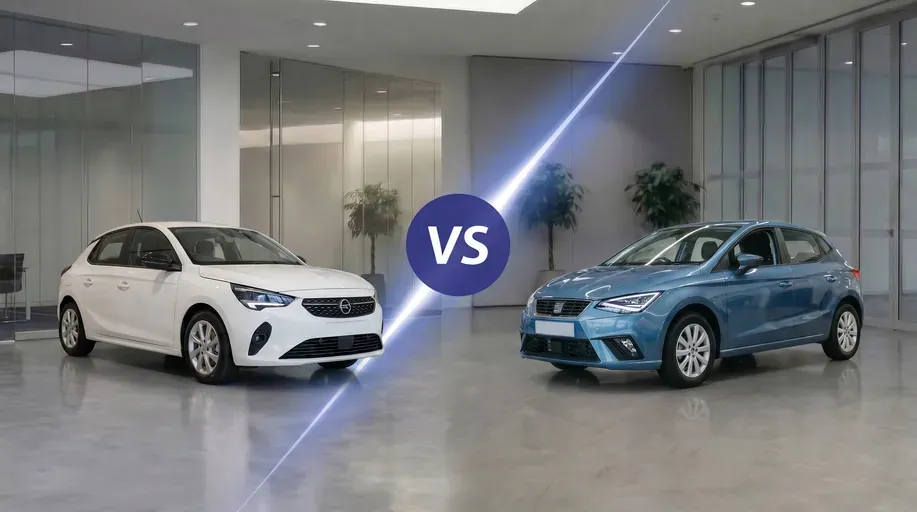
Car battle
Opel Corsa vs. Seat Ibiza: Complete comparison 2026
Opel Corsa vs. Seat Ibiza: A detailed comparison of popular hatchbacks. Discover the differences in engines, equipment, and reliability, and choose your ideal used car.
May 16, 2026
Fiat 500 review: real owner experience, electric range, running costs, common faults and used prices — everything you need before you buy.
October 21, 2026
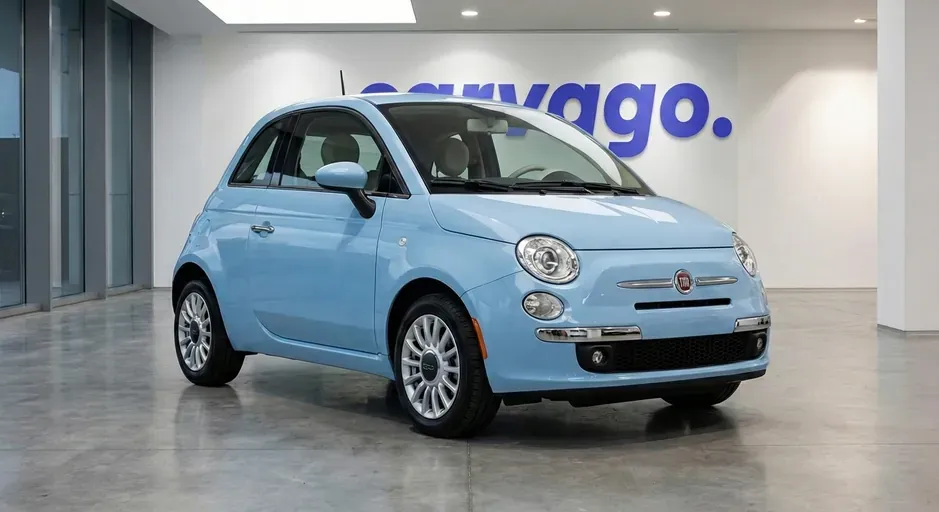
The Fiat 500 represents the third modern generation (internal code Type 332) of the Italian city car, positioned at the premium end of the European A-segment. This review covers vehicles delivered to European customers from November 2020 through to the present. Developed on a dedicated platform engineered originally around battery-electric propulsion, this generation stands separate from its long-running predecessor, which concluded European production in June 2024.
Buyers can choose between three distinct body styles: a traditional three-door hatchback, a cabriolet with a power-retractable fabric roof, and a "3+1" variant equipped with a small, rear-hinged additional door on the passenger side to facilitate rear-seat access. The model lineup initially arrived purely as the electric Fiat 500, before European order books opened in November 2025 for the petrol mild-hybrid Fiat 500 Hybrid, with first customer deliveries commencing in January 2026.
The car is primarily targeted at city commuters and multi-car households seeking an agile urban runabout with compact dimensions for straightforward street parking, prioritizing distinct design and tight-space manoeuvrability over outright passenger and cargo capacity.
European customer deliveries of the electric Fiat 500 began in November 2020, while the petrol-powered hybrid Fiat 500 joined the lineup with initial deliveries in January 2026. Because fleet mileage on the mild-hybrid remains low, long-term mechanical reliability is not yet established. For the electric Fiat 500, technical assessments show durable basic mechanics, but low-voltage electrical components and charging connections require attention.
Tests describe recurring issues with the 12V auxiliary battery, particularly on cars produced between 2020 and 2022. Background telematic modules waking during vehicle sleep cycles can drain the low-capacity battery. When voltage drops below operating thresholds, the flush electronic exterior door releases fail to respond, requiring the mechanical emergency key to access the cabin. Updated control software significantly reduces this parasitic drain. In addition, tests and owners report that heavy liquid-cooled DC fast-charging cables can exert downward strain on the socket, causing pin misalignment and charging interruptions during the initial handshake. Supporting the connector manually until the latch engages prevents drops. Central touchscreen freezing and smartphone connectivity drops have also been documented, which workshops address through firmware updates.
Tests describe accelerated surface oxidation and pitting on the mechanical brake discs. Because city driving in high-regeneration one-pedal modes rarely activates the hydraulic friction brakes, disc faces can develop rust bands in wet or winter conditions. Periodically braking in standard driving mode clears the disc surfaces and avoids premature disc wear.
Official safety recalls across European deliveries have addressed software anomalies, brake units, and isolated high-voltage battery defects.
| Defect | Affected Production Window | Stated Reach | Required Remedy |
|---|---|---|---|
| Cluster warning indicator software inconsistency | 04.12.2025 – 09.07.2026 | EU-wide | Workshop software flash of instrument cluster and body control |
| Traffic sign recognition assistance calibration | 14.03.2024 – 11.06.2024 | European market | Over-the-air radio software download |
| Traction battery negative terminal clamp loose | 21.09.2021 – 10.11.2023 | Worldwide (30 vehicles) | Complete replacement of the high-voltage battery pack |
| Battery cell raw material contamination | 05.10.2020 – 12.07.2021 | Worldwide (48 vehicles) | Complete replacement of the high-voltage battery pack |
| Passenger airbag status indicator software error | 08.09.2020 – 26.01.2021 | Worldwide (14,534 vehicles) | Airbag control module software update |
| Defective integrated brake system (IBS) module | 2020 production | European market | Inspection and replacement of the brake system module |
The third-generation Fiat 500 launched as a dedicated battery-electric city car before expanding its range to include a petrol mild-hybrid option. Front-wheel drive is standard across all variants, with drivetrain choices split between single-speed reduction automatics for the electric models and a manual gearbox for the combustion powertrain.
| Engine | Fuel | Power | Gearbox | Model years |
|---|---|---|---|---|
| Electric (23.8 kWh) | Electric | 70 kW (95 hp) | automatic | 2020 – present |
| Electric (42 kWh) | Electric | 87 kW (118 hp) | automatic | 2020 – present |
| 1.0 FireFly GSE | Mild hybrid (petrol) | 48 kW (65 hp) | 6-speed manual | 2025 – present |
Choosing the right powertrain depends primarily on your access to charging infrastructure and your driving profile outside city limits:
For details on common technical issues, battery health, and verified service campaigns, refer to the owner experiences section.
| Dimension / Capacity | Electric (All body styles) | Hybrid (All body styles) |
|---|---|---|
| Length | 3,632 mm | 3,631 mm |
| Width (excluding mirrors) | 1,683 mm | 1,684 mm |
| Height | 1,527 mm | 1,532 mm |
| Wheelbase | 2,322 mm | 2,322 mm |
| Boot volume (upright / folded) | 185 / 550 l | 185 / 550 l |
As a dedicated city vehicle, the Fiat 500 functions strictly as a 2+2 seater. Front passengers enjoy reasonable headroom and elbow room, but the rear bench is severely cramped. Legroom disappears almost entirely behind tall front occupants, leaving the rear accommodation suitable primarily for children or short emergency trips across town. To facilitate ingress to the back, the 3+1 body style incorporates a rear-hinged half-door on the passenger side that unlatches only once the front door is opened.
Everyday cargo usability in the Fiat 500 hatchback and Fiat 500 convertible is tailored for weekly grocery shopping rather than touring luggage. The luggage compartment has a pronounced loading lip, and electric variants provide no storage compartment beneath the front bonnet to stow charging cables out of the way. When carrying bulkier loads, the rear seatbacks fold down—either standard as a single-piece folding bench or in a 50/50 split-folding arrangement on higher trims—though the seat base remains fixed. Towing is not permitted on any version of this generation, with a factory towing capacity rating of 0 kg.
Road tests consistently highlight the urban agility of the modern Fiat 500. Thanks to its compact footprint and flat cornering stance, the chassis darts cleanly through tight city streets with dependable mechanical grip. The steering is light and straightforward for parking, yet professional reviews point out a lack of road feedback on open roads. Damping is tuned on the firm side: while composed on smooth tarmac, the short wheelbase makes the ride choppy over undulating surfaces, and sharp ridges or cobbles transmit abrupt jolts into the cabin. The convertible Fiat 500 also exhibits slight cowl shudder over uneven paving. Acoustic isolation in the electric Fiat 500 is calm at city speeds, but tyre rumble and wind rustle around the pillars become prominent on the motorway.
Inside, testers appreciate the retro dashboard design and the practical retention of physical buttons for primary climate functions. The central touchscreen displays crisp graphics, although operating menus on the move requires deliberate accuracy. Material quality is mixed: while upper inserts look smart, hollow and scratch-prone plastics cover the lower doors and centre console. Evaluators also criticise the elevated seating posture, limited lateral seat support, and the absence of height adjustment on the front passenger seat. Professional opinion converges on the model's nimble city manners and chic cabin layout, while agreeing that long-distance refinement and rough-road suspension compliance remain noticeable trade-offs.
Current listings for the Fiat 500 show advertised median asking prices spanning from €11,000 for 2019 models to €26,000 for 2025 examples, alongside €19,700 for 2026 cars. All charts in this section reflect Carvago listings across the broader Fiat 500 model family, including previous generations present in the data, rather than filtering exclusively for the latest iteration. Because listings from different production eras overlap across these build dates, this dataset does not establish an isolated price level for the newest generation alone.
The chart outlines the volume of active Fiat 500 listings per month between April 2026 and September 2026, opening at 12,499 cars and closing the period at 12,731.
Active listings over time
| Month | Fiat 500 |
|---|---|
| 2026-04 | 12 499 |
| 2026-05 | 12 419 |
| 2026-06 | 12 525 |
| 2026-07 | 12 965 |
| 2026-08 | 12 466 |
| 2026-09 | 12 731 |
Source Carvago
Buyers can expect an abundant selection of vehicles, with overall availability remaining stable across the six months within a narrow range between 12,419 and 12,965 listings.
Among listings advertised today, the median asking price of cars built in 2019 is €11,000, whereas the median asking price of cars advertised today built in 2025 reaches €26,000, illustrating how asking levels differ across build years.
Median advertised price by year of manufacture
| Model year | Fiat 500 |
|---|---|
| 2019 | 11 000 |
| 2020 | 11 900 |
| 2021 | 12 400 |
| 2022 | 13 500 |
| 2023 | 14 900 |
| 2024 | 15 500 |
| 2025 | 26 000 |
| 2026 | 19 700 |
Source Carvago
Buyers targeting 2019 through 2021 model years see median asking prices ranging between €11,000 and €12,400, while 2024 models are listed at €15,500. The figures across model years do not follow an uninterrupted increase, with 2025 models peaking at €26,000 while 2026 models are at €19,700.
This depreciation curve illustrates how the Fiat 500 sheds value over time, with average residual value dropping by 30% by age two and 37% by age three. The steepest losses occur early on, as shown in the progression below.
Residual value by vehicle age
| Vehicle age | Fiat 500 |
|---|---|
| New | 20 800 |
| 1 yr | 17 900 |
| 2 yrs | 14 500 |
| 3 yrs | 13 200 |
| 4 yrs | 12 500 |
| 5 yrs | 11 500 |
| 6 yrs | 10 700 |
| 7 yrs | 10 000 |
Source Carvago
Across the full seven-year span, the model loses roughly 52% of its initial value, though the rate of depreciation slows considerably from age three onward, where year-over-year declines moderate into single-digit percentages.
Across the period from April to September 2026, the chart tracks advertised cars per fuel type, showing 7,386 petrol and 3,885 electric listings in September 2026. The monthly figures illustrate how the available choices were distributed over this timeframe.
Supply composition by fuel type
Petrol
Diesel
Hybrid
Electric
LPG
| Month | Petrol | Diesel | Hybrid | Electric | LPG |
|---|---|---|---|---|---|
| 2026-04 | 7 357 | 113 | 406 | 4 359 | 184 |
| 2026-05 | 7 399 | 131 | 625 | 3 986 | 193 |
| 2026-06 | 7 451 | 145 | 877 | 3 779 | 200 |
| 2026-07 | 7 746 | 120 | 937 | 3 901 | 205 |
| 2026-08 | 7 296 | 97 | 932 | 3 916 | 173 |
| 2026-09 | 7 386 | 105 | 1 127 | 3 885 | 175 |
Source Carvago
Buyers will find the widest selection among petrol and electric models, while hybrid availability accounted for 1,127 listings in September 2026. In comparison, diesel and LPG options are far less common, represented by 105 and 175 advertised cars respectively in the same month.
The chart below shows the average asking price for the Fiat 500 from April 2026 to September 2026, opening the period at €14,600.
Average price development over time
| Month | Fiat 500 |
|---|---|
| 2026-04 | 14 600 |
| 2026-05 | 14 600 |
| 2026-06 | 14 600 |
| 2026-07 | 14 800 |
| 2026-08 | 15 100 |
| 2026-09 | 15 100 |
Source Carvago
Overall movement across the six months was small relative to the vehicle prices, with the average asking price increasing by roughly 3% from €14,600 to €15,100.
Agile urban handling with a compact footprint suited to tight street parking
Retro dashboard layout retaining practical physical buttons for climate controls
Responsive electric acceleration with one-pedal driving modes for city traffic
Severely cramped rear seating with minimal legroom behind tall occupants
Firm suspension that produces a choppy ride over uneven surfaces and cobbles
Small boot with a pronounced loading lip and no front cable storage on electric models
The mechanical components of the electric Fiat 500 are durable, though earlier production years can suffer from auxiliary battery drain that disables the electronic door releases. Control software updates significantly reduce this issue, while long-term reliability for the petrol mild-hybrid version is not yet established.
The larger-battery electric Fiat 500 is the most versatile option for mixed driving thanks to faster rapid-charging capability, although sustained motorway cruising depletes the battery noticeably faster. The hybrid Fiat 500 suits drivers without home charging plugs, but its modest non-turbo engine requires frequent gear changes on inclines.
Check official dealer records against the car's VIN to confirm all manufacturer recalls have been completed. A pre-purchase physical inspection should also verify auxiliary battery health and check the brake discs for corrosion.
The Fiat 500 functions strictly as a 2+2 city car with severely restricted rear legroom behind taller front occupants. Rear seating is practical only for children or brief emergency journeys across town, even on body styles fitted with the rear-hinged side half-door.
Sources: media.stellantis.com, adac.de, autocar.co.uk, autoexpress.co.uk, whatcar.com
This article was prepared using artificial intelligence tools. The section guarantor is Petr Dušek.
Opel Corsa vs. Seat Ibiza: A detailed comparison of popular hatchbacks. Discover the differences in engines, equipment, and reliability, and choose your ideal used car.
May 16, 2026
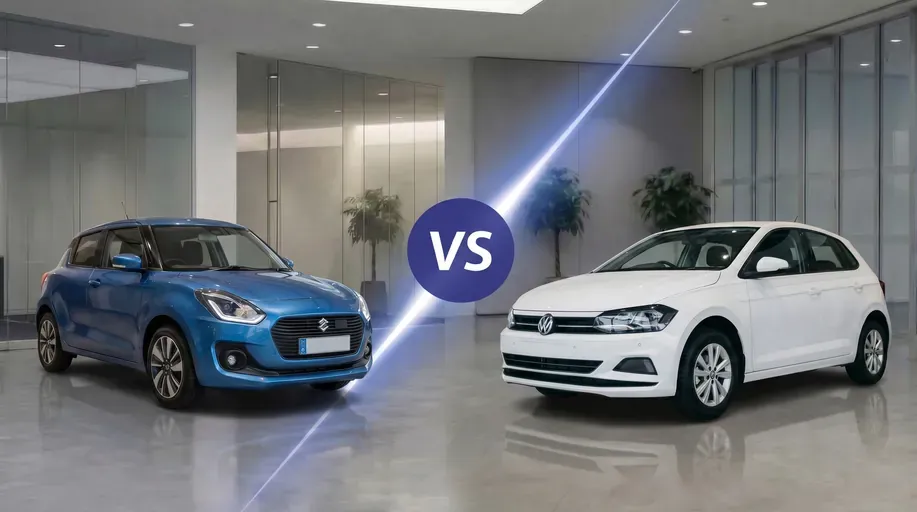
The Big Comparison: Suzuki Swift vs. Volkswagen Polo. Which hatchback to choose? We reveal the differences in fuel consumption, equipment, and reliability, and provide a clear verdict.
Oct 16, 2026
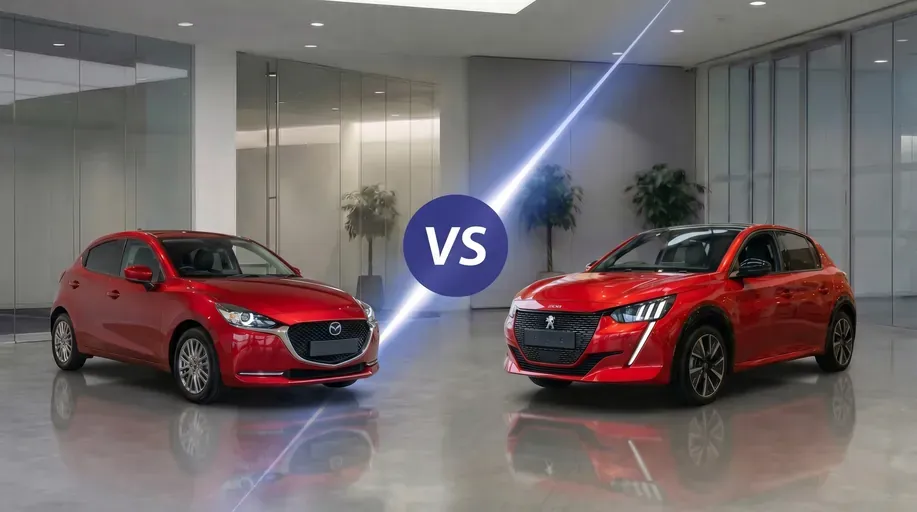
Detailed comparison of used Mazda 2 vs Peugeot 208 cars. Find out the differences in reliability, equipment, and fuel consumption. Read our verdict and make the right choice!
Oct 16, 2026