Car battle
Jaguar E-Pace vs. Volvo XC40: Complete 2025 Comparison
Detailed comparison of Jaguar E-Pace vs Volvo XC40. Explore performance, equipment, and our verdict to help you choose the best compact premium SUV.
Apr 14, 2026
Articles
Car battle
Detailed comparison of Hyundai Tucson vs. Toyota RAV4. Read real-world experiences, a comparison of reliability, fuel consumption, and equipment, and find out our final verdict.
April 17, 2026
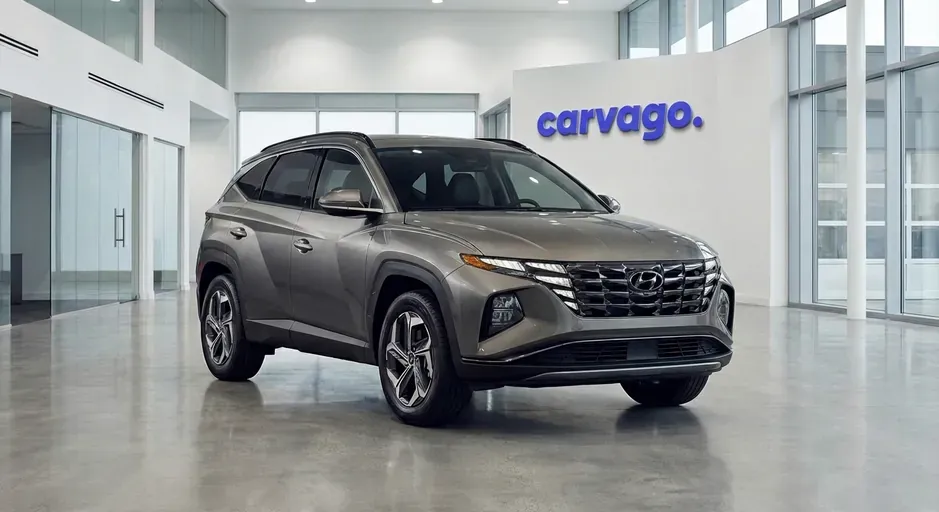
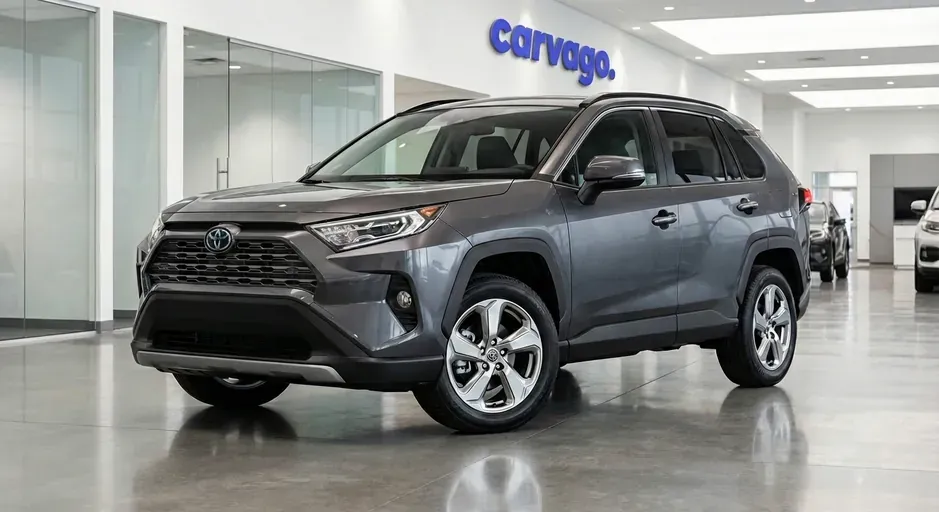
The South Korean Hyundai Tucson, which was also sold in the past and in some markets under the Hyundai ix35 designation, is an exceptionally popular compact SUV that attracts customers with its bold design and advanced technological equipment. Its main competitor is the iconic Japanese Toyota RAV4, which can be found in various global markets under alternative names such as Toyota Vanguard, Toyota Wildlander, or in Europe as the rebranded twin Suzuki Across, and which builds primarily on its legendary reliability and fuel-efficient hybrid powertrains. The following comparison will provide a detailed look at the key differences between both cars on the used car market and help you find out which of these models represents a smarter choice for your daily journeys.
When choosing a compact family SUV, exterior dimensions play a key role not only for overall interior space but also for daily maneuvering in heavy city traffic. If we focus on models roughly four years old, namely the widely represented third-generation Hyundai Tucson and the fifth-generation Toyota RAV4, we find that although both cars target the same audience, they approach proportions slightly differently. The Toyota RAV4 makes a slightly more massive and classic impression on the road, which is confirmed by the numbers themselves – with a length of 4,600 mm, it is roughly 90 to 100 mm longer than its South Korean competitor.
The Tucson, on the other hand, bets on a more dynamic and slightly wider stance. With a width of 1,865 mm, it exceeds the Toyota by 10 mm, which, together with its bold design, gives it a visually more planted look. However, the RAV4 takes its decimeters back in overall body height, where at 1,685 mm, it towers over the Tucson by 35 mm. This taller build results not only in a generally more robust off-road appearance for the Japanese car but also in a slightly higher driving position, which many drivers in this category subconsciously seek.
An interesting look at the wheelbase, which primarily determines the longitudinal space in the cabin for the crew. Here, there is almost perfect agreement, as the Toyota with a wheelbase of 2,690 mm surpasses the Hyundai (2,680 mm) by a completely negligible one centimeter. In practice, this means that although the RAV4 is longer overall, it does not benefit from this in terms of cabin architecture and legroom. For daily life, the final choice may depend mainly on your space constraints – the shorter Tucson fits a bit more easily into tight parallel parking spots or smaller garages, while the RAV4 will appeal to motorists who prefer the more conservative proportions of a slightly larger SUV.
| Parameter | Hyundai Tucson SUV | Toyota RAV4 SUV |
|---|---|---|
| Length (mm) | 4500 - 4510 | 4600 |
| Width (mm) | 1865 | 1855 |
| Height (mm) | 1650 | 1685 |
| Wheelbase (mm) | 2680 | 2690 |
Luggage space is one of the key parameters for family SUVs, and it plays a crucial role when choosing a roughly four-year-old used car. Whether you're planning regular weekend shopping, daily transport of strollers, or long family holiday trips, every extra liter of available volume simply counts. In a direct comparison of popular representatives of this class – specifically the third-generation Hyundai Tucson and the fifth-generation Toyota RAV4 – we find quite clear differences that define the extent to which both models are adapted for maximum family practicality.
The South Korean Hyundai Tucson (3rd generation, on the market since 2020) boasts a transport capacity that is among the very best in its segment. In the standard version with a conventional or gasoline mild-hybrid engine, it offers a generous trunk volume of an excellent 620 liters. After easily folding down the rear seats, this space increases to a massive 1,799 liters, representing a huge loading area perfectly sufficient even for transporting bulky furniture or complete sports equipment. In contrast, the Japanese Toyota RAV4 (XA5 generation, available since 2019) provides a slightly more modest, though still very usable, base volume of 580 liters. With the backrests fully folded, the RAV4 offers a maximum capacity of 1,690 liters. A numerical difference of exactly 40 liters in the basic configuration means, in practice, space for about one additional small suitcase or several bulky shopping bags for Tucson owners.
When choosing a specific used car, however, it is also necessary to take into account the increasingly popular plug-in hybrid (PHEV) variants, where additional battery packs necessarily take up some of the valuable trunk space. If you opt for the RAV4 variant with plug-in charging, the base trunk capacity drops to 520 liters. A similar compromise also awaits you with the plug-in hybrid Tucson, whose trunk shrinks to approximately 558 liters (for diesel mild-hybrids, it is 546 liters). Despite these technologically driven trade-offs, both SUVs remain exceptionally spacious for daily driving. Overall, however, the Tucson benefits from more efficient interior space packaging and emerges as the clear winner of this comparison for those looking for maximum volume.
| Parameter | Hyundai Tucson SUV | Toyota RAV4 SUV |
|---|---|---|
| Base volume (liters) | 620 | 580 |
| Max volume with seats folded down (liters) | 1799 | 1690 |
Although both family SUVs are exceptionally practical, the third-generation Hyundai Tucson offers a slightly larger and more usable trunk in most engine configurations. For those with high demands for transport space, the extra liters represent a clear argument for the Korean model.
Towing capacity is a key parameter for many SUV drivers, whether they are planning a camping trip with a family caravan or need to transport heavy loads. Between the Hyundai Tucson and Toyota RAV4 models on the market for roughly four-year-old used cars (the current 3rd generation Tucson and the XA5 generation of the RAV4), there are very significant differences that can play a decisive role when choosing a vehicle. While one model relies on balanced values across the entire range, the other shows extreme differences depending on the chosen drivetrain type.
The Hyundai Tucson (3rd generation) offers excellent consistency. Standard petrol and diesel versions (1.6 T-GDI and 1.6 CRDi, including mild-hybrids) can tow a standard braked trailer with a maximum weight of 1650 kg, and the full hybrid variant maintains this decent capacity without compromise. A noticeable difference only comes with the plug-in hybrid version (PHEV), where the maximum towing capacity is reduced to 1350 kg due to the heavy battery (it even drops to 1210 kg for the latest model years).
The fifth-generation Toyota RAV4 (XA5), on the other hand, offers a wide range of extremes. If you are looking for maximum towing power, the classic conventional engine version with a two-litre petrol engine easily handles an excellent 2000 kg. However, those interested in hybrid versions with reduced capacity must be very careful. While the RAV4 Hybrid with all-wheel drive (AWD-i) can handle a satisfactory 1650 kg, the front-wheel drive (FWD) version offers only a very modest 800 kg. The popular Plug-in Hybrid (PHEV) then represents a kind of middle ground with a limit of 1500 kg.
Although exact factory data for unbraked trailers are not always specifically stated for these generations, the standard legislative limit of 750 kg applies to cars in this category. Towing such a trailer works, in simple terms, as space for a few extra suitcases, which is fully sufficient for weekend shopping or a longer holiday. Owners of the basic front-wheel drive RAV4 Hybrid will have to rely mainly on lighter cargo or tent trailers (800 kg limit). Conversely, with the Tucson in most engine versions, or with the petrol and AWD hybrid Toyota, you can already tow a medium-sized caravan.
Conclusion: If maximum possible towing power for pulling heavy trailers is your priority, the purely petrol Toyota RAV4 (2.0) represents an unbeatable choice with a value of 2000 kg. However, if you are aiming for hybrid engines, the Hyundai Tucson proves to be a much more user-friendly and safer option – unlike the Toyota, where you must pay extra for all-wheel drive to get reasonable towing power in a hybrid, most Tucson models will tow 1650 kg regardless of the drivetrain type.
| Model and engine | Braked trailer weight (kg) | Unbraked trailer weight (kg) |
|---|---|---|
| Hyundai Tucson 3rd Gen 1.6 CRDi | 1650 | Not specified |
| Hyundai Tucson 3rd Gen 1.6 T-GDI | 1510 - 1650 | Not specified |
| Hyundai Tucson 3rd Gen 1.6 T-GDI Hybrid | 1360 - 1650 | Not specified |
| Hyundai Tucson 3rd Gen 1.6 T-GDI Plug-in Hybrid | 1210 - 1350 | Not specified |
| Toyota RAV4 XA5 2.0 | 2000 | Not specified |
| Toyota RAV4 XA5 2.5 Hybrid | 800 - 1650 | Not specified |
| Toyota RAV4 XA5 2.5 Plug-in Hybrid | 1500 | Not specified |
While both the Hyundai Tucson and Toyota RAV4 offer a diverse range of engines reflecting modern trends with an emphasis on electrification, their overall approach differs slightly. Hyundai relies exclusively on small-displacement turbocharged engines (both petrol and diesel) with a uniform displacement of 1.6 litres. These are combined with a wide spectrum of electric motor assistance – from 48V mild-hybrid and full hybrid (HEV) to plug-in hybrid technologies. This will be particularly appreciated by buyers looking for a wide range of choices or those who prefer economical diesel units for long motorway journeys. In contrast, the Toyota RAV4 bets on what it does best – 2.5-litre naturally aspirated petrol engines, which it combines with its long-renowned and reliable full hybrid system. Furthermore, the conventional pure petrol two-litre engine at Toyota completely disappeared from the range as early as mid-2020. So, if you are looking for a roughly four-year-old used car on the market, you will mostly be choosing from hybrids with Toyota, while the Tucson will provide you with a much more varied range of internal combustion alternatives.
The basic range for the Hyundai Tucson (3rd generation, from 2020) opens with the 1.6 T-GDI turbocharged petrol four-cylinder with an output of 110 kW (150 hp). This engine is also available as a 48V mild hybrid, in two power versions: 110 kW (150 hp) and a more powerful 132 kW (180 hp). Unlike its competitor Toyota, Hyundai does not abandon diesel engines. However, the basic pure diesel variant 1.6 CRDi (85 kW / 115 hp) was only kept in the range until February 2022. Buyers interested in newer used cars from recent years will therefore more often come across its more powerful alternative, the 1.6 CRDi supplemented with 48V mild-hybrid technology (100 kW / 136 hp), which is commonly paired with a seven-speed dual-clutch automatic and optional all-wheel drive. An alternative for the most demanding is the full hybrid version 1.6 T-GDI Hybrid (169 kW / 230 hp) and the top-of-the-range 1.6 T-GDI Plug-in Hybrid with an output of 195 kW (265 hp).
| Engine type | Fuel | Power (kW) | Torque (Nm) | Transmission |
|---|---|---|---|---|
| 1.6 T-GDI | Petrol | 110 | 250 | 6M |
| 1.6 T-GDI 48V Mild Hybrid | Petrol / MHEV | 110 / 132 | 250 / 265 | 6M / 7DSG |
| 1.6 T-GDI Hybrid | Petrol / HEV | 169 | 350 | 6AT |
| 1.6 T-GDI Plug-in Hybrid | Petrol / PHEV | 195 | 350 | 6AT |
| 1.6 CRDi (until 02/2022) | Diesel | 85 | 280 | 6M |
| 1.6 CRDi 48V Mild Hybrid | Diesel / MHEV | 100 | 320 | 6M / 7DSG |
The Toyota RAV4 (XA5 generation, from 2019) is an absolute master of hybrids in the market and bets on simplicity. Although it was initially possible to purchase the car with a classic 2.0 naturally aspirated petrol four-cylinder with 129 kW (175 hp), this pure internal combustion engine was withdrawn from the official range in mid-2020. Customers looking for a four-year-old used car thus have almost exclusively electrified variants available. The core is the reliable 2.5 Hybrid combining a petrol engine with an e-CVT continuously variable transmission. The powertrain has an output of 160 kW (218 hp) for front-wheel-drive models and 163 kW (222 hp) for all-wheel-drive models with the AWD-i system, which adds a dedicated electric motor for the rear axle. For those who are not afraid to plug in and want significant power, there is also the 2.5 Plug-in Hybrid offering a massive 225 kW (306 hp) and dynamics that will surprise many a driver of much sportier cars.
| Engine type | Fuel | Power (kW) | Torque (Nm) | Transmission |
|---|---|---|---|---|
| 2.0 (until 06/2020) | Petrol | 129 | 208 | 6M / CVT |
| 2.5 Hybrid (FWD) | Petrol / HEV | 160 | 221 + electric motor | e-CVT |
| 2.5 Hybrid (AWD-i) | Petrol / HEV | 163 | 221 + electric motors | e-CVT |
| 2.5 Plug-in Hybrid | Petrol / PHEV | 225 | 227 + electric motors | e-CVT |
While the Hyundai Tucson impresses with a much wider range of engines, including popular diesel versions for motorway mile-munchers, the Toyota RAV4 focuses primarily on bulletproof, reliable, and city-efficient hybrid technology in the used car market.
Choosing the right engine is a key factor for long-term satisfaction with a used car, with our recommendations based on real-world experience, mechanical reliability, and fuel consumption in normal traffic. While Hyundai offers a wide range for the Tucson model, from classic internal combustion engines to plug-in hybrids, Toyota has bet almost exclusively on its renowned hybrid drive for the RAV4 generation. Looking at the history of available engines, the retreat of diesels is clearly visible – previously popular powerful diesel engines, such as the 2.0 CRDi in the Tucson, definitely ended with the second generation in 2020. Toyota is in a similar position, having completely removed the 2.2 D-CAT or 2.0 D-4D diesel versions from the current fifth generation (XA5, available since 2019) from its lineup. Today's market for approximately four-year-old used cars is thus clearly dominated by sophisticated electrified units, which make the most sense for most users.
This full hybrid powertrain (HEV) represents the best choice within the third generation of the Tucson (on sale since late 2020) in terms of balance between performance, consumption, and user-friendliness. The combination of a turbocharged four-cylinder and an electric motor offers a total output of 169 kW (230 hp), ensuring very confident dynamics even for a fully loaded family car. A major advantage over most Asian competitors is the use of a classic six-speed automatic transmission. This eliminates the unpopular "vacuum cleaner" effect during sharp acceleration and provides the driver with a more natural driving feel. In real-world operation, the consumption of this hybrid hovers around a very respectable 6 liters per 100 km. From a maintenance perspective, however, it is necessary to take into account that the internal combustion engine is equipped with direct fuel injection (GDI) and a gasoline particulate filter (GPF).
Toyota is an absolute pioneer of hybrid technologies, and its naturally aspirated 2.5-liter hybrid in the XA5 generation (available since 2019) is considered one of the most mechanically durable powertrains on the entire used car market. The system uses a robust gasoline engine operating on the Atkinson cycle, which is paired with a proven e-CVT planetary gearbox. A fundamental advantage is that risky and expensive components such as a turbocharger, classic clutch, starter, or conventional alternator are completely absent – mechanically, there is simply almost nothing to go wrong. Despite the huge interior space, the RAV4 with this engine can drive in urban and suburban traffic for a fantastic 5 to 5.5 liters of gasoline.
Official fuel consumption figures provided by manufacturers often differ significantly from everyday reality, which is especially true for modern hybrid and plug-in hybrid technologies. To get the most accurate picture possible, we rely on real-world data from thousands of everyday drivers collected on the crowdsourcing platform Spritmonitor.de. We focused exclusively on vehicles that make the most sense in today's four-year-old used car market – namely the third generation of the Hyundai Tucson (produced since 2020) and the corresponding XA5 generation of the Toyota RAV4 (since 2019).
Source: Spritmonitor.de
| Model and Powertrain | Average Consumption (l/100 km) |
|---|---|
| Toyota RAV4 2.5 Plug-in Hybrid (PHEV) | 1.0 |
| Hyundai Tucson 1.6 T-GDI Plug-in-Hybrid (PHEV) | 1.4 |
| Toyota RAV4 2.5 Hybrid (HEV) | 5.6 |
| Hyundai Tucson 1.6 CRDi 48V-Mildhybrid (Diesel) | 5.6 |
| Hyundai Tucson 1.6 T-GDI Hybrid (HEV) | 6.1 |
| Toyota RAV4 2.0 (Petrol) | 6.2 |
| Hyundai Tucson 1.6 T-GDI 48V-Mildhybrid (Petrol) | 6.7 |
| Hyundai Tucson 1.6 T-GDI (Petrol) | 6.8 |
Looking at the collected data, the sophistication with which Toyota tunes its hybrid systems is clearly evident. Its full-hybrid RAV4 (HEV) achieves an excellent average consumption of 5.6 l/100 km. In the case of the Tucson, only the economical 1.6 CRDi diesel mild-hybrid can compete with this figure in the long term. A surprising finding may be the real-world operation of Hyundai's small-displacement turbocharged petrol engines. Although they rely on advanced mild-hybrid assistance, their consumption is dangerously close to the 7-liter mark, and downsizing does not bring the expected savings here. In contrast, Toyota's old-school naturally aspirated 2.0-liter engine manages to run at a very respectable 6.2 liters. The extremely low values for both plug-in hybrids (1.0 to 1.4 l/100 km) naturally reflect the specific profile of drivers who diligently charge their cars from the grid every day, and do not represent the vehicle's consumption once the traction battery is depleted.
The facts above clearly indicate what a potential buyer should focus on. If you are a city driver or spend most of your time commuting on suburban routes, the full-hybrid Toyota RAV4 is a clear all-rounder that saves fuel on every kilometer. However, for drivers crisscrossing the country on motorways, the XA5 generation does not offer any diesel engine. This opens up a huge advantage for the Hyundai Tucson with the 1.6 CRDi engine, which is the most economical choice in the entire comparison for long distances. For budget-conscious buyers, the clear message is to be cautious with the base petrol engines of the Tucson, where the savings at purchase are offset by higher operating costs.
In conclusion, fuel consumption certainly does not take a back seat in this comparison. On the contrary, it is a fundamental decision-making factor, where the reliable and time-tested hybrid Toyota reigns supreme in urban areas, while Hyundai attracts those whose annual mileage on high-speed roads gives them a compelling reason to opt for diesel.
Looking at approximately four-year-old used cars, which are among the most sought-after on the market, the different pricing policies and depreciation rates of both brands are clearly evident. For comparison, we focused on the fourth-generation Hyundai Tucson (NX4) and the fifth-generation Toyota RAV4 (XA50) from 2021 to 2022. Both cars at this age represent an attractive alternative to new vehicles, offering modern technology and often still being covered by the factory warranty.
The South Korean SUV benefits from a very wide range of engines on the used car market, which is also reflected in the greater price variability. As a four-year-old used car, the Tucson represents a much more affordable entry point into the family SUV segment than its Japanese rival.
The Toyota RAV4 is considered an absolute phenomenon on the used car market. Its reputation for bulletproof reliability combined with a proven hybrid powertrain means it holds its value significantly better than most competitors. This is great news for sellers, but it means a higher initial investment for buyers.
| Model and specification | Indicative price (from) | Indicative price (to) |
|---|---|---|
| Hyundai Tucson 1.6 T-GDI (Basic/Manual) | €17,000 | €20,000 |
| Hyundai Tucson 1.6 T-GDI MHEV (Automatic) | €20,000 | €24,000 |
| Hyundai Tucson 1.6 HEV (Hybrid 4x4) | €27,000 | €29,000 |
| Toyota RAV4 2.0 Valvematic (Petrol) | €25,000 | €28,000 |
| Toyota RAV4 2.5 Hybrid FWD (Hybrid 4x2) | €27,000 | €30,000 |
| Toyota RAV4 2.5 Hybrid AWD-i (Hybrid 4x4) | €29,000 | €35,000 |
While the Hyundai Tucson experiences its greatest drop in value in the first three years of operation, for a used car buyer, this represents an excellent opportunity to acquire a modern, attractively designed vehicle for very good money. In contrast, the Toyota RAV4's price drops very slowly. For the same budget, you will get an older Toyota with higher mileage or a vehicle with less equipment, but you will be rewarded with a car that has the lowest long-term loss of value for potential resale.
You can get a Hyundai Tucson on the used car market for a significantly lower amount, and it will offer more modern onboard technology, while the more expensive Toyota RAV4 remains a long-term investment thanks to its unrivaled ability to hold its residual value.
Both the Hyundai Tucson and Toyota RAV4 achieved the maximum five-star rating in crash tests by the independent organization Euro NCAP, confirming their excellent level of overall safety. However, when comparing these two popular family SUVs on the used car market, it is crucial to put their overall results into the correct context and consider the year the respective tests were conducted.
Euro NCAP's testing methodology has evolved continuously over the years to reflect progress in engineering. Testing protocols become stricter year by year and place increasing emphasis on proactive safety and active assistance systems. They include, for example, new frontal crash simulations with a mobile barrier, more sensitive cyclist detection, or vehicle behavior at complex intersections. For this reason, percentage results for cars from different years cannot be directly and simply compared – percentages obtained in recent years almost always mean meeting significantly tougher criteria.
The Toyota RAV4 in its current fifth generation underwent testing in 2019. The fourth-generation Hyundai Tucson entered the testing laboratories two years later, in 2021, when it already had to comply with the most modern and noticeably stricter requirements of the redesigned protocols.
| Parameter | Hyundai Tucson | Toyota RAV4 |
|---|---|---|
| Year of testing | 2021 | 2019 |
| Adult occupant protection | 86 % | 93 % |
| Child occupant protection | 87 % | 87 % |
| Vulnerable road users protection | 66 % | 85 % |
| Safety assist systems | 70 % | 77 % |
At first glance at the table, it may seem that the Toyota RAV4 clearly dominates with its score, especially in adult occupant and vulnerable road user protection. However, it is essential to take into account that these are results based on the milder standards valid until the end of the decade. The rating of the Hyundai Tucson, which may appear slightly more modest on paper, actually represents an exceptionally strong level of protection within a much more demanding testing cycle.
In terms of equipment, both manufacturers installed the best from their workshops into the vehicles – Toyota uses the proven Toyota Safety Sense package, while Hyundai relies on the rich Hyundai Smart Sense system. Euro NCAP safety certification usually has a formal validity of six years, which for the RAV4 means it already corresponds to an earlier engineering generation in terms of emergency assistants. Conversely, the Tucson reflects a step newer trend in how the car communicates with the driver and how it can automatically prevent accidents.
In conclusion, both vehicles represent an excellent and perfectly safe choice that reliably protects adult passengers and children. However, if you are looking for the most modern standard of assistance features, the Hyundai Tucson has a slight technological lead due to its newer development and success in the tougher testing conditions of 2021, which can play a key role in confusing real-world situations.
Both cars provide top-tier five-star protection, but the Hyundai Tucson leads slightly thanks to more advanced assistance systems designed to withstand even the strictest modern tests.
In addition to standard equipment, each model offers several unique features that can be decisive for customers when choosing a car, with both automakers taking a completely different approach to innovation and added value.
Bold and modern design that looks futuristic on the road even after years
Wide range of powertrains including mild-hybrids, full hybrids, plug-in hybrids, and an efficient diesel
High-quality interior with premium materials and advanced technological equipment
Above-standard interior space for passengers and a generous luggage compartment volume
High level of overall driving comfort and precise cabin soundproofing
Absence of physical buttons for climate control and infotainment (in pre-facelift models) can be distracting
Higher fuel consumption for hybrid versions at steady highway speeds compared to competitors
Overly zealous and sometimes annoying lane-keeping assistant
The fourth-generation Hyundai Tucson is a perfect choice for those looking for a technologically advanced, comfortable, and practical family SUV with a slightly premium feel. It impresses primarily with its unmistakable appearance and a very wide range of powertrains, allowing it to meet the needs of a very diverse range of drivers.
Phenomenal efficiency of the hybrid powertrain, especially in city and suburban traffic
Renowned reliability and extraordinary longevity of the hybrid system and overall mechanics
Excellent residual value retention on the used car market and high liquidity
Very spacious and practically designed interior ready for everyday family use
Rich standard safety equipment within the Toyota Safety Sense package
Outdated and slower infotainment with less attractive graphics
More pronounced noise from the revved engine and e-CVT transmission during sudden acceleration
Harder and cheaper-feeling plastics in the interior, which has a more utilitarian than luxury character
Average driving characteristics focused exclusively on comfort without any sporting ambitions
The Toyota RAV4 is the undisputed leader in terms of overall operating efficiency, real-world fuel consumption, and long-term reliability. It is an ideal car for rational buyers who prefer robust and proven technology with minimal depreciation over state-of-the-art displays and luxury materials.
Based on long-term user experience, service statistics, and reports from our inspection technicians, we have compiled an overview of the most common problems for both models that are worth focusing on before buying a used car. However, every safe purchase should be preceded by a detailed physical vehicle inspection, which will help reveal any potential hidden defects of a specific unit and protect your finances.
For the fourth generation of the Hyundai Tucson (produced since 2020), users report above-average mechanical reliability overall, yet some recurring ailments related to electronics and specific driving conditions appear:
The current generation Tucson does not suffer from fatal mechanical defects; however, buyers should watch for smooth operation of the dual-clutch transmission and ensure the infotainment software is up to date.
The fifth generation of the Toyota RAV4 (since 2018) has long been ranked at the top of reliability charts, yet there are several specific and often structural weaknesses that need to be monitored:
Toyota's hybrid system is among the most durable on the market; however, when buying the all-wheel-drive version, it is absolutely essential to have the condition of the high-voltage wiring of the rear electric motor professionally checked.
When buying a used car, a thorough inspection is key. Both of these SUVs are considered advanced and generally reliable cars, however, they have their specifics and weak points that you should watch out for. Before making a final decision, it is always worth getting a detailed independent technical inspection of the car's condition, which will reveal hidden defects before they cost you money.
Both models are very similar in this regard, but the exact volume varies depending on the chosen engine. The Hyundai Tucson provides up to 620 liters for internal combustion versions, while for hybrids, this volume decreases to 577 liters. The Toyota RAV4 offers a stable 580 liters for the hybrid version and features a very regular trunk shape, which makes loading bulkier items easier.
Toyota uses a naturally aspirated 2.5-liter engine combined with an electric motor and a planetary e-CVT gearbox, ensuring exceptionally smooth operation and very low fuel consumption in the city. The Korean competitor combines a turbocharged 1.6 T-GDI engine with a classic six-speed automatic, which brings a slightly more traditional and dynamic shifting feel. However, Toyota's system is globally proven and excels in the long term with slightly lower real-world average fuel consumption.
The Japanese model has long been considered a benchmark for reliability, and its hybrid system without complex clutches or traditional gearboxes is extremely durable and almost failure-free. Hyundai, however, counters with an excellent five-year factory warranty with unlimited mileage, which still provides significant peace of mind for roughly four-year-old used cars. Both cars are above average, but Toyota maintains a better global reputation for minimal long-term service costs.
Hyundai offers overall slightly better cabin soundproofing, and its turbocharged engines provide more pleasant acoustic comfort when maintaining higher speeds. Due to the specific e-CVT gearbox, the RAV4 is characterized by higher engine noise during sharp highway acceleration or on long climbs. While the chassis of both vehicles is tuned for comfort, the Korean SUV feels overall quieter and calmer for long highway journeys.
The Tucson bets on a modern, even futuristic design with large displays and touch surfaces instead of classic buttons, complemented by high-quality soft-touch materials. The Japanese representative takes a more conservative path with a robust and functional interior that includes massive rubberized controls easy to use even with gloves. While Hyundai's infotainment is graphically more advanced and snappier, Toyota's cabin feels sturdier and better withstands the demands of daily family use.
Choosing between roughly four-year-old used Hyundai Tucson and Toyota RAV4 represents a classic decision between modern technology and bulletproof mechanical durability. The South Korean Tucson will primarily appeal to drivers looking for bold design, a futuristic interior with advanced equipment, and who require a wider range of powertrains, including diesel engines ideal for long highway trips. Conversely, the Japanese Toyota RAV4 is the absolute ideal for rationally-minded families who care about robust reliability, the unrivaled operational efficiency of a years-proven hybrid powertrain in urban and suburban traffic, and exceptional residual value retention. Although both family SUVs offer top-tier safety and generous interior space, the final choice depends on whether you prefer a more premium technological experience at a more favorable purchase price, or if you are betting on an economical and reliable workhorse with minimal depreciation upon resale in the long run.
Sources: ADAC, forbes.cz, aktualne.cz, hybrid.cz, motorvize.cz, automotodrom.cz
This article was prepared using artificial intelligence tools. The section guarantor is Petr Dušek.
Detailed comparison of Jaguar E-Pace vs Volvo XC40. Explore performance, equipment, and our verdict to help you choose the best compact premium SUV.
Apr 14, 2026
Detailed comparison of used Hyundai Tucson and Mazda CX-5. Real-world experience, equipment comparison, and a detailed verdict to help you choose the right SUV.
Apr 14, 2026
Detailed comparison of Mazda CX-5 vs Volkswagen Tiguan. Find out which used SUV has better engines, equipment, and driving characteristics. Read our clear verdict!
Apr 2, 2026