Articles

Car battle

Ford Tourneo Connect vs. Renault Kangoo: Complete comparison 2026

Ford Tourneo Connect vs Renault Kangoo. A detailed comparison of popular family cars. We evaluated interior space, engines, and comfort. Find out our verdict!

April 13, 2026

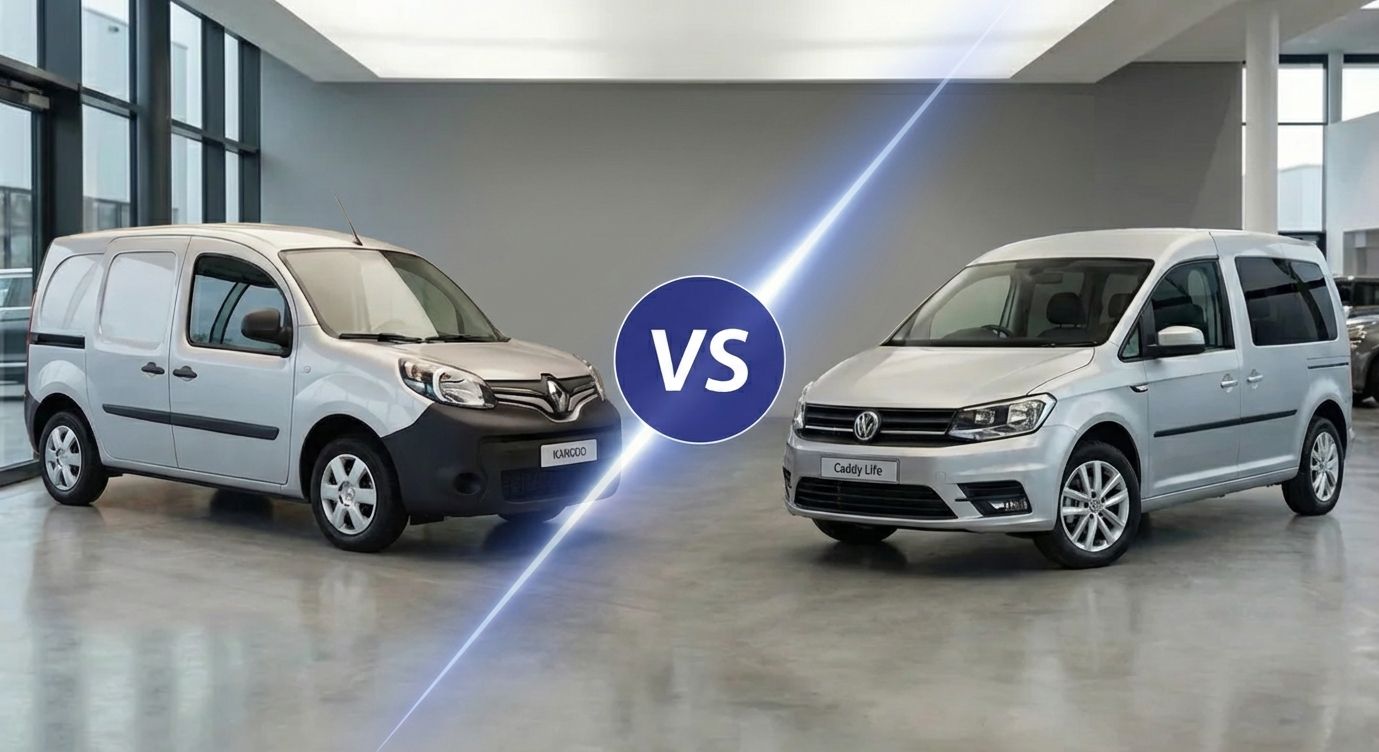
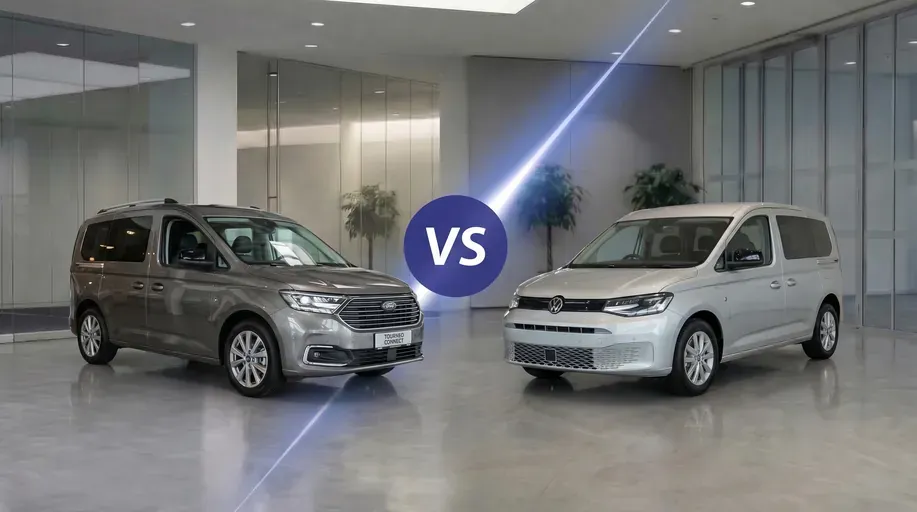
VS
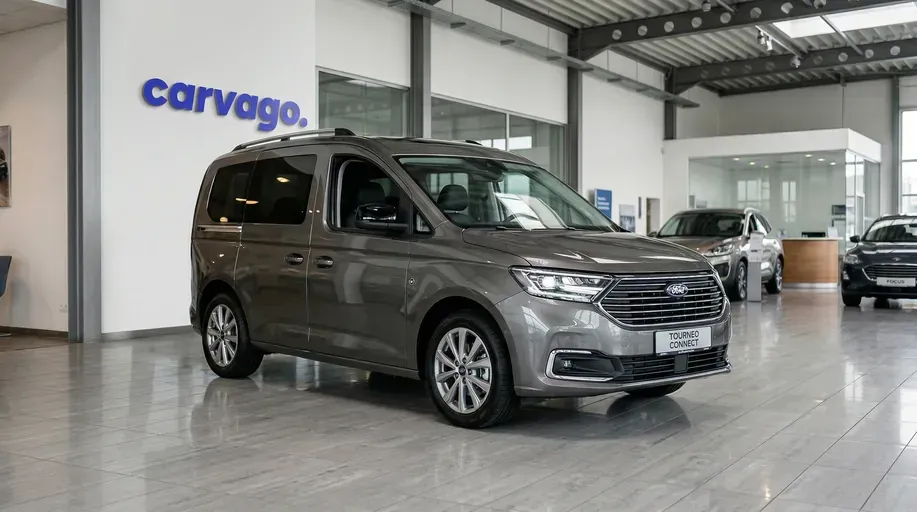
Ford Tourneo Connect

Ford Tourneo Connect

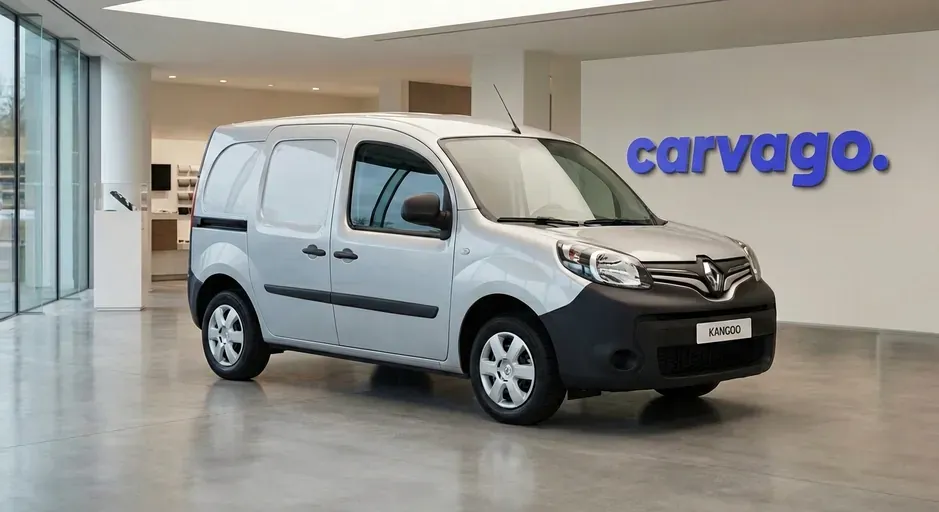
Renault Kangoo

Renault Kangoo

Introduction

Ford Tourneo Connect is an immensely practical passenger MPV which, in its third generation, shares its technical foundation with the Volkswagen Caddy and is known as the Transit Connect in its purely commercial version. Its French challenger is the exceptionally versatile Renault Kangoo, which also appears on the market under the sister names Nissan Townstar, Mercedes-Benz Citan, or as the more luxuriously conceived Mercedes-Benz T-Class. Let's compare in detail which of these two spacious vehicles represents a better choice on the four-year-old used car market in terms of utility value, reliability, and everyday comfort.

Comparison of External Dimensions

When comparing the exterior dimensions of these two popular passenger vans, we find that the standard third-generation versions of both models (which are most relevant for the four-year-old used car market) target a very similar audience. The third-generation Ford Tourneo Connect measures 4500 to 4515 mm in length, while the standard third-generation Renault Kangoo, at 4486 mm, is a negligible 14 to 29 mm shorter. In practice, this minimal deviation means that both vehicles behave very similarly in city traffic, and parking them requires no special compromises. However, the French automaker offers a significant advantage in the form of the extended Grand Kangoo version, which stretches to an impressive 4911 mm. This substantial increase in length provides unrivaled space for larger families or transporting bulky cargo, although it will require a bit more driving skill in cramped underground garages.

If we focus on width and height, the differences become slightly more noticeable. Ford Tourneo Connect maintains a stable width of 1855 mm and stands 1833 to 1835 mm tall. In contrast, the Renault Kangoo is slightly wider – its value reaches 1860 to 1919 mm (depending on the specific equipment or electric version), and the height of the standard model is 1838 mm, while the Grand version grows to 1869 mm. The Kangoo's wider stance can mean welcome extra centimeters for the shoulders of second-row passengers; however, it will require a touch more caution when navigating narrow streets or parking next to wide SUVs. In both cases, the typically boxy shape and taller body construction guarantee excellent headroom and an overall very airy interior, which is exactly what buyers in this segment primarily look for.

A key parameter for interior spaciousness and overall driving stability is the wheelbase. The Ford Tourneo Connect offers a solid 2755 mm, ensuring very stable behavior on the highway and plenty of legroom for rear passengers. The standard Renault Kangoo has a slightly shorter wheelbase, exactly 2716 mm (39 mm less), but its extended Grand Kangoo variant reigns supreme with a massive 3100 mm. The stretched wheelbase of the French competitor makes it the clear favorite for those seeking uncompromising transport capacity. Ultimately, the choice depends primarily on whether you prefer the happy medium of the well-balanced and more compact Ford, or whether you will fully utilize the extreme interior space that only the extended Kangoo can offer on the used car market.

ParameterFord Tourneo Connect EstateRenault Kangoo EstateRenault Kangoo Pick-up
Width (mm)18551860 - 19191860
Length (mm)4500 - 45154486 - 49114486 - 4910
Height (mm)1833 - 18351838 - 18691854 - 1864
Wheelbase (mm)27552716 - 31002716 - 3100

Trunk Volume

Luggage space is often the main selling point for family passenger vans, as it directly determines the car's daily practicality and family utility. Both compared models offer generous values in their current, roughly four-year-old generations, although each manufacturer approaches the measurement of the stated volume slightly differently. Differences in total transport capacity can play a crucial role for larger families with small children, active athletes with bulky equipment, or tradespeople who switch their work vehicle for a spacious family cruiser on weekends. The right choice can mean the difference between effortlessly loading everything and the need to purchase an additional roof box.

When comparing the standard versions (both registered as Estate/combi), we find very interesting figures. The third-generation Renault Kangoo offers a very respectable 775 liters in its basic five-seat configuration, measured as standard up to the luggage cover. If you fold the rear seats, you get a massive volume of up to 3500 liters, and the car also allows for transporting exceptionally long items thanks to the useful forward-folding passenger seat. The third-generation Ford Tourneo Connect, on the other hand, impresses at first glance with a larger base volume of 1213 liters. However, it is necessary to take into account Ford's different methodology, as they often state this figure for their passenger vans when loaded to the roof. After fully folding the rear seats, the standard-length Tourneo Connect reaches a maximum value of 2556 liters. Regarding alternative powertrains, any electrified variants – whether it's the purely electric Kangoo E-Tech or the recently introduced plug-in hybrid Tourneo Connect PHEV – maintain their original transport capacity practically without significant space limitations, thanks to modern platforms and clever battery placement under the floor.

In practice, these volumes mean that both cars can easily swallow an unfolded stroller, children's balance bikes, and still have room for several extra suitcases, which is reliably sufficient for weekend shopping and longer holidays. However, thanks to its purely boxy shape and the ability to create a giant flat loading area, Renault Kangoo offers slightly better utility for uncompromisingly moving bulkier loads. Ford Tourneo Connect, on the other hand, boasts a more refined enclosed space with first-class seat variability, which will serve the vast majority of families perfectly in fulfilling various daily tasks.
ParameterFord Tourneo Connect EstateRenault Kangoo Estate
Base volume (liters)1213775
Max volume with seats folded down (liters)25563500

Space for every occasion 📦

While the Ford Tourneo Connect bets on a generous luggage volume even in its base configuration, the Renault Kangoo counters with impressive transport capacity and moving practicality after folding the seats. Both of these family vans offer a huge space reserve on the used car market that regular estates can only dream of.

Leave it to Carvago CarAudit™

Order CarAudit™

Trailer Weights

Trailer weight and total towing capacity are often decisive factors for those interested in family or practical vans, as they directly define the vehicle's versatility. Whether you plan to tow a heavier caravan or simply need space for a few extra suitcases in a smaller trailer, both representatives in their generations corresponding to roughly four-year-old used cars (Ford Tourneo Connect 3rd generation and Renault Kangoo III) provide excellent values in this class.

The Ford Tourneo Connect guarantees a standard braked trailer weight of 1400 kg for the base 1.5 EcoBoost petrol engine. The maximum for this model is 1500 kg, which the more powerful 2.0 EcoBlue diesel variants reliably achieve. In contrast, the Renault Kangoo offers complete user certainty and uniformity – the braked trailer weight is fixed at a maximum of 1500 kg across the entire range of internal combustion engines, regardless of whether you choose the TCe petrol or Blue dCi diesel.

The biggest surprise for both vehicles, however, comes with electrification. While it is common on the market for hybrid or fully electric variants to have significantly reduced towing capacity, the engineers here made no concessions. Both the plug-in hybrid Ford Tourneo Connect PHEV and the fully electric Renault Kangoo E-Tech Electric maintain a maximum towing capacity of 1500 kg. Regarding unbraked trailer weight, both competitors offer the legislative maximum of 750 kg. This tonnage is sufficient for weekend shopping or a longer holiday without the slightest problem and will satisfy most common logistical needs.

In conclusion, both vehicles meet the strictest standards and easily serve as full-fledged towing vehicles. However, the Renault Kangoo offers a slight advantage in user-friendliness, as you always get that 1500 kg limit with any engine. With the Ford Tourneo Connect, you have to select the vehicle's specification – especially the choice of powertrain – a bit more carefully to achieve the same maximum.

Model and motorizationBraked weight of trailer (kg)Unbraked weight of trailer (kg)
Ford Tourneo Connect 1.5 EcoBoost1400 - 1500750
Ford Tourneo Connect 2.0 EcoBlue1500750
Ford Tourneo Connect 1.5 EcoBoost PHEV1500750
Renault Kangoo TCe (75–96 kW)1500750
Renault Kangoo Blue dCi (70–85 kW)1500750
Renault Kangoo E-Tech Electric1500750

Overview of Most Common Motorizations

The range of powertrains differs significantly between the two cars, which is closely related to their origins. The third-generation Ford Tourneo Connect fully benefits from the collaboration with the Volkswagen Group and adopts its advanced technology (the EcoBoost and EcoBlue designations actually hide the 1.5 TSI and 2.0 TDI platform engines). In contrast, the Renault Kangoo relies on French Alliance petrol engines, the 1.3 TCe, and the renowned fuel-efficient 1.5 Blue dCi diesels. Both manufacturers cater to both regular families and drivers with high annual mileage. Ford counters with the availability of all-wheel drive (AWD) for the more powerful diesel and modern plug-in hybrid technology with electric range, while Renault will please fans of pure electromobility with the E-Tech version and smooth EDC dual-clutch transmissions. For buyers of approximately four-year-old used cars, this means a rich selection of modern and efficient units where it is hard to go wrong.

Ford Tourneo Connect

Under the hood of the third-generation Ford Tourneo Connect (available mostly from May 2022), the petrol base is formed by the refined 1.5 EcoBoost (84 kW) four-cylinder. For long-distance drivers, the 2.0 EcoBlue diesel is available in 75 kW and 90 kW variants, with the more powerful version being one of the few in this segment to offer reliable all-wheel drive (AWD) and a massive 320 Nm of torque. If you were choosing from older examples from the end of the second generation (production until early 2022), you would encounter earlier pure Ford engines, the 1.5 EcoBlue or 1.0 EcoBoost, which no longer feature in the new platform. At the other end of the current spectrum stands the modern 1.5 EcoBoost PHEV (110 kW), introduced in mid-2024, which combines a total torque of up to 350 Nm with the possibility of locally emission-free driving. Standard engines can be paired with a six-speed manual or a seven-speed dual-clutch automatic.

Engine typeFuelPower (kW)Torque (Nm)Transmission
1.5 EcoBoostPetrol842206MT / 7A
1.5 EcoBoost PHEVPlug-in hybrid1103506A
2.0 EcoBlueDiesel75 / 90280 / 3206MT / 7A

Renault Kangoo

The base engine for the passenger versions of the third-generation Renault Kangoo (since 2021) is the popular 1.3 TCe 100 FAP petrol four-cylinder with 75 kW. More demanding users will be fully satisfied by its more powerful TCe 130 FAP variant with 96 kW and 240 Nm of torque, which you can also get with the responsive seven-speed EDC automatic. Diesel options are provided by the reliable 1.5 Blue dCi engine tuned to 70 kW or 85 kW. Especially the more powerful version with 115 hp (and 270 Nm) is ideal for a fully loaded vehicle on long holidays. In older used family Kangoos (2019–2020) from the end of the second generation, you might still come across the weakest diesel variant, the Blue dCi 80, which, however, disappeared from the passenger versions of the third generation and only appears in the commercial Rapid models. The latest addition at the end of 2022 was the fully electric E-Tech variant with a 45kWh battery, providing smooth operation with 90 kW for quiet urban and suburban traffic.

Engine typeFuelPower (kW)Torque (Nm)Transmission
1.3 TCe 100 FAPPetrol752006MT
1.3 TCe 130 FAPPetrol962406MT / 7EDC
1.5 Blue dCi 95Diesel702606MT
1.5 Blue dCi 115Diesel852706MT / 7EDC
E-Tech Electric EV45Electric902451A

Decision based on driving type 🛣️

If you prefer long highway routes or trips to the mountains, the Ford with its confident 2.0 EcoBlue diesel and optional four-wheel drive is the more robust choice. Renault, on the other hand, scores with its sophisticated 1.3 TCe petrol engine, responsive EDC dual-clutch automatic, and the option of quiet fully electric drive for efficient suburban operation.

Choosing the right engine is absolutely crucial for long-term satisfaction with a family or work van. Our recommendations are based on real-world experience, driving dynamics, actual fuel consumption, and the mechanical reliability of modern used cars around four years old, which corresponds to the current third generations of both vehicles. Interestingly, while Ford opted for exceptionally efficient and proven Volkswagen Group technology for the new Tourneo Connect, Renault equipped the Kangoo with its top-tier petrol four-cylinder engines, developed in close cooperation with Mercedes-Benz.

For Ford Tourneo Connect we recommend: 2.0 EcoBlue (90 kW)

Although it bears the traditional Ford EcoBlue badge on the tailgate, under the hood of the 3rd generation (since 2022) is actually the Volkswagen Group 2.0 TDI engine (EA288 Evo series). This shared technology represents the best choice for a vehicle of this size.

  • Why it is the best choice: The two-liter diesel offers an excellent compromise between pull and operating economy. It handles a fully loaded car well (especially in the heavier and longer seven-seater Grand version) and has sufficient power reserves for safe overtaking.
  • Technical advantages: A huge advantage here is the Twin Dosing system with two catalytic converters, which effectively reduces emissions and ensures compliance with the strictest standards. Real-world consumption remains fantastically low even with such a large body, most often between 5.0 and 5.5 liters per 100 km. And unlike older Ford van engines, it does not use a delicate wet timing belt (belt-in-oil) but a much more robust conventional solution.
  • Known risks and weaknesses: Since it is a sophisticated diesel, the main enemy is exclusively short-distance city driving, during which the diesel particulate filter (DPF) does not have time to regenerate. How does the problem manifest? More frequent fan operation after turning off the engine, and in worse cases, a warning light on the dashboard or a drop in power. The solution is to regularly take the car for a steady drive on the highway and use high-quality diesel with additives. Early 2022 models occasionally suffered from infotainment "teething troubles" (screen freezing), so during a test drive, verify if the seller has installed the latest software update.
  • Who it is suitable for: This engine is an ideal servant for families who often travel long distances, people with an active lifestyle, and tradespeople. It excels on the highway and under heavy loads, but for city hopping from the kindergarten to the shopping center, you should look for a petrol alternative instead.

For Renault Kangoo we recommend: 1.3 TCe 130 (96 kW)

For the third generation of the Renault Kangoo (since 2021), the 1.3 TCe turbocharged petrol four-cylinder is clearly the most pleasant and reliable daily companion. It is an exceptionally well-engineered and globally recognized engine.

  • Why it is the best choice: For a vehicle that will often serve as a typical family MPV in suburban conditions, a modern petrol engine makes the most sense. It offers unexpected refinement, warms up quickly, is perfectly quiet inside the cabin, and saves you from all the concerns about clogging complex emission systems that plague diesel versions.
  • Technical advantages: The 1.3-liter's pull at low RPMs is more reminiscent of a turbodiesel, so the car is pleasantly responsive right from the bottom. Furthermore, the engine is equipped with a proper and durable timing chain. It no longer suffers from excessive oil consumption like the older 1.2-liter units from previous years. Real-world combined consumption for this engine stays around 6.5 to 7.5 liters, which is a great result considering the vehicle's massive frontal resistance.
  • Known risks and weaknesses: Since the engine relies on direct fuel injection, it is naturally more prone to carbon buildup on the intake valves, especially with defensive driving and so-called "lugging" (driving at too low RPMs). How to recognize this problem? In the early stages, by a rougher idle and slight jerking during acceleration. The easiest way to prevent this phenomenon is not to be afraid to rev the engine higher on country roads occasionally, and we also strongly advise shortening the very optimistic factory oil change interval to a reasonable 15,000 km. Especially in early cars, a quiet rattling may occur when lifting off the throttle (from the turbo wastegate linkage), though this is more of an unpleasant sound than a defect with fatal consequences.
  • Who it is suitable for: It is a great and rational choice for family drivers with an average annual mileage of up to 20,000 km. The engine will please anyone who drives mostly in and around the city but requires a brisk and reliable car for family travel on weekends.

Real Fuel Consumption

Official fuel consumption figures in manufacturers' catalogs often appear very optimistic, but real-world operation shows a slightly different picture. Especially for spacious and boxy family vans, such as the third-generation Ford Tourneo Connect and Renault Kangoo (relevant for the market of approximately four-year-old used cars from 2021–2022), aerodynamics and overall weight play a crucial role. For an objective comparison, we have therefore looked at user data from the popular Spritmonitor.de portal, where drivers themselves record their actual receipts from filling stations over the long term. The resulting real-world consumption thus reflects the everyday use of these practical vehicles much better.

Model and engineAverage consumption (l/100 km)
Petrol engines
Ford Tourneo Connect 1.5 EcoBoost 84 kW6.6
Renault Kangoo 1.3 TCe 130 96 kW6.7
Diesel engines
Renault Kangoo 1.5 Blue dCi 95 70 kW5.2
Ford Tourneo Connect 2.0 EcoBlue 90 kW5.5

Looking at the hard data, it is clear that diesel engines in both vehicles still make a lot of sense in terms of fuel economy. Despite the advanced technologies of small petrol turbo engines, neither the 1.5 EcoBoost in the Ford nor the 1.3 TCe in the Renault can completely cheat the physics of high frontal drag – in the real world, petrol consumption remains steadily above the six-and-a-half-liter mark and increases significantly under heavier loads. Conversely, diesel units are much more efficient. Renault's popular 1.5 Blue dCi engine is a true fuel-sipper, averaging 5.2 liters of diesel per 100 km. Ford's larger 2.0 EcoBlue engine (which in this generation comes from a collaboration with Volkswagen) requires about three-tenths of a liter more, but considering the higher displacement and power, it is still a top-tier result.

What does this mean for the average user and the family budget? If you plan to use the car mainly for short hops around town, school runs, and weekend trips in the immediate vicinity, petrol variants will be a safer and, in the long run, likely more service-friendly choice due to faster warm-up and lower sensitivity to cold starts. However, if you are looking for a workhorse for long highway hauls, regular commuting, or family vacations across Europe, diesel variants will save you significant amounts on fuel in the long run and, moreover, please you with better pull at lower revs.

In conclusion, although the Renault Kangoo with the 1.5 Blue dCi diesel engine is the slight winner in the discipline of absolute economy, the difference compared to the Ford Tourneo Connect when choosing a comparable fuel is not that vast. Consumption should therefore not be the only deciding factor. It is much more important to focus on the overall technical condition of a specific used car, its service history, and the actual type of routes you plan to take most often.

Price Range and Used Car Offerings

When looking at the market for used cars approximately 4 years old (i.e., 2021 to 2022 models), both models are in a very interesting turning point in their generation cycles. During this time, both Ford and Renault brought entirely new generations of their passenger vans to the market, which is significantly reflected in their residual values at used car dealerships today.

Key Generational Milestones (2021–2022):

  • Ford Tourneo Connect: The year 2022 marked the arrival of the 3rd generation, which was created in cooperation with Volkswagen (a technical twin of the Caddy model). Four-year-old cars from 2021 thus primarily represent the very end of the highly popular and robust 2nd generation after its facelift. Conversely, models produced from 2022 onwards already offer the most modern shared platform, which comes with a substantially higher price tag on the market.
  • Renault Kangoo: During 2021, the brand-new 3rd generation began full sales. It brought a revolutionarily designed interior, higher-quality materials, and modern assistance systems. The vast majority of four-year-old used cars already fall into this modern era, making the Kangoo a technologically very advanced competitor.

Estimated Used Car Prices (cars approx. 4 years old)

ModelGenerationEstimated Price RangeMost Common Engines
Ford Tourneo ConnectEnd of 2nd gen (2021)€13,000 – €17,0001.5 EcoBlue (diesel)
Ford Tourneo Connect3rd generation (2022)€18,000 – €24,0002.0 EcoBlue (diesel) / 1.5 EcoBoost
Renault Kangoo3rd generation (2021–2022)€14,000 – €20,0001.5 Blue dCi / 1.3 TCe (petrol)

What Influences the Price for Ford?

  • The Generational Jump: If the older 2nd generation platform (2021 model year) is sufficient for you, you can save well over €4,000 compared to the newer model. However, 3rd generation models (from 2022) hold their value much more firmly and depreciate more slowly thanks to the technology shared with the VW Group.
  • Trim Levels: The adventure-styled Active version with plastic cladding or the more luxurious Titanium trim, combined with a 7-speed dual-clutch automatic, climb toward the upper end of the price spectrum.

What Influences the Price for Renault?

  • Excellent Value for Money: A used 3rd generation Kangoo is generally slightly more affordable than a modern 3rd generation Tourneo Connect. The French brand traditionally loses value a bit faster, which plays into the hands of used car buyers who get a modern car for reasonable money.
  • Interesting Petrol Alternatives: While diesel dominates the used car market for Ford in this category, the refined and economical 1.3 TCe turbocharged four-cylinder petrol engine appears very frequently and at attractive prices for the Renault Kangoo.

💰 Who Rules the Wallet?

The 2022 Ford Tourneo Connect, thanks to its shared technology with the VW Caddy, keeps its market price uncompromisingly high, while the Renault Kangoo from the same period represents a more affordable path to a spacious and modern family van.

Safety and Euro NCAP Rating

When comparing the safety of family vehicles, we often encounter the general statement that both cars achieve five-star results in independent Euro NCAP tests. However, it is always essential to emphasize the extreme importance of context and the year of testing. Euro NCAP testing protocols and methodologies are constantly evolving and becoming much stricter every year. Percentage results from different years cannot be directly compared. Where a rigid body used to be enough for a great rating, today's uncompromising standards require advanced simulations of new types of frontal impacts, reliable cyclist detection, and flawlessly functioning autonomous emergency braking at intersections.

Ford Tourneo Connect

The third-generation Ford Tourneo Connect model underwent a series of Euro NCAP tests during 2021 and early 2022. Given that it is a technological twin of the Volkswagen Caddy, the tests were largely proven on its basis, supplemented by specific trials. The car confirmed a top level of safety and received a full 5 stars according to the latest strict protocols. The occupants are protected by a robust construction, which earned 84% for adult protection. Furthermore, the car features highly modern active assistants (79%), which reliably cover scenarios with obstacle detection and lane departure warning. The certification is fully up-to-date and shows that Ford is ready to protect the occupants even in the most demanding situations.

Renault Kangoo

The latest generation Renault Kangoo also passed through Euro NCAP test labs in 2021, thus in an environment of exactly the same and very strict rules. Although many vehicles in this category are talked about in terms of five stars, the latest Kangoo took home a very solid 4 stars overall according to this strict methodology. Despite the slightly lower score, its construction offers highly reliable protection. The Kangoo literally excels in the area of child passenger safety – a score of 87% is excellent for the given class and clearly beats its rival in this regard. The loss of one star stemmed from slightly weaker chest protection for adults in a side impact (78%) and somewhat less complex reactions of the assistance systems (72%).

Final Safety Assessment

In an overall comparison, the Ford Tourneo Connect offers a more modern and slightly more comprehensive safety package awarded the full number of stars, as evidenced by better adult protection and more reliable assistance systems. However, the Renault Kangoo is hot on its heels and becomes an ideal favorite for those families for whom the maximum possible protection of the little ones in child car seats is an absolute priority.

ParameterFord Tourneo ConnectRenault Kangoo
Year of testing20212021
Adult occupant protection84%78%
Child protection82%87%
Vulnerable road user protection69%67%
Safety assistance systems79%72%

Family battle for safety 🛡️

While the Ford Tourneo Connect wins with an overall five-star rating and more advanced driving assistants, the Renault Kangoo manages to surprise with unrivaled child protection, in which it narrowly beats its opponent.

Comparison of Interesting Equipment Features

In addition to standard equipment, each model offers several unique features that can be decisive for customers when choosing an ideal and practical vehicle.

Ford Tourneo Connect: Advanced Digitalization and German Engineering

  • Infotainment and digitalization: The third generation of the Tourneo Connect shares its technology with the Volkswagen Caddy, bringing a modern dashboard architecture. The base features an 8.25-inch touchscreen, while higher trim levels boast a 10-inch screen and the option to pay extra for a fully digital 10.25-inch instrument cluster. Remote access to vehicle functions via the FordPass app is also available.
  • Ergonomic seats: On longer journeys, the crew will appreciate the top-of-the-line front seats with AGR medical certification (available on Titanium and Active trims). They offer an extendable seat cushion and a fully adjustable four-way lumbar support.
  • All-wheel drive: This is a great rarity in the passenger van category. For this model, Ford offers all-wheel drive with the 2.0 EcoBlue diesel engine (in combination with a manual transmission), making it an ideal companion for active families heading to the mountains.
  • Active off-road package: The model attracts with its stylish and extremely popular crossover look. The Active variant adds dark protective body cladding, silver bumper protection elements, and specific 17-inch alloy wheels.
  • Smart electronics and assistants: The vehicle features an arsenal of up to 19 assistance systems. However, a true unique feature is the optional Pro Trailer Backup Assist, which significantly simplifies maneuvering with a trailer, even for less experienced drivers.

Renault Kangoo: French Charm and Masterful Space Solutions

  • Innovative approach and "Open Sesame": In the commercial variants (Van), Renault shocks with the absence of the right B-pillar, creating a side opening with a record width of 1,446 mm. In the passenger family variants, the crew benefits from wide sliding doors and front doors that can be opened up to an angle of 90 degrees, ensuring unrivaled comfort when getting in or placing children in car seats.
  • Revolutionary storage spaces: Instead of the traditional and often cluttered glove box, there is a spacious and practical 7-liter "Easy Life" pull-out drawer. Another interesting feature is the innovative internal rack (Easy Inside Rack) suspended under the ceiling, which is used for the safe transport of long items such as skis.
  • Ingenious roof racks: The Kangoo features roof rails that can be easily switched from a longitudinal arrangement to crossbars with a simple release – and completely without tools. Additionally, you can load up to 80 kg of family cargo or sports equipment onto them.
  • Infotainment and digital view: The EASY LINK entertainment system with an 8-inch screen brings full support for smartphone mirroring. Given the giant trunk, you will also appreciate the smart electronic "Permanent Rear View" mirror, which transmits the rear image from a camera even when the trunk is loaded up to the roof.
  • Materials and comfort: The interior underwent a huge revolution in the third generation. Work-oriented materials have been replaced by soft-touch plastics, elegant wood-imitation decor, and comfortable seats. Add to that the traditionally comfort-tuned French chassis, and the Kangoo feels very close to a classic passenger car.

Key Advantages and Disadvantages

Ford Tourneo Connect

Pros

Huge interior space with the option of a full seven-seat layout

Economical and reliable diesel engines (technology shared with the Volkswagen Caddy)

Practical sliding side doors facilitating entry in tight parking spaces

Significant improvement in the quality of materials and interior workmanship compared to the previous generation

Excellent price-to-utility ratio compared to family SUVs

Cons

Due to the VW chassis platform, the car has lost some of its previously typical agile driving characteristics

Operating the touchscreen infotainment is unnecessarily complex and confusing while driving

The huge tailgate requires a lot of space behind the vehicle when opening

Significant body roll must be expected when cornering more briskly

Ford Tourneo Connect is an exceptionally practical family car that, thanks to its technical kinship with the Volkswagen Caddy, offers advanced equipment and economical operation. It is an ideal choice for larger families or active individuals who prefer a huge and variable interior space for transporting equipment over the fashionable look of classic SUVs.

Renault Kangoo

Pros

Modern and attractive design that very successfully masks the car's van origins on the road

Very comfortably tuned chassis that filters out most bumps excellently

Bright and airy cabin with a large number of cleverly designed storage compartments

Easy handling and excellent visibility from the car simplify maneuvering in city traffic

Also available as a successful fully electric E-Tech version suitable for suburban commuting

Cons

Base engines can feel a bit underpowered when the luggage compartment is fully loaded

On-board technology and multimedia system graphics lag slightly behind German competitors

For petrol versions, average to slightly higher fuel consumption must be expected

Better-equipped versions maintain a relatively strong purchase price on the used car market

Renault Kangoo bets primarily on a high level of travel comfort and French charm combined with maximum everyday practicality. It targets users looking for a quiet, exceptionally comfortable, and agile car that can handle the morning school run and weekend trips with a full trunk without stress.

Common Problems and Owner Complaints

Based on our own data, breakdown statistics, service reports, and long-term user experience, we have compiled an overview of the most common problems in approximately four-year-old vehicles of both models that buyers should watch out for. A detailed used car inspection before purchase always reveals hidden defects, but it is good to know where the biggest risks lie for these models.

Ford Tourneo Connect

For the 2021 and 2022 model years, representatives of the outgoing and the completely new third generation (which is a technical twin of the Volkswagen Caddy) meet on the market. Despite a solid mechanical basis, those interested in these vehicles should watch out for specific problems stemming mainly from electronics and the powertrain.

  • Engine and transmission: In diesel engines paired with an automatic transmission, owners quite often complain about delayed or slightly jerky shifting. This problem appears especially in colder weather and typically after driving 60,000 to 80,000 kilometres. With frequent short trips, there is also a risk of faster clogging of the diesel particulate filter (DPF) in diesel versions.
  • Electronics and software: Especially in the incoming third generation with large displays, there may be software shortcomings in the infotainment, such as screen freezing and slower reactions. Occasionally, there are reports of failure of the electric tailgate opening due to faulty limit switches.
  • Air conditioning: A relatively frequent defect is the loss of cooling performance of the air conditioning. Mostly it is a result of refrigerant leakage, compressor failure, or faulty temperature sensors.
  • Chassis and brakes: Many owners in reviews point out unusually fast wear of the rear brake pads, which may require replacement as early as around 30,000 kilometres in fully loaded vehicles.

Ford Tourneo Connect: A robust workhorse with minor electronic quirks

The mechanical basis of the Tourneo Connect is very reliable, but when buying automatic versions and newer models full of modern electronics, it is necessary to pay attention to the smoothness of shifting and software reactions.

Renault Kangoo

The third generation of the Renault Kangoo, which arrived in 2021, offers a major technological leap. Although it is a reliable workhorse with a durable construction, any neglected maintenance can quickly become expensive. A careful comprehensive car inspection with professional diagnostics is therefore appropriate.

  • Engine and emissions: The popular economical 1.5 Blue dCi diesel often pays the price for constant city traffic. This accelerates carbon buildup and causes clogging of the EGR valve, leading to a drop in engine power. In used cars with higher mileage, there are also occasional problems with degraded seals and subsequent "blowing" of fuel injectors.
  • Transmission: In vehicles with manual shifting that have carried heavier loads in the past, wear of synchros or bearings may appear after some time. Drivers usually recognize this by more difficult and stiffer engagement of the second gear or reverse.
  • On-board systems: The Easy Link infotainment and navigation system occasionally suffers from loss of Bluetooth connection or loading delays. Among electronic trifles, owners also point out occasional malfunctions of the electric windows due to weaker contacts.
  • Interior and body: With harder interior plastics, a slight squeaking starts to be heard relatively early when driving over bumps. In models equipped with sliding side doors, the sliding mechanism can occasionally jam, requiring thorough cleaning and regular lubrication of the guide rails.

Renault Kangoo: A practical choice that requires care for the engine and EGR system

The Kangoo is an extremely practical and robust vehicle, but in the widely represented diesel versions, pay close attention to the condition of the injectors and the regularity of EGR valve cleaning to prevent loss of power.

Tips for Buying a Used Car

When buying a used car, a thorough inspection is key. Here are some specific points to focus on for these two models.

When choosing a Ford Tourneo Connect:

  • Infotainment and software functionality: In newer generations (sharing a technical basis with VW), watch out for slow responses, freezing displays, or non-functional touch surfaces. During the test drive, click through all menus, test the phone connection, and ensure the onboard system runs smoothly.
  • Automatic gearbox behavior: Dual-clutch transmissions (DSG) require great caution. Focus on the smoothness of shifting under load and during slow crawling. Any jerking when starting off, delayed reactions when shifting into reverse, or metallic sounds often indicate excessive wear of the clutch plates or problems with the mechatronics.
  • DPF filter and EGR valve condition: Diesel engines (EcoBlue/TDI) are extremely sensitive to short city trips that do not allow for proper regeneration of the particulate filter. Do not underestimate warning messages on the dashboard about exhaust filter overload. The level of DPF clogging is best revealed by diagnostics, which is included in an independent technical inspection of the car.
  • Chassis play and fluid leaks: Focus on dull knocking from the front axle when driving over small bumps and any oil leaks around the valve cover or steering. The Tourneo Connect is often used as a work tool, so chassis parts may be prematurely worn.

When choosing a Renault Kangoo:

  • Carbon buildup in the 1.3 TCe engine: In this very popular direct-injection petrol engine, carbon gradually builds up on the intake valves. During the test drive, watch closely to see if the engine idles unevenly and if it hesitates or jerks unpleasantly during sharp acceleration.
  • Injector seals on the 1.5 Blue dCi: For diesel versions, open the hood and listen for a distinct hissing sound from the engine, resembling blowing off. At the same time, verify that there is no smell of diesel in the cabin, even with the ventilation on. These are typical signs of leaking injectors (so-called "black death"), which a physical inspection of the used car will reliably reveal.
  • EDC gearbox smoothness: The seven-speed dual-clutch automatic faces very similar issues to the Ford. Test the car's behavior when crawling in traffic – rough shifting at lower speeds or even a transmission overheating warning on the display means that a very expensive service awaits you in the near future.
  • Electrical system quirks: Thoroughly check the functionality of all onboard electronics. Test the electric windows, central locking, and sliding door mechanisms. In some models, water can leak into the comfort unit area, which then manifests as bizarre instrument cluster failures, such as the speedometer needle suddenly dropping for no reason.

FAQ: Most Frequently Asked Questions

The Ford Tourneo Connect in the standard five-door version offers a gigantic 1,213 liters, while the Renault Kangoo provides 775 liters. In the extended Grand Tourneo Connect version, the space can be increased to a staggering 3,105 liters after removing the rear seats. Both cars, however, excel with a low loading sill, boxy trunk shape, and great variability for family use.

The Renault Kangoo from this era scores with the fully electric E-Tech version with a useful range of around 285 kilometers per charge. The 2022 Ford Tourneo Connect, on the other hand, relied exclusively on traditional fuel-efficient gasoline and diesel engines. So, if you are looking for a zero-emission electric car for the city on the used car market, the Kangoo is the right choice of the two.

Yes, both vehicles benefit from their van origins and are an absolutely ideal alternative to conventional SUVs for large families. The Renault Kangoo boasts an exceptionally wide rear bench, where three child car seats can be placed side by side without major problems. The Ford Tourneo Connect offers similarly generous space and, in addition, it is easier to find practical seven-seater variants on the market.

The Ford Tourneo Connect is overall slightly more agile and benefits from proven technology shared with the Volkswagen Caddy. Its engines achieve higher outputs, with more powerful versions offering better confidence when the car is fully loaded on the highway. The Renault Kangoo lags behind in absolute power but rewards with very refined operation and a slightly softer suspension setup for a calm ride.

For the Tourneo Connect, Ford adopted a minimalist dashboard with touch controls from the VW Group, which may require some getting used to. Renault, on the other hand, opted for a more traditional and ergonomic layout for the Kangoo with classic physical controls for climate settings. In both cases, however, there has been a huge leap in material quality between generations, so the cars feel more like regular passenger cars inside than work vans.

Conclusion: Which Model to Choose?

Our Verdict

Both compared vehicles represent the absolute top of the family van segment in the four-year-old used car market, yet each targets a slightly different customer. Ford Tourneo Connect with advanced group technology and an economical diesel engine will primarily appeal to drivers covering long highway distances or active families who will appreciate the all-wheel drive, which is rare in this class. On the other hand, the Renault Kangoo scores with extraordinary travel comfort, clever interior variability led by excellent child protection, and a very refined petrol engine that is perfectly suited for suburban traffic. While the technology-packed Ford is a robust and confident highway express, the slightly more affordable French competitor represents an ideal choice for comfortable daily commutes and stress-free family travel.

Find your ideal car

Sources: ADAC, denik.cz, e15.cz, autoservis.cz, hybrid.cz, rallylife.cz

This article was prepared using artificial intelligence tools. The section guarantor is Petr Dušek.

Related articles

Car battle

Mercedes-Benz Citan Tourer vs. Volkswagen Caddy: Complete comparison 2026

Detailed comparison of Mercedes-Benz Citan Tourer vs. Volkswagen Caddy. We reveal the differences in space, equipment, and reliability to help you choose the ideal family van.

Apr 13, 2026

Car battle

Renault Kangoo vs. Volkswagen Caddy: Complete comparison 2026

Renault Kangoo or Volkswagen Caddy? Our detailed comparison reveals the key differences and helps you decide which car is right for you.

Apr 13, 2026

Car battle

Ford Tourneo Connect vs. Volkswagen Caddy: Complete comparison 2026

Detailed comparison of Ford Tourneo Connect vs. Volkswagen Caddy. Discover the differences in space, equipment, and reliability and read our clear final verdict!

Apr 13, 2026

We accept online card payments as well as wire transfers.

visa payment provider logovisa-electron payment provider logomastercard payment provider logomaestro payment provider logodiners-club payment provider logodiscover payment provider logo