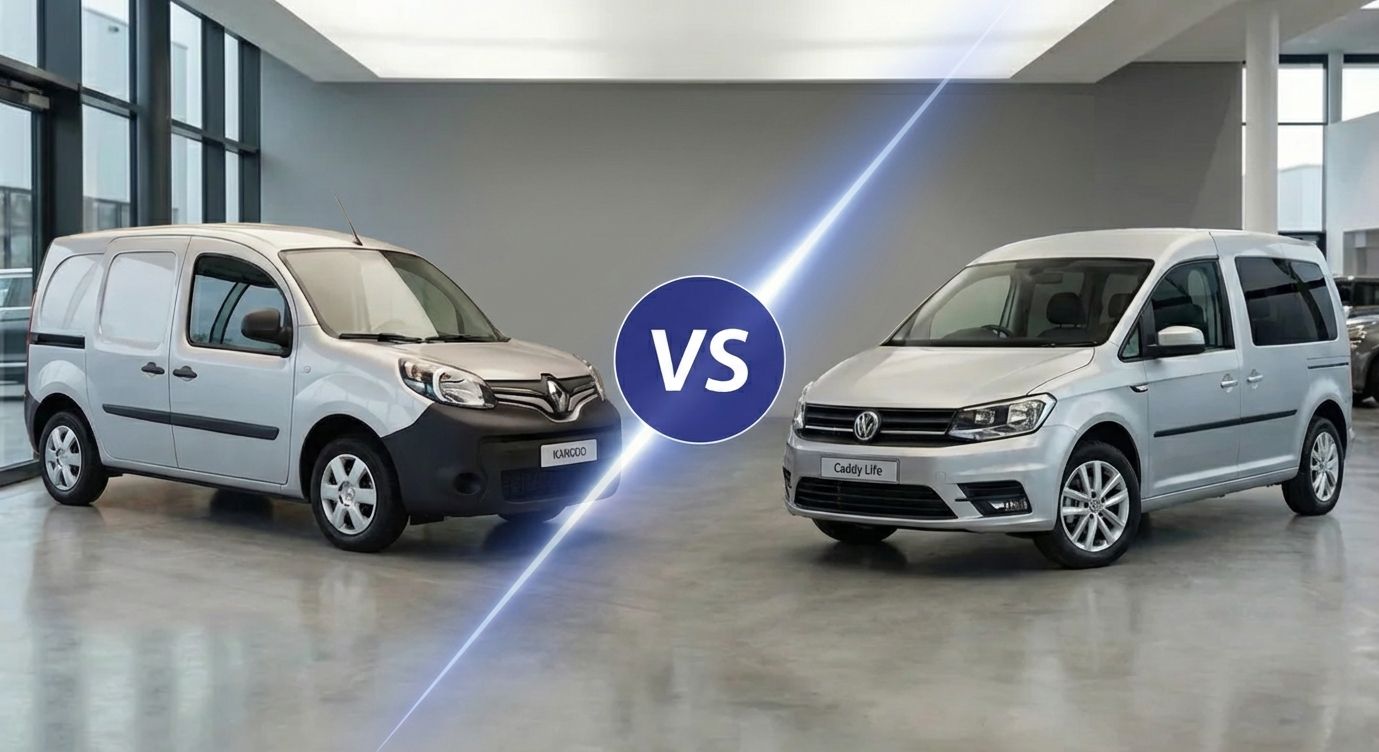
Car battle
Renault Kangoo vs. Volkswagen Caddy: Complete comparison 2026
Renault Kangoo or Volkswagen Caddy? Our detailed comparison reveals the key differences and helps you decide which car is right for you.
Apr 13, 2026
Articles
Car battle
Detailed comparison of Ford Tourneo Connect vs. Volkswagen Caddy. Discover the differences in space, equipment, and reliability and read our clear final verdict!
April 13, 2026
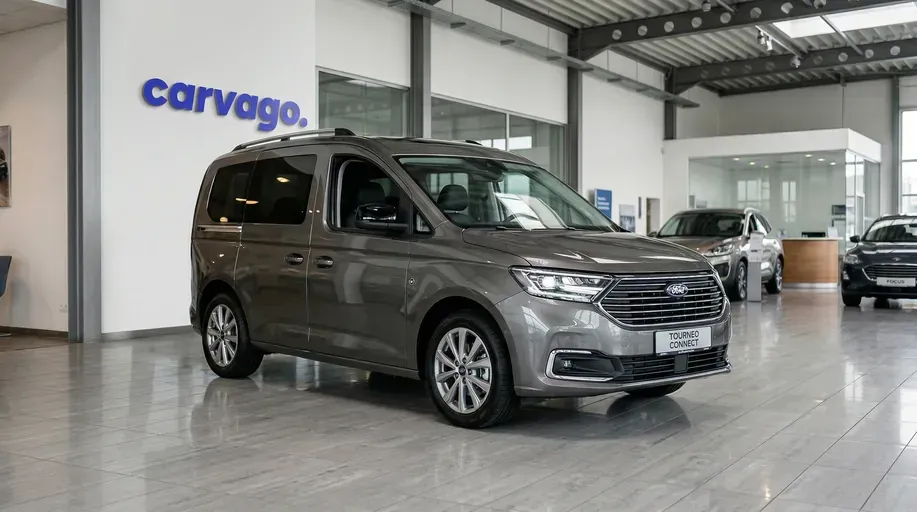
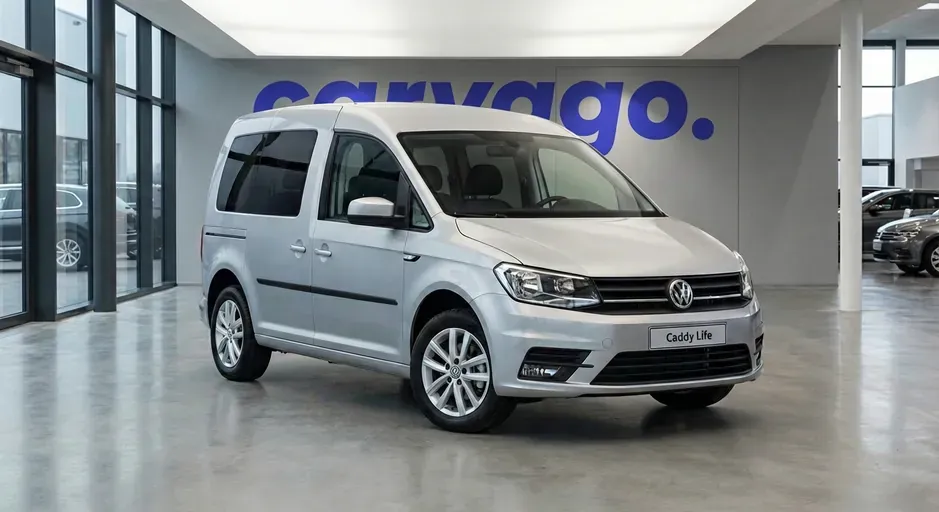
Ford Tourneo Connect, the passenger version of the popular Transit Connect model (also available in the extended Grand Tourneo Connect version), is a versatile family car that, in its latest generation, relies on a shared technical platform with its current rival. Volkswagen Caddy, also known on the market in the comfortable Caddy Life passenger version, the exceptionally spacious Caddy Maxi variant, or as the purely commercial Caddy Cargo, represents a long-standing benchmark in its class, successfully combining extraordinary interior space with advanced technologies. Let's take a detailed look at how these two immensely popular and technologically intertwined competitors stand in a direct comparison and which one offers better features for your daily travel.
If you are looking for a passenger van that is approximately four years old, you will likely come across the third generation of the Ford Tourneo Connect (produced since 2022) and the fifth generation of the Volkswagen Caddy (since 2020). When comparing their exterior dimensions, we encounter one very important and interesting fact – they are technological siblings that share the identical platform from Volkswagen. For this reason, their physical proportions are almost indistinguishable, meaning that whichever one you choose, you get a practically identical footprint.
Both vehicles in their standard length measure an identical 1855 mm in width and share the exact same wheelbase of 2755 mm. The wheelbase is a key parameter for interior spaciousness, which means that passengers in both cars have the same legroom to the millimeter. A minor difference can only be found in the overall length, where the Ford Tourneo Connect can be up to 15 mm longer (up to 4515 mm compared to 4500 mm for the standard Caddy) due to the different shaping of the front bumper and radiator grille.
From the perspective of practical everyday use, these deviations represent no real difference. Both models offer excellent maneuverability in the city and fit into standard parking spaces without any problems. The height of both vehicles in standard versions is just above the 1.8-meter mark, which guarantees safe and trouble-free entry into the vast majority of underground garages and shopping centers. However, an advantage of the Volkswagen Caddy on the used car market is the very frequent occurrence of the extended Maxi version, which stretches the overall length of the vehicle up to 4853 mm.
| Parameter | Ford Tourneo Connect Estate | Volkswagen Caddy Van |
|---|---|---|
| Width (mm) | 1855 | 1855 |
| Length (mm) | 4500 - 4515 | 4500 - 4853 |
| Height (mm) | 1833 - 1835 | 1819 - 1860 |
| Wheelbase (mm) | 2755 | 2755 - 2970 |
In conclusion, when choosing between these two models, exterior dimensions will not be the deciding factor, as the vehicles share the same foundation. If you are looking for a standard-sized vehicle, both cars will take up the identical space in a parking lot and provide the same cabin airiness. The Volkswagen Caddy has an advantage in this regard only for customers who specifically require as many extra centimeters as possible – its Maxi version with an extended wheelbase (2970 mm) offers a significant increase in both length and transport capacity.
When choosing a family car or a vehicle for active use, luggage capacity often plays a key role. The third-generation Ford Tourneo Connect (produced since 2022) and the fifth-generation Volkswagen Caddy (since 2020) represent the absolute top of the market for approximately four-year-old used cars in this regard. The practicality of these vehicles is extraordinary, making them perfect companions for families with children and outdoor sports enthusiasts. Since the third generation of the Ford Tourneo Connect was built on a shared group platform and is effectively a direct technological twin of the Volkswagen Caddy, comparing their transport capacity is very simple – both vehicles offer an identical luggage space down to the last liter.
In the standard body version, owners can look forward to a basic trunk volume of 760 liters (measured to the lower edge of the rear windows). This provides generous space for several extra suitcases, a bulky stroller, and other equipment, which is perfectly sufficient for weekend shopping or longer holidays. If you load the vehicle up to the ceiling behind the second row of seats, the capacity increases to 1,213 liters. However, the true hauling potential of both models is fully revealed when the rear seats are folded down or completely removed. The maximum usable volume then grows to a gigantic 2,556 liters.
Manufacturers have also thought of customers with the highest space requirements and offer extended versions – the Ford Grand Tourneo Connect and the Volkswagen Caddy Maxi. In these variants, the basic volume increases to an excellent 1,057 liters, and the maximum capacity reaches an amazing 3,105 liters. If you choose a seven-seat configuration, the usable space behind the third row of seats logically decreases to 191 liters for the standard version and 446 liters for the extended variant. It is also worth mentioning the modern plug-in hybrid (PHEV) powertrains, which maintain almost identical main practicality; however, due to the installation of traction batteries, you must expect a slight reduction in the hidden space under the trunk floor. In terms of overall trunk usability, you simply cannot go wrong with either vehicle when deciding between the two.
| Parameter | Ford Tourneo Connect Estate | Volkswagen Caddy Van |
|---|---|---|
| Base volume (liters) | 760 | 760 |
| Max volume with seats folded down (liters) | 2556 | 2556 |
Whether you choose the Ford Tourneo Connect or the Volkswagen Caddy, in both cases you get a generous luggage space that is identical to the liter. You can therefore base your choice at a used car dealership purely on brand preference and the condition of the specific unit with a clear conscience.
Trailer weight is a key parameter for many families and tradespeople, as it significantly expands the overall practicality of the vehicle. Whether you need to hitch up a caravan for summer trips or a standard trailer for building materials to free up space for a few extra suitcases inside, both compared models have plenty to offer. Given that the third generation of the Ford Tourneo Connect (offered since 2022) and the fifth generation of the Volkswagen Caddy (on the market since 2020) are direct siblings sharing the same technical platform in the nearly-new used car market, their towing capabilities are practically identical.
For both vehicles, the standard braked trailer weight ranges from 1400 kg to 1500 kg. Common petrol engines, namely the 1.5 EcoBoost in the Ford and the 1.5 TSI in the Volkswagen, can tow between 1300 and 1500 kg depending on the specific body version. Diesel units (2.0 EcoBlue and 2.0 TDI) then provide the maximum possible capacity of 1500 kg in most cases. A huge positive is that there is no capacity reduction for these models even with modern plug-in hybrid versions – both the Tourneo Connect PHEV and the Caddy eHybrid maintain a towing capacity in the range of 1400 to 1500 kg. The limit of around 1.5 tonnes is fully sufficient for weekend shopping for bulky items as well as longer holidays with a caravan. In conclusion, when it comes to towing capability, the vehicles are perfectly matched and neither will let you down during work or recreation.
(Note: Unbraked trailer weight data is not specified in the current technical specifications.)
| Model and motorization | Braked weight of trailer (kg) | Unbraked weight of trailer (kg) |
|---|---|---|
| Ford Tourneo Connect 3rd gen 1.5 EcoBoost (84 - 85 kW) | 1400 - 1500 | Not specified |
| Ford Tourneo Connect 3rd gen 2.0 EcoBlue (75 - 90 kW) | 1500 | Not specified |
| Ford Tourneo Connect 3rd gen 1.5 EcoBoost PHEV (85 kW) | 1500 | Not specified |
| Volkswagen Caddy V 1.5 TSI OPF (84 - 85 kW) | 1300 - 1500 | Not specified |
| Volkswagen Caddy V 2.0 TDI SCR (55 - 90 kW) | 1400 - 1500 | Not specified |
| Volkswagen Caddy V 1.5 TSI eHybrid (85 kW) | 1400 - 1500 | Not specified |
Those interested in roughly four-year-old used family vans (around model year 2022) will find that the third-generation Ford Tourneo Connect and the fifth-generation Volkswagen Caddy are technical siblings. Thanks to close cooperation between the two brands, these vehicles share the same platform and engine lineup, differing mostly only in marketing names. While Ford uses its traditional EcoBoost for petrol and EcoBlue for diesel, Volkswagen sticks with the proven TSI and TDI acronyms. Both manufacturers emphasize reliability, with two-litre diesels being the ideal choice for high-mileage drivers or trips with a fully loaded vehicle due to their efficiency and high torque. Conversely, the 1.5-litre petrol engines impress with their refined, quiet operation and represent a great choice for shorter routes, budget-conscious customers, and daily city traffic. Both brands recently expanded their range with modern plug-in hybrid versions for locally emission-free driving, but these newcomers are practically non-existent on the used car market for now.
The engine range for the Ford Tourneo Connect (from 2022) focuses on the most popular and field-proven units. The petrol representative is the reliable 1.5 EcoBoost four-cylinder with 84 kW, providing sufficient dynamics for normal family travel. Users preferring diesel can choose the 2.0 EcoBlue engine, available in two power levels – 75 kW and 90 kW. The most powerful diesel has the huge advantage of being the only one in the range available with all-wheel drive (AWD), which residents of mountainous areas will certainly appreciate. Smooth shifting is handled by either a precise six-speed manual gearbox or a comfortable seven-speed dual-clutch automatic. A brand-new addition is the advanced 1.5 EcoBoost PHEV variant, but according to data, it has only been available since August 2024, so you won't encounter this engine in the four-year-old used car category yet.
| Engine type | Fuel | Power (kW) | Torque (Nm) | Transmission |
|---|---|---|---|---|
| 1.5 EcoBoost | Petrol | 84 | 220 | 6MT / 7DSG |
| 1.5 EcoBoost PHEV | Plug-in Hybrid | 110 | 350 | 6DSG |
| 2.0 EcoBlue | Diesel | 75 | 280 | 6MT |
| 2.0 EcoBlue | Diesel | 90 | 320 | 6MT / 7DSG |
The fifth-generation Volkswagen Caddy (from 2020) brings a slightly wider range of engines, although technically identical units to the Ford are hidden under the hood. The base is the four-cylinder petrol 1.5 TSI OPF, which reliably complements the 2.0 TDI SCR diesel variants. Purely commercial Cargo versions or the absolute base for passenger models could be purchased on the primary market with a detuned diesel producing just 55 kW. The middle of the range consists of a sensible 75 kW version, and at the top stands the 90 kW variant, which can be paired with 4MOTION all-wheel drive. A unique rarity that you may occasionally come across on the used market is the eco-friendly compressed natural gas version, the 1.5 TGI (96 kW). However, it must be emphasized that this specific CNG engine was only on sale for a very short time (exclusively from 06/2022 to 06/2023) for the extended Maxi models and is no longer produced today. Just like the Blue Oval, Volkswagen also freshly added a plug-in hybrid version designated as 1.5 TSI eHybrid OPF to the price list at the end of summer 2024.
| Engine type | Fuel | Power (kW) | Torque (Nm) | Transmission |
|---|---|---|---|---|
| 1.5 TSI OPF | Petrol | 84 | 220 | 6MT / 7DSG |
| 1.5 TSI eHybrid OPF | Plug-in Hybrid | 110 | 350 | 6DSG |
| 1.5 TGI | CNG | 96 | 200 | 6MT |
| 2.0 TDI SCR | Diesel | 55 | 250 | 6MT |
| 2.0 TDI SCR | Diesel | 75 | 280 | 6MT |
| 2.0 TDI SCR | Diesel | 90 | 320 | 6MT / 7DSG |
Since both vehicles currently share the same excellent group technology, the choice in terms of engine for used cars is largely limited to your fuel preference and market availability – for regular longer and more demanding trips, the more powerful 90 kW two-litre diesel is the most versatile choice of all.
Choosing the right engine is absolutely crucial for long-term satisfaction with the vehicle, and our recommendations are based on performance characteristics, real-world fuel consumption, owner feedback, and documented mechanical reliability. A very interesting and significant fact regarding roughly four-year-old used cars from 2021 to 2022 is that the Ford Tourneo Connect (3rd generation) and the Volkswagen Caddy (5th generation) share the exact same platform and engines developed by the Volkswagen Group. This means that the units labeled as "EcoBoost" and "EcoBlue" by Ford are actually VW's TSI and TDI units. Therefore, the choice narrows down to which fuel and engine type best suit your specific use case.
This two-liter diesel (mechanically identical to VW's popular 2.0 TDI Evo engine) is by far the best choice for those buying a van for its true purpose – carrying cargo and families over long distances. It offers an excellent compromise between towing power, robustness, and operating economy, ensuring that a fully loaded car doesn't lose steam even on hills.
While we chose a heavy-duty diesel for the Ford for long distances, for the Caddy, we select the 1.5 TSI four-cylinder petrol engine, which is the absolute ideal for modern suburban families. If your daily bread consists of trips under 20 kilometers, this engine is a much safer and more user-friendly path than a diesel in terms of both maintenance and comfort.
When choosing a family van, fuel consumption often plays a key role, and this is doubly true for used cars. While the stated "paper" values according to laboratory cycles provide some idea, real-world practice on the roads is often different. For an objective comparison of the actual appetite of both vehicles, we used data from the independent community portal Spritmonitor.de, where thousands of drivers from across Europe share their refueling records over the long term. We focused on engines that are most relevant for the market of roughly four-year-old used cars, which for the Volkswagen Caddy includes the end of the fourth and the onset of the fifth generation, and for the Ford Tourneo Connect, the second and the beginning of the third generation.
| Model and engine | Average consumption (l/100 km) |
|---|---|
| Ford Tourneo Connect 1.5 EcoBoost (3rd gen) | 6.6 |
| Volkswagen Caddy 1.5 TSI (5th gen) | 6.5 |
| Volkswagen Caddy 1.4 TSI (4th gen) | 6.4 |
| Ford Tourneo Connect 2.0 EcoBlue (3rd gen) | 5.3 |
| Volkswagen Caddy 2.0 TDI (5th gen) | 5.1 |
| Ford Tourneo Connect 1.5 EcoBlue (2nd gen) | 5.5 |
A detailed look at the data immediately reveals the strong technological kinship between the newer iterations of both models. The third generation of the Ford Tourneo Connect directly shares its chassis and engine platform with the fifth generation of the Volkswagen Caddy, which is reflected in almost identical average consumption values. Modern petrol units, the 1.5 EcoBoost and 1.5 TSI, require an average of 6.5 to 6.6 liters of petrol per 100 kilometers in real-world operation. Given the large frontal area and higher weight of the MPV body type, this is a solid result. However, one trend is clearly visible here – modern small-displacement turbo engines do not save as much fuel as was generally expected, and their consumption has practically not decreased between generations compared to the older 1.4 TSI unit. On the other hand, diesel engines can still boast excellent efficiency. The two-liter TDI (sold by Ford under the trade name 2.0 EcoBlue) can run at an excellent 5.1 to 5.3 liters of diesel. The older and smaller-displacement 1.5 EcoBlue diesel engine from the second generation of the Ford also performs very well and economically, maintaining a stable average of around 5.5 liters per 100 km.
For the typical family car buyer, these data lead to a clear recommendation based on specific driving scenarios. If you mostly drive shorter routes and in urban or suburban traffic, the 1.5 TSI or 1.5 EcoBoost petrol variants are the ideal choice. Although their average consumption is a liter and a half higher than their diesel counterparts, for a reasonable amount of money you will avoid the potential risks associated with clogging the diesel particulate filter (DPF), which suffers greatly from city driving. Conversely, for drivers covering longer distances daily, for highway travelers, or families often heading out on fully loaded weekend trips, the two-liter turbodiesel is the clear winner, rewarding you with immense economy that saves the family budget.
Overall, the representatives from Volkswagen and Ford have nothing to fault each other for in the discipline of real-world fuel consumption. Due to the unification of technology in the generations that currently form the backbone of the nearly-new used car market, the vehicles are so close that consumption alone will certainly not be the deciding factor that tips the scales in favor of one brand or the other. It is much more important to make the right decision before purchasing between a petrol and a diesel engine, tailored exactly to your real mileage and habits.
When looking for a family or work vehicle on the used car market with an average age of around four years (model years 2021 to 2023), you will encounter a very specific and interesting situation with these two competitors. Prices and utility value are strongly influenced by the shared technology of the latest generations.
| Model | Common Price (base trims, shorter versions, higher mileage) | Price for Higher Trims (Titanium/Style, extended Maxi versions) |
|---|---|---|
| Ford Tourneo Connect | €16,000 – €21,000 | €21,000 – €27,000 |
| Volkswagen Caddy | €18,000 – €23,000 | €23,000 – €30,000 |
When buying a roughly four-year-old car, it is important to think about future service costs. For model years 2022 and newer, when the Ford Tourneo Connect and Volkswagen Caddy already share most parts, the prices of spare parts (from chassis components to brake pads) are essentially identical. Both brands benefit from the huge availability of parts on the aftermarket, as the technology comes from the VW Group's massive parts pool. However, if you were to choose a 2021 Ford model (previous generation), you will encounter specific service procedures for the original Ford units, where maintenance prices are also very friendly, but parts are not interchangeable with VW.
While the Volkswagen Caddy offers a wider selection of used cars and holds its residual value slightly better, the Ford Tourneo Connect from 2022 and newer is a secret tip – you get identical, modern VW Group technology often at a significantly more attractive purchase price.
Both models, as they share the same technical platform, offer an excellent foundation in the field of passive and active safety and boasted a five-star rating at their market launch. However, when comparing their results in independent Euro NCAP crash tests, it is absolutely crucial to understand the context and the year of testing. The organization's methodology and test protocols are constantly evolving and becoming more stringent, with increasing emphasis on modern cyclist detection, intersection collision avoidance, or stricter frontal impact scenarios with a mobile barrier. Percentage scores from different years cannot be directly compared. What was easily enough for five stars a few years ago may result in a lower percentage rating in today's much tougher tests, even though the car itself remains just as safe for passengers.
Ford Tourneo Connect currently boasts a five-star rating from the 2021 test cycle, when it was certified based on data from its technical twin. In the adult occupant protection test, it achieved a very confident 84%, and it earned 82% for child occupant protection. The vehicle's assistance systems (including autonomous emergency braking or lane-keeping assist) received a very respectable 79% at the time. Protection of vulnerable road users was rated at 69% according to the metrics of that time. These results reliably reflect the robust body structure and effectively tuned assistance features according to the standards in force at the time the generation was created.
Although the Volkswagen Caddy originally received the same five-star rating as the Ford, Euro NCAP decided to test and assess the model again in 2025, using its latest, extremely strict safety protocols. According to this current methodology, the Caddy received a total of 4 stars. Due to significantly tougher criteria for frontal and side impacts, the percentage score for adult protection formally decreased to 72% and for children to 80%. However, the car showed a significant improvement in the protection of vulnerable road users (a jump to a very nice 80%), which is a demonstrable result of the deployment of improved emergency braking software that detects pedestrians and cyclists more sensitively. Safety assistants were rated at 71% according to the latest 2024/2025 standards.
| Parameter | Ford Tourneo Connect | Volkswagen Caddy |
|---|---|---|
| Year of testing | 2021 | 2025 |
| Adult occupant protection | 84 % | 72 % |
| Child occupant protection | 82 % | 80 % |
| Vulnerable road user protection | 69 % | 80 % |
| Safety assistance systems | 79 % | 71 % |
In conclusion, despite the different number of stars and varying percentages in the official tables, both vans are essentially identical structurally and technologically. The differing numbers are a textbook example of how significantly Euro NCAP has tightened its requirements for active systems and passive safety in the last few years. The 2025 results for the Volkswagen Caddy thus provide future owners of both cars from the used-car market with a much more realistic and up-to-date picture of how their family van stands against today's strictest standards. For those interested in an approximately four-year-old used car, this means a clear conclusion: whether you choose the Ford or the VW, you are getting an exceptionally safe family car with a modern package protecting both the occupants and the surroundings.
Although they have a different testing year and final score on paper, both structurally identical vehicles offer top-tier protection; the stricter four-star result for the Caddy from 2025 only proves that the modern safety platform easily stands up even against today's most demanding standards.
In addition to standard equipment, each model offers several unique features that can be decisive for the customer. Although both vehicles share the same technical foundation and are produced on the same assembly line, both automakers have approached the enhancement of their models in their own way, preparing specific functions and completely differently tuned design packages.
Often more favorable purchase price and richer standard equipment of used cars compared to VW
More attractive front grille design in the style of Ford passenger cars
Reliable group technology under the hood (MQB platform) and a quiet interior
Huge interior spaciousness with the option of up to 7 seats (in the extended Grand version)
More comfortably tuned chassis that filters out bumps perfectly on family trips
Narrower range of powertrains on the used car market (missing the basic economical diesel available in the Caddy)
Loss of the typical sportier driving dynamics that older Ford cars boasted
Ergonomically problematic fully touch-based infotainment taken directly from Volkswagen
Slightly faster depreciation of the car's value on the used car market compared to its German sibling
The third generation of the Ford Tourneo Connect (from 2022) is an ideal choice for families looking for a modern and maximally spacious car with advanced technology, but at a more attractive price tag than its direct competitors. Thanks to the different front-end appearance and softer chassis, it is a pleasant rational alternative for buyers who do not want to pay extra for another brand's logo.
Extremely strong position on the used car market and traditionally excellent residual value
Wider range of engines, including the affordable and very economical 2.0 TDI (75 kW) version
More premium feel of interior materials and a richer range of original optional equipment
Driving characteristics that, thanks to the chassis platform from the Golf model, closely resemble a classic hatchback
Extraordinary practicality and huge transport capacity (especially in the extended Maxi variant)
Higher average purchase price of a used car compared to an equally equipped Ford
User-unfriendly touch controls with missing physical buttons and an unlit volume bar
Very conservative and strictly "utilitarian" design that may not appeal to everyone
Higher hourly rates at authorized service centers and overall slightly more expensive maintenance
The fifth-generation Volkswagen Caddy is the unwritten benchmark in the family passenger van market, attracting customers with its precise fit and finish, confident driving characteristics, and huge space variability. With its reliable character, it will primarily appeal to more conservative drivers and families who appreciate slower depreciation and are willing to pay a little extra for the quality and image of the VW brand.
Based on long-term owner experience, failure statistics, service reports, and data provided by Comprehensive Car Audit as part of the CarAudit service, we have compiled an overview of the most common problems that used car buyers should watch out for.
The Ford Tourneo Connect (generation offered until 2022) is generally a very robust vehicle; however, certain weaknesses may appear in used cars with higher mileage, particularly with diesel engines and automatic transmissions.
Ford offers great mechanical durability and utility value, but it requires consistent servicing of the automatic transmission, and its diesel engines definitely do not benefit from frequent short city trips.
The fifth-generation Volkswagen Caddy (from 2020, MQB Evo platform) brought a huge leap in digitalization and comfort, which simultaneously became its biggest teething problem. However, its mechanical foundations are excellent.
The latest generation Caddy is confident in its driving characteristics and engine efficiency, but buyers must arm themselves with patience regarding the occasionally fickle infotainment and overly active assistance systems.
When buying a used car, a thorough inspection is key. Here are some specific points to focus on for these two models, whether you choose four-year-old vehicles with different designs or the latest ones that share technology.
To avoid financial disappointment after the purchase, a comprehensive physical inspection of the used car is essential before the final decision. By ordering a professional CarAudit inspection, you get a detailed 270-point check under the guidance of an experienced mechanic, including diagnostics and a check of the vehicle's complete history, thereby eliminating the risk of clocked mileage or hidden accidents.
The Ford Tourneo Connect and the latest generation Volkswagen Caddy (from 2020/2022) are technological twins built on the same MQB platform from Volkswagen. The main differences lie only in the design of the front grille, the shape of the headlights, and the logos on the steering wheel. All basic technology and body construction are otherwise completely identical.
Since both models share an absolutely identical body, the luggage compartment volume is exactly the same. In the basic short version, both cars offer a huge space of up to 2,556 liters after removing the rear seats. If you choose the extended version (Grand Tourneo Connect or Caddy Maxi), you get even more space and the possibility of a full seven-seat layout.
Although Ford uses its traditional EcoBoost and EcoBlue designations for its vehicles, under the hood of both competitors work exclusively engines originating from Volkswagen's development (these are TSI and TDI units). Reliability, dynamics, and real fuel consumption are thus practically identical for both gasoline and diesel variants. Differences can only be found in service plans or the length of the factory warranty provided by the individual car manufacturers.
The dashboard layout is based on Volkswagen's architecture, so in both cases, you will find modern digital displays and a minimum of physical buttons. The Volkswagen Caddy relies exclusively on its touch surfaces and infotainment known from the Golf model, which may take some getting used to. Ford has adopted the same software but slightly modified the graphics and the steering wheel, which has retained a more traditional layout of control elements.
Ford usually tries to attract buyers with slightly richer standard equipment in its basic trim levels and slightly more attractive price tags. Volkswagen, on the other hand, benefits from a stronger brand image in this segment, which ensures a slightly better residual value and a wider selection on the used car market. Ultimately, the decision should be based primarily on the condition of the specific unit, maintenance history, and which front design you prefer.
Since the current generations of the Ford Tourneo Connect and the Volkswagen Caddy share the same group platform and engine range, in both cases you get an exceptionally spacious, safe, and technologically advanced family car with identical transport parameters. The Volkswagen Caddy represents a classic safe bet with excellent residual value retention and a huge selection of used cars, which perfectly appeals to more conservative customers. The Ford Tourneo Connect, on the other hand, appears to be a smarter choice for buyers looking for a better price-to-equipment ratio in a nearly new used car, who like its distinctive exterior design, or who appreciate slightly more traditional controls with fewer touch surfaces. Your final decision can therefore confidently be based purely on personal preference for a specific brand, available budget, and the technical condition of the chosen vehicle, because in terms of mechanics and overall practicality, you won't go wrong with either of these exceptionally well-matched siblings.
Sources: ADAC, denik.cz, forbes.cz, dopravniinfo.cz, smartmania.cz, autospecial.cz
This article was prepared using artificial intelligence tools. The section guarantor is Petr Dušek.
Renault Kangoo or Volkswagen Caddy? Our detailed comparison reveals the key differences and helps you decide which car is right for you.
Apr 13, 2026
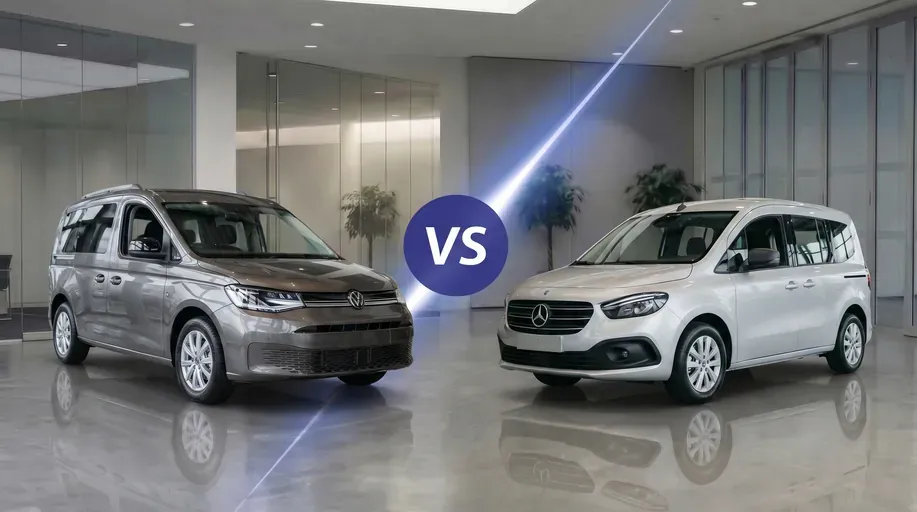
Detailed comparison of Ford Tourneo Connect vs. Mercedes-Benz Citan Tourer. Discover the real differences in space, equipment, and reliability. Which car to choose?
Apr 13, 2026
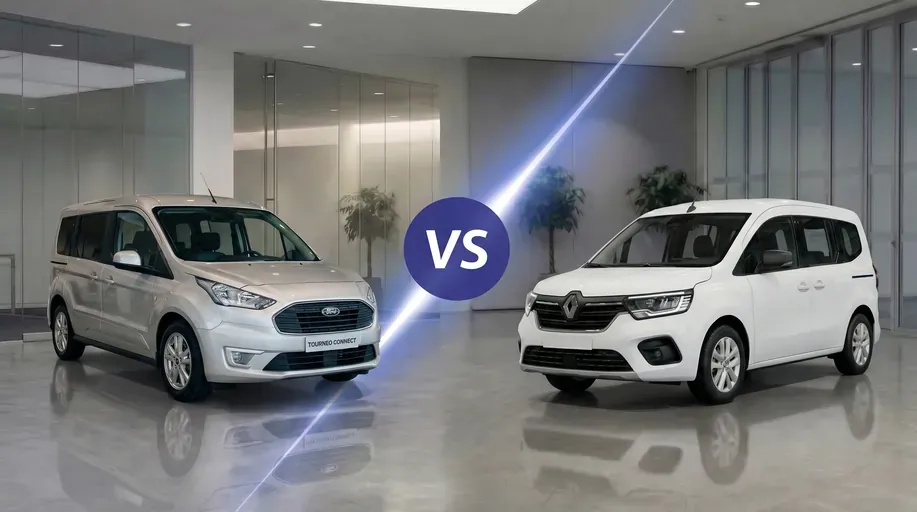
Ford Tourneo Connect vs Renault Kangoo. A detailed comparison of popular family cars. We evaluated interior space, engines, and comfort. Find out our verdict!
Apr 13, 2026