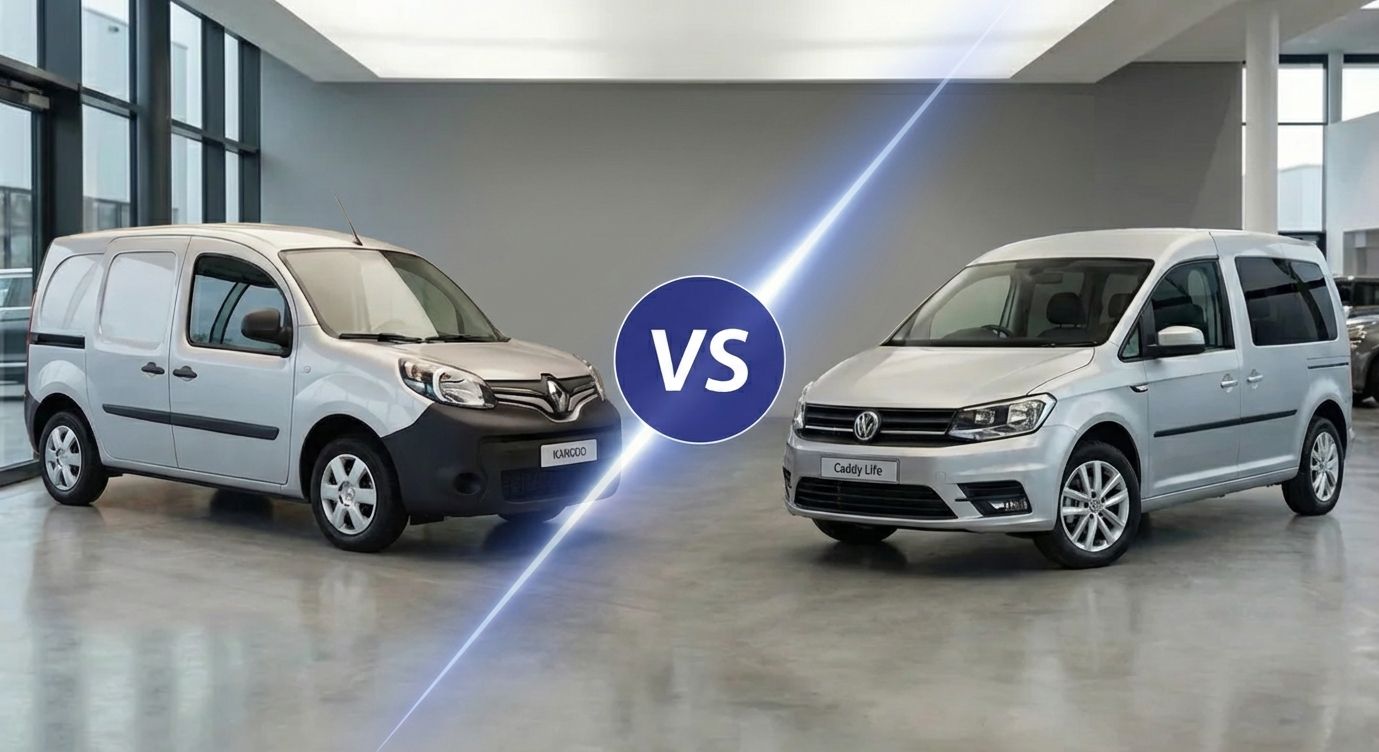
Car battle
Renault Kangoo vs. Volkswagen Caddy: Complete comparison 2026
Renault Kangoo or Volkswagen Caddy? Our detailed comparison reveals the key differences and helps you decide which car is right for you.
Apr 13, 2026
Articles
Car battle
Detailed comparison of Mercedes-Benz Citan Tourer vs. Volkswagen Caddy. We reveal the differences in space, equipment, and reliability to help you choose the ideal family van.
April 13, 2026
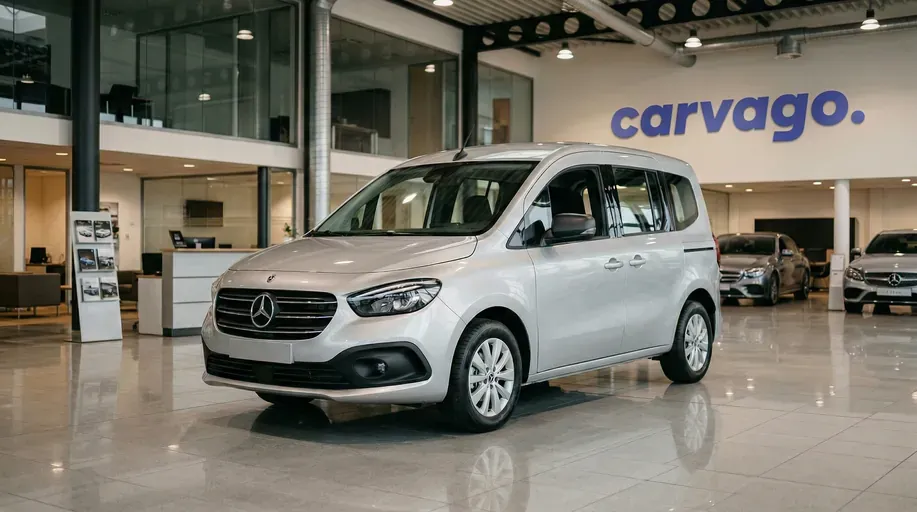
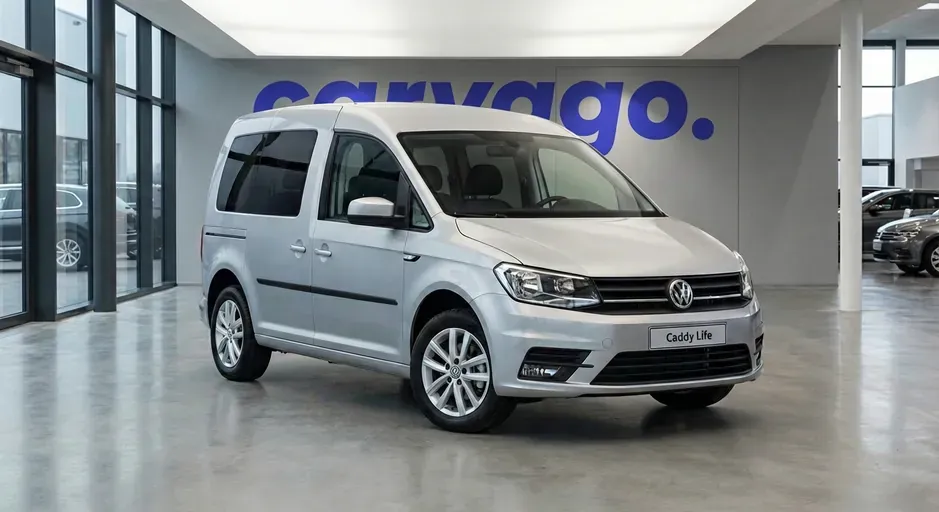
The Mercedes-Benz Citan Tourer, the passenger version of the compact van sharing its technical basis with the Renault Kangoo and closely related to the more premium T-Class, represents a highly practical and comfortable companion for families and entrepreneurs alike. Standing against it is the Volkswagen Caddy, whose passenger versions often carry the Caddy Life designation (while its current generation can also be seen on the roads under the sister name Ford Tourneo Connect), which has long been considered the absolute benchmark for spaciousness and variability in its class. Let's take a detailed look in the following comparison at which of these two popular versatile vehicles offers those interested in a roughly four-year-old used car a better combination of driving characteristics, utility value, and everyday comfort.
When comparing external dimensions in the nearly new used car market (focusing on current generations produced roughly since 2020 and 2021), the Mercedes-Benz Citan Tourer and Volkswagen Caddy are very evenly matched rivals. In their basic configurations, both cars are surprisingly similar – the standard Caddy measures exactly 4500 mm in length, while the standard Citan, at 4498 mm, is shorter by a completely negligible two millimetres. For everyday parking and maneuvering through city traffic, both basic versions offer a practically identical footprint that easily fits into even narrower spaces.
A closer look at width and height, however, reveals the first differences. At 1859 mm wide, the Mercedes-Benz Citan is slightly wider than the Volkswagen Caddy (1855 mm). Conversely, Volkswagen slightly dominates in the vertical direction, reaching a height of up to 1860 mm depending on the version, while the Citan tops out at 1830 mm. In practice, this means that while the taller Caddy may offer a bit more headroom when transporting bulky cargo or for taller passengers, the slightly wider Citan provides a more airy feel in the interior around the shoulder area.
The most significant difference appears when looking at the extended versions of both models, which are often purchased for larger families or business use. The extended Volkswagen Caddy Maxi grows to a respectable 4853 mm with a wheelbase of 2970 mm. However, Mercedes-Benz went even further with its "Lang" version – the body length is 4922 mm and the wheelbase has been stretched to a massive 3100 mm (130 mm more than the Caddy Maxi). Therefore, if you require maximum directional stability on the highway, the greatest possible longitudinal legroom, or uncompromising transport capacity from a family or work van, the extended Citan emerges from this comparison as the more spatially generous choice.
| Parameter | Mercedes-Benz Citan Estate | Mercedes-Benz Citan Pick-up | Volkswagen Caddy Van |
|---|---|---|---|
| Width (mm) | 1859 | 1859 | 1855 |
| Length (mm) | 4498 - 4922 | 4498 - 4922 | 4500 - 4853 |
| Height (mm) | 1811 - 1830 | 1819 - 1830 | 1819 - 1860 |
| Wheelbase (mm) | 2716 - 3100 | 2716 - 3100 | 2755 - 2970 |
Luggage space is one of the most important parameters for passenger vans and family MPVs. Trunk volume and its practical utility often determine whether a specific vehicle becomes the ideal partner for a large family, active athletes, or small business owners. Differences in this class can be surprisingly significant, and every extra liter means better daily flexibility for transporting strollers, bulky sports equipment, or simply larger grocery hauls.
When comparing standard five-seater versions from the latest generations on the used car market (i.e., cars about 4 years old), the fifth-generation Volkswagen Caddy clearly has the upper hand. Its trunk offers a fantastic 760 liters up to the parcel shelf, a value that easily satisfies even very demanding family needs. In contrast, the Mercedes-Benz Citan Tourer (W420 generation from 2021) provides a basic volume of 520 liters up to the height of the load cover. The 240-liter difference in favor of the Volkswagen in the basic configuration literally means space for several extra suitcases. However, the Citan Tourer is very cleverly designed in terms of shape, features a huge loading opening, and its volume is more than sufficient for weekend shopping and longer vacations with a standard crew.
When it comes to moving or transporting truly large cargo and the rear seats need to be folded down, both cars transform into almost full-fledged utility workhorses. The Volkswagen Caddy reaches a maximum volume of up to 2556 liters here, while the Mercedes-Benz Citan Tourer follows closely with its 2390 liters. Furthermore, extended versions (Caddy Maxi and Citan Tourer Lang) also appear on the used car market for both models, pushing the total transport capacity even further. An advantage of modern representatives of this class is that potential electric and hybrid variants (such as the eCitan Tourer) maintain an identical volume to the classic internal combustion versions thanks to cleverly placed batteries in the floor.
| Parameter | Mercedes-Benz Citan Tourer Estate | Volkswagen Caddy Van |
|---|---|---|
| Base volume (liters) | 520 | 760 |
| Max volume with seats folded down (liters) | 2390 | 2556 |
Although the Mercedes-Benz Citan offers a great and easily accessible cargo space, the Volkswagen Caddy is the clear winner for families and drivers who need to transport an above-standard amount of luggage thanks to its total volume.
Towing capacity is one of the most important parameters for compact passenger vans. The trailer weight determines whether you can use the vehicle for towing a family caravan, transporting a boat, or simply needing to occasionally transport heavier construction materials. If you are choosing roughly four-year-old models on the used car market, both the Mercedes-Benz Citan Tourer (current generation 420) and the fifth-generation Volkswagen Caddy offer exceptionally comparable and highly practical values for everyday life. Both vehicles easily handle an unbraked trailer with the standard legal weight of 750 kg; however, their approach to rating braked trailers differs slightly.
From a specifications perspective, the Mercedes-Benz Citan Tourer offers maximum clarity – all its internal combustion engine versions (petrol and diesel) have a uniform maximum and standard braked trailer weight of exactly 1500 kg. It is even more pleasing that the fully electric eCitan Tourer version retains this capacity without compromise, making it an above-average capable zero-emission workhorse in this class. Conversely, the Volkswagen Caddy approaches limits in more detail based on the specific body version and chosen engine. While standard values for weaker specifications or certain more utility-oriented versions start at 1300 to 1400 kg, the vast majority of more powerful and popular variants can tow the maximum. Whether it's the more powerful 1.5 TSI petrol four-cylinders, the economical 2.0 TDI diesels, or the modern 1.5 TSI eHybrid plug-in hybrid, their braked trailer weight reaches the same limit of 1500 kg.
From a practical standpoint, these figures represent an ideal situation. With both models, you can easily tow a small to medium-sized family caravan, which provides comfortable space for a few extra suitcases and offers capacities that are fully sufficient for weekend shopping or longer holidays. As a result, trailer weight will not be the parameter that should definitively decide your purchase – whether you choose the Citan with its unified capacity or the Volkswagen Caddy, you will find a practical companion with identical upper limits in both.
| Model and motorization | Braked weight of trailer (kg) | Unbraked weight of trailer (kg) |
|---|---|---|
| Mercedes-Benz Citan Tourer (all internal combustion engines) | 1500 | 750 |
| Mercedes-Benz eCitan Tourer | 1500 | 750 |
| Volkswagen Caddy 1.5 TSI OPF | 1300 - 1500 | 750 |
| Volkswagen Caddy 1.5 TSI eHybrid OPF | 1400 - 1500 | 750 |
| Volkswagen Caddy 2.0 TDI SCR | 1400 - 1500 | 750 |
When choosing a compact family or utility vehicle, the powertrain plays a crucial role. Those looking for roughly four-year-old used cars from around 2022 will choose between two different approaches. The Mercedes-Benz Citan Tourer relies primarily on smaller-displacement alliance engines developed in cooperation with Renault. These score points for overall refinement and excellent efficiency, which will be appreciated especially by calmer drivers. In contrast, the fifth-generation Volkswagen Caddy bets on proven and slightly larger-displacement group units, which provide robust torque in diesel versions and make it an ideal workhorse for driving under full load. Over time, both brands have also reflected new trends – Mercedes-Benz later offered a fully electric model, while Volkswagen enriched its range with natural gas variants or a modern plug-in hybrid.
The basis of the petrol range for the current generation Citan Tourer (since 2021) is a proven 1.33-liter turbocharged four-cylinder. It is available in two power variants: the base 110 (75 kW) and the more powerful 113 (96 kW). These engines are exceptionally quiet and represent a great choice for suburban driving. For drivers with high annual mileage, the 1.5-liter diesel four-cylinder is ideal, bearing the commercial designations 110 CDI (70 kW) and 112 CDI (85 kW). As standard, the engines are paired with a six-speed manual gearbox, but for more powerful versions, a very well-tuned seven-speed dual-clutch transmission (DCT) could also be chosen. Later (from approximately 2023), the range also expanded to include the fully electric eCitan model, but this currently appears only exceptionally on the four-year-old used car market.
| Engine type | Fuel | Power (kW) | Torque (Nm) | Transmission |
|---|---|---|---|---|
| 110 | Petrol | 75 | 200 | 6MT |
| 113 | Petrol | 96 | 240 | 6MT / 7DCT |
| 110 CDI | Diesel | 70 | 260 | 6MT / 7DCT |
| 112 CDI | Diesel | 85 | 270 | 6MT / 7DCT |
| eCitan | Electricity | 90 | 245 | Automatic (1-speed) |
The Volkswagen Caddy range will especially please proponents of slightly higher displacements. The petrol range on the market is represented by the 1.5 TSI four-cylinder with 84 kW, which can effectively deactivate cylinders (ACT) for maximum fuel consumption reduction. However, the dominant force in the used car market is the exceptionally popular 2.0 TDI SCR diesel two-liter. Depending on the version, it is supplied with outputs of 55 kW, 75 kW, and as a top variant with 90 kW. This most powerful turbodiesel also boasts a massive 320 Nm of torque and could be equipped with the excellent 4MOTION all-wheel drive, an invaluable feature you won't find on the Citan. Power transmission in most specifications is handled by a six-speed manual or a lightning-fast seven-speed DSG dual-clutch gearbox. Also worth mentioning is the less common compressed natural gas version (1.5 TGI), which appeared in the range only limitedly between 2022 and 2023. Additionally, from the end of 2024, a modern 1.5 TSI eHybrid plug-in hybrid with 110 kW was added, but it does not yet feature among currently four-year-old cars.
| Engine type | Fuel | Power (kW) | Torque (Nm) | Transmission |
|---|---|---|---|---|
| 1.5 TSI OPF | Petrol | 84 | 220 | 6MT / 7DSG |
| 2.0 TDI SCR | Diesel | 55 / 75 / 90 | 250 / 280 / 320 | 6MT / 7DSG |
| 1.5 TGI | CNG / Petrol | 96 | 200 | 6MT |
| 1.5 TSI eHybrid | PHEV | 110 | 350 | 6DSG |
Choosing the right powertrain for passenger vans is critical for long-term satisfaction, as these vehicles often face heavy loads and high mileage. While the Mercedes-Benz Citan Tourer generation W420 (available since late 2021) benefits from shared development with the Renault-Nissan alliance and uses finely tuned units with French roots, the fifth-generation Volkswagen Caddy (on the market since late 2020) relies fully on the MQB group platform and the proven evolution of its own engines. Our recommendation for roughly four-year-old used cars is based on real service experience, real fuel consumption, and daily user-friendliness.
This engine, internally designated OM 608, is based on the legendary and incredibly time-tested 1.5 dCi unit from Renault. However, Mercedes-Benz specifically modified it for the Stuttgart brand's needs (using its own control unit and different software). For the family-oriented Citan Tourer, it represents the absolute ideal – offering smooth pull, strong torque of 270 Nm available from low revs, and exemplary refinement. Furthermore, a fully loaded car does not suffer from breathlessness on highway climbs, and real fuel consumption easily stays between an excellent 5.0 and 5.5 liters per 100 km.
The fifth generation of the Caddy model brought evolutionary diesel engines from the EA288 evo generation under the hood, and the 90 kW variant is clearly the most versatile and best choice in the range. It provides excellent dynamics, confident torque of 320 Nm, and the immense mechanical durability of a robust two-liter block. It works perfectly with both the precise manual transmission and the fast seven-speed DSG automatic. The engine is excellently soundproofed, and real combined fuel consumption, even for such a tall vehicle, easily stays within the 6 liters per 100 km limit.
When choosing a family passenger van, fuel consumption plays a crucial role, but official laboratory values from manufacturers can differ significantly from real-world figures on the road. For the most accurate picture of the operating costs of roughly four-year-old used cars (both models are current generations sold since 2020 and 2021), we focused on real data from drivers themselves. The independent community portal Spritmonitor.de, which collects records from the daily operation of hundreds of owners, served as the ideal platform for this comparison.
Data source: Spritmonitor.de
| Model and engine | Average consumption (l/100 km) |
|---|---|
| Mercedes-Benz Citan Tourer 110 CDI 70 kW | 5.8 |
| Mercedes-Benz Citan Tourer 112 CDI 85 kW | 6.0 |
| Volkswagen Caddy 2.0 TDI 75 kW | 6.1 |
| Volkswagen Caddy 2.0 TDI 90 kW | 6.3 |
| Mercedes-Benz Citan Tourer 110 75 kW | 7.4 |
| Volkswagen Caddy 1.5 TSI 84 kW | 7.5 |
| Mercedes-Benz Citan Tourer 113 96 kW | 7.7 |
From the collected data, it is clearly evident that despite the huge technological progress in petrol engines, diesel remains king in the category of tall family passenger vans. Diesel engines (labeled CDI for Mercedes, TDI for Volkswagen) can power the large body with consumption balancing on the edge of six liters. For petrol variants, there is a noticeable increase in fuel consumption. Small turbocharged petrol engines often have to struggle with poorer aerodynamics and vehicle weight, which in practice means an average of over seven liters. A slight surprise is the excellent efficiency of the 1.5-liter diesel in the Mercedes Citan, which manages to drive on average about half a liter more economically than the larger two-liter under the hood of the Caddy, even though the Volkswagen engine is also considered very efficient.
For the typical user and buyer of a used car, clear recommendations follow. If you are buying a family van primarily for short hops around town or suburban traffic (for example, taking children to school and clubs), petrol variants (Citan 110/113 or Caddy 1.5 TSI) will be a better compromise regarding faster warm-up and the absence of a particulate filter prone to urban clogging. Increased consumption here is the price for lower service risks. However, as soon as you are looking for a highway workhorse or a partner for long weekend holidays, it clearly pays to go the route of diesel versions. Their consumption is not only fundamentally lower, but it also doesn't rise nearly as much even after being fully loaded with family cargo.
In conclusion, consumption should not be the only criterion, but it plays a big role. The Diesel Mercedes Citan Tourer comes out slightly more economical in the measurements and represents the absolute top for a family budget watching every liter. In contrast, the Volkswagen Caddy with the larger 2.0 TDI shows only a slightly higher appetite, which it balances perfectly with better flexibility. In terms of operating costs, however, the diesel engines of both brands are fantastic, and consumption will not be the element that should tip you directly towards one or the other rival.
The market for used family vans and MPVs is very specific. Focusing on models approximately 4 years old, we encounter two completely different situations. On one hand, there is the absolute used-car hit in the form of the fifth-generation Volkswagen Caddy; on the other, the slightly less traditional but more premium second-generation Mercedes-Benz Citan Tourer, which shares its technical basis with the Renault Kangoo.
The representative from Wolfsburg holds its value with absolute confidence. Huge demand from families and tradespeople means its price depreciation is very gradual.
Although the Citan has the three-pointed star on the hood, it paradoxically loses value slightly faster than its German competitor on the used market, making it a very interesting and often overlooked choice.
| Model | Typical starting price (Used) | Price for premium equipment | Residual value |
|---|---|---|---|
| VW Caddy V | from €16,000 | €23,000 – €27,000 | Extremely high |
| MB Citan Tourer II | from €14,000 | €18,000 – €21,000 | Average |
Used market evaluation:
Paradoxically, you can often buy the more premium Mercedes-Benz Citan Tourer as a four-year-old used car for less than the class benchmark, the Volkswagen Caddy, which keeps its price extremely high due to massive demand.
Both of these family models boast that they achieved the maximum five-star Euro NCAP safety rating in their original tests. However, it is absolutely crucial to view this result in context and take into account the year the testing actually took place. Euro NCAP methodology and testing protocols are constantly evolving and becoming significantly more stringent over time. Percentage scores from different years cannot be directly compared, as newer tests include much more demanding frontal collision simulations, advanced cyclist detection, or emergency scenarios at intersections. A result that was enough for the absolute top a few years ago often means fewer points by today's standards.
Mercedes-Benz Citan Tourer underwent Euro NCAP testing in 2022, from which it took home a full five-star rating. The vehicle dominated particularly in the areas of passive safety – earning a top score of 91% for adult occupant protection and as much as 93% for child protection. The assessors highlighted the perfect stability of the cabin and the protection of the driver's and passenger's knees and thighs in a frontal impact. The safety assistance equipment also performed very well with a rating of 90%, although in the category of vulnerable road user protection (69%), the vehicle showed some minor shortcomings in the event of a potential collision with a pedestrian.
Although the Volkswagen Caddy was originally awarded five stars in 2021, it underwent a significantly stricter reassessment in 2025, after which its overall result dropped to four stars. This shift clearly demonstrates the rigor of modern tests, which now penalize the vehicle's aggressiveness in a collision and require, for example, advanced protection against opening doors into the path of a cyclist (so-called "dooring"). In the current 2025 tests, the Caddy achieved 72% for adult protection and 80% for child protection. However, it significantly excelled in the protection of vulnerable road users (80%), where its modernized radars and systems were able to detect pedestrians and motorcyclists much more accurately.
In terms of overall safety, both models offer the best for their age, but each scores well in different areas. While the Mercedes-Benz Citan Tourer benefits from fantastic figures in structural occupant protection according to 2022 standards, the Volkswagen Caddy offers slightly more modern solutions for threat detection in cities, as confirmed by the uncompromising 2025 tests. For families looking for maximum passive protection in the cabin, the Citan is an excellent choice; the Caddy, on the other hand, will satisfy drivers who appreciate the most advanced active safety assistants for heavy city traffic.
| Parameter | Mercedes-Benz Citan Tourer | Volkswagen Caddy |
|---|---|---|
| Year of testing | 2022 | 2025 |
| Adult occupant protection | 91 % | 72 % |
| Child protection | 93 % | 80 % |
| Vulnerable road user protection | 69 % | 80 % |
| Safety assistance systems | 90 % | 71 % |
Both vehicles provide families with a top-tier level of safety; the Citan Tourer impresses with excellent passive occupant protection, while the Caddy shines with modern and sensitive assistants for treacherous city traffic.
In addition to standard equipment, each model offers several unique features aimed at making daily use more pleasant and which can be decisive for the customer in the final selection. While Mercedes-Benz brings a premium atmosphere and top-tier voice control to the small van segment, Volkswagen bets on extensive digitalization and assistance technologies adopted from passenger cars.
Very comfortably tuned chassis that effectively filters out bumps
Modern and user-friendly MBUX multimedia system with advanced voice control
High standard of safety and assistance equipment even in the base trim
Higher-quality workmanship and better cabin soundproofing compared to the technically related Renault Kangoo
Practical sliding side doors with a large and easily accessible entry opening
Higher purchase price of used cars due to the premium logo on the hood
Absence of more powerful engines; under the hood, you'll only find 1.5 and 1.3 units
Limited range of versions, for example, the option of all-wheel drive is missing
More complex touch controls on the steering wheel, which require getting used to
The Mercedes-Benz Citan Tourer is a great choice for families looking for a highly practical van with a touch of premium and excellent ride comfort. Thanks to the advanced MBUX system and great soundproofing, it will especially appeal to drivers who demand modern technology and a quiet, supple ride.
Great driving characteristics and agility thanks to the MQB platform shared with the Golf
Highly efficient, dynamic, and time-tested 2.0 TDI diesel engines
Availability of the extremely spacious Maxi version and the option to pay extra for 4Motion all-wheel drive
Top-tier residual value on the used car market, facilitating later resale
Modern digital instrument cluster (Virtual Cockpit) with excellent readability
Frustrating fully touch-based interior controls, including an unlit climate control bar
Harder and cheaper-feeling plastics in the cabin compared to the previous generation
Slightly bouncier and stiffer rear axle tuning when the vehicle is completely empty
Significantly higher price tag on the used car market compared to most competitors
The Volkswagen Caddy represents the universal benchmark of its class, which, thanks to its passenger car platform, drives confidently and offers immense space variability. It is an ideal companion for active families or cottage owners who appreciate the 4x4 option and powerful diesel engines, for which they must, however, pay extra.
Based on service reports, long-term user reviews, and data from our inspections, including CarAudit – an independent comprehensive car check, we have compiled an overview of the most common problems that buyers of used cars around 4 years old should watch out for.
The second generation of the Mercedes-Benz Citan Tourer (W420, from 2021) is built on a shared platform with the Renault Kangoo. It benefits from a solid mechanical foundation, but it is not immune to specific teething troubles.
The second-generation Citan mainly suffers from minor software bugs and sensitive exhaust system sensors, but mechanically it offers above-standard longevity and durability.
The fifth generation of the Volkswagen Caddy (Type SB, from 2020) brought a transition to the group's MQB platform, which significantly improved comfort and safety, but at the same time triggered problems with unrefined onboard electronics architecture.
The new Caddy is an extremely pleasant and sophisticated van to drive, but its reputation is marred by a complicated and often faulty electronic system that requires patience and frequent updates.
When buying a used car, a thorough inspection is key. Here are some specific points to focus on for these two models. Although both family vans can handle high mileages, a comprehensive car audit should always be the first step before signing a purchase agreement to avoid expensive repairs due to neglected maintenance.
The Volkswagen Caddy offers a more voluminous luggage compartment in its basic configuration and also has the advantage of being able to completely remove the rear seats. The Mercedes-Benz Citan Tourer, on the other hand, has a slightly lower loading sill, which significantly facilitates the handling of heavier items. Both vehicles are also available in extended versions, which further expand the space possibilities for family or business.
The second generation of the Citan was developed in cooperation with the Renault-Nissan-Mitsubishi alliance and shares a common technical basis with the Renault Kangoo model. However, Mercedes took great care with the different chassis tuning, steering adjustments, and better soundproofing of the entire cabin. Inside, you will also find the brand's typical steering wheel, higher-quality materials, and the modern MBUX infotainment system, giving the vehicle a significantly more premium feel.
The Volkswagen Caddy relies on its own group engines, dominated by the popular 2.0 TDI diesels and 1.5 TSI petrol four-cylinders with an optional DSG dual-clutch transmission. Mercedes uses engines from the French collaboration, namely the very efficient 1.5 dCi diesel units and 1.3 TCe petrol engines complemented by a seven-speed automatic. While the engines in the Volkswagen offer a slightly higher power range, the units in the Citan stand out for their above-average refinement and quiet operation.
The Volkswagen is built on the advanced MQB platform from standard passenger cars, which gives it exceptionally confident and stable driving characteristics comparable to a regular hatchback. However, thanks to specifically tuned shock absorbers and springs, the Mercedes has a noticeably softer and more compliant chassis setup. For a more cushioned ride on broken city roads, the Citan Tourer is somewhat more comfortable, while the Caddy will please drivers who prefer a firmer and more dynamic feel.
Mercedes-Benz considered electrification from the very beginning when developing the current generation and offers a fully electric version on the market called the eCitan Tourer, which can travel nearly 300 kilometers on a single charge. The fifth-generation Volkswagen Caddy does not provide a purely electric variant and is mostly limited to traditional internal combustion engines. Therefore, if you are looking for 100% emission-free operation in a used car around four years old, the Citan is the only choice from this pair.
While the Volkswagen Caddy represents an unrivaled benchmark for interior spaciousness and, thanks to the advanced MQB platform and powerful two-liter diesel engines, appeals to drivers looking for immense transport capacity for long distances, the Mercedes-Benz Citan Tourer scores on the nearly-new used car market with a surprisingly better price-to-value ratio. The Stuttgart representative will particularly delight users who appreciate a more premium interior concept with the smart MBUX system, an exemplary comfortable chassis, and the excellent refinement of highly efficient engines. The final decision thus depends purely on your priorities; for highway mile-munchers or cottage owners requiring a maximum trunk, there is the traditional and price-stable Caddy, while those looking for a smoother, quieter, and more affordable family alternative for every day will find the ideal companion in the Citan.
Sources: ADAC, garaz.cz, denik.cz, fdrive.cz, autorevue.cz, motorsport.cz
This article was prepared using artificial intelligence tools. The section guarantor is Petr Dušek.
Renault Kangoo or Volkswagen Caddy? Our detailed comparison reveals the key differences and helps you decide which car is right for you.
Apr 13, 2026
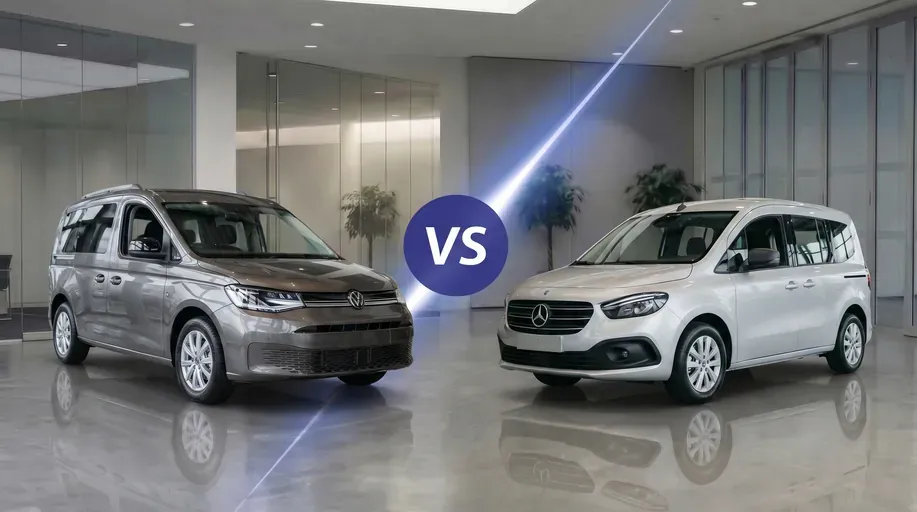
Detailed comparison of Ford Tourneo Connect vs. Mercedes-Benz Citan Tourer. Discover the real differences in space, equipment, and reliability. Which car to choose?
Apr 13, 2026
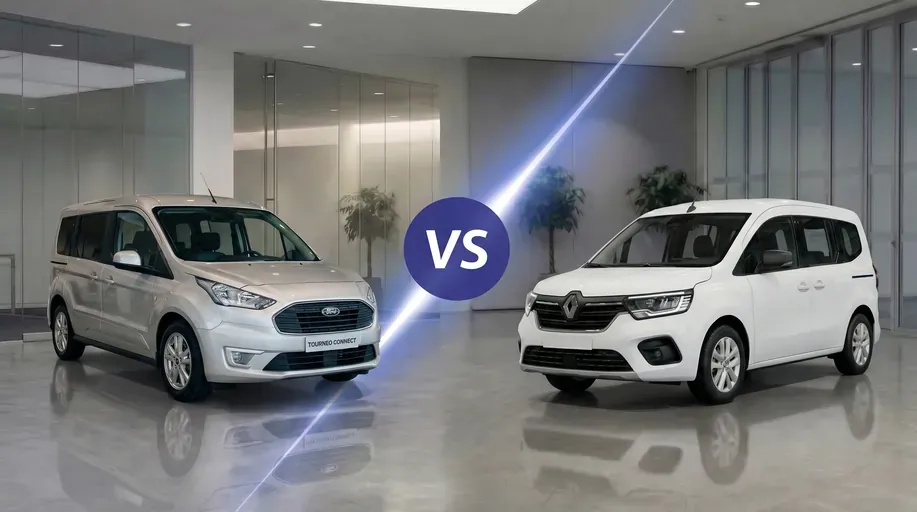
Ford Tourneo Connect vs Renault Kangoo. A detailed comparison of popular family cars. We evaluated interior space, engines, and comfort. Find out our verdict!
Apr 13, 2026