Nissan X-Trail vs. Volkswagen Tayron: Complete comparison 2026
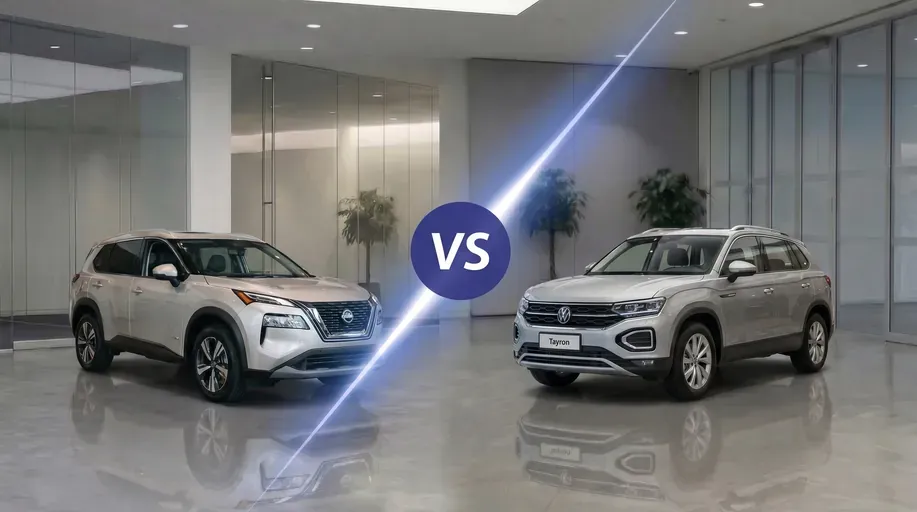
Nissan X-Trail vs. Volkswagen Tayron comparison. Read our detailed verdict, equipment comparison, and real-world experiences. Choose the ideal SUV for your family.
Apr 25, 2026
Articles
Car battle
Detailed comparison of Kia Sorento vs. Nissan X-Trail (Rogue). Discover real-world fuel consumption, differences in space and equipment, and get a clear verdict before you buy.
April 26, 2026


The Kia Sorento is a robust and spacious family SUV that has gained popularity among customers primarily due to its high comfort, rich technological equipment, and premium interior finish. Standing against it is the versatile Nissan X-Trail, also known as the Nissan Rogue in some overseas markets, which has long scored points for its practicality, excellent use of interior space, and confident driving characteristics for daily commutes and light off-roading. Let's take a detailed look at which of these two strong competitors offers a better overall package on the used car market and becomes the ideal choice for your needs.
Looking at the exterior dimensions, it is immediately apparent that although both cars belong to the popular family vehicle segment, they target slightly different needs. The fourth-generation Kia Sorento (code-named MQ4), which prevails in the market for roughly four-year-old used cars, proudly positions itself as a full-fledged mid-size SUV. With a length of 4810 mm, it significantly outgrows the competing Nissan X-Trail. With its length of 4680 to 4690 mm (depending on the generation transition between T32 and T33 in 2022), the latter balances on the border between the compact and mid-size classes. The Sorento is therefore roughly 120 to 130 mm longer, which brings a completely different approach to the interior layout.
The wheelbase is a key parameter for the longitudinal spaciousness of the cabin. Here, the Kia Sorento completely dominates with a value of 2815 mm, while Nissan offers 2705 mm. This significant difference of 110 mm in favor of the Korean representative means noticeably more legroom for passengers in the second row and a much more usable optional third row of seats in practice. The Sorento is also 60 to 80 mm wider (exactly 1900 mm compared to 1820–1840 mm for the Nissan X-Trail). This seemingly minor difference adds valuable centimeters in shoulder room, which you will appreciate especially when you need to seat three adults in the back or place three child car seats side by side.
On the other hand, a smaller footprint brings undeniable advantages in everyday traffic. With its shorter and narrower body, the X-Trail maneuvers much better in narrow city streets, and parallel parking as well as moving in tight spaces of shopping centers are significantly less stressful with it. Interestingly, however, although the X-Trail has a smaller overall footprint, with a height of up to 1720 mm, it slightly exceeds the Sorento (1695 mm). This proportion gives it a visually very robust and classic "off-road" stance, and in addition, it can provide slightly more generous headroom.
The decision between the two cars therefore depends on your definition of everyday practicality. If you prefer maximum interior space and comfort on long highway trips for the whole family, the Kia Sorento fully justifies its larger dimensions. However, if you are looking for a more agile and compact SUV for more frequent city driving that is easier to park, the Nissan X-Trail will be more attractive to you due to its dimensions.
| Parameter | Kia Sorento SUV | Nissan X-Trail SUV |
|---|---|---|
| Length (mm) | 4810–4815 | 4680–4690 |
| Width (mm) | 1900 | 1820–1840 |
| Height (mm) | 1695 | 1700–1720 |
| Wheelbase (mm) | 2815 | 2705 |
Luggage capacity is one of the most important parameters when choosing a family SUV. It determines whether you can stress-free pack the family for a two-week holiday, comfortably transport a stroller, or manage a weekend grocery run supplemented by sports equipment. In a direct comparison of roughly four-year-old used cars, specifically the Kia Sorento MQ4 and Nissan X-Trail T33 generations, the difference in the overall size of both vehicles is fully evident. While the Sorento approaches the parameters of full-size large SUVs and offers space for several extra suitcases, the X-Trail remains a more compact representative with a greater emphasis on overall urban agility.
The South Korean Kia Sorento is a true leader when it comes to luggage transport. In the case of the purely five-seater version (which is rather rare on the used car market), it offers a gigantic base volume of up to 898 liters. You will much more frequently encounter the seven-seater layout, where after folding the third row of seats into the floor, an excellent 604 to 616 liters remain. The value varies slightly for plug-in hybrid (PHEV) powertrains, where the battery installation has taken a few liters from the total capacity, yet the trunk remains massive. Once you also fold down the second-row backrests, the Sorento transforms into an improvised van with a maximum volume exceeding the 2,000-liter mark, which safely covers even an unexpected move.
The Japanese Nissan X-Trail counters with great variability, although it logically does not reach the absolute figures of its more voluminous competitor. In the five-seater version, it provides a trunk with a solid volume of 585 liters, which is slightly reduced to 575 liters in the highly sought-after e-Power hybrid versions due to the battery installation. This space is still fully sufficient for a weekend grocery run or a longer holiday. However, the difference in size class is fully revealed after folding down the rear backrests, where in the Nissan you get a maximum space of around 1,424 liters – compared to the Sorento, the space for transporting oversized items is significantly smaller.
| Parameter | Kia Sorento SUV/Offroad | Nissan X-Trail SUV/Offroad |
|---|---|---|
| Base volume (l) | 604 – 898 l | 575 – 585 l |
| Max. volume with seats folded (l) | 1988 – 2011 l | 1396 – 1424 l |
Overall, it can be said that while the Nissan X-Trail easily covers the standard logistical tasks of a family of four, the Kia Sorento provides an impressive reserve for all those who demand the absolute maximum and do not want to make any compromises when packing for a long weekend.
If you regularly move large items or pack for holidays with a huge amount of luggage, the gigantic trunk of the Kia Sorento will be invaluable, while you will appreciate the Nissan X-Trail for its sufficient capacity traded for better agility.
When choosing a family SUV from the used car market, the permissible trailer weight is often a decisive factor. Whether you plan to tow a caravan, a boat, or just occasionally use a utility trailer, there are quite fundamental differences between roughly four-year-old models of the Kia Sorento (MQ4 generation) and the Nissan X-Trail (T33 and the transitional T32 generation). These parameters largely determine the overall practicality of the vehicle and how well the car will serve you during more demanding tasks.
Kia Sorento is the favorite in terms of towing power, but with one major caveat – everything depends on the chosen engine. If you opt for the popular 2.2 CRDi diesel engine, you get an excellent maximum braked trailer weight of 2500 kg. However, the situation changes radically with electrified versions, where limits are set by the more complex drivetrain. The standard hybrid (1.6 T-GDI Hybrid) can tow 1650 kg, and the plug-in hybrid version (PHEV) is mostly limited to 1500 kg (up to 1700 kg for newer models from the end of this cycle).
The Nissan X-Trail, on the other hand, offers values that are slightly more modest but highly practical for most common situations. In the more modern T33 generation (from 2022), the 1.5 VC-T mild-hybrid version can tow a braked trailer weighing 1800 to 2000 kg. The unique e-Power full-hybrid system then offers a towing capacity of 1650 kg. For older run-out versions of the T32 generation (e.g., 1.3 DIG-T), expect a fixed maximum of 1500 kg.
In practice, these technical specifications have a clear impact on how you use the vehicle. Values around 1500 to 1650 kg for both hybrid representatives are fully sufficient for a weekend purchase of bulky materials at a DIY store or for towing a smaller recreational trailer. But if you hitch a large caravan with a higher payload to the more powerful Sorento with its 2500 kg capacity, you suddenly free up the car's own payload capacity. This gives you valuable space for a few extra suitcases and hassle-free packing for a longer holiday.
Summary: If regular towing of heavy trailers is an absolute priority for you, the diesel Kia Sorento from the MQ4 generation is the clear and only logical choice. The Nissan X-Trail and the hybrid versions of the Sorento, on the other hand, serve excellently as versatile family cars whose towing capacity fully covers common and occasional recreational purposes.

| Model and engine | Braked trailer (kg) | Unbraked trailer (kg) |
|---|---|---|
| Kia Sorento 2.2 CRDi (MQ4 generation) | 2500 | 750 |
| Kia Sorento 1.6 T-GDI Hybrid (MQ4 generation) | 1650 | 750 |
| Kia Sorento 1.6 T-GDI Plug-in-Hybrid (MQ4 generation) | 1500 – 1700 | 750 |
| Nissan X-Trail 1.5 VC-T Mild-Hybrid (T33 generation) | 1800 – 2000 | 750 |
| Nissan X-Trail 1.5 VC-T e-Power (T33 generation) | 1650 | 750 |
| Nissan X-Trail 1.3 DIG-T (T32 generation) | 1500 | 750 |
When choosing a roughly four-year-old used car in the spacious family SUV category, the two rivals present diametrically opposed approaches to powertrains. This difference plays a crucial role in terms of dynamics, reliability, and overall running costs. While the Kia Sorento fully meets the needs of traditional drivers, offering an exceptionally powerful and efficient diesel engine ideal for motorways or towing caravans, the Nissan X-Trail has undergone a major revolution on the used car market. Customers looking at the older generation of the Nissan (produced until roughly summer 2022) will find classic turbocharged petrol and diesel engines. However, with the arrival of the latest generation, Nissan has completely phased out diesel units in favour of the unique e-Power system, which combines an internal combustion engine with the driving characteristics of an electric vehicle. For motorway cruisers or those travelling with a trailer, the Kia Sorento will be more appealing; conversely, families with a predominance of urban and suburban driving will appreciate the incredible smoothness of the hybrid Nissan.
The current MQ4 generation Sorento (on the market since 2020) has opted for a very clear and confident powertrain portfolio. The dominant choice on the used car market is the 2.2 CRDi four-cylinder diesel with 148 kW (202 hp). It benefits as standard from a fast eight-speed dual-clutch transmission (8DCT) and a massive 440 Nm of torque. This makes it one of the best towers in its class. For more eco-friendly urban use, Kia has advanced petrol hybrids in reserve. The more common, self-charging 1.6 T-GDI Hybrid offers a system output of 169 kW (230 hp). The highlight in terms of dynamics is the 1.6 T-GDI Plug-in Hybrid, which boasts a peak system output of 195 kW (265 hp) and a battery large enough to cover dozens of kilometres in pure electric mode. Both hybrid powertrains are paired with a conventional six-speed automatic transmission.
| Engine type | Fuel | Power (kW) | Torque (Nm) | Transmission |
|---|---|---|---|---|
| 1.6 T-GDI Hybrid | Petrol / HEV | 169 | 350 | 6AT |
| 1.6 T-GDI Plug-in Hybrid | Petrol / PHEV | 195 | 350 | 6AT |
| 2.2 CRDi | Diesel | 148 | 440 | 8DCT |
Roughly four-year-old Nissan X-Trail vehicles are an ideal example of how SUV development shifts between two generations. In used car dealerships, you will most often find the proven 1.3 DIG-T four-cylinder petrol engine with 116 kW, paired with a seven-speed dual-clutch automatic, in the outgoing T32 generation. For diesel purists, a 1.7 dCi diesel (110 kW) was previously available, but production of this engine was completely discontinued by the end of 2020, and it has not been available as new since then. Production of the reliable 1.3 DIG-T petrol engine then continued until summer 2022.
The modern successor generation, the T33, delivered since late 2022, has erased diesel from its vocabulary entirely and switched to electromobility. The portfolio opens with the 1.5 VC-T mild-hybrid three-cylinder petrol engine with 120 kW (163 hp) and an Xtronic CVT. A true technological gem is the top-of-the-range e-Power drive. In this unique series hybrid, the 1.5 VC-T combustion engine acts exclusively as a quiet and efficient electric generator. However, the wheels themselves are driven by a powerful 150 kW electric motor (2WD version). The top of the range is the e-Power e-4ORCE all-wheel drive, which uses two independent electric motors. It delivers an extraordinary system output of 157 kW (213 hp) and an impressive combined torque of up to 525 Nm with absolutely instantaneous response.
| Engine type | Fuel | Power (kW) | Torque (Nm) | Transmission |
|---|---|---|---|---|
| 1.3 DIG-T (T32)** | Petrol | 116 | 270 | 7DCT |
| 1.7 dCi (T32)* | Diesel | 110 | 340 | 6MT / CVT |
| 1.5 VC-T Mild-Hybrid | Petrol / MHEV | 120 | 300 | CVT (Xtronic) |
| 1.5 VC-T e-Power (2WD) | Petrol / HEV | 150 | 330 | Automatic (reduction gear) |
| 1.5 VC-T e-Power e-4ORCE | Petrol / HEV | 157 | 525 | Automatic (reduction gear) |
*The 1.7 dCi diesel engine for the T32 model was only on sale until the end of 2020.
**Production of the 1.3 DIG-T (T32) combustion unit was discontinued during 2022 with the arrival of the new generation.
For long motorway journeys and reliable towing of heavy trailers, the clear favourite is the Kia Sorento with its indestructible 2.2 CRDi diesel, while for the city and smooth suburban traffic, the technologically refined Nissan X-Trail with the e-Power system makes significantly more sense.
Choosing the right engine is critical for long-term satisfaction. Our recommendations are therefore carefully based on proven performance, real-world fuel consumption, owner feedback, and documented mechanical reliability. When looking for a used car roughly four years old, we encounter a fascinating intergenerational technological shift. Historical data clearly shows that older conventional Nissan X-Trail T32 generation engines, such as the more problematic 1.6 dCi and 1.7 dCi diesel engines or the 1.3 DIG-T gasoline engine, are no longer available in newer models from late 2022 onwards. These discontinued engines made way for the innovative T33 series hybrid. In contrast, Kia has retained a masterfully tuned heavy-duty diesel engine for the Sorento (MQ4 generation, produced since 2020) even for the modern age, representing an interesting contrast to the Japanese electric path.
Although the fourth generation (MQ4, on the market since 2020) is heavily promoted with gasoline or plug-in hybrid powertrains, for a heavy family SUV, the robust diesel four-cylinder from the Smartstream family makes the most sense in practice.
While earlier X-Trail models relied primarily on conventional internal combustion powertrains, for a modern four-year-old used car (T33 generation from late 2022), we recommend avoiding the outdated remnants of the range and reaching for the absolute technological peak: the revolutionary e-Power technology in the e-4ORCE (4WD) version.
Paper fuel consumption figures provided by manufacturers often look tempting, but the reality on the road is usually different. For an objective comparison of used cars, it is therefore best to look at real-world statistics, such as those offered by the independent community portal Spritmonitor.de, where thousands of regular drivers enter their records. In our comparison, we specifically focus on engines typical for roughly four-year-old cars, which are the most sought-after on the used car market. For the Kia Sorento, this means the MQ4 generation (from 2020), while for the Nissan X-Trail, we cover the transition phase between the popular outgoing T32 generation and the technologically innovative T33 generation.
| Model and engine | Average consumption (l/100 km) | Source |
|---|---|---|
| Diesel engines | ||
| Nissan X-Trail 1.7 dCi (T32) | 6.5 | Spritmonitor.de |
| Kia Sorento 2.2 CRDi (MQ4) | 7.5 | Spritmonitor.de |
| Petrol engines | ||
| Nissan X-Trail 1.3 DIG-T (T32) | 8.5 | Spritmonitor.de |
| Hybrid engines | ||
| Kia Sorento 1.6 T-GDI Hybrid (MQ4) | 6.8 | Spritmonitor.de |
| Nissan X-Trail 1.5 VC-T e-Power (T33) | 7.4 | Spritmonitor.de |
Looking at real-world data, it is clear that for large family SUVs, a diesel engine still makes a lot of sense in terms of operational efficiency. A surprising finding, however, is that small-displacement turbocharged petrol units cannot completely cheat physics and do not always bring the desired savings. The 1.3 DIG-T petrol four-cylinder in the Nissan, in a heavy car with a taller body structure, asks for an average of 8.5 litres, which significantly increases real operating costs. The comparison of advanced hybrid technologies is then very interesting. While the classic full-hybrid 1.6 T-GDI in the Kia Sorento can drive for a very decent average of 6.8 litres, the innovative e-Power system in the newer Nissan X-Trail, where the internal combustion engine acts exclusively as an electric generator for the electric motor, is slightly higher, around 7.4 l/100 km. The popular and powerful 2.2 CRDi diesel in the Sorento, considering its proportions, still maintains a reasonable average of 7.5 l/100 km.
For a typical buyer of a used family car, there are clear recommendations. If you spend most of your time in the city and in suburban traffic, hybrid engines will be the most advantageous for you. This is because they can fully benefit from frequent braking energy recuperation and thus push consumption down significantly. Conversely, if you are looking for a reliable motorway mile-muncher or need to regularly tow a heavy trailer or caravan, diesel variants will offer much better consumption stability and overall more relaxed operation on long routes without unnecessary engine revving.
While fuel consumption plays an important role in choosing a used SUV, it should not be the absolute only deciding factor. The Kia Sorento proves to be a slightly more economical choice in the world of hybrid technologies, while the Nissan X-Trail makes the most economic sense in its older but proven diesel engine version. In the end, it primarily depends on what route profile prevails for you and which type of drive best suits your daily use.
When choosing a roughly 4-year-old used family SUV (we will primarily focus on the 2021 to 2022 model years), you will encounter a rather different situation with these two Asian competitors. While the Kia Sorento was already fully established in its latest, luxuriously tuned fourth generation at that time, the Nissan X-Trail was just undergoing a major generational change on the market. This fact significantly affects the selection and how much of the family budget you will ultimately spend.
The fourth generation of the Sorento (code-named MQ4) is a sought-after and prestigious item on the used car market. Thanks to its confident American design, premium interior, and massive internal space, this car holds its value exceptionally well.
With roughly four-year-old X-Trails, you must carefully monitor which generation it is. For the same calendar age of the vehicle, you can pay diametrically different sums.
| Model | Generation | Estimated used price (2021 model) | Estimated used price (2022 model) |
|---|---|---|---|
| Kia Sorento | 4th generation (MQ4) | €25,000 – €31,000 | €31,000 – €37,000+ |
| Nissan X-Trail | 3rd (T32) / 4th (T33) | €16,000 – €21,000 (mostly T32) | €31,000 – €35,000+ (mostly T33) |
In terms of total investment, the Sorento represents a more expensive but extremely value-stable SUV. Conversely, with the X-Trail, thanks to the generational overlap, you can choose either a huge saving by buying the aging version or pay extra for a top-tier modern hybrid solution in a new package.
If you are looking for the most affordable path to a large SUV, the run-out third-generation Nissan X-Trail with its significant price drop clearly wins, while the Kia Sorento, on the other hand, guarantees a more premium experience and the certainty that the vehicle will maintain its financial value in the long term.
Both models boast a maximum five-star rating in Euro NCAP crash tests, making them highly safe family SUVs. However, it is extremely important to view these results in the context of the time the tests were conducted. Euro NCAP methodology and requirements are constantly evolving and tightening, so percentage results from different years cannot always be directly compared. With each new protocol update (such as the introduction of new mobile deformable barriers or stricter intersection accident simulations), it becomes much harder to achieve a high score.
The fourth-generation Kia Sorento underwent safety tests in 2020. Within the standards of that time, it offered excellent protection, aided by the introduction of a center airbag, which prevents the heads of the driver and front passenger from colliding in a side impact. The Sorento earned a solid rating for body stability and occupant protection but lost valuable points in the protection of vulnerable road users, where it achieved 63%.
The Nissan X-Trail (T33 generation) was tested in 2022, with the tests largely based on the structurally related 2021 Qashqai model and supplemented by specific tests for the heavier X-Trail. Due to its newer architecture and very advanced package of assistance features, Nissan achieved excellent results. It excelled particularly in the category of active safety and assistance systems (95%) and in adult occupant protection (91%).
| Parameter | Kia Sorento | Nissan X-Trail |
|---|---|---|
| Year of testing | 2020 | 2022 |
| Adult occupant protection | 82 % | 91 % |
| Child occupant protection | 85 % | 90 % |
| Vulnerable road user protection | 63 % | 70 % |
| Safety assistance systems | 87 % | 95 % |
Overall, thanks to its more recent development date, the Nissan X-Trail offers a slightly more modern and comprehensive safety standard, which is reflected primarily in more reliable accident prevention and more advanced responses from assistance systems. However, the Kia Sorento remains a highly resilient vehicle in terms of passive safety, protecting the occupants safely in the event of an accident.
Although both SUVs provide top-tier passive safety and five Euro NCAP stars, the Nissan X-Trail offers more advanced assistance systems and more effective accident prevention thanks to its more recent development. For those interested in a spacious second-hand family car, however, both cars represent a very safe and reliable haven.
In addition to standard equipment, each of these models offers several unique features that can be decisive for the customer, bringing a specific approach to added value and everyday use.
Huge and versatile interior space with a more usable third row of seats
Premium cabin craftsmanship with high-quality materials
Fast and graphically very sophisticated infotainment system
Wide range of powertrains including fuel-efficient full-hybrid and plug-in hybrid versions
Rich standard equipment and advanced assistance systems even in the base trim
Firmer suspension tuning, which filters sharp bumps less effectively on the largest available wheels
Higher purchase price on the used car market compared to older generations
Significantly reduced luggage compartment volume when fully occupied by seven people
The Kia Sorento is an ideal choice for larger families looking for maximum space, a luxurious interior feel, and top-tier on-board technology. Thanks to its versatility and sophisticated hybrid powertrains, it serves perfectly for both long highway trips and daily city driving with a full load of passengers.
Innovative e-POWER hybrid drive offering a smooth pull similar to an electric vehicle
Exceptionally comfortably tuned suspension that irons out broken roads perfectly
Advanced e-4ORCE all-wheel-drive system with very fast reactions to poor traction
Excellent cabin soundproofing during smooth and quiet driving
Very cramped third row of seats, which is truly suitable only for smaller children
The infotainment system has a slower response and lags behind Korean competitors graphically
Increased and monotonous internal combustion engine noise during sharp acceleration or driving up steep hills
Smaller total and maximum luggage compartment volume compared to the Kia
The Nissan X-Trail will primarily appeal to drivers who demand uncompromising driving comfort and smooth, fluid operation thanks to the specific e-POWER hybrid system. It is a perfect SUV for families who primarily need five-seat utility and prefer a calm, quiet, and smooth ride over more aggressive dynamics.
Based on our own data from comprehensive car inspections, breakdown statistics from technical inspections, service bulletins, and long-term owner experiences, we have compiled an overview of the most common problems you should watch out for when buying these used SUVs.
The fourth-generation Kia Sorento is generally a reliable car, but specific faults can occur with certain engines and onboard systems.
The fourth-generation Sorento is mainly troubled by software imperfections in the dual-clutch transmissions and infotainment. A physical inspection of used cars should focus particularly on operating fluid leaks in hybrid versions and the smoothness of shifting.
The Nissan X-Trail, in generations typical for the four-year-old used car market, mainly struggles with faster wear of chassis parts and the specifics of its continuously variable transmissions.
For the X-Trail, a verifiable service history is absolutely crucial, especially regular oil changes in the continuously variable transmission. We recommend thoroughly checking the chassis of a used car on a lift due to frequent play in the front axle suspension.
When buying a used car, a thorough inspection is crucial. Here are some specific points to focus on for these two models. Given the complexity of modern systems, the best choice when buying a used car is always CarAudit, which is a detailed independent technical inspection of the car's condition that can reveal potential hidden defects before signing the purchase agreement.
The Kia Sorento is overall a larger car, which is reflected in a significantly more spacious cabin and a more voluminous luggage compartment. In a five-seat configuration, it offers a trunk with a volume of over 700 liters, while the Nissan X-Trail is around 585 liters. If you are looking for maximum transport capacity for a large family and luggage, the Korean model is the clear choice.
Both cars can be purchased in a seven-seat configuration, but the actual space for passengers in the back differs fundamentally. The third row in the Nissan is more suitable as an emergency solution for smaller children over short distances. The Sorento, on the other hand, provides surprisingly enough space in the back even for teenagers, and additionally offers its own air conditioning vents and USB ports.
For long trips on the highway, the proven 2.2 CRDi diesel engine is a highly sought-after choice, offering great dynamics and reasonable fuel consumption in the Sorento. In the newer generation X-Trail, on the other hand, the e-Power hybrid system dominates, which excels mainly in the city and on country roads. Therefore, if you spend most of your time on expressways, the powerful diesel in the Kia will be a more efficient choice for a used car.
A significant advantage of a used Kia is its seven-year factory warranty (or up to 150,000 km), which transfers seamlessly to subsequent owners. For a four-year-old car, you still have a significant portion of the warranty ahead of you, which reduces the risk of unexpected expenses. Nissan standardly offers a three-year warranty, so for a model of similar age, you must already rely exclusively on any commercial insurance.
The Kia Sorento equipped with a diesel engine is an excellent towing vehicle, as it can handle a braked trailer weighing up to 2,500 kg. The Japanese competitor has a significantly lower towing capacity; for hybrid and older gasoline versions, the maximum is usually between 1,500 and 1,800 kg. For active caravanners or boat owners, the Sorento is thus a much more confident and safer alternative.
When deciding between these two popular family SUVs, it primarily depends on your space requirements and preferred environment. The Kia Sorento is an uncompromising choice for larger families, offering massive interior space, a more usable third row of seats, and, in combination with a powerful diesel engine, functions as a confident hauler on long highway journeys with a heavy trailer. In contrast, the Nissan X-Trail represents a slightly more compact and agile alternative that, thanks to its innovative e-Power hybrid powertrain, brings silence and smoothness on par with pure electric vehicles to urban traffic. While the Korean model is the ideal for those interested in a premium-finished car with a huge trunk capacity, the Japanese competitor will appeal more to drivers looking for an exceptionally comfortable chassis and a technologically advanced solution for smooth daily travel.
Sources: ADAC, auto.cz, lidovky.cz, automix.cz, autorevue.cz, autickaruvblog.cz
This article was prepared using artificial intelligence tools. The section guarantor is Petr Dušek.

Nissan X-Trail vs. Volkswagen Tayron comparison. Read our detailed verdict, equipment comparison, and real-world experiences. Choose the ideal SUV for your family.
Apr 25, 2026

Detailed comparison of Seat Tarraco vs Toyota Highlander. Find out which 7-seater SUV offers better space, equipment, and driving characteristics. Make the right choice!
Apr 18, 2026

Ford Edge vs. Volkswagen Tayron: Which SUV to choose? A detailed comparison of equipment, driving characteristics, and real-world experiences. Read our final verdict.
Apr 20, 2026