Car battle
Opel Grandland vs. Seat Ateca: Complete comparison 2026
Opel Grandland vs. Seat Ateca: Which SUV to choose? Our detailed comparison will reveal the key differences and help you find the right car for you.
Apr 14, 2026
Articles
Car battle
Detailed comparison of used SUVs: Ford Kuga vs. Volkswagen Tiguan. We evaluated reliability, engines, practicality, and real-world driving characteristics. Which one to choose?
April 19, 2026
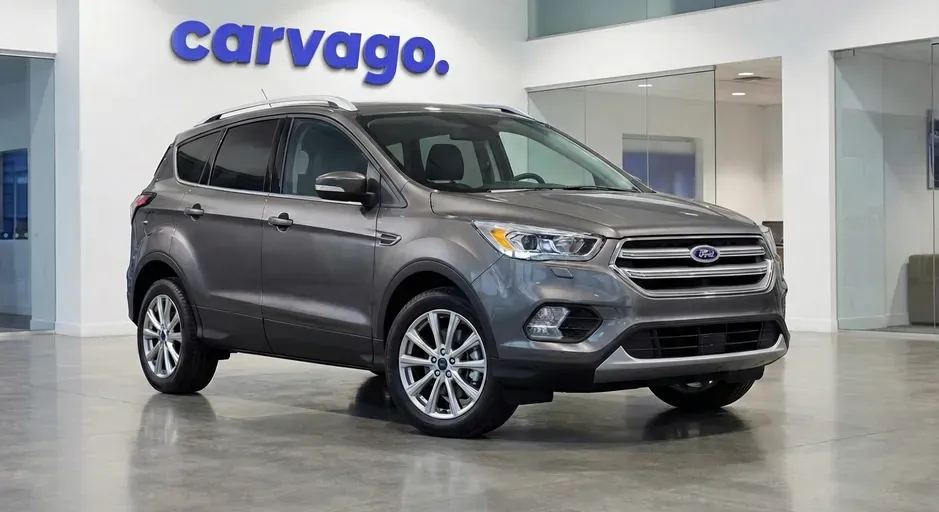
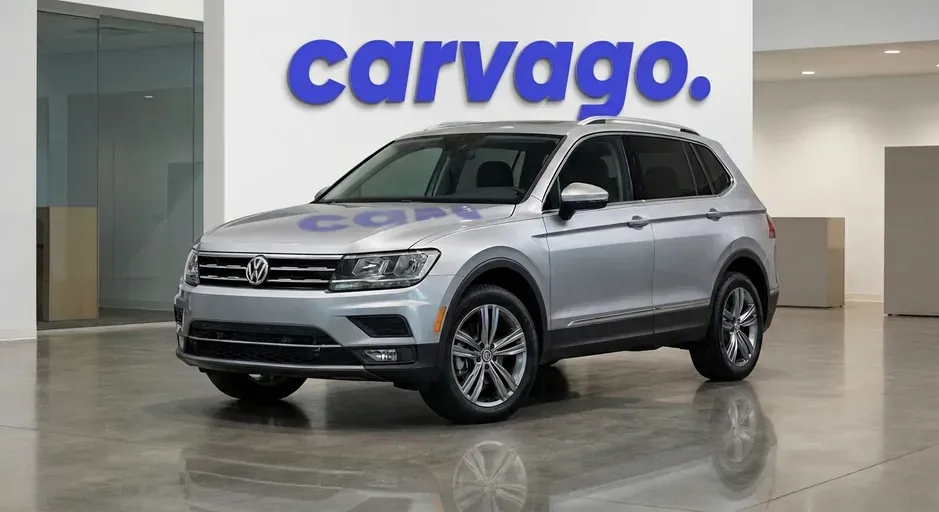
Ford Kuga, also sold as the Ford Escape in some global markets, is a popular compact SUV that has earned drivers' attention primarily through its confident handling and wide range of engines. Its rival today is the Volkswagen Tiguan, a long-term European bestseller in its class, which traditionally relies on precise ergonomics, a spacious cabin, and high-quality craftsmanship. Let's take a detailed look at which of these two sought-after family vehicles represents a smarter choice on the market for approximately four-year-old used cars.
When choosing a used SUV around four years old, we encounter quite fundamental differences in external dimensions between these two popular competitors. The third generation of the Ford Kuga makes a more massive and athletic impression on the road. With a length starting at 4614 mm and a width of 1883 mm, the Kuga is a substantial 105 mm longer and 44 mm wider than the comparable second-generation Volkswagen Tiguan after its facelift. This difference means that the Kuga offers a more dominant stance on the road and a more generous interior width. The Tiguan, on the other hand, scores valuable points with its more compact proportions during daily parking and maneuvering in tight city streets, where you will appreciate the car's smaller footprint.
If we focus on the body height, the tables turn in favor of the German representative. With a height reaching up to 1675 mm, the Tiguan profiles itself as a more traditional, boxier SUV. It is roughly 12 to 25 mm taller than the Kuga, which gives the car a better sense of upright seating and often slightly more headroom. However, the Kuga has a strong ace up its sleeve in the form of its wheelbase. With a value of 2710 mm, it surpasses the Tiguan by 30 to 32 mm. This difference in longitudinal space plays into Ford's hands, benefiting primarily rear-seat passengers thanks to more legroom.
As a result, the external proportions of both models clearly define their different characters. While the Ford Kuga bets on a longer and wider silhouette with a longer wheelbase, which favors a dynamic look, travel spaciousness, and driving stability, the Volkswagen Tiguan is an excellent pragmatic compromise. It provides a classic taller SUV build and does not unnecessarily extend the overall length, making it a more agile and practical choice for heavy city traffic.
| Parameter | Ford Kuga SUV | Volkswagen Tiguan SUV |
|---|---|---|
| Width (mm) | 1883 | 1839 - 1859 |
| Length (mm) | 4614 - 4629 | 4509 - 4514 |
| Height (mm) | 1650 - 1663 | 1668 - 1675 |
| Wheelbase (mm) | 2710 | 2678 - 2680 |
Luggage capacity is one of the main decision-making criteria for many people interested in a used family car. In this regard, both the Ford Kuga and the Volkswagen Tiguan focus on maximum usability and flexibility, highlighted by sliding rear seats in both vehicles. The trunk volume of both models thus largely depends on whether you currently prefer more legroom for rear passengers or need space for a few extra suitcases. Overall, however, the Volkswagen Tiguan offers a more regular trunk shape and, as a result, slightly better real-world use of the interior space.
Looking at specific figures for roughly four-year-old conventional versions (3rd generation Ford Kuga and 2nd generation Volkswagen Tiguan after the 2020 facelift), the German representative offers a standard trunk volume starting from 520 liters, which can be increased to an excellent 615 liters by sliding the rear bench all the way forward. When the rear backrests are folded down, you get a maximum space of 1,655 liters. The Ford Kuga, on the other hand, has a basic volume of 475 liters with maximum space for rear passengers. However, by sliding the seats forward, its capacity can be increased to an impressive 645 liters. After folding down the rear backrests, the volume increases to 1,534 liters. The trunks of both SUVs are thus perfectly sufficient in their parameters for weekend shopping as well as longer holidays.
When choosing a used car, it is important to point out the plug-in hybrid (PHEV) variants of both models, which lose valuable liters due to the placement of the traction battery under the floor. In the Volkswagen Tiguan eHybrid, the maximum basic trunk volume has decreased from the original 615 to 476 liters. The Ford Kuga PHEV is similar, offering a reduced volume ranging from 411 to 581 liters depending on the position of the rear seats. Despite this noticeable reduction, both cars still maintain acceptable space and a smaller compartment under the floor for neatly storing charging cables.
| Parameter | Ford Kuga SUV | Volkswagen Tiguan SUV |
|---|---|---|
| Basic volume (liters) | 475 - 645 | 520 - 615 |
| Max. volume with seats folded (liters) | 1534 | 1655 |
The Volkswagen Tiguan emerges from this comparison as the absolute winner for moving larger loads, primarily thanks to its overall maximum capacity with the seats folded and its boxier body shape. While the Kuga scores points for clever variability and can compete well with the Tiguan in its basic configuration, due to its more sportily sloping roof, it ultimately carries slightly less cargo overall after folding the rear bench.
If your priority is raw maximum trunk volume and trouble-free packing of bulky items, the Volkswagen Tiguan offers a more airy and better-utilizable trunk with more space after folding the seats.
Towing capacity is a key parameter for many mid-size SUV buyers, whether it's for towing a heavy caravan on a summer holiday or just transporting materials to a cottage. When comparing approximately four-year-old used Ford Kuga (3rd generation) and Volkswagen Tiguan (2nd generation) models, we encounter significant differences. The Volkswagen Tiguan has long excelled in this class – its standard braked towing capacity starts at 1600 to 1800 kg for the basic 1.5 TSI petrol versions, while the more powerful 2.0 TDI and 2.0 TSI two-litre engines can easily handle a maximum of 2500 kg. In contrast, the Ford Kuga offers slightly lower figures for most internal combustion engine options. The 1.5 EcoBoost petrol version can handle 1600 to 1800 kg, and the top-of-the-range 2.0 EcoBlue diesel can tow a solid, but compared to the Tiguan, slightly lower 2100 kg.
Significant deviations in towing power can be found in the popular hybrid versions, where the impact of heavier batteries is negatively felt. While the plug-in hybrid Tiguan 1.4 eHybrid maintains a still respectable 1800 kg, for Ford Kuga 2.5 Plug-in Hybrid models (especially from 2020–2024), expect a significantly reduced capacity of only 1200 to 1500 kg. In practice, this means the weaker hybrid Kuga is more suitable for a light utility trailer providing space for a few extra suitcases, which is fully sufficient for weekend shopping of bulkier household equipment. The diesel Tiguan, on the other hand, represents a workhorse that will be a reliable partner even for longer holidays with a truly large caravan. The choice thus depends on your actual needs – for demanding and regular towing of heavy loads, the Volkswagen Tiguan is the clear favorite, while for more common use with occasional use of the tow bar, the Ford Kuga will also fully suffice. For all mentioned specifications, the value for an unbraked trailer is the standard legislative maximum of 750 kg.
| Model and engine | Braked trailer (kg) | Unbraked trailer (kg) |
|---|---|---|
| Ford Kuga 1.5 EcoBoost (110 kW) | 1800 | 750 |
| Ford Kuga 2.0 EcoBlue (110 - 140 kW) | 2100 | 750 |
| Ford Kuga 2.5 Plug-in Hybrid (112 kW) | 1200 - 1500 | 750 |
| VW Tiguan 1.5 TSI OPF (110 kW) | 1800 | 750 |
| VW Tiguan 2.0 TDI SCR (110 - 147 kW) | 2000 - 2500 | 750 |
| VW Tiguan 2.0 TSI OPF (140 - 169 kW) | 2500 | 750 |
| VW Tiguan 1.4 eHybrid OPF (110 kW) | 1800 | 750 |
The engine range for the Ford Kuga and Volkswagen Tiguan reflects the different approaches of both manufacturers to the modern compact SUV market, which is one of the most important criteria for buyers of roughly four-year-old used cars. While both vehicles provide a solid foundation with efficient engines, they differ significantly in their emphasis on electrification and the availability of high-performance versions. The entry-level and mid-range spectrum consists of reliable turbocharged petrol engines – the Kuga relies on the 1.5 EcoBoost three-cylinder, while the Tiguan offers the proven 1.5 TSI four-cylinder. For drivers with high annual mileage, diesels were previously the clear winners, with Volkswagen offering an extensive range of 2.0 TDI units with front-wheel and 4MOTION all-wheel drive, against which Ford traditionally pitted the 1.5 EcoBlue and 2.0 EcoBlue models. However, the fundamental difference lies in the approach to hybrids: the third-generation Ford Kuga stands out with highly advanced full-hybrid (FHEV) and plug-in hybrid (PHEV) systems based on a larger 2.5-litre engine, which have become a huge sales hit. In contrast, the Tiguan responds with the 1.4 eHybrid model and, for speed enthusiasts, offers the powerful petrol Tiguan R with a massive 235 kW (320 hp), to which the family-oriented Ford has no direct answer. For budget-conscious drivers looking for a modern hybrid, the Kuga is the clear choice, whereas the Tiguan better serves motorway travellers or fans of spirited driving.
The third generation of the Ford Kuga (available since 2020) has significantly shifted its focus towards alternative powertrains. The entry point in the used car market is the 1.5 EcoBoost petrol three-cylinder, which is perfectly adequate for daily suburban driving. However, the big draw is the hybrid models based on the efficient 2.5-litre naturally aspirated four-cylinder. You will find both the self-charging full-hybrid (FHEV) and the very popular Plug-in hybrid (PHEV) with 165 kW, which can cover up to 50 kilometres on pure electricity with a charged battery. The hybrid vehicles use a continuously variable transmission (CVT), which ensures a very smooth ride, although the engine can be slightly noisier during sharp acceleration. From a used car perspective, pay attention to the diesel engine offerings – a four-year-old Kuga still commonly features the 1.5 EcoBlue and the dynamic 2.0 EcoBlue (also available with mild-hybrid technology). It is interesting to note, however, that with the arrival of refreshed models in later years (especially from the 2024 facelift), the manufacturer completely removed diesel engines from the range, so diesel fans must look exclusively among older used Ford models.
| Engine Type | Fuel | Power (kW) | Torque (Nm) | Transmission |
|---|---|---|---|---|
| 1.5 EcoBoost | Petrol | 88 / 110 | 240 | 6MT |
| 1.5 EcoBlue | Diesel | 88 | 300 | 6MT / 8AT |
| 2.0 EcoBlue | Diesel | 110 / 140 | 370 / 400 | 6MT / 8AT |
| 2.5 FHEV | Hybrid (Petrol) | 140 | 200 | CVT |
| 2.5 PHEV | PHEV (Petrol) | 165 | 200 | CVT |
For those interested in a vehicle approximately four years old, the ideal choice is the updated version of the second-generation Tiguan (facelift from late 2020 to 2023). Volkswagen takes a much more conservative approach to engines with the Tiguan, relying on a wide selection of pure internal combustion versions, usually paired with the fast DSG dual-clutch automatic transmission. The average user will appreciate the standard 1.5 TSI OPF, but for full utilization of a family SUV, the 2.0 TSI petrol engines (from 140 kW to 180 kW) are popular. Unlike the Kuga, the Tiguan steadfastly maintains its range of excellent 2.0 TDI SCR diesel units with the Twin Dosing system, which are available in 90, 110, and 147 kW outputs and excel with very low motorway fuel consumption and perfect synergy with 4MOTION all-wheel drive. The plug-in hybrid Tiguan can be found under the 1.4 eHybrid (180 kW) designation. Its main advantage is brisk dynamics, but it loses out slightly to the Kuga's larger displacement and the smoothness of its combustion unit. If you crave a sporty derivative, the limited and extremely fast Tiguan R version is a gem among mainstream used SUVs.
| Engine Type | Fuel | Power (kW) | Torque (Nm) | Transmission |
|---|---|---|---|---|
| 1.5 TSI OPF | Petrol | 96 / 110 | 220 / 250 | 6MT / 7DSG |
| 2.0 TSI OPF | Petrol | 140 / 180 / 235 | 320 / 370 / 420 | 7DSG |
| 2.0 TDI SCR | Diesel | 90 / 110 / 147 | 320 / 360 / 400 | 6MT / 7DSG |
| 1.4 eHybrid | PHEV (Petrol) | 180 (combined) | 400 (combined) | 6DSG |
While the Ford Kuga reigns supreme in the used car market thanks to its exceptionally efficient and well-thought-out hybrid systems (PHEV and FHEV), the Volkswagen Tiguan wins over conservative drivers and high-mileage commuters with its fantastic range of proven 2.0 TDI diesel engines and 4x4 drive.
Choosing the right engine is absolutely crucial for long-term satisfaction, reliability, and reasonable operating costs. While Volkswagen continues to convincingly dominate the market for approximately four-year-old used cars (Tiguan II generation) with its crystal-refined diesel classic ideal for long highway hauls, Ford has masterfully jumped on the electrification wave with its third-generation Kuga (available since 2020). It surprised the market with one of the most reliable hybrid powertrains in Europe, which, with its naturally aspirated concept and planetary gearbox, closely resembles the indestructible technology from Toyota. The following recommendations are based on real-world experience, service reliability, and user-friendliness of both vehicles.
This large-displacement, naturally aspirated 2.5-liter four-cylinder gasoline engine (available as both a full hybrid FHEV and a plug-in hybrid PHEV) is by far the most sensible and mechanically durable choice on the used car market within the third-generation Kuga.
In the second generation of the Volkswagen Tiguan, which is currently a pillar of the four-year-old used SUV market, the proven two-liter diesel from the improved EA288 Evo family remains the absolute king.
When it comes to fuel consumption, manufacturers' paper figures often differ from the reality of daily operation. For an objective comparison of approximately four-year-old used cars, we used not only official technical data but also the real-world experiences of thousands of drivers from independent crowdsourcing platforms, such as the popular portal Spritmonitor.de. Thanks to these long-term records, we get a much more accurate picture of what owners of the third-generation Ford Kuga and the popular second-generation Volkswagen Tiguan can actually expect on the road.
| Model and engine | Average consumption (l/100 km) |
|---|---|
| Ford Kuga 1.5 EcoBlue (Diesel) | 5.1 |
| Ford Kuga 2.0 EcoBlue (Diesel) | 5.8 |
| VW Tiguan 2.0 TDI SCR (Diesel) | 5.8 |
| Ford Kuga 1.5 EcoBoost (Petrol) | 6.6 |
| VW Tiguan 1.5 TSI OPF (Petrol) | 6.6 |
| VW Tiguan 2.0 TSI OPF (Petrol) | 8.3 |
| Ford Kuga 2.5 Hybrid (HEV) | 5.5 |
| Ford Kuga 2.5 PHEV (Plug-in)* | 1.2 |
| VW Tiguan 1.4 eHybrid (Plug-in)* | 1.6 |
Note to the table: Data for plug-in hybrids (PHEV) correspond to averaged data assuming regular charging. When driving with a discharged battery, their consumption behaves like that of conventional petrol engines and rises above the 5 liters per 100 km mark.
A detailed look at the hard data reveals that both carmakers are remarkably in tune when it comes to efficiency. The entry-level petrol engines show a practically identical average consumption of 6.6 liters in both cars, but like most smaller turbo engines, these units do not like highway speeds, where their appetite rises to eight liters. Diesel variants, on the other hand, confirm their reputation as reliable long-distance workhorses. The two-liter diesels of both brands stay at an excellent 5.8 l/100 km, while Ford's smaller 1.5-liter diesel can push the average down to a great 5.1 liters. Hybrid vehicles are a chapter of their own. The classic full-hybrid in the Kuga works very consistently, but the plug-in hybrid models in both cars are extremely dependent on driver discipline. The table values between one and two liters are only achievable with a charged battery.
For the average user of a used SUV, these data provide clear recommendations on which technology to choose:
In the end, it turns out that fuel consumption is unlikely to be the main factor deciding the winner among these approximately four-year-old vehicles. Both Ford and Volkswagen have deployed extremely comparable and efficient technology in these generations. Instead of a battle of badges on the hood, it will be much more important for your wallet to honestly evaluate your daily routes and choose the appropriate type of powertrain.
When looking for a used family SUV approximately four years old (model year around 2022), the third-generation Ford Kuga meets the facelifted second-generation Volkswagen Tiguan on the market. The different strategies of the carmakers and brand perceptions are fully reflected in the residual values of both vehicles.
Depreciation and Market Situation
The Volkswagen Tiguan has traditionally held its value exceptionally well across generations. Its higher original purchase price is also reflected in the used car market, where it is among the most expensive and sought-after compact SUVs. For four-year-old models, prices for basic petrol versions start significantly higher than those of the competition. Models with the popular 2.0 TDI engine, 4Motion all-wheel drive, and in the sporty R-Line trim protect their price with surprising tenacity.
The Ford Kuga, on the other hand, represents a much more attractive price proposition from a used car buyer's perspective. Depreciation for Ford is somewhat steeper in the first few years, making it a very affordable used SUV. For the price of a basic petrol Volkswagen, you can get a top-tier Ford trim (such as the attractive ST-Line) or a very efficient plug-in hybrid (PHEV) powertrain, which has long been a sales hit in Europe.
| Category / Trim | Ford Kuga (MK3) | Volkswagen Tiguan (MK2 Facelift) |
|---|---|---|
| Base version (petrol, lower trim) | €17,000 – €20,000 | €22,000 – €25,000 |
| The golden mean (diesel / hybrid) | €20,000 – €23,000 | €26,000 – €31,000 |
| Top models (ST-Line / R-Line, 4x4) | €23,000 – €27,000 | €32,000 – €39,000 |
Note: The prices listed are indicative and depend on mileage, engine, and documented service history of specific used cars on the market.
What do you get for your money?
While a used Volkswagen Tiguan represents a safe bet and firmly holds its value, a four-year-old Ford Kuga offers a much more attractive price tag, for which you often get a better-equipped car with a modern hybrid powertrain.
Both models, Ford Kuga and Volkswagen Tiguan, achieved the maximum five-star rating in crash tests by the independent organization Euro NCAP. When choosing a used car, however, it is necessary to consider the context and the specific year these tests took place. Euro NCAP's methodology and protocols are constantly evolving and becoming stricter, meaning that percentage results from different years cannot be simply compared directly. Newer tests place much greater emphasis on active safety, pre-collision systems with automatic braking, and comprehensive protection for vulnerable road users such as pedestrians and cyclists.
The third generation of the Ford Kuga underwent Euro NCAP tests in 2019 under stricter and more modern rules. The Kuga performed excellently, scoring 92% for adult protection and 86% for child protection. Particularly impressive is the 82% result in the category of protection for vulnerable road users, reflecting the standard presence of modern assistance systems with advanced pedestrian and cyclist detection. In the safety assist category, the car received a solid 73%. This package of assistance features remains very relevant on the used car market and provides a high level of safety that fully meets current demands for a family SUV.
The second-generation Volkswagen Tiguan, which is the most typical representative on the four-year-old used car market today, was tested by Euro NCAP back in 2016. It earned an excellent 96% for adult protection and 84% for child protection. Given the year of testing and the less strict methodology at the time, it achieved 72% for pedestrian protection and 68% for safety assists. Although the Tiguan still offers robust passive safety and an exceptionally strong body structure, its official 2016 certification has already expired due to age, as is common practice with Euro NCAP after several years. While used Tiguan models after the 2020 facelift feature additionally improved systems, their baseline safety structure was evaluated through the lens of older standards.
In terms of passive safety during an actual impact, both cars represent above-average safe choices that reliably protect the occupants. However, thanks to its newer engineering foundation and testing under significantly stricter methodologies, the Ford Kuga offers a demonstrably more sophisticated package of active safety features. In a direct comparison, the Kuga thus better meets today's strict safety standards, while the Tiguan's great results must be viewed in the context of older regulations.
| Parameter | Ford Kuga | Volkswagen Tiguan |
|---|---|---|
| Year of testing | 2019 | 2016 |
| Adult occupant protection | 92 % | 96 % |
| Child protection | 86 % | 84 % |
| Vulnerable road user protection | 82 % | 72 % |
| Safety assistance systems | 73 % | 68 % |
Although both cars are exceptionally safe, the Ford Kuga was tested according to newer and stricter methodologies, offering more advanced assistance systems. The Tiguan's excellent passive rating comes from an earlier time, and its certification has now expired.
In addition to standard equipment, each of the models offers several unique features and technological solutions that can be decisive for the customer. While one bets on sophisticated electrification and practical variability, the other counters with premium equipment and advanced assistance systems.
Excellent driving characteristics and an agile chassis, which is among the best in its class
More attractive purchase price and a great price-to-value ratio on the used car market
Very successful plug-in hybrid (PHEV) version with a realistically long electric range
Practical sliding rear seats that allow for flexible adjustment of boot volume and legroom
Cheaper-feeling interior plastics compared to German competitors
More outdated graphics and slower response of the SYNC 3 infotainment in older model years
Noticeably smaller luggage space in the plug-in hybrid variant due to battery placement
Ford Kuga is ideal for those looking for a driver-focused and affordable SUV with a very well-tuned chassis. It will be appreciated especially by active drivers and families who don't mind a slightly more ordinary interior finish, but instead prefer a great ratio of price, equipment, and reliable hybrid technologies.
Top-notch interior build quality and a more premium selection of materials
Excellent interior spaciousness and great ergonomics for passengers in both the front and rear
High residual value and very easy subsequent resale
Great cabin soundproofing and a highly comfortable driving experience on long journeys
Wide range of proven engines, including very economical and powerful TDI diesel engines
Noticeably higher purchase price on the used car market compared to direct competitors
Impractical and frustrating touch surfaces on the steering wheel and climate control panel in facelifted versions (from 2020)
Too conservative design, which can look a bit boring next to more modern-looking competitors
Volkswagen Tiguan represents a safe bet for buyers looking for a more premium-finished family SUV with high comfort and excellent ergonomics. Higher purchase costs on the used car market are balanced by excellent craftsmanship, a representative appearance, and the fact that this model holds its value exceptionally well.
Based on long-term owner experience, service bulletins, and thousands of inspections included in our comprehensive car audit, we have compiled a detailed overview of the most common problems you should watch out for with these approximately four-year-old used cars.
The third generation of the Ford Kuga struggled with several "teething problems" in the early stages of production; however, after these were addressed, it is considered a mechanically robust vehicle that requires attention mainly in the areas of software and hybrid propulsion.
While common internal combustion engines are mostly troubled by minor issues and software glitches, for the plug-in hybrid, it is an absolute necessity to verify the recall history. Mechanically, however, it is overall a reliable and durable vehicle.
The updated version of the second-generation Volkswagen Tiguan brought significant digitalization of the interior and advanced assistance systems, which are unfortunately the areas where most service interventions originate today.
Under the hood, the Tiguan offers exceptionally durable and proven powertrains and transmissions that only require quality and timely maintenance. However, the real stumbling block for modernized model years is the unstable onboard software and malfunctioning assistance system sensors.
When buying a used car, a thorough inspection is key, and a comprehensive car audit is the best way to avoid unexpected expenses. Here are some specific points to focus on for these two models.
The Volkswagen Tiguan has a slightly larger and more practical trunk with a basic volume of up to 615 liters, thanks to the standard sliding rear seats. The Ford Kuga offers a volume between 412 and 526 liters, depending on the seat position and engine (especially in hybrids, where the battery takes up space). For families needing to transport bulky strollers and large luggage, the Tiguan is therefore a more suitable choice.
The Ford Kuga has long been considered one of the best-driving SUVs in its class, offering a sportier chassis and very precise steering. The Volkswagen Tiguan, on the other hand, focuses more on maximum driving comfort, a smooth ride, and top-tier cabin soundproofing. The choice thus depends on whether you prefer driver engagement behind the wheel or calm and quiet mile-munching.
If you have the option to charge and are looking for a plug-in hybrid, the Ford Kuga PHEV is among the absolute top on the market thanks to its excellent efficiency and real-world electric range of over 50 km. The Volkswagen Tiguan, conversely, excels with its refined and economical 2.0 TDI diesel engines, which are unbeatable for long highway trips. The Kuga is therefore ideal for daily suburban commuting on electricity, while the Tiguan reigns supreme on long-distance journeys.
Both cars provide ample space for a family of four and boast the practical option of sliding the rear bench by several centimeters. Thanks to its boxier body, the Volkswagen Tiguan feels airier inside and offers more headroom, which taller adult passengers will especially appreciate. The Ford Kuga has a slightly sloping roofline, however, the legroom and shoulder room in both vehicles are very comparable.
Volkswagen models traditionally hold their residual value significantly better on the European used car market, and the Tiguan is no exception. This vehicle is highly sought after due to its more premium image, wider range of used diesel options, and conservative design that ages slowly. The Ford Kuga, on the other hand, is somewhat more affordable as a used car, making it a very attractive purchase for customers looking for a great price-to-performance ratio.
Choosing between a roughly four-year-old Ford Kuga and Volkswagen Tiguan depends primarily on your daily driving profile and personal preferences. The Ford Kuga represents a smart choice for drivers looking for agile driving characteristics, an exceptionally attractive price-to-equipment ratio, and highly reliable hybrid powertrains ideal for daily suburban commuting. The Volkswagen Tiguan, on the other hand, will appeal to more conservative buyers, offering top-tier premium interior craftsmanship, unrivaled diesel engines for highway travel, and a boxier, maximally usable trunk with excellent towing capacity for a slightly higher purchase price. While the dynamically tuned Kuga is thus a perfect modern all-rounder for families frequently moving around the city, the Tiguan remains the unwavering king of long distances and a pragmatic partner for moving larger loads.
Sources: ADAC, svetmotoru.cz, garaz.cz, autozive.cz, autoweb.cz, dopravacek.cz
This article was prepared using artificial intelligence tools. The section guarantor is Petr Dušek.
Opel Grandland vs. Seat Ateca: Which SUV to choose? Our detailed comparison will reveal the key differences and help you find the right car for you.
Apr 14, 2026
Detailed comparison of the Hyundai Kona and Volkswagen T-Cross. Discover real-world experiences, equipment comparisons, and a clear verdict to help you choose a used SUV.
Apr 15, 2026
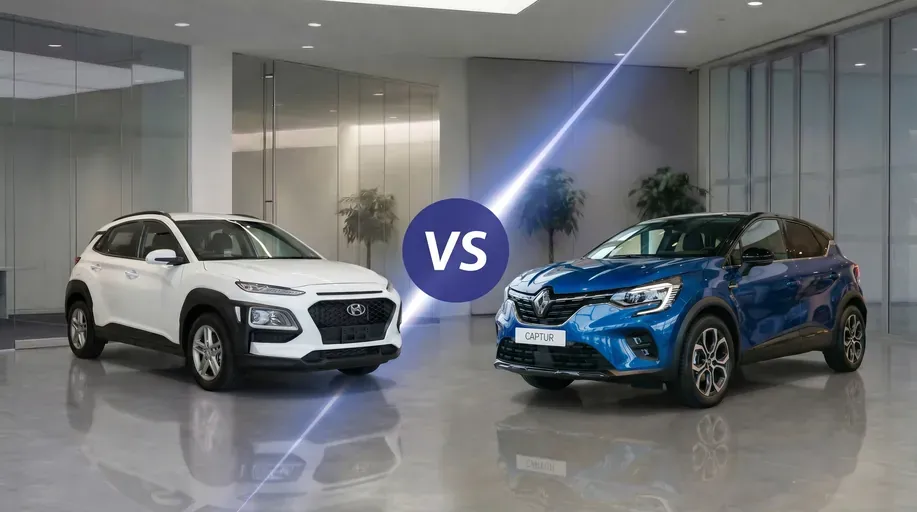
Hyundai Kona vs. Renault Captur: Which urban SUV to choose? A detailed used car comparison, equipment evaluation, and a clear verdict to make your choice easier.
Apr 16, 2026