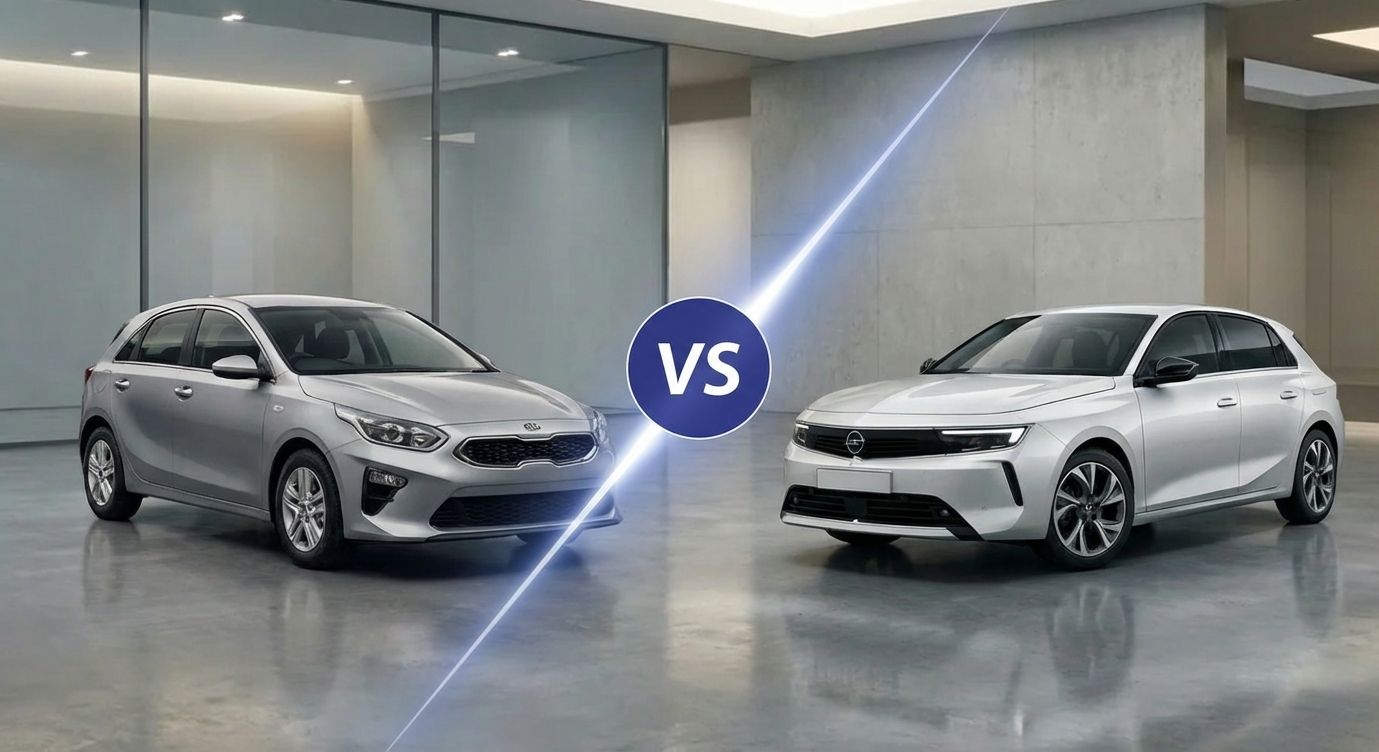
Car battle
Kia Ceed vs. Opel Astra: Complete comparison 2026
Detailed comparison of the Kia Ceed and Opel Astra. We compared real-world fuel consumption, reliability, and equipment. Find out which popular hatchback is worth buying.
Apr 14, 2026
Articles
Car battle
Detailed comparison: Peugeot 308 vs Volkswagen Golf (VW Golf). Read real-world experiences, engine comparisons, and a clear verdict on which hatchback to choose.
April 16, 2026
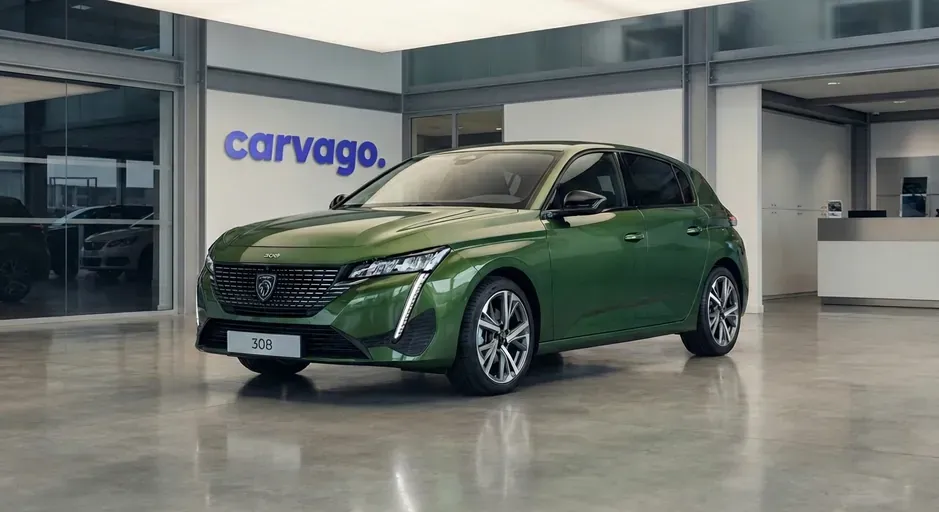
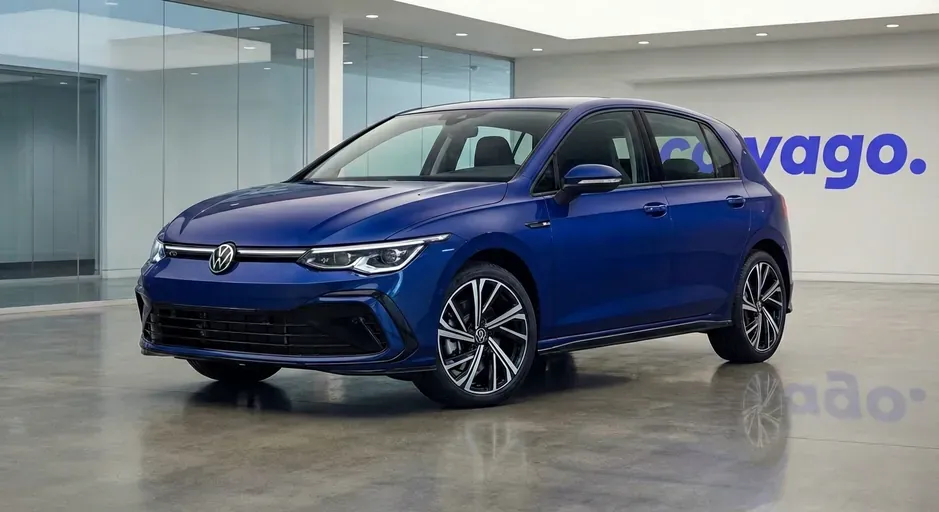
Peugeot 308 represents the embodiment of French elegance in the compact class segment, which in current generations impresses primarily with its dynamic design and innovative interior layout. Standing against it is the traditional benchmark of compact cars, the Volkswagen Golf, which has long scored points thanks to its renowned ergonomics, balanced driving characteristics, and a wide range of reliable engines. In this comparison, we will focus in detail on the key differences and specifications of both models to help you make a decision when choosing the ideal car for your daily journeys.
When looking at the exterior dimensions of roughly four-year-old used cars, typically represented on the market by the third generation of the Peugeot 308 and the eighth generation of the Volkswagen Golf, we encounter very different approaches by both automakers to vehicle proportions. Peugeot opted for a significantly more dynamic silhouette – the car is overall wider, lower, and visually more low-slung. Particularly in the hatchback version, the French representative is a significant 83 mm longer and 63 mm wider than the base Golf. This gives the "308" a more muscular and sportier stance on the road, while the Golf carefully maintains its traditional, slightly more compact and practical shapes.
In the case of family-oriented estate versions (Peugeot 308 SW and Volkswagen Golf Variant), the overall length of both cars is almost equal, with both cars measuring slightly over 4.6 meters. Where Peugeot noticeably dominates, however, is the wheelbase. Its value of 2732 mm for the SW version exceeds the Golf Variant by a noticeable 63 mm. In practice, this means calmer directional stability at highway speeds and better potential for longitudinal interior space. Volkswagen, on the other hand, offers a noticeably taller body structure for both body styles (nearly 50 mm more in the base models), from which taller passengers can benefit primarily due to a larger headroom reserve.
This different physical build has a very direct impact on how the cars feel in daily use. You will appreciate the Golf's shorter and narrower footprint when parking in narrow city streets or cramped underground garages, where the German compact fits noticeably more easily and naturally. The Peugeot 308 by contrast, offers a more mature impression. Thanks to its unusual width of over 1.85 meters and long wheelbase, it gives the impression both behind the wheel and from the outside that its dimensions are confidently peering straight into the mid-size class.
| Parameter | Peugeot 308 Hatchback | Volkswagen Golf Hatchback | Peugeot 308 Estate | Volkswagen Golf Estate |
|---|---|---|---|---|
| Length (mm) | 4367 | 4282 - 4296 | 4636 | 4631 - 4651 |
| Width (mm) | 1852 | 1789 | 1852 | 1789 - 1795 |
| Height (mm) | 1438 - 1441 | 1454 - 1491 | 1438 - 1442 | 1462 - 1510 |
| Wheelbase (mm) | 2675 | 2619 - 2630 | 2732 | 2669 - 2679 |
Trunk space is a key factor for many used car buyers, whether you are looking for a car for daily family duties, large weekend shopping trips, or long holiday journeys. In the compact car class, which includes the Peugeot 308 and the Volkswagen Golf, every single liter counts. For these models, automakers take great care to offer maximum practicality despite the push for more aerodynamic and dynamic designs. When choosing used cars around four years old (corresponding to the current 3rd generation Peugeot and 8th generation Golf), you will quickly discover an interesting fact: while the French representative is more generous in its hatchback version, its German competitor narrowly takes the lead with the more practical estate body style.
In the case of the classic five-door hatchback, the Peugeot 308 offers a trunk volume of 412 liters, surpassing the Volkswagen Golf with its 381 liters. This difference of just over 30 liters practically means enough space for one extra cabin suitcase or several additional shopping bags, which is a very pleasant bonus for everyday family usability. However, for the popular estate versions (Peugeot 308 SW and Volkswagen Golf Variant), the competition is neck-and-neck. The Peugeot 308 SW scores with 608 liters in its basic configuration, but the Volkswagen Golf Variant has a slight edge with 611 liters. Both cars can easily accommodate a stroller and full luggage for a two-week holiday. With the rear seat backrests fully folded down, the Volkswagen Golf Variant offers an impressive 1642 liters, while the Peugeot 308 SW lags slightly behind with a maximum capacity of 1634 liters.
When buying a used car, however, pay close attention to the specific engine choice. Especially if you are considering more eco-friendly plug-in hybrid versions, you must expect significant compromises, as the battery takes up a large portion of the usable volume. In the Peugeot 308 SW with a plug-in hybrid powertrain, the basic trunk volume drops from 608 to a more modest 548 liters (and the maximum from 1634 to 1574 liters). The electrified eHybrid and GTE variants of the Volkswagen Golf are in a similar position, where the hatchback's trunk shrinks to less than 280 liters. While such values are sufficient for commuting to the office, they may limit the owner when it comes to moving house or a weekend family shopping trip.
| Parameter | Peugeot 308 Hatchback | Volkswagen Golf Hatchback | Peugeot 308 Estate | Volkswagen Golf Estate |
|---|---|---|---|---|
| Basic volume (liters) | 412 | 381 | 608 | 611 |
| Max. volume with seats folded (liters) | 1323 | 1237 | 1634 | 1642 |
While the Peugeot 308 benefits from a larger and more practical trunk in the hatchback version, the Volkswagen Golf takes the lead in the highly sought-after estate version thanks to its 611-liter volume. Both cars can easily handle the role of the main family hauler, but avoid the plug-in hybrid versions if you need to utilize their cargo capacity to the absolute maximum.
Trailer weight, or towing capacity, plays a surprisingly large role for many buyers of used compact cars. Although they are not typical "towing vehicles", the ability to hitch a trailer significantly expands their overall utility. The eighth-generation Volkswagen Golf (from 2020) and the third-generation Peugeot 308 (from 2021) offer very solid parameters in this regard, but a closer comparison reveals fundamental differences that can easily decide the final choice for more active users.
The base petrol engines of both models represent a perfectly adequate standard for occasional use. The Peugeot 308 with the popular 1.2 PureTech engine can tow 1,200 to 1,300 kg on a braked trailer. The comparable Volkswagen Golf with 1.0 eTSI and 1.5 TSI engines mostly handles a slightly higher weight in the range of 1,300 to 1,500 kg. In practice, these values are sufficient for a weekend purchase of bulky building materials or towing a lighter family caravan. Data for unbraked trailers are not explicitly stated in the examined data, but legally and technically for this class of vehicles, an upper limit of 750 kg traditionally applies depending on the car's kerb weight.
However, if you need to transport heavier loads, the gap between the two cars begins to widen significantly. The maximum for the current Peugeot 308 is provided by the economical 1.5 BlueHDi diesel version, which can handle a braked trailer weighing 1,550 to 1,600 kg. In contrast, the Volkswagen Golf aims much further. Standard versions with the 2.0 TDI engine can tow 1,600 kg, but as soon as you reach for the popular raised estate Golf Alltrack 2.0 TDI, the towing capacity jumps to an impressive 2,000 kg. Such a value offers surprising confidence and safe space for towing heavy trailers with a boat or two horses, which you will fully appreciate both at work and on longer holidays.
Also worth mentioning are the plug-in hybrid versions, which are increasingly common in this class. For both competitors, it must be taken into account that due to the installation of heavy batteries, the towing capacity is slightly compromised and does not reach the absolute records of the top diesel engines. The Peugeot 308 Plug-In Hybrid can tow 1,450 to 1,500 kg with a trailer. The hybrid Volkswagen Golf eHybrid is very similar and reliably handles a load of up to 1,500 kg, keeping pace with its French rival.
Final evaluation: While the Peugeot 308's values will easily satisfy the vast majority of regular drivers, occasional gardeners, and weekend cottagers, the Volkswagen Golf is a much more versatile and talented hauler. Especially in the Alltrack specification, it can, without exaggeration, do the work of a much more robust mid-size SUV. For demanding travelers and motorists with large caravans, the German hatchback, or estate, is a clear and rational choice.
| Model and engine | Braked trailer (kg) | Unbraked trailer (kg) |
|---|---|---|
| Peugeot 308 1.2 PureTech (96 kW) | 1200 - 1300 | Not specified |
| Peugeot 308 1.5 BlueHDi (96 kW) | 1550 - 1600 | Not specified |
| Peugeot 308 1.6 Plug-In Hybrid (133 kW) | 1450 - 1500 | Not specified |
| VW Golf 1.0 eTSI (81 kW) | 1300 | Not specified |
| VW Golf 1.5 eTSI (110 kW) | 1500 | Not specified |
| VW Golf 2.0 TDI SCR (110 kW) | 1600 | Not specified |
| VW Golf Alltrack 2.0 TDI (147 kW) | 2000 | Not specified |
Prospective buyers of a roughly four-year-old compact hatchback face an interesting decision, as the Peugeot 308 (current 3rd generation) and the Volkswagen Golf (8th generation) take different approaches to their engine lineups. While Volkswagen traditionally relies on an exceptionally wide range covering everything from 1.0 TSI three-cylinder engines to the popular 1.5 TSI four-cylinders, powerful 2.0 TDI diesel engines, and top-tier sporty 2.0 TSI versions (for GTI and R models with up to 235 kW), Peugeot has simplified its offering to a smaller number of carefully tuned units. In the French car, the 1.2 PureTech three-cylinder petrol and the 1.5 BlueHDi four-cylinder diesel take center stage, complemented by highly sought-after powerful plug-in hybrids with the 1.6 PureTech engine (up to 165 kW). Both brands emphasize efficiency and electrification – the Golf offers eTSI mild-hybrid versions and 1.4 eHybrid or sporty GTE plug-in hybrids, while Peugeot has included the 1.2 Hybrid mild-hybrid and the all-electric e-308 alongside its plug-in hybrids. The decision thus depends on the driver's profile: high-mileage highway drivers will appreciate the resilient and larger-displacement 2.0 TDI in the Golf with the option of 4MOTION all-wheel drive, while families and city drivers will prefer Peugeot's advanced plug-in hybrids or its straightforward petrol versions.
The third-generation Peugeot 308 (on the market since the turn of 2021/2022) focuses on efficiency rather than a wide selection of conventional large-displacement internal combustion engines. The entry-level and mid-range power spectrum is covered by the 1.2 PureTech turbocharged three-cylinder with 81 kW or 96 kW. Over time, this classic petrol unit is being gradually replaced on the market by the newer 1.2 Hybrid mild-hybrid variant (100 kW), which combines lower fuel consumption with the e-DSC6 dual-clutch automatic transmission. Diesel enthusiasts can opt for the exceptionally efficient and quiet 1.5 BlueHDi four-cylinder with 96 kW. A major draw of this generation, however, are the plug-in hybrid units combining a 1.6 petrol engine with a powerful electric motor, offering a total output of 132 kW or 165 kW. In the used car market, they are among the best in terms of smoothness and the possibility of daily driving purely on electricity. The range was recently crowned by the all-electric e-308 model.
| Engine type | Fuel | Power (kW) | Torque (Nm) | Transmission |
|---|---|---|---|---|
| 1.2 PureTech | Petrol | 81 / 96 | 205 / 230 | 6-speed manual / 8-speed automatic |
| 1.2 Hybrid | Petrol (Mild-hybrid) | 100 | 230 | 6-speed automatic e-DSC6 |
| 1.5 BlueHDi | Diesel | 96 | 300 | 6-speed manual / 8-speed automatic |
| 1.6 Plug-In Hybrid | Petrol (Plug-in hybrid) | 132 / 165 | 360 | 8-speed automatic e-EAT8 |
| e-308 | Electricity | 115 | 270 | 1-speed automatic |
As usual, the eighth-generation Volkswagen Golf has one of the richest and most comprehensive engine lineups in its class, perfectly suited to the specifics of the nearly-new car market. The foundation for older model years was the 1.0 TSI three-cylinder and its 1.0 eTSI mild-hybrid equivalents. However, it's worth noting that these one-liter engines are gradually disappearing from the lineup and have been replaced in the latest model years (post-facelift) by detuned versions of the 1.5 TSI four-cylinder. The 1.5 TSI four-cylinder (or the 1.5 eTSI mild-hybrid) with 96 kW or 110 kW represents the sweet spot in used car dealerships and an ideal compromise between performance and running costs. For highway drivers, the legendary 2.0 TDI diesel is available, offered in 85 kW, 110 kW, and the top-tier GTD version with 147 kW. Volkswagen's competition for Peugeot includes plug-in hybrids with the 1.4 eHybrid engine (including the faster GTE version with 180 kW). The Golf then offers ultimate performance with the renowned 2.0 TSI engine in GTI and GTI Clubsport versions, and in the case of the Golf R, even with 4MOTION all-wheel drive and power pushed up to 235 kW.
| Engine type | Fuel | Power (kW) | Torque (Nm) | Transmission |
|---|---|---|---|---|
| 1.0 TSI / eTSI | Petrol / Mild-hybrid | 66 / 81 | 175 / 200 | 6-speed manual / 7-speed DSG |
| 1.5 TSI / eTSI | Petrol / Mild-hybrid | 96 / 110 | 200 / 250 | 6-speed manual / 7-speed DSG |
| 1.5 TGI | CNG / Petrol | 96 | 200 | 7-speed DSG |
| 2.0 TDI | Diesel | 85 / 110 | 300 / 360 | 6-speed manual / 7-speed DSG |
| 2.0 TDI GTD | Diesel | 147 | 400 | 7-speed DSG |
| 1.4 eHybrid / GTE | Petrol (Plug-in hybrid) | 150 / 180 | 350 / 400 | 6-speed DSG |
| 2.0 TSI (GTI / R) | Petrol | 180 / 221 / 235 | 370 / 400 / 420 | 6-speed manual / 7-speed DSG |
While the Peugeot 308 relies on a smaller range of carefully tuned engines and exceptionally efficient plug-in hybrids, the Volkswagen Golf counters with a staggering breadth of powertrains that offer something for everyone – from the manager eating up highway miles with a 2.0 TDI to the sport-oriented driver with a GTI or R model.
A comparison of the engine ranges for roughly four-year-old used cars shows the different approaches of both manufacturers to modern powertrains. While the 8th generation Volkswagen Golf (on the market since 2020) relies on an exceptionally wide range of advanced four-cylinder petrol engines with innovative mild-hybrid technology (eTSI) and the proven evolution of the legendary TDI diesels, the third generation Peugeot 308 (sold since late 2021) builds its success primarily on the award-winning PureTech three-cylinder petrol engines, highly efficient BlueHDi diesels, and a strong focus on plug-in hybrid systems. Choosing the right "heart" of the car is absolutely critical for your long-term satisfaction. Our recommendations for those interested in these slightly used cars are therefore based on a balanced combination of real-world dynamics, daily fuel consumption, owner feedback, and verifiable mechanical reliability.
This four-cylinder diesel represents the best and most balanced choice in the 308 model range (especially for the 3rd generation, model year 2021 and newer), particularly when paired with the smooth-shifting eight-speed EAT8 automatic. Its main technical advantages include an excellent torque of 300 Nm, available from as low as 1750 rpm, and unrivaled operating efficiency. Real-world fuel consumption during steady driving outside the city commonly stays below 5 liters per 100 km. Regarding mechanical risks, it is necessary to mention occasional wear of the camshaft timing chain in earlier 7mm versions. A key recommendation for a roughly four-year-old used car is therefore to have an experienced mechanic verify by ear whether the engine has a noisy or rattling sound during a cold start. Similarly, keep in mind the DPF filter and the urea injection system (AdBlue), which function reliably only if the car is given the opportunity to regenerate. For these reasons, the diesel 308 is ideal for highway travelers and drivers commuting longer distances. Short hops around town are detrimental to it, and a petrol alternative would be more suitable for such use.
For the eighth generation of the Volkswagen Golf, this four-cylinder from the EA211 Evo family is the absolute sweet spot and represents the smartest choice in the range for the vast majority of buyers. The engine excels in top-tier refinement, linear pull without turbo lag, and innovative Active Cylinder Technology (ACT), which imperceptibly reduces the load during steady driving. The result is a real average fuel consumption of around a great 5.5 to 6 l/100 km for a petrol engine of this power. The eTSI variant, paired with the seven-speed DSG automatic, adds mild-hybrid assistance for velvety smooth starts and coasting with the engine off. In terms of potential risks, it is a reliable unit, but like any direct-injection engine, it is more prone to carbon buildup on the intake valves. You can best eliminate and identify this problem by thoroughly checking the service history of oil changes (do not rely on 30,000 km intervals) and treating the car to high-quality additivated fuel with occasional spirited driving of the warmed-up car at higher revs. This 150-hp unit is perfect for a wide range of users – it handles morning city commutes to work with grace and maximum silence, while not losing steam with a fully loaded car on the highway over the weekend.
When it comes to fuel consumption, laboratory figures often differ from what drivers experience in everyday traffic. Although modern measurement cycles have brought some improvement in accuracy, it is always much more reliable to look into real-user databases, such as the popular independent platform Spritmonitor.de. In our comparison, we focus on used cars around four years old. This means a direct duel between the eighth generation of the Volkswagen Golf (launched in 2020) and the incoming third generation of the Peugeot 308 (available since 2022). The following table shows how the most common engines of both competitors perform in the real world.
| Model and engine | Average consumption (l/100 km) |
|---|---|
| Peugeot 308 1.5 BlueHDi 130 (96 kW) | 5,1 |
| VW Golf 2.0 TDI (110 kW) | 5,2 |
| VW Golf 1.0 TSI (81 kW) | 5,6 |
| VW Golf 1.5 TSI (110 kW) | 6,1 |
| Peugeot 308 1.2 PureTech 130 (96 kW) | 6,3 |
When interpreting real-world data, it is clear that diesel engines still hold the undisputed crown in fuel economy. An interesting and perhaps surprising finding for some is that the larger and significantly more powerful two-litre diesel from Volkswagen (2.0 TDI) can match the efficiency of the smaller French 1.5-litre (1.5 BlueHDi) without any problems. For both cars, the average driver can easily stay just slightly above the respectable limit of five litres per hundred kilometres.
Conversely, with petrol engines, a common ailment of small turbocharged three-cylinder engines is fully revealed. The Peugeot 308 with its 1.2 PureTech unit is paradoxically slightly "thirstier" in real-world traffic than the larger but very sophisticated 1.5 TSI four-cylinder from Volkswagen. The German engine benefits greatly from the cylinder deactivation system at low load (ACT) and generally works less hard with a heavy vehicle. The basic 1.0 TSI three-cylinder in the Golf can run economically, but as soon as you fully load the car or hit the highway more often, its consumption quickly catches up with the larger versions.
For a typical user, this results in a clear division of roles:
In the end, it cannot be said that one of the cars absolutely dominates in terms of fuel consumption. While there is practically a technical draw between the diesel versions and the purchase will be decided more by preference for the character of the engine itself, Volkswagen Golf has a slight upper hand in the petrol league. The average consumption value will thus likely not be the only and main deciding factor in the final decision, but it clearly shows that betting on small engines under the guise of savings (so-called downsizing) does not always pay off in the real world.
When choosing a roughly four-year-old vehicle (models from 2021 to 2022), both competitors are at an ideal point in terms of price-to-value ratio. They have already experienced their steepest price drop but still offer modern technology and very good reliability. In the used car market at this age, the 8th generation Volkswagen Golf meets the modern 3rd generation Peugeot 308, which arrived on the market at the turn of 2021 and 2022.
The eighth-generation Volkswagen Golf is a staple that holds its residual value exceptionally well. This is due to strong demand, buyer confidence, and popularity among both private owners and the former corporate fleet market.
In its third generation, the Peugeot 308 brought revolutionary design, an aggressive look, and a significantly more premium interior concept. On the used market from 2021 and 2022, however, it is available to buyers at noticeably more attractive prices than its German rival.
| Model (2021–2022) | Estimated price from | Estimated price to | Most common engines on the used market |
|---|---|---|---|
| Volkswagen Golf (8th gen.) | €16,000 | €23,000 | 1.5 TSI / eTSI, 2.0 TDI |
| Peugeot 308 (3rd gen.) | €14,000 | €18,000 | 1.2 PureTech, 1.5 BlueHDi |
The prices listed reflect the actual supply on the used car market and may vary depending on specific equipment, mileage, and the overall technical condition of a particular unit.
While the Volkswagen Golf holds its value excellently and is a long-term safe bet, a four-year-old Peugeot 308 represents a better deal on the used market thanks to its steeper initial price drop.
When comparing the safety of modern used cars, buyers often follow the historical assumption that both of these popular model series routinely achieved the five-star Euro NCAP standard. For cars roughly four years old, however, it is absolutely crucial to perceive the results in the context of the specific testing year. The Euro NCAP methodology is constantly evolving and becoming significantly stricter. Percentage scores obtained in different years cannot be directly compared. The latest protocols now include far more demanding frontal crash simulations with a mobile barrier, much stricter requirements for cyclist and pedestrian detection, or testing of emergency scenarios for assistance systems directly at intersections.
The eighth-generation Volkswagen Golf was first tested in 2019. However, the German automaker did not rest on its laurels and significantly improved the car for the following years – including the standard introduction of a modern center airbag between the front seats. Thanks to these innovations, the Golf was successfully retested in 2022 according to the much stricter protocols of the time. It confidently defended its five-star rating. The data points primarily to the excellent functionality of the autonomous emergency braking (AEB) assistants and excellent protection for adult occupants.
The third generation of the Peugeot 308 entered the rigorous Euro NCAP tests in 2022. Although it offers an excellent and rigid structural base, the car ultimately achieved an overall score of four stars. The main penalty from the perspective of the new standards was precisely the missing additional protection in the form of a center airbag, which slightly worsens the protection result in a severe side impact. At the same time, the French representative recorded a slightly lower score in tests of active safety assistants. Despite the loss of one star, the protection of child passengers and vulnerable road users is at a very solid level.
| Parameter | Peugeot 308 | Volkswagen Golf |
|---|---|---|
| Year of testing | 2022 | 2022 (originally 2019) |
| Adult occupant protection | 76 % | 88 % |
| Child occupant protection | 84 % | 87 % |
| Vulnerable road user protection | 68 % | 74 % |
| Safety assistance systems | 65 % | 82 % |
From the overall data comparison, it is evident that the Volkswagen Golf offers a slightly more certain safety package according to stricter and more modern standards. Its ability to improve both passive and active protection to such an extent that the car excelled even in the demanding 2022 retest makes it a model representative of its class, with a clear lead over its French competitor.
Although both cars provide great structural protection on the road, the Volkswagen Golf, thanks to its additional center airbag and top-tuned assistants, meets the strictest modern standards with a greater margin.
In addition to standard equipment, each model offers several unique features that can be decisive for the customer and bring a completely different approach to added value in everyday use.
Very attractive and bold exterior design that stands out on the road
High-quality interior craftsmanship using premium and soft-touch materials
Excellent acoustic insulation of the cabin and high suspension comfort
Wide range of successful plug-in hybrid powertrains
Modern and fast-responding infotainment with configurable virtual buttons (i-Toggles)
Specific driving position (i-Cockpit) with a small steering wheel does not suit all body types
Significantly more limited legroom for rear passengers compared to competitors
Most vehicle functions are controlled exclusively via the touchscreen
Reduced luggage capacity in plug-in hybrid versions due to battery placement
Peugeot 308 represents an ideal choice for drivers looking for a stylish and very comfortable hatchback with a premium feel. Thanks to its extravagant exterior appearance and innovative interior concept, it primarily targets individuals who do not mind slight compromises in rear-seat spaciousness in exchange for exceptional design.
Great use of interior space with plenty of room for passengers even in the rear seats
Exceptionally wide range of efficient engines, from mild-hybrids (eTSI) to the legendary 2.0 TDI diesel
Confident and mature driving characteristics with an excellent balance between comfort and handling
Traditionally very good residual value and huge liquidity on the used car market
Excellent ergonomics of the front seats (especially the ergoActive version) and great visibility from the car
Frustrating unlit touch sliders for volume and temperature control (typical for pre-facelift models)
More frequent software glitches and slower infotainment response in earlier years of the eighth generation
Higher proportion of hard and cheaper plastics in the interior compared to the previous, seventh generation
Very conservative exterior design, which may seem bland next to French competitors
The eighth-generation Volkswagen Golf remains an unsurpassed all-rounder that will please families and corporate fleets looking for an exceptionally practical car for daily use. Despite initial missteps with touch ergonomics, it defends its position thanks to mature driving characteristics, a great range of powertrains, and a reputation as a car that easily holds its market value.
Based on a used car inspection, long-term user experience, service reports, and breakdown statistics, we have compiled an overview of the most common problems that used car buyers should watch out for.
In the third generation of the Peugeot 308, most teething troubles and technical imperfections revolve around the onboard electronics and specific service requirements for some conventional engines.
The third generation is overall much more reliable and mechanically durable than its predecessors, but it requires strict adherence to service plans for petrol engines and caution when testing the onboard system.
The eighth generation of the Volkswagen Golf faced a significant number of complaints after its market launch, stemming almost exclusively from the transition to a new, fully digital vehicle software architecture.
Mechanically and engine-wise, it is a robust and highly advanced car, but for models from the first years of eighth-generation production, pay close attention to the electronics' refinement and the functionality of the touch steering wheel.
When buying a used car, a thorough inspection is key, and even for four-year-old cars, a comprehensive car audit should be carried out for your peace of mind. Here are some specific points to focus on for these two modern representatives of the compact class.
The Peugeot 308 offers a trunk capacity of 412 liters in the hatchback version, surpassing the Volkswagen Golf with its 381 liters. In the more practical estate versions, the situation is very close. The Volkswagen Golf Variant has 611 liters, while the Peugeot 308 SW offers 608 liters of luggage space.
The eighth-generation Volkswagen Golf generally has very reliable engines, but earlier units occasionally experienced infotainment software glitches. The Peugeot 308 features exceptionally durable diesels, though with older gasoline engines, it's necessary to monitor timing belt replacement intervals. Both cars serve without major issues when service schedules and regular maintenance are followed.
The Volkswagen Golf has long been the benchmark for comfort in the compact class, especially with the optional DCC adaptive chassis. The Peugeot 308 is tuned slightly firmer and sportier, yet it still filters common city bumps very capably. However, for the most peaceful and smooth ride on poor surfaces, the Volkswagen Golf is the better choice.
In real-world driving, both cars are very evenly matched and economical; diesel engines typically average around 4.5 to 5 liters per 100 km. With turbocharged gasoline variants, you will most often range between 5.5 and 6.5 liters with both cars. Real savings thus depend more on your driving smoothness and the choice of a specific engine than on the vehicle brand itself.
The eighth-generation Volkswagen Golf switched almost exclusively to touch controls, which requires some getting used to and can be more distracting while driving. The newer Peugeot 308 also relies on screens but cleverly complements them with programmable i-Toggles touch buttons and physical switches. For many drivers, the ergonomics and speed of controlling basic functions are somewhat more intuitive in the Peugeot.
The choice between the third-generation Peugeot 308 and the eighth-generation Volkswagen Golf ultimately depends on whether emotion and style or cold rationality win you over. The French representative attracts with a premium-looking interior featuring the innovative i-Cockpit layout, a striking design, and a more favorable purchase price on the used car market, thus appealing primarily to individualists and those interested in efficient plug-in hybrid powertrains. In contrast, the Volkswagen Golf continues to defend its position as an unsurpassed all-rounder, scoring with a slightly more spacious cabin, mature driving characteristics, and a huge range of engines covering everything from economical mild-hybrids to powerful highway diesels. If you are looking for maximum family practicality, excellent residual value, and rational certainty, the German benchmark is the ideal choice, while the Peugeot will bring the most joy to drivers longing for extravagance and everyday French charm.
Sources: ADAC, idnes.cz, svetmotoru.cz, autotechnik.cz, automix.cz, powerfan.cz
This article was prepared using artificial intelligence tools. The section guarantor is Petr Dušek.
Detailed comparison of the Kia Ceed and Opel Astra. We compared real-world fuel consumption, reliability, and equipment. Find out which popular hatchback is worth buying.
Apr 14, 2026
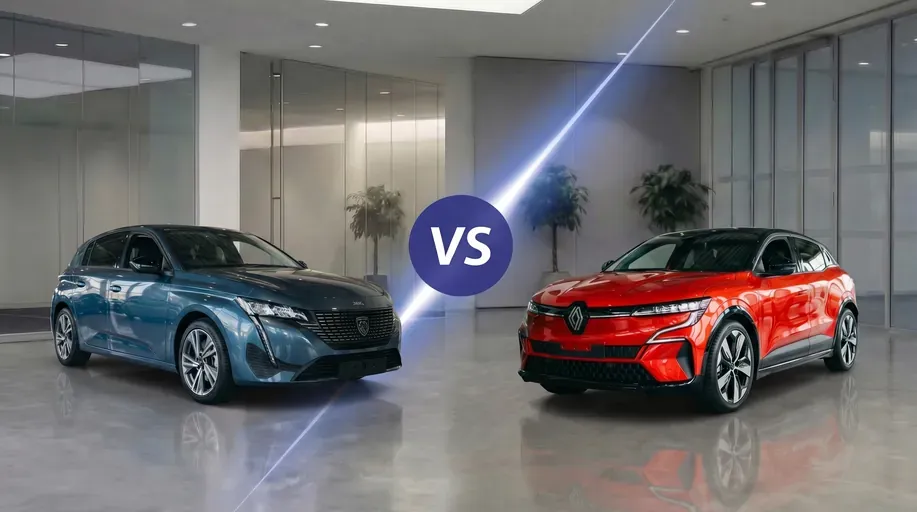
Detailed comparison of the Peugeot 308 and Renault Mégane. Compare engines, equipment, and the reliability of used cars. Read our verdict and choose the best car!
Apr 15, 2026
Detailed comparison of Škoda Octavia vs. VW Golf (Volkswagen Golf). Discover real-world experiences, differences in space, and our verdict on which car is more worth it.
Apr 15, 2026