Car battle
Peugeot 3008 vs. Volkswagen Tiguan: Complete comparison 2026
Detailed comparison: Peugeot 3008 vs Volkswagen (VW) Tiguan. We compared driving characteristics, engines, and space. Which used SUV is the better choice for you?
May 18, 2026
Articles
Car battle
Detailed comparison of the Mazda CX-5 and Peugeot 3008. Find out details about equipment, reliability, and driving characteristics and choose the best used SUV.
May 20, 2026
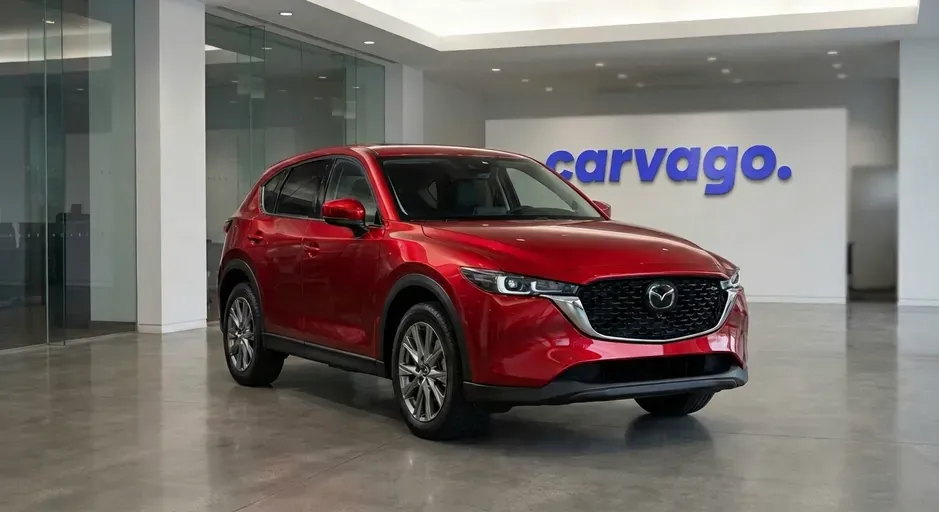
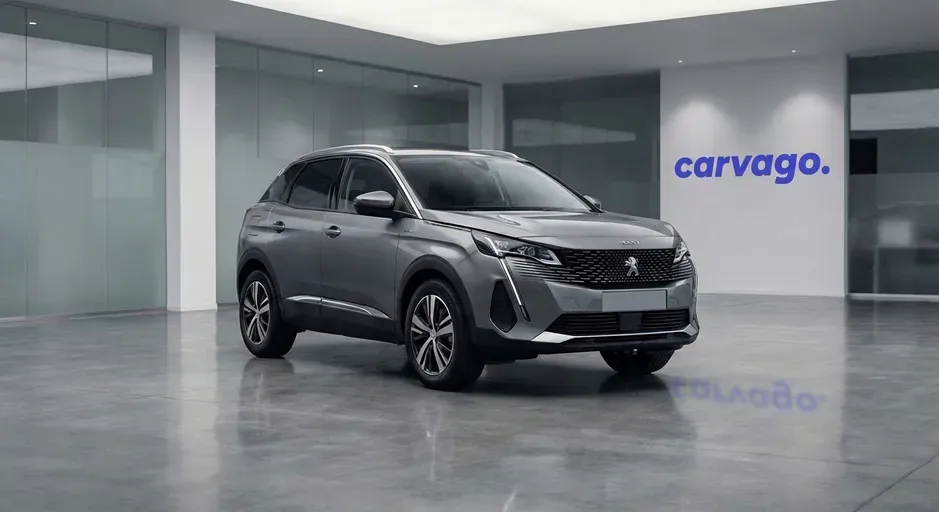
Mazda CX-5 has established a strong position as one of the best-handling family SUVs, attracting owners with its sporty driving characteristics, sophisticated technology, and timeless design. In contrast, the Peugeot 3008 (also known as the Peugeot 4008 in some markets) charms primarily with its avant-garde French flair, futuristic i-Cockpit interior architecture, and maximum emphasis on passenger comfort. Let's take a detailed look at how these two popular representatives of compact crossovers fare in a direct comparison and which of them represents the better choice for your daily journeys.
When choosing a roughly four-year-old used car in the compact SUV category, you will encounter quite noticeable differences in exterior dimensions between these two models. Although both cars target the same customer group, the Japanese Mazda CX-5 (KF generation) bets on a more classic and overall more robust body structure than the popular second generation of the French Peugeot 3008.
A closer look at the technical specifications reveals that the Mazda takes up more space on the road. With a body length ranging from 4550 to 4575 mm, the Japanese representative is about 10 to 13 centimeters longer than the Peugeot, which measures 4447 mm. The Mazda CX-5 also reaches a height of 1680 mm, surpassing its rival by 56 millimeters and visually giving a more mature, typical "SUV-like" impression. However, one area where both cars remarkably agree is the width. For both vehicles, it is just above 1840 mm, which in practice brings comparable demands on parking space width and similarly generous shoulder room inside the cabin.
A key figure is also the wheelbase, which favors the Mazda with a value of exactly 2700 mm compared to 2675 mm for the Peugeot 3008. This 25mm bonus for the Mazda helps not only for a slightly more relaxed and smoother ride on the highway but also gives engineers a chance to conjure up more knee room for rear-seat passengers. However, the French competitor does not come out of this comparison as a loser. Thanks to its overall more compact dimensions and shorter wheelbase, it represents a significantly more agile option for city driving. If you often move through narrow streets or struggle with parking at shopping centers, the Peugeot 3008 will undoubtedly make daily maneuvering easier.
| Parameter | Mazda CX-5 SUV | Peugeot 3008 SUV |
|---|---|---|
| Width (mm) | 1840 – 1845 | 1841 |
| Length (mm) | 4550 – 4575 | 4447 |
| Height (mm) | 1680 | 1624 |
| Wheelbase (mm) | 2700 | 2675 |
Luggage compartment volume is often one of the key parameters for those interested in mid-size family SUVs. Whether you're planning family vacations, regular weekend shopping, or need to frequently transport a stroller or sports equipment, differences in interior layout and liters can play a surprisingly large role in everyday use. Looking at models found on the used car market around four years of age (approximately 2021 and 2022 model years), both the Mazda CX-5 and Peugeot 3008 offer very solid transport capacities, albeit with a somewhat different emphasis on maximizing space.
The Japanese Mazda CX-5 (KF generation) focuses on a balanced compromise between dynamic design and family practicality. Standard versions with internal combustion engines provide a basic boot volume ranging from 494 to 522 liters, depending on the chosen engine and trim level. If you decide to fold down the rear backrests, you get a very generous cargo space with a total volume of 1608 to 1638 liters. In practice, this means many more options for transporting long items or space for several extra bulky suitcases. This volume is thus perfectly sufficient for weekend shopping as well as a longer vacation for four people.
The second-generation French Peugeot 3008 is very similar in the standard five-seat configuration, offering a symmetrically shaped luggage compartment with a decent basic volume of 520 liters. However, a fundamental difference compared to its Japanese competitor occurs when the rear seats are folded down, as the maximum capacity of the Peugeot increases to 1482 liters, which lags significantly behind the Mazda. You must also pay increased attention to the choice of engine – the widely represented and popular plug-in hybrid versions (e.g., HYBRID 225 and HYBRID4 300) pay the price for the installation of heavy batteries, and their boot volume drops to a noticeably more modest 395 liters (and a maximum of 1357 liters after folding).
When deciding, it therefore very much depends on how you plan to use the vehicle. While the pure ICE versions of both cars provide an almost identical and fully satisfactory portion of space in their basic configuration, the Mazda clearly dominates when moving house or driving as a pair with a fully loaded car. Furthermore, with the Peugeot, you must carefully consider whether the more eco-friendly plug-in hybrid is worth it at the expense of a reduced luggage compartment, where you will already have to make certain compromises when packing for the family.
| Parameter | Mazda CX-5 SUV | Peugeot 3008 SUV |
|---|---|---|
| Basic volume (liters) | 494 – 522 | 520 (395 for PHEV) |
| Max. volume with seats folded (liters) | 1608 – 1638 | 1482 (1357 for PHEV) |
The ICE versions of both vehicles offer a very comparable and practical basic boot of around 520 liters, but after folding the seats, the Mazda CX-5 offers significantly more space. Furthermore, the Peugeot 3008's hybrid versions pay the price for battery installation, losing a staggering 125 liters from the original volume.
Towing capacity is an absolutely key parameter for many SUV owners, whether they plan to tow a caravan, sports equipment, or just a heavier load. In this regard, the approach of both manufacturers to approximately four-year-old models on the used car market differs fundamentally and reflects their overall engineering focus. The available data clearly shows a tough battle between a robust Japanese workhorse and a French car that emphasizes a lightweight platform and electrification.
Mazda CX-5: A confident workhorse with a huge reserve
The Mazda CX-5 in the popular KF generation (covering models from 2021–2023) offers exceptionally high values. Even with the base 2.0 e-SKYACTIV-G (121 kW) petrol engine, you can tow a braked trailer weighing 1800 to 2000 kg. The absolute pinnacle is the sought-after 2.2 SKYACTIV-D diesel versions, where the maximum permitted weight of a braked trailer has climbed to a top-tier 2100 kg.
Peugeot 3008: Battery limits on an otherwise great car
The second generation of the Peugeot 3008 targets family comfort and urban efficiency, which is reflected in its more modest figures. Standard conventional powertrains such as the 1.2 PureTech 130 petrol or 1.5 BlueHDi 130 diesel have a maximum towing capacity in the range of 1300 to 1500 kg. However, a significant limitation occurs with the highly popular plug-in hybrid versions (e.g., 1.6 Plug-In Hybrid 225 or Hybrid4 300). Due to the considerable weight of the traction batteries, the capacity of these electrified models is strictly reduced to just 1250 kg.
Final verdict
If your priority is regular towing of heavy loads and uncompromising stability of the combination, the Mazda CX-5 clearly dominates this duel and functions as a first-class workhorse. The Peugeot 3008 will serve well for drivers who only need to attach a lighter trailer, but if you choose its innovative plug-in hybrid variants, you will have to accept a noticeable compromise in terms of towing power.
| Model and engine | Braked trailer weight (kg) | Unbraked trailer weight (kg) |
|---|---|---|
| Mazda CX-5 2.0 e-SKYACTIV-G 165 | 1800–2000 | 750 |
| Mazda CX-5 2.2 SKYACTIV-D 150/184 | 2000–2100 | 750 |
| Mazda CX-5 2.5 e-SKYACTIV-G 194 | 2000 | 750 |
| Peugeot 3008 1.2 PureTech 130 | 1400 | 750 |
| Peugeot 3008 1.5 BlueHDi 130 | 1300–1500 | 750 |
| Peugeot 3008 1.6 Plug-In Hybrid 225/300 | 1250 | 750 |
While the Mazda CX-5 stubbornly sticks to traditional values in the form of naturally aspirated petrol engines and powerful, larger-displacement diesel units, the Peugeot 3008 confidently follows the path of significant downsizing and electrification. This difference is crucial for buyers in the market for approximately four-year-old used cars. The Japanese automaker relies on sophisticated mechanics that will thrill more conservative drivers looking for excellent handling, the linear power delivery of large four-cylinder engines, and the promise of long-term reliability without the risk of repairing complex turbochargers. In contrast, its French competitor proves its qualities primarily in suburban driving. Peugeot impresses with economical small-displacement units and stunning top-tier plug-in hybrid units with an impressive output of up to 300 hp. While Mazda maintains its reputation as the ultimate touring car with available all-wheel drive across the range, Peugeot scores with modern technologies and the ability to drive dozens of kilometers purely on electricity.
The engine lineup for the Mazda CX-5 KF generation (corresponding to cars from 2021 to 2024) is unique by today's standards. The standard engine is the naturally aspirated 2.0 SKYACTIV-G petrol (updated to e-SKYACTIV-G with mild-hybrid technology around the turn of 2022/2023), which generates 121 kW. If you often drive with a loaded car, the larger 2.5 SKYACTIV-G petrol engine with 143 kW is a great choice, combined exclusively with the smooth-shifting six-speed automatic (SKYACTIV-Drive). Despite market trends, Mazda has not abandoned large diesel engines either. Its robust 2.2 SKYACTIV-D four-cylinder diesels in two power variants (110 kW and 135 kW) represent invaluable workhorses with excellent torque of up to 445 Nm in the more powerful version. A strong point of the entire engine range is that practically all engines can be paired with both front-wheel drive and intelligent all-wheel drive (AWD).
| Engine Type | Fuel | Power (kW) | Torque (Nm) | Transmission |
|---|---|---|---|---|
| 2.0 (e-)SKYACTIV-G 165 | Petrol / MHEV | 121 | 213 | 6MT / 6AT |
| 2.5 (e-)SKYACTIV-G 194 | Petrol / MHEV | 143 | 258 | 6AT |
| 2.2 SKYACTIV-D 150 | Diesel | 110 | 380 | 6MT / 6AT |
| 2.2 SKYACTIV-D 184 | Diesel | 135 | 445 | 6MT / 6AT |
The facelifted second-generation Peugeot 3008 (also focusing on 2021–2023 models) relies purely on turbocharging and hybrid solutions compared to the Mazda. The starting point is the 1.2 PureTech turbocharged three-cylinder with 96 kW, which is extremely common on the used car market. This base was supplemented in 2023 by a completely new mild-hybrid version, the 1.2 Hybrid 136 (100 kW), which brought the e-DSC6 dual-clutch transmission with a built-in electric motor to the car. Diesel proponents can opt for the economical 1.5 BlueHDi four-cylinder with the same 96 kW output, which is excellent for a relaxed drive. However, attention should be paid to the 1.6 PureTech four-cylinder engine (133 kW) – this was only available until mid-2021 and is relatively rare on the market for younger used cars. The automaker completely replaced its position with sophisticated plug-in hybrids. The entry-level 1.6 Plug-In Hybrid 225 variant provides an interesting 165 kW to the front wheels, while the absolute top of the range is the Plug-In Hybrid4 300 with a combined output of 220 kW. This top model is also the only way to get all-wheel drive (via a rear electric motor) on this generation of the Peugeot 3008 and boasts a massive 520 Nm of torque. For most standard and electrified engines, Peugeot uses the popular EAT8 eight-speed automatic.
| Engine Type | Fuel | Power (kW) | Torque (Nm) | Transmission |
|---|---|---|---|---|
| 1.2 PureTech 130 | Petrol | 96 | 230 | 6MT / 8AT |
| 1.2 Hybrid 136 | Petrol / MHEV | 100 | 230 | 6AT |
| 1.5 BlueHDi 130 | Diesel | 96 | 300 | 6MT / 8AT |
| 1.6 PureTech 180* | Petrol | 133 | 250 | 8AT |
| 1.6 Plug-In Hybrid 225 | PHEV | 165 | 360 | 8AT |
| 1.6 Plug-In Hybrid4 300 | PHEV | 220 | 520 | 8AT |
*Note: Production of the 1.6 PureTech 180 engine was discontinued during 2021 in favor of electrified plug-in hybrid units.
The decision between these two completely different approaches to propulsion depends entirely on how you use the car. If you are a highway traveler, accustomed to crossing the whole country, or regularly tow a heavy trailer, go for the Mazda CX-5 with its excellent and powerful 2.2 SKYACTIV-D diesel engine combined with AWD without hesitation. For drivers who appreciate longevity and trouble-free servicing over the years, Mazda's naturally aspirated petrol four-cylinders are among the best on the market. In contrast, the Peugeot 3008 is the perfect family crossover for those whose car spends most of its life in and around the city. For owners with home charging facilities, the plug-in hybrid version offers the invaluable comfort of cheap electric driving during the week, while having the dynamics of a sports car available on the weekend. For budget-conscious drivers, the 1.5 BlueHDi diesel four-cylinder with its fantastically low combined fuel consumption makes the most sense in the Peugeot.
While Mazda scores with the renowned reliability of large naturally aspirated engines and excellent all-wheel drive for long-distance travelers, Peugeot impresses with modern plug-in hybrids with massive power, ideally suited for people with home charging capabilities.
Choosing the right engine is an absolutely critical step toward long-term satisfaction with a used car, and our recommendations are based on performance, real-world fuel consumption, user experience, and, above all, proven mechanical reliability. When comparing these two models, we encounter completely different philosophies. With the CX-5, Mazda has long resisted the trend of downsizing and turbocharging, which has made its naturally aspirated petrol engines benchmarks for reliability on the market. In contrast, the Peugeot 3008 makes the most sense as a used car with an economical diesel engine. An interesting fact is that while just a few years ago the robust and powerful 2.0 BlueHDi 180 diesel was among the best engines for the Peugeot, historical data shows its production for the second generation ended in 2020. Therefore, if you are looking for a typical four-year-old used car, this excellent engine is no longer available in the range of accessible models, and it is necessary to look for a smaller-displacement alternative.
The 2.5-liter naturally aspirated petrol four-cylinder (also referred to as e-SKYACTIV-G 194 with mild-hybrid technology in newer model years of the KF generation) is undoubtedly the most comprehensive and best choice across the entire CX-5 range.
For the second generation of the Peugeot 3008, the choice for a four-year-old used car is more pragmatic. Given that the powerful 2.0 BlueHDi engine has already disappeared from the market of available recent used cars (it was only available until 2020) and the widely used 1.2 PureTech petrol three-cylinder carries significant risks associated with the degradation of the wet timing belt, the 1.5-liter diesel becomes the most logical and safest choice.
The difference between the stated laboratory consumption and the harsh reality of daily operation is one of the most common surprises awaiting a used car buyer. Manufacturers often list unrealistically low values in catalogs, so to find the true appetite of engines, it is best to look at data from the drivers themselves. To objectively evaluate the fuel requirements of the popular SUVs Peugeot 3008 (2nd generation) and Mazda CX-5 (KF generation), whose roughly four-year-old examples make the most sense on the used car market right now, we looked into the database of the popular crowdsourcing portal Spritmonitor.de. Thousands of user records from real-world driving clearly show who is the true fuel-saver on the road.
| Model and Engine | Average Consumption (l/100 km) |
|---|---|
| Peugeot 3008 1.2 PureTech 130 (Petrol) | 7.2 |
| Mazda CX-5 2.0 SKYACTIV-G 165 (Petrol) | 7.4 |
| Peugeot 3008 1.6 PureTech 180 (Petrol) | 7.6 |
| Mazda CX-5 2.5 SKYACTIV-G 194 (Petrol) | 8.2 |
| Peugeot 3008 1.5 BlueHDi 130 (Diesel) | 6.0 |
| Mazda CX-5 2.2 SKYACTIV-D 150 (Diesel) | 6.7 |
Several interesting trends can be read from the table above, which is sorted by fuel type and then ascending by consumption for clarity. A very surprising finding is the fact that the popular downsizing in the form of the turbocharged three-cylinder 1.2 PureTech in the Peugeot does not pay off much in the real world for such a large SUV. This small turbo engine saves only two-tenths of a liter per hundred kilometers compared to the full-blooded naturally aspirated two-liter 2.0 SKYACTIV-G in the Mazda, while the Japanese unit offers significantly more refined and smoother operation. Significant differences are traditionally found in the diesel versions. The French 1.5 BlueHDi diesel is satisfied with an average of exactly 6.0 l/100 km, proving the long-standing dominance of French carmakers in the efficiency of diesel engines. The larger 2.2 SKYACTIV-D diesel four-cylinder under the Mazda's hood asks for seven-tenths of a liter more, but rewards with an incomparably more generous displacement and better dynamics.
From the perspective of a typical user, the situation is quite clear. If you are looking for a car for shorter commutes, weekend trips, and frequent movement in the city or on suburban routes, the basic petrol versions of both models will be the optimal choice, where any minor differences in consumption will be completely lost in the family budget. Highway flyers with high annual mileage and budget-oriented drivers, on the other hand, will find salvation in the French diesel engine, with which the cost per kilometer can be pushed to an absolute minimum.
Summarizing all the data, the Peugeot 3008 emerges as a slight winner from the battle at the gas stations. Nevertheless, the absolute differences between the two cars – except for the top-of-the-line 2.5 SKYACTIV-G petrol engine in the Mazda – are rather marginal. Deviations of just a few tenths of a liter should certainly not be the only and main factor that ultimately decides the purchase of the car. Much more significant weight in the final selection will be given to completely different design philosophies, cabin space solutions, and above all, different chassis tuning, which in the Japanese car aims more at driving pleasure, while in its French rival, supple comfort dominates.
When choosing a used SUV approximately 4 years old (2021 and 2022 models), you will encounter an interesting difference in how both cars hold their value. Both vehicles at this age offer modern design and equipment following their last major facelifts, but their price tags are formed differently.
Mazda's four-year-old used cars reflect the legendary Japanese reliability and the popularity of classic engines without unnecessary complexities. This means the car holds its value very well on the market.
The French competitor, after its 2020 refresh, gained an even more attractive look, but as a used car, it loses value significantly faster than the Mazda. For buyers on the used car market, however, this is a distinct advantage.
| Model | Starting price (base trim/higher mileage) | Price for premium version (AWD/Hybrid, top condition) |
|---|---|---|
| Mazda CX-5 | ~ €19,000 | ~ €33,000 |
| Peugeot 3008 | ~ €16,000 | ~ €29,000 |
When deciding, it mainly depends on your financial strategy. The Peugeot 3008 is a great choice if you are looking for a modern and visually attractive family car for the lowest possible initial investment. While the Mazda CX-5 initially requires a higher budget, it will return this investment in the form of slower depreciation during potential resale and excellent time-tested reliability.
The Peugeot 3008 attracts buyers on the used market with a significantly lower purchase price and rich equipment, while the slightly more expensive Mazda CX-5 represents the certainty of high residual value and mechanical durability.
When choosing a roughly four-year-old family SUV on the used car market, safety is often one of the deciding factors. Both the Mazda CX-5 and the Peugeot 3008 boast a maximum five-star rating in crash tests by the independent organization Euro NCAP. However, it is important to view these results in a broader context. The methodology and requirements for safety tests evolve and become significantly stricter over time, meaning that percentage scores from different years cannot be directly compared. Older five-star cars must be viewed through the lens of that time.
The Peugeot 3008 was tested in 2016 as part of the launch of its second generation, while the Mazda CX-5 underwent testing a year later, in 2017. Given that today's strict protocols require advanced simulations of frontal impacts into mobile barriers, comprehensive cyclist detection, or emergency braking at intersections, the validity of these older five-star certificates has technically expired from today's perspective. In terms of passive protection within the vehicle frame itself, however, both models continue to offer a highly rigid, durable, and protective body.
A more detailed comparison of the results reveals several key differences:
When buying a used car, the Mazda CX-5 appears to be a vehicle with slightly more massive and reliable passive protection for adult occupants, while the Peugeot 3008 makes a strong case for families with children in the rear seats. Given the average baseline results in the assistance systems category, it is worth looking for units on the market for which the first owners paid extra for extended active safety feature packages (often called the Safety Pack for Peugeot or advanced i-Activsense for Mazda).
| Parameter | Mazda CX-5 | Peugeot 3008 |
|---|---|---|
| Year of testing | 2017 | 2016 |
| Adult occupant protection | 95 % | 86 % |
| Child occupant protection | 80 % | 85 % |
| Vulnerable road users protection | 78 % | 67 % |
| Safety assist systems | 59 % | 58 % |
Although both popular SUVs benefit from a very robust construction, the Mazda CX-5 protects adult passengers in the front row slightly better, while the Peugeot 3008 offers more sophisticated safety for children in the back.
Both models offer much more than just standard basic equipment, with each approaching the user experience and added value in its own unique way.
Great driving dynamics and communicative driver-focused steering
Premium interior craftsmanship using high-quality and soft-touch materials
Reliable naturally aspirated petrol engines without complex turbocharging
Excellent ergonomics with physical buttons for climate control preserved
Smooth and logically shifting classic automatic transmission
Outdated and less intuitive infotainment system
Average luggage capacity compared to main competitors
More limited knee and foot room for rear-seat passengers
Higher fuel consumption for more powerful petrol engines
The Mazda CX-5 is an ideal choice for traditionalists and driving enthusiasts who expect not only practicality from an SUV, but above all driving pleasure and a premium feel. Its reliable naturally aspirated engines and classic ergonomics with physical buttons suit those who prefer proven technology over ubiquitous touchscreens.
Distinctive and modern exterior design that still looks very attractive after years
Innovative i-Cockpit driver's station with high-mounted digital instruments
Very comfortably tuned chassis for pleasant travel
Wide range of fuel-efficient engines, including efficient plug-in hybrid versions
Easily accessible and spacious luggage compartment
The specific layout of the small steering wheel and instruments (i-Cockpit) may not suit every body type
Tedious and unintuitive climate control exclusively via the touchscreen
Slower response of the onboard infotainment and occasional system freezes
Less communicative steering and a more detached driving experience
The Peugeot 3008 targets families and buyers looking for a stylish look, maximum travel comfort, and modern technology in a used car. Thanks to its unique interior, compliant chassis, and the availability of advanced hybrid powertrains, it excels primarily in calm, quiet, and relaxed travel.
Based on our own experience from comprehensive vehicle inspections, long-term user reviews, breakdown statistics, and service bulletins, we have compiled an overview of the most common problems that buyers of both used models should watch out for.
Mazda CX-5 has long held a reputation on the used car market as one of the most reliable SUVs, yet several typical weak points have emerged over the years that are worth knowing about.
The Japanese SUV is mechanically very durable, especially if you choose the popular naturally aspirated gasoline engine. Recorded problems are mostly limited to minor electronic issues or more sensitive paint, but major breakdowns are avoided with proper maintenance.
The second-generation Peugeot 3008 took a big step forward in reliability, but given the specific technical solutions of some power units, it requires a very cautious selection and a careful service history.
The design-attractive and comfortable French SUV requires a careful owner. Before buying, it is absolutely critical to check the condition of the timing belt and the service history of oil changes, especially if you have the 1.2 PureTech or BlueHDi diesel engine in your sights.
When buying a used car, a thorough inspection is crucial, and although both models are generally very popular and reliable, each has its specific weak points. For peace of mind, it is always worth getting a comprehensive car inspection before purchasing, which can reveal even well-hidden problems. Here are a few specific points to focus on for these roughly four-year-old used cars.
The Mazda CX-5 offers a classic and very reliable mechanical all-wheel drive system, which is available for most of its petrol and diesel engines. Its French competitor has 4x4 reserved exclusively for the most expensive plug-in hybrid version, the Hybrid4, where the rear axle is driven by an independent electric motor. For more frequent driving in the mountains or on snow, the Japanese model is a much more accessible and traditional choice.
Both cars offer a very similar boot volume, which is fully sufficient for normal family use. The Peugeot provides 520 litres as standard, but in plug-in hybrid versions, this space is reduced to 395 litres due to the batteries. Mazda offers a comparable 506 to 522 litres depending on the specific equipment and generation, benefiting from a very practical cargo area shape.
The Japanese SUV is considered one of the most reliable cars in its class, mainly thanks to its durable naturally aspirated Skyactiv-G engines, which do not suffer from complex turbocharger failures. With the Peugeot 3008, on the other hand, increased attention needs to be paid to the 1.2 PureTech three-cylinder petrol engines, which can suffer from degradation of the timing belt immersed in oil in used cars. For more worry-free long-term ownership of a used car, Mazda is therefore generally a safer bet.
The Mazda CX-5 is much more attractive to drive thanks to its precise steering, excellently tuned chassis, and sportier driving position. Peugeot, on the other hand, bets on smooth comfort, cabin quietness, and the futuristic i-Cockpit interior with a small steering wheel, whose specific layout some drivers have to get used to. If you are looking for fun and a connection with the car, the Mazda will please you, while the French SUV is ideal for a relaxed drive.
Peugeot clearly leads in this area, as its range includes advanced plug-in hybrid versions with a pure electric range of around 50 kilometres. Used Mazda CX-5s around four years old relied almost exclusively on classic internal combustion engines, or were supplemented only by very mild mild-hybrid assistance. If you have the possibility to charge the car at home and want to drive daily short distances on electricity, the Peugeot is the right choice.
While the Mazda CX-5 represents a traditional, driver-oriented SUV with an emphasis on robust mechanics and the excellent reliability of large-displacement naturally aspirated engines, the Peugeot 3008 attracts with its avant-garde design, maximum travel comfort, and modern electrified powertrains. The Japanese model is an ideal choice for more conservative motorists, long-distance highway travelers, or drivers who need to tow heavy trailers and appreciate the security of slower vehicle depreciation. The French crossover, on the other hand, makes the most sense for families looking for a stylish and comfortable car for daily suburban commuting, while on the market for roughly four-year-old used cars, it pleases with a significantly more attractive purchase price and generous equipment. The final decision thus depends entirely on whether you prefer long-term mechanical durability and immediate driving pleasure, or if you instead prioritize a futuristic interior and smooth travel for less money.
Sources: ADAC, idnes.cz, e15.cz, autoweb.cz, autoservis.cz, rallylife.cz
This article was prepared using artificial intelligence tools. The section guarantor is Petr Dušek.
Detailed comparison: Peugeot 3008 vs Volkswagen (VW) Tiguan. We compared driving characteristics, engines, and space. Which used SUV is the better choice for you?
May 18, 2026
Nissan Juke vs. Volkswagen T-Cross: Which urban SUV is better? Find out in our detailed comparison of fuel consumption, equipment, space, and reliability of used cars.
May 8, 2026
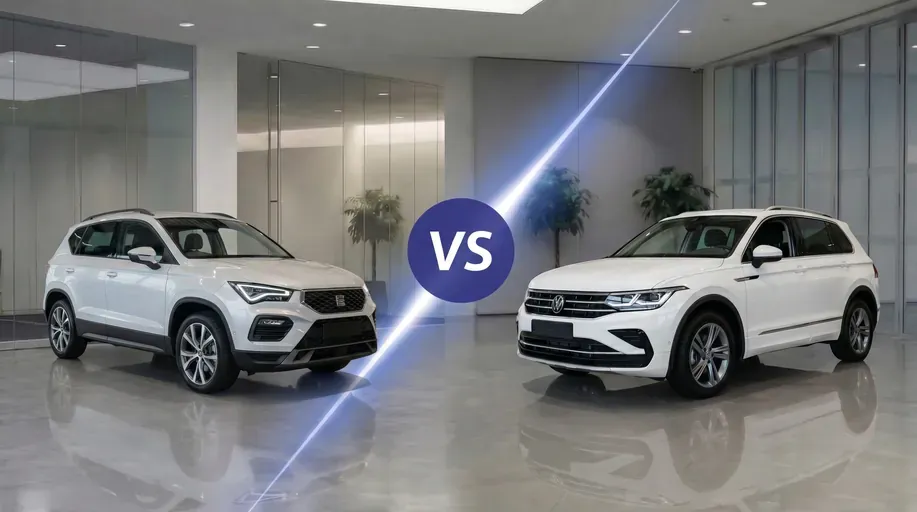
Seat Ateca vs. Volkswagen Tiguan: Which used SUV is better? Read our detailed comparison of engines, space, and equipment and discover your winner.
May 14, 2026