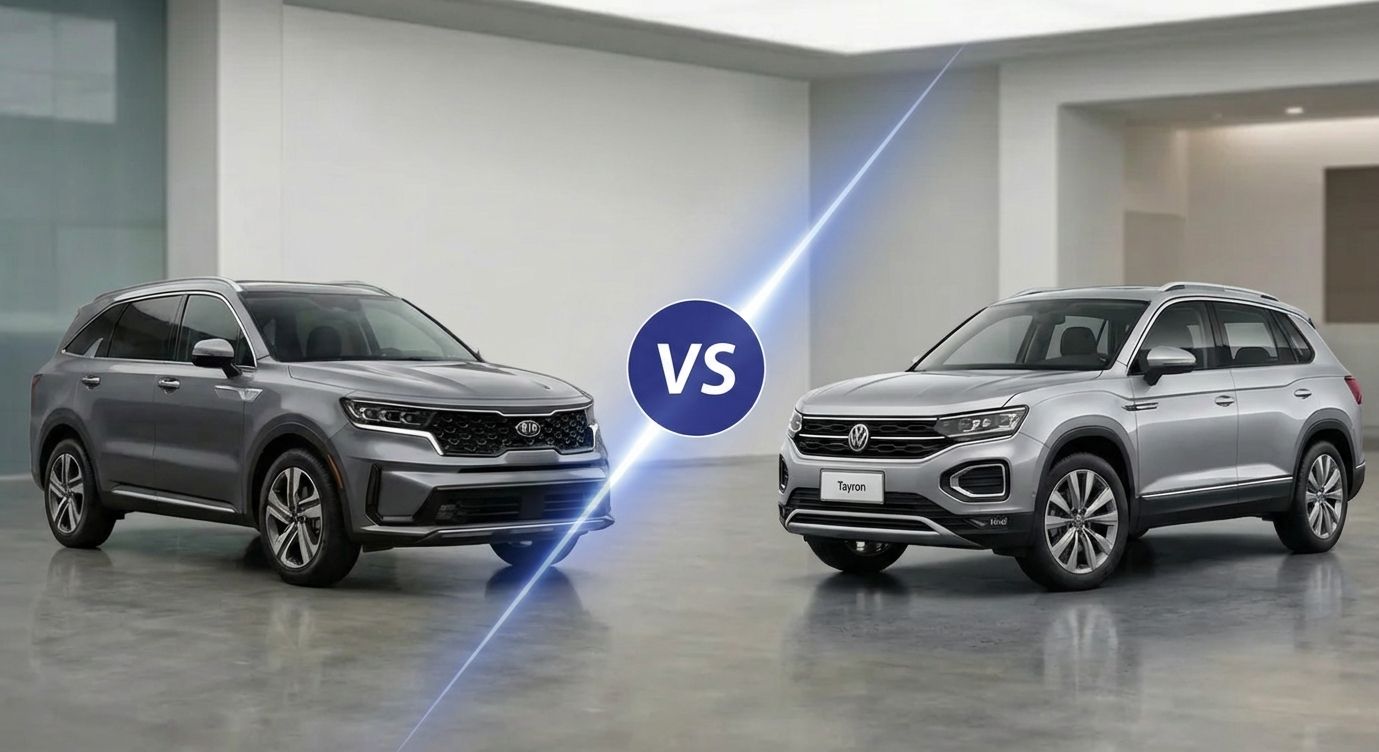
Car battle
Kia Sorento vs. Volkswagen Tayron: A Complete 2025 Comparison
Kia Sorento vs. Volkswagen Tayron. Which large SUV is better? A detailed comparison of price, features, and driving performance to help you decide.
Apr 13, 2026
Articles
Car battle
Detailed comparison: Kia Sorento vs. Seat Tarraco. Discover the differences in driving characteristics, space, and reliability. Which used family SUV is the better choice?
May 8, 2026


The South Korean Kia Sorento represents a majestic and technology-packed family SUV that attracts buyers on the used car market with its confident design and exceptionally generous interior space. Standing against it is the Spanish SEAT Tarraco, the brand's spacious flagship, which skillfully combines dynamic temperament with proven Volkswagen Group technology. Let's take a closer look at which of these two popular SUVs, typically sought after in the category of roughly four-year-old used cars, offers the future owner a better balance of price, overall practicality, and driving pleasure.
Looking at the exterior dimensions of roughly four-year-old used cars (the MQ4 generation for the Kia Sorento and the KN generation for the Seat Tarraco), it is clear that although both models fall into the category of larger family SUVs, they differ in their overall footprint. The Kia Sorento, with a length of 4810 to 4815 mm, is up to 80 mm longer than the Seat Tarraco (4735 mm). The same trend continues with width, where the South Korean model, at 1900 mm, surpasses its Spanish competitor by a significant 61 mm. From a practical standpoint, these figures mean that the Kia offers more generous interior shoulder room for passengers and has a noticeably more imposing presence on the road. While the Kia will appeal to drivers who prefer maximized space and a robust look, the Tarraco benefits from its more compact exterior dimensions with easier maneuverability and demonstrably less stressful parking in tight city garages.
Differences can also be found in height and wheelbase, which play a key role not only in the interior layout but also in driving characteristics. The Sorento is 37 mm taller than the Tarraco (1695 mm vs. 1658 mm), which is reflected positively in a more upright driving position and a better view of the road. The wheelbase, which is crucial for longitudinal legroom for passengers in the second and third rows, is 2815 mm for the Sorento. The Seat Tarraco lags only slightly behind with a value of 2790 mm. The 25 mm difference in favor of the Sorento and its overall taller build make it a somewhat more stable highway cruiser with a better view, while the slightly shorter wheelbase and lower silhouette of the Tarraco favor more agile handling in corners and lower aerodynamic drag.
Overall, it can be said that the exterior dimensions of both SUVs cater to slightly different types of users. If your absolute priority is maximum physical size, a majestic presence, and you don't mind slightly higher demands on parking space, the wider and longer Kia Sorento is the more logical choice. The Seat Tarraco, on the other hand, represents an excellent compromise for families looking for a seven-seater SUV but who also want proportions that are much quicker and easier to live with in everyday European city traffic.
| Parameter | Kia Sorento SUV | Seat Tarraco SUV |
|---|---|---|
| Width (mm) | 1900 | 1839 |
| Length (mm) | 4810-4815 | 4735 |
| Height (mm) | 1695 | 1658 |
| Wheelbase (mm) | 2815 | 2790 |
Luggage space is one of the most important parameters when deciding on a large family SUV. Whether you're planning to pack for a two-week holiday, need to transport bulky sports equipment, or just want to be sure you can easily load a giant weekend shop and a pram, every extra litre counts. Both the Kia Sorento and the Seat Tarraco are exceptionally practical representatives of their class in this regard, yet they approach the use of interior space slightly differently.
Looking at models appearing on the used car market today as roughly four-year-old vehicles (Sorento MQ4 and Tarraco KN generations), the Seat Tarraco with a conventional internal combustion engine offers an excellent basic volume of 760 litres in the standard five-seat configuration. In contrast, the fourth-generation Kia Sorento provides 705 litres in the same configuration (or just 187 litres if you fully utilise the third row of seats). The Spanish model thus has a slight edge for everyday transport of standard luggage and offers space for a few extra suitcases. However, the tables turn dramatically the moment you fold down the rear seats in both cars. The Sorento suddenly transforms into a transport giant with a maximum volume of up to 2,100 litres, while the Tarraco ends at 1,775 litres. The Korean representative is thus much more useful for transporting furniture or extra-long items.
It is also important to consider which engine you choose, as the batteries of electrified models significantly encroach on the boot floor. The plug-in hybrid Kia Sorento retains a very respectable 693 litres, representing only a slight decrease compared to purely combustion versions. Conversely, the Seat Tarraco e-HYBRID loses significantly more of its practicality, with its basic luggage compartment shrinking to 610 litres.
If you carry a family of five and need the absolute maximum for their luggage without folding the seats, the Tarraco with a conventional engine will be a slightly better choice. However, for drivers who more often transport bulky loads with the seats folded or are specifically looking for a hybrid used car, the more spacious and practical Kia Sorento is the clear winner.
| Parameter | Kia Sorento SUV | Seat Tarraco SUV |
|---|---|---|
| Basic volume (litres) | 705 | 760 |
| Maximum volume with seats folded (litres) | 2100 | 1775 |
While the Seat Tarraco impresses with a larger boot in the basic five-seat configuration, the Kia Sorento dominates once the rear backrests are folded and offers significantly less space restriction in the popular hybrid versions.
When choosing a large family SUV, towing capacity often plays a key role, whether you plan to tow a heavy caravan on a long holiday or transport horses or a boat. In this regard, both models, roughly four years old, offer solid values, but with a different approach across the offered engines. The fourth-generation Kia Sorento (MQ4) clearly excels in its 2.2 CRDi diesel version, which can tow a braked trailer with a maximum weight of up to 2,500 kg. The competing Seat Tarraco, with its more powerful 2.0 TDI and 2.0 TSI engines, still offers a very above-standard maximum of 2,300 kg.
However, an interesting situation arises with the entry-level and electrified powertrains. While the Seat Tarraco in 1.4 e-HYBRID variants or with the 1.5 TSI petrol engine maintains a standard and very decent towing capacity of 1,800 kg, the greener versions of the Sorento lose out in this regard. The standard hybrid Kia can handle 1,650 kg, and the popular plug-in hybrid variant even drops to the 1,500 kg mark.
In practice, this means that for towing truly heavy loads, the diesel Kia is an unbeatable workhorse; however, the hybrid version of the Seat offers greater towing versatility. The 1,800 kg capacity of the Tarraco is perfectly sufficient for the trouble-free transport of building materials for a weekend project as well as a heavier family caravan for a long holiday. In conclusion, it can be summarized that if extreme towing power is your absolute priority, the diesel Sorento is the clear winner, but for owners of hybrids or smaller caravans, the Spanish competitor may be a more flexible choice.
| Model and engine | Braked trailer weight (kg) | Unbraked trailer weight (kg) |
|---|---|---|
| Kia Sorento 2.2 CRDi | 2500 | 750 |
| Kia Sorento 1.6 T-GDI Hybrid | 1650 | 750 |
| Kia Sorento 1.6 T-GDI Plug-in-Hybrid | 1500 | 750 |
| Seat Tarraco 2.0 TDI | 2000 - 2300 | 750 |
| Seat Tarraco 2.0 TSI | 2250 - 2300 | 750 |
| Seat Tarraco 1.5 TSI ACT | 1800 | 750 |
| Seat Tarraco 1.4 e-HYBRID | 1800 | 750 |
When choosing the ideal family SUV, the engine range plays a key role. In this regard, the Kia Sorento and Seat Tarraco offer different approaches that cater to various types of drivers, from those on a tight budget to high-mileage motorway cruisers. While Kia, with the MQ4 generation (since 2020), bets on a highly efficient and focused offering including a powerful diesel engine and modern electrified units, Seat, from the Volkswagen Group family, benefits from immense variability. The Tarraco model (KN generation) thus covers a significantly wider performance and price spectrum. For those interested in a used car around four years old, this means the Sorento is the clear choice for towing trailers or tech enthusiasts looking for hybrids, while the Tarraco is substantially more flexible, offering both an economical petrol base for city commuting and sport-tuned versions with high performance.
Under the hood of the fourth-generation Kia Sorento, we find a well-thought-out trio of powerplants. The clear favorite for high mileage is the proven 2.2 CRDi diesel four-cylinder with 148 kW and an impressive 440 Nm of torque, which is always paired with a modern eight-speed dual-clutch transmission. If you are looking for more refined operation for suburban traffic, the carmaker offers a turbocharged 1.6 T-GDI petrol engine, which was offered as a conventional hybrid (HEV) with a system output of 169 kW, and since 2021 also as a plug-in hybrid (PHEV) boosted to 195 kW. Both electrified variants use a conventional six-speed automatic. While older generations of the car relied purely on larger-displacement internal combustion engines, the MQ4 generation shows a transition to sophisticated efficiency. Used Sorento models are often available with reliable all-wheel drive (AWD), although the diesel engine and the basic hybrid also appear on the market in cheaper front-wheel drive (2WD) configurations.
| Engine type | Fuel | Output (kW) | Torque (Nm) | Transmission |
|---|---|---|---|---|
| 1.6 T-GDI Hybrid | Petrol / HEV | 169 | 350 | 6AT |
| 1.6 T-GDI Plug-in-Hybrid | Petrol / PHEV | 195 | 350 | 6AT |
| 2.2 CRDi | Diesel | 148 | 440 | 8DCT |
The Seat Tarraco, in its first and only generation (produced 2019–2024), benefits from the exceptionally rich engine range of the VW Group. Production of this model and the vast majority of its engines officially ended during 2024, and these cars are now available exclusively on the used car market. The most affordable engine for relaxed drivers is the 1.5 TSI ACT petrol four-cylinder (110 kW), which is often found with a manual transmission in used cars, although a DSG was available at an extra cost. A motorway classic is the popular 2.0 TDI diesel (110 kW or 147 kW), which in the more powerful version always comes with 4Drive all-wheel drive. Especially between 2020 and 2023, the range expanded for dynamically minded drivers, targeted by the 2.0 TSI petrol versions (with up to 180 kW in the FR model). As a response to the hybrid Sorento, Seat also sold the 1.4 e-HYBRID (PHEV) between 2021 and 2024, with an all-electric range and a total output of 180 kW.
| Engine type | Fuel | Output (kW) | Torque (Nm) | Transmission |
|---|---|---|---|---|
| 1.5 TSI ACT | Petrol | 110 | 250 | 6MT / 7DSG |
| 1.4 e-HYBRID | Petrol / PHEV | 180 | 400 | 6DSG |
| 2.0 TSI | Petrol | 140 / 180 | 320 / 370 | 7DSG |
| 2.0 TDI | Diesel | 110 | 340 - 360 | 6MT / 7DSG |
| 2.0 TDI | Diesel | 140 / 147 | 400 | 7DSG |
While the Kia Sorento impresses motorway cruisers and weekend travelers with its exceptionally strong and robust diesel as standard, the Seat Tarraco stands out with a wide range of engines, where an economical city driver with the 1.5 TSI and a sport-oriented family man in a powerful two-liter petrol engine will both find their ideal match.
Choosing the right engine is absolutely crucial for your long-term satisfaction with the vehicle, which is why our recommendations are based on real-world experience, performance characteristics, actual fuel consumption, owner feedback, and mechanical reliability. While the fourth-generation Kia Sorento (MQ4) boasts a completely redesigned diesel engine with a new aluminum block that is nearly 20 kg lighter than its predecessor, the Seat Tarraco benefits from proven Group technology and is manufactured directly in its home plant in Wolfsburg alongside its sibling model, the Tiguan Allspace. In their best specifications, both large family SUVs rely on sophisticated diesel units which, despite the growing popularity of petrol hybrids, remain by far the most practical and reliable choice for the four-year-old used car market and frequent long-distance travel.
This four-cylinder diesel is the absolute top of the range for the MQ4 generation Sorento and represents the ideal balance between immense towing power and reasonable running costs. Its greatest technical advantage is its refined operation and strong pull from low revs (440 Nm of torque); furthermore, it is paired with a modern eight-speed wet-clutch transmission (DCT8). This shifts exceptionally smoothly and is much more reliable and durable than older dry-clutch dual-clutch transmissions from the Group, while real-world consumption remains at an excellent 6.5 to 7.5 liters of diesel, considering the size of the vehicle. A known risk with used units can be a clogged diesel particulate filter (DPF) or dangerous engine oil dilution with diesel due to incomplete regenerations. You can prevent this problem by avoiding cars operated primarily in the city on short trips and by preventively shortening the oil change interval to 15,000 km. This choice is best suited for drivers who regularly cover hundreds of highway kilometers, often tow a heavy trailer (the car can handle up to 2.5 tons), or need confident dynamics even when fully occupied by seven passengers.
For the KN generation Seat Tarraco family car, we clearly recommend the more powerful version of the 2.0-liter turbodiesel. Although production of this top-tier engine for most trim levels was phased out during 2023, it is by far the best find on the market for roughly four-year-old used cars. The technical strength of the TDI Evo family engines is the Twin Dosing AdBlue injection system, which radically reduces emissions without losing dynamics, and the 4Drive all-wheel drive, with which the car achieves real-world consumption of around 6.5 to 7 liters per 100 km. Weaknesses and risks can include neglected service tasks on the more complex drivetrain. As experienced mechanics, we advise carefully checking whether the previous owner strictly followed oil changes not only in the engine itself but also in the DSG gearbox and the 4x4 system's center coupling (at most every 60,000 km). Jerking when pulling away during a test drive is the first warning sign. The powerful diesel Tarraco is ideal for active families with a slightly more dynamic driving style who appreciate safe power reserves when overtaking, excellent traction during regular trips to the mountains, and overall mechanical robustness on long holiday routes.
Official fuel consumption figures provided by manufacturers for large family SUVs often differ significantly from everyday reality on the road. This difference is most apparent in heavier all-wheel-drive vehicles and especially in plug-in hybrid systems, whose official measurements rely on specific and very optimistic laboratory cycles. To get an objective picture of the operating costs of roughly four-year-old used cars (the Kia Sorento MQ4 generation and the Seat Tarraco KN generation), we used real-world data from drivers themselves on the independent community portal Spritmonitor.de. Here, thousands of owners record their actual fuelings over the long term, giving us a much more accurate idea of what actually awaits you at the filling station.
| Model and engine | Average consumption (l/100 km) |
|---|---|
| Plug-in hybrid engines (PHEV) | |
| Seat Tarraco 1.4 e-HYBRID 110 kW | 4.5 (highly dependent on charging) |
| Kia Sorento 1.6 T-GDI Plug-in Hybrid 195 kW | 5.5 (highly dependent on charging) |
| Full hybrid engines (HEV) | |
| Kia Sorento 1.6 T-GDI Hybrid 169 kW | 7.1 |
| Diesel engines (Diesel) | |
| Seat Tarraco 2.0 TDI 110/147 kW | 6.8 |
| Kia Sorento 2.2 CRDi 148 kW | 7.5 |
| Petrol engines (Petrol) | |
| Seat Tarraco 1.5 TSI ACT 110 kW | 7.5 |
| Seat Tarraco 2.0 TSI 140/180 kW | 9.0 |
A detailed look at the real-world data reveals several clear trends. For vehicles of this size and weight, a diesel engine remains the most logical choice for regular highway travel. While the Seat Tarraco, with its proven 2.0 TDI engine, can average a very respectable 6.8 liters, the bulkier, taller, and more powerful Kia Sorento with the 2.2 CRDi engine requires around 7.5 liters in real-world conditions. An interesting finding is the behavior of smaller turbocharged petrol engines. The entry-level 1.5 TSI unit in the Seat has to work quite hard with such a heavy vehicle, and despite the cylinder deactivation technology (ACT), its real-world consumption often hovers around 7.5 l/100 km – so it is not as miraculously economical a choice as the official figures might suggest. The more powerful 2.0 TSI then typically asks for nine liters. For the hybrid versions, it is clear that Kia's classic full-hybrid (1.6 T-GDI HEV) works very effectively in suburban driving with an average of 7.1 liters, while the plug-in hybrid powertrains of both brands only make financial sense if you charge them faithfully and regularly. With a depleted battery, you can easily exceed the 6.5-liter mark due to the vehicle's higher weight.
What does this mean for the average user and the family budget? If your daily driving is predominantly in urban and suburban environments on shorter routes and you have the option to charge the vehicle regularly from a home wallbox or at work, the plug-in hybrid versions will be unbeatable in terms of operating costs. Conversely, if you are a classic "mileage eater" on long highway stretches or often drive fully loaded, opting for diesel in the form of the Seat Tarraco 2.0 TDI or the Kia Sorento 2.2 CRDi will guarantee an above-average range and stable, predictable costs. For drivers who require maximum user-friendliness without the need to look for chargers, the full-hybrid Sorento HEV is an excellent compromise.
In the end, fuel consumption alone should not be the only deciding factor between these two popular vehicles. While the Seat Tarraco benefits from its slightly lighter and more aerodynamic build as well as its more economical 2.0 TDI engine, the Kia Sorento confidently balances this slight handicap at the pump with its overall greater interior spaciousness and a sophisticated range of self-charging hybrids, which are completely missing from Seat's lineup. Both platforms thus offer an adequate economical solution for different types of drivers.
When looking for a four-year-old family SUV on the used car market (primarily 2021–2022 models), you will quickly find that both models target slightly different budgets. While the first-generation Seat Tarraco plays the role of a more affordable and sportier-styled alternative to the Škoda Kodiaq, the fourth-generation Kia Sorento (MQ4) has moved significantly towards the premium segment in terms of both design and technology.
Thanks to its technical kinship with other VW Group vehicles, the Seat Tarraco is very well represented on the used car market, which pleasantly pushes average prices down. This makes it possible to find cars with a relatively flexible price range.
The fourth generation of the Kia Sorento has undergone a massive leap in build quality and materials used compared to its predecessor. This is naturally reflected in higher purchase prices on the secondary market. However, a huge draw for roughly four-year-old cars from 2022 is the fact that they are still covered by the renowned factory warranty.
To make the comparison complete, it is good to consider the features that directly affect depreciation and the buyer's wallet in the first years of used car ownership:
| Feature | Seat Tarraco (2021–2022 models) | Kia Sorento (2021–2022 models) |
|---|---|---|
| Factory warranty on a used car | Usually close to expiration (standard 5 years) | Commonly still active (7 years / 150,000 km) |
| Equipment and impact on price | Large price jumps based on optional equipment | Smaller variance (rich equipment is already standard) |
| Service and parts | Widely available and cheaper (MQB platform) | Higher price for original parts, but covered by warranty |
| Market supply | Easier to find cheaper SUVs without 4x4 | Prevalence of more expensive, fully equipped 4x4 units |
The Seat Tarraco represents a rational and much more budget-friendly path to a spacious SUV, while the slightly more expensive Kia Sorento justifies its higher market price with a more premium interior and, above all, the peace of mind provided by a long factory warranty.
Both vehicles, the Kia Sorento and the Seat Tarraco, boast a maximum five-star rating in the rigorous Euro NCAP safety tests. However, when comparing these used SUVs, it is necessary to consider the context and the year of testing itself. The Euro NCAP test methodology is constantly evolving and becomes significantly stricter every year. Therefore, percentage results from different years cannot be compared directly, as newer years take into account, for example, more demanding simulations of frontal impacts with a moving obstacle, more advanced cyclist detection, or emergency scenarios at intersections.
The fourth-generation Kia Sorento underwent Euro NCAP safety tests in 2020, thus already according to very strict modern standards. The car achieved reliable results with a rating of 82% for adult protection, 85% for child protection, and 63% for the protection of vulnerable road users. However, it performed exceptionally well in the safety assist systems category, where it earned an outstanding 87%. These results were aided by a rigid body and, above all, extensive standard equipment including seven airbags, including a new center airbag that effectively protects the heads of front passengers from colliding with each other. Furthermore, the advanced autonomous emergency braking system responded very effectively to potential collisions with other vehicles and pedestrians, confirming a top-tier level of active safety.
The Seat Tarraco underwent Euro NCAP testing a year earlier, in 2019. It also received a full five stars, shining particularly in adult occupant protection, where it took home an absolutely exceptional 97%. Child protection was rated at a solid 84%, pedestrian and cyclist protection at 79%, and assistance systems also received 79%. In its time, the Tarraco demonstrated excellent cabin rigidity and reliable functionality of collision avoidance systems. However, it is important to mention that the 2019 tests did not yet include the very latest protocols (such as the mandatory evaluation of the previously mentioned center airbag). Furthermore, the validity of Euro NCAP certificates from this year formally expired at the beginning of 2026. When compared to other cars of a similar age in used car dealerships, however, it is naturally still a highly safe and proven family car.
In the overall assessment, both models offer an excellent level of passive and active safety that easily meets the needs of demanding family use. While the Seat Tarraco dazzles with a stunning percentage result in adult protection from 2019, the Kia Sorento benefits from a newer safety architecture tested under the stricter 2020 regime. Its standard center airbag and slightly more advanced assistance systems thus give it a slight advantage in terms of meeting more modern standards on the road.
| Parameter | Kia Sorento | Seat Tarraco |
|---|---|---|
| Year of testing | 2020 | 2019 |
| Adult occupant protection | 82 % | 97 % |
| Child protection | 85 % | 84 % |
| Protection of vulnerable road users | 63 % | 79 % |
| Safety assist systems | 87 % | 79 % |
Although both family SUVs received the maximum number of stars, the Kia Sorento represents a step more modern and safer choice thanks to the newer 2020 testing standards and the innovative center airbag.
In addition to standard equipment, each of the models offers several unique features and technological highlights that add value to the vehicles and can be decisive for the customer during the final selection.
The South Korean SUV relies on state-of-the-art technologies that were more common in the premium segment at the time of its market launch, and on maximum care for the occupants in all rows of seats.
The Spanish sibling of the Škoda Kodiaq benefits from Volkswagen Group technology but adds a more dynamic look and technologies focused on driving pleasure and maximum everyday practicality.
Premium look and high-quality interior craftsmanship with high-grade materials
Generous space with relatively comfortable seating even in the third row
Attractive 7-year factory warranty, which often covers even four-year-old used cars
Wide range of engines including an economical diesel and successful hybrids (HEV and PHEV)
Rich standard equipment and very advanced safety and assistance systems
Significantly higher purchase price on the used car market compared to the Tarraco
Larger exterior dimensions and higher weight make maneuvering in narrow city streets more difficult
With all seven seats occupied, only a minimal amount of luggage space remains
More complex infotainment controls with a larger number of touch-sensitive surfaces
Kia Sorento is an ideal choice for more demanding buyers looking for a robust and luxurious-feeling family SUV with above-standard passenger space. Thanks to the long factory warranty and modern hybrid powertrains, it brings a high level of certainty and efficiency to the used car market, even with frequent short trips.
Confident driving characteristics and, for a large SUV, very agile performance in corners
Proven Group engines (TDI and TSI) with good dynamics and acceptable fuel consumption
More favorable used car prices and an excellent overall price-to-value ratio
Great interior ergonomics with a separate climate control panel and physical buttons
Huge luggage space in a five-seat configuration
The third row of seats is very cramped and realistically usable only for smaller children
The interior feels austere and conservative compared to its Korean rival
Stiffer suspension tuning, which reduces comfort on larger wheels (e.g., in the FR trim)
The plug-in hybrid version (e-Hybrid) is not offered in a seven-seat configuration at all
Seat Tarraco will appeal to rationally thinking drivers who need a practical and spacious family car but don't want to lose the joy of driving. It benefits from reliable VW Group technology and represents a more affordable alternative for those for whom the third row of seats is sufficient only as an emergency solution.
Based on service reports, long-term owner experiences, and findings from every physical inspection of a used car, we have compiled an overview of the most common problems that buyers of roughly four-year-old cars should watch out for.
The fourth generation of the Kia Sorento (produced since 2020) is overall very robust and reliable, but early model years experienced several teething problems that often required service intervention.
The fourth-generation Kia Sorento is primarily plagued by software bugs and teething problems with dual-clutch transmissions in early model years. Major mechanical engine failures are avoided, and thanks to the long warranty, the history of most cars is usually very well maintained.
Seat's largest SUV shares all its group technology with models like the Volkswagen Tiguan Allspace or Škoda Kodiaq. It thus brings proven solutions, but also the typical ailments of group platforms from those production years.
The Tarraco is a solidly built family car that primarily experiences the classic ailments of group DSG transmissions and troublesome MIB3 infotainment. With proper and careful maintenance, it is a highly reliable workhorse.
When buying a used car, a thorough inspection is key. Although both models are generally reliable among four-year-old used cars, they have their specifics and weak points. Here are several specific points you should focus on, while for maximum certainty, a comprehensive Used Car Audit by an experienced mechanic is always the ideal step.
Kia Sorento provides slightly more space in the cabin and the luggage compartment, which in the five-seater version reaches a massive volume of up to 910 litres. SEAT Tarraco offers a very good 760 litres in the same configuration, which is easily sufficient for most families. The Sorento is overall wider and more massive, which provides passengers with a subjectively airier interior.
Kia scores significantly on the used car market with its factory seven-year warranty (or 150,000 km), so with a four-year-old car, you still have valid coverage for major components. SEAT standardly offered a five-year warranty (up to 100,000 km), which may soon expire for some used examples. Both vehicles are considered mechanically reliable; SEAT also benefits from easily available spare parts and the wide service network of the Volkswagen Group.
Yes, both of these family SUVs can be purchased in a practical seven-seater version. However, the third row of seats in the Kia Sorento is slightly more usable, and you can seat an adult relatively comfortably for shorter trips. In the SEAT Tarraco, the seats at the very back are more cramped and are primarily suitable only for transporting smaller children.
If you are looking for a proven diesel for longer trips, both cars offer powerful and economical diesel engines (2.2 CRDi for the Kia and 2.0 TDI for the SEAT) with real-world consumption around 6.5 l/100 km. However, the Kia Sorento excels with a wider range of full hybrid (HEV) and plug-in hybrid (PHEV) powertrains, which are exceptionally efficient in city traffic. On the other hand, the SEAT Tarraco has the advantage of a wider range of classic, more affordable TSI petrol engines.
Thanks to a stiffer suspension setup and slightly lower weight, the SEAT Tarraco is more agile in corners and provides a more engaging driving experience. In contrast, the Kia Sorento focuses on maximum driving comfort, a smooth ride, and top-tier cabin soundproofing. For dynamically oriented drivers, the Spanish SUV is the better choice, while the Korean representative handles comfortable long-distance travel better.
The choice between these two popular family SUVs depends primarily on your budget and preferred driving style. The South Korean Kia Sorento represents a more premium and majestic choice, which, thanks to its generous interior space, efficient hybrid powertrains, and still-valid long factory warranty, will appeal to more demanding families looking for maximum comfort and technological sophistication. On the other hand, the Spanish SEAT Tarraco scores on the used car market with an excellent price-to-value ratio, more agile driving characteristics, and a diverse range of proven Group engines, making it an ideal partner for drivers requiring a sportier feel and easier city maneuverability. If space, more luxurious materials, and confident towing of heavy trailers are your absolute priorities, go for the Sorento, while for rational buyers looking for a more affordable, reliable, and nimble family car, the Tarraco will be the smartest choice.
Sources: ADAC, novinky.cz, idnes.cz, autozive.cz, autotechnik.cz, doprava.cz
This article was prepared using artificial intelligence tools. The section guarantor is Petr Dušek.
Kia Sorento vs. Volkswagen Tayron. Which large SUV is better? A detailed comparison of price, features, and driving performance to help you decide.
Apr 13, 2026

Detailed comparison of Ford Edge vs. Nissan X-Trail (Rogue). Discover the differences in spaciousness, equipment, and reliability. Read our verdict and make the right choice!
Apr 15, 2026

Detailed comparison of Hyundai Santa Fe vs. Seat Tarraco. Real-world experience, evaluation of spaciousness and driving characteristics. Find out which family SUV is better!
May 6, 2026