Car battle
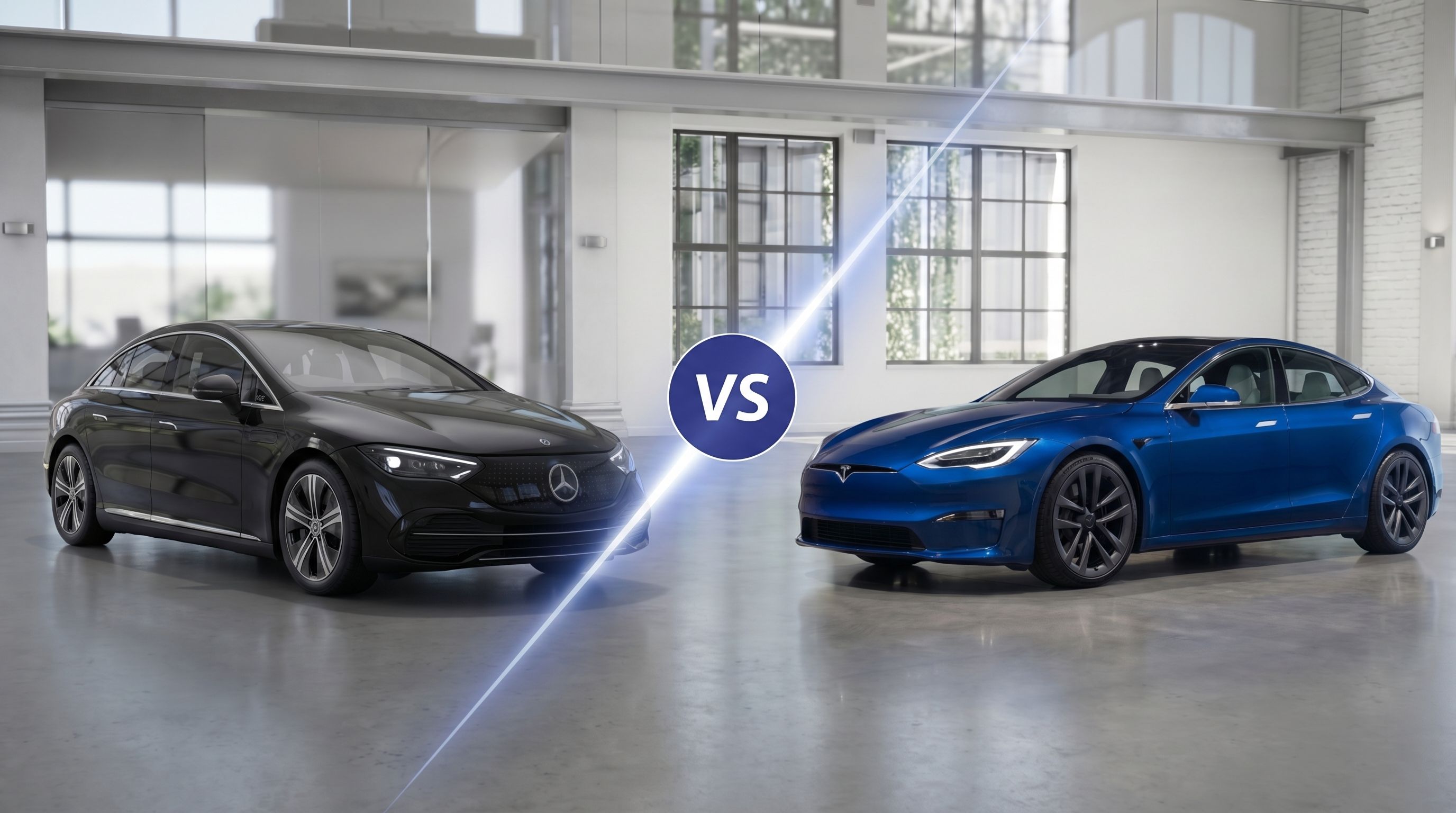
Mercedes-Benz EQE vs. Tesla Model S: Complete comparison 2026
Mercedes-Benz EQE vs Tesla Model S: A detailed comparison of range, technology, and comfort. Our final verdict will help you choose the best electric car.
Apr 13, 2026
Articles
Car battle
Detailed comparison of BMW i5 vs Porsche Taycan. A detailed look at real-world range, performance, equipment, and our verdict. Choose the right luxury electric car.
May 8, 2026
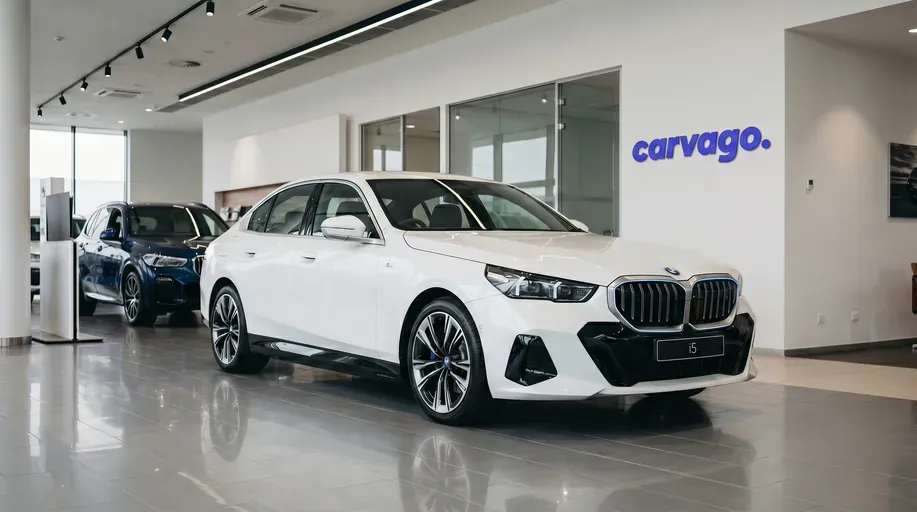
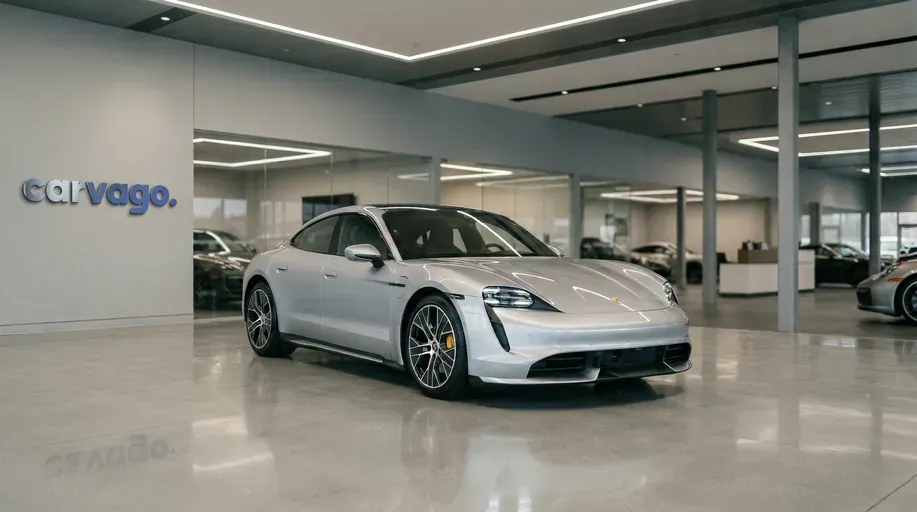
BMW i5, also known simply as the all-electric version of the eighth-generation BMW 5 Series, brings top-tier travel comfort, the latest technology, and locally emission-free operation to the world of executive cars. Standing against it is the Porsche Taycan, originally developed under the Mission E designation, which represents a pioneering electric sports car that clearly proved that even in the era of electromobility, the genuine dynamics and driving passion typical of this Stuttgart brand can be preserved. Let's take a detailed look at how these two exceptional German electric cars fare in a direct comparison and which of them represents a better choice for your daily journeys on the nearly-new used car market.
When comparing the exterior dimensions of the BMW i5 and Porsche Taycan, the different philosophies of the two manufacturers are clearly evident. While the BMW i5 follows the classic proportions of the executive class and offers a majestic body length, the Porsche Taycan relies on purebred sporting DNA. With a length of 5,060 mm, the BMW i5 is nearly 100 mm longer than the base Taycan (4,963 mm), giving it a more stately appearance and logically making it a somewhat bulkier car for everyday city maneuvering.
Significant differences can also be found in width and height, which define the overall stance of the cars on the road. At 1,966 mm, the Porsche Taycan is a noticeable 66 mm wider than the BMW i5 (1,900 mm). Combined with a significantly lower body construction – the base Taycan measures only around 1,380 mm in height compared to 1,515 mm for the BMW i5 – the Porsche gains an undeniable aerodynamic advantage and a much lower center of gravity. This makes it a more confident car in corners and on country roads. On the other hand, the Taycan's greater width can be a slight disadvantage when parking in narrow garages or cramped European parking lots.
Regarding the wheelbase, which is key for longitudinal space in the cabin, the BMW i5 wins. Its value of 2,995 mm is 95 mm larger than that of the Taycan (2,900 mm). In practice, this means that passengers in the rear seats of the BMW i5 will enjoy noticeably more knee and legroom. Together with the higher roof, the Bavarian model thus provides an overall airier and more comfortable interior. In contrast, the Taycan focuses more on a tighter, sports-oriented cockpit with a lower seating position. For family use, or frequent trips with adult passengers in the back, the BMW will therefore be a significantly more welcoming choice.
| Parameter | BMW i5 Sedan | Porsche Taycan Coupé | BMW i5 Estate | Porsche Taycan Estate |
|---|---|---|---|---|
| Width (mm) | 1900 | 1966 | 1900 | 1966–1967 |
| Length (mm) | 5060 | 4963 | 5060 | 4963–4974 |
| Height (mm) | 1505–1515 | 1378–1395 | 1505–1515 | 1379–1409 |
| Wheelbase (mm) | 2995 | 2900 | 2995 | 2900–2904 |
When it comes to practicality and everyday family usability, luggage compartment volume plays a key role. Although both cars are top representatives of the premium segment, their approach to transport capacity differs fundamentally. While BMW bets on traditional proportions and maximum spaciousness typical of the upper middle class, Porsche prioritizes aerodynamic shape and a sporty silhouette. For those interested in a slightly used car, typically around four years old, this means a clear choice between maximum versatility and ultimate sporty style.
In the basic body versions, the BMW i5 (sedan category) offers a generous 490 liters, which represents comfortable space for a few extra suitcases on the way to the airport. In contrast, the Porsche Taycan, classified as a sporty four-door coupé, has a standard volume of 407 liters. For more powerful specifications from 2020 to 2024, such as the Taycan Turbo or Turbo S, this space is further reduced to 366 liters due to the installation of bulkier drive technologies (in the track-focused Turbo GT version, it even drops to 326 liters). Although the Taycan has the advantage of an additional smaller front trunk (frunk), the rear luggage compartment of the Munich rival is significantly more welcoming and better shaped for regular travel.
The biggest differences and practical advantages are fully revealed in the estate body variants. The BMW i5 Touring has an excellent basic volume of 570 liters, which grows to a massive 1700 liters after folding the rear seats. It is therefore a space without compromise, fully sufficient for weekend shopping or a longer holiday filled with sports equipment. Porsche, with its more family-oriented Taycan Cross Turismo and Sport Turismo models, responds with a solid 446 liters in the base (405 liters for Turbo versions), while offering a maximum of 1212 liters after folding the backrests. When deciding between these cars, a simple proportion applies – if you carry a family or bulky items more often, the BMW i5 Touring is an irreplaceable hauler. The Taycan, on the other hand, represents a great choice for those who only need to carry basic luggage for a long weekend, but for whom dynamics are the priority.
| Parameter | BMW i5 Sedan | Porsche Taycan Coupé | BMW i5 Touring | Porsche Taycan Estate |
|---|---|---|---|---|
| Basic volume (liters) | 490 | 326 - 407 | 570 | 405 - 446 |
| Maximum volume with seats folded (liters) | - | - | 1700 | 1171 - 1212 |
The BMW i5 is the clear choice for those who demand maximum family practicality and a huge trunk, while the Porsche Taycan will appeal to drivers willing to sacrifice some transport capacity in exchange for unrivaled sporty shapes and aerodynamics.
Towing capacity (trailer weight) can be one of the deciding factors when choosing a luxury electric car, especially for buyers who require maximum practicality for their hobbies or family activities. In this regard, the two cars differ diametrically and target completely different needs. The BMW i5 (G60/G61 generation, available on the market since 2023) offers a very confident towing capacity for an electric sedan and estate. Standard single-axle drive models, such as the i5 eDrive40 version, can tow a braked trailer weighing 1,500 kg. If you opt for the more powerful all-wheel-drive variants, specifically the i5 xDrive40 or the top-of-the-line sport specification i5 M60, the maximum braked trailer weight increases to an excellent 2,000 kg. This capacity is thus perfectly sufficient for weekend shopping of oversized materials as well as longer holidays with a family caravan. Even a smaller attached trailer effortlessly provides the driver with space for several extra suitcases.
In contrast, the Porsche Taycan (in pre-facelift specifications from 2020–2024, i.e., from the relevant Y1A generation on the used car market) represents a pure electric sports car that was not intended for towing loads at all. The car is simply not homologated for these purposes, and its official trailer weight is 0 kg. Although specific body versions like the Taycan Cross Turismo can be factory-equipped with a rear preparation device, this is designed with a reduced load capacity exclusively for mounting a bicycle rack, not for connecting a standard cargo trailer.
In conclusion, this discipline is easy to decide: if the ability to tow a trailer or caravan is important to you, the BMW i5 is the only and at the same time a very capable choice in this duel. The Porsche Taycan, on the other hand, profiles itself purely as a track and backroad athlete that leaves the necessity of towing loads entirely to others.
Since towing values are not homologated for the Porsche Taycan, the table below contains data only for the individual BMW i5 powertrains.
| Model and powertrain | Braked trailer weight (kg) | Unbraked trailer weight (kg) |
|---|---|---|
| BMW i5 eDrive40 / Touring eDrive40 (G60/G61) | 1500 | 750 |
| BMW i5 xDrive40 / Touring xDrive40 (G60/G61) | 2000 | 750 |
| BMW i5 M60 / Touring M60 (G60/G61) | 2000 | 750 |
BMW i5 and Porsche Taycan represent the pinnacle of modern electric engineering, yet they approach the philosophy of drive and power delivery quite differently. While the BMW i5 (generation G60/G61, on the market since 2023) focuses on a balanced combination of efficiency and smooth dynamics of a luxury executive sedan (or wagon) using a traditional single-speed transmission, the Porsche Taycan (generation Y1A) is conceived from the ground up as a genuine sports car. For the used car market, considering a four-year age limit, the pre-facelift Taycan models from 2020–2024 are currently the most relevant, featuring a unique two-speed automatic transmission on the rear axle. This innovation allows the Taycan to achieve more explosive acceleration from a standstill while maintaining higher efficiency at highway speeds. Another fundamental difference is Porsche's 800V electrical architecture compared to BMW's 400V system, which gives the Taycan an advantage under repeated extreme loads and charging speeds at ultra-fast stations. For drivers seeking uncompromising comfort and the latest technology for long journeys, the calmer and more modern BMW i5 makes more sense. Conversely, sport-oriented individuals who prefer driving emotions, a lower center of gravity, and blistering off-the-line acceleration will swear by the Porsche Taycan.
BMW i5 offers a straightforward yet highly capable range of pure electric powertrains, which has been current within the G60 generation since roughly late 2023, covering needs from everyday commuting to aggressive dynamics. The cornerstone and logical choice for most buyers is the eDrive40 version with a single electric motor on the rear axle, providing a respectable output of 250 kW and torque of up to 430 Nm in overboost mode. From spring 2024, the range was expanded with the xDrive40 all-wheel drive, with power increased to 290 kW, ideal for year-round operation in more demanding conditions. At the very top of the range sits the i5 M60 xDrive. This fierce model from the M Performance division features two electric motors (all-wheel drive) with a total system output of an impressive 442 kW (601 hp) and a massive torque of 820 Nm, allowing it to accelerate to 100 km/h in less than four seconds without any trouble. All versions rely on linear power delivery through a single-speed transmission and are available as both a sedan and a practical Touring wagon.
| Engine type | Fuel | Power (kW) | Torque (Nm) | Transmission |
|---|---|---|---|---|
| eDrive40 | Electricity | 250 | 400 - 430 | 1-speed automatic |
| xDrive40 | Electricity | 290 | 590 | 1-speed automatic |
| M60 xDrive | Electricity | 442 | 820 | 1-speed automatic |
Porsche Taycan (generation Y1A) brings a significantly more diverse spectrum of performance levels. Looking at models up to approximately four years old (i.e., production from 2020–2024, before the significant facelift arrived in March 2024), we find both rear-wheel drive and confident all-wheel drive models on the market. The entry point into the Taycan world is the rear-wheel-drive version, delivering 300 kW of power thanks to overboost, or 350 kW with the larger Performance Battery Plus. However, the vast majority of used cars rely on the 4S variant with two electric motors, offering a well-balanced 390 to 420 kW and up to 650 Nm. If the budget is not the primary concern and your territory is the highway or the track, the GTS, Turbo, and ultimate Turbo S variants push the limits of physics. In particular, the flagship Taycan Turbo S, thanks to the Launch Control function, momentarily produces an explosive 560 kW (761 hp) and a crushing 1050 Nm of torque, which, with the help of the advanced two-speed transmission, catapult the car forward with supercar-like vigor. This range of powertrains applies not only to the traditional coupe-sedan body but also extends to the attractive and more practical Cross Turismo and Sport Turismo body variants.
| Engine type | Fuel | Power (kW) | Torque (Nm) | Transmission |
|---|---|---|---|---|
| Taycan (RWD) | Electricity | 300 - 350 | 345 | 2-speed automatic |
| Taycan 4S | Electricity | 390 - 420 | 640 - 650 | 2-speed automatic |
| Taycan GTS | Electricity | 440 | 850 | 2-speed automatic |
| Taycan Turbo | Electricity | 500 | 850 | 2-speed automatic |
| Taycan Turbo S | Electricity | 560 | 1050 | 2-speed automatic |
While the BMW i5 brings top-tier refinement and plenty of linear power for luxuriously and calmly devouring highway miles, the Porsche Taycan, with its unique two-speed transmission and breathtaking launch control, targets drivers for whom crushing dynamics and the behavior of a thoroughbred sports car are the priority.
Choosing the right powertrain is crucial for long-term satisfaction with a vehicle, and this is doubly true for premium electric vehicles. While with internal combustion engine (ICE) cars we deal with fuel consumption and mechanical engine wear, with electric models like the BMW i5 and Porsche Taycan, we focus on real-world range, battery thermal management efficiency, and the overall reliability of the high-voltage system. These models represent different approaches to electric mobility – BMW primarily offers high comfort and excellent operational efficiency for long distances, while Porsche utilizes advanced 800V architecture for brutal dynamics and ultra-fast charging. Our recommendations are based on real-world experience, the power-to-consumption ratio, and feedback from current owners in the used car market.
Although the top-of-the-line M60 xDrive version offers crushing dynamics, for the vast majority of buyers, the most logical and best-balanced choice is the base eDrive40 version with rear-wheel drive. This electric motor, tuned to 250 kW (340 hp) and 400 Nm of torque, is more than sufficient for very brisk and smooth travel while maintaining excellent efficiency. In real-world driving, consumption hovers around a reasonable 18–20 kWh/100 km, which, with a usable battery capacity of 81.2 kWh, means a reliable real-world range of over 400 kilometers on a single charge.
Given that the i5 model (G60 generation) has only been on sale since 2023 and these are still relatively new cars, mechanical wear or fatal powertrain failures have not yet occurred. The main pitfall with the earliest units can be occasional software glitches in the infotainment (OS 8.5) and assistance systems. Therefore, when buying, always verify with the dealer that the vehicle has undergone all recall campaigns and has the latest software updates installed via OTA (Over-The-Air). The eDrive40 powertrain is perfectly tuned for highway travelers and corporate users looking for an exceptionally quiet, comfortable, and economical executive car for daily driving.
In the used car market, where we target vehicles approximately four years old, the absolute "sweet spot" is the Taycan 4S version. This original pre-facelift variant from the Y1A generation was produced from 2020 until February 2024; it is no longer offered as new in this form, but this means it has undergone the most dramatic depreciation on the used market and makes immense sense. We strongly recommend looking for cars with the optional larger battery (Performance Battery Plus with a total capacity of 93.4 kWh).
This all-wheel-drive powertrain offers a maximum output of 420 kW (571 hp) in overboost mode and a linear torque curve, which, thanks to a specific two-speed gearbox on the rear axle, ensures relentless acceleration even at highway speeds. A huge technical advantage is the 800V onboard network allowing a charging power of up to 270 kW. However, for older model years (2020–2021), pay close attention to the reliability of the high-voltage heating element (PTC heater). If the car does not heat well in winter conditions, you face a costly repair. Always check the diagnostics before buying, verify the service history (to see if the part has already been replaced under warranty), and ask about the condition of the 12V battery, which suffered from unexpected discharge in early versions. The Taycan 4S is a great choice for dynamically minded drivers requiring an uncompromising sports experience on backroads, all-weather traction, and, thanks to the large battery, sufficient practicality.
The difference between official paper values and reality on the road is often even more profound for electric vehicles than for cars with internal combustion engines. While standardized WLTP tests often state consumption for both the BMW i5 and Porsche Taycan well below 20 kWh per 100 kilometers, real-world operation shows different figures. Especially with premium vehicles, whose high performance literally tempts one into more dynamic driving, energy demands rise quickly. To get the most accurate picture of actual consumption, we analyzed real-world data from hundreds of users on the popular independent portal Spritmonitor.de. For the Porsche Taycan, we focused on the first generation from 2020–2024, which currently ideally covers the market for approximately four-year-old used cars, while for the BMW i5, we logically base our findings on the only available generation, G60/G61, which has been on the market since 2023.
| Model and Powertrain | Average Consumption (kWh/100 km) |
|---|---|
| BMW i5 eDrive40 (250 kW) | 23,3 |
| BMW i5 xDrive40 (290 kW) | 23,8 |
| BMW i5 M60 xDrive (442 kW) | 24,5 |
| Porsche Taycan (300 kW) | 23,6 |
| Porsche Taycan 4S (390 kW) | 24,8 |
| Porsche Taycan Turbo / Turbo S | 26,1 |
Interesting trends clearly emerge from the table above. The base variants with single-axle drive (BMW i5 eDrive40 and the base Porsche Taycan) are logically the most economical in normal traffic; however, the difference compared to the much more powerful dual-motor versions is nowhere near as drastic as some might expect. For example, the extremely powerful Taycan Turbo or Turbo S derivatives do not automatically bring a massive increase in consumption and, at a reasonable pace, consume only about 2 to 3 kWh more than the base model. A surprising finding, however, is that the BMW i5, despite the shape of a traditional executive sedan and a larger frontal area, manages to be slightly more efficient than the highly aerodynamic Taycan. In the case of the Porsche, the higher consumption is attributed to extremely wide performance tires and an overall setup focused primarily on uncompromising driving dynamics rather than the pursuit of every saved watt.
For typical users, these figures provide clear takeaways. If you spend most of your time commuting from suburban areas and moving mainly around the city, the rear-wheel-drive models (i5 eDrive40 and Taycan) will offer you the best efficiency and extend the real-world range by valuable tens of kilometers. Conversely, drivers covering long highway distances can easily accept the slightly higher consumption of the Taycan 4S or Turbo, because Porsche's 800V onboard architecture allows for significantly faster charging, which ultimately shortens stops much more effectively than the slightly lower consumption of the BMW could. Those interested in the most powerful specifications who monitor their operating budget more closely must, however, expect that consumption above 25 kWh/100 km at highway speeds will require relatively frequent visits to fast-charging stations for both models, making overall long-distance trips more expensive.
In conclusion, it can be said with certainty that electricity consumption alone will not be the main deciding factor that would definitively sway a buyer toward one car or the other. Although the BMW i5 is overall fractions of a kilowatt-hour more efficient than the older pre-facelift Taycan from 2021–2024, in the real world, both cars operate in a very similar range of 23 to 26 kWh per 100 kilometers. The real argument when purchasing will thus be the different character of the two cars – traditional luxury and touring comfort presented by BMW, versus the pure sporting behavior ruled by Porsche.
When choosing a premium electric car on the used market, depreciation plays a huge role. Since we are comparing models from different stages of their life cycle, the market dynamics of both cars are very different and offer interesting opportunities for buyers.
The first generation of the Porsche Taycan is a classic example of how quickly expensive premium electric cars can lose value. While the purchase price of a new car commonly exceeded €144,000 (and easily approached €206,000 for the Turbo or Turbo S versions), prices on the used market for models from 2020 to 2022 are significantly more attractive today.
Thanks to the steep drop in value, the buyer gets Porsche engineering for a fraction of the original price, making a used Taycan an exceptionally tempting offer.
Since the electric BMW i5 hit the market in late 2023, on the secondary market we are mostly talking about one- to two-year-old cars. While these cars have already undergone their initial depreciation, they are still nearly-new models equipped with the latest technology and often still under factory warranty.
| Model and Generation | Market Launch | Estimated used price (around 2026) | Used market price development |
|---|---|---|---|
| Porsche Taycan (2019-2023) | 2019 | €49,000 – €91,000 | Extreme drop from a very high original price, now excellent value for money. |
| BMW i5 (G60/G61) | 2023 | €47,000 – €80,000 | Nearly-new models. Initial depreciation has already occurred, prices remain relatively more stable. |
Deciding between these two cars on the used market is primarily a choice between a slightly older generation, yet technically and dynamically superior super-sports sedan, and a nearly-new, digitally advanced executive car for a similar final price.
While the slightly older Porsche Taycan attracts with a huge drop from its original price and offers a purebred sports experience, the nearly-new BMW i5 will appeal more to those interested in the latest technology with the security of a newer car in the same price range.
Both models, the BMW i5 and the Porsche Taycan, received the maximum five-star rating in rigorous independent crash tests by Euro NCAP. However, when assessing the safety of used cars, it is essential to take into account the context and the exact year of testing. The Euro NCAP methodology evolves and tightens regularly. While older tests focused primarily on the body's structural rigidity and passive safety, new protocols place enormous emphasis on active accident prevention, advanced braking at intersections, or early detection of cyclists. For this reason, percentage scores from different time periods cannot be directly compared without context.
The Porsche Taycan underwent its tests in 2019, at the time of the first generation's market launch. Under the conditions of that time, the car excelled in immense structural strength, earning 85% for adult protection and 83% for child protection. The rigid safety cage and low-mounted battery provide excellent protection against deformation in both side and frontal impacts. Protection of vulnerable road users (70%) and the rating of assistance systems (73%) were sufficient at the time to easily earn five stars, but from the perspective of today's strictest standards, they logically no longer reach the absolute top.
The BMW i5, a representative of the eighth-generation 5 Series, underwent the Euro NCAP methodology in 2023. The tests thus reflect much more modern and demanding standards. The electric vehicle from BMW scored a top 89% for adult protection and 85% for child protection. However, the real generational difference in safety standards is shown in the rating for the protection of vulnerable road users, where the i5 model received a fantastic 86%. The car also scored significantly better in the evaluation of safety assistants, where it obtained 78% despite complex test scenarios with new intersection simulations.
| Parameter | BMW i5 | Porsche Taycan |
|---|---|---|
| Year of testing | 2023 | 2019 |
| Adult protection | 89 % | 85 % |
| Child protection | 85 % | 83 % |
| Protection of vulnerable road users | 86 % | 70 % |
| Safety assistance systems | 78 % | 73 % |
From the detailed comparison, it is evident that although the Porsche Taycan offers robust occupant protection typical of a premium sports car, the BMW i5 brings a more modern and comprehensive safety package thanks to its much more recent creation date. In terms of active safety and preventive assistance systems, the BMW corresponds much better to today's highest standards, protecting not only its occupants but also its immediate surroundings.
Although both cars received excellent five-star ratings, the BMW i5, thanks to newer technologies and a 2023 test date, offers a more advanced package of assistance systems according to the strictest current standards. For those interested in a used car, this means that with the i5 model, they get slightly more modern and sensitive preventive protection for themselves and their surroundings.
In addition to standard equipment, each model offers several unique features that can be decisive for the customer, with both cars approaching added value in their own way.
Excellent driving comfort and top-tier cabin soundproofing
Spacious and luxurious interior with an exceptionally smooth iDrive system
Exemplary efficiency and long real-world range for the single-motor eDrive40 variant
Larger and more usable luggage space for everyday needs
Availability in the practical Touring (estate) body style
Compromises resulting from a shared platform with internal combustion engines (e.g., presence of a center tunnel)
Significant curb weight, which partially limits agility in sharper corners
Older 400V architecture meaning slower maximum charging speeds compared to Porsche
Polarizing exterior design that may not suit every buyer on the used car market
The BMW i5 is an ideal choice for those looking for an exceptionally comfortable, technologically advanced, and spacious executive electric car for daily commuting and long highway trips. It impresses primarily with its smooth ride and top-tier user interface, although it may feel too cumbersome for drivers seeking sharp sporting experiences.
Fantastic driving characteristics, low center of gravity, and top-tier handling typical of the Porsche brand
Advanced 800V architecture allowing for extremely fast charging (up to 270 kW)
Stunning, aerodynamic, and timeless-looking sports design
Ability to repeatedly deliver maximum performance without significant reduction in dynamics (thermal throttling)
Significantly more cramped rear seat space and smaller volume of both luggage compartments
Noticeably higher purchase price and expensive potential repairs on the used car market
Less intuitive infotainment system with many displays, which takes some getting used to
Average real-world range, especially in older model years equipped with the base battery capacity
The Porsche Taycan is an uncompromising choice for enthusiastic drivers for whom an unrivaled driving experience, precise steering, and the ability for lightning-fast charging on the road clearly win out. It manages to mask its weight perfectly on the road and functions as a purebred sports car, though the owner pays the price in the form of more limited family practicality and higher operating costs.
Based on our own records from the CarAudit service, long-term user experience, failure statistics, and recall data, we have compiled an overview of the most common issues that used car buyers should watch out for. To avoid expensive surprises after purchase, a comprehensive independent inspection of the car's technical condition is an absolute necessity.
Since the electric 5 Series has been on the market for a relatively short time and cars on the used market are at most two to three years old, most reported defects fall into the category of teething troubles, which the manufacturer is continuously addressing through warranty and updates.
The BMW i5 excels in build quality and the reliability of the hardware itself, with the vast majority of reported issues in used cars consisting of software shortcomings and connectivity problems that the manufacturer is actively fixing.
The first generation of the Porsche Taycan has been on the market significantly longer and fits perfectly into the four-year-old used car category. However, with longer operation, specific hardware flaws have emerged that require great attention when choosing.
The Taycan offers an unrivaled driving experience, but for four-year-old used cars, it is absolutely crucial to thoroughly check the functionality of the electric heater and the history of recalls for both the high-voltage and 12V batteries.
When buying a used electric car, a thorough independent technical inspection of the vehicle is absolutely crucial. Both models represent the technological peak, but they have their specifics and weak points that need to be carefully watched during the inspection and test drive.
The BMW i5 usually provides a slightly longer and more stable real-world range of around 450 to 500 km depending on the specific version and wheel size. The Porsche Taycan, on the other hand, dominates in charging speed thanks to its 800V architecture, which allows recharging from 10 to 80% in just 22 minutes. In contrast, the BMW i5 uses a standard 400V system with a slightly slower maximum charging power.
The BMW i5 is a classic executive sedan with significantly more generous space for rear passengers, a higher roofline, and better cabin access. Its rear luggage compartment offers a volume of 490 liters, which is easily sufficient for normal family trips. The Porsche Taycan is noticeably more cramped inside; however, as practical compensation, it adds a front luggage compartment (the so-called frunk), which is missing in the i5 model.
The Porsche Taycan is designed from the ground up as an uncompromising sports car, thanks to which it offers an extremely low center of gravity, perfectly precise steering, and top-tier handling in corners. The BMW i5 relies more on a smoother compromise, where it combines decent dynamics typical of the Bavarian brand with a maximum emphasis on passenger comfort. While the Taycan actively involves the driver in the action and masks its weight, the i5 feels overall more detached and calmer.
The BMW i5 excels in the field of digital technology thanks to the latest generation of the iDrive system, which is more intuitive and is dominated by a massive curved display stretching across the dashboard. The system in the Porsche Taycan is very fast and offers great graphics, but it places more emphasis on a stark sports design divided into several smaller screens. Control in the BMW is overall more suitable for everyday use and offers significantly more advanced and natural voice control.
For frequent and long highway journeys, the BMW i5 is a slightly more comfortable choice, benefiting from excellent cabin soundproofing and a very soft basic suspension setup. Although the Porsche Taycan can be equipped with top-tier air suspension that brilliantly irons out bumps, its overall acoustic and chassis character is generally stiffer. Furthermore, the BMW offers significantly more advanced and smoother-functioning assistants for partially autonomous driving, which effectively reduces driver fatigue on long routes.
The choice between a nearly new BMW i5 and a slightly used Porsche Taycan ultimately depends on whether you prefer everyday versatility and comfort, or uncompromising sporty experiences. The Bavarian model represents the ideal choice for those looking for an exceptionally comfortable, spacious, and technologically advanced executive car with excellent efficiency for long motorway journeys or family travel with a full boot. In contrast, the Stuttgart electric car will primarily appeal to enthusiastic drivers, offering them unrivaled driving characteristics, breathtaking dynamics with a unique two-speed gearbox, and ultra-fast 800V charging, thanks to a very attractive drop in prices on the used car market, albeit at the cost of a more cramped interior and zero towing capacity. While the BMW i5 excels as a perfectly soundproofed and modern daily companion, the Taycan remains a genuine driver's gem that can deliver pure driving pleasure even in the silent electric era.
Sources: ADAC, e15.cz, aktualne.cz, smartmania.cz, autoweb.cz, fastcars.cz
This article was prepared using artificial intelligence tools. The section guarantor is Petr Dušek.
Mercedes-Benz EQE vs Tesla Model S: A detailed comparison of range, technology, and comfort. Our final verdict will help you choose the best electric car.
Apr 13, 2026
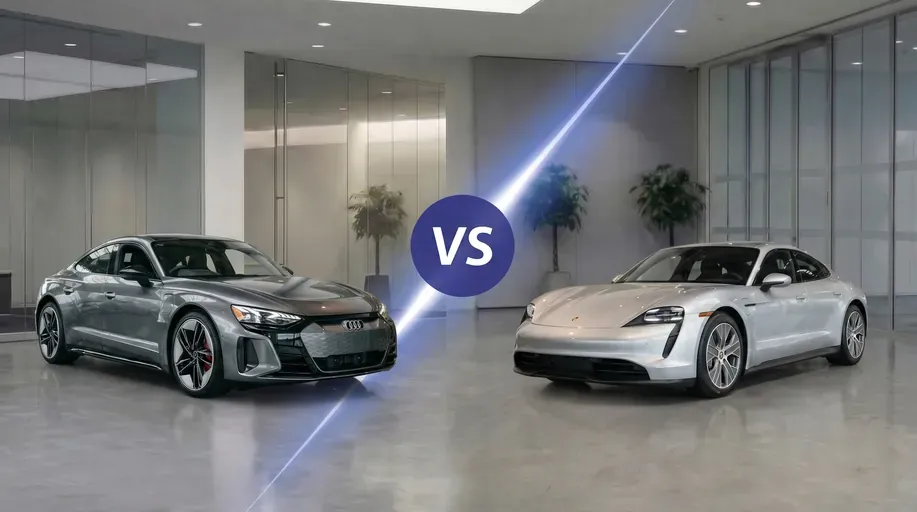
Audi e-tron GT vs. Porsche Taycan Comparison: Which luxury electric car should you choose? Find out everything about performance, real-world range, and read our final verdict.
Apr 14, 2026
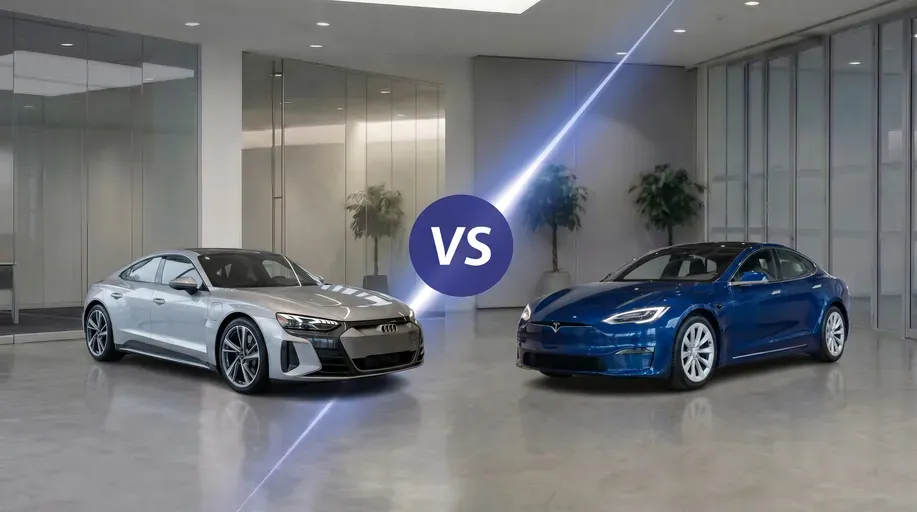
Audi e-tron GT vs Tesla Model S: A comprehensive comparison of premium electric vehicles. Find out everything about real-world range, performance, and features, and read our verdict.
Apr 23, 2026