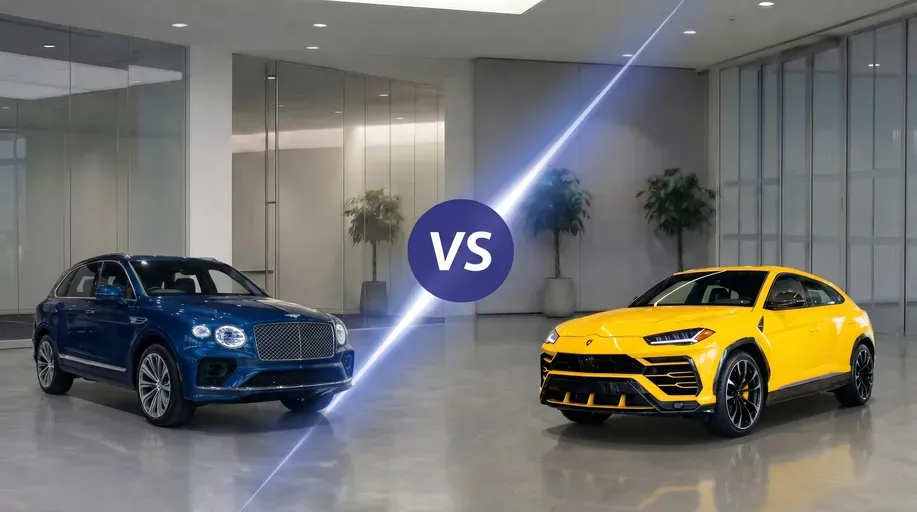
Bentley Bentayga vs. Lamborghini Urus: Complete comparison 2026
Detailed comparison of luxury SUVs Bentley Bentayga vs. Lamborghini Urus. Discover the real differences in performance, equipment, and comfort, and read our verdict.
Apr 16, 2026
Articles
Car battle
Audi Q8 vs Mercedes-Benz GLS: Which premium SUV to choose? Read a detailed comparison of performance, comfort, and reliability to help you choose the right used car.
May 7, 2026


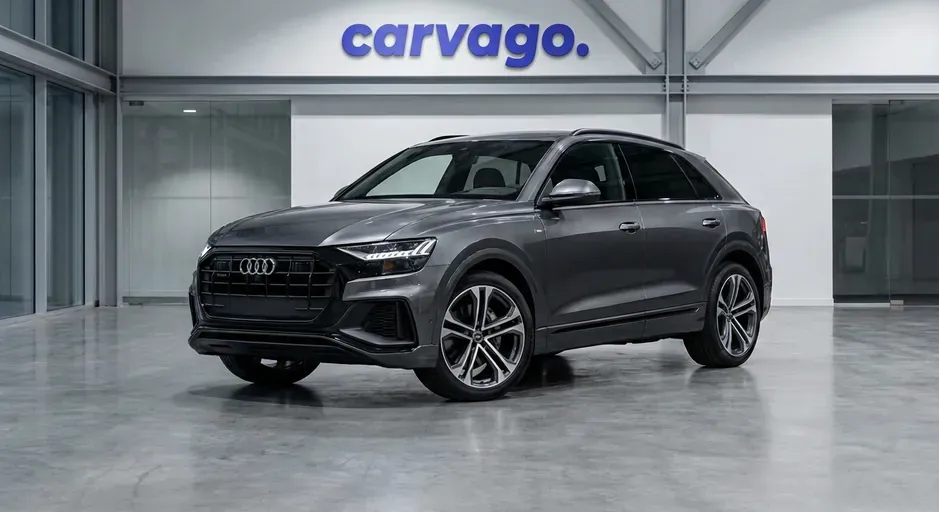
Audi Q8 represents the brand's flagship offering in the luxury SUV coupé segment, where it confidently combines sporting dynamics with first-class technology and an attractive design. Standing against it is the Mercedes-Benz GLS, a model formerly known as the GL-Class, which serves as the proverbial S-Class among giant SUVs and places extraordinary emphasis on absolute comfort and maximum interior space for seven passengers. Let's take a detailed look at how these two prestigious representatives of the premium class stand in a head-to-head battle and which of them will better suit your daily and driving needs.
Although the Audi Q8 and Mercedes-Benz GLS belong to the prestigious luxury SUV segment, their exterior proportions reflect completely different approaches by the two automakers to design and interior space. If we focus on used car market models roughly four years old (the 4M generation for Audi and 167 for Mercedes from 2020–2022), it is clear at first glance that while Audi bets on a dynamic silhouette evoking a sports coupe, Mercedes-Benz offers a more classic, boxy concept of a full-sized family cruiser. In terms of overall length, the Mercedes-Benz GLS dominates with an impressive 5207 mm, meaning it is exactly 221 mm longer than the Audi Q8, which measures 4986 mm in length. A similar difference exists in the wheelbase, where Mercedes offers 3135 mm compared to 2995 mm for Audi. This significant difference in overall length and the 140 mm longer wheelbase clearly earmark the Mercedes-Benz for larger families who care about maximum space and the option of a third row of seats, while the more compact Audi Q8 will be appreciated by drivers looking for a compromise between luxury and at least partially acceptable maneuverability when parking in city centers and underground garages.
However, a very interesting turn occurs when we compare both SUVs in terms of width. Although the Audi Q8 is a noticeably smaller car in the longitudinal direction, with its width of 1995 mm, it paradoxically surpasses the mammoth Mercedes-Benz GLS (1956 mm) by a significant 39 mm. This contrast is further enhanced by the vast difference in body height. The Mercedes-Benz towers to a majestic height of 1823 mm, while the athletically cut Audi measures only 1705 mm. This represents a huge difference of 118 mm in favor of the Stuttgart representative. The wide track in combination with the significantly lowered roofline gives the Audi a much more aggressive and road-hugging stance. While the lower and wider build of the Audi Q8 contributes to significantly higher stability in corners and gives the driver more sporty confidence behind the wheel, the tall and narrower body of the Mercedes guarantees unsurpassed headroom for all passengers and a dominant view of the road, sought after by lovers of traditional large SUVs.
| Parameter | Audi Q8 SUV | Mercedes-Benz GLS SUV |
|---|---|---|
| Length (mm) | 4986 | 5207 |
| Width (mm) | 1995 | 1956 |
| Height (mm) | 1705 | 1823 |
| Wheelbase (mm) | 2995 | 3135 |
When choosing a luxury SUV, trunk capacity often plays a key role, especially if you plan to use the vehicle as your primary family car. The difference between the Audi Q8 (4M generation) and the Mercedes-Benz GLS (167 generation), which dominate the market for roughly four-year-old used cars, is quite fundamental in this regard. Both cars approach the concept of interior space differently – while the Mercedes-Benz GLS is a massive family cruiser offering up to a seven-seat layout, the Audi Q8 bets on a more dynamic silhouette and an exclusively five-seat interior, which directly affects both the available and stated trunk capacity.
The Audi Q8 scores with excellent accessibility and offers a very generous 605 liters in its basic configuration, which is plenty of space for weekend shopping or longer vacations. After folding the rear seats, the total capacity increases to an impressive 1,755 liters. However, if you are considering a more eco-friendly option, it's good to know that the popular plug-in hybrid versions (such as the Q8 55 TFSI e) have a slightly reduced trunk space of 505 liters due to the traction battery being placed under the floor. This still represents a solid value, but this difference can play a role when packing bulkier items.
In contrast, the Mercedes-Benz GLS is literally the king of space. While the tables show a basic value of 355 liters (where the Audi Q8 has a technical lead of 250 liters), this only applies when all seats in all three rows are upright. The real advantage of this model fully manifests as soon as you start folding the rear rows into the floor. In a two-seat configuration, the GLS provides a gargantuan 2,400 liters of maximum volume, outclassing the Audi Q8 by a staggering 645 liters. In practice, this means huge space for several extra suitcases, trouble-free transport of bulky sports equipment, or even the possibility of transporting smaller furniture.
| Parameter | Audi Q8 SUV | Mercedes-Benz GLS SUV |
|---|---|---|
| Basic volume (liters) | 605 | 355 |
| Maximum volume with seats folded (liters) | 1755 | 2400 |
If you regularly carry more than five people and need the absolute maximum transport capacity, the Mercedes-Benz GLS will amaze you with its maximum volume of 2,400 liters, while the Audi Q8 is the ideal choice for those who find 605 liters of easily accessible space wrapped in a much sportier design sufficient.
When choosing a large premium SUV from the used car market, towing capacity often plays a key role. The weight of the trailer that the car can safely pull determines its practicality for an active lifestyle – whether it's towing a heavy caravan, a horse trailer, or a boat. Here, it turns out that between roughly four-year-old Audi Q8 (generation 4M) and Mercedes-Benz GLS (generation 167) models, there are quite fundamental differences that could significantly influence your decision.
While the Mercedes-Benz GLS, as a massive full-size SUV, offers a standard and maximum braked trailer capacity of a full 3,500 kg in all common engine versions (GLS 450 and diesel GLS 450 d), the situation with the Audi Q8 is a bit more varied. Common combustion variants of the Audi Q8, such as the popular 45 TDI and 50 TDI diesel engines or the 55 TFSI petrol from 2020–2022, can standardly handle a braked trailer weighing 2,800 kg (with some older petrol versions even only 2,700 kg). Both manufacturers then consistently offer a capacity of 750 kg for an unbraked trailer, which is the maximum set by European legislation.
The differences deepen if you focus on alternative powertrains. An interesting exception in the Audi range from those years (2020–2022) is the top-of-the-line plug-in hybrid model Q8 60 TFSI e, whose design allows for towing a maximum of 3,500 kg, matching the GLS. However, if you were considering the fully electric Q8 e-tron (generation GE), expect a significantly reduced capacity – this electric car can only tow a trailer up to 1,800 kg.
In practice, this difference means that the Audi Q8's towing power at 2.8 tonnes is fully sufficient for a standard family caravan or a medium-sized boat for a longer holiday, but it may reach its limits with professional and extremely heavy trailers. In contrast, with the 3.5-tonne capacity of the Mercedes-Benz GLS, you get maximum versatility without having to worry about which engine you actually have under the hood.
Conclusion: If you plan to use the car as the ultimate workhorse for the heaviest loads, the Mercedes-Benz GLS represents a safe bet. With the Audi Q8, you either have to settle for a slightly lower (though still very good) towing capacity, or you must specifically look for the particular high-performance Q8 60 TFSI e plug-in hybrid from the specified production years.
| Model and engine | Braked trailer weight (kg) | Unbraked trailer weight (kg) |
|---|---|---|
| Audi Q8 45 TDI / 50 TDI (generation 4M) | 2800 | 750 |
| Audi Q8 55 TFSI (generation 4M) | 2700 - 2800 | 750 |
| Audi Q8 60 TFSI e (generation 4M, 2020-2022) | 3500 | 750 |
| Audi Q8 e-tron 50 / 55 (generation GE) | 1800 | 750 |
| Mercedes-Benz GLS 450 (generation 167) | 3500 | 750 |
| Mercedes-Benz GLS 450 d (generation 167) | 3500 | 750 |
When choosing a luxury SUV, the range of engine options plays a crucial role, as it affects not only dynamics and fuel consumption but also the overall character of the vehicle. Both the Audi Q8 and Mercedes-Benz GLS rely exclusively on powerful six-cylinder units with all-wheel drive, yet their approach to electrification and performance differs slightly. While the Audi Q8 offers a wide spectrum of classic TDI diesel engines and advanced plug-in hybrid (TFSI e) variants with the possibility of purely electric range, the Mercedes-Benz GLS focuses its internal combustion versions on velvety smooth inline-six engines supported exclusively by 48V mild-hybrid EQ Boost technology. For used car buyers looking at vehicles approximately four years old, this means a clear choice: the sportier-styled Audi can be very efficient with regular charging from the grid, while the majestic Mercedes-Benz scores with the mammoth torque of its mild-hybrids, which excel during long highway journeys and when towing heavy trailers.
The engine range for the Audi Q8 (generation 4M) covers a wide spectrum of needs, with all standard versions relying on a 3.0-liter V6 and the proven eight-speed Tiptronic automatic transmission paired with quattro all-wheel drive. The base of the diesel range is the 45 TDI version with 170 kW, however, a much more sought-after choice on the used car market is the more powerful 50 TDI with 210 kW and a solid 600 Nm of torque. Traditional petrol engines are represented by the standard 55 TFSI (250 kW). For drivers who want to combine high performance with the possibility of daily emission-free commuting, Audi offers the 55 TFSI e plug-in hybrid models and the flagship 60 TFSI e, boasting a powerful system output of 340 kW. The electrified TFSI e variants became a permanent part of the range between 2020 and 2025, although for used units, it is necessary to keep in mind the higher curb weight due to the built-in batteries.
| Engine type | Fuel | Power (kW) | Torque (Nm) | Transmission |
|---|---|---|---|---|
| 45 TDI | Diesel | 170 | 500 | 8-speed Tiptronic |
| 50 TDI | Diesel | 210 | 600 | 8-speed Tiptronic |
| 55 TFSI | Petrol | 250 | 500 | 8-speed Tiptronic |
| 55 TFSI e | Plug-in hybrid | 280 | 600 | 8-speed Tiptronic |
| 60 TFSI e | Plug-in hybrid | 340 | 700 | 8-speed Tiptronic |
The Mercedes-Benz GLS (generation 167) takes a more majestic approach to propulsion, hiding refined 3.0-liter inline-six engines under the hood, which are always paired with the smooth-shifting 9G-TRONIC nine-speed automatic transmission and the 4MATIC all-wheel drive system. A specific feature of the GLS engine range is the widespread implementation of mild-hybrid technology, which effectively aids efficiency and the smoothness of starts, and allows for "coasting" with the internal combustion engine switched off. The petrol GLS 450 version offers a generous 270 kW (increased to 286 kW in newer model years). Although older diesel versions like the 350 d or 400 d were available on the market in the first years of production, today's selection of younger used cars and newer models focuses on more advanced units. A major innovation from 2023 is the GLS 450 d model, which confidently replaced the previous diesels with 270 kW and a mammoth 750 Nm of torque. These mild-hybrid six-cylinder engines represent an absolutely ideal compromise between dazzling dynamics and reasonable running costs.
| Engine type | Fuel | Power (kW) | Torque (Nm) | Transmission |
|---|---|---|---|---|
| GLS 450 | Petrol (MHEV) | 270 / 286 | 500 | 9-speed automatic |
| GLS 450 d | Diesel (MHEV) | 270 | 750 | 9-speed automatic |
While the Audi Q8 will please tech enthusiasts thanks to its efficient plug-in hybrids and economical TDI six-cylinders for brisker driving, the Mercedes-Benz GLS will win the hearts of drivers looking for highway serenity, space, and the uncompromising pulling power of mild-hybrid inline engines represented by the robust 450 d model.
Choosing the right engine is crucial for long-term satisfaction, and both premium SUVs require a powertrain adequate for their dimensions. While the Audi Q8 bets on a sharper design and is tuned with a greater emphasis on the driving experience, the massive Mercedes-Benz GLS functions as a luxury family cruiser that must effortlessly move a weight approaching 2.5 tons. An interesting point from a development perspective is the different approach of the manufacturers to six-cylinder engines – Audi relies on the traditional V-shaped (V6) layout for its core TDI units, while Mercedes-Benz returned to masterfully balanced inline-sixes (R6) for the X167 generation. Our recommendations for the market of roughly four-year-old used cars (or a generation younger) are based on performance, real-world fuel consumption, mechanical durability, and long-term owner feedback.
In the vast competition of premium engines, the 3.0 V6 TDI diesel (labeled as 50 TDI) represents the best compromise between dynamics, reliability, and everyday usability. As shown in the table with available years (AVAILABLE_YEARS), the early iteration of the 50 TDI version for the market of roughly four-year-old used cars from 2020–2022 is no longer produced in its original form today, making it an exceptionally interesting and sought-after choice on the secondary market.
For the majestic seven-seater SUV, a powerful diesel six-cylinder is the only truly rational choice. If you are looking for a classic roughly four-year-old used car, you will likely come across older versions labeled as 350 d or 400 d. However, as you can notice in the availability data (AVAILABLE_YEARS), these older engines are no longer recorded in the databases of newer generations and are not available. Therefore, for maximum reliability, we recommend focusing on slightly younger used cars with the modernized and extremely successful GLS 450 d unit (available from late 2023), which is their direct successor.
Paper fuel consumption values stated by manufacturers according to measurement standards often differ significantly from everyday reality in practice, which is doubly true for large and heavy SUVs with a weight reliably exceeding two tons. To obtain an objective and as accurate as possible picture of the actual operating costs of approximately four-year-old used cars, it is therefore ideal to look at long-term user statistics. Data from the popular independent platform Spritmonitor.de, where thousands of drivers enter real values from every refueling, provide us with a clear idea of the appetite with which individual engines of the Audi Q8 (4M generation) and Mercedes-Benz GLS (167 generation) operate in the real world.
| Model and engine | Average consumption (l/100 km) |
|---|---|
| Audi Q8 45 TDI | 8.5 |
| Audi Q8 50 TDI | 8.9 |
| Mercedes-Benz GLS 450 d | 9.2 |
| Audi Q8 55 TFSI e | 6.5 |
| Audi Q8 55 TFSI | 11.5 |
| Mercedes-Benz GLS 450 | 11.8 |
A detailed look at the averaged data reveals a completely clear trend: despite today's massive onset of electrification, modern diesel six-cylinders remain an absolutely unsurpassed benchmark of efficiency for giant premium SUVs. The popular Audi Q8 50 TDI diesel or the majestic Mercedes-Benz GLS 450 d can, despite their gigantic dimensions and standard all-wheel drive, drive with a real average consumption of around nine liters per hundred kilometers, which is a fantastic result considering their power and frontal resistance. Large purely gasoline engines (Q8 55 TFSI and GLS 450) score with drivers for their top-notch refinement, but in practice, they regularly ask for about 2.5 to 3 liters more fuel. Plug-in hybrids, such as the Audi Q8 55 TFSI e, are a completely specific category. Their standardized "paper" consumption of around two liters is illusory in normal mode without daily battery charging. In long-term combined operation, their real average most often settles around 6.5 l/100 km.
For the average user and those interested in a luxury family SUV, these values mean a relatively clear layout of priorities. For drivers who use the vehicles for long highway commutes or regularly swallow hundreds of kilometers across Europe, classic diesel power makes the most sense both economically and for the user. It offers not only reasonable fuel bills but, above all, a confident range approaching a thousand kilometers on a single tank. Gasoline variants, on the other hand, are more suitable for buyers with lower annual mileage who are happy to pay extra for absolute silence and do not mind more frequent visits to gas stations. The Plug-in hybrid Audi Q8 is then an ideal choice almost exclusively for that circle of owners who have the possibility of trouble-free overnight charging at home or at work and whose daily city commuting is fully covered by the purely electric range.
Fuel consumption may not be the only and absolutely most important parameter when buying a premium used car with a price tag exceeding €41,000, but it plays a very significant role in total operating costs at higher mileages. Summarizing the real data above, diesel variants for both cars remain the most rational possible choice in terms of everyday economy, robustness, and travel comfort. Whether you reach for the sportier-tuned Audi Q8 or prefer the maximally spacious Mercedes GLS, diesel under the hood will guarantee you a reliable and, by the standards of the class, surprisingly frugal companion.
The luxury used SUV market offers very interesting opportunities after approximately four years of operation. In this comparison, we focus on models from 2021 and 2022, which represent the ideal age for buying a used car. In the case of the Audi Q8, these are first-generation vehicles (code name 4M) that defined the category of sportily styled SUV coupés with the four rings on the grille. During the same period, the Mercedes-Benz GLS falls into its third generation (X167), which is considered the proverbial "S-Class among SUVs" and, unlike the Audi, offers massive space for up to seven passengers.
Both cars started at very high purchase prices when new. While they experience a significant drop in value after a few years, their price dynamics on the used market differ slightly due to their different character and target audience.
The table below shows the approximate price range for four-year-old models with a verifiable history and clear origin on the European market.
| Category | Audi Q8 (1st generation) | Mercedes-Benz GLS (3rd generation) |
|---|---|---|
| Base models (mileage over 120,000 km) | from approx. €39,000 | from approx. €45,000 |
| Ideal choice (good equipment, mileage up to 80,000 km) | €53,000 – €66,000 | €62,000 – €78,000 |
| Top-tier versions (SQ8/RSQ8 vs. GLS 580/AMG 63) | €74,000 – €103,000+ | €90,000 – €144,000+ |
Used Audi Q8s from 2021 and 2022 are very popular choices for drivers looking for a prestigious and dynamic design backed by cutting-edge technology.
The Mercedes-Benz GLS is a physically larger vehicle that has targeted a different – more family-oriented and maximum-comfort-oriented – clientele from the start. This is positively reflected in its residual value.
Luxury vehicles in this weight and price category experience the steepest drop in value during the first three years of operation. When buying a four-year-old car, the buyer pays only about 50% of the original list price of a new vehicle.
The Audi Q8 loses value slightly faster in percentage terms, partly due to strong competition in the prestigious large SUV coupé segment (where it competes fiercely with the likes of the BMW X6 or Mercedes-Benz GLE Coupé). In contrast, the GLS benefits from its relative exclusivity. There are fewer luxury family cruisers of this size on the European market (practically the only direct rival is the BMW X7), which naturally keeps used GLS prices at a higher level.
While the Audi Q8 represents a more affordable path to sportily styled luxury, the Mercedes-Benz GLS commands a premium on the used market for its massive spaciousness and seven-seat layout, but it rewards with better residual value for the future.
When choosing a used premium SUV, safety is often one of the main criteria. In this class, a five-star Euro NCAP rating is common, but it is crucial to put these results into the correct context and take the year of testing into account. Euro NCAP crash test methodology and protocols are constantly evolving and becoming more stringent. They include, for example, new frontal impact simulations, more advanced cyclist detection, or emergency scenarios at intersections. For this reason, percentage ratings from different years cannot be directly compared, as an older five-star result may no longer meet today's stricter safety standards.
Audi Q8 underwent Euro NCAP crash tests in 2019, receiving the maximum five-star rating. Given this year, the certification is older by current standards and was conducted according to the regulations of the time; however, the car showed above-average structural strength and a high level of protection. The model achieved a score of 93 % for adult occupant protection, 87 % for child occupant protection, 71 % for vulnerable road user protection (pedestrians and cyclists), and 73 % for safety assist systems. The results show that while occupant protection is top-notch, there is already a gap between its active assistants and the most modern requirements of today.
In the case of the Mercedes-Benz GLS (current generation X167), official data is missing because Euro NCAP did not test this model directly. This is a relatively common practice for very expensive and heavy luxury SUVs with lower sales in Europe. However, conclusions can be drawn from the results of the technically related and slightly smaller Mercedes-Benz GLE, which also received a full five stars in the same year. Since there is no relevant crash test data specifically for the GLS model, we are leaving its values in the table blank.
In conclusion, both vehicles offer superior protection due to their massive construction, advanced crumple zones, and a wealth of active safety features. Although the Audi Q8 has its safety level formally confirmed by an older test and the Mercedes GLS lacks this confirmation, both models represent an exceptionally safe choice on the four-year-old used car market.
| Parameter | Audi Q8 | Mercedes-Benz GLS |
|---|---|---|
| Year of testing | 2019 | Not tested |
| Adult occupant protection | 93 % | - |
| Child occupant protection | 87 % | - |
| Vulnerable road user protection | 71 % | - |
| Safety assist systems | 73 % | - |
Even though only the Audi Q8 has an official five-star Euro NCAP certificate and tests are missing for the Mercedes-Benz GLS, with both premium SUVs you get top-built vehicles with excellent passive and active occupant protection.
In addition to the rich standard equipment, each of the models offers several unique features that clearly demonstrate their different approaches to luxury and overall added value.
The brand's flagship SUV-coupe focuses primarily on combining dynamic design with advanced dashboard digitalization.
Mercedes' largest SUV is designed from the ground up as the ultimate family cruiser, prioritizing maximum space, state-of-the-art assistance systems, and unparalleled passenger care.
Attractive and dynamic coupe-SUV body design
Top-notch build quality and premium interior materials
Surprisingly agile handling, especially in models with rear-axle steering
Powerful and refined powertrains (V6 TDI and TFSI)
Advanced MMI infotainment system with fast response
Absence of a third row of seats (the car is strictly a five-seater)
Smaller trunk volume and limited rear headroom due to the sloping roofline
Climate control via touchscreen is distracting and surfaces are prone to fingerprints
The Audi Q8 is an ideal choice for those looking for a prestigious and sporty SUV with an emphasis on attractive design and a premium feel on board. It is perfectly suited for couples or smaller families for whom style, dynamics, and driving experience are more important than maximum transport capacity.
Fully seven-seater interior with usable space even in the last row
Huge luggage space when rear seats are folded (up to 2,400 liters)
Exceptionally comfortable ride thanks to top-tier air suspension
Advanced MBUX multimedia system with excellent voice control
Extremely quiet and luxurious cabin that clearly shows its kinship with the S-Class sedan
Enormous external dimensions significantly complicate parking and maneuvering in narrow city streets
Higher operating costs, fuel consumption, and more expensive service tasks on the used car market
More cumbersome and less sporty driving behavior in corners
Higher purchase price of a used car compared to five-door competitors
The Mercedes-Benz GLS represents the absolute pinnacle of family luxury and is intended for demanding buyers who require a full seven-seater vehicle without any compromises in comfort and spaciousness. It is an ideal highway cruiser for long journeys, but one must expect that its size and weight bring higher maintenance costs and poorer maneuverability in the city.
Based on long-term user experience, service reports, and our detailed inspections, such as an independent car condition check, we have compiled an overview of the most common problems that used car buyers should watch out for.
The Audi Q8 is a robust and precisely crafted SUV, but its complex electrical system and emission systems take their toll on used cars.
Despite overall solid mechanical reliability, the failure of the 48V starter-generator in six-cylinder versions represents the greatest risk. A thorough check of the electrical system and service history is an absolute necessity for three- to five-year-old used cars.
The Mercedes-Benz GLS offers extreme space and maximum luxury, but its massive dimensions and advanced technologies bring their own specific risks and high service costs.
The GLS is a technological fortress on wheels, but failures of the 48V EQ Boost system and the complex air suspension can mean astronomical service expenses. A careful check of the functionality of all equipment and chassis components is key.
When buying a used car, a thorough inspection is key. Here are some specific points to focus on for these two models, which is why an Independent technical inspection of the car should take place before every purchase, as it can detect potential hidden defects in their very complex technology in time.
The Mercedes-Benz GLS offers significantly more space and, depending on the configuration, up to seven full-size seats. While the GLS provides a massive luggage compartment of up to 890 liters (with the third row of seats folded), the Audi Q8, as a sportier five-seater SUV coupe, has a more modest 605 liters. For maximum transport capacity and versatility, the Mercedes is the clear winner.
The Audi Q8 is slightly more suitable for city driving because it is shorter, more compact overall, and feels more agile. The Mercedes-Benz GLS measures over 5.2 meters in length, which can make parking in narrow city streets and older underground garages quite challenging. Although both cars offer advanced camera systems and parking assistants, the smaller dimensions play significantly in favor of the Audi.
The Mercedes-Benz GLS is often rightfully referred to as the "S-Class among SUVs," and its sophisticated air suspension provides unrivaled smoothness. The Audi Q8 also offers a very comfortable ride for its passengers, but its chassis is tuned to a firmer and sportier note to mask the car's high weight in corners. If you are looking for absolute isolation from road imperfections and maximum relaxation on long highway journeys, the Mercedes will be the better choice.
Both premium SUVs require a higher fuel budget; however, the Audi Q8 comes out slightly more economical in this comparison. The Mercedes-Benz GLS is significantly heavier and has higher aerodynamic drag, which results in higher average consumption for both diesel and gasoline engines. The Audi Q8 benefits from its lower body profile, which brings measurable fuel savings, especially at higher speeds.
For a large family, the Mercedes-Benz GLS is clearly more suitable thanks to its three rows of seats and generous space in each of them. The Audi Q8 is exclusively a five-seater, and its sloping roofline may slightly limit headroom for taller passengers in the rear seats. Furthermore, the Mercedes offers a solid level of comfort even for adults traveling in the very back, which is fundamentally impossible in the Q8 due to its body style.
While the Audi Q8 will primarily appeal to drivers looking for an attractive combination of dynamic SUV coupé design, sportier driving characteristics, and better agility, the Mercedes-Benz GLS represents an uncompromising choice for those who demand absolute spatial comfort. The majestic seven-seater representative from Stuttgart functions as a perfect family highway cruiser and a tireless hauler of heavy trailers, making it an ideal vehicle for large families with the highest demands for transport capacity and luxury. In contrast, the proportionally smaller Audi Q8 fits much better into everyday city traffic and will please users who care more about cutting-edge technology, the driving experience, and stylish elegance. Your final choice from the used car market should therefore depend on the main purpose of the vehicle: for opulent spaciousness and a smooth ride, reach for the GLS model without hesitation, while for more agile and sportier travel in a five-seat configuration, the Q8 will clearly be the better companion.
Sources: ADAC, novinky.cz, lidovky.cz, motorvize.cz, autozive.cz, veteran.cz
This article was prepared using artificial intelligence tools. The section guarantor is Petr Dušek.

Detailed comparison of luxury SUVs Bentley Bentayga vs. Lamborghini Urus. Discover the real differences in performance, equipment, and comfort, and read our verdict.
Apr 16, 2026

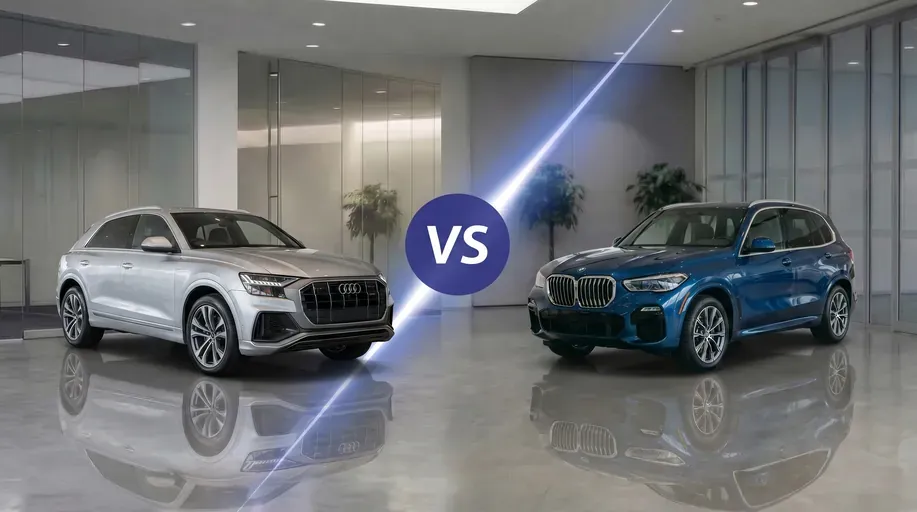
Detailed comparison of Audi Q8 vs BMW X5. Real-world experience, comparison of equipment, driving characteristics, and the final verdict. Find out which luxury SUV to choose!
May 3, 2026

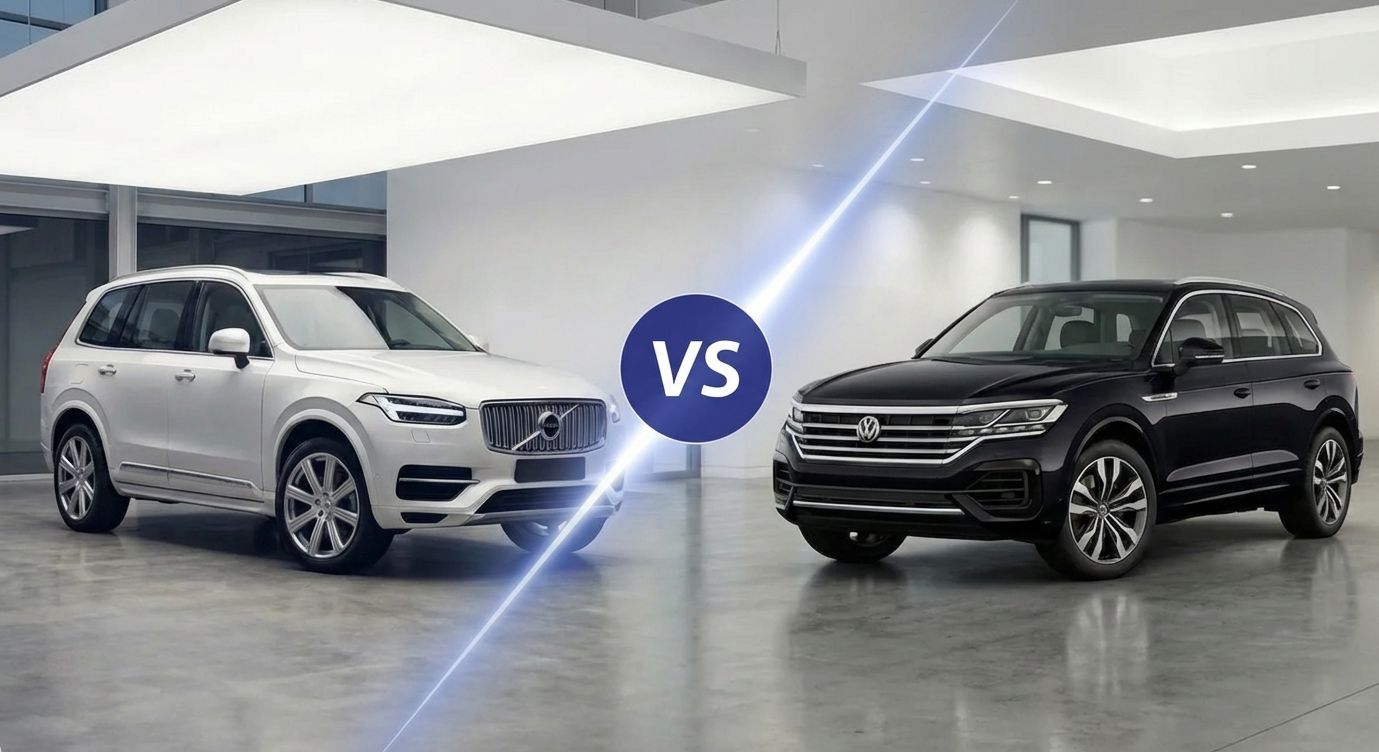
Volvo XC90 vs. Volkswagen Touareg: Which premium SUV is better? A detailed comparison, tests, and a clear verdict will help you choose.
Apr 14, 2026