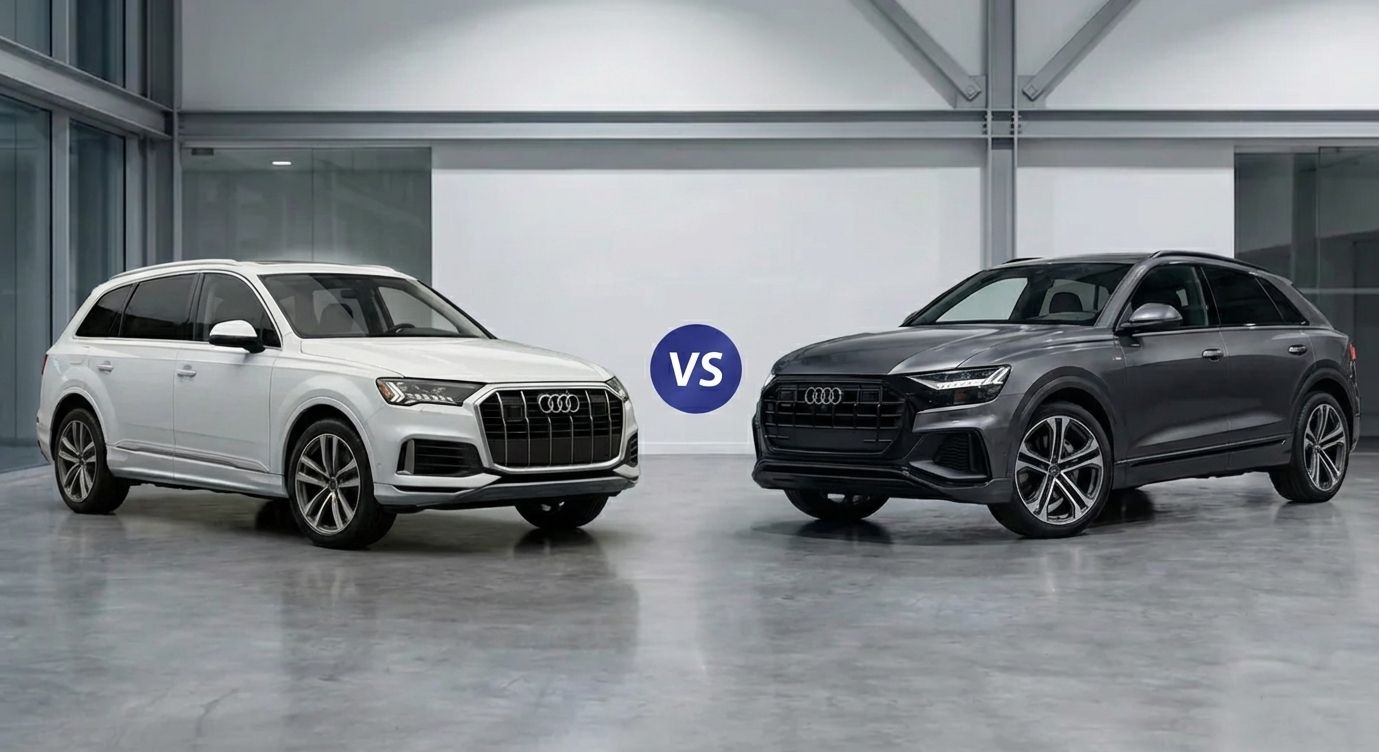
Car battle
Audi Q7 vs. Audi Q8: A Complete 2025 Comparison
Audi Q7 vs. Audi Q8: Which luxury SUV is better for you? A detailed comparison of design, practicality, and driving performance to help you decide.
Apr 13, 2026
Articles
Car battle
Detailed comparison of luxury SUVs Bentley Bentayga vs. Lamborghini Urus. Discover the real differences in performance, equipment, and comfort, and read our verdict.
April 16, 2026


The Bentley Bentayga represents the British pinnacle in the ultra-luxury SUV segment, combining top-tier craftsmanship, premium materials, and exceptionally quiet driving comfort. In contrast, the Lamborghini Urus, although it uses the same group platform, takes a completely opposite approach, bringing brutal performance, aggressive design, and the uncompromising dynamics of a purebred supercar into a practical five-door package. The following detailed comparison of these two exceptional vehicles will help you determine whether your personality and driving preferences are better suited to majestic elegance or, conversely, an unrestrained adrenaline experience.
Although both the Bentley Bentayga and the Lamborghini Urus share the same group MLB Evo platform, and you will encounter the first generation of both models on the four-year-old used car market, their exterior dimensions clearly reflect their different focuses. While the British SUV bets on majesty and the classic proportions of a luxury cruiser, the Italian model profiles itself as an aggressive supercar on stilts, striving for the most aerodynamic and crouched stance possible.
In terms of overall footprint, both cars are true giants that command respect in standard European parking lots. Standard versions of the Bentley Bentayga and Lamborghini Urus measure just over 5.1 meters in length (the Urus measures 5,112 mm, while the Bentayga ranges from 5,125 to 5,144 mm depending on the year of manufacture and engine). The wheelbase in these basic configurations is almost identical, oscillating around three meters. However, Bentley has a major ace up its sleeve for those interested in maximum space in the form of the EWB (Extended Wheelbase) version. This extended variant, which is slowly starting to appear on the used car market, measures an impressive 5,305 mm in length and offers a massive 3,175 mm wheelbase, making it an unrivaled choice for rear-seat passengers.
The most significant visual and physical difference between the two cars is their height and width. The Bentayga stands 1,728 to 1,742 mm tall, providing the driver with that typical, commanding view of the road and making entry easier. In contrast, the Urus, at 1,638 mm, is about 10 centimeters lower. When combined with the fact that the Urus is, on average, nearly two centimeters wider (up to 2,026 mm compared to 1,998 mm for the Bentley), the Italian SUV gives a much more muscular impression.
From an everyday use perspective, both cars are quite challenging to maneuver in urban environments due to their width approaching the two-meter mark. However, the lower center of gravity and wider track of the Lamborghini contribute significantly to its better handling in sharp corners, while the Bentley's taller build enhances the feeling of driving in a luxurious and impregnable fortress.
| Parameter | Bentley Bentayga SUV | Lamborghini Urus SUV |
|---|---|---|
| Width (mm) | 1998 | 2016 - 2026 |
| Length (mm) | 5125 - 5305 | 5112 - 5137 |
| Height (mm) | 1722 - 1742 | 1618 - 1638 |
| Wheelbase (mm) | 2992 - 3175 | 3003 - 3006 |
Although you buy models like Bentley Bentayga and Lamborghini Urus primarily for their breathtaking dynamics and unrivaled luxury, for many prospective buyers they also represent full-fledged family cars. Differences in luggage compartment volume can thus play a surprisingly important role in decision-making, especially if you plan to use the vehicle not only for daily city driving but also for longer family vacations or large weekend shopping trips. Both of these representatives of the luxury segment share a group platform, but their approach to interior space differs quite fundamentally due to the different focus of both carmakers.
Perhaps surprisingly, it is the aggressively and sportily styled Lamborghini Urus that offers a more generous basic trunk. In the standard five-seat configuration, it provides an excellent 616 liters of space. This is a value perfectly sufficient for several extra suitcases and large golf bags without the family having to limit themselves. If you were to come across the more exclusive four-seat version on the used car market, this volume drops to a still very decent 574 liters. The practicality of the Italian car is further enhanced by the adaptive air suspension, which can lower the rear of the vehicle on command, significantly facilitating the loading of oversized and heavy items. After folding the rear backrests, the area increases to a maximum of 1,596 liters.
The Bentley Bentayga, typically powered by a velvety V8, offers a standard luggage volume of 484 liters. For a family's normal weekly routine, this is enough, but in direct comparison with its Italian competitor in the basic layout, it lags significantly behind. Buyers of the plug-in hybrid version (Bentayga Hybrid), which is very popular on the secondary market for roughly four-year-old cars, must be especially cautious. The installation of the traction battery takes away more valuable liters from the capacity, and the volume can drop to a modest 387 liters in the luxury four-seat variant. However, the British aristocrat makes up for it when you need to turn the car into a hauler – after folding the rear seats, it can offer a full 1,774 liters, surpassing the sportier Urus by nearly 200 liters.
| Parameter | Bentley Bentayga SUV | Lamborghini Urus SUV |
|---|---|---|
| Basic volume (liters) | 484 | 616 |
| Maximum volume with seats folded (liters) | 1774 | 1596 |
In terms of everyday family usability, the Lamborghini Urus brings noticeably better starting conditions for luggage. If you plan to regularly travel with four or five people on long trips, you will appreciate its generous basic volume. The Bentley Bentayga, on the other hand, will appeal to those who don't usually travel so packed but occasionally need the maximum possible storage space with the rear seats folded for transporting bulky loads.
If you carry a full trunk and need all the seats, the Lamborghini Urus will surprise you with a much more voluminous basic space, while the Bentley shows its hauling power only after folding the rear backrests.
Although dynamics and opulent equipment are the primary focus for ultra-luxury and high-performance SUVs, the ability to tow heavy trailers plays a surprisingly crucial role for many owners. Whether you need to take a luxury boat to the lake for the weekend or tow a trailer with a racing car to the track, the maximum permissible trailer weight determines how truly versatile a given car is.
The first-generation Bentley Bentayga absolutely dominates on-paper comparisons in this regard. Regardless of whether you opt for the standard V8 variant, the version with the massive W12 engine, or even the extended EWB version, the British SUV can tow a braked trailer with a standard and maximum weight of an impressive 3,500 kg. It is particularly impressive that the plug-in hybrid version (Bentayga Hybrid) also fully retains this maximum capacity. This is a complete rarity in the automotive world, as heavy batteries in many other vehicles radically limit towing power.
In the case of the first-generation Lamborghini Urus, our official database does not list any values for the towing hitch at all. This Italian sibling, described as the first "Super SUV," simply focuses primarily on brutal performance, low weight, and track characteristics, where towing trailers is not an engineering priority. Although both cars share the same group platform and it is known from practice that the Urus would physically handle a heavy load from a technical standpoint, it appears with an empty column in the basic tables.
In practice, these differences mean that with the British aristocrat, you have absolute certainty of space for several extra suitcases, or for the reliable transport of two adult horses to a competition. Conversely, with the Italian bull, you have to accept that the primary purpose of the vehicle is emotion behind the wheel, not the role of a towing workhorse, and towing capacities depend solely on individual modifications and optional extras.
In conclusion, if a certified capacity that can confidently handle the heaviest trailers is key for you when choosing a used car, the Bentley Bentayga is demonstrably the more practical and uncompromising choice.
| Model and Engine | Braked trailer (kg) | Unbraked trailer (kg) |
|---|---|---|
| Bentley Bentayga V8 / EWB V8 | 3500 | 750 |
| Bentley Bentayga W12 / Speed | 3500 | 750 |
| Bentley Bentayga Hybrid | 3500 | 750 |
| Bentley Bentayga V8 Diesel | 3500 | 750 |
When choosing between the Bentley Bentayga and Lamborghini Urus, luxury SUV buyers decide between two distinct approaches to performance, even though both vehicles share a common group platform and the technical foundation of a gasoline V8. While Bentley builds on aristocratic refinement, immense low-end power, and offers a more diverse range of powertrains (including a plug-in hybrid) for various lifestyles, Lamborghini bets everything on brutal sporting character, explosiveness, and acoustic drama. For those interested in a car approximately four years old, this means a choice between majestic travel in silence (Bentayga) and supercar performance that impresses even on the racetrack (Urus). The advantage of both cars is the standard sophisticated permanent all-wheel drive and lightning-fast eight-speed automatic transmission. Even in standard specification, however, the Italian bull with its 478 kW outclasses its British competitor, whose most common V8 engine offers 404 kW.
The range of powertrains for the Bentley Bentayga is exceptionally wide, covering everything from quiet city cruising to extreme highway dynamics. For used cars around four years old (after the 2020 facelift), the most common choice is the velvet-smooth 4.0 V8 unit with 404 kW, offering an ideal balance between operating costs and effortless flexibility. The economically-minded Bentayga Hybrid version also attracts significant attention on the used car market. It combines a 3.0 V6 with an electric motor (totaling 330 kW) and allows for dozens of kilometers of emission-free and perfectly silent driving, which is especially appreciated by drivers in strictly regulated urban zones. The absolute technological crown jewel of these years is the top-tier Bentayga Speed version, powered by the legendary twin-turbocharged 6.0 W12 engine, producing 467 kW and an impressive 900 Nm. This iconic giant twelve-cylinder—much like the rare V8 Diesel engine sold in the very early days—is no longer available as a new car (the Speed version was discontinued during 2024), which adds immense exclusivity and collector value on the used market.
| Engine | Fuel | Power (kW) | Torque (Nm) | Transmission |
|---|---|---|---|---|
| 3.0 V6 Hybrid | Petrol / Electric | 330 | 700 | 8AT |
| 4.0 V8 | Petrol | 404 | 770 | 8AT |
| 6.0 W12 (Speed) | Petrol | 467 | 900 | 8AT |
Since its market launch, the Lamborghini Urus has refused any compromise, focusing on a single dominant philosophy: breathtaking performance in every situation. Customers do not have to worry about choosing an engine concept, as cars from around 2021 rely exclusively on an extremely potent 4.0 V8 twin-turbocharged engine. This base unit generates a crushing 478 kW (650 hp) and mammoth torque of 850 Nm, available across a wide rev range. The automaker redesigned the engine from the ground up compared to similar units in the group, equipping it with new cylinder heads and sharper tuning so that the robust SUV reaches 100 km/h in just 3.6 seconds. In 2022, this base specification was replaced in the catalog by the updated Urus S and the lightweight Urus Performante, which offered a slight power increase to 490 kW (666 hp) while maintaining the same torque. For lovers of the latest technology, the Urus SE plug-in hybrid with massive system power was created at the end of 2024, but for those seeking an attractive and financially sensible four-year-old used car, the pure, uncompromising, and acoustically inimitable purely gasoline configuration takes center stage.
| Engine | Fuel | Power (kW) | Torque (Nm) | Transmission |
|---|---|---|---|---|
| 4.0 V8 (Urus) | Petrol | 478 | 850 | 8AT |
| 4.0 V8 (S / Performante) | Petrol | 490 | 850 | 8AT |
While the Lamborghini Urus appeals to aggressive drivers who want purebred supercar performance in an SUV package, the Bentley Bentayga represents a more versatile and comfortable choice with a wider range of powertrains, highlighted by both the efficient hybrid and the now-discontinued full-blooded twelve-cylinder.
Choosing the right engine is absolutely crucial for long-term satisfaction, which is why our recommendations are based on real-world performance experience, actual fuel consumption, owner feedback, and mechanical reliability. An interesting point of this comparison is that both luxury SUVs under consideration hide the same corporate four-liter V8 with the code designation EA825 under their hoods. However, while the British Bentley tuned this sophisticated engine for dignified, smooth, and velvety operation, engineers in Italy's Sant'Agata Bolognese radically redesigned it – equipping it with more aggressive cooling, specific turbochargers, and sharper ECU mapping. Thanks to this, the Lamborghini Urus offers that famous, explosive, and sonically unmistakable temperament so typical of the brand with the raging bull in its emblem.
In the category of approximately four-year-old used cars (i.e., versions from the 2020 facelift onwards), this gasoline V8 is clearly the best and most sensible choice. It is important to mention that the legendary W12 engine and the V8 Diesel were permanently phased out of the standard range by this time (you will only find them in older models from before 2020), making the V8 the perfect compromise between daily usability and high performance.
For the first generation of the Lamborghini Urus (offered between 2018–2022, which perfectly covers the market for four-year-old used cars), this power unit was, conversely, the only possible choice in the lineup. However, this is certainly not a bad thing, as it is an absolute engineering masterpiece that pushed the limits of the SUV category.
When looking at the official fuel consumption figures for luxury and high-performance SUVs, we often encounter values that seem like pure utopia in everyday driving. While laboratory standards promise dream numbers for these giants, the reality on the road is significantly thirstier. To get an objective idea of how much fuel these models actually burn, we rely on real-world user data from the popular independent portal Spritmonitor.de. We focused primarily on the engines and generations of both cars that are currently typical for the market of roughly four-year-old used cars, i.e., vehicles from the 2021 to 2022 period.
| Model and engine | Average consumption (l/100 km) |
|---|---|
| Bentley Bentayga 3.0 V6 Hybrid | 7.4 |
| Bentley Bentayga 4.0 V8 | 15.2 |
| Bentley Bentayga 6.0 W12 Speed | 16.0 |
| Lamborghini Urus 4.0 V8 | 19.7 |
| Lamborghini Urus Performante 4.0 V8 | 20.5 |
A closer look at the real-world data reveals several interesting and sometimes surprising trends. Although the Bentley Bentayga Hybrid looks like an ecological miracle on paper with a homologated value of around 3.3 l/100 km, in practice, the consumption for four-year-old used cars averages over 7 liters. This is because, once the battery is depleted, the plug-in hybrid powertrain pulls the more than 2.5-ton car using only the six-cylinder engine. Nevertheless, it is by far the most economical choice for city driving. In contrast, the conventional V8 engines of both brands show a stark difference. While the Bentley Bentayga V8 manages combined driving with consumption just above the 15-liter mark, the technically closely related Lamborghini Urus, tuned for a significantly sharper and more aggressive performance, requires nearly 20 liters per hundred kilometers in the real world. A very surprising finding is that the top-of-the-line Bentayga Speed with its massive W12 engine does not mean a dramatic increase in consumption compared to the V8 in practice, and is actually more economical than the V8 Urus. The historically most economical variant – the V8 diesel from Bentley with consumption under 9 liters – is no longer found on the market for four-year-old used cars, as its production ended in 2019.
For the average user, this means several key findings regarding daily use. Although owners of luxury cars with a price tag exceeding €205,000 usually do not worry about their fuel budget, the driving range plays a crucial role for them. If you plan long highway trips across Europe, you will spend significantly less time at gas stations with a Bentley Bentayga than with a Urus. Shorter gearing and a dynamic engine map in the Lamborghini mean rapid fuel depletion from the tank, making long journeys a less smooth experience. Conversely, the aforementioned plug-in hybrid makes the most sense for clientele who mostly drive shorter routes in the city and have access to home or corporate charging.
In conclusion, although the price of gasoline itself is usually not the main decision criterion when choosing between a Urus and a Bentayga, real-world consumption significantly affects the experience of living with the car. The Lamborghini Urus pays a high price for its uncompromising dynamics and emotions in the form of an extreme appetite, which significantly limits its range. The Bentley Bentayga, on the other hand, even with its large engines, offers a somewhat more refined and economical approach, which perfectly complements the relaxed character of this traditional British cruiser.
When looking at the market for roughly four-year-old used cars (2021 and 2022 models), you encounter two completely different worlds with these two vehicles. Even though both SUVs share a common technical foundation, the used car market perceives them diametrically differently. While Bentley offers a very attractive price-to-luxury ratio after a few years due to a steeper drop in value, Lamborghini proves to be one of the best value-retaining premium cars today.
The updated (facelift) version of the Bentley Bentayga from 2021 and 2022 is available on the used car market at significantly more accessible price points than when new. The traditional British luxury segment carries a typical trait in the form of higher depreciation.
The Lamborghini Urus is an absolute sales hit for the Italian automaker and serves as a strong status symbol. Huge demand translates directly into used car prices. A four-year-old Urus holds its value with surprising tenacity.
| Model (2021–2022 Generation) | Estimated used car price (€)* | Average depreciation after 5 years |
|---|---|---|
| Bentley Bentayga | €144,000 – €185,000 | Approx. 48–50% |
| Lamborghini Urus | €205,000 – €267,000 | Approx. 34–36% |
*Prices may vary depending on mileage, service history, and specific optional equipment.
While purchasing a used Bentley Bentayga represents a very rational path to maximum luxury due to the sharp drop in price for the first owner, the Lamborghini Urus holds its value with steely certainty and requires a significantly higher initial investment.
While in most comparisons we would start with a general statement that both cars received a five-star Euro NCAP rating, it is always necessary to emphasize the importance of context and the year of testing. Euro NCAP testing protocols are constantly evolving and becoming stricter over time, which means that percentage scores from different years cannot be directly compared. Newer standards include, for example, improved frontal impact simulations, advanced cyclist detection, and detailed analysis of intersection scenarios. In the case of the Bentley Bentayga and Lamborghini Urus, however, there is one fundamental specific: neither of these ultra-luxury models has been officially tested by Euro NCAP due to low-volume production and extremely high purchase prices. Any safety ratings on the used car market are thus derived primarily from their group siblings with shared architecture, for which a five-star standard is a matter of course.
The Bentley Bentayga relies primarily on its enormous weight, massive safety structure, and a wide range of assistance systems. Due to the absence of tests, we cannot state the exact year of testing or how the car would fare under the latest and strictest protocols. For used cars roughly four years old, however, it is clear that the level of active safety is at the absolute top. The car is equipped with comprehensive packages including autonomous emergency braking with pedestrian detection, intersection assist, lane keeping, and a precise night vision system. These systems effectively prevent collisions and fully meet the most modern safety requirements for vulnerable road users.
Similar rules apply to the Lamborghini Urus. Although official percentage scores for adult and child passenger protection are missing, the sporting DNA of this SUV required the deployment of even more aggressively calibrated stabilization and safety assistants. The Urus excels in advanced traction control, intelligent adaptive cruise control, and very fast reactions of predictive safety functions. The body structure shared with other premium vehicles gives buyers the assurance of top-tier rigidity and protection even at extreme speeds. The lack of testing in this case does not diminish the technological sophistication and protection the car provides to its occupants.
In conclusion, despite the empty tables of official Euro NCAP ratings, both cars provide a top level of safety on the modern used car market. However, the Bentley Bentayga offers slightly more extensive equipment focused on maximum comfort and proactive assistance in city traffic, while the Lamborghini Urus benefits from the precise reactions of systems optimized more for dynamic driving. From the perspective of current safety standards, both vehicles represent an excellent choice, with the Bentley appearing as a slightly more comprehensive family package thanks to its holistic approach to assistance features.
| Parameter | Bentley Bentayga | Lamborghini Urus |
|---|---|---|
| Year of testing | - | - |
| Adult occupant protection | - | - |
| Child occupant protection | - | - |
| Vulnerable road user protection | - | - |
| Safety assistance systems | - | - |
Despite the lack of official Euro NCAP tests, both models share excellent group technology and represent the absolute pinnacle for occupant safety in real-world traffic, which used car buyers can rely on 100%.
In addition to standard luxury equipment, each model offers several unique features that can be decisive for the customer, and through these, both cars clearly demonstrate their completely different approach to added value and everyday use.
Bentley focuses on uncompromising comfort, master craftsmanship, and top-tier representation, transforming every journey into an experience on par with a private jet.
Lamborghini, on the other hand, bets on pure adrenaline, sharp design, and technology inspired by the world of motorsport and aerospace engineering. The car is driver-focused, aiming for maximum engagement.
Unrivaled level of luxury, premium materials, and interior craftsmanship
Exceptionally comfortable air suspension perfectly smoothing out all road imperfections
Excellent cabin soundproofing ensuring absolute silence even at high highway speeds
Wide range of powertrains, including an efficient plug-in hybrid suitable for city commuting
Immense prestige and majestic appearance of a traditional British brand
Very high curb weight, which noticeably limits sporting ambitions and agility in corners
Noticeably higher and faster depreciation on the used car market compared to its Italian competitor
Astronomical costs for genuine spare parts and any non-standard service
More conservative and, for some, perhaps too bulky exterior design
Bentley Bentayga represents the absolute pinnacle in the luxury SUV segment and targets clients who prefer maximum comfort, nobility, and isolation from the outside world over dynamics. It is an ideal choice for demanding buyers looking for a highly representative family cruiser that turns even long transcontinental journeys into a relaxing experience.
Stunning dynamics and explosive performance from the twin-turbocharged V8 engine (650 hp)
Top-tier driving characteristics and agility that, thanks to active aerodynamics and rear-wheel steering, defy the laws of physics
Aggressive, unmistakable design with sharp lines inspired by supercars
Excellent residual value on the used car market, which cushions long-term financial losses
Standard-issue giant carbon-ceramic brakes with fade-resistant performance
Noticeably stiffer and less compliant suspension tuning, even in the most comfortable Strada mode
Due to the sloping roofline, there is less rear headroom and a smaller luggage compartment volume
Obvious visual and functional similarity of some buttons and the infotainment system to Audi models
Extremely high fuel consumption and a relatively small fuel tank limiting range
Lamborghini Urus is an uncompromising super-SUV created for drivers who demand a constant supply of adrenaline, brutal acceleration, and desire to be the center of attention. It perfectly suits those who need the practicality of a vehicle with higher ground clearance but strictly refuse to give up the emotions and driving performance of a purebred supercar.
Based on long-term user feedback, service reports, recalls, and data provided by independent physical car inspections as part of our certified CarAudit service, we have compiled an overview of the most common problems for both models that prospective used car buyers should watch out for.
Bentley Bentayga shares its technical platform (MLB Evo) with the Audi Q7, providing it with a solid foundation. However, the extremely complex onboard electronics and advanced chassis systems occasionally take their toll and require expensive servicing.
The Bentayga is a robust car with proven mechanics, but the vast amount of luxury electronics and adaptive air suspension increase the risk of expensive repairs. Careful and regular maintenance by specialists is an absolute necessity here.
Lamborghini Urus is technically closely related to the Porsche Cayenne and Audi RS Q8 models. Thanks to this, it can rely on a surprisingly durable powertrain, but as a super-sporty SUV, it suffers from specific ailments and extreme costs for wear-and-tear parts.
Thanks to proven group technology, the Urus is exceptionally reliable by Italian supercar standards. However, expect occasional software strikes and prepare a high budget for extremely expensive consumables, especially the braking system and tires.
When buying a used car, a thorough inspection is key, and for such exclusive and extremely powerful models, this is doubly true, as even minor neglect can lead to astronomical service bills. A careful and independent technical inspection of the car should be an absolute standard before purchase. Here are some specific points to focus on.
Lamborghini is clearly focused on maximum performance, allowing it to accelerate from zero to 100 km/h in just 3.6 seconds. Its British rival prioritizes smooth power delivery, and in its most common V8 version, it reaches the same speed in 4.5 seconds. The Italian model thus offers a much sharper and more aggressive driving experience on the road.
Bentley is the absolute pinnacle in terms of ride comfort, luxury materials, and perfect cabin soundproofing. Its air suspension can flawlessly smooth out most road imperfections, while its sportier sibling has a noticeably stiffer setup even in standard mode. For long and relaxing journeys, the British car is clearly the better choice.
Both SUVs are built on the same MLB Evo group platform and fundamentally use a very similar 4.0-liter twin-turbocharged V8. However, in the Italian car, this engine is specially tuned to 650 hp, while the V8 Bentayga has an output of 550 hp. Additionally, Bentley offers a majestic twelve-cylinder (W12) or a more efficient plug-in hybrid as alternatives.
Although both models have very similar exterior dimensions, Bentley offers much greater interior versatility. You can get it in a luxurious four-seat, standard five-seat, or even a practical seven-seat configuration. In contrast, its sportily-shaped competitor accommodates a maximum of five passengers and has slightly less headroom in the rear seats due to the sloping roofline.
In both cases, these are ultra-luxury vehicles with a premium price tag, so you must expect very high costs for routine maintenance and insurance. However, due to its more aggressive focus and standard carbon-ceramic brakes, the Lamborghini entails significantly more expensive replacements of wear-and-tear parts. Thanks to its calmer character, the British car typically experiences slightly less wear on tires and the braking system.
Although the Bentley Bentayga and Lamborghini Urus share the same technological foundation, they represent two completely different worlds in the market for roughly four-year-old luxury used cars. The British Bentayga is the perfect choice for demanding customers looking for uncompromising comfort, majestic representation, and isolation from the outside world on long journeys in a family car. In contrast, the Urus functions as a genuine supercar in an SUV body, appealing to drivers who demand constant emotion behind the wheel with its brutal V8 dynamics, aggressive design, and excellent value retention. While the Bentley excels as a versatile, luxurious, and exceptionally quiet cruiser with the ability to tow heavy trailers, the Lamborghini wins wherever extroverted expression, uncompromising agility, and untamed adrenaline are the priorities.
Sources: ADAC, novinky.cz, auto.cz, emobility.cz, autoservis.cz, transport.cz
This article was prepared using artificial intelligence tools. The section guarantor is Petr Dušek.
Audi Q7 vs. Audi Q8: Which luxury SUV is better for you? A detailed comparison of design, practicality, and driving performance to help you decide.
Apr 13, 2026
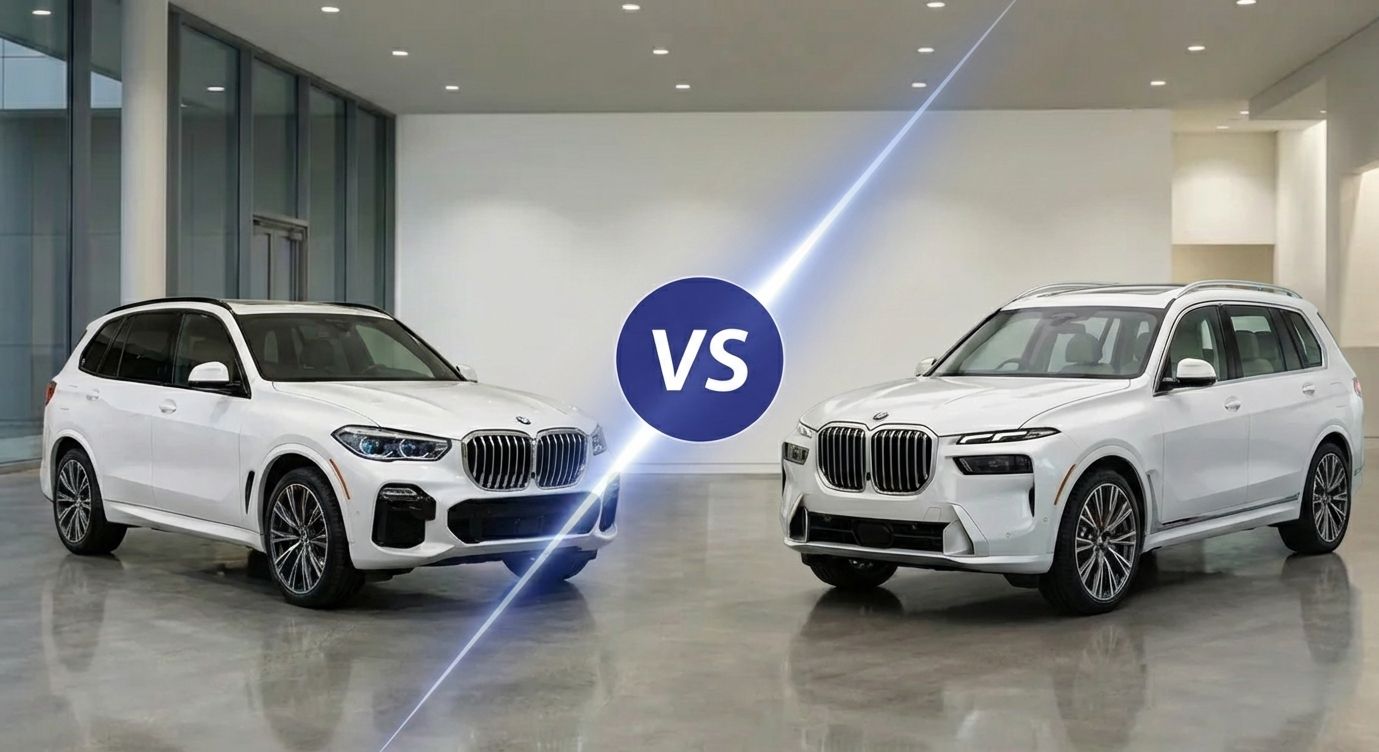
Detailed comparison of the BMW X5 vs. BMW X7. Discover the main differences in space, equipment, and real-world driving characteristics. Read our verdict and make the right choice!
Apr 14, 2026
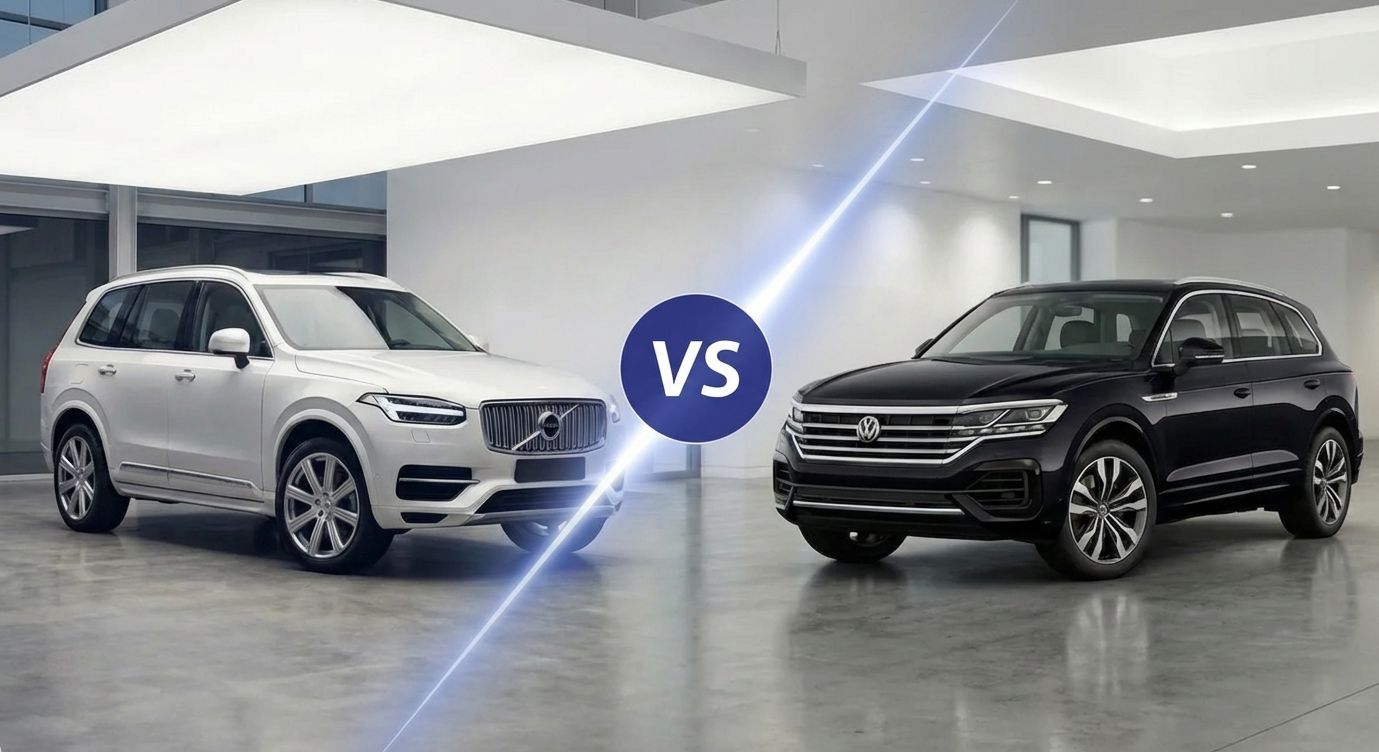
Volvo XC90 vs. Volkswagen Touareg: Which premium SUV is better? A detailed comparison, tests, and a clear verdict will help you choose.
Apr 14, 2026