Articles

Car battle

Audi Q8 e-tron vs. Mercedes-Benz EQE SUV: Complete comparison 2026

Comparison: Audi Q8 e-tron vs. Mercedes-Benz EQE SUV. Find out the real range, compare the equipment, and read our clear verdict. Which electric SUV to choose?

May 10, 2026

VS
Audi Q8 e-tron

Audi Q8 e-tron

Mercedes-Benz EQE SUV

Mercedes-Benz EQE SUV

Introduction

The Audi Q8 e-tron, formerly known on the market simply as the Audi e-tron, represents a seasoned pioneer of luxury electromobility that bets on majestic comfort and an elegant design familiar to fans of the brand's traditional internal combustion models. Standing against it is the Mercedes-Benz EQE SUV, a technology-packed premium model that brings top-tier aerodynamics and a strictly futuristic, innovative interior to this segment. In the following comparison, we will take a detailed look at which of these two prestigious German electric SUVs offers a better combination of range, driving characteristics, and overall utility value.

Comparison of External Dimensions

When looking at the external dimensions of these premium electric SUVs, the different approach of both carmakers to body proportions is striking. The Audi Q8 e-tron (in its updated GE generation) is, with its total length of 4915 mm, up to 52 mm longer than the Mercedes-Benz EQE SUV (generation 294), whose length ranges from 4863 to 4879 mm depending on the version. The width of both cars is very similar; Audi offers 1937 to 1994 mm, while Mercedes has a standard value of 1940 mm. The greater overall length gives the Ingolstadt model a slightly more majestic appearance of a traditional large SUV, but in narrow city streets and during parallel parking, the more compact footprint of the Mercedes will be a slight advantage. In terms of daily maneuverability and city parking, the EQE SUV may thus seem like a slightly more practical and driver-friendly choice.

A fundamental difference lies in the wheelbase values, where the advantage of Mercedes' purely electric platform over Audi's redesigned foundations is fully evident. Although the EQE SUV is shorter overall, its wheelbase is an impressive 3030 mm. The competing Q8 e-tron counters with a value of only 2923 to 2928 mm. This represents a massive difference of about 100 mm in favor of the Stuttgart model. This design detail means that Mercedes was able to push the wheels further into the corners of the body, which in practice translates into significantly more generous longitudinal space for passengers, especially in the rear seats. If your main priority is maximum interior space and comfort for adult passengers in the back, Mercedes-Benz clearly dominates in this discipline thanks to its long wheelbase and represents the better choice.

An interesting comparison is also provided by looking at the overall height of the vehicles. The Audi Q8 e-tron offers slightly more variability on the used car market, especially thanks to the availability of the sportier Sportback version, where the height is reduced to 1619 mm (standard SUV versions reach up to 1683 mm). The Mercedes-Benz EQE SUV sticks to a more traditional and uniform build with a height between 1669 and 1685 mm. The lower silhouette of the Audi not only benefits a more dynamic visual impression but also plays a role in aerodynamics, which can theoretically help efficiency at highway speeds. On the other hand, the slightly taller and more upright build of the Mercedes makes entry easier and ensures the popular upright position with an excellent view. For those looking for a more elegant look and a lower profile, the Audi Q8 e-tron is the more attractive choice, while the EQE SUV targets fans of classic SUV airiness and more comfortable cabin access.

ParameterAudi Q8 e-tron SUVMercedes-Benz EQE SUV
Length (mm)49154863 - 4879
Width (mm)1937 - 19941940
Height (mm)1619 - 16831669 - 1685
Wheelbase (mm)2923 - 29283030

Trunk Volume

When choosing a premium electric SUV, practicality and trunk capacity play a key role. Whether you're planning a family holiday, a weekend getaway into nature with plenty of gear, or just need enough space for a large grocery shop, extra liters can make a big difference. Both the Audi Q8 e-tron and the Mercedes-Benz EQE SUV bring generous space to the used car market, but each benefits from a slightly different body architecture and interior packaging.

Audi Q8 e-tron impresses in its standard body style (SUV) with a very solid base trunk capacity of 569 liters. This is a value fully sufficient for family travel, where you can easily fit suitcases and a stroller. After fully folding the rear seats, the space increases to 1,637 liters. If you are attracted to the more aerodynamic and stylish Q8 Sportback e-tron variant with its sloping roofline, you must expect a slight penalty for the design. The base trunk capacity of the Sportback version drops to 528 liters, and the total maximum cargo capacity after folding the seats is 1,567 liters.

The competing Mercedes-Benz EQE SUV offers a capacity of 520 liters in its basic five-seat configuration, placing it just below the classic Audi Q8 e-tron and on par with its Sportback version. However, the situation completely reverses when you need to transport bulkier cargo and fold the rear seats. At that point, the Mercedes reveals its perfect use of the platform and offers a maximum capacity of 1,675 liters. Thus, in its maximum configuration, the EQE SUV surpasses both Audi versions and provides users with space for several extra suitcases, which is excellent for moving house or transporting larger sports equipment.

ParameterAudi Q8 e-tron SUVAudi Q8 Sportback e-tron SUVMercedes-Benz EQE SUV
Base capacity (liters)569528520
Maximum capacity with seats folded (liters)163715671675

📦 Audi for daily basics, Mercedes for moving

While the Audi Q8 e-tron with its classic body style holds more luggage in its base configuration and facilitates everyday travel, the Mercedes-Benz EQE SUV excels in modularity and carries by far the largest load after the seats are folded.

Discover the true condition of the car thanks to an independent inspection

Order CarAudit™

Trailer Weights

Towing capacity is often a key factor for premium electric SUVs, especially if you are looking for a versatile family car. In practice, the trailer weight determines whether you can safely hitch up only a small garden waste trailer or if you have enough capacity for a large caravan or horsebox.

When comparing models from 2023 to 2025, which are the most relevant on the nearly-new used car market, the Audi Q8 e-tron offers complete peace of mind. Regardless of which performance version you choose (50 or 55) or if you opt for the more aerodynamic Sportback body, the maximum braked towing capacity is always fixed at 1800 kg. With this model, you don't have to deal with any compromises across the range.

Conversely, the Mercedes-Benz EQE SUV (generation 294) shows quite significant differences depending on the chosen motorization. Standard base variants, such as the 300 and 350+ versions (typically with rear-wheel drive to achieve maximum range), have a braked towing capacity limited to only 750 kg. To reach the maximum value of 1800 kg, which matches the rival Audi, you must look for more powerful all-wheel-drive versions of the Mercedes – specifically the 350, 500, or the sporty AMG versions (43 and 53).

The difference between 750 kg and 1800 kg has major practical implications. While the 750 kg limit on the base EQE SUV serves as space for a few extra suitcases or is sufficient for a weekend purchase of bulky material on an unbraked trailer, the 1800 kg towing capacity of the Audi and the more powerful Mercedes models will reliably serve you even for a long family holiday with a full-sized caravan.

In summary, the Audi Q8 e-tron represents a more universal and safer choice if you are buying a used car and require solid towing power regardless of the trim level. While the Mercedes-Benz EQE SUV offers identical maximum parameters, choosing one on the used market requires much more careful checking of the selected drivetrain to avoid an unpleasant surprise.
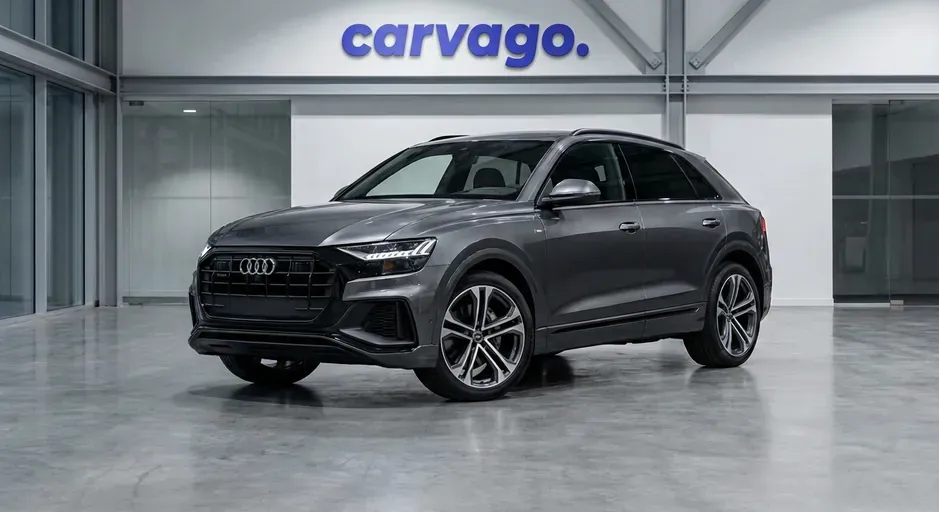
Model and engineBraked towing capacity (kg)Unbraked towing capacity (kg)
Audi Q8 e-tron 501800750
Audi Q8 e-tron 551800750
Audi Q8 Sportback e-tron (50, 55)1800750
Mercedes-Benz EQE SUV 300750750
Mercedes-Benz EQE SUV 350+750750
Mercedes-Benz EQE SUV 3501800750
Mercedes-Benz EQE SUV 5001800750
Mercedes-Benz EQE SUV 43 / 53 AMG1800750

Overview of Most Common Motorizations

When choosing a premium electric SUV, the powertrain plays a major role – it doesn't just dictate dynamics, but directly determines real-world range and overall efficiency. In the comparison between the Audi Q8 e-tron and the Mercedes-Benz EQE SUV, we encounter two completely different philosophical approaches to the electric platform. With the Q8 e-tron, Audi bets on certainty and robustness, providing two electric motors, massive torque, and quattro permanent all-wheel drive as standard for all its standard powertrains. Interestingly, thanks to this strategy, both of its available versions have an identical torque of 664 Nm and differ only in maximum power. Conversely, Mercedes has cast a much wider net with its dedicated EQE SUV. It provides purist single-motor versions focused on the lowest possible consumption and maximum range (which will be especially appreciated by long-distance highway drivers), but at the same time, it doesn't hesitate to offer extreme dual-motor derivatives from the AMG division with staggering power that far exceeds Audi's top standard offering.

Powertrains: Audi Q8 e-tron

The iconic fully electric Audi Q8 e-tron (GE generation) offers a straightforward and clear approach, where the drivetrain is uncompromisingly focused on traction and stability. Both of its standard specifications are equipped with quattro all-wheel drive as standard thanks to two built-in electric motors. The entry-level Q8 e-tron 50 provides a very solid 250 kW (340 hp), which is a respectable value for a base model. Its more powerful sibling, the Q8 e-tron 55, adds extra power with its 300 kW (408 hp). Although the power output differs, both powertrains share the same and immensely strong torque of 664 Nm. When choosing on the used car market, however, it is absolutely crucial to take into account the fact that, according to availability databases, production of these specific powertrains (50 and 55) for the Q8 e-tron model ended in February 2025. Today, you can find these electric variants primarily in the selection of nearly new, approximately 1 to 4-year-old used cars, where they represent an excellent purchase given their premium quality.

Engine typeFuelPower (kW)Torque (Nm)Transmission
50 quattroElectric2506641-speed auto
55 quattroElectric3006641-speed auto

Powertrains: Mercedes-Benz EQE SUV

On the opposite side of the spectrum stands the Mercedes-Benz EQE SUV (generation 294), which utilizes its pure electric architecture to provide maximum variability. If your priority is absolute range, the single-motor rear-wheel drive (RWD) models 300 (180 kW) and 350+ (215 kW) represent the peak of highway efficiency in the entire portfolio. For drivers who require traction on both axles, there is the 350 4MATIC version (which has the same 215 kW output but adds an enormous 765 Nm of torque) and the 500 4MATIC model, which shares the same 300 kW output as the more powerful Audi. Real ferocity, however, begins with the AMG sports division. It should be noted that the high-performance 43 AMG 4MATIC (350 kW) variant was withdrawn from sale and production in April 2025, making it an increasingly rare used car. The role of the ultimate performance peak is then confidently held by the 53 AMG 4MATIC+ powertrain, producing a brutal 460 kW.

Engine typeFuelPower (kW)Torque (Nm)Transmission
300Electric1805501-speed auto
350+Electric2155651-speed auto
350 4MATICElectric2157651-speed auto
500 4MATICElectric3008581-speed auto
43 AMG 4MATICElectric3508581-speed auto
53 AMG 4MATIC+Electric4609501-speed auto

Strengths and weaknesses of both concepts

The comparison of these two electric giants clearly shows the strengths and weaknesses of both strategies. The main advantage of the Audi Q8 e-tron is the absolute confidence of its foundation – you can't go wrong even with the base model, as you immediately get a top-tier 664 Nm of torque and reliable all-wheel drive. The only disadvantage is the narrow model range, which completely lacks "lightweight" single-axle drive versions for maximum range. The Mercedes-Benz EQE SUV lineup excels precisely in targeting the customer accurately. RWD models are champions of efficiency across highways, although the lack of front-axle drive might be an unforgivable compromise on winter roads for some in such a heavy and expensive SUV.

For families and drivers looking for traction and everyday safety, the robust (though no longer available as new) Audi Q8 e-tron 50 can be warmly recommended as a reliable four-year "partner". Conversely, for economically minded long-distance drivers, the Stuttgart-based EQE SUV 350+ will serve best, while fans of spirited driving and dream-like acceleration have no choice but to go for the AMG versions – in this performance territory, Audi offered no competition within this specific car family.

⚡ Two different approaches to electricity

While the Audi Q8 e-tron charms in the used car market with confident all-wheel drive in every version sold, the Mercedes-Benz EQE SUV wins on flexibility thanks to its range of efficient RWD models and uncompromising rockets from the AMG division.

Choosing the right powertrain is essential for these premium electric SUVs for long-term satisfaction, as the massive curb weight exceeding 2.5 tons places extreme demands on both powertrain efficiency and real-world battery capacity. While the Audi Q8 e-tron represents a solid evolution of the first e-tron with improved battery chemistry and relies on the robust MLB Evo group platform, the Mercedes-Benz EQE SUV is built on the fully dedicated EVA2 pure electric architecture. In the Mercedes, this manifests, among other things, in top-tier aerodynamic drag and a cleverly designed interior space. Our recommendations for an ideal used car roughly three to four years old are based on a balanced ratio of highway range, mechanical reliability, and everyday user comfort.

ModelRecommended powertrainPowerUsable batteryMarket availability
Audi Q8 e-tron55 quattro300 kW106 kWh2023 – present
Mercedes-Benz EQE SUV350 4MATIC215 kW89 kWh2023 – present

Note on availability: As shown by historical production data, both of our recommended fully electric versions were launched in 2023 and have been available without interruption since then. If you come across older internal combustion plug-in hybrids (e.g., Q8 55 TFSI e) in advertisements within the "Q8" family, check the model year – these models had a production hiatus and were completely absent from the new car market during 2023.

For the Audi Q8 e-tron, we recommend: 55 quattro, 300 kW

The 55 quattro version is by far the best choice in Audi's electric lineup because, unlike the base 50 version, it features a massive battery with a usable capacity of 106 kWh (vs. 89 kWh). This difference is key. The car's enormous weight simply requires a substantial energy reserve for the vehicle to confidently handle a real-world highway range of around 350 to 400 km without stress. You get an exceptionally calm cruiser whose two electric motors with 664 Nm of torque offer fantastically smooth acceleration in every situation.

  • Technical strengths: The absolute pride of this powertrain is its stable charging curve. The system can maintain a speed of 170 kW well past half the battery capacity, so you can charge from 10 to 80% at a fast charger in an excellent 31 minutes or so. The traction and confidence of the quattro all-wheel drive on snow are breathtaking in this class.
  • What to watch out for: The extreme weight on a conceptually older platform has two main drawbacks. The first is higher highway consumption (easily over 24 kWh/100 km). The second is rapid wear of the front tires and suspension arms. During the test drive, turn off the audio system and listen carefully for any dull thuds from the front axle or knocking in the steering. As a precaution, to protect the tires and expensive suspension components, we recommend performing a precise laser wheel alignment immediately after purchasing a used car.
  • Who the car is ideal for: This specification will delight more conservative high-mileage drivers. If you demand absolute tomb-like silence on board, traditional intuitive button ergonomics, and unsurpassed comfort for the whole family, this model is your clear favorite.

For the Mercedes-Benz EQE SUV, we recommend: 350 4MATIC, 215 kW

In the diverse range (starting with the base rear-wheel-drive 300 and ending with the devastatingly fast but expensive 500 or AMG models), the 350 4MATIC is the most rational middle ground. Although the 215 kW (292 hp) output may seem more modest on paper compared to the Audi, it lacks nothing in terms of lightning-fast response, and thanks to the efficient distribution of the massive 765 Nm torque, you won't feel a lack of dynamics even when the car is fully loaded.

  • Technical strengths: The battery with a usable capacity of 89 kWh fully benefits from the advantages of the dedicated EVA2 platform. The combination of sophisticated thermal management and teardrop-shaped aerodynamics pushes real-world consumption significantly closer to the 20 kWh/100 km mark, resulting in an easily achievable range of over 400 km. A major triumph in used cars is also the often-present rear-axle steering (up to 10 degrees) – thanks to it, the bulky SUV turns in parking garages with the agility of a city hatchback.
  • What to watch out for: The brake pedal in EQ family models initially has a very specific, almost "spongy" feel, and due to integration with intelligent recuperation, it will occasionally physically sink under your foot. This is not a brake fault, but a matter of habit, for which you should set aside a longer test drive. Mechanically, check the AIRMATIC air suspension compressor – before buying, have the car raised and lowered to its maximum. If the compressor runs very loudly or doesn't turn off, it's likely masking a microscopic air leak in a bellows. Ignoring this problem inevitably leads to the compressor burning out and a financially painful repair.
  • Who the car is ideal for: The EQE SUV is a perfect fit for tech enthusiasts and fans of futuristic "lounge" interiors. It is a wonderfully versatile vehicle for anyone who balances daily life in a congested city, where they will appreciate the unmatched maneuverability, but likes to enjoy an exceptionally soothing atmosphere on the highway on weekends.

Real Fuel Consumption

When evaluating both electric SUVs, it is necessary to keep in mind that real energy consumption can differ significantly from the official, laboratory-measured WLTP cycle values. To achieve the most objective comparison possible, we therefore base our findings on the real experiences of owners shared on the Spritmonitor.de platform and on independent user tests, where drivers record their long-term data from daily operation. This methodology provides us with an accurate picture of the actual energy requirements of both models, which you would find on the market as approximately four-year-old used cars.

Model and engine versionAverage consumption (kWh/100 km)
Mercedes-Benz EQE SUV 350+18.2
Mercedes-Benz EQE SUV 30018.6
Mercedes-Benz EQE SUV 500 4MATIC19.0
Mercedes-Benz EQE SUV 350 4MATIC19.1
Audi Q8 Sportback e-tron 5020.3
Audi Q8 Sportback e-tron 5520.7
Audi Q8 e-tron 5020.9
Audi Q8 e-tron 5522.8
Mercedes-Benz EQE SUV 43 AMG23.2
Mercedes-Benz EQE SUV 53 AMG23.2

The interpretation of the data shows a relatively clear trend. The Mercedes-Benz EQE SUV emerges from the comparison as a significantly more efficient electric car, thanks primarily to its sophisticated body aerodynamics and advanced architecture designed purely for electric drive. The most economical variant is the 350+ version with rear-wheel drive; however, even the more powerful all-wheel-drive versions (EQE 350 and 500) average around a very respectable 19 kWh/100 km. In contrast, the Audi Q8 e-tron, which uses a modified platform (GE generation) sharing some elements with internal combustion engine vehicles, shows significantly higher consumption. The basic 50 versions are safely above 20 kWh, and for the more powerful 55 version in the classic SUV body style, the average real consumption rises to nearly 23 kWh/100 km. At the same time, measurements clearly confirm that the smoothly sloping roof of the more aerodynamic Sportback version can actually save several tenths of a kilowatt-hour for every hundred kilometers in the Audi.

For the average user, these differences have a tangible impact on daily life with the car, especially on long journeys. For those who regularly cover many highway miles, the Mercedes-Benz EQE SUV will be a substantially more comfortable choice due to its lower energy requirements. The vehicle can squeeze a longer real-world range out of the battery, which ultimately means fewer forced stops at fast-charging stations. While the Audi Q8 e-tron tries to mask its appetite with a huge battery capacity (especially in the 55 variant), which is sufficient for a very decent range, the higher electricity consumption inevitably translates into more expensive operation and higher charging bills.

In conclusion, if overall operating efficiency and energy consumption economy are key factors for you, the Mercedes-Benz EQE SUV clearly has the upper hand over its rival from Ingolstadt in this regard. Although the Audi Q8 e-tron scores with top-tier travel comfort and luxurious craftsmanship, from a pragmatic point of view regarding consumption, the representative with the three-pointed star emerges as the winner of this electric duel.

Price Range and Used Car Offerings

Looking at the used car market roughly three to four years after their introduction (2022–2023 models), it is clear that both premium electric SUVs have seen a significant drop from their original list prices. The Mercedes-Benz EQE SUV and Audi Q8 e-tron (which replaced the original e-tron name in 2023) today represent an attractive entry point into the world of luxury electromobility on the secondary market, albeit with slightly different price curves.

Estimated Used Car Prices (2023–2024 Models)

ModelStarting Price (high mileage)The Golden Mean (optimal equipment)Top-tier Versions (AMG / SQ8)
Audi Q8 e-tronfrom €45,000€55,000 – €66,000€74,000 and more
Mercedes-Benz EQE SUVfrom €49,000€58,000 – €70,000€78,000 and more

A Detailed Look at the Audi Q8 e-tron

The Audi Q8 e-tron benefits from the fact that it is a deep facelift of the original and very popular e-tron model. Thanks to a wide base and an overall higher supply on the European used car market, it has become a slightly more affordable choice.

  • Entry-level Availability: The most affordable versions, labeled 50 quattro and with highway mileages over 60,000 km, start just above the €45,000 mark.
  • Best Value for Money: The most sensible compromise on the market is the more powerful 55 quattro version with a significantly larger battery (usable capacity 106 kWh). These models with mileage up to 40,000 km can be purchased for around €58,000 to €62,000, and in this price range, you will often find the desirable S line visual package.
  • Body Style Factor: Sportback versions with a sloping roofline are traditionally €2,000 to €4,000 more expensive on the used market than variants with the classic body style.

A Detailed Look at the Mercedes-Benz EQE SUV

Mercedes-Benz maintains a slightly higher average market value. This is partly due to it being a structurally newer model built from the ground up on a purely electric platform (EVA2), and also thanks to the often extremely expensive optional equipment that the first owners invested in.

  • Entry Level: Models with single-axle drive (e.g., EQE 300 or 350+) and higher mileage start at roughly €49,000.
  • Desired Specifications: All-wheel drive variants like the 350 4MATIC or the more powerful 500 4MATIC, ideally equipped with the futuristic MBUX Hyperscreen dashboard, rear-axle steering, and AIRMATIC air suspension, hold their value very firmly. Buyers typically pay between €62,000 and €70,000 for such a vehicle with an accident-free history.
  • Premium AMG: Sport-tuned derivatives from Affalterbach, namely the EQE 43 and the extreme EQE 53 AMG, appear relatively rarely on the secondary market, and their price seldom drops below the €78,000 mark.

From the perspective of total value loss, both vehicles represent a rational choice. After the initial massive drop from list prices, the secondary market offers generous electric vehicles for a fraction of the original amount. Audi leads in pure affordability for more powerful versions, while Mercedes-Benz benefits from its reputation as a technological leader, which is reflected in its more confident price tags.

Electric vehicles with a premium discount ⚡

While the Audi Q8 e-tron scores with a slightly more attractive price for desirable trim levels and a longer range for the mid-range version at a favorable price, the Mercedes-Benz EQE SUV holds its value slightly better thanks to its purely electric platform and top-tier technological equipment.

Safety and Euro NCAP Rating

Both of these premium electric vehicles earned the maximum five-star rating in independent Euro NCAP crash tests. However, when choosing a used car, it is crucial to put this score into the correct context. The methodology and requirements of the tests are constantly becoming more stringent over the years, so percentage results from different testing periods are not directly comparable. Newer protocols place much greater emphasis on precise assistance systems, protection of vulnerable road users, and sophisticated scenarios, such as autonomous braking in the event of a potential collision with a cyclist at an intersection.

Audi Q8 e-tron: A solid foundation proven by time

In terms of safety, the Audi Q8 e-tron benefits from the highly durable construction of the original e-tron model, from which it inherited its five-star certification obtained back in 2019. Although the tests were conducted according to older and less stringent standards, the car offers excellent structural rigidity, which is reflected in an outstanding 91% for adult occupant protection. However, in the areas of pedestrian protection (71%) and safety assistants (76%), the scores logically reflect the technological level of previous years. Although the Q8 e-tron is a very safe car, its rating simply does not include today's most modern and toughest certification scenarios.

Mercedes-Benz EQE SUV: Technological advancement from new tests

The Mercedes-Benz EQE SUV underwent Euro NCAP tests in 2023, i.e., according to one of the strictest current methodologies. Despite high demands including new types of frontal barriers, the car excelled. It earned an impressive 90% in child occupant protection and 85% for its advanced assistance systems. A slightly lower percentage for adult protection (87%) was, according to the test assessors, caused by a minor penalty for the performance of the center airbag for occupants of different body proportions. In all other respects, however, the Mercedes demonstrated that it possesses a top-tier and modern safety arsenal.

Euro NCAP results overview

ParameterAudi Q8 e-tronMercedes-Benz EQE SUV
Year of testing20192023
Adult protection91%87%
Child protection85%90%
Vulnerable road user protection71%80%
Assistance systems76%85%

Final evaluation
While the Audi Q8 e-tron represents a solidly built and immensely robust vehicle that met the requirements perfectly in its time, the Mercedes-Benz EQE SUV is a step forward thanks to its more recent testing date. It meets the more complex requirements of today's market and, from the perspective of modern active safety technologies, represents a slightly more advanced choice for buyers in the used car market.

More modern assistance for the EQE SUV 🛡️

Both cars guarantee a five-star level of safety, but the Mercedes-Benz EQE SUV was tested under a significantly stricter methodology in 2023, giving it a tangible lead in the quality and range of active assistants.

Comparison of Interesting Equipment Features

Both premium electric SUVs offer much more than just basic equipment, with each brand taking its own, very distinctive approach to added value, comfort, and technological innovation.

Audi Q8 e-tron: Advanced Aerodynamics and Triple-Motor Extremes

Audi relies on a combination of traditional luxury and futuristic elements for its flagship electric SUV, which actively improve the efficiency and safety of everyday driving.

  • Virtual exterior mirrors: This iconic feature (available as an option) replaces traditional mirrors with cameras. The image is projected onto OLED displays integrated into the front door panels. This solution is not only eye-catching but, above all, significantly reduces aerodynamic drag and wind noise at highway speeds.
  • Digital Matrix LED headlights: Audi's top-tier lighting technology can function as a video projector. On the highway, it can project a "light carpet" that guides the driver precisely within their lane, and in narrow sections, it shows the exact width of the vehicle, making orientation much easier.
  • MMI touch response control: The interior relies on a pair of stacked displays with haptic and acoustic feedback. This gives the driver the feeling of pressing physical buttons, helping with more confident control of the climate and infotainment even while driving.
  • SQ8 e-tron sports variant: For drivers seeking maximum dynamics, Audi offers a unique concept with three electric motors (one at the front, two at the rear). This solution enables fully variable torque vectoring between the rear wheels in real-time, giving the heavy SUV unexpected agility and sporty behavior in corners.
  • Standard air suspension: Every Q8 e-tron is equipped with adaptive air suspension as standard, which can change the vehicle's ground clearance by up to 76 millimeters. At higher speeds, the car crouches closer to the road for better range; in off-road conditions, it rises.

Mercedes-Benz EQE SUV: Hyperscreen and Absolute Agility

Mercedes-Benz benefits from the advantage of a dedicated all-electric platform (EVA2) and brings technologies to the segment focused on maximum visual experience, spatial comfort, and unrivaled maneuverability.

  • Revolutionary MBUX Hyperscreen: Available as an option (or standard on top versions), you'll find a dashboard consisting of a single seamless curved glass panel. It hides three separate screens, including a dedicated display for the passenger, who can watch movies while driving without distracting the driver.
  • Rear-axle steering: The EQE SUV can be equipped with rear-wheel steering with a steering angle of up to 10 degrees. This system reduces the turning circle from 12.3 meters to just 10.5 meters, meaning this large SUV maneuvers in tight city garages with the same ease as a compact hatchback.
  • Filtration system with HEPA filter: Part of the Energizing Air Control Plus equipment is a giant HEPA filter located under the front hood. It can remove up to 99.65% of fine dust particles, pollen, and even odors from the intake air, creating an environment in the interior on par with clean laboratory spaces.
  • Acoustic experience and Dolby Atmos: The Burmester 3D sound system doesn't just bring top-tier music listening supported by the Dolby Atmos format, but also specific "Soundscapes" for the drive itself. Sounds like Silver Waves or Roaring Pulse react dynamically to the accelerator pedal position and speed, compensating for the silence of the electric motor.
  • Top AMG models: The EQE SUV range is enriched by Mercedes-AMG models (e.g., EQE 43 and EQE 53). These bring not only extreme performance exceeding 600 hp but also the specific AMG Ride Control+ system, enhanced cooling for repeated loads, and a more aggressive aerodynamic package that clearly distinguishes the vehicle from standard versions.

Key Advantages and Disadvantages

Audi Q8 e-tron

Pros

Excellent ride comfort on long journeys thanks to the standard air suspension

Top-tier cabin soundproofing, making it one of the quietest cars in its class

More traditional and logical interior ergonomics with some physical buttons retained

Very flat fast-charging curve that maintains maximum power for a long time

Larger base luggage capacity (569 liters) and a more practical rear shape

Cons

Higher electricity consumption due to the use of a modified platform originally for internal combustion vehicles (MLB evo)

High curb weight (over 2.5 tons) impairing agility and handling in corners

The onboard system and infotainment graphics look slightly dated compared to more modern competitors

The Audi Q8 e-tron is an ideal choice for drivers looking for maximum comfort, precise craftsmanship, and a more conservative design that doesn't scream "electric car" at first glance. It is perfectly suited for long highway trips, where the occupants will appreciate the fantastic soundproofing and reliable charging speed without significant power drops.

Mercedes-Benz EQE SUV

Pros

Dedicated electric platform (EVA2) ensuring excellent overall efficiency and space utilization

Great aerodynamics and lower average energy consumption, resulting in a longer real-world range

Top-tier technology led by the MBUX system and the optional Hyperscreen dashboard

Stunning maneuverability in urban environments thanks to available rear-axle steering (up to 10 degrees)

Cons

Specific rounded body design, which is less majestic in terms of proportions and may not suit everyone

Ambiguous and artificial brake pedal feel during the transition between recuperation and mechanical brakes

Slightly smaller luggage compartment (520 liters) compared to the Q8 e-tron

Less headroom in the rear seats due to the significantly sloping roofline for aerodynamics

The Mercedes-Benz EQE SUV will appeal to tech enthusiasts and buyers who prefer the longest possible range supported by top efficiency and modern electric architecture. It is a perfect choice for those looking for futuristic luxury inside the cabin and unrivaled agility in narrow streets, albeit at the cost of slight compromises in trunk space.

Common Problems and Owner Complaints

Based on experience from long-term testing, fault statistics, user reports, and practical results, including a comprehensive car inspection, we have compiled an overview of the most common problems that buyers of both used electric vehicles should watch out for.

Audi Q8 e-tron

For the Audi Q8 e-tron (and its immediate predecessor, the e-tron), most common problems relate to software imperfections and the vehicle's massive weight; however, it has not escaped more critical recalls focused on the braking system.

  • Braking system and wear: The extreme weight of this large SUV leads to rapid wear of brake pads and discs. Owners frequently report vibrations from the front brakes even during light braking. The car also faced recalls due to an over-tightened brake line connection (fluid leak) and even a potential loosening of the brake pedal.
  • Software and infotainment: Software glitches often appear in the form of MMI system freezes, communication failures with the myAudi mobile app, and occasional malfunctions of the rear parking camera display. Most of these issues are reliably resolved with a free software update at the dealer.
  • Charging issues: Especially at DC fast-charging stations, problems with charging initialization (the "handshake" between the car and the charger) occasionally occur, which can interrupt the process halfway or prevent it from starting at all.
  • Water ingress and build quality: User reports occasionally mention water leaking through the panoramic sunroof, typically due to clogged drainage channels, or annoying creaking of plastics on the center console.
  • Coolant leak into the motor: This is an expensive structural problem primarily known from older e-tron models; however, given the identical technical basis of the platform, it is essential to have the tightness of the cooling circuit for both electric motors thoroughly checked on a lift.

Audi Q8 e-tron: Watch out for brakes and software

A well-built SUV with above-average reliability of high-voltage batteries, but with a risk of expensive brake repairs and frequent software ailments. A documented service history, including resolved recalls, is an absolutely essential condition for purchase.

Mercedes-Benz EQE SUV

Mercedes' electric SUV faced several significant "teething problems" in its first years of production, with recalls for electrical wiring and control software requiring the most attention for used cars.

  • Battery Management System (BMS) and loss of power: A large portion of models underwent a very serious recall due to battery management software. Faulty software could lead to a sudden shutdown of the high-voltage circuit and a complete loss of driving power while driving. It is therefore necessary to verify whether the software has been updated to the latest version as part of this official recall.
  • Electrical system and fuses: The manufacturer also addressed physical defects in the electrical system, such as a problematic main fuse that could cause a failure of critical systems. User complaints about unexpected and excessive discharge of the 12V battery during longer periods of vehicle inactivity are also common.
  • Steering and chassis: A certain group of EQE SUV vehicles from early production was recalled due to an improperly tightened steering coupling bolt. If it were to loosen, there would be a risk of partial to complete loss of vehicle control.
  • Tires and braking system: Rapid wear of front tires, which are often ready for replacement after less than 30,000 km, is the rule for such a heavy electric vehicle. If the driver does not actively use strong regenerative braking for deceleration, very rapid wear of brake components must also be expected.
  • Assistance systems and interior details: Occasional difficulties include malfunctions of the external acoustic pedestrian warning when reversing (the AVAS system required a widespread update), unexpected failures of ambient LED lighting segments on the passenger side, or minor drivetrain vibrations felt at very low speeds.

Mercedes-Benz EQE SUV: Verify key updates

An exceptionally comfortable car whose early production was marked by several serious software and electrical issues. However, once it has all safety repairs documented and applied, it becomes a reliable highway cruiser where you mainly need to watch out for rapidly disappearing tires.

Tips for Buying a Used Car

When buying a used car, a thorough inspection is key. Here are some specific points to focus on for these two models, while the ideal assurance is always an independent used car inspection by a professional.

When choosing an Audi Q8 e-tron:

  • Brake pedal behavior and brake wear:
    Why it matters: The high weight of this large SUV causes faster wear of both brake discs and pads. Additionally, some model years had a recall for the brake pedal screw connection, which could affect braking efficiency.
    How to detect a potential problem: During the test drive, test the smoothness of the braking and notice if the brake pedal engages too deep or makes unusual noises. Visually check the edge and thickness of the brake discs.
  • Charging system and charging port functionality:
    Why it matters: On the Q8 e-tron (as well as its predecessor), there can be issues with charging interruptions on DC fast chargers or problems with 220V charging cables, for which a recall was issued due to overheating risks.
    How to detect a potential problem: Try opening and closing the charging port cover, which occasionally sticks or freezes in cold weather. Connect the car to an AC charger and observe if the vehicle starts charging without error messages and if the cable locks correctly.
  • Coolant leaks into electric motors:
    Why it matters: This is a very costly defect where, due to seal failure, coolant can leak directly into the internals of the electric motor.
    How to detect a potential problem: A physical leak inside the stator is invisible to the naked eye, but a warning sign is a low coolant level message on the dashboard. If the car reports a cooling error, it is a major reason why a thorough physical inspection of the vehicle should take place.
  • Air suspension and its smoothness:
    Why it matters: The Q8 e-tron relies on air suspension as standard. Although it guarantees immense comfort, a potential compressor failure or a ruptured air spring is an unpleasant expense.
    How to detect a potential problem: While the car is stationary, try changing the ride height across all driving modes (e.g., from Dynamic to Offroad). Observe if the car rises evenly and if you hear any hissing from the wheels indicating an air leak.
  • MMI infotainment stability and reversing camera:
    Why it matters: Screen freezes and software glitches are relatively common quirks, and Audi previously addressed issues with the parking camera display failing.
    How to detect a potential problem: During the test drive, try switching quickly between navigation, media, and the parking camera view. If the system responds with a long delay, the screen goes black, or it restarts on its own, it indicates the need for a software intervention.

When choosing a Mercedes-Benz EQE SUV:

  • Battery Management System (BMS) software status and 12V network:
    Why it matters: Many EQE SUV models were subject to an extensive recall due to a battery management software error that could unexpectedly disconnect the high-voltage battery and cause a sudden loss of power while driving.
    How to detect a potential problem: Request confirmation from the service history that the vehicle has undergone the necessary software update at a dealer. While exploring the trip computer, also focus on whether the car suffers from excessive battery drain while parked (so-called phantom drain).
  • Electric motor mounts (bushings) and vibrations:
    Why it matters: The heavy powertrain and immense torque put the motor mounts through a lot of stress. Worn bushings transmit unpleasant shocks to the entire body.
    How to detect a potential problem: During the drive, alternate between sharp acceleration and subsequent strong recuperation. If you feel vibrations in the floor or steering wheel, or hear dull metallic thuds from the chassis when the load changes, the motor mounts may be due for replacement. A comprehensive car inspection will always reliably detect this problem.
  • Interior build quality and plastic creaking:
    Why it matters: Many owners of EQE family models complain about the occasional use of cheap-feeling plastics and their creaking, which strongly disrupts the premium experience in an otherwise perfectly soundproofed electric cabin.
    How to detect a potential problem: Turn off the audio system and drive over cobblestones or speed bumps. Also, try pressing lightly with your fingers on the dashboard trim, wood decors, and center console – loud cracking or creaking indicates poor fit and finish.
  • Steering and steering column recall:
    Why it matters: Some early models had an issue with an incorrectly tightened bolt on the steering coupling. This is an absolutely critical safety component.
    How to detect a potential problem: While driving slowly, turn the steering wheel fully from one lock to the other. The steering must be perfectly smooth and precise at all times. Any grinding, excessive play in the steering, or subtle clicking in the column is a reason for an immediate technical inspection.
  • Abnormal tire wear and wheel alignment:
    Why it matters: The EQE SUV is a vehicle with a huge curb weight. Rapid starts from intersections can "eat" a set of tires in less than 25,000 km on more powerful versions.
    How to detect a potential problem: Before driving, visually check and measure the tread depth on all wheels. If you notice that the edges of the tires are worn significantly more than their center, the car will urgently need a wheel alignment to prevent further expensive wear on the tires.

FAQ: Most Frequently Asked Questions

The Mercedes-Benz EQE SUV is overall more aerodynamic and energy-efficient, which ensures a slightly longer range in real-world driving. Although the Audi Q8 e-tron offers a battery with a larger capacity in its top versions, this compensates for its higher overall energy consumption. Depending on the chosen motorization, however, both luxury SUVs can cover over 500 kilometers on a single charge according to the WLTP standard.

The Audi Q8 e-tron wins in terms of overall practicality with a main trunk volume of 569 liters and adds a handy 62-liter front trunk (frunk), ideal for storing charging cables. The Mercedes-Benz EQE SUV has a slightly smaller luggage compartment with a capacity of 520 liters. The front storage space is completely missing in the Mercedes because the hood is permanently closed from the factory and can only be opened by a service center.

Both premium vehicles support DC fast charging with a maximum power of up to 170 kW in top specifications. Audi boasts an excellent and flatter charging curve, thanks to which it maintains maximum power for a much longer time. In practice, you will spend a similar amount of time at a fast charger with both models when charging from 10 to 80%, around 30 minutes.

The Mercedes-Benz EQE SUV has a significant advantage in the city thanks to the optional rear-axle steering system of up to 10 degrees. This innovative feature significantly reduces the turning radius to the level of compact hatchbacks, making parallel parking and turning easier. Audi, on the other hand, is more of a traditional, bulky SUV that can feel a bit more cumbersome in narrow multi-story parking garages.

Mercedes impresses with a futuristic and extravagant concept, especially if equipped with the massive MBUX Hyperscreen, which seamlessly covers the entire width of the dashboard. Audi, on the other hand, bets on the evolution of its traditional design with two central touchscreens and emphasizes absolutely precise and conservative craftsmanship. While Mercedes will thrill fans of the latest gadgets, Audi will appeal to drivers who prefer elegant and proven ergonomics.

Conclusion: Which Model to Choose?

Our Verdict

Choosing between the Audi Q8 e-tron and the Mercedes-Benz EQE SUV represents a choice between honest traditional luxury and advanced electric architecture. The Audi Q8 e-tron scores with majestic comfort, top-tier soundproofing, and everyday versatility thanks to a larger luggage compartment and standard high towing capacity, making it an ideal highway cruiser for families and more conservative drivers. In contrast, the Mercedes-Benz EQE SUV fully benefits from a dedicated platform, which brings excellent aerodynamics, more efficient operation with a longer real-world range, and, thanks to active rear-axle steering, also unprecedented agility in tight city traffic. If you are looking for the uncompromising comfort of a classic large SUV with the robustness and confidence of all-wheel drive, go for the Audi, while tech enthusiasts requiring maximum efficiency and a futuristic interior will find their perfect companion in the Stuttgart model.

Find your ideal car

Sources: ADAC, forbes.cz, e15.cz, hybrid.cz, emobility.cz, autosport.cz

This article was prepared using artificial intelligence tools. The section guarantor is Petr Dušek.

Related articles

Car battle

BMW iX3 vs. Jaguar I-Pace: Complete comparison 2026

Detailed comparison of the BMW iX3 vs Jaguar I-Pace. Discover the differences in range, equipment, and driving experience. Read our verdict and choose the best premium electric SUV.

Apr 23, 2026

Car battle

Škoda Enyaq iV vs. Volkswagen ID.4: Complete comparison 2026

Detailed comparison of the Škoda Enyaq iV vs. Volkswagen (VW) ID.4. Discover the real differences in range, equipment, and reliability, and choose the right electric SUV for you.

Apr 27, 2026

Car battle

Audi Q4 e-tron vs. Volvo XC40 Recharge: Complete comparison 2026

Detailed comparison of the Audi Q4 e-tron and Volvo XC40 Recharge. Which premium electric SUV has better range and real-world consumption? Read our clear verdict.

Apr 22, 2026

We accept online card payments as well as wire transfers.

visa payment provider logovisa-electron payment provider logomastercard payment provider logomaestro payment provider logodiners-club payment provider logodiscover payment provider logo