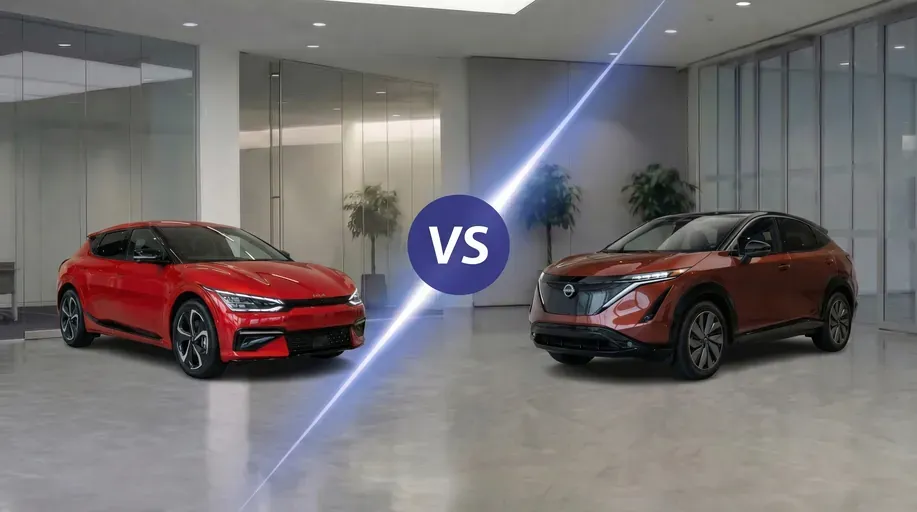
Car battle
Kia EV6 vs. Nissan Ariya: Complete comparison 2026
Detailed comparison of Kia EV6 vs. Nissan Ariya. A detailed look at range, performance, and real-world experience. Find out which electric crossover is the right one for you.
Apr 14, 2026
Articles
Car battle
Comprehensive comparison of Toyota bZ4X vs. Volkswagen ID.4. Discover the real-world range, differences in equipment, and read our verdict on which electric SUV to choose.
April 15, 2026
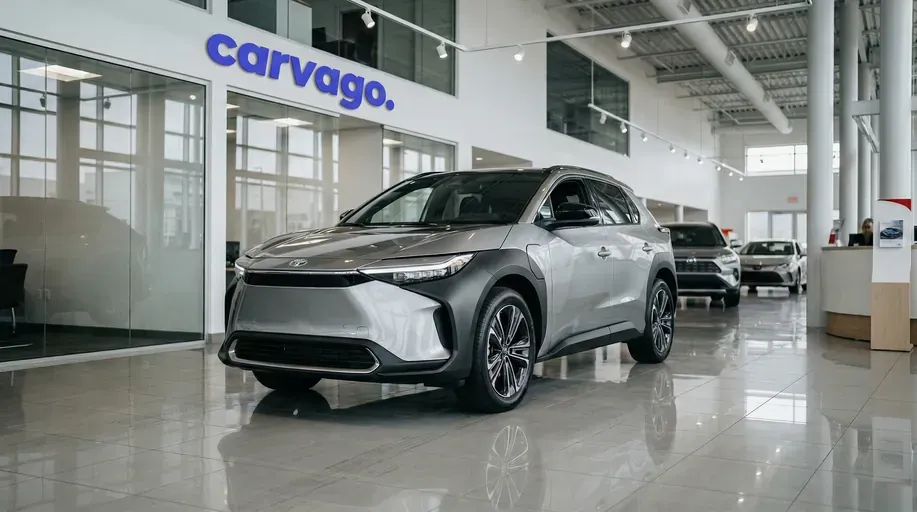
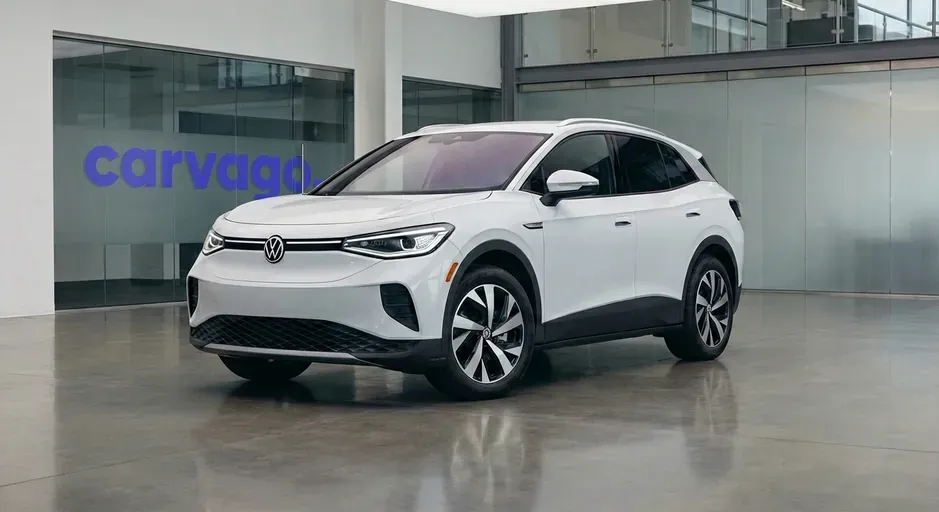
In today's showdown, we take a look at the innovative electric SUV Toyota bZ4X, which is also sold under the shortened name Toyota bZ in selected markets such as North America or Ireland. Its rival is the established Volkswagen ID.4, which is available in Asian countries under the names ID.4 Crozz or ID.4 X and which, as part of recent corporate changes, is gradually transitioning to the new designation ID. Tiguan. Let's explore the features of both cars in detail and find out together which of these modern family electric vehicles emerges as the overall winner from our direct comparison.
Looking at the exterior dimensions of both electric family SUVs, we find that although they target the same audience, their proportions differ slightly. The Toyota bZ4X is, with its length of 4690 mm, approximately 106 to 108 mm longer than the Volkswagen ID.4 (4582–4584 mm depending on the version and equipment). In terms of width, both models are almost identical; the bZ4X measures 1860 mm and the ID.4 just a negligible 8 millimetres less (1852 mm). The greater overall length of the Japanese car gives it a more elongated, dynamic silhouette, while the slightly shorter body of its German competitor, on the other hand, makes manoeuvring in narrow city streets and parallel parking easier.
A different approach to design can be found when looking at the height of both vehicles. The Volkswagen ID.4 comes across as a more traditional, robust SUV with a height between 1632 and 1640 mm, whereas Toyota bets on a lower build with a value of exactly 1600 mm. Toyota's lower centre of gravity and more aerodynamic profile can theoretically help overall highway stability and airflow efficiency. Volkswagen, on the other hand, benefits from its slightly taller build in the interior – passengers have more headroom, which will be appreciated especially by taller adult passengers.
However, the key parameter for the interior layout is the wheelbase, where the Japanese representative leads significantly. The Toyota bZ4X offers a generous 2850 mm, which is nearly 80 mm more than the Volkswagen ID.4 with its 2769–2771 mm. This difference translates positively into longitudinal legroom in the rear seats, where the Toyota can easily compete even with cars a class larger. When choosing a used car, it mainly depends on personal preferences: if maximum knee room is a priority for you and you are attracted by a sportier low profile, the Toyota makes sense, while if you prefer a more airy feeling overhead with more compact exterior dimensions, the Volkswagen will serve you better.
| Parameter | Toyota bZ4X SUV | Volkswagen ID.4 SUV |
|---|---|---|
| Length (mm) | 4690 | 4582–4584 |
| Width (mm) | 1860 | 1852 |
| Height (mm) | 1600 | 1632–1640 |
| Wheelbase (mm) | 2850 | 2769–2771 |
Luggage capacity is a key factor for many buyers, especially when choosing a practical family electric SUV. When comparing models available on the used car market from the first years of production (around 4 years old), the German model has a clear advantage in the basic configuration. The Volkswagen ID.4 offers a generous standard trunk volume of 543 liters, which is significantly more than the Toyota bZ4X, which has a space of 452 liters. In practice, the 91-liter difference represents space for one larger suitcase or several extra travel bags. This makes the Volkswagen a slightly more suitable choice for worry-free packing for a weekend or a longer family holiday without having to stack luggage all the way to the roof.
However, an interesting twist comes when you need to transport bulkier cargo and fold down the rear seats. Here, the situation levels out, and in terms of space, the two cars are almost identical, or even the opposite. The maximum volume of the Volkswagen ID.4 stops at 1,575 liters after fully folding the seats, while the Toyota bZ4X, thanks to its excellent interior packaging, offers up to 1,589 liters. The Japanese model also scores points with a sufficiently wide loading opening and a relatively flat loading surface, which greatly facilitates handling longer sports equipment, bicycles, or bulky furniture from a DIY store.
When choosing a used car, however, it is good to keep in mind the minor differences between individual equipment levels and versions. While the Volkswagen ID.4 surprisingly maintains its 543-liter capacity even in the more powerful dual-motor GTX version with all-wheel drive, the situation is slightly different for the Toyota bZ4X. Some models with the AWD (all-wheel drive) badge or versions equipped with the optional JBL audio system with a subwoofer have a different floor layout, and the trunk volume can thus drop to between 410 and 421 liters. It is also important to mention that neither of these SUVs offers a practical storage space under the front hood (the so-called frunk), so muddy charging cables must always be stored in the double floor of the rear trunk. As a result, the Volkswagen better meets the typical needs of a family, but the Toyota does not lag behind at all when fully loaded.
| Parameter | Toyota bZ4X SUV | Volkswagen ID.4 SUV |
|---|---|---|
| Basic volume (liters) | 452 | 543 |
| Max. volume after folding seats (liters) | 1589 | 1575 |
Thanks to its larger basic trunk, the Volkswagen ID.4 is a significantly better choice for families looking for everyday practicality; however, after folding the seats, both cars offer an excellent and spatially perfectly balanced solution for bulky cargo.
Historically, electric vehicles have not been among the champions of towing heavy loads, but for many buyers, the trailer weight remains an absolutely key figure. It determines the overall practicality of the car, whether it's for transporting garden waste, moving bulky items, or traveling with a caravan. Looking at roughly four-year-old used cars from 2021 to 2024, the two compared models offer quite different possibilities that can play a crucial role in choosing a vehicle.
If we focus on older Toyota bZ4X models (from 2022–2024), we find that their towing capacity is very limited. Both the standard and maximum braked trailer weight for these model years is only 750 kg, which also corresponds to the capacity for an unbraked trailer. In contrast, the first-generation Volkswagen ID.4 (from 2021–2023) fares significantly better. Its basic rear-wheel-drive versions, such as the ID.4 Pure or Pro Performance, can easily handle a braked trailer weighing 1,000 kg. For more powerful variants or all-wheel-drive models, including the Pro version or the sportier ID.4 GTX, the maximum limit for these model years increases to a solid 1,200 kg. In the case of an unbraked trailer, Volkswagen also offers a standard limit of 750 kg.
In practice, these differences mean that while the tow bar on the Toyota bZ4X serves primarily as a solid base for a heavier e-bike rack or is sufficient for a small trailer for a weekend trip to the DIY store, the Volkswagen ID.4 is much more versatile. The higher weight limit gives you the necessary space for a few extra suitcases in the form of a bulky roof box with a fully loaded trailer behind the car, but above all, it allows you to hitch up even a lighter caravan for a longer holiday or safely move heavier pieces of furniture.
From the perspective of overall utility value, the German representative clearly has the upper hand in this age category for active drivers. Although Toyota has significantly increased the towing capacity in its newer models, in the market for roughly four-year-old used cars, the ID.4 offers noticeably better and more usable towing capabilities, significantly expanding its everyday versatility.
| Model and powertrain | Braked trailer weight (kg) | Unbraked trailer weight (kg) |
|---|---|---|
| Toyota bZ4X (2022 – 2024) | 750 | 750 |
| Volkswagen ID.4 Pure / Pure Performance | 1000 | 750 |
| Volkswagen ID.4 Pro Performance | 1000 | 750 |
| Volkswagen ID.4 Pro | 1000-1200 | 750 |
| Volkswagen ID.4 GTX (2021 – 2023) | 1200 | 750 |
Both models, the Toyota bZ4X and the Volkswagen ID.4, position themselves in the market as family battery electric SUVs (BEVs), but their approach to powertrains is diametrically different, which fundamentally influences used car buyers. While the Japanese automaker bets on a minimalistic and exceptionally clear range of two variants for its first full-fledged electric car (standard FWD with 150 kW and a slightly more powerful AWD with 160 kW), Volkswagen sticks to its proven tactic of a broad portfolio. For a four-year-old ID.4 model, customers can choose from purely budget and city-oriented variants (Pure with 109 kW), through stronger "mileage eaters" (Pro Performance with 150 kW), to high-performance all-wheel drive under the GTX label (220 kW). This diversity of concepts gives Volkswagen a clear advantage in flexibility for buyers with a very tight or, conversely, higher budget. Toyota, in return, excels with an excellent compromise, emphasizing an outstanding traction system for AWD models called X-MODE, developed with Subaru, which gives the bZ4X surprising capabilities for its class in light off-road conditions or snow. For both manufacturers, the driving force is pure electricity combined with a single-speed automatic transmission.
The Toyota bZ4X (EAM1 generation) entered the market in the spring of 2022 and follows a philosophy where there is no need to complicate the price list. The base is the front-wheel drive (FWD) version, which delivers 150 kW (204 hp) and a generous 266 Nm of torque via a single electric motor, making it an absolutely ideal and balanced setup for longer daily trips with an emphasis on the lowest possible energy consumption. More demanding clients in the used car market can then opt for the sophisticated AWD version with all-wheel drive. It uses two separate 80kW motors on the front and rear axles, generating a combined system output of 160 kW (218 hp) with a maximum torque of 337 Nm. Although both motorizations remained untouched in later production phases, you can no longer find the original early equipment packages today, such as the widely sold Comfort and Technology Package AWD from the period 08/2022 to 04/2024. These richly equipped first versions are thus an exclusive matter solely for the market of nearly new and four-year-old used cars.
| Engine type | Fuel | Power (kW) | Torque (Nm) | Transmission |
|---|---|---|---|---|
| Electric motor (FWD) | Electricity | 150 | 266 | 1-speed automatic |
| Electric motor (AWD) | Electricity | 160 | 337 | 1-speed automatic |
While Toyota's offering is sparse and stable, the situation for the Volkswagen ID.4 (1st generation) changed dramatically between 2021 and 2024. For the market of roughly four-year-old vehicles, this means one absolutely key thing: most used cars from this period rely on power units that are no longer in production and have become the exclusive domain of the second-hand market. Those looking for a more affordable family car often come across the rear-wheel drive Pure (109 kW) and Pure Performance (125 kW) models from 2021 and 2022, whose production has already ended. The Pro Performance (150 kW) variant, producing a solid 310 Nm, has thus become a clear favorite among used cars, with its life cycle for new vehicles ending in October 2023. This highly versatile variant was complemented by the Pro 4MOTION (195 kW) all-wheel drive. However, if a driver required pure dynamics, they could choose the top-tier GTX 4MOTION (220 kW, 460 Nm) edition. Similar to the Pro specification, the original 220 kW GTX also ceased production in October 2023 to make way for even more powerful successors (GTX from 10/23 offers 250 kW). For budget-conscious drivers, we recommend looking for available Pure Performance models, while individuals preferring brisker highway travel with 4x4 drive will undoubtedly appreciate the availability of the aforementioned original 220 kW GTX model.
| Engine type | Fuel | Power (kW) | Torque (Nm) | Transmission |
|---|---|---|---|---|
| Pure (RWD) | Electricity | 109 | 220 | 1-speed automatic |
| Pure Performance (RWD) | Electricity | 125 | 310 | 1-speed automatic |
| Pro Performance (RWD) | Electricity | 150 | 310 | 1-speed automatic |
| Pro 4MOTION (AWD) | Electricity | 195 | 425 | 1-speed automatic |
| GTX 4MOTION (AWD) | Electricity | 220 | 460 | 1-speed automatic |
While the Volkswagen ID.4 pleases with an unrivaled number of discontinued but proven powertrains, from which every buyer can choose their ideal performance and price, the Toyota bZ4X is a simple and reliable bullseye with a flawless all-wheel drive system.
Choosing the right powertrain is crucial for long-term satisfaction with electric vehicles, as it affects not only real-world range and dynamics but also charging speed and overall vehicle reliability. While the Toyota bZ4X entered the market in 2022 with an emphasis on robustness and long-term battery life through very conservative management, the Volkswagen ID.4—a representative of the established MEB platform from 2021–2022—bets on rear-wheel drive, which gives it excellent agility in the city, and offers a wider range of batteries. Both cars primarily target families, yet their approach to efficiency and software management differs significantly. Our recommendations are based on real-world experience, consumption, user feedback, and the mechanical reliability of vehicles approximately three to four years old.
Official consumption figures provided by manufacturers often appear very optimistic in catalogs, but the reality on the road tends to be somewhat different. This is doubly true for electric vehicles, where consumption and subsequent range heavily depend on the route profile, driving style, and outside temperature. To get the most accurate picture of how both electric SUVs perform as roughly four-year-old used cars, we used real-world data from hundreds of users on the Spritmonitor.de portal, reflecting everyday family and highway use.
| Model and motorization | Average consumption (kWh/100 km) |
|---|---|
| Toyota bZ4X | 15.3 |
| Volkswagen ID.4 Pro Performance | 16.5 |
| Volkswagen ID.4 Pure | 16.8 |
| Volkswagen ID.4 Pro | 17.1 |
| Volkswagen ID.4 GTX | 17.6 |
Very interesting trends emerge from the collected data. The Toyota bZ4X proves to be the more economical choice overall in the real world. According to long-term data, the Japanese representative shows a solid average of around 15.3 kWh/100 km. With the Volkswagen ID.4, on the other hand, we encounter a minor paradox more commonly known from the era of conventional powertrains – a weaker motorization does not automatically mean lower consumption. The base Pure version and the standard Pro version range between 16.8 and 17.1 kWh/100 km. In contrast, the more popular and powerful Pro Performance variant (150 kW) paradoxically fares slightly better, settling at an average of 16.5 kWh. The reason is a more efficient matching of engine power to vehicle weight and more sophisticated recuperation calibration. The least economical, though most capable model, is the sport-tuned GTX all-wheel drive with consumption approaching 17.6 kWh/100 km.
For the average user, a clear recommendation follows from these facts. If you are looking for an electric car primarily for efficient movement on suburban routes and frequent stop-and-go traffic, the Toyota bZ4X can reduce operating costs for home charging thanks to its exemplary energy management. Conversely, those interested in the Volkswagen ID.4 who frequently take to the highways should not aim for the weakest versions when choosing from a used car dealership. The Pro Performance model makes clear sense in terms of efficiency, as it requires slightly less energy for its services on long trips than the weaker specifications, while offering a much more pleasant power reserve for safe overtaking.
In conclusion, although the Japanese model wins the consumption comparison quite convincingly, a difference of roughly 1.5 to 2 kWh per hundred kilometers does not represent a financial catastrophe. With a typical annual mileage in an electric SUV, this value will not drastically affect the family budget. Consumption as such should therefore not be the sole determining argument in this duel – decisions should rather be based on the required trunk size, usable battery capacity, and real-world highway range, which is influenced not only by efficiency itself but also by the overall battery size of both rivals.
When choosing a used electric SUV around four years old, it's not just the original purchase price that matters, but primarily the different rates of depreciation and the varying lengths of time both models have been on the market. While one of the vehicles is already firmly established on the secondary market, the other is still perceived more as a hot new arrival, which is naturally reflected in the used car price tags.
| Feature | Volkswagen ID.4 | Toyota bZ4X |
|---|---|---|
| Typical age on the used market | 4–5 years (2021–2022) | 3–4 years (2022–2023) |
| Approximate price from | ~ €18,000 | ~ €27,000 |
| Used car availability | High | Lower |
| Key second-hand attraction | Availability and huge selection of equipment | Excellent battery warranty and reliability |
The Volkswagen ID.4 represents a more affordable and flexible choice on the used market thanks to its diverse range of used vehicles, while the Toyota bZ4X requires a higher initial investment, which is balanced by its younger age and traditional emphasis on long-term warranty.
Both of these family-oriented electric vehicles, the Toyota bZ4X and the Volkswagen ID.4, achieved the maximum five-star rating in independent Euro NCAP crash tests. However, when interpreting these results for roughly four-year-old used cars, it is essential to understand the broader context and check the specific year of testing. Euro NCAP test protocols are constantly evolving and becoming stricter over the years – adding more complex simulations of frontal impacts into moving obstacles, emergency scenarios at intersections, and much more demanding parameters for detecting cyclists or pedestrians. Percentage results from different years are therefore not absolutely and directly comparable; they serve more as an indicator of how successfully a given model handled the strict methodologies of its time.
The Toyota bZ4X underwent testing at the end of 2022. Its excellent result fully reflects the implementation of the then-latest assistance features within the advanced Toyota Safety Sense package. The model earned an extraordinary 91% in the safety assist category, where test commissioners particularly praised the precise autonomous emergency braking that reacts not only to cars but also to vulnerable road users. With adult occupants (88%) and child occupants (87%), the structure handled impacts excellently, and the passenger compartment remained highly stable. Protection of vulnerable road users at 79% is a very solid standard for a larger electric SUV.
The Volkswagen ID.4 underwent crash tests a year earlier, in 2021. Its results clearly demonstrate the structural advantages of the rigid MEB platform, thanks to which the ID.4 excels primarily in passive safety. Adult occupant protection reached a great 93% and child protection exactly 89%. Volkswagen significantly benefited from, among other things, the installation of an innovative center airbag, which effectively prevents the heads of the driver and front passenger from colliding during a severe side impact. With a rating of 85% for assistance systems and 76% for vulnerable road users, the car proves that its standard features, including the innovative Car2X hazard warning technology, set a complete trend at the time.
Overall, both models offer a first-class safety standard for everyday driving. While the Volkswagen ID.4 dominates thanks to its exceptionally massive architecture, which earned it slightly higher percentage gains in purely passive protection for both adults and children, the Toyota bZ4X effectively counters with a more modern and even slightly better-rated set of active assistants that can effectively prevent dangerous situations. In terms of long-term protection, both of these choices are a guarantee of maximum safety according to the strictest European standards for those interested in a used electric car.
| Parameter | Toyota bZ4X | Volkswagen ID.4 |
|---|---|---|
| Year of testing | 2022 | 2021 |
| Adult occupant protection | 88 % | 93 % |
| Child protection | 87 % | 89 % |
| Vulnerable road user protection | 79 % | 76 % |
| Safety assist systems | 91 % | 85 % |
Whether you choose the Volkswagen with its massive occupant protection during an impact, or the Toyota with its excellently tuned active assistants, with both you get a maximally safe car that won't let you down in a crisis situation.
In addition to standard equipment, each model offers several unique features that can be decisive for the customer and demonstrate the automakers' completely different approaches to innovation and the daily use of an electric vehicle.
Unique battery warranty from Toyota (up to 10 years when following service inspections)
Above-average off-road capabilities thanks to all-wheel drive and the tuned X-MODE system
Retention of logical physical buttons for key functions, which improves ergonomics
Bold and distinctive exterior design that stands out on the road
Slower fast-charging (DC) speeds compared to European competitors, especially in cold weather
Smaller luggage capacity (452 liters) compared to direct rivals
Interior quirks, such as the complete absence of a glove box
Real-world highway range often falls significantly short of the stated WLTP values
The Toyota bZ4X is an ideal choice for drivers who appreciate the brand's legendary reliability, long battery warranty, and require confidence from their SUV even off paved roads. However, due to the smaller trunk and slower charging, it is more suitable for daily suburban commuting than for regular long-distance trips across Europe.
Excellent interior spaciousness for passengers and a generous luggage compartment (543 liters)
Great turning radius on the rear-wheel-drive version, which significantly facilitates city parking
High suspension comfort and an overall very quiet and smooth ride
More stable and predictable fast-charging curve, facilitating longer family trips
Frustrating touch controls on the steering wheel and unlit climate control bar in older model years
Slow and occasionally unstable infotainment software (prior to newer updates)
Higher curb weight of the vehicle, which is noticeable during more dynamic driving in corners
Relatively conservative and understated design compared to the Toyota
The Volkswagen ID.4 will primarily appeal to families looking for an exceptionally spacious, comfortable, and practical electric SUV with balanced driving characteristics for everyday use. Although models from the first years of production may suffer from teething problems in the area of touch controls and software, its overall practicality and comfort make it a very rational choice on the used car market.
Based on our own CarAudit data, long-term user experience, service reports, and recall statistics, we have compiled an overview of the most common problems that buyers of these used electric vehicles should watch out for.
Although the Japanese automaker usually excels in unrivaled reliability, the first generation of the purely electric Toyota bZ4X model struggled in its early days with several teething problems and specifics that are good to check on used cars.
Mechanically, the Toyota bZ4X is a very solid car, but it is necessary to accept a more conservative approach to battery management and slower fast charging in winter. For the first model years, it is crucial to monitor the history of recalls, especially the one concerning wheel attachment.
The Volkswagen ID.4 is among the very popular family electric SUVs, but for the first model years from 2020 to 2022, software and minor electronic faults appear quite frequently, requiring thorough attention before purchase.
The ID.4 is an exceptionally practical electric car whose greatest weakness in the first model years was unrefined onboard software and electronics. A careful check of the service history, confirming that the car has undergone all service updates and 12V battery replacement, is absolutely essential for a worry-free used car purchase.
When buying a used car, a thorough inspection is key. For modern electric vehicles, this is doubly true because, in addition to common mechanical parts, software updates and traction battery health play a vital role. A comprehensive car inspection by an experienced expert should therefore be the first step before a final purchase decision to avoid unpleasant and expensive surprises. Here are some specific points to focus on for these two models.
Volkswagen ID.4 offers a longer range with the version featuring the larger 77kWh battery, reaching over 520 km according to the WLTP methodology. Toyota bZ4X has a stated range of around 450 to 516 km with a similarly sized battery (71.4 kWh), depending on the chosen drive and equipment. The rear-wheel-drive Volkswagen is thus a slightly more efficient choice for more frequent long trips.
The Volkswagen ID.4 offers a significantly more spacious trunk, with a basic volume of 543 liters. The Toyota bZ4X has a noticeably smaller luggage compartment, offering only 452 liters of space. If you are looking for a full-fledged family car and often transport bulkier items, the ID.4 is the more practical option.
The Toyota bZ4X has a huge advantage in this regard, as it offers a battery capacity warranty of up to 10 years or 1,000,000 kilometers with regular service inspections. The Volkswagen ID.4 provides the standard industry warranty, i.e., 8 years or 160,000 kilometers for maintaining at least 70% capacity. For a used electric car buyer, Toyota thus represents much greater long-term certainty.
The Toyota bZ4X benefits from cooperation with Subaru and, in the all-wheel-drive (AWD) version, features the advanced X-MODE system, which ensures excellent performance in light terrain. Even in its dual-motor GTX version, the Volkswagen ID.4 can handle unpaved roads without problems, but its drive is tuned purely for better traction on the road. For driving off-asphalt or in more demanding winter conditions, the Toyota is clearly more capable.
After software updates, the Volkswagen ID.4 (manufactured around 2022) supports fast charging at 135 kW, with more powerful versions reaching up to 175 kW with an excellent charging curve. The Toyota bZ4X can handle a maximum charging power of 150 kW, but in early models, the charging curve was quite conservative to protect the battery, especially in winter months. In real-world conditions at fast-charging stations, you will usually spend slightly less time with the Volkswagen.
When choosing a roughly four-year-old used vehicle from these two electric SUVs, it primarily depends on what you expect most from a family car. Thanks to its larger trunk, huge selection on the secondary market, and more stable fast charging, the Volkswagen ID.4 represents a highly practical and rational choice for frequent family travel over longer distances. In contrast, the Toyota bZ4X is ideal for drivers who appreciate uncompromising Japanese reliability backed by a unique long-term warranty on the traction battery and, thanks to the sophisticated X-MODE all-wheel drive, are not afraid to venture off paved roads. While the German model thus clearly wins in everyday family versatility and spaciousness, the Japanese challenger will win you over with an unrivaled sense of long-term security and mechanical durability.
Sources: ADAC, idnes.cz, mdcr.cz, autoservis.cz, auto-mania.cz, autorskola.cz
This article was prepared using artificial intelligence tools. The section guarantor is Petr Dušek.
Detailed comparison of Kia EV6 vs. Nissan Ariya. A detailed look at range, performance, and real-world experience. Find out which electric crossover is the right one for you.
Apr 14, 2026
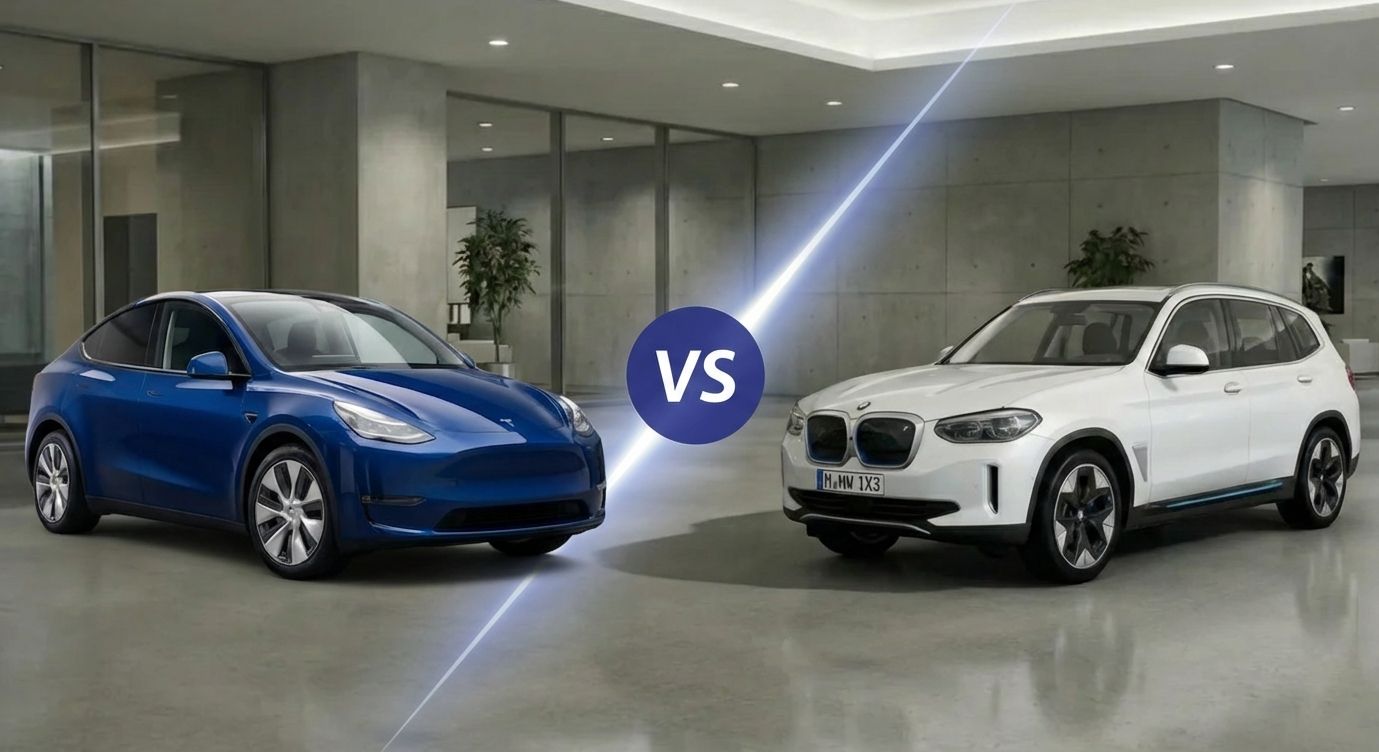
Tesla Model Y vs. BMW iX3: A detailed test of real-world range, features, and a verdict to help you choose the right electric SUV.
Apr 14, 2026
They share the same platform, but which one is better? A detailed comparison of the Audi Q8 and Volkswagen Touareg. We have evaluated the features and prices, and we provide a clear final verdict.
Apr 2, 2026