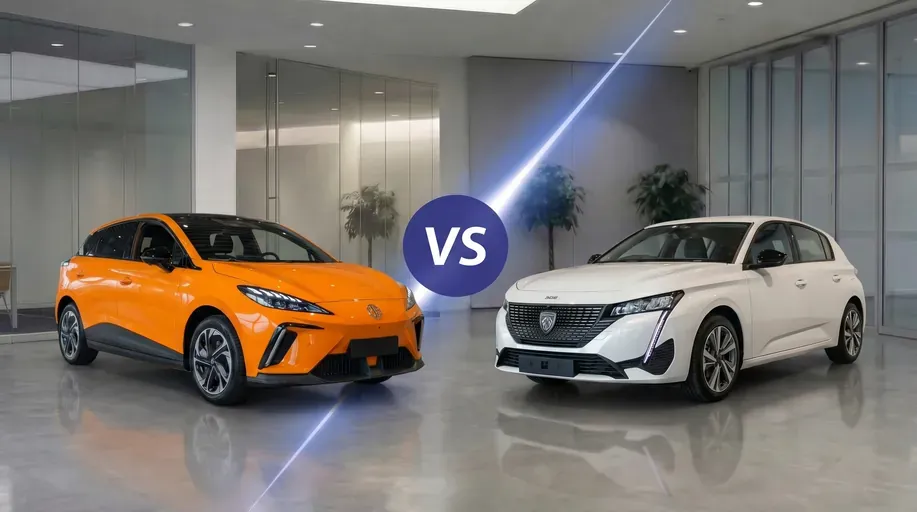
MG4 vs. Peugeot e-308: Complete comparison 2026
Detailed comparison of the MG4 and Peugeot e-308. We compared the real-world range, equipment, and driving characteristics of both electric vehicles. Read our verdict before you buy!
Apr 13, 2026
Articles
Car battle
Nissan Leaf vs Peugeot e-308 Comparison: Which electric car to choose? We reveal the real range, equipment details, and the final verdict for an easy used car purchase.
April 26, 2026


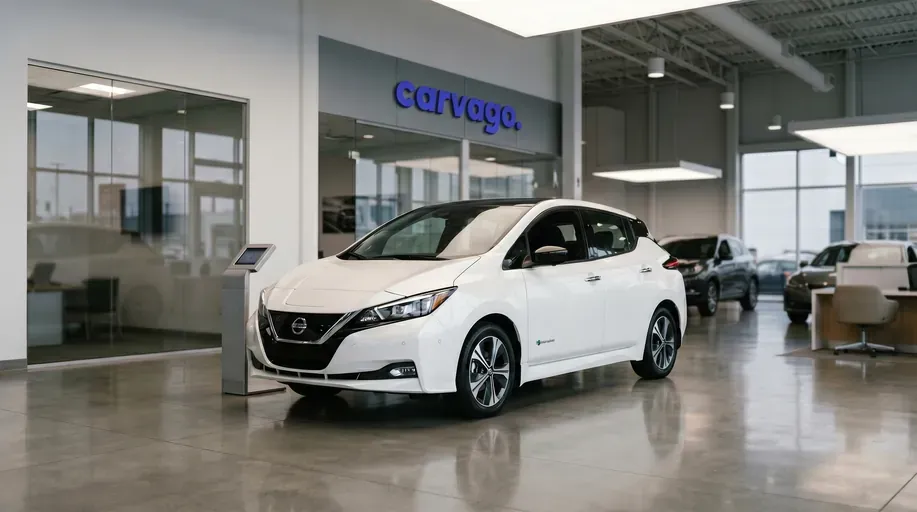
Nissan Leaf is one of the pioneers of global electromobility and a proven family hatchback that has built an exceptionally strong reputation over its existence. Standing against it is the Peugeot e-308 (often also written under the newer designation E-308), a modern and stylish French car that brings the latest technologies and a very attractive design to the segment of fully electric compacts. Let's take a detailed look at how these two cars fare in a direct comparison and which of them represents a better choice for your daily journeys.
When comparing the exterior dimensions of these two electric vehicles, we encounter different approaches to design and body construction. The Nissan Leaf (in the ZE1 generation, which is typical for the roughly four-year-old used car market) represents a more classic, slightly elevated hatchback. With a total length of 4,490 mm, it is a significant 123 mm longer than the base five-door version of the Peugeot e-308. However, the French competitor from the current third generation of the 308 family counters with a significantly wider build – at 1,852 mm, it exceeds the Leaf by 64 mm. In practice, this means that while the Leaf may appear more majestic in length, Peugeot offers a more confident stance on the road and a more generous interior width in the shoulder area. Furthermore, the shorter body of the e-308 hatchback makes maneuvering in narrow city streets and parking across town slightly easier.
The most striking difference between the two cars, however, is found in their height and the range of body styles offered. The Nissan Leaf, at 1,530 to 1,545 mm, is roughly 100 mm taller than the Peugeot. This slightly taller concept brings an undeniable advantage in the form of easier entry and a better view from the car, which is particularly appreciated in daily life by older drivers or families with small children. The Peugeot e-308, on the other hand, bets on a more dynamic, sportily low-slung silhouette (height around 1,440 mm), which clearly benefits aerodynamics and highway range. While the wheelbase of the standard Nissan Leaf (2,700 mm) slightly exceeds the short Peugeot (2,675 mm) and promises generous rear legroom, Peugeot plays a huge trump card in the form of the estate version (labeled as SW or Estate).
The presence of a more practical estate body for the Peugeot completely changes the game for those looking for a full-fledged primary family car. The e-308 Estate version extends the total length to 4,636 mm and stretches the wheelbase to an excellent 2,732 mm. In terms of overall choice and the impact of dimensions, it primarily depends on your priorities: if you are looking for a comfortable, somewhat taller car with plenty of space in a standard hatchback form, the Leaf still makes a lot of sense. However, if you prefer a sporty, wider silhouette or absolutely need a voluminous family cruiser, the Peugeot e-308, with its more versatile portfolio, clearly wins.
| Parameter | Nissan Leaf Hatchback | Peugeot e-308 Hatchback | Peugeot e-308 Estate |
|---|---|---|---|
| Width (mm) | 1788 | 1852 | 1852 |
| Length (mm) | 4490 | 4367 | 4636 |
| Height (mm) | 1530-1545 | 1438-1441 | 1438-1442 |
| Wheelbase (mm) | 2700 | 2675 | 2732 |
Luggage capacity is often a decisive factor when choosing a family electric car, as it directly affects daily practicality and the vehicle's utility for leisure activities. When comparing the Nissan Leaf and the Peugeot e-308, we encounter interesting differences that partly stem from the different approaches to the platforms used. While the current second-generation Leaf (ZE1) was designed from the ground up as a pure electric vehicle with an emphasis on space, the Peugeot e-308 utilizes a flexible multi-energy platform. For the electric version, this necessitated slight compromises in the base boot volume compared to its internal combustion and hybrid siblings. For buyers in the nearly-new used car market, this means carefully considering how much luggage they actually carry and whether a traditional hatchback will suffice, or if they should rather opt for a more spacious estate.
In terms of specific figures, the Nissan Leaf in its hatchback version offers a very solid base volume of 435 litres, which is an above-average value for a compact car. With the rear seats folded down, the luggage compartment expands to 1,176 litres. In contrast, the electric Peugeot e-308 hatchback has a smaller base volume of 361 litres (reduced from the original 412 litres in standard internal combustion versions due to the battery and electrical installation). However, if you fold the rear seats down, the e-308 offers a full 1,271 litres, thereby surpassing its Japanese rival. A huge strategic advantage for Peugeot is also the availability of a practical estate body style. The e-308 Estate model boasts a base volume of 548 litres and provides an impressive 1,574 litres of space with the seats folded.
In practice, these differences mean that for typical daily commuting and weekend shopping, the Nissan Leaf in its base configuration can accommodate a few more shopping bags or one extra small suitcase. The Peugeot e-308 hatchback, on the other hand, will better serve those who occasionally transport bulkier items and can make use of the larger total capacity after folding the backrests. However, if you need enough space for weekend shopping as well as longer holidays, sports equipment, or a baby stroller, the electric e-308 Estate with its excellent access and low loading sill offers incomparably higher utility value.
From the perspective of family practicality, Peugeot represents a much more versatile solution thanks to the estate variant, while the Nissan Leaf clearly wins the direct head-to-head of five-door hatchbacks with its more generous base space.
| Parameter | Nissan Leaf Hatchback | Peugeot e-308 Hatchback | Peugeot e-308 Estate |
|---|---|---|---|
| Base volume (litres) | 435 | 361 | 548 |
| Maximum volume with seats folded (litres) | 1176 | 1271 | 1574 |
Although the Nissan Leaf offers a more voluminous boot in the hatchback version, the Peugeot e-308 is a much more versatile and practical choice for families with higher space requirements thanks to the full-fledged estate variant.
The ability to tow a trailer represents a key factor of practicality for many used car buyers, but with pure electric vehicles, it often encounters technical limitations. If we look at cars roughly four years old, both compared models for the used car market share a common shortcoming.
Both the second generation Nissan Leaf (ZE1 generation, focused on the years 2018–2024) and the pure electric Peugeot e-308 (based on the third generation from 2023) lack manufacturer homologation for towing a trailer. The official standard and maximum braked trailer weight for both of these electric versions is simply 0 kg.
From a practical standpoint, this means that if you have a tow bar installed on these pure electric models, it will serve exclusively for vertical load – i.e., for installing a bicycle rack. If you expect the tow bar to allow for a trailer that offers space for several extra suitcases or additional volume sufficient for weekend shopping or a longer holiday, these electric versions will not meet your requirements.
However, fundamental differences can be found in alternative powertrains:
Final Verdict: If the ability to tow a trailer is an absolute necessity for you, neither the roughly four-year-old pure electric Nissan Leaf nor the newer Peugeot e-308 will unfortunately be a suitable choice, and they completely fail in this discipline on paper. A practical-minded buyer in this comparison should rather opt for the plug-in hybrid Peugeot 308, which can effectively combine partially electric operation with full towing potential.
| Model and powertrain | Braked trailer weight (kg) | Unbraked trailer weight (kg) |
|---|---|---|
| Peugeot 308 1.6 Plug-In Hybrid 180/225 | 1,500 | Not specified |
| Peugeot 308 SW 1.6 Plug-In Hybrid 180/225 | 1,450 | Not specified |
| Nissan Leaf 52/75 kWh (ZE2 generation, from 2026) | 975 | Not specified |
Comparing powertrains in purely electric models like the Nissan Leaf and Peugeot e-308 plays a crucial role in car selection, as it directly affects overall dynamics, real-world range, and daily usability. While the Nissan Leaf, a steady pioneer of the EV market, relies in its second generation (ZE1, forming ideal roughly four-year-old used cars) on a more diverse selection of two battery capacities and two performance levels, the French Peugeot e-308, as a newer addition to the market, bets on a single but precisely optimized and efficient motorization. For buyers looking for greater variability and much more emphatic acceleration, the more powerful version of the Nissan represents an attractive choice. Conversely, drivers focused on the lowest possible electricity consumption and smooth, fluid operation without unnecessary excesses will appreciate Peugeot's modern and highly economical approach.
The second-generation Nissan Leaf (ZE1), which is highly sought after on the used car market, offers two main motorizations differing not only in battery capacity but primarily in the tuning of the electric motor itself. The base of the range is a version relying on a 40kWh battery and an output of 110 kW (150 hp). Its very decent torque of 320 Nm makes it an extremely agile car, perfectly sufficient for normal urban and suburban commutes. For drivers craving a longer range and even more confident highway travel, the manufacturer prepared the more powerful e+ version equipped with a 62kWh battery. Here, the motor boasts a significantly better output of 160 kW (217 hp) and torque increased to 340 Nm. In both variants, instantaneous driving force goes exclusively to the front wheels via a single-speed reduction automatic transmission, ensuring a perfectly smooth and undisturbed driving experience.
| Motorization | Fuel | Power (kW) | Torque (Nm) | Transmission |
|---|---|---|---|---|
| Electric motor (40 kWh) | Electricity | 110 | 320 | 1-speed automatic |
| Electric motor e+ (62 kWh) | Electricity | 160 | 340 | 1-speed automatic |
The Peugeot e-308 enters the game as a representative of the modern third generation of the popular hatchback and estate, with its fully electric version, launched in 2023, bringing a different philosophy. Unlike its Japanese competitor or the wider range of internal combustion engines in the standard 308 version, the automaker bet on a single zero-emission variant for the electric "e". The heart of the model is therefore exclusively a new compact electric motor with an output of 115 kW (156 hp), which sends 260 Nm of torque to the front axle via a single-speed transmission. Although it may seem slightly defensive on paper in terms of overall performance compared to the more powerful Leaf e+, its clear strength is absolutely excellent electricity consumption stemming from the technologically advanced tuning of the entire platform. This single safe bet will be appreciated primarily by family-oriented and economically-minded drivers.
| Motorization | Fuel | Power (kW) | Torque (Nm) | Transmission |
|---|---|---|---|---|
| Electric motor 156 (54 kWh) | Electricity | 115 | 260 | 1-speed automatic |
The Nissan Leaf scores among used cars with the possibility of choice and more massive power in its top version, while the more modern Peugeot e-308 offers a cleverly built compromise with a single, all the more technologically efficient motorization.
Choosing the right powertrain is crucial for long-term satisfaction with a car, which is why our recommendations are based on real-world performance experience, actual consumption, owner feedback, and mechanical and electrical reliability.
Both cars approach electric drive slightly differently, largely due to their time of origin and technological cycle. While the second-generation Nissan Leaf (ZE1 generation) is considered a historical pioneer of electromobility and offers a time-tested, albeit technologically older concept with passive battery cooling on the used car market, the Peugeot e-308 is a modern representative of the popular hatchback's 3rd generation. For four-year-old vehicles, you will find a very wide selection in the case of the Nissan, while the e-308, as a car produced since 2023, represents the younger and more expensive end of the used car spectrum. Peugeot benefits from an exceptionally efficient platform with new battery chemistry and standard CCS fast charging, while the Leaf scores with a massive database of long-term reliability data from real-world operation.
In the market for roughly four-year-old used cars (this generation was produced mainly between 2018–2024), the version with the larger 62kWh battery labeled e+ is the clear favorite and makes much more sense than the basic 40kWh variant. Compared to the weaker version, it offers not only a significantly higher output of 160 kW (217 hp) but, above all, a much more usable real-world range reliably exceeding 350 km. The electric motor's power curve provides solid pull even beyond highway limits, and the car is surprisingly dynamic.
However, the Leaf's biggest technical weakness remains the absence of active liquid battery cooling (so-called "Rapidgate"). In practice, this means that if you connect the car to a fast charger several times in a row on a long journey, the software will significantly limit the charging power to protect against overheating. It is also necessary to account for the receding Japanese CHAdeMO fast-charging standard. When inspecting a used car, therefore, fundamentally focus on the battery health report (SOH – State of Health). This can be easily read on the Leaf using an OBD module and the LeafSpy app. It will help you detect any excessive degradation from the previous owner.
This powertrain is absolutely ideal for drivers who have the option of home charging and use the car primarily for suburban commuting or daily routes up to 200 kilometers. In such a regime, the fantastic mechanical and electrical reliability of this model, its great comfort, and minimal service costs fully stand out.
The Peugeot e-308 enters the market with the latest evolution of the electric powertrain from the Stellantis Group (in production since 2023), and the choice here is actually very simple – only one electric system is available, combining a 115 kW (156 hp) electric motor with a modern 54kWh battery (of which 51 kWh is actually usable).
Its absolute greatest advantage is exceptional energy efficiency. The new electric motor architecture (developed in cooperation with Nidec) and improved battery cell composition (NMC 811) ensure that consumption in real-world combined operation easily hovers around a great 13 to 14 kWh/100 km. Unlike the older Leaf, the Peugeot e-308 already fully relies on active thermal management (liquid battery cooling) and the standard European CCS connector. This completely changes the game when traveling long distances – charging power is stable and the battery does not overheat.
Since these are relatively young cars from the beginning of the 3rd generation production on the used car market, always check the onboard menu and service history to see if the car has the latest software updates installed. Early versions of the battery management system (BMS) software and onboard systems could cause occasional error messages in the first months of production, which updates address.
The 156 hp output doesn't exactly mean a speed demon; the emphasis here is more on a smooth and relaxed performance. This powertrain is perfect for pragmatic drivers with refined style who do not require extreme performance but, on the contrary, appreciate a highly modern, incredibly economical car. Thanks to excellent thermal management, the car will also not disappoint those users who more frequently cover highway miles.
Paper consumption figures for modern electric vehicles often differ significantly from everyday reality, especially if you take them on the highway or if outdoor temperatures drop to freezing point. While the official WLTP measurement methodology always paints a very optimistic picture, the actual energy demands are only revealed by long-term data from the owners themselves. For the most accurate comparison of real operating costs in the used car category, we used the user database from Spritmonitor.de, which collects detailed independent records from daily operation.
Source: Spritmonitor.de
| Model and powertrain | Average consumption (kWh/100 km) |
|---|---|
| Peugeot e-308 115 kW | 16.2 |
| Nissan Leaf 40 kWh 110 kW | 16.8 |
| Nissan Leaf 62 kWh e+ 160 kW | 18.5 |
A detailed look at average electricity consumption fully reveals the generational difference between the two vehicles. The French Peugeot e-308 (a representative of the 3rd generation), built on the new Stellantis Group platform with a highly efficient electric motor, shows excellent real-world consumption just above the 16 kWh per 100 km mark. In contrast, the Japanese pioneer Nissan Leaf, in its most common ZE1 generation on the used car market, pays the price for an older technological design and slightly less sophisticated aerodynamics.
The basic version of the Leaf with a 40kWh battery is still acceptable for regular driving with an average of 16.8 kWh/100 km. However, the more powerful and heavier Leaf e+ model with a 62kWh battery realistically hits a much higher value of around 18.5 kWh. This clearly demonstrates the physical reality of electric vehicles – while a large battery extends the paper range, the inevitable increase in the car's curb weight takes its toll in the form of higher overall consumption.
In terms of real-world use, these differences translate into two distinct driving scenarios:
In the overall assessment, energy consumption is a key parameter for those interested in these electric hatchbacks. While the Nissan Leaf ZE1 serves as an affordable and spacious entry point into the world of electromobility with reasonable demands in the city, the more modern Peugeot e-308 benefits from its technological up-to-dateness. Its overall efficiency and better consumption management make it a more mature choice for more demanding use, even though it has a smaller battery capacity than the more powerful Leaf variants.
When choosing a used compact electric hatchback, you will encounter a fundamental difference in acquisition costs between these two models. While the Nissan Leaf is a proven staple of the used car market with very favorable prices, the Peugeot e-308 is a relative newcomer, which is significantly reflected in its noticeably higher residual value.
The second-generation Nissan Leaf (ZE1 generation) is currently among the most affordable full-fledged electric vehicles on the used market suitable for family use. Models approximately four years old with the basic 40kWh battery can commonly be purchased in the price range of €12,000 to €16,000.
If you require a longer range and are looking for the version with the larger 62kWh battery (labeled as e+), prices for 2020 and 2021 models range roughly between €16,000 and €21,000. Due to the model's age on the market and the wide selection of used cars, the Leaf has experienced the greatest depreciation, making it a very rational and affordable choice in terms of price and utility value.
The fully electric Peugeot e-308, equipped with a battery with a usable capacity of 50.8 kWh (54 kWh total), only entered the market at the end of 2023. For this reason, it mostly appears in advertisements as a nearly new, demonstrator, or so-called "one-year-old" car. The purchase prices of these models when new approached the €41,000 mark.
Today, slightly used units (with very low mileage) are most often sold in the range of €31,000 to €35,000. Although the initial investment in a used Peugeot is up to twice as high as for a Leaf, you get a substantially more modern interior, more efficient battery thermal management, a more striking French design, and above all, a vehicle that is often still covered by the full factory warranty.
| Model and battery capacity | Typical age of used car | Estimated price range (€) |
|---|---|---|
| Nissan Leaf (40 kWh) | 4–6 years | €12,000 – €16,000 |
| Nissan Leaf e+ (62 kWh) | 3–5 years | €16,000 – €21,000 |
| Peugeot e-308 (54 kWh) | 1–3 years | €31,000 – €35,000 |
While the older Nissan Leaf currently represents one of the cheapest and most sensible paths to a family electric vehicle, the nearly new Peugeot e-308 targets buyers who demand the latest technology, a longer lifespan ahead of them, and a more exclusive look for an appropriate premium.
At first glance, one might automatically expect a five-star Euro NCAP rating for such popular family cars. While older models (like the Nissan Leaf) often reached these milestones, it is crucial to emphasize the immense importance of context and the year of testing right from the start. Euro NCAP protocols continuously evolve and become significantly stricter over the years. For this reason, percentage results from different years are not directly comparable – what was enough for an excellent rating in the past would hardly stand up today.
Nissan Leaf underwent crash tests in 2018. In its time, it was among the highest-rated cars, as it was one of the first to successfully pass the then-new autonomous emergency braking (AEB) tests with cyclist detection. It thus earned a full five-star rating. Today, however, its certification according to current Euro NCAP standards is considered expired. While the 2018 values look great on paper, they do not reflect the current, much tougher conditions.
Peugeot e-308 (whose safety rating is based on the identical internal combustion version 308) underwent testing in 2022. Here, a significantly more modern methodology was already in place, which included new frontal collision simulations with a mobile barrier, much broader intersection scenarios, and advanced driver alertness monitoring. Due to the extreme strictness of these rules, the 308 model range received a solid four stars. Although this might seem like a worse result, in reality, it reflects the fact that the car faced incomparably more demanding tests.
| Parameter | Nissan Leaf | Peugeot e-308 |
|---|---|---|
| Year of testing | 2018 | 2022 |
| Adult occupant protection | 93 % | 76 % |
| Child occupant protection | 86 % | 84 % |
| Vulnerable road users protection | 71 % | 68 % |
| Safety assist systems | 71 % | 65 % |
What do these numbers mean for a used car buyer? While the Nissan Leaf's percentages look majestic and its cabin protection was top-notch in its time, the lower score for the Peugeot is merely a consequence of the shift in safety standards. In terms of active safety, sensors, and the car's ability to prevent accidents, the Peugeot e-308 offers undeniably more modern and comprehensive equipment, calibrated for today's traffic hazards.
Even though the Nissan Leaf dazzles with high percentages and a five-star result from 2018, the Peugeot e-308 offers significantly more modern assistance technologies and an architecture that meets today's strict safety standards.
In addition to standard equipment, each of the models offers several unique features that can be decisive for the customer and demonstrate the automakers' different approaches to value-added and everyday electric vehicle use.
Attractive price-to-utility ratio on the used car market
Very comfortable chassis tuning for daily driving
e-Pedal function allowing intuitive and smooth one-pedal driving
Solid luggage compartment volume of up to 435 liters
Bidirectional charging capability (V2G/V2H) thanks to the CHAdeMO connector
Outdated CHAdeMO fast-charging standard, with support decreasing at new stations in Europe
The battery lacks active liquid cooling, which significantly increases charging times during repeated charging on long trips
More outdated and slower infotainment system compared to modern competitors
Limited steering wheel adjustment options and poorer lateral seat support
The second-generation Nissan Leaf is an ideal choice for drivers looking for an affordable, spacious, and exceptionally comfortable electric car for daily commuting and city driving. However, due to the lack of active battery cooling and the receding CHAdeMO connector, it is not very suitable for users who frequently travel long highway routes.
Attractive exterior design and a premium-finished interior with modern materials
Standard European CCS connector with support for faster charging (up to 100 kW) and better thermal management
Highly efficient powertrain ensuring very low electricity consumption
Fast and visually appealing infotainment with intuitive controls
Availability in an exceptionally practical estate (SW) body style
The specific driving position (i-Cockpit) with a small steering wheel and high-mounted instrument cluster won't suit everyone
Higher purchase price on the used car market due to its more recent market launch
More limited knee room for adult passengers in the rear seats
Smaller total battery capacity compared to the top-tier Leaf version (e+ with 62 kWh)
The Peugeot e-308 targets more demanding customers who require modern technology, a premium look, and hassle-free long-distance travel thanks to the universal CCS standard. It is a very stylish and economical car, but before buying, it is necessary to personally test whether the unconventional ergonomics of the driver's cockpit suit your physique.
Based on our own inspections through the CarAudit service, breakdown statistics, service bulletins, and long-term user feedback, we have compiled an overview of the most common problems you should watch out for when choosing these electric vehicles.
The second-generation Nissan Leaf has been on the market for a long time and has hundreds of thousands of kilometers under its belt, making its typical ailments and weak points very well mapped.
Mechanically, the Nissan Leaf is a very reliable and durable car, but the lack of battery cooling represents a significant limitation for drivers on long trips. The key to satisfaction is a thorough check of battery degradation before the purchase itself.
The Peugeot e-308 uses the newer Stellantis platform and belongs to the younger model years on the used car market, so we mainly encounter so-called "teething troubles" and electronic faults associated with modern equipment.
The Peugeot e-308 impresses with attractive technology and craftsmanship, but it struggles with typical group ailments – from glitchy software to occasional on-board charger failure. Buying a young used car with a clear service history and resolved recall actions is the best prevention.
When buying a used car, a thorough inspection is key, and for electric vehicles in particular, a comprehensive car audit is well worth it. Here are several specific points to focus on for these two models.
The Peugeot e-308 with its 54kWh battery offers a certified range of over 400 km, which in real-world conditions translates to roughly 320 to 350 km. The Nissan Leaf in the e+ version with a 62kWh battery provides a very similar real-world range, but its cheaper and more common 40kWh version only manages around 240 km on a single charge. Furthermore, the Peugeot benefits from a newer architecture and overall more efficient energy management.
The Peugeot e-308 utilizes the modern European CCS standard with fast-charging power of up to 100 kW, which is easily found at the vast majority of public stations today. The Nissan Leaf relies on the older Japanese CHAdeMO connector, whose support at newly built public chargers in Europe is declining quite rapidly. In terms of long-term practicality and trouble-free long-distance travel, the charging system in the Peugeot is therefore significantly more future-proof.
The Nissan Leaf is only available as a hatchback and offers a very solid basic trunk volume of 420 to 435 liters depending on the trim level and audio system. The Peugeot e-308 as a hatchback has a smaller volume of 361 liters, but unlike the Leaf, it is also sold in the popular estate (SW) body style. It is the e-308 SW version that offers an excellent 548 liters, making it a much better choice for family use.
For driving in heavy city traffic, the Nissan Leaf excels primarily thanks to its e-Pedal function, which allows for smooth acceleration and braking to a complete stop using only the accelerator pedal. The Peugeot e-308, on the other hand, offers a more advanced and stiffer chassis, which provides higher comfort and better stability when commuting from suburban areas or on the highway. Both cars are, however, very quiet, reliable, and represent an excellent choice for daily commuting.
The Peugeot e-308 makes a significantly more modern impression, as evidenced by its futuristic i-Cockpit interior with a fully digital and configurable 3D instrument cluster. The Nissan Leaf is based on an older design school; its multimedia system has more dated graphics, is slower, and you'll find more classic physical buttons on the dashboard. If you value a fast digital environment and modern connectivity, the French model will suit you much better.
Choosing between the Nissan Leaf and the Peugeot e-308 depends primarily on your budget and how you intend to use the car. While the more affordable Nissan Leaf represents an exceptionally rational choice for daily suburban commuting thanks to its spacious interior and proven reliability, it pays the price on long journeys due to the lack of active battery cooling and the receding CHAdeMO charging standard. On the other hand, the significantly more expensive but nearly new Peugeot e-308 will appeal to more demanding buyers, offering top-tier energy efficiency, modern technology with future-proof CCS fast charging, and, in the case of the estate version, unrivaled family practicality. So, if you are looking for a cost-effective entry into the world of electromobility primarily for shorter distances, the Leaf will serve you excellently; however, for carefree highway cruising and maximum technological versatility, the more modern French competitor makes much more sense.
Sources: ADAC, garaz.cz, e15.cz, fdrive.cz, hybrid.cz, automotorsport.cz
This article was prepared using artificial intelligence tools. The section guarantor is Petr Dušek.

Detailed comparison of the MG4 and Peugeot e-308. We compared the real-world range, equipment, and driving characteristics of both electric vehicles. Read our verdict before you buy!
Apr 13, 2026

Deciding between the MG4 and the Opel Astra Electric? Our detailed comparison of range, price, and equipment will help you choose the right electric hatchback for you.
Apr 14, 2026

Tesla Model 3 vs. BMW i4: Which premium electric car is better? Our detailed comparison of range, performance, and price will help you choose.
Apr 14, 2026