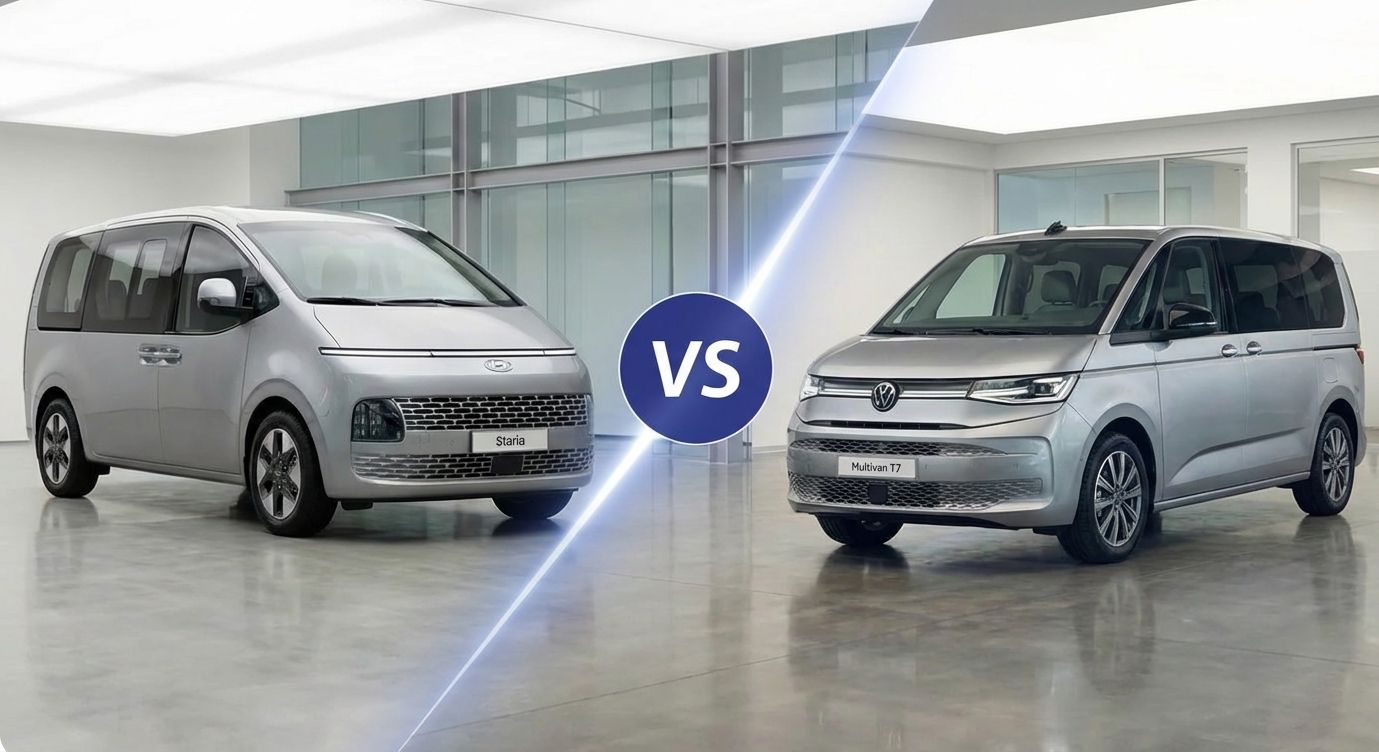
Car battle
Hyundai Staria vs Volkswagen Multivan: Complete Comparison 2025
Hyundai Staria vs. Volkswagen Multivan. Detailed comparison of design, practicality and price. Find out which large MPV is the better choice for you.
Apr 13, 2026
Articles
Car battle
Detailed comparison of Mercedes-Benz Vito Tourer vs Renault Trafic SpaceClass. Discover the differences in comfort and equipment, and choose the best passenger van.
April 28, 2026
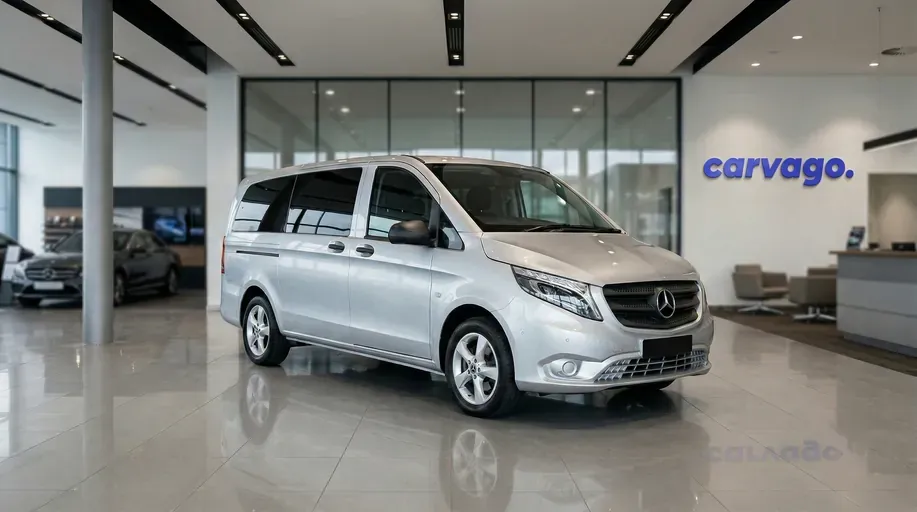
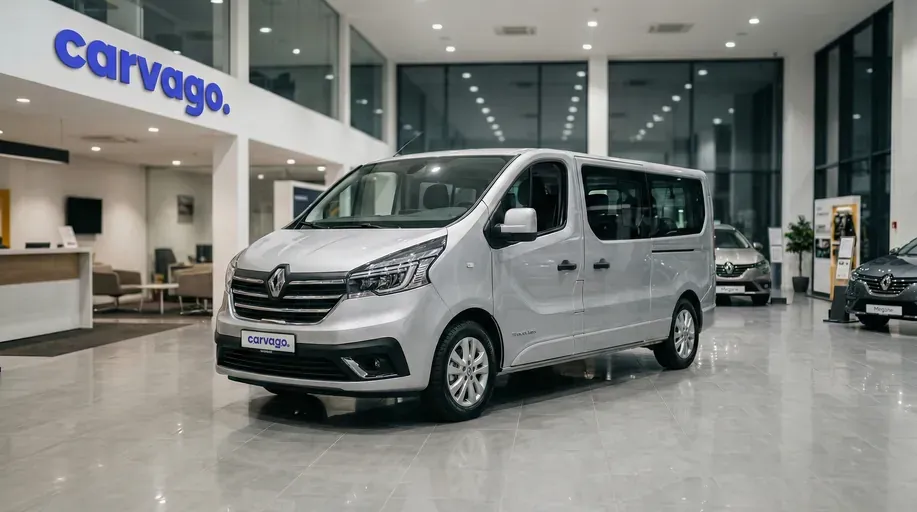
Mercedes-Benz Vito Tourer, also sold in some markets under the names Mercedes-Benz Valente or Mercedes-Benz Metris, represents a premium passenger van that emphasizes a high level of comfort and advanced technology. Its challenger today, the Renault Trafic SpaceClass, which shares its technical basis within its generation with models such as the Nissan NV300, Nissan Primastar, Fiat Talento, or Mitsubishi Express, counters with an exceptionally spacious and versatile interior focused on maximum practicality. Let's take a detailed look at how these two popular representatives of the MPV segment stand in a head-to-head battle and which of them will be the better choice for your needs on the used car market.
When looking at the exterior dimensions of both models that most frequently appear on the four-year-old used car market (model years around 2021 and 2022), you quickly find that each manufacturer approaches the interior space offering slightly differently. Mercedes-Benz Vito Tourer (generation 447) gives customers a choice of three body lengths – Compact (4,895 mm), Long (5,140 mm), and Extra Long (5,370 mm). In contrast, the Renault Trafic SpaceClass (3rd generation) makes do with a more traditional division into two versions: the shorter L1 (5,080 mm) and the extended L2, often referred to as Grand (5,480 mm). In its longer version, the Renault thus exceeds its German competitor by 110 mm, which provides literally royal space for the crew and luggage inside, albeit at the cost of slightly worse maneuverability in narrow city streets.
A fundamental difference that may be a deciding factor for many families or companies can be found in the height of both vehicles. With a height oscillating between 1,890 and 1,918 mm, the Mercedes-Benz maintains excellent clearance for the vast majority of underground garages and parking houses. The Renault, with a height of 1,973 to 1,974 mm, is noticeably taller. While it fits safely into more modern garages with a 2-meter limit, you simply won't be able to park it in older facilities with a 1.9-meter restriction. On the other hand, the Trafic compensates for this design element with a greater width (1,956 mm compared to 1,928 mm for the Vito), which in practice means valuable extra centimeters for passengers' shoulders. This is particularly noticeable when three adults are sitting side-by-side in the second or third row.
Wheelbase also plays a key role in daily maneuvering. The shorter version of the Renault benefits from a very compact wheelbase of 3,098 mm, making the car much easier to handle in tight spaces, while even the shortest Vito (Compact) stands on a chassis with a longer wheelbase of 3,200 mm. However, the situation is reversed for the longest versions of both cars. The extended Trafic has a massive 3,498 mm between the axles; while it is exemplarily stable and smooth on the highway, perpendicular parking to the curb requires more practice and a wider turn. The Vito Extra Long, with its 3,430 mm, fits into a parking space just a bit more easily. Overall, the choice largely depends on whether you prefer absolute volume and maximum interior width in a family car (Trafic), or if you would rather rely on finer length variability and completely worry-free parking in low garages (Vito).
| Parameter | Mercedes-Benz Vito Tourer Van | Renault Trafic SpaceClass Van |
|---|---|---|
| Width (mm) | 1928 | 1956 |
| Length (mm) | 4895 - 5370 | 5080 - 5480 |
| Height (mm) | 1890 - 1918 | 1973 - 1974 |
| Wheelbase (mm) | 3200 - 3430 | 3098 - 3498 |
For families with children, active athletes, and VIP transfer operators, the luggage compartment volume of passenger vans is often the primary argument for purchase. When choosing on the used car market, focusing on roughly four-year-old models (manufactured around 2022), the Mercedes-Benz Vito Tourer (W447 generation) and Renault Trafic SpaceClass (third generation) represent the absolute peak in transport capacity. Both vehicles are designed to accommodate a large crew and a mountain of luggage without compromise, making them ideal companions for long vacations or comfortable client transport to the airport.
When it comes to the numbers, both models benefit from being offered in multiple body lengths. You can get the Mercedes-Benz Vito Tourer in three versions – Compact, Long, and Extra-long. In the basic configuration behind the third row of seats, the shortest version has a volume of 580 liters, the medium variant holds a solid 990 liters, and the longest Extra-long swallows a massive 1,700 liters. In contrast, the more luxuriously tuned Renault Trafic SpaceClass offers a choice of two lengths (standard L1 and extended L2). The French competitor benefits from a cleverly designed sliding rear bench. The basic trunk volume for the shorter version ranges from 550 to 1,000 liters, and for the extended version from 890 to a breathtaking 1,800 liters.
From a practical standpoint, these dimensions mean plenty of freedom for several extra suitcases and carefree packing of whatever you can think of, even when traveling at full capacity. If you completely remove the rear rows of seats in both vehicles, they transform into regular moving vans with a maximum capacity of around 3,600 to 4,000 liters. Customers considering more eco-friendly operation will surely be pleased that fully electric versions, such as the Mercedes-Benz eVito Tourer, do not have a reduced luggage space thanks to the clever placement of batteries in the floor. The only objective disadvantage of both rivals remains the fact that handling heavy rear benches when trying to achieve maximum cargo volume requires considerable physical strength.
| Parameter | Mercedes-Benz Vito Tourer Van | Renault Trafic SpaceClass Van |
|---|---|---|
| Basic volume (liters) | 580 - 1700 l | 550 - 1800 l |
| Maximum volume with seats folded / removed (liters) | 3600 - 4000 l | 3672 - 4053 l |
In conclusion, whether you choose the Mercedes or the Renault, you will certainly not suffer from a lack of space. The Renault Trafic SpaceClass offers slightly better everyday variability thanks to its sliding bench, and its extended L2 version slightly surpasses even the longest Vito Tourer. Mercedes-Benz, on the other hand, scores with a wider choice of three body lengths, allowing many drivers to find a much better compromise between easy maneuverability in tight cities and overall transport capacity.
Both vehicles offer a gigantic luggage space exceeding 1,700 liters in their extended versions even when fully occupied by eight passengers, but Renault provides slightly better variability for flexible family use thanks to the sliding benches.
Towing capacity is a crucial parameter for those interested in spacious passenger vans, determining whether the vehicle will be used just for regular passenger transport or also for towing heavy caravans or bulky work trailers. The Mercedes-Benz Vito Tourer (generation 447, for roughly four-year-old used cars from 2021–2024) offers a very consistent braked trailer weight of 2000 kg across its popular diesel engines, such as the 114 CDI (100 kW) or 119 CDI (140 kW). In earlier years, however, basic versions (e.g., 110 CDI) appeared, where the maximum towing capacity was reduced to just 1000 kg. According to technical data, electric eVito variants generally do not allow trailer towing at all. The competing Renault Trafic (generation III), on which the more luxurious SpaceClass derivative is technically based, shows much greater variability in comparably old used cars. The "golden mean" is the Blue dCi 150 engine, which can tow up to an impressive 2500 kg on the hitch, while the top-of-the-line Blue dCi 170 version is surprisingly limited to a range of 1630 to 1680 kg in some specific configurations. Although data for unbraked trailers is missing from the primary data for these models, given their weight and robust construction, the standard legislative maximum of 750 kg applies to them. In practice, these differences mean that while the Vito is a stable certainty sufficient for weekend shopping for heavy materials or a longer holiday with a large caravan, a correctly configured Trafic offers the capacity to tow even heavier loads, such as large boats. Renault will thus please users with demands for extreme loads, while Mercedes scores by betting on a reliable two tonnes for most of its classic models.
| Model and engine | Braked trailer weight (kg) | Unbraked trailer weight (kg) |
|---|---|---|
| Mercedes-Benz Vito Tourer 114 CDI (100 kW) | 2000 | 750 |
| Mercedes-Benz Vito Tourer 119 CDI (140 kW) | 2000 | 750 |
| Renault Trafic SpaceClass / Combi Blue dCi 150 (110 kW) | 1630 - 2500 | 750 |
| Renault Trafic SpaceClass / Combi Blue dCi 170 (125 kW) | 1630 - 1680 | 750 |
When choosing a four-year-old used vehicle, the range of powertrains reveals a completely different approach from both manufacturers, which is crucial information for those interested in a family or company van. While Mercedes-Benz bets on immense variability with the Vito Tourer model, covering everything from economical entry-level versions to powerful all-wheel drives and purely electric variants, Renault takes a path of maximum straightforwardness with the luxuriously styled Trafic SpaceClass model. It exclusively offers proven 2.0-liter diesel engines that power only the front wheels. For buyers in the used car market, this means that more specific, tailor-made configurations can be found with the Mercedes (e.g., a powerful version for the mountains), while Renault scores with a simpler lineup that attracts with excellent durability and more favorable operating costs of its Blue dCi engines.
The German representative, the Mercedes-Benz Vito Tourer (generation 447), relies primarily on the modern OM 654 family diesel four-cylinder in the young used car market. The entry-level engine was long the 110 CDI with 75 kW; however, available data shows that its use for the Tourer passenger versions ended in late 2020. For roughly four-year-old used cars, the range effectively opens with the very popular 114 CDI (100 kW) variant. Conversely, the most demanding drivers will be satisfied by the top-tier 124 CDI version with a massive 500 Nm of torque and an output of 176 kW (239 hp). From the 114 CDI variant upwards, original owners could opt for intelligent all-wheel drive (4x4) and the advanced 9G-TRONIC nine-speed automatic transmission, which effectively reduces fuel consumption on the highway. For eco-conscious buyers, the purely electric eVito Tourer represents an interesting alternative, which can be found on the secondary market with a battery of 60 or even 90 kWh usable capacity.
| Engine Type | Fuel | Power (kW) | Torque (Nm) | Transmission |
|---|---|---|---|---|
| 110 CDI | Diesel | 75 | 270 | 6MT |
| 114 CDI | Diesel | 100 | 330 | 6MT / 9G-TRONIC |
| 116 CDI | Diesel | 120 | 380 | 6MT / 9G-TRONIC |
| 119 CDI | Diesel | 140 | 440 | 9G-TRONIC |
| 124 CDI | Diesel | 176 | 500 | 9G-TRONIC |
Under the hood of its French competitor, the Renault Trafic SpaceClass (III generation), you won't find any all-wheel drive or electrified variants after the 2021 facelift. While older model years were powered by engines labeled as ENERGY dCi (e.g., the discontinued ENERGY dCi 145 versions), in four-year-old used cars, you will exclusively encounter the innovated Blue dCi series 2.0-liter diesels. These units meet the strictest emission standards and bring significantly higher refinement. The entry-level Blue dCi 110 (81 kW) is the choice for fuel-conscious fleets, but for a frequently fully loaded and heavy vehicle, the more powerful Blue dCi 150 (110 kW) variant clearly makes the most sense. At the very top stands the Blue dCi 170 version, boasting 125 kW (170 hp) and a solid 380 Nm of pull. While the weaker models could be configured with a manual, the more powerful ones (standard on the 170 version) utilized the comfortable EDC six-speed dual-clutch transmission. For families frequently heading to the mountains, the fact that all Trafic models only feature front-wheel drive may be a limiting factor.
| Engine Type | Fuel | Power (kW) | Torque (Nm) | Transmission |
|---|---|---|---|---|
| Blue dCi 110 | Diesel | 81 | 300 | 6MT |
| Blue dCi 150 | Diesel | 110 | 350 | 6MT / 6EDC |
| Blue dCi 170 | Diesel | 125 | 380 | 6EDC |
While the Renault Trafic SpaceClass pleases with exceptionally reliable engines and reasonable operating costs, the Mercedes-Benz Vito Tourer completely dominates thanks to available all-wheel drive, a premium nine-speed automatic, and substantially more powerful top-tier engines.
While the Mercedes-Benz Vito Tourer, in its more desirable specifications, relies on a premium concept with rear-wheel or all-wheel drive and a longitudinally mounted aluminum two-liter engine, the Renault Trafic SpaceClass offers a more traditional and slightly more maintenance-friendly approach with front-wheel drive and a proven cast-iron block. Choosing the right engine is critical for long-term satisfaction with these large multi-purpose vehicles. Our following recommendations for roughly four-year-old used cars are based on a balance of performance, real-world fuel consumption, owner feedback, and verifiable mechanical reliability.
Official fuel consumption figures provided by manufacturers for large vans are often overly optimistic, and real-world road conditions show a somewhat different picture. To get the most accurate idea of the actual fuel appetite of approximately four-year-old used cars, we relied on long-term user data from the independent community portal Spritmonitor.de, where owners carefully record their actual refueling.
| Model and engine | Average consumption (l/100 km) |
|---|---|
| Renault Trafic SpaceClass Blue dCi 110 (81 kW) | 7.7 |
| Renault Trafic SpaceClass Blue dCi 150 (110 kW) | 8.0 |
| Renault Trafic SpaceClass Blue dCi 170 (125 kW) | 8.1 |
| Mercedes-Benz Vito Tourer 114 CDI (100 kW) | 8.9 |
| Mercedes-Benz Vito Tourer 116 CDI (120 kW) | 8.9 |
| Mercedes-Benz Vito Tourer 119 CDI (140 kW) | 8.3 |
A detailed look at the average consumption values reveals several interesting trends. The most economical choice remains the reliably weaker diesel units from Renault, where the version less used on highways can realistically stay below the eight-liter mark. The ideal middle ground for the Trafic, however, is the popular two-liter Blue dCi 150, which offers an excellent compromise between decent dynamics and a consumption of exactly eight liters. Renault's exclusively diesel offering underscores the fact that diesel still makes absolute sense in this class and gasoline engines would not be efficient. For Mercedes, on the other hand, a surprising but practically logical finding emerges – the top-of-the-line 119 CDI diesel engine with 140 kW is significantly more economical in real-world traffic than the weaker 114 CDI and 116 CDI versions. The powerful engine doesn't struggle as much with the heavy vehicle, and thanks to the excellent gearing of the 9G-Tronic nine-speed automatic, it can manage fuel much more efficiently. Rare gasoline versions of the Vito (e.g., 124) are almost non-existent on the four-year-old used car market, and with real-world consumption often exceeding ten liters, they don't make much sense from an economic standpoint.
What does this mean for the typical user? If you are looking for a more affordable family hauler or a comfortable vehicle for suburban shuttle transport, the French Renault Trafic SpaceClass will please you with its slightly lower appetite and save the family or company budget. However, drivers who often cover long highway stretches across Europe with a fully loaded vehicle should definitely focus their attention on the more powerful Vito Tourer 119 CDI. In its case, the higher initial investment is partially compensated by dynamics and highway confidence, supported by surprisingly reasonable fuel costs.
In conclusion, fuel consumption itself is unlikely to be the most important deciding factor for these two models. While the Renault Trafic scores with values about a liter more favorable in normal traffic, Mercedes has an ace up its sleeve in the form of an unexpectedly economical and agile top-tier engine. The final choice will therefore depend primarily on whether you prefer the operational economy and robustness of the Renault, or require the power reserve and prestige of the Mercedes.
When choosing a passenger van or a premium minibus on the used car market, budget plays a key role. If we focus on vehicles approximately 4 years old (model years 2021–2022), which represent an ideal compromise between a reasonable purchase price and still high reliability, we find that both models move in different price tiers.
Mercedes-Benz traditionally maintains a very high residual value, and the Vito Tourer is no exception. For four-year-old models, however, prices can vary significantly depending on the chosen equipment, engine, and drive type.
The Renault Trafic, in its top-tier SpaceClass passenger version, offers an exceptionally attractive price-to-utility ratio. As a used car, it is noticeably more affordable than its German competitor, while even in the basic version of this trim, it offers above-standard rich equipment focused on passenger comfort.
| Parameter (2021–2022 models) | Mercedes-Benz Vito Tourer | Renault Trafic SpaceClass |
|---|---|---|
| Estimated price (good condition, average mileage) | €35,000 – €41,000 | €27,000 – €31,000 |
| Starting price (high mileage, basic) | from approx. €29,000 | from approx. €25,000 |
| Price for top versions (4x4, luxury equipment) | €49,000+ | max. around €35,000 |
| Depreciation over time | Slow (premium brand) | Medium-fast |
While Mercedes-Benz benefits from a strong brand image, a wider range of drive concepts, and very slow value loss, Renault represents a strongly pragmatic choice from a financial perspective. For the price of a basic used Vito Tourer, one can often purchase a fully equipped Trafic SpaceClass with a powerful engine, automatic transmission, and lower mileage.
While the Renault Trafic SpaceClass scores among used cars with an unbeatable ratio of price to rich luxury equipment, the Mercedes-Benz Vito Tourer easily justifies its higher price tag thanks to the availability of 4x4 drive and excellent future value retention.
When looking at the safety of passenger vans, it is customary to start by saying that both vehicles achieved five-star ratings in their peak and specific Euro NCAP tests. However, it is absolutely crucial to put these results into context and carefully consider the year of testing. The testing methodology has constantly evolved and tightened over the years. Percentage gains from different years cannot be simply compared because modern protocols today, unlike in the past, require much more complex frontal impact simulations, stricter detection of vulnerable road users (including cyclists), and advanced scenarios for assistant interventions during confusing intersection crossings.
The Mercedes-Benz Vito Tourer was last examined as part of full Euro NCAP passenger car tests in 2014 (with subsequent official validation also valid for newer electric versions) and took home a maximum five-star result. At that time, the model fully capitalized on the excellent structural strength of the body with a result of 93 % for adult protection and 87 % for child protection. To demonstrate continuous development, the Vito Tourer from recent production years also underwent the latest safety assistant assessment (Commercial Van Safety). Here, the vehicle dominated and, according to current very strict standards, achieved Platinum status for the 2024/2025 model year. Today, the vehicle offers a top level of active safety, which relies on standard autonomous emergency braking (AEB) with high-precision pedestrian and cyclist detection or an advanced lane-keeping system.
The story of the Renault Trafic SpaceClass is different from the perspective of methodology. Its passenger variant last underwent a classic crash test in 2015, when it received only three stars. Given the time elapsed, the validity of this certification has expired from today's perspective, and for used cars on the market from around 2021 and 2022, there are no relevant percentage data from modern passenger crash tests. For this reason, values for Renault are not included in the comparison table. However, it is not that the vehicle ignores safety. Thanks to recent innovations, the SpaceClass stood its ground in the specific active safety assessment (Commercial Van Safety), earning a respected Gold medal, while offering an AEB system with obstacle recognition as standard. However, its architecture loses out slightly to the technological sophistication and sensor sensitivity of the Mercedes.
In a comprehensive assessment, the Mercedes-Benz Vito Tourer provides a demonstrably more modern and complete protection package corresponding to current demands. While Renault has taken a significant step forward by implementing modern software and safety assistants, Mercedes adds historically top-tier passive protection for the crew and perfectly tuned active technology, making it a much more confident choice in crisis scenarios.
| Parameter | Mercedes-Benz Vito Tourer | Renault Trafic SpaceClass |
|---|---|---|
| Year of testing | 2014 (passive) / 2024 (active) | Passenger test data unavailable |
| Adult occupant protection | 93 % | - |
| Child protection | 87 % | - |
| Vulnerable road user protection | 67 % | - |
| Safety assist systems | 85 % | - |
The Mercedes-Benz Vito Tourer combines long-proven passive safety with a platinum rating for modern assistants, offering overall more confident and comprehensive protection than the competing Renault.
In addition to standard equipment, each of the models offers several unique features that can be decisive for the customer and demonstrate the different approaches of both brands to passenger transport.
Prestigious brand image and consistently high residual value
Wide range of drivetrains (rear-wheel drive or advanced 4MATIC all-wheel drive)
Smooth-shifting 9-speed 9G-TRONIC automatic transmission in newer models
Powerful, refined, and reliable diesel engines (OM 654 generation)
Advanced assistance systems and top-tier passive safety
Significantly higher purchase price on the four-year-old used car market
More expensive authorized service, insurance, and genuine spare parts
Basic versions of the infotainment and instrument cluster feel technologically outdated
Slightly narrower body, which limits shoulder room in the third row
The Mercedes-Benz Vito Tourer is ideal for more demanding customers, VIP transfers, and large families who require a representative appearance, top-tier driving characteristics, and the option of all-wheel drive. It rewards its owner with excellent travel comfort and slower depreciation, although higher initial and operating costs must be taken into account.
Excellent price-to-value ratio on the used car market
Huge and boxy interior space with better utilization of headroom
Highly variable interior with the option of swiveling seats and a folding table
Economical and durable 2.0 Blue dCi diesel engines
Comfortably tuned chassis that effectively dampens road imperfections
Only front-wheel drive available, which can limit traction when fully loaded
The EDC dual-clutch transmission is not as smooth as a torque-converter automatic during slow crawling
Despite the luxury moniker, cheaper and harder plastics are noticeable in the interior
Older basic vehicle architecture, dating back to 2014
The Renault Trafic SpaceClass targets practically-minded families and travelers looking for maximum interior space and flexibility at a much more affordable price. It represents an excellent alternative for those who prioritize interior modularity and lower service bills over a premium badge on the hood and all-wheel drive.
Based on long-term user experience, service reports, and comprehensive vehicle inspections, we have compiled an overview of the most common problems that buyers of used vehicles of both models should watch out for.
For the Mercedes-Benz Vito Tourer, problems most often relate to complex emission electronics and bodywork mechanisms.
The Vito Tourer offers great durability and endurance, but buyers should watch out for the condition of the AdBlue system and the sliding door mechanism, repairs of which can be more costly.
The Renault Trafic SpaceClass is perceived in the used car market as a robust workhorse, yet it shows several typical weaknesses, especially in the area of the chassis and automatic transmission behavior.
The Trafic is a highly reliable vehicle in terms of its engine, provided you don't only drive short distances. The risks with used cars are primarily play in the front axle and the condition of the EDC dual-clutch transmission at higher mileages.
When buying a used car, a thorough inspection is key, and for large passenger vans, this is doubly true as they often serve as heavily used fleet vehicles. Whichever model you choose, a comprehensive car inspection will give you peace of mind before signing the final contract. Here are some specific points to focus on for these two models to avoid unpleasant surprises:
The Mercedes-Benz Vito Tourer benefits from its premium heritage, offering higher-quality materials and the more advanced MBUX infotainment system. However, the Renault Trafic SpaceClass is a very capable runner-up, and when equipped with swiveling seats, it creates an exceptionally cozy mobile lounge. For maximum overall luxury and a quiet ride on long journeys, the German representative remains the better choice.
With the Vito Tourer, you can opt for the very capable 4MATIC all-wheel drive on most engine versions, making it an excellent car for winter. In contrast, the Trafic SpaceClass relies exclusively on front-wheel drive. Therefore, if you frequently need to drive in challenging mountain conditions, the Mercedes is the clear winner.
The Renault represents fantastic value for money and, thanks to its boxier body, provides an enormous interior space, which large families with lots of luggage will particularly appreciate. The Mercedes has a slightly more sophisticated chassis and a more prestigious appearance, which is why it is more commonly used as a corporate shuttle. However, both cars can realistically handle both roles with great ease and comfort.
The French vehicle uses a six-speed dual-clutch EDC transmission, which shifts very quickly but can occasionally jerk slightly when crawling in traffic jams. The Vito Tourer, on the other hand, is equipped with the top-tier nine-speed 9G-Tronic torque converter automatic. This provides smoother take-offs, better highway fuel economy thanks to more gears, and an overall more refined driving experience.
Routine servicing and original spare parts are generally cheaper for the Trafic, which helps reduce your total expenses in the long run. While the Vito Tourer requires slightly more expensive maintenance, this difference is partially offset by its slower depreciation on the used car market. Real-world fuel consumption for the 2.0-liter diesel engines is very similar for both vehicles, ranging between 7 and 8 liters per 100 km.
The battle between these large-capacity vehicles has no clear winner, as both models excel in slightly different disciplines. Renault Trafic SpaceClass represents a pragmatic choice with an unrivaled price-to-space ratio, which will delight active families and camping enthusiasts with its interior modularity. Mercedes-Benz Vito Tourer, on the other hand, confidently justifies its higher price tag by offering premium technologies, the option of all-wheel drive, and top-tier safety, making it an ideal machine for demanding travelers or VIP transport operators. The final decision on the used car market will thus depend purely on whether you prioritize maximum utility and more favorable operating costs, or if you would rather pay extra for prestige, confident driving characteristics, and top-notch highway comfort with the three-pointed star on the hood.
Sources: ADAC, auto.cz, aktualne.cz, fdrive.cz, automix.cz, portalridice.cz
This article was prepared using artificial intelligence tools. The section guarantor is Petr Dušek.
Hyundai Staria vs. Volkswagen Multivan. Detailed comparison of design, practicality and price. Find out which large MPV is the better choice for you.
Apr 13, 2026
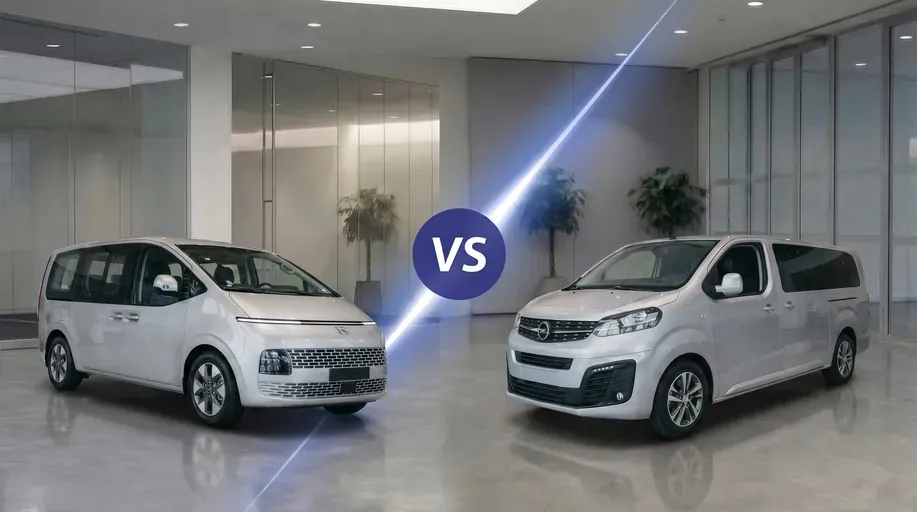
Detailed comparison of Hyundai Staria vs Opel Zafira Life. Discover real-world experiences, a detailed analysis of space and engines, and a clear verdict for choosing the ideal MPV.
Apr 21, 2026
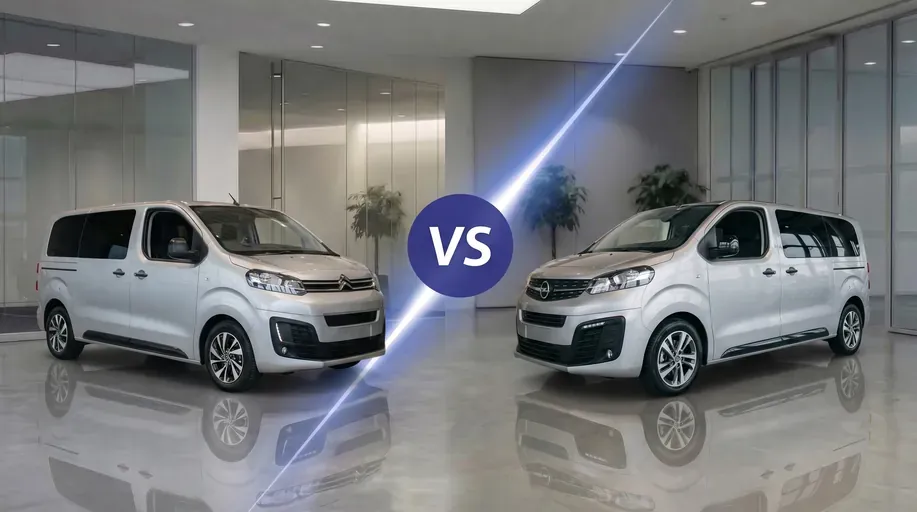
Detailed comparison of Citroën SpaceTourer and Opel Zafira Life. Find out which family MPV offers better engines, equipment, and space. Read our verdict!
Apr 14, 2026