
Car battle
Audi Q5 vs. Volvo XC60: Complete comparison 2026
Audi Q5 vs Volvo XC60: Which luxury used SUV should you choose? Read our detailed comparison of equipment, driving dynamics and practicality, complete with our final verdict.
May 4, 2026
Articles
Car battle
Detailed comparison of Kia Sorento vs. Škoda Kodiaq. Find out which family SUV offers better engines, real-world fuel consumption, and equipment in our final verdict.
May 10, 2026


The South Korean family SUV Kia Sorento, which was also sold under the name Sorento Prime in some foreign markets in the past, attracts buyers with its confident design, premium technologies, and exceptionally generous interior space. Standing against it is the popular European bestseller Škoda Kodiaq, which, on the other hand, has long scored points mainly for its unrivaled practicality, huge luggage compartment, and cleverly designed details for everyday life. Let's take a detailed look at which of these two very popular cars makes more sense on the market for roughly four-year-old used vehicles and will become a better companion for your family.
When comparing the exterior dimensions of both family SUVs on the used car market, it is clear at first glance that the fourth-generation Kia Sorento (MQ4, sold since 2020) aims slightly higher in overall size than the popular first-generation Škoda Kodiaq. The South Korean model makes a more robust impression, which is clearly confirmed by the figures. With a length of 4,810 mm, the Sorento exceeds the standard versions of the Kodiaq by 113 mm. The Sorento is also 18 mm wider and slightly taller overall, giving it a more dominant stance on the road.
These extra millimeters naturally translate into everyday practicality. The wheelbase, which is key for cabin space, offers a value of 2,815 mm for the Sorento, while for the Kodiaq, this value is around 2,788 mm. A difference of nearly three centimeters means the advantage of slightly more generous longitudinal space for passengers. You will especially appreciate this when you frequently carry taller adult passengers in the second row or regularly use the optional third row of seats. On the other hand, the slightly more compact proportions of the Škoda Kodiaq are a clear benefit during daily movement in cramped city traffic. With an overall length of around 4.7 meters, the Kodiaq makes perpendicular parking in front of supermarkets and maneuvering in narrow underground garages easier.
The choice between these two vehicles from the perspective of exterior dimensions is thus closely related to the environment in which you will move most often. If you require maximum interior space in a family car, prefer an American feel of bulkiness, and don't mind maneuvering a vehicle exceeding 4.8 meters in length, the Kia Sorento makes a lot of sense. If, on the other hand, you are looking for a compromise between a generous interior and slightly easier maneuverability in cramped city spaces, the dimensionally more modest Škoda Kodiaq might well be a more user-friendly option for you.
| Parameter | Kia Sorento SUV | Škoda Kodiaq SUV |
|---|---|---|
| Length (mm) | 4810 | 4697 - 4705 |
| Width (mm) | 1900 | 1882 |
| Height (mm) | 1695 | 1660 - 1688 |
| Wheelbase (mm) | 2815 | 2788 - 2791 |
When choosing a family car on the used car market, trunk capacity is one of the most important criteria. The Kia Sorento and Škoda Kodiaq models are champions in this regard, targeting drivers who demand maximum practicality. Both SUVs can easily accommodate equipment for an active family, a stroller, sports gear, and still have enough space left for weekend shopping or a longer holiday. However, differences between them exist and can be decisive for specific needs.
Looking at the numbers for approximately four-year-old cars, the first-generation Škoda Kodiaq (after the 2021 facelift) leads in the basic configuration. In the five-seat configuration, it offers a staggering 835 liters, making it hard to beat in its class. The rival Kia Sorento MQ4 generation (from 2020) counters with a very respectable basic volume of 705 liters for the standard diesel engine. However, the tables turn slightly when you fold down the rear seats. In that case, the Sorento offers a total capacity of up to 2,100 liters, while the Kodiaq's maximum value stops at 2,065 liters. In practice, this difference means space for several extra suitcases when moving or transporting bulky items.
On the used car market, it is necessary to pay attention to the chosen engine and interior layout. If you opt for the hybrid or plug-in hybrid version of the Kia Sorento, the battery takes up some space, and the basic volume decreases to 693–697 liters. For the seven-seat variants of both models, which are in high demand on the market, also expect the trunk to shrink significantly when the third row of seats is upright. At that point, the Sorento offers a rather symbolic 175 to 187 liters. The choice between these two cars therefore depends on whether you prefer an absolute record in the basic layout for daily use or maximum hauling capacity for occasional transport.
| Parameter | Kia Sorento SUV | Škoda Kodiaq SUV |
|---|---|---|
| Basic volume (liters) | 705 | 835 |
| Maximum volume with seats folded (liters) | 2100 | 2065 |
While the Škoda Kodiaq offers an unrivaled basic volume for daily family use, the Kia Sorento scores with slightly more space after the seats are fully folded.
The ability to tow a heavy trailer is one of the key decision-making factors for many buyers of large family SUVs. Whether you plan to transport a caravan, a boat, or just need to hitch up a utility trailer, towing capacity determines the car's true practicality. While some versions offer ultimate power for heavy loads, other models are more suited for a weekend trip to the DIY store or transporting a light trailer with space for a few extra suitcases on a longer holiday.
Looking at used cars from roughly 2020 to 2023 (1st generation Škoda Kodiaq and 4th generation Kia Sorento designated MQ4), we find that both cars offer excellent but very different values depending on the chosen powertrain.
In practice, these differences mean that both the diesel Sorento and the more powerful Kodiaq will tow a large twin-axle caravan or horse trailer without any problems and with a large margin. However, Kia's hybrid models will serve those who only need to tow smaller and lighter loads.
In conclusion, if absolute towing power and heavy-duty work are your priorities, the diesel Kia Sorento is the clear winner thanks to its 2.5-tonne capacity. The Škoda Kodiaq, on the other hand, is an excellent all-rounder that does not suffer from such dramatic drops in towing power even with weaker petrol engines.
| Model and Engine | Braked trailer (kg) | Unbraked trailer (kg) |
|---|---|---|
| Kia Sorento 2.2 CRDi (MQ4) | 2500 | 750 |
| Kia Sorento 1.6 T-GDI Hybrid (MQ4) | 1650 | 750 |
| Kia Sorento 1.6 T-GDI Plug-in Hybrid (MQ4) | 1500 | 750 |
| Škoda Kodiaq 2.0 TDI / RS (1st generation) | 1950 - 2300 | 750 |
| Škoda Kodiaq 2.0 TSI (1st generation) | 2200 | 750 |
| Škoda Kodiaq 1.5 TSI (1st generation) | 1800 - 2000 | 750 |
When choosing a mid-size family SUV on the market for roughly four-year-old used cars, you will encounter two completely different approaches to engine lineups with the Kia Sorento and Škoda Kodiaq, which fundamentally affects the overall efficiency, fuel consumption, and driving characteristics of the vehicles. While the South Korean carmaker responded to strict standards with significant electrification for the fourth-generation Sorento (MQ4), supplementing its robust diesel base with two advanced petrol hybrid powertrains, the Czech Kodiaq sticks to a much more traditional lineup of units within its first-generation facelift from 2021. Škoda, by contrast, scores points with a substantially wider selection of classic pure internal combustion engines, ranging from the economical 1.5 TSI base to the sporty RS variants. The decision for buyers thus depends primarily on whether they are looking for modern technology ideal for suburban traffic with lower petrol consumption (Kia), or prefer the broad flexibility of traditional diesel and petrol engines proven over time (Škoda).
Under the hood of a roughly four-year-old Kia Sorento, we find a very clearly defined range of three main powertrains. An innovative family choice is the turbocharged 1.6 T-GDI four-cylinder petrol engine in a full hybrid (HEV) specification with a combined output of 169 kW, which is complemented for maximum efficiency by a plug-in hybrid (PHEV) variant with power increased to 195 kW and the option of charging from a socket for pure electric driving. Both petrol-electric units are paired as standard with a classic six-speed automatic transmission. For drivers travelling mainly on long motorway routes or for owners of heavy trailers, the 2.2 CRDi diesel engine is the clear choice. An output of 148 kW and an impressive torque of 440 Nm are met here by a lightning-fast eight-speed dual-clutch transmission (8DCT). While diesel versions offered a choice between front-wheel and all-wheel drive, the more powerful plug-in hybrid was always delivered to the market in an AWD configuration.
| Engine type | Fuel type | Power (kW) | Torque (Nm) | Transmission |
|---|---|---|---|---|
| 1.6 T-GDI Hybrid | Petrol / HEV | 169 | 350 | 6AT |
| 1.6 T-GDI Plug-in-Hybrid | Petrol / PHEV | 195 | 350 | 6AT |
| 2.2 CRDi | Diesel | 148 | 440 | 8DCT |
The Škoda Kodiaq, on the other hand, relies on a richer and more conservative selection of units without the addition of advanced electrification. The standard entry into the world of this popular family SUV is the economical 1.5 TSI petrol engine with 110 kW and Active Cylinder Technology (ACT). Significantly higher dynamics are provided by the more powerful 2.0 TSI (140 kW). The sporty Kodiaq RS is a chapter of its own. When hunting through classifieds, pay close attention to the year of manufacture – the extremely popular but emission-heavy 2.0 BiTDI diesel engine with 176 kW ceased production at the end of 2020. In roughly four-year-old cars after the facelift, you will exclusively encounter the newer, noticeably lighter, and higher-revving 2.0 TSI petrol unit originating from the Octavia RS with an output of 180 kW. However, the true sales and user ideal on the used market remains the extremely efficient 2.0 TDI SCR diesel engines. These are available in variants with 110 kW and a more powerful 147 kW. The vast majority of Kodiaq engines send power to the wheels through a seven-speed DSG dual-clutch automatic, although a precise six-speed manual transmission can exceptionally be found with the base engines.
| Engine type | Fuel type | Power (kW) | Torque (Nm) | Transmission |
|---|---|---|---|---|
| 1.5 TSI ACT | Petrol | 110 | 250 | 6MT / 7DSG |
| 2.0 TSI | Petrol | 140 | 320 | 7DSG |
| 2.0 TSI RS | Petrol | 180 | 370 | 7DSG |
| 2.0 TDI SCR | Diesel | 110 | 340 | 6MT / 7DSG |
| 2.0 TDI SCR | Diesel | 147 | 400 | 7DSG |
The greatest strength of the Korean Kia Sorento is undoubtedly its high and perfectly functional level of electrification, which brings exceptional economy during daily commuting, along with the robust towing power of the 2.2 CRDi diesel engine, capable of hauling even a horse trailer. A weakness may be the somewhat narrower selection of conventional engines. The Czech Škoda Kodiaq impresses with the excellent power scaling of its proven TDI diesel engines and surprises with the sharply tuned petrol powertrain in the RS version. However, it loses out due to the complete absence of full hybrid variants, for which you simply have to go to the competition. If you commute daily from the outskirts to the city or prefer the velvety smooth operation of a combined powertrain, the advanced hybrid Sorento will serve you exceptionally well. If, however, you prefer longer motorway journeys with a car full of children, carefully monitor fuel consumption on long trips, or are simply tempted to drive a family SUV with an aggressive sporty character under the baton of the RS edition, the Škoda Kodiaq will be a much more accurate bullseye.
The decision between the Sorento and Kodiaq narrows down to a choice between innovative hybrid technology for urban and suburban traffic and the almost infinite motorway flexibility of proven TSI and TDI engines.
Choosing the right engine is absolutely crucial for long-term satisfaction with a vehicle. Therefore, our recommendations for these used models are based on balanced performance, real-world fuel consumption, feedback from long-term owners, and documented mechanical reliability. Looking at roughly four-year-old cars on the used market, both manufacturers take slightly different paths, which brings interesting facts to the comparison itself. While the Škoda Kodiaq (1st generation) relies on an extremely wide range of reliable TSI petrol and TDI diesel engines from the EVO family with the innovative Twin Dosing system for drastic emission reduction, the Kia Sorento (MQ4 generation, available 2020–2024) built its offering on advanced petrol hybrids and a completely new diesel engine with an aluminum block, which saved an impressive 19.5 kilograms of weight on the front axle compared to its predecessor.
For such a massive SUV, the diesel four-cylinder from the Smartstream family is objectively the best and most practical choice in the entire range. With its confident operating characteristics, it often outshines even the theoretically attractive full-hybrid and plug-in hybrid variants (available in the listings across the 2021–2024 model years) in practice. Its greatest technical advantage is the substantial 440 Nm of torque with an excellently tuned curve, which ensures a very effortless pull even from low revs. The interaction with the new eight-speed DCT8 wet-clutch transmission is exceptionally smooth, and real-world fuel consumption remains easily between 6.5 and 7.5 liters per 100 km, even for such a heavy and aerodynamically demanding vehicle.
A major risk for this engine (as with most modern diesels) is using the vehicle exclusively for short city trips. Constant stop-and-go driving prevents proper regeneration, leading to rapid clogging of the diesel particulate filter (DPF) and dangerous engine oil dilution with unburnt diesel. You can avoid this problem with a used car by checking the service history and shortening oil change intervals to a maximum of 15,000 km, ideally combined with regular highway runs. This engine is perfect for highway drivers, families making full use of the seven-seat interior, and anyone who needs to regularly tow heavy trailers or caravans.
From the extremely rich range of first-generation engines, this variant represents the absolute "golden mean" and, in terms of long-term operational reliability, the most secure purchase for used cars from 2020 to 2023. Although a more dynamic 147 kW (200 hp) version is also available, service experience with older units shows that the more powerful engine can suffer from slightly higher oil consumption in some vehicles, which subsequently puts a negative load on and accelerates the degradation of the DPF filter. In contrast, the lower-output 110 kW version is considered a bulletproof engine. It offers refined operation and excellent efficiency – with gentle driving, consumption in both FWD and 4x4 versions can commonly be pushed well below the 6.5-liter mark.
When buying this recommended Kodiaq, you don't need to worry about the engine itself, but you must pay close attention to the maintenance of the drivetrain. Always insist on clearly documented oil changes in both the DSG dual-clutch transmission and the all-wheel-drive clutch (ideally every 60,000 km). Neglecting this task is the most common cause of very expensive failures in older used cars. This engine is ideal for calmer and pragmatically minded drivers, for long highway holidays, or as a tireless family workhorse where the primary goal is massive space at the lowest possible operating costs.
Official fuel consumption figures often differ significantly from real-world driving conditions, especially for large family SUVs with a larger frontal area and substantial curb weight. To get the most accurate and objective picture of operating costs, we do not rely on laboratory figures from manufacturers, but on real-world user data collected from platforms such as Spritmonitor.de and database records. We focused on the generations of vehicles that currently dominate the market for roughly four-year-old used cars – specifically the Kia Sorento MQ4 generation (from 2020) and the facelifted first-generation Škoda Kodiaq (around 2021).
| Model and engine | Average consumption (l/100 km) |
|---|---|
| Kia Sorento 1.6 T-GDI Plug-in-Hybrid | 1.6 |
| Škoda Kodiaq 2.0 TDI SCR | 5.9 |
| Kia Sorento 2.2 CRDi | 5.9 |
| Kia Sorento 1.6 T-GDI Hybrid | 6.4 |
| Škoda Kodiaq 1.5 TSI ACT | 6.8 |
| Škoda Kodiaq 2.0 TSI | 8.0 |
| Škoda Kodiaq RS 2.0 TSI | 8.6 |
Looking at the table, it is clear that diesel still reigns supreme in the heavy SUV category. The 2.2 CRDi diesel engines from Kia and the 2.0 TDI from Škoda can move these large family cruisers with highly efficient consumption just below the six-liter mark, which is an impressive result given their dimensions. A surprising finding might be the behavior of the full-hybrid Sorento (HEV). Although modern technology promises savings, without external charging, the consumption of around 6.4 l/100 km in a typical mix of roads and highways is more of a compromise than a revolution. The opposite extreme is represented by the entry-level 1.5 TSI four-cylinder in the Kodiaq, which confirms the well-known rule that small displacement in a heavy car does not mean miraculously low fuel consumption – frequent operation under higher load pushes the average to almost seven liters. The figure of 1.6 l/100 km for the plug-in hybrid Sorento looks great on paper, but in reality, it is only achievable with absolute discipline and regular charging on short trips. The more powerful 2.0-liter petrol engines in the Kodiaq then exceed the eight-liter mark.
What do these numbers mean for a typical buyer of a four-year-old used car? For users who commute long distances daily or often travel on highways with a fully loaded vehicle, a diesel unit will be the clear choice – both the Sorento and the Kodiaq offer absolutely equivalent diesel operating economy. Conversely, drivers who spend most of the week in urban or suburban environments should consider the hybrid Sorento, which benefits greatly from recuperation in cities, or opt for the more affordable Kodiaq with the 1.5 TSI engine. The plug-in hybrid variant of the Kia only makes sense for those customers who have home charging available.
In the end, fuel consumption itself will not be the deciding factor in the tough battle between these two models. In the most popular diesel variant, both cars have absolutely nothing to fault each other for, and differences are easily erased by the driving style of a particular driver. The decisive factor for purchase will therefore more likely be whether you prefer modern electrified units, which Kia is gradually transitioning to, or whether you prefer a more diverse range of classic petrol engines focusing on dynamics, as offered by Škoda.
When searching for a family SUV from 2021 to 2022 (roughly 4-year-old vehicles), you will encounter a fundamental difference in the range of offers and equipment structure. Both cars hold their value relatively well, but their price curves behave differently on the secondary market.
The Škoda Kodiaq benefits from its immense popularity on the domestic market and within corporate fleets. This means there is plenty to choose from in used car dealerships, and prices can start relatively low as a result.
The fourth generation of the Kia Sorento (launched in late 2020) is much less common on the used car market. This vehicle serves as the brand's flagship, which is reflected in its equipment and prices.
| Criterion | Škoda Kodiaq | Kia Sorento |
|---|---|---|
| Base price (higher mileage / weaker equipment) | from approx. €23,000 | from approx. €28,000 |
| Average price (sought-after engines and trims) | €27,000 – €33,000 | €32,000 – €37,000 |
| Top versions and cars in top condition | €35,000 – €39,000+ | €37,000 – €41,000+ |
| Market availability of used cars | Immense | Limited (more exclusive) |
From a buyer's perspective, the Kodiaq is a more flexible choice if you have a strictly defined and somewhat tighter budget. You can compromise on performance or 4x4 drive requirements and save money. In contrast, the Kia Sorento scores with a more sophisticated standard – although you pay more for the base model, you get a car packed with technology that, even after four years, often still benefits from a seven-year factory warranty.
While the Škoda Kodiaq opens the way to a cheaper purchase thanks to a wider range and more modest base versions, the Kia Sorento requires a higher initial investment, which it immediately compensates for with more luxurious equipment and peace of mind in the form of an ongoing factory warranty.
Both models, the Kia Sorento and the Škoda Kodiaq, received the maximum five-star rating in their Euro NCAP crash tests. When comparing the safety of used family SUVs, however, it is crucial not to look only at the number of stars, but to pay attention to the year the vehicles were tested. The testing protocols of the independent Euro NCAP organization are constantly evolving and becoming stricter, so percentage scores from different years cannot be directly compared.
Trial by fire under new rules for Kia
The fourth-generation Kia Sorento underwent testing in 2020, meaning it had to withstand a significantly stricter and tougher methodology. This newly included more demanding simulations of a frontal impact against a moving barrier, protection in side collisions with an emphasis on contact between passengers, and more detailed checks for cyclist detection or handling crisis situations at intersections. Thanks to the deployment of advanced technologies, the Sorento earned an excellent 87% for safety assistance systems. Passive safety and excellent occupant protection were significantly aided by the then-innovative center airbag between the front seats, which effectively prevents the heads of the driver and passenger from colliding.
Older certification date for Škoda
The first-generation Škoda Kodiaq (including post-facelift versions) on the used car market is based on the safety check the car underwent at the time of its market launch in 2017. The bodywork and overall frame strength are top-notch, as clearly evidenced by a respectable 92% for adult protection. However, this score reflects testing standards that would be considered less demanding from today's perspective. The older certification date is primarily reflected in the assistance systems category. The 54% result points out that although the Kodiaq featured autonomous emergency braking, its sensors and reactive electronics at the time did not reach the complexity of today's systems. From the perspective of today's methodology, old tests have also expired.
| Parameter | Kia Sorento | Škoda Kodiaq |
|---|---|---|
| Year of testing | 2020 | 2017 |
| Adult occupant protection | 82 % | 92 % |
| Child occupant protection | 85 % | 77 % |
| Vulnerable road users protection | 63 % | 71 % |
| Safety assistance systems | 87 % | 54 % |
In terms of raw passive body protection, both SUVs are robust and very safe choices for transporting a family. But if your absolute priority is technological maturity, a modern effort to proactively prevent any accident, and certification approaching current trends, the Kia Sorento offers an undeniably more modern and comprehensive safety package.
Although both family SUVs offer exceptionally strong passive safety, the Kia Sorento, thanks to the 2020 tests, brings a generation more modern assistance systems and advanced protection. For a used car buyer who places the highest emphasis on current safety standards, it is thus the more logical choice.
In addition to standard equipment, each of the models offers several unique features that can be decisive for the customer and demonstrate the completely different approach of both carmakers to maximum added value.
Generous standard and safety equipment with a range of modern assistance systems
Efficient full-hybrid (HEV) and plug-in hybrid (PHEV) powertrains available
Above-standard 7-year factory warranty, which often transfers to subsequent owners of the used car
Very spacious interior with better and more comfortable access to the third row of seats
Distinctive and premium-looking exterior design and cabin craftsmanship
Higher purchase price of used models compared to direct competitors
Hybrid powertrains can lose their fuel efficiency during longer highway trips
Larger exterior dimensions and weight make parking and maneuverability in narrow city streets more difficult
Very limited selection of purely internal combustion engines on the used car market
The Kia Sorento represents an excellent choice for larger families looking for a technologically advanced and richly equipped SUV with alternative hybrid powertrain options. Thanks to its more luxuriously designed interior and generous space, it will suit those for whom maximum comfort, a sense of safety, and modern equipment are more important than sporty driving characteristics.
Top-tier interior packaging and unrivaled luggage capacity
Wide range of proven and efficient diesel (TDI) and gasoline (TSI) engines
Practical "Simply Clever" solutions (door edge protection, ice scraper, umbrellas) that make daily use easier
Excellent interior ergonomics with the retention of physical buttons for climate control
Excellent residual value, easy servicing, and a huge selection on the used car market
The optional third row of seats is very cramped and truly suitable only for smaller children
Complete absence of full-hybrid and plug-in hybrid powertrains in the first generation of the vehicle
Stiffer suspension tuning over bumps when using larger wheels, unless the car has DCC adaptive dampers
More conservative exterior design, which is ubiquitous on the roads
The Škoda Kodiaq is the perfect family workhorse, relying on maximum practicality, a huge trunk, and a wide range of popular conventional engines, led by the reliable 2.0 TDI unit. It will primarily appeal to pragmatically minded buyers who appreciate intuitive controls, excellent service availability, and the slow depreciation of the car's value on the secondary market.
Based on long-term owner feedback, service reports, recalls, and insights from our own comprehensive car audit, we have compiled an overview of the most common problems you should watch out for when buying these used SUVs.
The fourth generation of the Kia Sorento (produced since 2020) is considered a robust and reliable car, yet it suffers from specific teething troubles, particularly in the areas of software and new powertrains.
The fourth-generation Kia Sorento is a mechanically very durable SUV, whose most common problems revolve around electronics and software, which can usually be reliably resolved with an update at an authorized service center.
The popular Škoda Kodiaq, especially in its facelifted version from 2021 to 2023, benefits from reliable group technology, but it does not escape typical ailments associated with onboard electronics and more complex emission systems.
The Kodiaq is a practical and proven family car, where you should pay attention mainly to a documented maintenance history of the DSG automatic transmission and arm yourself with patience for occasional onboard system outages.
When buying a used car, a thorough inspection is key, and for modern, technology-packed family SUVs, this is doubly true. Both cars have their specific weak points. Here are several specific points to focus on for approximately four-year-old vehicles. For peace of mind before the purchase itself, the best step is always an independent comprehensive car inspection, which will rule out costly surprises.
Škoda Kodiaq in the five-seat configuration offers a slightly larger trunk with an enormous volume of up to 835 liters, while the Kia Sorento holds a very respectable 821 liters. When using all seven seats, however, the differences disappear and the luggage space in both cars logically shrinks to a minimum. For normal family trips and vacations, the total transport capacity of both models is more than sufficient.
Kia Sorento is the clear winner in this regard, as its fourth generation offers an advanced full-hybrid (HEV) and plug-in hybrid (PHEV). The first-generation Škoda Kodiaq (including the facelift) relies exclusively on traditional TSI gasoline and TDI diesel engines, with the plug-in hybrid only arriving with the brand-new 2024 generation. If you are looking for a roughly four-year-old electrified family SUV, the Korean car represents the only possible choice.
Kia traditionally scores with its seven-year warranty (or up to 150,000 km), which fully transfers to subsequent owners of the used car. Škoda standardly provides a two-year warranty, which first owners often extended to five years or 100,000 km for an additional fee. For a roughly four-year-old used car, the Sorento usually still has significantly longer factory coverage in case of unexpected breakdowns.
The Kia Sorento is slightly longer and wider overall, which has a very positive effect on the spaciousness in the optional third row of seats. Passengers in the very back have slightly more legroom in the Korean car and even have their own air conditioning vents with separate controls. While the Kodiaq can also carry seven passengers, the last row functions more as an emergency solution for children over shorter distances.
The popular group 2.0 TDI engine in the Škoda Kodiaq can achieve excellent fuel consumption of around 6 to 6.5 l/100 km in real-world traffic and on longer routes. The diesel version of the Kia Sorento, equipped with the powerful 2.2 CRDi engine, is slightly thirstier due to its larger body structure and typically requires 7 to 7.5 l/100 km. In the long run, the Czech representative will please you with slightly lower fuel operating costs.
The decision between a roughly four-year-old used Kia Sorento and Skoda Kodiaq ultimately depends on whether you prefer technological sophistication with a touch of premium feel or unrivaled everyday practicality in a family SUV. Thanks to its generous interior space, advanced hybrid powertrains, and still-valid seven-year warranty, the South Korean Sorento is an ideal choice for more demanding families desiring modern assistance systems and rich equipment. In contrast, the slightly more compact Kodiaq excels with its huge basic trunk, exceptionally economical and proven TDI diesel engines, and cleverly designed details, making it a perfect and more affordable workhorse for pragmatic drivers. Whether you opt for the innovative electrified path from Kia or choose the versatile internal combustion classic from Skoda, in both cases, you will gain an exceptionally capable and reliable partner for an active family life on the used car market.
Sources: ADAC, lidovky.cz, aktualne.cz, autosalon.tv, autoservis.cz, autospektrum.cz
This article was prepared using artificial intelligence tools. The section guarantor is Petr Dušek.
Audi Q5 vs Volvo XC60: Which luxury used SUV should you choose? Read our detailed comparison of equipment, driving dynamics and practicality, complete with our final verdict.
May 4, 2026
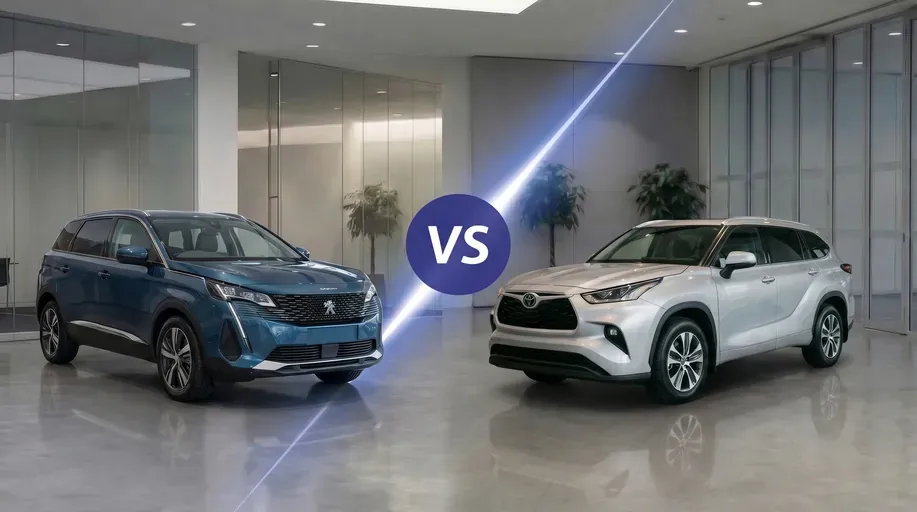
Detailed comparison: Peugeot 5008 vs. Toyota Highlander. Discover the differences in space, engines, and equipment of these used cars. Read our verdict before you buy!
Apr 28, 2026

Choosing a used SUV? Detailed comparison of the Alfa Romeo Stelvio vs. Volvo XC60. A detailed verdict, performance and equipment ratings will help you make your choice. Find out more!
Apr 21, 2026