Car battle
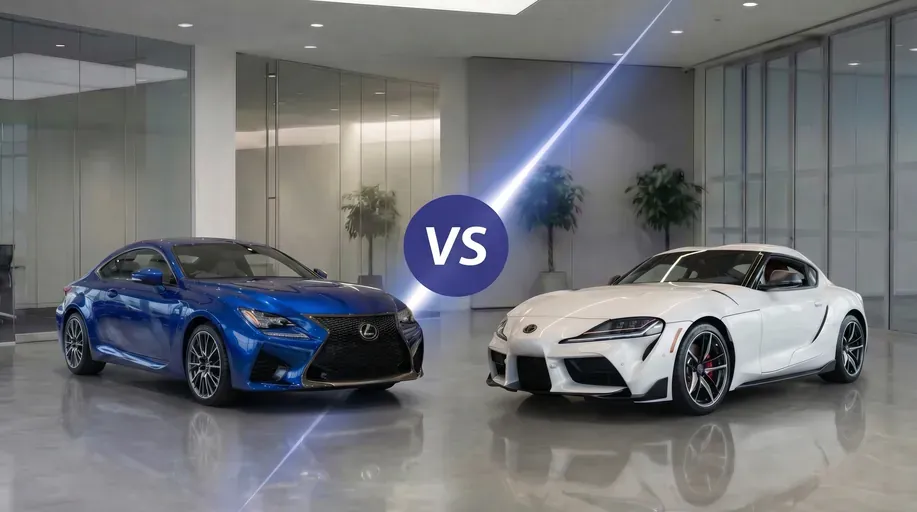
Lexus RC F vs. Toyota Supra: Complete comparison 2026
The Great Coupe Comparison: Lexus RC F vs Toyota GR Supra. A detailed look at performance, equipment, and real-world driving characteristics. Read our final verdict!
Apr 14, 2026
Articles
Car battle
Detailed comparison: Jaguar F-Type vs Porsche 718 Boxster. Compare performance, engines, and real-world driving characteristics of used cars. Find out which sports car to choose!
April 19, 2026
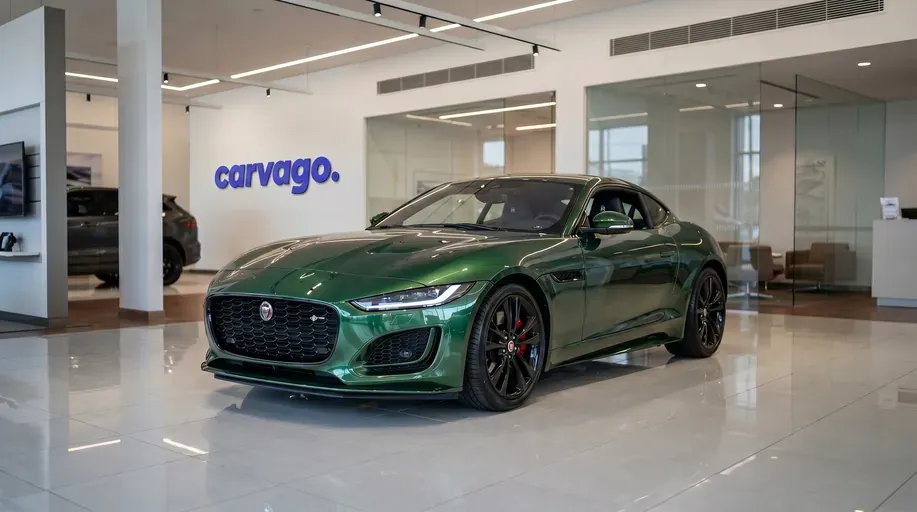
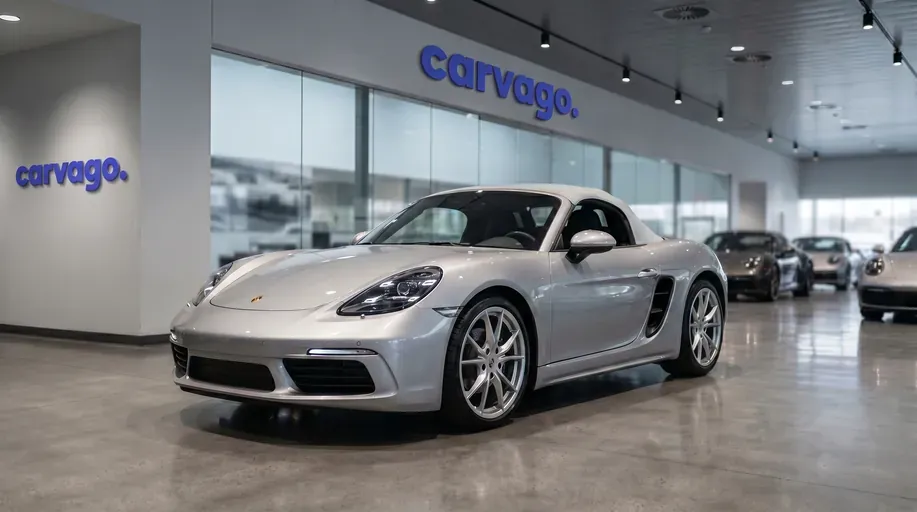
The British sports car Jaguar F-Type enchants drivers with its predatory design, charismatic sound, and classic layout, proudly representing the traditional school of British carmakers. Standing against it is the German benchmark of precision, the Porsche 718 Boxster, known among fans and historically simply as the Porsche Boxster, which, thanks to its mid-mounted engine, offers top-tier balance and surgically precise handling. Let's take a look together at how these two exceptional models, representing a dream come true of the ideal car for weekend joys, fare in a direct and ruthless comparison.
When looking at the external dimensions, the different concepts of both sports cars, which represent very different approaches in the market for approximately four-year-old used cars, are fully revealed. The Jaguar F-Type with its front engine and proportions of a classic grand tourer is noticeably more massive. Compared to the Porsche 718 Boxster, the British model is roughly 91 mm longer and, above all, a staggering 122 mm wider. This muscular width (1923 mm) gives the Jaguar an unmistakable, dramatic stance on the road. In practical life, however, this means that parking in narrow underground garages or driving through cramped city streets requires more attention and caution from the driver. The Jaguar's dimensions will thus primarily appeal to those looking for a strong visual presence on the road, even at the cost of minor compromises in daily maneuverability.
The Porsche 718 Boxster, with its mid-engine concept, bets on a significantly more compact footprint, which is fundamentally reflected in its unrivaled agility. The wheelbase is 2475 mm, which is a significant 147 mm less than the Jaguar. In practice, this means that the Porsche feels much more nimble on winding back roads, changes direction in a flash, and gives the driver the feeling of a perfectly tuned and lightweight machine. The Jaguar, on the other hand, benefits from its longer wheelbase (2622 mm) primarily in a straight line, where it offers more mature directional stability at high highway speeds. The smaller dimensions and shorter wheelbase of the Porsche thus clearly favor a purist driving experience in tight corners.
Differences can also be found in the height of both cars, although with sports models, we are logically moving very low above the asphalt. Depending on the specific version, the Porsche 718 Boxster sits even slightly lower with a height of 1262 to 1281 mm than the Jaguar, which measures up to 1311 mm in height for the Coupé version. The choice between these two cars, in terms of external proportions, is simply a choice between two different driving worlds. While the compact and low-slung 718 Boxster excels with its light-footedness and easy estimation of the bodywork, the more majestic Jaguar F-Type bets on opulent shapes that bring excellent stability and comfort but simply require more space to live.
| Parameter | Jaguar F-Type Coupé | Jaguar F-Type Cabriolet | Porsche 718 Boxster Cabriolet |
|---|---|---|---|
| Length (mm) | 4470 - 4482 | 4470 - 4482 | 4379 - 4391 |
| Width (mm) | 1923 | 1923 | 1801 |
| Height (mm) | 1311 | 1307 - 1308 | 1262 - 1281 |
| Wheelbase (mm) | 2622 | 2622 | 2475 |
In the segment of pure two-seater sports cars, luggage capacity might not be the primary selection criterion, but for the overall usability of the car, it plays a crucial role in the used car market. Especially if you are looking for a roughly four-year-old car and plan to take it on road trips or weekend adventures, the differences between the Jaguar F-Type (X152 generation, produced and updated for 2020–2022 models) and the Porsche 718 Boxster (982 generation) are enormous. These two popular models approach storage space completely differently, primarily due to their different engine layout concepts.
The Jaguar F-Type with its classic front-mounted engine is available in two body styles that differ dramatically in practicality. The closed Jaguar F-Type Coupé offers a relatively practical base volume of 310 liters (measured under the load cover). Thanks to the liftback-style rear hatch with glass, access to the trunk is excellent. In practice, this model offers enough space for several suitcases or a larger set of golf clubs. Conversely, the Jaguar F-Type Convertible pays a heavy price for its folding roof mechanism – its very shallow trunk provides only a modest 196 liters.
The Porsche 718 Boxster, available exclusively as a soft-top roadster/convertible, benefits from its mid-engine layout. Instead of one trunk, it offers two. The deep space under the front hood holds 150 liters, and the rear trunk adds another 122 liters. Together, the Boxster provides a very solid usable volume of 272 liters.
The practical implications of these values for daily life with the car are striking. The split capacity in the Porsche is surprisingly usable and perfectly sufficient for a weekend grocery run or a longer holiday for two; you just need to swap large suitcases for more flexible soft bags. While the Jaguar Coupé scores with its large, single storage space for bulkier items, the F-Type Convertible version will require strict compromises and significant limitations when packing. Furthermore, since all these cars are strictly two-seaters, there are simply no rear seats, and therefore no maximum volume after folding them down. None of these models (whether the F-Type in P300/P450 versions or the Boxster S and GTS 4.0) suffer from the installation of heavy batteries found in potential plug-in hybrid versions, so the stated capacity remains constant across common engine options.
The final choice depends on your body style preferences. If you insist on a car with a folding roof, the Porsche Boxster will undoubtedly offer much better everyday usability and more room for packed items than the not-so-generous F-Type Convertible. However, if you prefer a fixed roof, the Jaguar F-Type Coupé version guarantees the largest single-piece trunk of all.
| Parameter | Jaguar F-Type Coupé | Jaguar F-Type Convertible | Porsche 718 Boxster Convertible |
|---|---|---|---|
| Base volume (liters) | 310 | 196 | 272 |
| Max volume with seats folded down (liters) | N/A (two-seater) | N/A (two-seater) | N/A (two-seater) |
While the Jaguar F-Type Coupé provides the largest and most practical single trunk on the used car market in this class, when choosing a convertible, the clever use of two luggage compartments in the Porsche 718 Boxster clearly wins.
When comparing attractive sports cars such as the Jaguar F-Type (X152 generation, current for the four-year-old used car market) and the Porsche 718 Boxster (982 generation, relevant for the same period), trailer weight might seem like a marginal parameter. From the perspective of overall practicality and potential efforts for more universal use of the car, however, it is a relatively important factor. However, do not look for any difference between these two cars, as both the standard and maximum trailer weight for both cars is exactly 0 kg. Manufacturers have completely excluded the installation of a tow bar for these purebred sports models. This fact applies across the board to all available versions – from the basic two-liter four-cylinders to the top specifications, such as the Jaguar F-Type R with a supercharged V8 (423 kW) or the Porsche 718 Boxster GTS 4.0 (294 kW). The values do not change in any case, as there are no hybrid variants with potentially limited capacity in these generations. The practical consequence of this design feature is that you are fully dependent on the internal storage space. While it offers space for a few extra suitcases, which is sufficient for both cars for weekend shopping or a longer holiday for two, you simply have to forget about towing a caravan or attaching a trailer with track equipment. In conclusion, it can be stated that if you strictly require towing capacity for your active lifestyle, neither of these purist sports cars will be the right choice for you. Since, for obvious reasons, neither model has any towing capacity and values are logically missing for them in our database, no data is listed in the table below.
| Model and motorization | Braked weight of trailer (kg) | Unbraked weight of trailer (kg) |
|---|
Both models offer thrilling dynamics but approach them from completely different philosophical directions. For those interested in a used sports car, this means a choice between raw power and perfect precision. The Jaguar F-Type bets on a classic front-engine layout, a huge dose of charisma, and a predatory, emotive sound profile that shines best with its flagship V8 engines. The Porsche 718 Boxster, on the other hand, makes the most of its mid-engine layout. This solution gives it unrivaled balance and surgically precise handling. Decisions in this category often depend on whether you prefer the theater and power of the British beast or the uncompromising driving precision of German engineering, which in selected versions also boasts a phenomenal naturally aspirated engine.
Under the long hood of the Jaguar F-Type, you will find exclusively petrol engines on the four-year-old used car market, all of which are paired with the smooth and fast eight-speed Quickshift automatic transmission. The entry point is the P300 turbocharged 2.0-liter four-cylinder with 221 kW, which forms a rational, lightweight, and surprisingly agile base for daily driving with rear-wheel drive. However, the true pride of the British brand are the supercharged 5.0-liter V8s: the P450 (331 kW) and the flagship R or R75 (423 kW) versions, which provide the car with brutal pull and an unmistakable soundtrack. If you search the market for slightly older units (manufactured until the turn of 2019 and 2020), you may also come across the popular supercharged V6s, the P340 and P380. However, these disappeared from the range due to stricter emission standards, and their role was taken over by the aforementioned detuned P450 V8. For more powerful versions, Jaguar offers optional all-wheel drive (AWD) (standard on the R version), which significantly improves power usability in poor conditions.
| Engine type | Fuel | Power (kW) | Torque (Nm) | Transmission |
|---|---|---|---|---|
| P300 (2.0 Turbo) | Petrol | 221 | 400 | 8AT (Quickshift) |
| P340 (3.0 V6 Supercharged) (until 2020) | Petrol | 250 | 450 | 8AT (Quickshift) |
| P380 (3.0 V6 Supercharged) (until 2020) | Petrol | 280 | 460 | 8AT (Quickshift) |
| P450 (5.0 V8 Supercharged) | Petrol | 331 | 580 | 8AT (Quickshift) |
| R / R75 (5.0 V8 Supercharged) | Petrol | 423 | 700 | 8AT (Quickshift) |
In its current generation (982), the Porsche 718 Boxster relies exclusively on boxer engines and, unlike its British competitor, always sends power purely to the rear wheels. The range opens with turbocharged four-cylinders: a 2.0-liter for the standard version and the driver-focused T model (220 kW), above which sits the more powerful 2.5-liter for the S version (257 kW). A turning point for the generation that now forms the mainstream of the nearly-new car market was 2020. That's when Porsche listened to the fans' calls and replaced the original 2.5-liter four-cylinder in the GTS version with a phenomenal naturally aspirated 4.0-liter six-cylinder labeled GTS 4.0 (294 kW). This engine represents driving nirvana and returns the traditional acoustic profile to the car. A major triumph for Porsche in the eyes of enthusiasts is also the choice of transmissions – all engines can be enjoyed with a fantastic six-speed manual transmission or the lightning-fast seven-speed dual-clutch PDK automatic, which gives the car better dynamics and smoothness.
| Engine type | Fuel | Power (kW) | Torque (Nm) | Transmission |
|---|---|---|---|---|
| 718 Boxster / T (2.0 Turbo) | Petrol | 220 | 380 | 6MT / 7PDK |
| 718 Boxster S (2.5 Turbo) | Petrol | 257 | 420 | 6MT / 7PDK |
| 718 Boxster GTS (2.5 Turbo) (until 2020) | Petrol | 269 | 430 | 6MT / 7PDK |
| 718 Boxster GTS 4.0 (4.0 V6 NA) | Petrol | 294 | 420 (MT) / 430 (PDK) | 6MT / 7PDK |
While the Jaguar enchants with raw explosive power and the theatrical performance of its supercharged V8s, Porsche counters with lightness, the option of a manual transmission, and a return to the high-revving naturally aspirated six-cylinder in the GTS 4.0 version.
Choosing the right engine is absolutely crucial for long-term satisfaction with the car, which is why the following recommendations are based on real owners' experiences, mechanical reliability, actual fuel consumption, and overall user comfort. Looking at the production years, one particularly interesting fact stands out that sharply divides the two cars: while the Porsche 718 Boxster replaced the iconic naturally aspirated six-cylinders with efficient turbocharged four-cylinders for its standard versions throughout the 982 generation, Jaguar took almost the opposite step with the F-Type. As the data on available engines shows, Jaguar completely ended production of the popular supercharged six-cylinders (e.g., P340 and P380 versions) at the end of 2019 and focused only on base four-cylinders or full-blooded five-liter V8s for the facelifted models. This creates two completely different approaches to sports driving.
Why it's the best choice:
For cars on the used market around 4 years old (from the 2020 facelift onwards), the P450 engine is the absolute ideal. Given that the characterful six-cylinders disappeared irretrievably from the range at that time, the British brand left a choice between only the base two-liter (P300) or the massive V8. The P450 uses the same 5.0-liter supercharged V8 as the brutal R version, but with slightly reduced power. From a daily use perspective, it provides an absolutely perfect compromise between crushing power, refinement, and slightly more rational operating costs than the top model.
Technical advantages:
The greatest weapon of this engine is its absolutely instantaneous response, which it owes to the mechanical supercharger. Power comes on without the noticeable lag known from modern turbo engines, and the sound of the supercharged V8 is among the very best in the modern automotive industry. Real-world fuel consumption during normal smooth driving ranges between 11 and 13 liters per 100 km, which is fully acceptable for a car with a heavy 5.0-liter engine and 450 hp.
Risks and what to watch out for:
This unit is mechanically extremely robust but requires responsible and timely maintenance.
Who it's ideal for:
This engine is made for enthusiastic hedonists who aren't looking to chase tenths of a second on the track but long for a weekend car full of emotion, mechanical theater, and classic British charisma. You will appreciate it during summer cruising on favorite country roads or fast highway transfers, where it feels confident at any speed.
Why it's the best choice:
Although die-hard purists swear by the 4.0-liter naturally aspirated six-cylinder from the GTS 4.0 version (available only from 2020), for the vast majority of buyers considering a car in the nearly-new category, the honest base two-liter turbocharged four-cylinder boxer makes the most sense. In today's market, it provides an uncompromising balance between a lower purchase price, stunning real-world dynamics, and surprisingly low operating costs. The switch to turbocharging provided the car with a significant boost in torque in the lower rev range, making the base Boxster unexpectedly comfortable even in normal heavy traffic.
Technical advantages:
The turbocharged two-liter generates a confident 380 Nm of torque, starting from low revs. The pull is therefore very intense in practically any situation. A huge advantage of this engine is its fantastic pairing with the fast PDK dual-clutch automatic transmission, with which the car operates smoothly and completely predictably. Travelers will also be pleased by the top-tier fuel consumption – during more relaxed driving and on longer trips, you can easily reach an average of 7.5 to 8.5 liters per 100 km, making the Porsche one of the most efficient representatives of its category.
Risks and what to watch out for:
The two-liter four-cylinder boxer soon proved to be an extremely reliable unit and is not plagued by any serious mechanical ailments in civilian use. The only minor disadvantage remains the more synthetic and less roaring engine sound compared to older models.
Who it's ideal for:
The base version of the 718 Boxster is perfect for drivers with high demands for unrivaled driving surgery and perfect balance, but who also want to use the car for pleasure, travel, and normal daily operation. It will thrill everyone who can appreciate agility in tight Alpine passes and doesn't want to pay hundreds of thousands extra for the operation of an unnecessarily monstrous engine.
Official fuel consumption values provided by manufacturers often differ significantly from the reality of everyday driving. To get a more accurate picture, it is therefore ideal to look into databases where drivers themselves record their real-world refueling, such as the popular community portal Spritmonitor. For sports cars roughly four years old, such as the Jaguar F-Type generation (after the 2020 facelift) and the Porsche 718 Boxster (982 series), real-world consumption primarily depends on driving style. Nevertheless, average data from real users clearly shows what can be expected from these models on the road and which engine options make the most sense.
| Model and Engine | Average Consumption (l/100 km) |
|---|---|
| Porsche 718 Boxster 2.0 (221 kW) | 8.9 |
| Porsche 718 Boxster S 2.5 (257 kW) | 9.8 |
| Porsche 718 Boxster GTS 4.0 (294 kW) | 10.5 |
| Jaguar F-Type P300 2.0 (221 kW) | 10.5 |
| Jaguar F-Type P450 5.0 V8 (331 kW) | 12.5 |
| Jaguar F-Type R 5.0 V8 (423 kW) | 13.5 |
From the collected data, it is clear that the Porsche 718 Boxster is more economical in all respects. It is very surprising that the base two-liter turbocharged four-cylinder Jaguar F-Type (P300) achieves a real-world consumption of around 10.5 l/100 km, completely losing the advantage of so-called downsizing. It thus consumes the same amount of fuel as the much more powerful 4.0-liter naturally aspirated six-cylinder in the Porsche 718 Boxster GTS. Porsche thus proves that larger displacement does not necessarily mean brutal consumption, especially in combination with sophisticated aerodynamics and a significantly lighter body. In contrast, Jaguar's huge, supercharged V8s (P450 and R) logically demand more fuel, which is reflected in average values between 12.5 and 13.5 l/100 km. Here, the driver already pays a natural penalty for the heavier front end, massive power, and unmistakable sound.
For a typical user, this means that if they are looking for a car for more frequent drives, long weekend trips, or are at least marginally interested in operating costs, the Porsche 718 Boxster will be a much friendlier choice. Both the base version and the S version can be operated with very reasonable costs during smooth driving, even with occasional use in city traffic. On the other hand, buyers of the V8 Jaguar probably don't worry about every liter of gasoline and will use the car more as a pure weekend affair, where the fuel consumption figure on the trip computer is completely secondary.
In the end, fuel consumption can be one of the deciding factors, but primarily for those considering these cars for more frequent or even daily driving. Porsche clearly wins thanks to better engineering efficiency and lower overall weight, while Jaguar bets on raw power and emotions, for which it is simply necessary to pay significantly more at the gas station.
When searching for a used sports car with a production date roughly four years ago (typically 2020 to 2022), a very interesting perspective opens up on how both brands hold their value. From a generational standpoint, this age range is an ideal choice: with Jaguar, you already get the updated (facelifted) F-Type with slimmer headlights, while with Porsche, it's the mature 982 generation.
The price gap between these two cars on the used market is significant and clearly shows the market's different approach to top-tier British and German sports cars.
The British cat traditionally suffers from a slightly steeper depreciation on the used car market. For a second-hand buyer, however, this is excellent news, as a used F-Type represents a fantastic price-to-attractiveness ratio.
Porsche, on the other hand, is famous for how tenaciously its cars hold their value. With four-year-old models, you'll feel this immediately – the initial investment in a used one will be noticeably higher.
| Car Category | Jaguar F-Type | Porsche 718 Boxster |
|---|---|---|
| Entry-level and base versions | €35,000 – €45,000 | €58,000 – €66,000 |
| Higher-performance mid-range | €49,000 – €70,000 | €86,000 – €103,000 |
| Top models and limited editions | €78,000 – €99,000 | €99,000 – €123,000+ |
While the Jaguar F-Type offers a fantastic price-to-performance ratio on the four-year-old used market with a much more accessible entry threshold, the Porsche 718 Boxster requires a fatter wallet, for which it rewards you with uncompromising quality and a much more stable residual value for the future.
When evaluating the safety of common cars, it usually begins with a mention of achieving a five-star Euro NCAP rating. However, even with such top-tier results, it is crucial to consider the context and the year of testing. Testing protocols become radically stricter and evolve over time, so percentage scores from different years cannot be directly compared. While laboratories previously focused mainly on passive tests, new methodologies require advanced frontal collision simulations, cyclist detection capabilities, and effective intervention of assistance systems directly at intersections. For premium sports models, however, the situation is quite specific.
The Jaguar F-Type belongs to the category of low-volume cars, and for that reason, it has never undergone official Euro NCAP tests. Testing would be inefficient for this independent organization given the low production volumes. From a safety perspective, however, the F-Type certainly does not lag behind. It features an active hood for pedestrian protection, autonomous emergency braking (AEB), a lane-keeping system, and a full set of airbags covering front and side impacts. Even without an official certificate, Jaguar offers a relatively modern protective shield within its class.
The Porsche 718 Boxster has also never appeared in Euro NCAP laboratories. The Stuttgart-based automaker approaches safety with the philosophy that the best accident is the one that never happens. The roadster excels with an extremely rigid body, top-tier brakes, and a brilliant stabilization system, while protection during the impact itself is provided by six airbags. Given the open roof, massive roll bars are present behind the headrests, which deploy instantly in the event of an impending rollover. More advanced features, such as blind-spot monitoring or adaptive cruise control, were very often found only on the list of optional equipment for Porsche.
In conclusion, we can summarize that despite the absence of current crash tests, both cars are very safe. From the perspective of current standards, however, the Jaguar F-Type provides a slightly more modern and comprehensive package of standard active assistants, while the Porsche 718 Boxster relies on unrivaled mechanical grip and premium optional equipment.
| Parameter | Jaguar F-Type | Porsche 718 Boxster |
|---|---|---|
| Year of testing | Not tested | Not tested |
| Adult occupant protection (%) | - | - |
| Child occupant protection (%) | - | - |
| Vulnerable road users protection (%) | - | - |
| Safety assist systems (%) | - | - |
Although neither car was tested by Euro NCAP due to its low-volume nature, the Jaguar F-Type offers a slightly richer standard equipment of modern assistance systems. Porsche, on the other hand, bets on perfect handling and body rigidity, making it a very safe sports car in the event of an evasive maneuver.
Both models offer much more than just satisfying basic driving needs, and each approaches adding value in its own, very distinctive way.
Stunning and timeless exterior design that attracts attention
Fantastic exhaust note, especially with the supercharged V8 engines
More comfortable suspension tuning with a Grand Tourer character
Availability of all-wheel drive (AWD) for more confident traction in the wet
Very smooth-shifting eight-speed automatic transmission
Higher curb weight noticeably limits agility in tight corners
Interior architecture and infotainment are starting to feel dated
Extremely small luggage space in the Convertible version
Faster depreciation and potentially higher service costs
The Jaguar F-Type is the embodiment of classic British charm and will appeal to drivers looking for an emotional and charismatic car for long trips rather than a purebred sports tool. Its main weapons are uncompromising style, a thunderous sound, and cruising comfort, making it the perfect companion for weekend travel with elegance.
Absolutely top-tier and neutral driving characteristics thanks to the mid-engine layout
Excellent steering feedback and incredible agility on back roads
Very high level of build quality and top-tier driver's cockpit ergonomics
Surprising practicality with the use of two separate luggage compartments (front and rear)
Phenomenal PDK dual-clutch transmission and slow depreciation on the used car market
The sound of the turbocharged four-cylinder engines does not reach the emotionality of its predecessors or the Jaguar
Very expensive optional equipment items, which are often missing even in more expensive used cars
The button-laden center console reveals the true age of this generation
Higher levels of aerodynamic and road noise during highway travel
The Porsche 718 Boxster represents driving nirvana and is the ideal choice for automotive purists who demand perfect balance, precise handling, and surgical precision in corners. It is a fantastic driver's tool that, despite its primary sporting focus, surprises with everyday usability and solid reliability.
Based on long-term user experience, service reports, failure statistics, and data from comprehensive car inspections, we have compiled an overview of the most common problems that buyers of used examples of these sports models should watch out for.
Jaguar F-Type offers fantastic British character and breathtaking sound, but in terms of operational reliability, it requires more careful maintenance and vigilance, especially with more powerful engines and onboard electronics.
Although the F-Type charms with its performance, it struggles with minor fluid leaks, software bugs, and requires more meticulous preventive service.
Porsche 718 Boxster even with its turbocharged flat-four engines maintains a very high standard of German engineering precision and reliability, yet it does not escape some specific and often expensive faults.
Porsche prides itself on exemplary overall reliability and build quality; the main threat to the wallet remains failing active engine mounts and water pump issues.
When buying a used car, a thorough inspection is key. Here are some specific points to focus on for these two models. To eliminate hidden risks, we recommend using the certified CarAudit service. This independent physical inspection of a used car covers over 270 checkpoints, including a test drive and thorough diagnostics, giving you absolute certainty about the technical condition before you decide to buy.
Porsche 718 Boxster excels in steering precision and agility thanks to its mid-engine layout and significantly lower overall weight. The front-engined Jaguar F-Type is more of a muscular grand tourer, which, while not offering such surgically precise cornering, scores with a more aggressive character and the option of all-wheel drive.
The Jaguar F-Type is famous for its fantastic and loud sound, primarily thanks to its charismatic supercharged V8 engines. In its standard versions, the Porsche 718 Boxster uses turbocharged flat-four engines with a less distinctive acoustic profile, but it also offers phenomenal naturally aspirated six-cylinder engines in the GTS 4.0 versions, which will satisfy the most demanding purists.
The Porsche 718 Boxster is surprisingly the more practical choice because, thanks to its mid-engine placement, it offers two luggage compartments (front and rear) with a very usable total volume of 275 liters. The Jaguar's trunk in the convertible version has a relatively irregular shape and a volume of only 207 liters, which makes packing for longer trips somewhat complicated.
Both cars can be used daily without any problems, but the Jaguar F-Type offers a slightly more comfortable suspension setup, which is better suited for comfortable long-distance travel. The Porsche, on the other hand, provides significantly better visibility from the cabin, and its ergonomics with a perfect driving position make maneuvering in city traffic easier.
Porsche has long maintained an excellent reputation for mechanical reliability and overall build quality, which is also positively reflected in its very good resale value. With the Jaguar, minor electronic infotainment glitches may occur more frequently, and its service costs tend to be slightly higher for the large engine variants.
The choice between the Jaguar F-Type and the Porsche 718 Boxster on the nearly-new used car market represents a beautiful dilemma between untamed emotions and pure engineering perfection. If you are looking for a charismatic grand tourer with breathtaking design, a dramatic sound profile, and excellent touring comfort, the British beast will be the clear favorite for you, also thanks to its more favorable purchase prices. Conversely, the Porsche 718 Boxster serves as the ultimate tool for automotive purists who demand surgically precise handling, unrivaled mid-engine agility, and an unexpected level of everyday practicality. While the Jaguar will win your heart with its raw power and unmistakable theatrical performance, the Porsche ultimately triumphs with its uncompromising quality, perfect balance, and excellent residual value retention.
Sources: ADAC, novinky.cz, aktualne.cz, techfocus.cz, autotechnik.cz, autickaruvblog.cz
This article was prepared using artificial intelligence tools. The section guarantor is Petr Dušek.
The Great Coupe Comparison: Lexus RC F vs Toyota GR Supra. A detailed look at performance, equipment, and real-world driving characteristics. Read our final verdict!
Apr 14, 2026
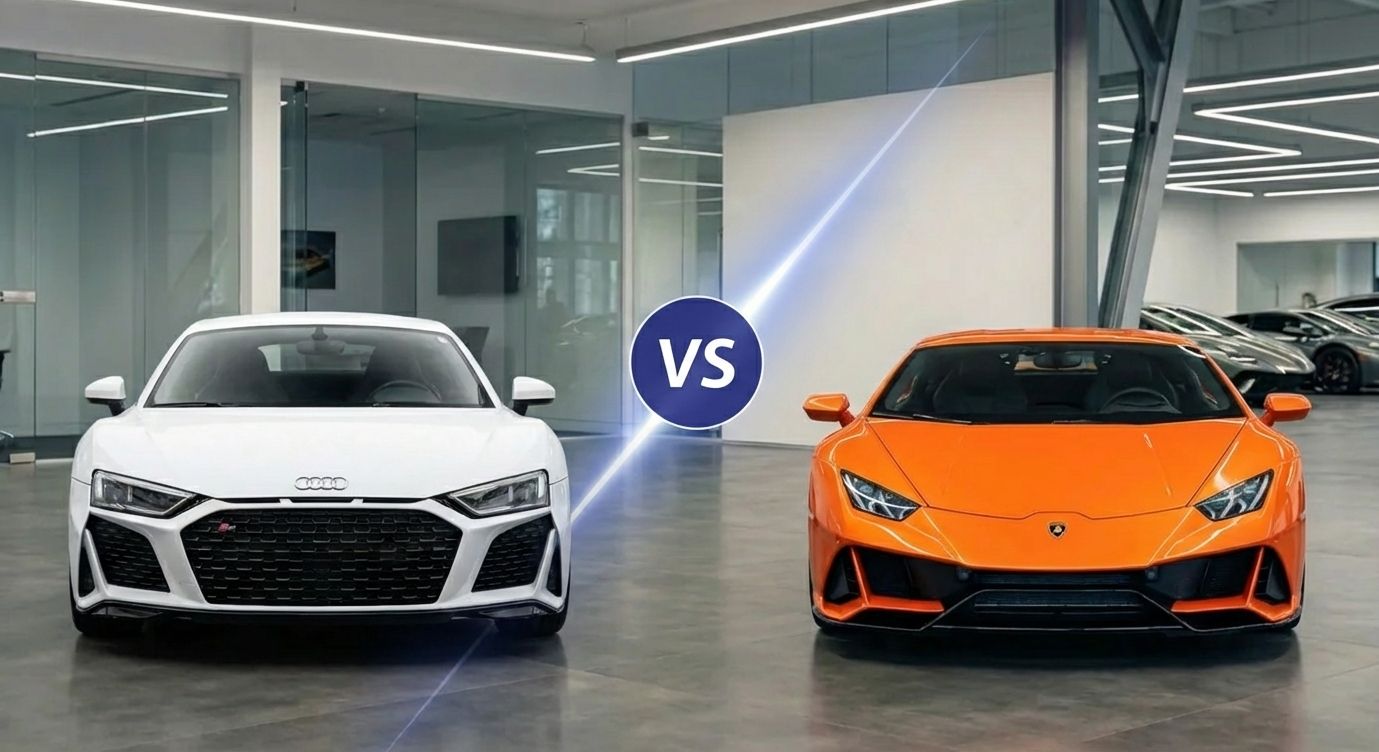
Detailed comparison of Audi R8 vs Lamborghini Huracán. We reveal the real differences, performance, and driving characteristics of these V10 supercars. Which one to choose?
Apr 14, 2026
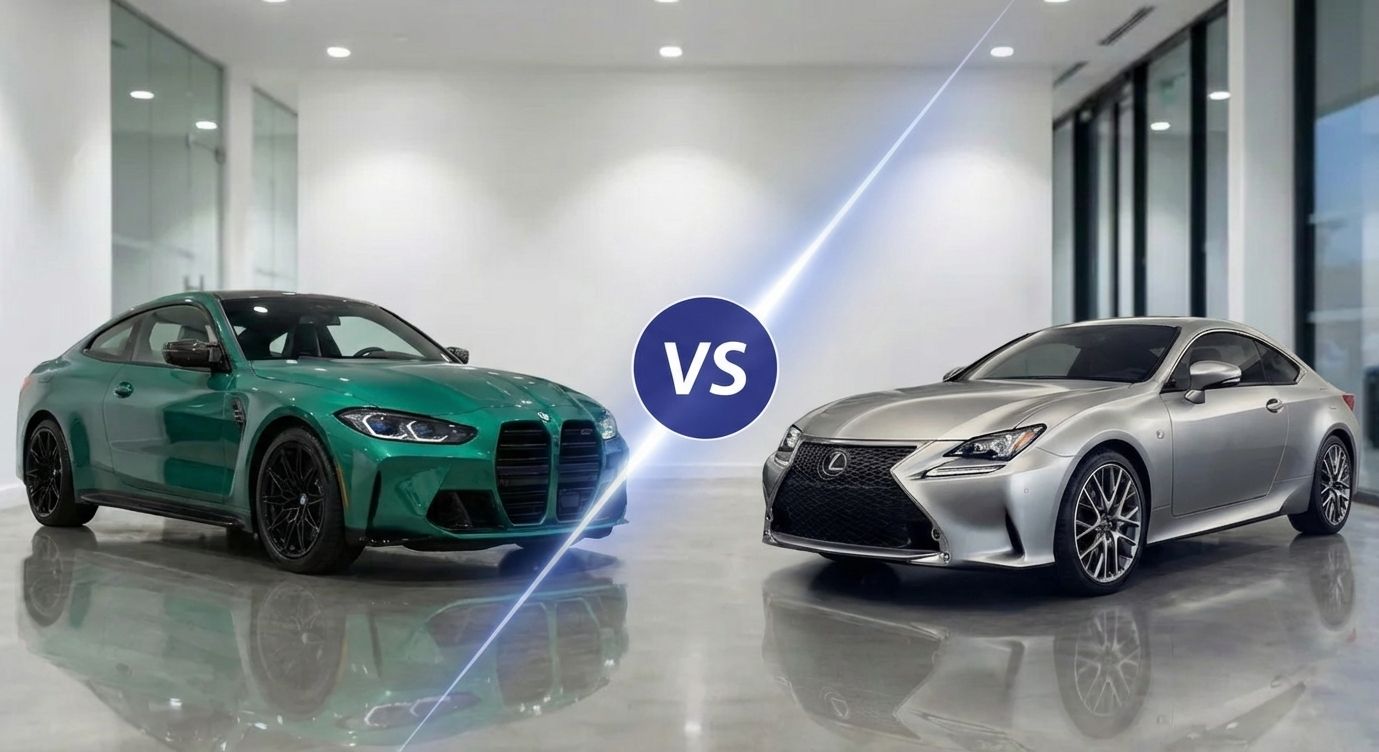
Detailed comparison of the BMW M4 and Lexus RC F. Discover the key differences in engines, driving characteristics, and reliability. Read our verdict before you buy.
Apr 14, 2026