Articles

Car battle

Jaguar F-Pace vs. Volvo XC60: Complete comparison 2026

Detailed comparison: Jaguar F-Pace vs Volvo XC60. Which premium SUV from the used car market is better? Discover the differences in equipment and engines, and read our clear verdict.

April 24, 2026

VS
Jaguar F-Pace

Jaguar F-Pace

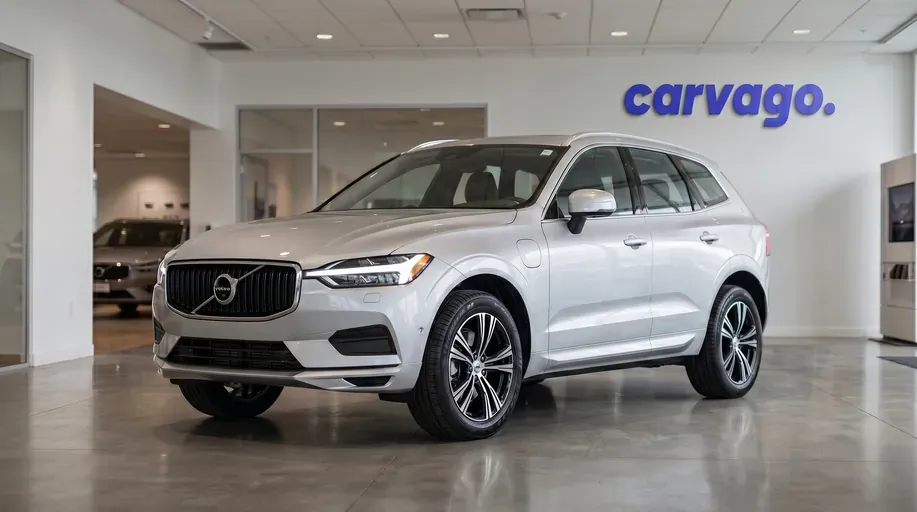
Volvo XC60

Volvo XC60

Introduction

Jaguar F-Pace represents the first-ever SUV from the traditional British automaker, which, on the used car market, combines dynamic driving characteristics with a sporty premium design. In contrast, the Swedish Volvo XC60 is an established staple of the segment, attracting customers primarily with its renowned level of safety, clean Nordic minimalism, and advanced technologies. Let's take a detailed look at how these two popular family SUVs stack up in a direct comparison and which one represents the better choice for you.

Comparison of External Dimensions

When looking at the exterior dimensions of both premium SUVs, which typically appear on the market as roughly four-year-old used cars (Jaguar F-Pace in the post-facelift X761 generation and the second generation of the Swedish Volvo XC60), we encounter clear proportional differences. The Jaguar F-Pace is visibly a more massive and sportier-looking car, which is confirmed by the numbers themselves. The British beast in its standard version measures 4747 mm in length (up to 4762 mm for the top SVR version), meaning it is approximately 6 centimeters longer than its competitor from the north. There is also a noticeable difference in width, where the Jaguar, at 1936 mm, surpasses the Volvo (1902 mm) by 34 mm.

These physical proportions have a direct impact on daily life with the car. Thanks to its more compact footprint, the Volvo XC60 is slightly more user-friendly and agile when maneuvering in tight underground garages or narrow city parking lots. The Jaguar, on the other hand, bets on its width and more muscular stance, which gives it a more dominant presence on the road. Furthermore, the greater width gives the British model a slight advantage in shoulder room for passengers.

Particularly interesting, however, is the comparison of the wheelbase, which is a key parameter for longitudinal interior space. Although the Jaguar is longer overall in terms of bodywork, its 2874 mm wheelbase exceeds the Volvo XC60 (2865 mm) by a completely negligible 9 millimeters. In practice, this means that a substantial part of the Jaguar's extra length is due to longer and more pronounced body overhangs, and both cars thus offer very similar basic legroom for the occupants. As for the overall height of the vehicles, the difference is only a few millimeters, which does not play a significant role in normal entry or luggage loading.

ParameterJaguar F-Pace SUVVolvo XC60 SUV
Length (mm)4747 - 47624688
Width (mm)19361902
Height (mm)1664 - 16701658
Wheelbase (mm)28742865

Trunk Volume

When it comes to choosing a premium family SUV, trunk capacity often plays a key role in the car's overall practicality. Whether you plan to regularly transport bulky sports equipment, strollers, or simply need a car sufficient for weekend shopping and longer vacations, the differences between these two popular models can be decisive for many buyers in the used car market. Although the Jaguar F-Pace (X761 generation) and Volvo XC60 (2nd generation) fall into the same size class and are huge hits in the market for roughly four-year-old cars, their approach to interior space utilization differs quite fundamentally.

In terms of absolute numbers, the British beast clearly has the upper hand. The standard internal combustion version of the Jaguar F-Pace offers a generous basic trunk volume of 650 liters, which in practice means safe space for several extra suitcases compared to its Swedish competitor. The Volvo XC60, on the other hand, has a slightly smaller trunk with a capacity of 483 liters in its common mild-hybrid powertrains. This difference is also very noticeable after folding down the rear seats. While the Jaguar F-Pace boasts a maximum loading capacity of up to 1,740 liters, the Volvo XC60 reaches 1,410 liters in its maximum configuration.

However, in the used car market, you will very often encounter modern plug-in hybrid powertrains, where the situation is different due to the need to accommodate traction batteries. In the Jaguar F-Pace P400e version, the trunk floor is raised, which significantly reduces the basic volume to 485 liters (1,299 liters after folding the rear backrests). In contrast, the Volvo XC60 in its Recharge versions (T6 and T8) managed the integration of the batteries under the floor slightly better and loses only a minimal amount of space – the hybrid version offers 468 liters in the base and 1,395 liters with the bench folded. Furthermore, the XC60 is traditionally praised for its more regular trunk shape and ideally flat loading area, which makes handling heavy objects significantly easier.

If maximum transport capacity is your absolute priority and you are looking for a classic internal combustion engine, the Jaguar F-Pace is the clear winner thanks to its giant trunk. However, if you are considering buying a plug-in hybrid, the differences on paper disappear and both cars will serve family purposes similarly well.

ParameterJaguar F-Pace SUVVolvo XC60 SUV
Basic volume (liters)650483
Max. volume with seats folded (liters)17401410

📦 Battle of the Trunks

The Jaguar F-Pace dominates in overall trunk size with standard powertrains, but if you opt for the popular plug-in hybrid, the interior space of both SUVs becomes practically equal.

Discover the true condition of the car thanks to an independent inspection

Order CarAudit™

Trailer Weights

The ability to tow heavy trailers is a key and closely watched parameter for premium mid-size SUVs, whether you are planning to tow a caravan, a boat, or a heavy horse trailer. In the context of approximately four-year-old used cars, the Jaguar F-Pace offers exceptionally consistent performance; for the vast majority of its conventional engines (including popular diesel and petrol versions such as the D200, D300, or P250), it boasts a generous maximum braked trailer weight of 2,400 kg. The second-generation Volvo XC60 is a strong contender in this regard, allowing its standard mild-hybrid variants (such as the B4 or B5) to safely tow a trailer weighing between 2,300 and 2,400 kg. However, a more significant difference appears in the increasingly popular plug-in hybrid specifications, where the presence of heavy traction batteries reduces the permitted rated load. While the Jaguar F-Pace P400e can tow a maximum of 2,000 kg, the hybrid Volvo XC60 (T6 and T8 Recharge variants) can handle 2,100 to 2,250 kg, depending on the exact model year. In practice, even with this slight reduction, these capacities are fully sufficient for a weekend purchase of heavy building materials for a cottage or a long family holiday with a large twin-axle caravan, providing substantial extra convenience. From the perspective of the final choice, this means that if you are looking for an uncompromising workhorse with a standard internal combustion engine, the Jaguar provides maximum assurance across almost all conventional versions. Conversely, the Volvo XC60 is a slightly more versatile choice for drivers who require an efficient electrified powertrain (PHEV) but do not want to make too many compromises in overall towing capacity.

Model and engineBraked trailer (kg)Unbraked trailer (kg)
Jaguar F-Pace D200 / D300 / P2502400750
Jaguar F-Pace P400e (Plug-in Hybrid)2000750
Volvo XC60 B4 / B5 / B6 (Mild-hybrid)2300 - 2400750
Volvo XC60 T6 / T8 (Plug-in Hybrid)2100 - 2250750

Overview of Most Common Motorizations

Powertrain Philosophy: Emotion vs. Maximum Efficiency

The range of powertrains clearly illustrates the completely different approach of both carmakers to current trends, which is a key factor for used car buyers. Following its facelift (affecting cars roughly 4 years old), the Volvo XC60 has bet exclusively on fully electrified 2.0-litre four-cylinder engines. Regardless of whether you choose diesel, petrol, or an extremely powerful plug-in hybrid, you will always find a 2.0-litre engine with mild-hybrid (MHEV) or plug-in hybrid (PHEV) technology under the hood. The Jaguar F-Pace, on the other hand, honors the more emotional British school. Alongside its own efficient four-cylinder engines with mild-hybrid technology and a plug-in hybrid, it also offers modern, silky-smooth 3.0-litre straight-sixes on the used market, and even a brutal supercharged 5.0-litre V8 for the top-of-the-line SVR version. While the Volvo XC60 appeals to drivers seeking relaxation, efficiency, and quietness, the Jaguar F-Pace also targets demanding drivers who prefer the characteristic sound and mechanical essence of large-displacement engines.

For the Jaguar F-Pace, the model range from the 2021 model year onwards covers an incredibly wide spectrum. Older units labeled 20d or 30d have disappeared from the range for good, replaced in the facelifted generation by a significantly redesigned line of MHEV engines. The entry-level options are the reliable and very economical 2.0-litre diesel four-cylinders, D165 and D200, ideal for high annual mileages. The real highlight for long-distance travel, however, is the silky-smooth D300 straight-six diesel. Petrol fans can choose the solid P250 four-cylinder or the immensely dynamic P400 six-cylinder. The compromise for electric driving in the city is the P400e plug-in hybrid. For absolute purists, Jaguar keeps the breathtaking SVR version in play, with its symphonic V8 sound and power exceeding 400 kW. All mentioned powertrains are paired with a proven eight-speed automatic and AWD for maximum smoothness.

Engine typeFuel typePower (kW)Torque (Nm)Transmission
D165Diesel (MHEV)1203808-speed automatic
D200Diesel (MHEV)1504308-speed automatic
D300Diesel (MHEV)2216508-speed automatic
P250Petrol1843658-speed automatic
P400Petrol (MHEV)2945508-speed automatic
P400ePlug-in hybrid2976408-speed automatic
SVR (5.0 V8)Petrol4057008-speed automatic

During the relevant period, the Volvo XC60 transitioned completely to a modernized engine family. Older, purely internal combustion generations like the D3, D4, T4, or T5 have already been replaced by innovative technology on the market for younger used cars and have completely disappeared from the lineup. The successors are units newly designated with the letters "B" and "Recharge". B4 and B5 variants are available in both diesel and petrol versions, with a 48V mild-hybrid system as standard to help smooth out start-stop cycles and reduce real-world fuel consumption. The top purely internal combustion choice is the powerful petrol B6. For fans of electric driving, the Recharge T6 and T8 models are intended. On the market for four-year-old used cars, you will commonly encounter their improved iterations with a larger battery, extended pure electric range (up to 80 km), and a staggering combined output reaching up to 335 kW in the T8 version. Power distribution is always handled by an eight-speed transmission, tuned primarily for comfort and smoothness.

Engine typeFuel typePower (kW)Torque (Nm)Transmission
B4Petrol (MHEV)1453008-speed automatic
B4 DieselDiesel (MHEV)1454208-speed automatic
B5Petrol (MHEV)1843508-speed automatic
B5 DieselDiesel (MHEV)1734808-speed automatic
B6Petrol (MHEV)2204208-speed automatic
T6 RechargePlug-in hybrid251 - 2576598-speed automatic
T8 RechargePlug-in hybrid288 - 3357098-speed automatic

Reason vs. Emotion 🏎️

While the Volvo XC60 scores with exemplary efficiency, refinement, and perfectly tuned plug-in hybrids with a 2.0-litre heart, the Jaguar F-Pace satisfies the desires of classic enthusiasts thanks to its range of powerful six-cylinder engines and a thrilling V8 engine.

While the Jaguar F-Pace targets emotions and sporty driving characteristics, retaining prestigious multi-cylinder engines even in its newer generations, the Volvo XC60 has chosen a completely pragmatic and safety-oriented approach. The Swedish carmaker not only limited its entire range exclusively to two-litre four-cylinder engines (Drive-E architecture) but, starting in 2020, became the first manufacturer to introduce a blanket electronic top speed limit of 180 km/h for all its vehicles. Choosing the right engine is key to long-term satisfaction – for used cars around four years old, we therefore focus on versions with the best ratio of performance, real-world fuel consumption, and mechanical reliability.

For the Jaguar F-Pace, we recommend: D200 AWD (150 kW / 204 hp)

This diesel two-litre mild-hybrid (MHEV) from the Ingenium engine family represents the best-balanced powertrain for everyday use. The successor to the older and more problematic versions was introduced under the hood as part of the model's facelift in early 2021.

  • Why it's the best choice: Compared to the previously available 20d version, which was produced until 2020, the D200 unit is fundamentally improved mechanically. It provides smooth operation, a reliable all-wheel-drive system, and real-world fuel consumption that consistently ranges between 6.5 and 7 liters per 100 km with sensible driving. Furthermore, compared to the top-tier D300 six-cylinder, you will save significantly on maintenance and insurance.
  • Technical advantages: Thanks to the integration of mild-hybrid assistance, the engine reliably masks turbocharger lag at low RPMs and provides strong torque (430 Nm) right from the bottom. However, the most significant innovation of this generation is the redesigned timing chain routing and an improved fuel system.
  • Known risks and how to prevent them: In older Ingenium units, timing chains failed massively, an issue that engineers largely resolved in versions from 2021 onwards. However, sensitivity to frequent interruptions of the diesel particulate filter (DPF) regeneration during city stop-and-go traffic remains. Short trips can thus lead to engine oil dilution with unburnt diesel. The recipe for longevity is simple: regularly take the car on longer trips and shorten the oil change interval to a maximum of 15,000 km.
  • Who it's for: For drivers who mostly cover long intercity distances, require a representative premium SUV with dynamic driving characteristics, and do not want to deal with the high operating costs of luxury sports variants.

For the Volvo XC60, we recommend: B4 Diesel AWD (145 kW / 197 hp)

The four-cylinder mild-hybrid diesel B4 engine with AWD, which Volvo deployed extensively until the end of 2023, is a quiet and economical benchmark in the mid-size SUV class.

  • Why it's the best choice: In early 2024, Volvo definitively ended global production of all its diesel engines, causing this fuel version to disappear completely from current price lists. As a result, the B4 Diesel has suddenly become a very attractive commodity on the four-year-old used car market. With this engine, you avoid the extreme electronic and mechanical complexity of the top-tier T8/T6 plug-in hybrids, and compared to the B4 petrol version, it offers significantly better fuel economy on long trips.
  • Technical advantages: At the heart of the system is an integrated 48V starter-generator, which makes cold starts and restarts practically imperceptible. Top-tier soundproofing in the Volvo cabin muffles the typical diesel clatter to a minimum, and 420 Nm of torque promises easy and smooth highway climbs or towing heavier trailers.
  • Known risks and how to prevent them: Powertrains from the Drive-E (VEA) family are generally considered very robust; however, long-term slow city driving can lead to carbon buildup in the intake and EGR valve. Similar to the Jaguar, it is clearly recommended to use premium, additivated diesel and shorten the oil service to approximately 15,000 km. This will save you trouble with the sensitive bi-turbo and extend the life of the timing belt.
  • Who it's for: It is a vehicle for families seeking exceptional safety and for composed drivers desiring an untiring highway cruiser. The Volvo XC60 B4 does not push you toward aggressive driving; on the contrary, it rewards a smooth driving style with silence, poise, and excellent ride comfort.

Real Fuel Consumption

When choosing a used premium SUV roughly four years old, it is good to keep in mind that the official fuel consumption figures provided by manufacturers can differ quite significantly from everyday reality on the road. To get the most accurate picture of the operating costs of roughly four-year-old vehicles (generations offered around 2021 and 2022), we combined available catalog values with the real-world experiences of drivers from the popular community portal Spritmonitor.de. Thanks to the honestly recorded refueling data from the owners themselves, we can get a much truer idea of the fuel appetite to expect from the Jaguar F-Pace and the second-generation Volvo XC60.

Model and EngineAverage Consumption (l/100 km)
Volvo XC60 B4 (Diesel)6.1
Jaguar F-Pace D200 (Diesel)6.2
Volvo XC60 B5 (Diesel)6.3
Jaguar F-Pace D300 (Diesel)7.4
Volvo XC60 B5 (Petrol)7.9
Jaguar F-Pace P250 (Petrol)9.3
Jaguar F-Pace P400e (PHEV)2.2
Volvo XC60 T6 Recharge (PHEV)2.4

Looking at the current data, it is clear that diesel engines in both models still represent the most sensible choice for long-distance and highway driving. The Volvo XC60 with B4 and B5 mild-hybrid diesels benefits from excellent aerodynamic tuning and, in the real world, stays just above the six-liter mark. The Jaguar F-Pace in its base D200 diesel version follows closely, however, with the larger British D300 six-cylinder, the average consumption logically exceeds the seven-liter threshold. A completely different situation prevails for pure petrol engines, where the higher weight and size of these premium SUVs are fully evident, and where small turbos do not save as much as one might expect. While the Swedish Volvo in the B5 version can keep consumption below eight liters with a light foot, the petrol Jaguar P250 often takes over nine liters per hundred kilometers from the tank. A very specific chapter is the popular plug-in hybrids (PHEV). Extremely low values of around 2.2 to 2.4 l/100 km for the F-Pace P400e and XC60 T6 versions reflect the official average and can only be achieved in the real world with consistent daily charging.

For the typical user, a fairly clear recommendation follows from this data: if you cover thousands of highway kilometers a month or commute long distances, the diesel variants of both brands will guarantee reliably low operating costs. For families and managers who, on the other hand, are looking for a representative SUV primarily for shorter city commutes with the possibility of charging in a garage or at work, plug-in hybrids make great sense, as they can drastically reduce fuel expenses. In total, however, average consumption alone will likely not be the main argument for choosing one model or the other. Both premium cars show very similar efficiency in both diesel and hybrid versions. While Volvo is a small step more economical with its petrol mild-hybrids, Jaguar compensates for this loss for many by offering larger and more powerful engines with an immersive character, for which drivers are happy to forgive a few extra deciliters.

Price Range and Used Car Offerings

Price range on the used car market

Looking at the market for roughly four-year-old used cars (2021 to 2022 models), we find very attractive offers for both vehicles. In this age range, you can find Jaguar F-Pace models after its relatively extensive facelift, which brought a significantly higher-quality interior and more modern technology. The Volvo XC60 in these years represents the popular second generation in its mature form, which has long maintained an excellent residual value.

Price differences reflect not only the different initial price but also the overall focus of both carmakers and the variety of engines.

Volvo XC60 (2021–2022 models)

The Swedish SUV is a highly sought-after commodity on the used car market. On one hand, this means a wide selection; on the other, a slightly slower price drop, which is pleasing for subsequent resale.

  • Entry level: The cheapest units start at roughly €27,000 to €31,000. These are mostly fleet diesel engines (e.g., B4 or older D4) with mileage exceeding 120,000 kilometers.
  • The sweet spot: The largest selection of cars ranges from €35,000 to €47,000. For this amount, you usually get very well-equipped versions (Inscription, R-Design, or newer Plus/Ultimate), reliable petrol or diesel mild-hybrids (B4, B5), and often cars with mileage under 80,000 km.
  • Top versions: Powerful plug-in hybrid models labeled Recharge (T6 and T8) with a well-preserved battery and low mileage sell for €49,000 to €57,000.

Jaguar F-Pace (2021–2022 models)

The British beast figures on the used market as a much more exclusive item. The selection of cars is nowhere near as wide as that of its Swedish competitor, but a used F-Pace after the update represents a fantastic way to enjoy British luxury for reasonable money.

  • Entry level: The cheapest four-year-old units (mostly basic D200 diesel four-cylinders with higher mileage) start at approximately €31,000 to €35,000, depending on condition.
  • The sweet spot: Well-maintained cars with better dynamics, premium equipment (typically the R-Dynamic HSE line), and desirable more powerful six-cylinders (e.g., D300 AWD) have settled on the market today at the €39,000 to €53,000 mark.
  • Top versions: The F-Pace SVR version, with a supercharged five-liter V8 under the hood, is in a completely different league. These cars exude raw power and hold their value very strongly. Used 2021/2022 SVR models rarely drop below €74,000 and often approach the €82,000 mark.

Quick comparison of used car prices (approx. 4 years old)

ModelPrices from (high mileage)Average price (rich equipment, good condition)Top versions (SVR / Recharge)
Volvo XC60from approx. €27,000€35,000 – €47,000€49,000 – €57,000
Jaguar F-Pacefrom approx. €31,000€39,000 – €53,000€74,000 and more

From the perspective of value retention, Volvo scores; its reputation as a solid, rational family car makes it an absolute hit in used car dealerships with very predictable depreciation. However, Jaguar will appeal to customers who crave design and uniqueness. As new cars, the F-Pace used to be slightly more expensive, but their faster initial price drop now makes them a very interesting choice, where you get a truly large piece of British luxury for mid-range money.

Reason vs. Emotion in the Wallet 💸

While the popular Volvo XC60 offers fantastic value stability and a wider choice at slightly lower entry prices, the used Jaguar F-Pace is a hidden gem for those who want an unmistakable and prestigious British SUV for the price of a family estate car, thanks to its higher initial depreciation.

Safety and Euro NCAP Rating

Both premium models achieved the maximum five-star rating in Euro NCAP crash tests, which is the expected standard for luxury SUVs on the used car market. However, it is crucial to view these results in the correct context. Euro NCAP's methodology is constantly becoming more stringent, and more demanding disciplines are continuously added to the testing protocols, such as new frontal impact simulations, more advanced cyclist detection tests, or solutions for critical situations at intersections. As a rule, percentage scores from different years cannot be directly compared. However, since both the Jaguar F-Pace and Volvo XC60 underwent safety testing in the same year (2017), they represent ideal candidates for a direct comparison. Although the formal validity of these older certificates has expired from the perspective of today's strictest standards, the vehicles examined share the same basic architecture as models sold around 2022 and still ensure an exceptionally high level of passive and active safety.

A detailed look at the individual results fully reveals the philosophy of both manufacturers, with the Nordic SUV living up to its reputation. The Volvo XC60 achieved a near-flawless 98% in adult occupant protection, making it one of the safest cars across all classes at the time. The brand also demonstrated fascinating dominance in safety assistance systems (95%), primarily thanks to its standard and superbly tuned autonomous emergency braking (AEB) system with pedestrian detection. While the British-engineered Jaguar F-Pace successfully keeps pace in passive protection and even slightly outperforms its Swedish rival in the vulnerable road users (pedestrians) category (80% vs. 76%), it lost significant ground in active assistance systems, for which it received a rather average 72% for its class from the commissioners.

While both cars provide excellent protection for the crew and children in the event of an accident thanks to their exceptionally rigid bodies and functional crumple zones, the winner in the overall technological maturity of active safety is undeniable. The Volvo XC60 offers significantly more modern and comprehensive protection built on reliable collision prevention, making it the clear choice for drivers looking for the absolute maximum in safety on the used car market.

ParameterJaguar F-PaceVolvo XC60
Year of testing20172017
Adult occupant protection93 %98 %
Child occupant protection85 %87 %
Vulnerable road users protection80 %76 %
Safety assist systems72 %95 %

🛡️ The Clear Safety Leader from Sweden

Although both premium SUVs earned five stars, the Volvo XC60 offers used car buyers a significantly more comprehensive level of safety thanks to its phenomenal passive adult protection and incomparably more advanced assistance systems.

Comparison of Interesting Equipment Features

In addition to standard equipment, each of the models offers several unique features that can be decisive for the customer, with both cars choosing a completely different approach to added value and the premium experience.

Jaguar F-Pace: British Elegance and Sporting DNA

The Jaguar F-Pace targets drivers looking for a combination of traditional luxury, modern technology, and an unmistakable sporting character. Its equipment focuses on a dynamic driving experience and stylish solutions.

  • Infotainment and Connectivity: Modernised models use the advanced Pivi Pro system. It features an 11.4-inch curved glass display that not only looks great but, thanks to its own backup power source, starts up almost immediately after ignition. Support for SOTA (Software Over The Air) remote updates and integrated dual-eSIM technology are a matter of course.
  • Smart Solutions for an Active Life: A unique feature is the so-called Activity Key. This is a waterproof and shockproof wristband that fully replaces the classic key. Users can go swimming or do sports with it, while the classic key remains safely deactivated inside the car.
  • Comfort and Acoustics: To achieve silence in the cabin, Jaguar uses an Active Road Noise Cancellation system. It constantly monitors vibrations from the wheels and sends sound waves in the opposite phase to the Meridian audio system, thereby eliminating disturbing frequencies.
  • Sport Package and Top-of-the-Line Versions: The range is distinguished by the dynamically styled R-Dynamic trims. A true unique offering in this class is the top-tier SVR version with a supercharged five-litre V8, which offers not only extreme performance but also an electronically active differential and the Adaptive Dynamics system for adjusting suspension stiffness.

Volvo XC60: Scandinavian Zen and Technological Revolution

The Volvo XC60 approaches the premium segment through minimalism, ecology, maximum safety, and perfect integration of modern digital services.

  • Infotainment and Integration: Newer XC60 model years took a radical step and switched to infotainment built directly on the Android Automotive OS platform. In practice, this means full integration of services such as Google Maps for unrivalled navigation, Google Assistant for voice control of vehicle functions, and the Google Play Store for downloading apps directly to the car without the need to connect a phone.
  • Sustainability and Luxury Details: Scandinavian design is evident in unique details, such as the optional automatic gear selector knob made of genuine Swedish Orrefors crystal. For customers who do not want leather, Volvo offers premium Tailored Wool Blend upholstery, which is breathable, eco-friendly, and does not heat up in summer.
  • Passenger Care and Air Purity: The XC60 can be equipped with an Advanced Air Cleaner that can filter out up to 95% of fine PM2.5 dust particles. Furthermore, passengers can monitor the current air quality outside and inside directly on the car's display.
  • Acoustic Experience: The optional Bowers & Wilkins audio system is among the highest-rated on the market. It includes a special "Gothenburg Concert Hall" acoustic mode, which precisely replicates the acoustics of the famous Swedish concert hall directly in the car's interior.
  • Electrification and Polestar Engineered: Volvo is betting heavily on plug-in hybrid models (Recharge). For more demanding drivers, there is a version tuned by the Polestar Engineered division, which adds manually adjustable Öhlins dampers, more powerful Akebono brakes, and specific design elements in the form of gold seat belts to the hybrid powertrain.

Key Advantages and Disadvantages

Jaguar F-Pace

Pros

Great driving characteristics with sporty tuning and a rear-biased drivetrain

Attractive design that still looks exceptional and fresh on the road even after years

Significantly improved, fast, and clear Pivi Pro infotainment (on post-2021 facelift models)

Availability of powerful and characterful six-cylinder engines with refined operation

Very solid basic luggage compartment volume

Cons

Higher costs for regular service and maintenance, more expensive spare parts

Stiffer chassis means worse comfort on broken roads, especially when choosing large wheels

Faster depreciation on the used car market compared to established Swedish and German competitors

Historically more mixed reputation regarding the long-term reliability of on-board electronics

The Jaguar F-Pace is built for drivers who expect not only practicality from an SUV, but above all, driving pleasure and a distinctive British flair. It is a more emotional choice with an excellently tuned chassis and powerful engines, though one must account for slightly higher operating costs and steeper depreciation.

Volvo XC60

Pros

Top-tier level of active and passive safety and excellently functioning assistance systems

Extremely comfortable seats and top-notch cabin soundproofing for a relaxing drive

Elegant, minimalist, and precisely crafted interior made from high-quality sustainable materials

Excellent and highly sought-after plug-in hybrid versions (Recharge) combining high performance and efficiency

Excellent residual value on the used car market and high liquidity

Cons

More detached driving experience and less sensitive steering with absolutely no sporty ambitions

Limited engine range focused exclusively on four-cylinder units

Smaller luggage compartment, which is further reduced in plug-in hybrid versions by the battery placement

Significant reliance on the touchscreen even for basic functions like climate control

The Volvo XC60 is the perfect premium cruiser for families seeking a maximum sense of safety, peace, and unsurpassed comfort on long journeys. It will primarily appeal to more composed drivers who appreciate top-notch Scandinavian design, efficient hybrid powertrains, and do not prioritize sporty cornering.

Common Problems and Owner Complaints

Based on our long-term experience from independent technical inspections, breakdown statistics, service reports, and user feedback, we have compiled an overview of the most common issues that buyers of roughly four-year-old used cars of these models should watch out for.

Jaguar F-Pace attracts with its appealing design and sporty driving characteristics, but from a long-term reliability perspective, it requires a more careful approach, and a thorough used car inspection is highly recommended before purchase.

  • Engines (Ingenium Diesel): Common problems with 2.0 diesel engines (labeled 20d) concern the timing chain, which is at risk of premature stretching. A serious risk is also engine oil dilution with diesel due to incomplete diesel particulate filter (DPF) regenerations during frequent short trips.
  • Electronics and Infotainment: Older software versions of the InControl Touch Pro system experience screen freezing, slow responses, sound dropouts, or phone pairing issues. Most of these ailments are resolved by a service software update.
  • Chassis: Drivers often complain about squeaking or knocking from the front axle when driving over bumps. This is caused by faster wear of the control arms and bushings, especially in cars equipped with giant optional wheels (21 or 22 inches), which put more strain on the chassis.
  • Build Quality: Some units exhibit squeaking interior plastics, rattling door panels, and occasional leaks into the luggage compartment due to poor sealing of the tailgate window.

Jaguar F-Pace: Risks associated with diesel engines

When choosing an F-Pace, pay close attention to the condition of the timing chain and DPF filter on Ingenium diesel engines; a verifiable service history and timely oil changes are absolutely crucial for trouble-free operation.

The second generation of the Volvo XC60 is generally considered a more robust and reliable choice, yet it still has several typical faults that a comprehensive car inspection can detect and price in time.

  • Electronics and Software: The infotainment system (both the older Sensus and the newer Android Automotive-based system) occasionally suffers from slow startups, navigation freezing, or rear-view camera failures. Regular OTA (Over-The-Air) updates or service intervention are usually the solution.
  • Engines (Diesel versions D4, D5): Diesel engines operated in city traffic experience problems with EGR valve clogging and carbon buildup in the intake manifold. This manifests as irregular running, loss of power, and the check engine light coming on.
  • Chassis (Air Suspension): If the car is equipped with the optional air suspension, air bag leaks or compressor failure may occur after higher mileage. Repairs to this system are always more financially demanding.
  • Body and Brakes: Common issues include noisy or malfunctioning electric tailgate struts. Owners also quite frequently report faster wear of brake discs and pads due to the vehicle's higher weight.

Volvo XC60: A solid performer with a weakness for software

The XC60 is a solidly built premium SUV, where the main risks are infotainment software issues and a clogged EGR system in diesel versions from city driving.

Tips for Buying a Used Car

When buying a used car, a thorough inspection is key. Here are some specific points to focus on for these two models.

When choosing a Jaguar F-Pace:

  • Check the smoothness of the automatic transmission (ZF 8-speed): Pay attention to the behavior of the eight-speed automatic when starting off and driving in traffic jams. Jerking, rough downshifting, or hesitation when changing gears can indicate wear or neglected oil changes (which should be performed preventively every 60–80 thousand kilometers).
  • Listen to the engine during a cold start: For four-cylinder engines from the Ingenium family, focus on disturbing rattling sounds immediately after starting. These can reveal a stretched timing chain. For diesel engines, watch for any power fluctuations during the drive, which are often related to a clogged or worn turbocharger.
  • Check the speed and stability of the infotainment: Test all functions of the touchscreen. System freezes, slow responses, or spontaneous restarts are relatively common issues (especially with older versions of the InControl system, but occasionally also with the newer Pivi Pro system in facelifted versions). Ensure the software responds smoothly.
  • Focus on squeaks and play in the chassis: During the test drive over bumps, turn off the radio and listen carefully. Thumping sounds or squeaking from the axle indicate worn control arms and bushings. A precise physical car inspection on a lift will reliably confirm the current condition of these chassis components.
  • Look for fluid leaks: Pay increased attention to the area around the valve cover and turbocharger, where minor oil leaks often occur in these vehicles. A carefully washed and polished engine at a dealership can mask problems, so it is important to look at the car from underneath on a lift.

When choosing a Volvo XC60:

  • Test the Android Automotive system (2022 models and newer): Check the smoothness of Google Maps, the response of the onboard system, and the functionality of the climate control via the display. Especially in the first versions of this system after the facelift, there were sound dropouts, loss of GPS signal, and freezing, so it is important to test how stably the system responds to commands and whether it has the latest software installed.
  • Check the behavior of the hybrid drive (Recharge T6/T8): If you are choosing a plug-in hybrid, monitor the switching between pure electric and combustion modes. Jerking, rough transitions, or error messages can indicate expensive problems with the Electric Rear Axle Drive (ERAD) module or degradation of the traction battery itself, which dramatically limits the pure electric range.
  • Test the functionality and tightness of the air suspension: If the car is equipped with optional air suspension, manually test its raising and lowering. Check if the car sags to one side after standing. Leaks in the air bellows or compressor faults will require very expensive repairs.
  • Focus on the condition of the DPF and EGR valve in diesel versions: Diesel mild-hybrid engines (B4/B5) that the previous owner used mainly for short city trips can suffer from clogging of the particulate filter and EGR valve. A detailed inspection of a used car using diagnostics will help reveal hidden error messages and estimate the actual state of the emission system.
  • Notice vibrations when braking: The XC60 is a very heavy SUV, which puts a lot of strain on the braking system. During the test drive, slow down smoothly but firmly from highway speeds. If vibrations are transmitted to the steering wheel or you hear squealing, the brake discs are most likely warped and require immediate replacement.

FAQ: Most Frequently Asked Questions

The Jaguar F-Pace in standard internal combustion versions provides a more voluminous trunk with a capacity of up to 613 liters. The Volvo XC60, on the other hand, offers a smaller base volume of 483 liters, which can be limiting for family travel. In plug-in hybrid versions, however, the difference disappears because the batteries in both cars take away valuable liters for luggage.

For a sportier drive, the Jaguar F-Pace is clearly the better choice, offering much more driver excitement thanks to its stiffer chassis and rear-biased 4x4 drive. The Volvo XC60, on the other hand, is tuned primarily for maximum comfort and a quiet, relaxed ride. The Swedish SUV tends to isolate you from the road rather than urging you to take corners quickly.

The Volvo XC60 with Recharge versions from the years after the modernization (around 2021/2022) dominates thanks to a significantly larger battery, which allows for a real electric range of over 70 km. While the Jaguar F-Pace P400e provides a high system output of 404 hp, its pure electric range is only around 50 km. Volvo is thus significantly more efficient for daily emission-free commuting.

Volvo switched to the Android Automotive system with built-in Google services in newer model years, ensuring unrivaled navigation and voice control. However, after its facelift, Jaguar deployed the Pivi Pro system, which is extremely fast, clear, and graphically very sophisticated. Although the Google solution in the Volvo is overall more practical, the British car's infotainment feels more luxurious.

Both SUVs received the maximum five-star rating in strict Euro NCAP tests and offer top-tier passive protection for the entire crew. However, Volvo has long been considered the class benchmark in active safety and offers more assistance systems even in the base equipment. If peace of mind and accident prevention are your absolute priorities, the Swedish representative has a slight edge.

Conclusion: Which Model to Choose?

Our Verdict

Choosing between these two attractive premium SUVs on the market for roughly four-year-old used cars ultimately depends primarily on your personal driving priorities. If you require the maximum level of safety, top-tier travel comfort, and sophisticated plug-in hybrid technology wrapped in a calm Scandinavian design, the Volvo XC60 is an ideal and highly rational family choice with excellent residual value. On the other hand, the Jaguar F-Pace will reliably appeal to more demanding drivers who appreciate a larger basic trunk, a more emotive range of multi-cylinder engines, and unmistakable British flair complemented by sporty driving characteristics. While the Swedish representative thus represents the perfect cruiser for a safe and relaxed daily routine, the British beast will reward all those for whom even ordinary family travel remains an opportunity for true driving pleasure.

Find your ideal car

Sources: ADAC, garaz.cz, denik.cz, autoexpress.cz, autotechnik.cz, e-auto.cz

This article was prepared using artificial intelligence tools. The section guarantor is Petr Dušek.

Related articles

Car battle

Nissan X-Trail vs. Peugeot 5008: Complete comparison 2026

Nissan X-Trail vs. Peugeot 5008 SUV comparison. We compared real-world fuel consumption, family space, and the equipment of used models. Read our detailed verdict before buying!

Apr 14, 2026

Car battle

Škoda Kodiaq vs. Volkswagen Tayron: Complete comparison 2026

Hesitating between the Škoda Kodiaq and the Volkswagen Tayron? Our detailed comparison of engines, design, and prices will help you choose the right spacious SUV for your family.

Apr 8, 2026

Car battle

Renault Espace vs. Škoda Kodiaq: Complete comparison 2026

Detailed comparison of Renault Espace vs. Škoda Kodiaq. Find out how these family cars perform in real-world driving, space, and reliability. Read our verdict!

Apr 16, 2026

We accept online card payments as well as wire transfers.

visa payment provider logovisa-electron payment provider logomastercard payment provider logomaestro payment provider logodiners-club payment provider logodiscover payment provider logo