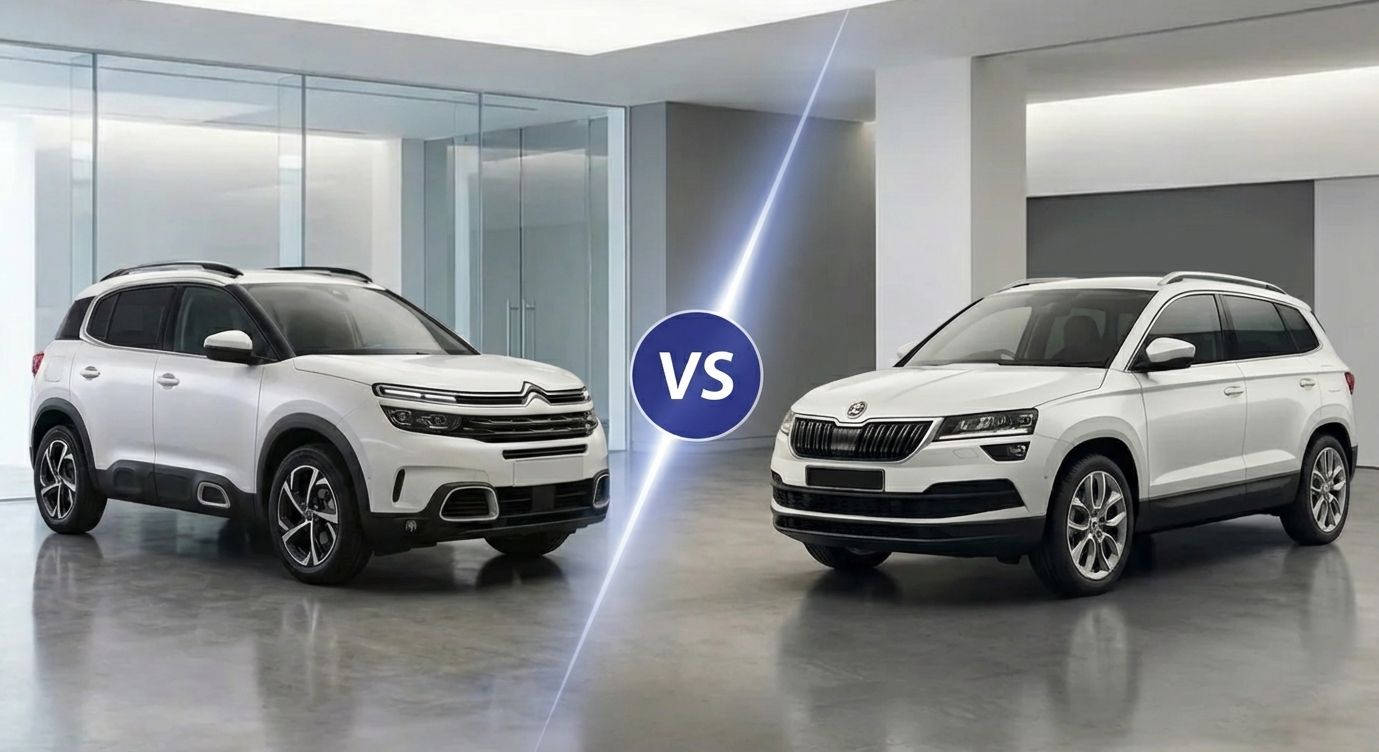
Car battle
Citroën C5 Aircross vs. Škoda Karoq: Complete comparison 2026
Hesitating between the Citroën C5 Aircross and the Škoda Karoq? Our detailed comparison and verdict will help you choose the right SUV for your needs.
Apr 8, 2026
Articles
Car battle
Detailed comparison of Ford Kuga vs. Mazda CX-5. Discover real-world experiences, differences in engines and equipment, and read a clear verdict before choosing a used SUV.
April 17, 2026

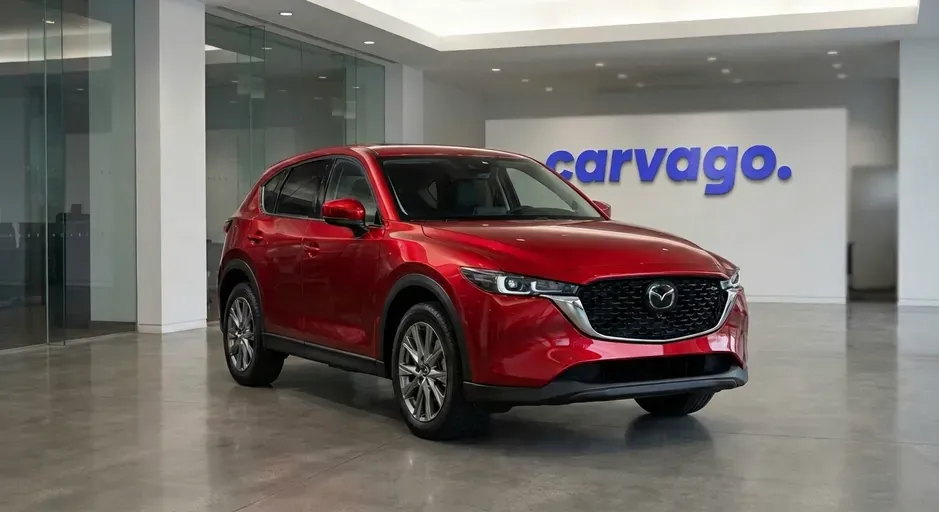
Ford Kuga, also known as the Ford Escape in some global markets, is a practical and driver-focused compact SUV that scores points with buyers primarily for its solid interior space and wide range of fuel-efficient engines. Standing against it is the popular Mazda CX-5, a reliable Japanese model renowned for its precisely crafted interior, elegant design, and excellently tuned engines with sophisticated Skyactiv technology. The following detailed comparison of these two popular used cars will reliably tell you which one will be the better choice for your daily needs.
When choosing a used mid-size SUV around four years old, the third-generation Ford Kuga and the Mazda CX-5 (the generation designated as KF) are among the most sought-after choices. Although both models target a similar audience of families and active drivers, a detailed look at the exterior dimensions reveals interesting differences that give both cars a distinct character and slightly different proportions.
Ford Kuga is a slightly larger vehicle in this comparison. With a length typically ranging from 4614 to 4629 mm, it is approximately 40 to 60 mm longer than the Mazda CX-5, whose length for roughly four-year-old used cars ranges between 4550 and 4575 mm. However, the most significant difference is found in the body width. The Kuga has a width of 1883 mm, while the Mazda stays at a more modest 1840 to 1845 mm. The Japanese model, on the other hand, leads slightly in height – at 1680 mm, it is about 20 to 30 mm taller than the standard versions of the American representative. The wheelbase, which often determines the cabin size, differs only minimally: 2710 mm for the Ford versus 2700 mm for the Mazda.
In practice, this play with millimeters means that the Ford Kuga has a more muscular and expansive presence on the road. The greater width translates positively into interior shoulder room, which you will appreciate especially when the rear seats are occupied by three passengers. On the other hand, the Mazda CX-5 benefits from its slightly smaller footprint and greater height when parking and maneuvering in narrow city garages. Its proportions ensure slightly easier estimation of the body corners and a slightly more upright driving position, which corresponds to the traditional concept of SUV category vehicles.
| Parameter | Ford Kuga SUV | Mazda CX-5 SUV |
|---|---|---|
| Width (mm) | 1882 - 1883 | 1840 - 1845 |
| Length (mm) | 4604 - 4645 | 4550 - 4575 |
| Height (mm) | 1650 - 1681 | 1680 |
| Wheelbase (mm) | 2710 - 2711 | 2700 |
When choosing a family SUV from the used car market, trunk capacity is one of the most important criteria. Whether you're planning regular weekend shopping trips, carrying a stroller, or long family holiday journeys, the family will appreciate every extra liter. In a direct comparison of approximately four-year-old vehicles, namely the third-generation Ford Kuga and the KF-generation Mazda CX-5, we reveal two different approaches to trunk layout and overall interior variability.
While the Japanese representative bets on a more traditional and absolutely larger trunk, Ford counters with very useful variability. Mazda CX-5 offers a generous base volume of 506 to 522 liters (depending on the specific engine specification), which is space easily sufficient for a full weekend shop or a longer holiday, with guaranteed room for several extra suitcases. In contrast, the Ford Kuga offers 475 liters as standard in its conventional internal combustion versions. However, its secret weapon is the sliding rear bench, which allows you to significantly increase the trunk size if you don't need as much legroom for rear passengers at the moment. It is crucial to keep in mind, however, that the highly sought-after plug-in hybrid (PHEV) variant of the Kuga must sacrifice some volume due to the battery placement under the floor, shrinking its base capacity to 411 liters.
The difference in favor of the Japanese SUV becomes fully apparent when you need to transport bulkier cargo and fold down the second-row seatbacks. At that point, the Mazda CX-5 provides a flat floor and a total capacity of up to 1,620 liters, which is absolutely ideal for moving smaller furniture or larger boxes. The Ford Kuga, by comparison, has a maximum volume of 1,534 liters. Ultimately, the choice depends purely on your priorities. If absolute cargo space size is key for you, the Mazda CX-5 will be the better workhorse, while the Kuga scores with those who appreciate the ability to flexibly slide the rear seats and adjust the space according to current needs.
| Parameter | Ford Kuga SUV | Mazda CX-5 SUV |
|---|---|---|
| Base volume (liters) | 475 (411 for PHEV) | 506 - 522 |
| Max. volume with seats folded (liters) | 1534 | 1620 |
While the Mazda CX-5 offers a larger overall trunk volume for heavier and bulkier loads, the Ford Kuga can compensate for its slight disadvantage with its clever sliding rear bench.
The ability to tow a trailer is a key factor for many prospective mid-size SUV buyers. It's not just about the towing power itself, but the overall practicality and flexibility of the vehicle. By attaching even a small unbraked trailer, you gain space for several extra suitcases or for the safe transport of bulky materials. An adequate towing capacity means the car will represent a versatile solution, sufficient for a weekend trip to the DIY store as well as a longer holiday with a large family caravan. Both the Ford Kuga and Mazda CX-5 offer excellent parameters in this regard, though each manufacturer approaches them slightly differently.
For the third-generation Ford Kuga (from 2020), it is necessary to study the engine labels more carefully when choosing from a used car dealer, as towing capabilities vary significantly. Standard 1.5 EcoBoost and 1.5 EcoBlue petrol and diesel engines can handle a braked trailer weighing 1,500 to 1,800 kg. Maximum towing capacity is offered by the powerful 2.0 EcoBlue diesel, which confidently handles up to 2,100 kg. The widely represented hybrid versions (HEV and PHEV) require special attention. While newer models or more powerful specifications maintain a top-tier 2,100 kg, some older electrified variants from the start of production (e.g., from 2020) have a reduced capacity of only 1,200 to 1,500 kg.
In its current generation (KF, produced since 2017 and regularly updated), the Mazda CX-5 offers much more consistent values across the range. Even with the base 2.0 Skyactiv-G petrol engine, you have a capacity of 1,800 to 2,000 kg available, depending on the drivetrain and equipment. More powerful variants, whether the large 2.5 Skyactiv-G petrol engine or the popular and torque-rich 2.2 Skyactiv-D diesel, offer a standard 2,000 up to a maximum of 2,100 kg.
The differences between the two models manifest in everyday life mainly when moving from smaller loads to heavy towing work. If your primary goal is to acquire a popular plug-in hybrid while also planning to tow a heavy caravan or horse trailer, the Mazda is a safe bet thanks to its more traditional internal combustion engines with a consistently high limit. However, if you know exactly which engine to choose for the Ford Kuga, you can easily reach the same maximum limits.
The table below shows an overview of towing capacities for the most common engines of approximately four-year-old cars on the used market. The maximum unbraked trailer weight for SUVs of this size is limited by European legislation across the board to 750 kg.
| Model and engine | Braked trailer (kg) | Unbraked trailer (kg) |
|---|---|---|
| Ford Kuga 1.5 EcoBlue / EcoBoost | 1500 - 1800 | 750 |
| Ford Kuga 2.0 EcoBlue | 2100 | 750 |
| Ford Kuga 2.5 Hybrid / PHEV | 1200 - 2100 | 750 |
| Mazda CX-5 2.0 Skyactiv-G | 1800 - 2000 | 750 |
| Mazda CX-5 2.5 Skyactiv-G | 2000 | 750 |
| Mazda CX-5 2.2 Skyactiv-D | 2000 - 2100 | 750 |
When choosing a roughly four-year-old used SUV on the current market, you will encounter two completely different engineering approaches to powertrains in the Ford Kuga and Mazda CX-5. While Ford bets on modern downsizing in the form of turbocharged units (e.g., 1.5 EcoBoost) and advanced electrification represented by the highly sought-after plug-in hybrid, the Japanese Mazda persistently follows its own path. Even in newer model years, its lineup relies primarily on large-displacement naturally aspirated four-cylinder engines and, by today's standards, exceptionally powerful 2.2-liter diesel engines. The differences in these philosophies fundamentally shape the driving experience – while Ford's turbocharged engines offer pull from the lowest revs and hybrids excel in city fuel consumption, Mazda's naturally aspirated engines attract with linear power delivery, smooth throttle response, and long-term reliability stemming from the absence of a complex turbocharger. For drivers looking for modern versatility, the Kuga tends to be more appealing; conversely, for highway cruisers and fans of the old school, the CX-5 remains a hard-to-beat choice.
The engine lineup for the third-generation Ford Kuga (available since 2020) is extraordinarily diverse. The base is the turbocharged 1.5 EcoBoost three-cylinder, which, despite its modest displacement, provides sufficient dynamics and refinement. For traditional users, the efficient 1.5 EcoBlue diesel was available, though it is important to note that it disappeared from the price lists at the end of 2022, so you will mostly find it in older model years on the used car market. More demanding drivers could opt for the 2.0 EcoBlue diesel, which was also combined with all-wheel drive or available as a mild-hybrid. However, the significant trump card of used Ford Kugas is undoubtedly the electrified versions – from the classic fuel-efficient full-hybrid (2.5 FHEV) to the dynamic plug-in hybrid (2.5 PHEV) with a generous system output of 165 kW.
| Engine type | Fuel type | Power (kW) | Torque (Nm) | Transmission |
|---|---|---|---|---|
| 1.5 EcoBoost | Petrol | 110 | 240 | 6MT |
| 1.5 EcoBlue | Diesel | 88 | 300 | 6MT / 8AT |
| 2.0 EcoBlue | Diesel | 110 / 140 | 370 / 400 | 6MT / 8AT |
| 2.5 Hybrid (FHEV) | Petrol / HEV | 140 | 200 | CVT |
| 2.5 PHEV | Petrol / PHEV | 165 | 200 | CVT |
The range of powertrains for the current generation of the Mazda CX-5 (KF series) will especially please those who are not satisfied with the current trend of engine downsizing. The petrol mainstay is the naturally aspirated 2.0 SKYACTIV-G. For those who like to travel fully loaded or require a power reserve, the manufacturer prepared the excellent 2.5 SKYACTIV-G four-cylinder, which can also imperceptibly deactivate cylinders to save fuel. Since the end of 2022, both petrol units have undergone modernization into a mild-hybrid form (sold as e-SKYACTIV-G). On the diesel side of the fence stands the robust and unmistakable 2.2 SKYACTIV-D four-cylinder. This is offered in two power levels, with its top-of-the-line version producing an impressive 445 Nm of torque, making it an ideal partner for long-distance trips and towing trailers. Mazda pairs its engines with a precise six-speed manual or a proven six-speed automatic of conventional design with a torque converter.
| Engine type | Fuel type | Power (kW) | Torque (Nm) | Transmission |
|---|---|---|---|---|
| 2.0 (e-)SKYACTIV-G | Petrol / MHEV | 121 | 213 | 6MT / 6AT |
| 2.5 (e-)SKYACTIV-G | Petrol / MHEV | 143 | 258 | 6AT |
| 2.2 SKYACTIV-D | Diesel | 110 | 380 | 6MT / 6AT |
| 2.2 SKYACTIV-D | Diesel | 135 | 445 | 6MT / 6AT |
While the Ford Kuga scores points with its superior range of advanced hybrids and top-tier turbocharging for ideal efficiency in the city and its surroundings, the Mazda CX-5 absolutely reigns supreme in the hearts of more conservative drivers with its unsurpassed naturally aspirated engines and powerful diesels.
Choosing the right engine is crucial for long-term satisfaction. Our recommendations are based on real-world experience, mechanical reliability ratings, actual fuel consumption, and daily usability in the market for roughly four-year-old used cars. When comparing these two models, you encounter a fascinating technological clash. While Ford, with the Kuga (Generation III), bets on a highly efficient hybrid system with an engine operating on the Atkinson cycle—conceptually similar to Toyota's indestructible hybrids—Mazda, with the CX-5 (Generation KF), takes a completely different path. It stubbornly and very successfully promotes honest, naturally aspirated petrol engines with an extremely high compression ratio without the use of a turbocharger.
This 2.5-liter naturally aspirated four-cylinder is by far the best the Kuga offers on the used car market in terms of reliability and operating costs. The combination of a robust Duratec petrol engine and an electronically controlled planetary gearbox (eCVT) means the car completely lacks traditional delicate components—it has no conventional turbocharger, no complex dual-clutch transmission, no traditional starter, and no failure-prone alternator. In practice, it is a bulletproof powertrain with fantastic efficiency. The plug-in version (labeled "2.5 Plugin-Hybrid" in databases for 2020–2024, and "2.5 PHEV" for younger post-facelift models) can realistically cover 40 to 50 km on pure electricity. If you don't have the option for regular home charging, you can also find the classic full-hybrid "2.5 Hybrid" version in the listings, which operates fully automatically without the need for external charging.
When buying a used car, as an experienced mechanic, watch out for the following risks and checkpoints:
This hybrid Kuga is literally tailored for drivers who commute around the city during the week (ideally with the option to charge at work or home) and head out on highway trips with the family on weekends, where they will appreciate the quiet and smooth ride.
The large-displacement 2.5-liter naturally aspirated petrol four-cylinder is a sought-after gem on the market for drivers who demand absolute mechanical durability and a traditional driving feel. In the listings, you will most often find the "2.5 SKYACTIV-G" versions (common until 2022) and the subsequently modernized "2.5 e-SKYACTIV-G" (available from late 2022 to 2024), which add noticeable mild-hybrid technology for smoother starts and minor fuel savings. The engine's greatest weapons are immediate response, exemplary refinement, and, above all, an honest six-speed automatic with a torque converter that shifts smoothly and, with proper service, will outlast the car itself. The only "tax" for the displacement is fuel consumption oscillating around 7.5 to 8.5 l/100 km, which, however, you will easily compensate for over the years by the absence of expensive service procedures.
To ensure your Mazda serves you reliably even after crossing the 200,000-kilometer mark, keep an eye on these aspects when buying a used one:
The 2.5 SKYACTIV-G engine will be appreciated primarily by more conservative drivers with a feel for mechanics. It is an absolutely ideal used car for someone who alternates between short city trips (which it handles with absolute grace, unlike modern small turbo engines) and relaxed family journeys across the continent.
When choosing a used car, it is crucial to remember that official fuel consumption figures provided by manufacturers often differ significantly from the reality of everyday operation. Standardized measurements take place in laboratory conditions that rarely correspond to real-world loads, active air conditioning, or the driving dynamics of an average driver. To get the most accurate picture of how much roughly four-year-old Ford Kuga (third generation) and Mazda CX-5 (KF generation) vehicles actually consume, we analyzed real-world data directly from the users themselves.
The values in the following table are based on the crowdsourcing portal Spritmonitor.de, where thousands of drivers carefully record their actual fuelings. The data is sorted by powertrain type for easier comparison.
| Model and Engine | Average Consumption (l/100 km) | Source |
|---|---|---|
| Ford Kuga 2.5 PHEV 165 kW (Plug-in Hybrid) | 2.8* | Spritmonitor.de |
| Ford Kuga 2.5 FHEV 140 kW (Full-Hybrid) | 5.7 | Spritmonitor.de |
| Ford Kuga 2.0 EcoBlue 110 kW (Diesel) | 5.7 | Spritmonitor.de |
| Mazda CX-5 2.2 SKYACTIV-D 110 kW (Diesel) | 6.2 | Spritmonitor.de |
| Mazda CX-5 2.2 SKYACTIV-D 135 kW (Diesel) | 6.8 | Spritmonitor.de |
| Ford Kuga 1.5 EcoBoost 110 kW (Petrol) | 7.1 | Spritmonitor.de |
| Mazda CX-5 2.0 SKYACTIV-G 121 kW (Petrol) | 7.3 | Spritmonitor.de |
| Mazda CX-5 2.5 SKYACTIV-G 143 kW (Petrol) | 8.1 | Spritmonitor.de |
\For the plug-in hybrid version (PHEV), real-world consumption is extremely dependent on charging frequency and the proportion of pure electric driving.*
Several very interesting trends emerge from the collected figures, accurately reflecting the philosophy of both brands:
For a typical user, these differences clearly define which engine is suitable for their specific daily routine:
In conclusion, fuel consumption will play a pivotal role when deciding between the Ford Kuga and Mazda CX-5. The Kuga offers sophisticated electrification and more economical diesel, which can push operating costs to an absolute minimum. Mazda, conversely, bets on honest internal combustion engines. While these will require a bit more money at the filling station, for a huge number of buyers in the used car market, this minor financial drawback is richly compensated by the prospect of long-term mechanical reliability.
The used car market clearly shows the different approaches of both automakers and customers themselves. If we look at models around four years old (2021 and 2022 model years), we discover quite significant price differences on the market. The Ford Kuga benefits from a larger presence in corporate fleets, which pushes its price down on the secondary market and makes the vehicle a very attractive purchase for the average driver. Conversely, the Mazda CX-5 holds its value exceptionally well, thanks to its long-popular naturally aspirated engines and slightly premium reputation.
A used Ford Kuga represents a very rational and wallet-friendly choice in terms of price/performance ratio. Regarding acquisition costs, it is currently one of the most affordable modern SUVs in its class.
The Japanese SUV from Mazda targets a slightly different buyer. On the used market, the CX-5 is highly valued, which means a higher initial investment but also promises minimal further depreciation in the following years.
While the Ford Kuga scores with an enticingly low purchase price, the Mazda CX-5 functions on the used market partly as a value holder and an investment in long-term reliability.
| Compared Parameter (2021–2022 models) | Ford Kuga | Mazda CX-5 |
|---|---|---|
| Starting price of a used car (approx.) | from ~€16,000 | from ~€23,000 |
| Price of better equipped/more powerful versions | ~€23,000 | up to €31,000 |
| Loss of value over time (Depreciation) | Higher (great advantage when buying) | Very low |
| Availability on the used market | High (often fleet vehicles) | Medium (private owners predominate) |
If you are looking for the most modern technology, a spacious cabin, and an economical plug-in hybrid powertrain for the least amount of money, the Kuga simply offers more bang for your buck. However, if you are willing to pay extra for a more traditional engine concept with excellent future residual values, the price premium for the more premium-feeling Mazda CX-5 makes perfect sense.
While the Ford Kuga attracts buyers with a very advantageous and unbeatable purchase price for four-year-old used cars, the Mazda CX-5 holds its value exceptionally well, representing a more conservative purchase with a much slower price decline in the future.
Both compared models, the Ford Kuga and Mazda CX-5, achieved the maximum five-star rating in crash tests by the independent organization Euro NCAP. However, it is essential to view these results in the context of when the testing actually took place. Euro NCAP's methodology and protocols are constantly evolving and becoming stricter, so percentage scores from different years cannot be directly compared. While older tests emphasized mechanical resistance and passive vehicle safety, newer ones evaluate advanced assistance systems much more strictly, such as cyclist detection capabilities or complex crisis scenarios at intersections.
The third-generation Ford Kuga underwent Euro NCAP tests in 2019, which precisely covers the vehicles available on the current four-year-old used car market. During these tests, the car demonstrated a high level of safety with an excellent result of 92% for adult occupant protection and 86% for child protection. Thanks to its more modern architecture, the Ford also succeeded in more dynamic categories, earning 82% for vulnerable road user protection and 73% in the safety assist systems rating. The results show that the Kuga already possessed advanced active features at that time, such as a high-quality emergency braking system, which guarantees reliable assistance even in today's heavy traffic.
The second-generation Mazda CX-5 completed its main Euro NCAP tests in 2017. For those interested in a roughly four-year-old used car (manufactured around 2022), this original certificate is the relevant one. The car boasts fantastic passive safety and extraordinary body rigidity, as evidenced by an excellent score of 95% for adult protection. However, other areas reflect the older testing methodology and the standard equipment settings of that time: child protection was rated at 80%, pedestrian protection at 78%, and assistance systems received 59%. Although the latest version of the Mazda underwent a successful retest at the end of 2025 according to current standards (where, among other things, the assistants improved to 83%), for most older used cars, it is necessary to expect that active assistance features correspond to the time of the original testing, when newer advanced safety technologies were missing.
In conclusion, if you are choosing a used car from around 2022, the Ford Kuga offers a slightly more modern and comprehensive package from the perspective of the safety standards and active equipment of that time. The Mazda CX-5, on the other hand, dominates with top-tier mechanical resistance and superior occupant protection during the impact itself, but lags slightly behind in terms of the technological sophistication of the assistants for the given model year.
| Parameter | Ford Kuga | Mazda CX-5 |
|---|---|---|
| Year of testing | 2019 | 2017 |
| Adult occupant protection | 92 % | 95 % |
| Child occupant protection | 86 % | 80 % |
| Vulnerable road user protection | 82 % | 78 % |
| Safety assist systems | 73 % | 59 % |
Both SUVs offer top-tier passive occupant protection with five stars from the tests, but on the used car market, the Ford Kuga offers a more comprehensive set of safety assistants, while the Mazda CX-5 wins in raw body rigidity.
In addition to standard equipment, each of the models offers several unique features that can be decisive for the customer. Both cars bring more than just basic equipment to the compact SUV class, but each chooses a completely different approach to added value and the overall driving experience.
With this model, Ford bets on everyday family practicality, a wide range of powertrains, and modern connectivity that simplifies vehicle use.
The Japanese automaker follows the path of traditional values, where the connection between the driver and the car, timeless design, and technical precision without unnecessary compromises take center stage.
Wide range of fuel-efficient engines, including the very popular and efficient plug-in hybrid (PHEV) version
Practical sliding rear seats that allow for variable adjustment of passenger and luggage space
Well-tuned chassis offering a great compromise between family comfort and confidence in corners
Overall more favorable price-to-value ratio on the used car market
Cheaper-looking materials and harder plastics in the interior compared to Japanese competitors
The SYNC 3 infotainment system lags behind graphically and feels somewhat outdated by today's standards
The plug-in hybrid version offers a slightly smaller total luggage capacity due to battery placement
Ford Kuga represents an ideal choice for pragmatically-minded families looking for maximum interior variability and low operating costs. Thanks to the affordable and reliable plug-in hybrid version, it is perfectly suited for drivers with home charging options who use the car daily for commuting to work or around town.
Exceptionally high-quality interior craftsmanship using premium materials that evoke much more expensive vehicles
Fantastic driving characteristics and precise steering with an emphasis on maximum driving pleasure
Highly reliable and durable naturally aspirated Skyactiv-G petrol engines without complex turbocharging
Attractive and timeless exterior design (Kodo) that reliably attracts attention on the road even after years
Less legroom in the rear seats and an overall more cramped feel in the cabin
Higher fuel consumption, especially with traditional petrol engines paired with all-wheel drive
Infotainment system with a smaller screen is controlled only by a rotary dial, which may not suit everyone
Mazda CX-5 is an SUV created primarily for those who do not want to compromise between a family car and a true driving experience. Thanks to traditional naturally aspirated engines and a luxuriously crafted interior, it appeals to buyers who prefer long-term mechanical reliability and a premium feel over the latest hybrid technologies.
Based on long-term user experience, service bulletins, and data provided daily by our comprehensive car audit, we have compiled an overview of the most common problems that buyers of these roughly four-year-old used cars should watch out for.
The third generation of the Ford Kuga took a big technological step forward, but it also brought some specific technical difficulties, especially in the early stages of its production.
With the Ford Kuga, pay the most attention to the verifiable service history of plug-in hybrids and adherence to shortened oil change intervals for EcoBlue diesel engines. While electronic quirks are often solved by updates, neglected engine service can become cruelly expensive.
The second generation of the Mazda CX-5 has long been considered one of the most reliable SUVs on the market, yet it is not immune to some characteristic, though mostly less fatal, ailments.
Gasoline variants of the Mazda CX-5 represent the benchmark of reliability and peace of mind for the wallet, but they require coming to terms with more fragile paint and occasional minor mirror faults. It is better to avoid diesel units, especially for frequent short trips.
When buying a used car, a thorough inspection is key. Here are some specific points to focus on for these two models, especially if you are choosing a car approximately four years old.
Mazda CX-5 offers a base boot capacity of 506 liters, which is a very solid and fully sufficient value in its class. The Ford Kuga, on the other hand, counters with practical sliding rear seats, thanks to which the luggage space can be continuously increased from 412 to an excellent 526 liters. The Kuga is thus slightly more flexible and adapts better to current family needs.
Both cars are among the best-driving SUVs on the market, but each approaches it in a slightly different way. Mazda bets on precise steering and a sportier driving feel with excellent feedback, while the Kuga offers a great compromise between comfortable suspension and confidence in corners. Overall, the Japanese representative is slightly more engaging and mechanical for the driver.
Ford clearly dominates in this area, offering a very successful plug-in hybrid (PHEV) for this model with a real pure electric range of around 50 kilometers. In the given model years, Mazda focused primarily on proven naturally aspirated gasoline engines and introduced mild-hybrid technology gradually. For frequent city driving with the possibility of home charging, the Kuga is therefore clearly more advantageous.
The Mazda CX-5 has long been targeting the premium segment, as evidenced by its top-quality soft-touch materials, excellent soundproofing, and elegant minimalist design. The Kuga's interior is ergonomically very well designed and often features more modern infotainment, but some of the plastics used feel a bit cheaper. If you are looking for a sense of luxury and precise workmanship, the Japanese SUV comes out on top in this pair.
The Japanese automaker is famous for its above-average reliability, especially thanks to its robust Skyactiv-G naturally aspirated engines, which do not suffer from the typical ailments of complex turbocharged engines. Ford is also doing quite well with the third-generation Kuga; however, the more complex plug-in hybrid technology may represent a slightly higher service risk in the long run. Generally, the Mazda is considered a safer bet for trouble-free operation on the used car market.
Choosing between a used Ford Kuga and Mazda CX-5 represents a classic battle between modern efficiency and traditional mechanical integrity in today's market. The American representative scores points primarily with its exceptionally favorable price-to-value ratio, clever interior variability with sliding rear seats, and highly efficient hybrid powertrains, making it an ideal choice for pragmatically-minded families. The Japanese SUV, on the other hand, targets more demanding drivers, offering a premium-crafted cabin, captivating driving characteristics, and the legendary long-term reliability of its robust naturally aspirated engines in exchange for a higher purchase price. If you are primarily looking for affordable modern technology and minimal operating costs for city commuting, the Kuga will thrill you, while for lovers of timeless design and a classic driving experience, the Mazda remains the clear favorite.
Sources: ADAC, novinky.cz, aktualne.cz, mobilmania.cz, autosalon.tv, powerfan.cz
This article was prepared using artificial intelligence tools. The section guarantor is Petr Dušek.
Hesitating between the Citroën C5 Aircross and the Škoda Karoq? Our detailed comparison and verdict will help you choose the right SUV for your needs.
Apr 8, 2026
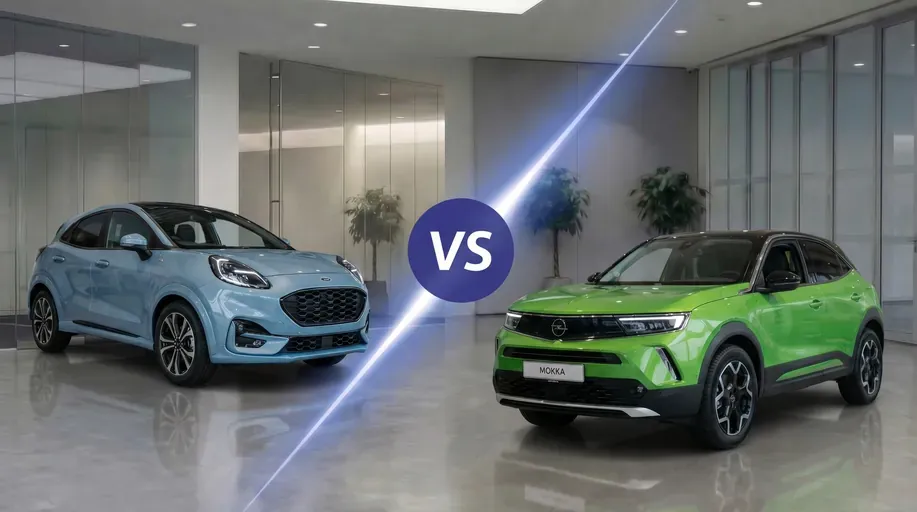
Ford Puma vs Opel Mokka: City SUV comparison. Read a detailed evaluation of engines, space, and driving characteristics and choose your ideal used car.
Apr 14, 2026
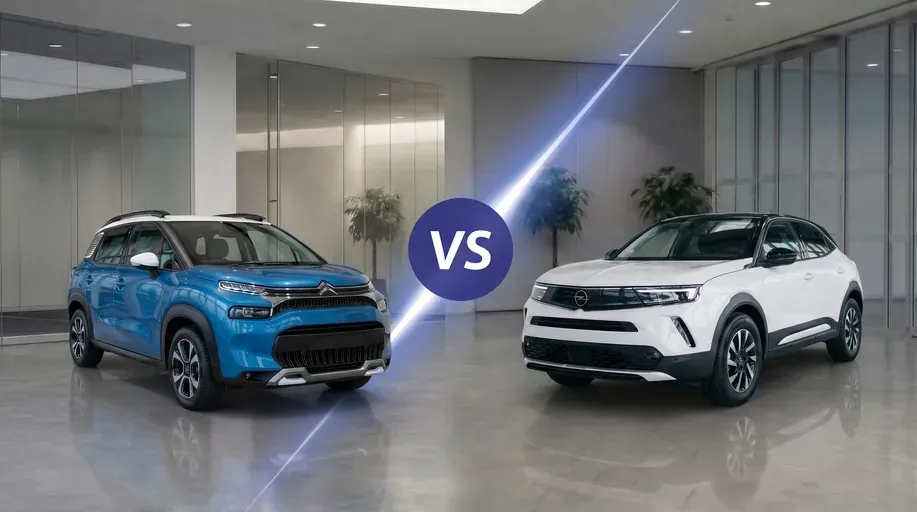
Citroën C3 Aircross vs Opel Mokka: A major comparison of popular SUVs. Discover the differences in spaciousness, engines, and equipment, and find out our final verdict.
Apr 16, 2026