Car battle
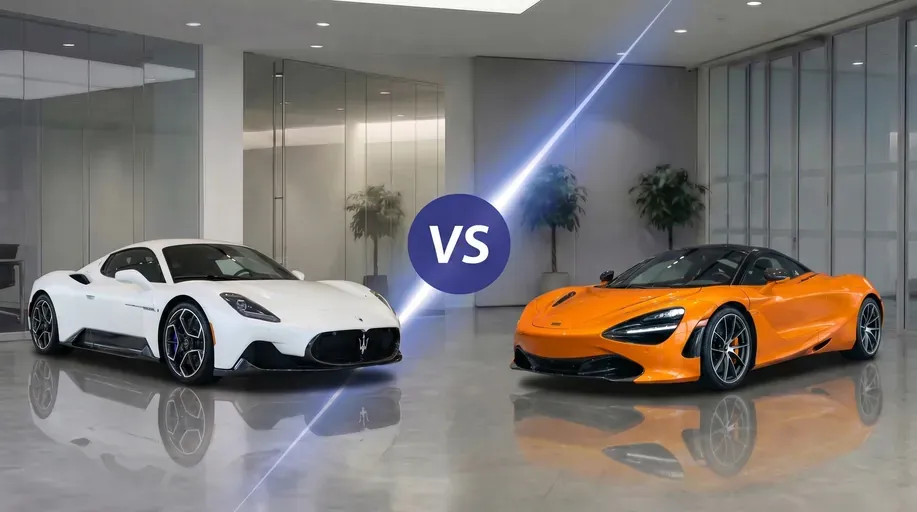
Maserati MC20 vs. McLaren 720S: Complete comparison 2026
Detailed comparison of the Maserati MC20 vs McLaren 720S supercars. Discover the differences in performance, equipment, and real-world driving. Read our verdict!
May 4, 2026
Articles
Car battle
Detailed comparison of the BMW M2 vs Toyota GR Supra. Discover the real differences in driving characteristics and performance, and read our final verdict before you buy.
May 15, 2026
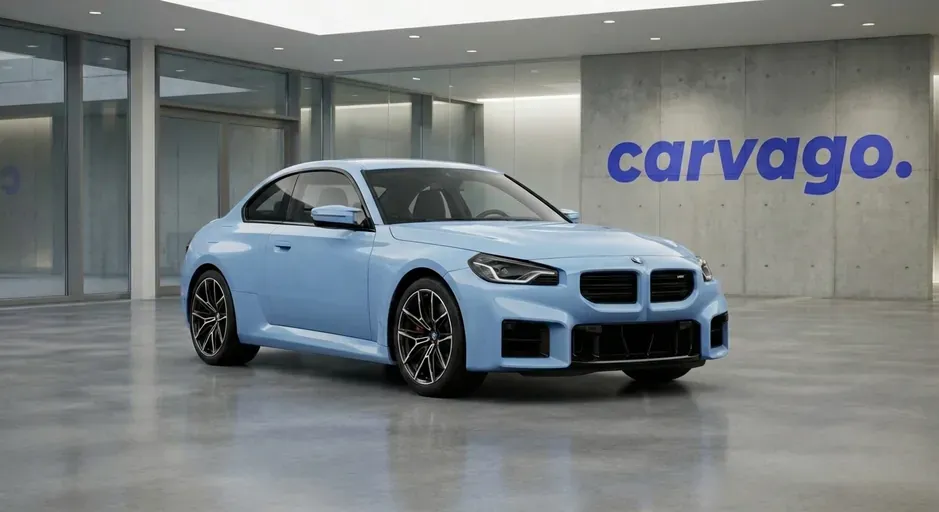
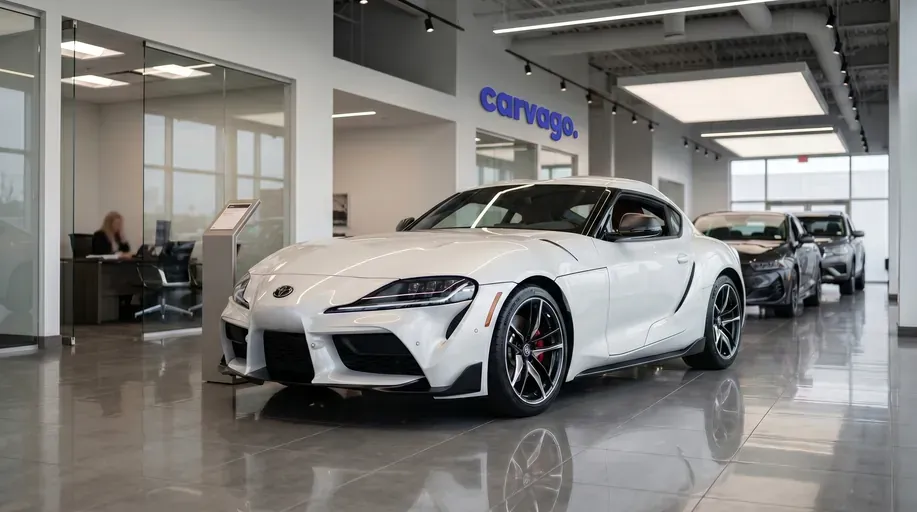
The BMW M2 represents a compact and purist sports coupe from Munich's M division, which has quickly won the hearts of automotive enthusiasts thanks to its aggressive character, powerful inline-six engine, and agile rear-wheel drive. On the other side of the ring stands the iconic Toyota Supra, sold in its current generation under the official name Toyota GR Supra (also known by the internal codes A90 or J29), which successfully revived the famous Japanese lineage after a long hiatus using shared German technology. The following comparison will explore in detail how these two fierce rivals perform in a head-to-head battle and which of them represents a more attractive and engaging choice for drivers on the market for nearly new sports cars.
In a direct comparison of exterior dimensions, the differing philosophies of the two cars immediately stand out. The Toyota GR Supra (A90 generation) is a genuine two-seater sports car, which is clearly reflected in its very compact build. With a fixed length of 4,379 mm, it is 82 to 208 mm shorter than the BMW M2, which, depending on whether you opt for the popular F87 generation or the newer G87 on the used car market, measures between 4,461 and 4,587 mm. An even more profound difference exists in height. While the Bavarian coupe measures around 1,400 mm in height, the Supra stays literally glued to the asphalt at just 1,276 to 1,292 mm. For the Toyota, this translates into an indisputable advantage in the form of a lower center of gravity and a sportier driving position, though the trade-off is noticeably more difficult entry and exit.
The Toyota Supra utilizes an extremely short wheelbase of 2,470 mm. While this gives it fantastic agility in tight corners and lightning-fast, almost go-kart-like reactions to steering inputs, it completely rules out the possibility of rear seats. The BMW M2, on the other hand, has a wheelbase ranging from 2,693 mm (F87 generation) to 2,747 mm (the latest G87). This extra 20-plus centimeters provides the BMW not only with the necessary space for a rear bench within a 2+2 layout but also gives the car significantly greater directional stability and composure at high highway speeds.
The width of both rivals, conversely, is surprisingly similar, ranging between 1,854 and 1,887 mm for modern generations. Both cars thus have a very confident and wide-stanced posture with significantly flared fenders. From a practical standpoint, the shorter Toyota is objectively more advantageous when maneuvering in cramped underground garages and parking in the city. However, its long front hood and limited visibility through narrow windows from the low cabin can make accurately judging distances unpleasantly difficult. While the BMW M2 gives a more massive and stocky impression, the more upright driver's position and more traditional body shaping offer an incomparably better overall view of where the car begins and ends.
| Parameter | BMW M2 Coupé | Toyota Supra Coupé |
|---|---|---|
| Width (mm) | 1854 - 1887 | 1854 - 1867 |
| Length (mm) | 4461 - 4587 | 4379 |
| Height (mm) | 1395 - 1414 | 1276 - 1292 |
| Wheelbase (mm) | 2693 - 2747 | 2470 |
Although buyers of sports coupes like the BMW M2 and Toyota Supra don't usually purchase them primarily with family practicality in mind, the luggage compartment volume plays a surprisingly important role. Whether it's daily city commuting, a weekend trip for two, or transporting helmets and sports equipment for a track day, the trunk size directly determines how versatile your dream sports car will be in everyday life.
A detailed comparison of used cars around four years old reveals a fairly fundamental difference in how both manufacturers approach overall space packaging. The Bavarian representative, the BMW M2 (both in the previous F87 generation and the succeeding G87), offers a surprisingly generous base volume of 390 liters. On the other hand, the Toyota Supra (the current A90 generation, which dominates the used car market) has a trunk with a volume of 290 liters. BMW thus provides you with a massive 100 liters more usable space right from the start. Due to the sporty and specific focus of both coupe body styles, manufacturers do not officially state the maximum volume after folding the seats for these models.
In practice, this difference has a huge impact on daily life with the car. While the 390 liters in the BMW M2 easily matches standard compact cars, offering space for several extra suitcases and being perfectly sufficient for weekend shopping or a longer holiday, the 290 liters in the Japanese Supra requires much more careful packing from the owner. The situation is further intensified by the fact that the Toyota Supra, unlike the Bavarian, is strictly a two-seater. In the Toyota, you therefore don't have the option to put jackets and soft bags in the second row, which is a major practical advantage that the BMW M2, thanks to its 2+2 interior layout, fulfills without hesitation.
| Parameter | BMW M2 Coupé | Toyota Supra Coupé |
|---|---|---|
| Base volume (liters) | 390 | 290 |
| Maximum volume with seats folded (liters) | Not available | Not available |
Thanks to a trunk that is 100 liters larger and the presence of rear seats, the BMW M2 is a much more usable car for every day, while the strictly two-seater Supra with its 290 liters is more suitable as a weekend toy.
When choosing a sports car on the market for roughly four-year-old used cars, evaluating the trailer weight might seem like a marginal issue, yet for some drivers, this figure is important in terms of overall everyday practicality. If we compare the popular BMW M2 models (on the border between the previous F87 generation and the current G87) and the Toyota GR Supra (A90 generation), we find that both cars behave identically in this regard. Neither of these vehicles is homologated by the manufacturer for towing a trailer, so the standard and maximum weight of both braked and unbraked trailers is exactly 0 kg for both cars. Given the purist focus on performance, these sports models are naturally not offered in any derivative or hybrid variants that would have a reduced or otherwise modified towing capacity – a strict zero applies to all versions. From a practical standpoint, this means you simply cannot create additional "space for a few extra suitcases" by attaching a trailer. You will have to rely exclusively on the internal trunk capacity of the coupe itself, which must be sufficient for weekend shopping or a longer holiday for two. As a result, this dimension means that when deciding between the BMW M2 and the Toyota GR Supra, towing capacity plays no role; both cars clearly demonstrate with their zero trailer capacity that their domain is twisty backroads and racing circuits, not hauling any heavy loads.
| Model and engine | Braked trailer (kg) | Unbraked trailer (kg) |
|---|---|---|
| BMW M2 | 0 | 0 |
| Toyota Supra | 0 | 0 |
When comparing the engines of these two iconic coupes, we come across an extremely interesting fact: both cars rely on the advanced Munich engineering school, but with very different approaches to the target driver. While the Toyota GR Supra uses standard, albeit phenomenally tuned, single-turbo BMW engines (in the form of a 2.0-liter four-cylinder and a 3.0-liter six-cylinder), the BMW M2 reserves the right to full-blooded units directly from the BMW M division with two turbochargers. For a buyer of a used car roughly 4 years old, this represents a crucial decision: the Supra offers not only a purist three-liter but also a more affordable and economical two-liter version that serves perfectly for daily driving. In contrast, the BMW M2 makes no compromises and delivers massive six-cylinder performance every time.
When searching for a BMW M2 on the market for slightly used cars (around 4 years old), you will encounter two distinct yet legendary generations. Both cars from the end of the previous F87 generation's production (especially the highly prized M2 Competition and the limited M2 CS produced until 2020) and early units of the current G87 generation, which arrived in 2023, will be represented. All these models share a 3.0-liter twin-turbocharged straight-six engine and exclusive rear-wheel drive. The older engine in the M2 Competition version (F87 series) offered a standard output of 302 kW (410 hp) and peaked with the extreme CS version at 331 kW (450 hp). The standard here was a six-speed manual transmission (6MT) or a lightning-fast seven-speed dual-clutch gearbox (7DSG, labeled by BMW as M DKG). The successor G87 generation then brought an updated engine with better pull and power increased to 338 kW (460 hp), where the original dual-clutch was replaced by a smoother yet still sport-tuned eight-speed automatic (8AT – M Steptronic).
| Engine type | Fuel | Power (kW) | Torque (Nm) | Transmission |
|---|---|---|---|---|
| 3.0 M TwinPower Turbo (F87 Comp.) | Petrol | 302 | 550 | 6MT / 7DSG |
| 3.0 M TwinPower Turbo (F87 CS) | Petrol | 331 | 550 | 6MT / 7DSG |
| 3.0 M TwinPower Turbo (G87) | Petrol | 338 | 550 | 6MT / 8AT |
The A90 generation Toyota GR Supra approaches its engine lineup with a wider audience in mind. It includes two petrol engine options, again always with rear-wheel drive. The base variant, which is an ideal choice for daily use and drivers looking for excellent handling, is represented by the 2.0 Turbo four-cylinder. This produces a very respectable 190 kW (258 hp) and, compared to its larger sibling, saves about 100 kg of weight on the front axle. Given the gradual withdrawal of this engine from new price lists in Europe (for model years 2024+), it is becoming an extremely interesting commodity on the used market. For enthusiasts of thoroughbred sports cars, there is the top-tier 3.0 Turbo engine with the legendary six-cylinder delivering 250 kW (340 hp) and a massive 500 Nm from the lowest revs. For a long time, the Supra was available exclusively with the reliable eight-speed ZF automatic (8AT), but models produced from 2022 onwards enriched the range for three-liter editions (such as Legend or Lightweight) with the long-awaited six-speed manual transmission.
| Engine type | Fuel | Power (kW) | Torque (Nm) | Transmission |
|---|---|---|---|---|
| 2.0 Turbo | Petrol | 190 | 400 | 8AT |
| 3.0 Turbo | Petrol | 250 | 500 | 6MT / 8AT |
Final Recommendation:
For drivers who are budget-oriented, looking for more economical operation, and seeking an agile coupe for daily commuting, the four-cylinder Toyota GR Supra 2.0 represents a completely rational and great choice. The six-cylinder Supra 3.0 will then please dynamically oriented drivers who want strong pull from low revs and (in newer used cars) the option of a manual gearbox. However, if you are a performance-oriented enthusiast or a fan of frequent weekend visits to racing circuits, the raw power and uncompromising ferocity of the BMW M2 models (whether the F87 or G87 generation) make them the clear winners.
While the Toyota GR Supra pleases a wider range of drivers thanks to its efficient four-cylinder and potent six-cylinder, the BMW M2 remains a pure muscle car whose twin-turbocharged units will satisfy even the most demanding track drivers.
Choosing the right engine is the key to long-term satisfaction with a car, which is why we have based our recommendations on real-world operating experience, driving performance, actual fuel consumption, and mechanical reliability. Although both cars share Munich blood in the form of inline six-cylinders, they hide different technological approaches under the hood – while BMW relies on a pure high-revving "M" engine with two turbochargers for older used cars, Toyota borrowed an extremely sturdy and versatile power unit with a single Twin-Scroll turbo for the Supra, which many consider one of the best modern engines ever made.
When looking for a used BMW M2 around four years old, we find ourselves in a specific situation. The F87 generation ended its journey as the top-tier M2 Competition version at the end of 2020, while the new G87 generation did not arrive until 2023. It is precisely the late F87 models with the S55 engine that are the most valuable items on the secondary market and the clear choice for enthusiasts.
The Toyota Supra A90 generation has been on sale continuously since 2019 (models from 2020 are thus an ideal choice in the four-year-old used car category). Although a weaker two-liter is also available, the Supra historically and characterfully demands a six-cylinder. The 3.0 version with the BMW engine is the unequivocally recommended variant among both mechanics and owners.
Official fuel consumption figures based on laboratory measurements are often very optimistic, which is doubly true for high-performance sports cars. The true appetite of these cars only becomes apparent in real-world traffic, where the route profile, traffic jams, and, above all, individual driving style come into play. For the most accurate comparison, we have used real-world data from owners themselves, sourced from the popular independent community portal Spritmonitor.de. We focused on models and generations that best correspond to the market for roughly four-year-old used cars – namely the Toyota GR Supra (A90) and BMW M2 Competition (F87) generations, with the newer M2 (G87) generation added for context.
| Model and Engine | Average Consumption (l/100 km) | Source |
|---|---|---|
| Toyota GR Supra 2.0 (A90) | 8.2 | Spritmonitor.de |
| Toyota GR Supra 3.0 (A90) | 9.5 | Spritmonitor.de |
| BMW M2 Competition (F87) | 10.2 | Spritmonitor.de |
| BMW M2 (G87) | 10.8 | Spritmonitor.de |
Looking at the hard data, a fairly clear trend is visible. Although it is often true that smaller turbocharged engines do not save as much fuel under load as one might expect from the official figures, the two-liter four-cylinder in the Toyota Supra is a bright exception and stands as the most economical choice by far. Its average of 8.2 l/100 km is excellent. The three-liter six-cylinder in the Supra logically means an increase in consumption to an average of 9.5 liters, which is still an outstanding value considering the massive jump in performance. Its Bavarian rival, the BMW M2 Competition with its more aggressively tuned inline-six (S55), requires over ten liters of petrol, and the newer, even heavier G87 generation asks for a few more tenths. The usual comparison of how more economical diesel engines fare against petrol is, of course, irrelevant in this class, as purebred sports coupes logically do not use diesel at all.
From the perspective of a typical user, these results can be interpreted as follows:
It can therefore be said that fuel consumption will play a rather marginal role when deciding between these two cars. While the Toyota can handle daily commutes with more respect for your wallet and proves to be the more economical choice, for sports cars with a price tag exceeding €41,000, the primary criterion is driving pleasure. The BMW M2's greater appetite is unlikely to deter any true petrolhead from buying, as it is fully compensated for by its phenomenal and wild character.
When choosing a sports coupe that is approximately four years old (with a production date around 2021–2022), two different pricing philosophies meet on the used car market. Both the BMW M2 and the Toyota Supra are among the cars that hold their value very well thanks to their enormous popularity among driving enthusiasts. However, the fundamental difference in residual values is determined by the specific generation and the chosen engine.
In the case of an approximately four-year-old BMW M2, we are moving on an interesting generational boundary in the used car market. Customers most often choose between late models of the outgoing and now iconic F87 generation (often in the sought-after Competition version) and the very first units of the current G87 generation.
The Bavarian representative benefits maximally from a huge fan base. The residual value of the high-performance F87 versions is excellent, and for well-cared-for units with low mileage, the price depreciation curve has essentially stagnated.
For a Toyota Supra from the same period (2021–2022), the pricing on the used market is flatter at first glance, but it creates a large gap regarding the engine under the hood. Although both variants of the car are almost identical in appearance, real market demand clearly separates the four-cylinder and six-cylinder versions.
In terms of long-term investment and resistance to uncompromising depreciation, the BMW M2 is slightly better off. The aforementioned F87 generation in particular is already considered a modern classic by many journalists, and further significant price drops are not expected. The Toyota Supra also performs above average in the more powerful three-liter specification; however, as a used car, it offers (especially in the two-liter engine version) a more flexible price compromise for those looking for exceptional design for a lower initial investment.
While the Toyota Supra offers an easier and cheaper entry into the world of sports coupes thanks to its two-liter engine, the BMW M2 from 2021–2022 holds its value more confidently and represents a more stable long-term investment in terms of residual value.
In general awareness and through superficial comparisons, you will often encounter information that both of these sports icons benefit from technical foundations associated with a five-star Euro NCAP rating. However, when buying a used car, it is crucial to emphasize the context and the specific year the testing took place. Euro NCAP's methodology evolves dynamically and becomes stricter over time. Today's testing protocols are much more complex than years ago – including new and more demanding frontal impact simulations, advanced cyclist detection, and complex crisis scenarios at intersections. For this reason, percentage scores from different years cannot be simply and directly compared.
BMW M2
The BMW M2 model was not tested as a standalone vehicle by Euro NCAP due to its exclusivity and low sales. In practice, its passive and active safety ratings are derived from the base platform, which is the BMW 2 Series Coupé (G42 generation). This base model underwent rigorous testing in March 2022, where it received a total of four stars according to current, uncompromising protocols. The loss of the fifth star primarily stemmed from extremely high demands on the behavior of autonomous braking assistants when crossing paths with cyclists, where the system occasionally reacted more slowly. Because direct test data is missing for the specifically tuned, distinct M2 model, specific percentage values are not listed in our table. Nevertheless, the results of the tested sibling model from 2022 show a reliable level of protection:
Toyota Supra
An identical situation occurs with the Toyota GR Supra (A90 generation), which also did not undergo a direct certified crash test. Its safety is assessed through its technological twin – the BMW Z4. The Z4 roadster completed Euro NCAP tests in 2019 and, according to the testing standards of the time – which are somewhat more benevolent from today's perspective – earned a full five stars. The results demonstrated above-average body rigidity and a sensitively functioning basic assistance package. The percentage values of the shared platform from 2019 were:
| Parameter | BMW M2 | Toyota Supra |
|---|---|---|
| Year of testing | - | - |
| Adult Occupant Protection | - | - |
| Child Occupant Protection | - | - |
| Vulnerable Road Users | - | - |
| Safety Assist | - | - |
In conclusion, both models are at the top of their class in terms of safety and offer a comprehensive range of active systems protecting the occupants. Although the Toyota Supra refers to a five-star platform with higher percentage results on paper, these figures come from the 2019 methodology. Conversely, the technical foundation for the BMW M2 was tested against disproportionately more demanding and modern standards from 2022. For this reason, the BMW M2 architecture represents a more complex, advanced safety package adapted to more current standards.
Although neither car has its own exact crash test, both are based on exceptionally robust platforms that will provide a highly effective and modern level of protection for those interested in a four-year-old used car.
Both models offer much more than just basic equipment, and each has its own distinctive approach to delivering added value to the enthusiastic driver.
While the basic architecture of the BMW M2 is based on traditional Bavarian shapes, the BMW M division has integrated technologies known from higher model series into the car.
Toyota approached the development of the GR Supra with an emphasis on historical heritage and perfect balance. The shared technology with BMW is carefully hidden under specific Japanese tuning and a distinctive design.
Fantastic driving dynamics thanks to the top-tuned chassis from the M division
More practical 2+2 layout with usable rear seats
Excellent turbocharged six-cylinder engines with huge performance potential
Manual transmission option for true driving purists
Excellent residual value retention on the used car market
Significantly higher curb weight compared to the Supra
More expensive servicing, spare parts, and higher overall maintenance costs
Very stiff suspension, which can be tiring on broken roads during daily use
Subjectively more controversial design in the latest generation (G87)
The BMW M2 is the embodiment of driving purity and, thanks to its 2+2 layout, offers an unexpected amount of daily practicality compared to pure coupes. It is the ideal choice for enthusiasts looking for an uncompromising and aggressive sports tool for weekend backroads and regular visits to racing circuits.
Low center of gravity and overall lower weight, which significantly benefits agility
Exceptionally reliable and efficient three-liter B58 six-cylinder with smooth power delivery
Exotic and aggressive design with the proportions of a classic sports coupe
Brilliantly tuned eight-speed automatic transmission for both spirited and calm driving
Slightly more compliant damper settings, better suited for daily commuting
Strictly two-seater interior with less storage space
Significantly worse rear-quarter visibility and a more cramped feeling in the cabin
Known issue with strong wind buffeting and vibrations when driving with the windows down
The dominance of BMW controls and infotainment may disappoint fans of Japanese originality
The fifth-generation Toyota Supra is a stunning two-seater gran turismo that perfectly combines top-tier German engineering with Japanese design style. It will primarily appeal to drivers who desire a stylish, fast, and relatively comfortable sports car for long journeys and do not require rear seats.
Based on reliability statistics, long-term user experience, and data from independent car technical inspections (CarAudit), we have compiled an overview of the most common problems that buyers of roughly four-year-old used examples of these sports models should watch out for.
The BMW M2 is generally considered a very robust and mechanically durable car; however, it requires meticulous maintenance and a documented history without unprofessional modifications.
The BMW M2 is mechanically more reliable than the larger models from the M division; however, its long-term condition depends on how conscientiously the previous owner approached servicing and whether the car was excessively abused on the race track.
The fifth-generation Toyota Supra shares the vast majority of its technology, including the platform and engines, with the BMW Z4, which guarantees it top-tier dynamics but also brings some specific German ailments.
The Supra benefits from the excellent Bavarian B58 engine, which is exceptionally resilient. Thus, the driver will be most bothered by occasional oil consumption, strong aerodynamic turbulence with open windows, and minor glitches in the onboard electronics.
When buying a used sports car, a thorough inspection is key, as these models often experience harsher treatment and track weekends. A thorough physical inspection of a used car can reveal hidden defects and save you significant money on future repairs. Here are some specific points to focus on for both mentioned models.
Although both cars use three-liter straight-six engines originating from BMW, they are not completely identical. The Toyota Supra uses the reliable B58 engine, which it shares with more common models of the Bavarian brand. The BMW M2, on the other hand, uses full-fledged M division engines (S55 or S58 depending on the generation), which offer significantly higher performance and a more aggressive character.
The Toyota Supra has a more compliant chassis and a slightly more comfortable setup, making it a more pleasant choice for regular daily commuting. The BMW M2 is significantly stiffer and more uncompromising from the ground up, so it can feel bouncy on broken city roads. Therefore, if you are looking for a compromise between sportiness and everyday comfort, the Supra is more accommodating.
The BMW M2 is a classic four-seater coupe with usable rear seats and a practical trunk with a capacity of 390 liters. The Toyota Supra, on the other hand, is strictly a two-seater, and its less accessible luggage compartment offers a more modest 290 liters. If you occasionally need to transport more people or larger luggage, the M2 has a huge advantage in terms of practicality.
On a technical track, the BMW M2 has a clear advantage thanks to its higher power, wider track, and more sophisticated limited-slip differential. While the Toyota Supra is very capable and agile due to its lower weight, it lacks the absolute sharpness of full-fledged M models. Furthermore, the BMW M2 is much better prepared for long-term track use from the factory with its brakes and cooling.
In the nearly-new used car market, the Toyota Supra offers a more favorable purchase price and slightly lower service costs thanks to its more civil technology. Although the BMW M2 requires a higher initial investment and more expensive M division-specific maintenance, it has historically held its residual value much better. For more affordable operation of a sports coupe, the Supra makes more economic sense, while the M2 is a better long-term investment for enthusiasts.
The duel between a nearly new BMW M2 and Toyota GR Supra has no absolute winner, as both sports coupes excel in different disciplines and target different driver priorities. The Toyota Supra represents a stylish, agile, and more affordable to operate two-seater gran turismo, which, thanks to its more compliant chassis and more economical engine, serves fantastically for daily commuting as well as long journeys. In contrast, the BMW M2 is an uncompromising powerhouse that justifies its higher price with a more practical 2+2 concept, a larger trunk, and pure M engines built for aggressive handling and regular stress on the racetrack. While the Japanese icon with German technology will appeal to those interested in an attractive and more comfortable sports car for every day, the Bavarian representative remains the clear choice for demanding purists seeking raw driving experiences and long-term stable value retention.
Sources: ADAC, garaz.cz, idnes.cz, autoservis.cz, autosalon.tv, automotorsport.cz
This article was prepared using artificial intelligence tools. The section guarantor is Petr Dušek.
Detailed comparison of the Maserati MC20 vs McLaren 720S supercars. Discover the differences in performance, equipment, and real-world driving. Read our verdict!
May 4, 2026
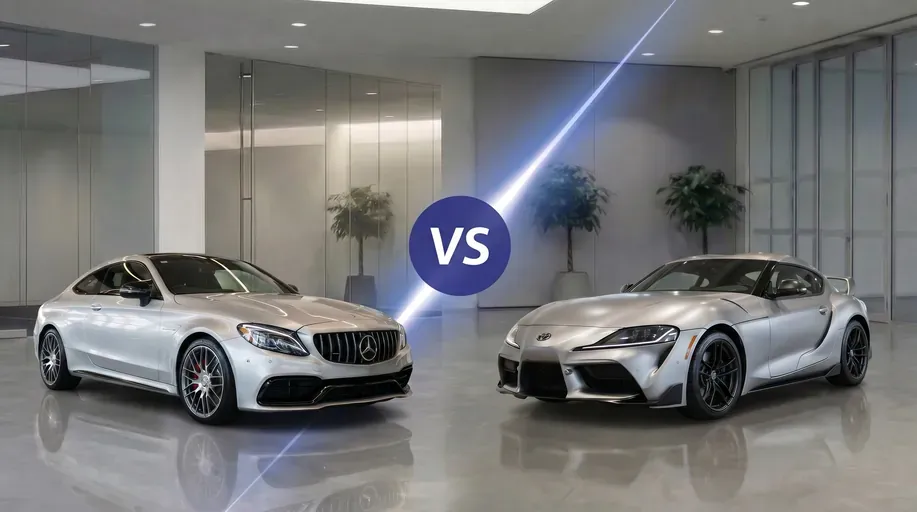
Mercedes-AMG C 63 Coupé vs. Toyota GR Supra comparison. Which used sports coupé offers better performance and equipment? Read our clear verdict before buying!
Apr 25, 2026
Detailed comparison of the BMW M4 vs. Jaguar F-Type. Discover real-world experiences, performance and equipment comparisons, and our verdict to help you choose your sports car.
Apr 24, 2026